1558: Toqui Caupolicán

Es algo formidable que vio la vieja raza:
robusto tronco de árbol al hombro de un campeón
salvaje y aguerrido, cuya fornida maza
blandiera el brazo de Hércules, o el brazo de Sansón.
Por casco sus cabellos, su pecho por coraza,
pudiera tal guerrero, de Arauco en la región,
lancero de los bosques, Nemrod que todo caza,
desjarretar un toro, o estrangular un león.
Anduvo, anduvo, anduvo. Le vio la luz del día,
le vio la tarde pálida, le vio la noche fría,
y siempre el tronco de árbol a cuestas del titán.
«¡El Toqui, el Toqui!» clama la conmovida casta.
Anduvo, anduvo, anduvo. La aurora dijo: «Basta»,
e irguióse la alta frente del gran Caupolicán.

-“Caupolican” by Ruben Dario

On this date in 1558, the Spanish executed Mapuche revolutionary Caupolicán by impalement.

A toqui (war chief) for the Mapuche as they launched in 1553 their decades-long insurrection against Spanish domination, Caupolican (English Wikipedia entry | the well-illustrated Spanish). It is he who had the conquistador Pedro de Valdivia put to death after one early Mapuche victory.

The Spanish were able to recover and throw back the indigenous rebels. Caupolicán’s force was destroyed, and he shortly after taken prisoner, when whilst besieging a Spanish fort called Cañete a Spanish double agent lured the Mapuche into a devastating ambush.

His end verges into the mythic thanks to Alonso de Ercilla‘s lengthy epic poem from a decade after Caupolicán’s death, La Araucana. (Full text at archive.org.) Two key events stand out.

In the first, the bound Caupolicán is reviled by his wife, Fresia, for permitting himself to be captured alive. Her gesture of scornfully abandoning their infant child in at Caupolicán’s feet has been captured on canvas numerous times, although Fresia’s historicity outside of Ercilla’s pen is quite dubious.


The prisoner Caupolicán and Fresia, by Raymond Monvoisin.

However, the conquered toqui redeems his valor at the last by kicking away the executioner and hurling himself upon the spike meant to impale him.

Eslo dicho, y alzando el pié derecho
aunque de las cadenas impedido,
dió tal coz al verdugo, que gran trecho
Je echó rodando abajo mal herido;
reprehendido el impaciente hecho,
y del súbito enojo reducido,

Je sentaron después con poca ayuda,
sobre la punta de la estaca aguda.

It is said that, raising his right foot
although impeded by the chains,
he dealt the hangman such a mighty kick
that the man was thrown from the scaffold;
that impatient reprimand delivered,
his fury abated
and he sat himself unaided
upon the tip of the sharp stake.

On this day..

1950: The Martyred, at the outset of the Korean War

On this date in 1950, the opening salvos of the Korean War were fired … and behind North Korea’s lines, in Richard E. Kim‘s novel The Martyred, 12 imprisoned Christian pastors were on that same day executed.

This psychologically complex novel takes place months later, when United States/United Nations forces backing South Korea have surged northward, capturing Pyongyang. Here the narrator, a South Korean intelligence officer named Captain Lee, is detailed to investigate how it came to pass that these 12 were killed … and that two others with them were spared.

One of those two has gone mad from the experience. The other is suspected of abandoning God to save his life.

We discover otherwise: that in fact, Rev. Shin was spared by his jailers because they admired his firmness whereas the executed men were the ones who turned coward. Even so, Rev. Shin refuses to publicize his innocence, preferring to embrace the unjust suspicion of his faithlessness in order to elevate the so-called martyrs — in turn giving heart and faith to his congregants.

We followed the chaplain up the aisle, flanked by the congregation that still sang, standing. Only a few of the chandeliers were lighted. A cold draft chilled my bare head, though I felt the warmth of human bodies surrounding me. Halfway up the aisle, I looked up toward the altar, behind which stood the elders, Park and a few others, and Mr. Shin. Soon Colonel Chang and I were with them, facing the congregation. Mr. Shin stepped forward. The candles on the lectern flickered. The congregation sat, hushed.

“Dear brethren,” he began quietly. “You all know who I am, and I know you. I know you, yes, I know you so well that I do not hesitate to say that I belong to you and you belong to me. I am you, you are me, and we are one. And I stand here in the shadow of my inglorious past, and say to you, welcome to the house of our Lord. This house of our Lord is filled tonight, and I am out there with you and you are up here with me. We are here together as one to worship our God and praise Him. Amen.”

Scattered voices in the congregation said, “Amen.”

“I know you well, so well that I know you did not come tonight to this house of our Lord to worship Him. You came to hear me. And I shall speak to you and you shall hear me. I am you and you are me. But who am I?” He paused. “I am a sinner.”

He paused again for a long moment; then, suddenly, his powerful voice boomed. “You came to hear me, a sinner, and you shall hear me, a sinner! Open your eyes! Bare your hearts! And hear! It was I who betrayed our martyrs!” He stopped, his hands clutching the lectern, his body bent slightly forward. He had stressed “I” so strongly that the high-ceilinged interior of the church rang with a vibrating “I” in a tremulous echoing that pervaded the dim, cold air — “… I … I … ” Not a soul stirred.

He said quietly, “On the eighteenth day of June, as you all know, the Communists imprisoned fourteen ministers, and I was one of them. On the twenty-fifth day, twelve ministers were murdered. For seven days and nights, they tortured our martyrs. My dear brethren, I say to you that they tormented the flesh of your martyrs for seven days and nights. I say, ‘flesh of your martyrs,’ for they could not harm their spirits. But how did they torture your martyrs?”

To my surprise — and uneasiness — Mr. Shin, for the next twenty minutes or so, described to the congregation in the minutest detail how each ministers was tortured, one after another, all twelve of them. Mr. Hann, said Mr. Shin, collapsed after three ays and nights of torture and becme ill. At first it seemed that the silent congregation was spellbound by the blood-smeared description, but gradually it began to bestir itself, the rustling of clothes, coughing, and concentrated heavy breathing disturbed the cold air.

Suddenly a woman shrieked. Cries went up. The entire congregation stirred with agitation. Some of the elders rose to their feet. Chaplain Koh hurried over to Mr. Shin, who stood unmoved, rigidly facing the crowd.

A voice from the back shouted, “Away with you!” and another voice, “We don’t want to hear from you!”

Then a woman hissed, “You — a sinner! How dare you defile our martyrs!”

On this day..

1485: William de La Marck, the Wild Boar of the Ardennes

On this date in 1485, the German warrior William de La Marck was beheaded at Maastricht.

“There is, moreover, in the land, a nobleman of good descent, and fame in warlike affairs, but otherwise, so to speak, Lapis offensionis et petra scandali — and a stumbling block of offence to the countries of Burgundy and Flanders. His name is William de la Marck.”

“Called William with the Beard,” said the young Scot, “or the Wild Boar of Ardennes?”

“And rightly so called, my son,” said the Prior, “because he is as the wild boar of the forest, which treadeth down with his hoofs and rendeth with his tusks. And he hath formed to himself a band of more than a thousand men, all, like himself, contemners of civil and ecclesiastical authority, and holds himself independent of the Duke of Burgundy, and maintains himself and his followers by rapine and wrong, wrought without distinction upon churchmen and laymen.”

Sir Walter Scott, Quentin Durward. The boar is a major antagonist in this novel, but Scott has him killed, ahistorically, in melee.

Le Sanglier des ArdennesThe Wild Boar of the Ardennes, so christened for his resemblance to that ferocious beast; “he affected to delight in this surname, and endeavoured to deserve it by the unvarying cruelty and ferocity of his life” — tusked his way onto history’s stage in the power vacuum following the collapse of Burgundy as an independent power.

Among other effects, Burgundy’s fall greatly widened the local autonomy of the city of Liege, in present-day Belgium — a city that Burgundy in its recent heyday had violently brought to heel.

And not merely the city, but the entire Prince-Bishopric of Liege.

A tasty truffle for the snuffling, to porcine eyes.

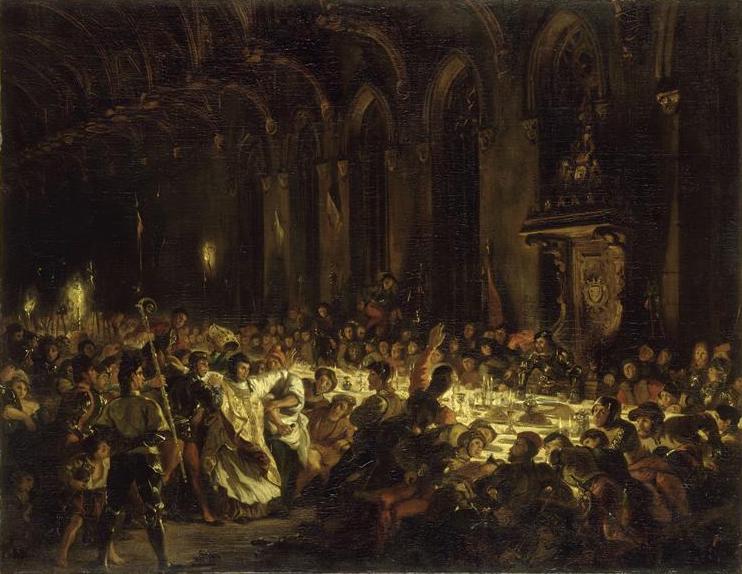
In 1482, the Wild Boar assassinated the sitting Prince-Bishop of Liege, Louis de Bourbon. It’s a scene captured in dark melodrama by Executed Today‘s court painter Eugene Delacroix.

He intended by this stroke to set up his son Jean de La Marck as the Prince-Bishop. Instead he kicked off a civil war and in lieu of the mitre he obtained a payoff from the Prince-Bishopric as Liege turned to resisting the inroads of the Austrian Empire. The Boar now allying with Liege in this endeavor, he was ingloriously ambushed by imperial forces and brought in for butchering.

On this day..

1527: Hans Hergot, immovable type

Nuremberg printer Hans Hergot was beheaded in Leipzig on this date in 1527.*

He’d previously published work of revolutionary Thomas Müntzer and he proved his simpatico with that fellow’s millenarian vision by publishing his own tract, Von der newen Wandlung Eynes Christlichen (The New Transformation of Christian Living). It was for this utopian sedition that Hergot lost his life, and no wonder.

The vision is of an egalitarian, agrarian society organized on a parochial basis in which goods are held in common for the use of all, habitation is after the Carthusian pattern, farming and crafts operate harmoniously, and every invidious ground and sign of social distinction has disappeared …

The enemies of Hergot’s revelation on whom he pronounces God’s imminent wrath are the ruling nobility and the Lutheran “scripture wizards” who theologically collude with them, the unjust acquitting the unjust …

It is precisely the eclecticism of Hergot’s prophetic voice that underlies its importance. For it suggests how a far-flung outburst of enthusiasm for divine or evangelical law, as opposed to corrupt and compromised human ordinances, was a connecting thread among myriad reforming orientations int he early sixteenth century — humanist, Lutheran, mystical, and apocalyptic — all of which intersected with the German Peasants’ War and the development of Anabaptism and other strands of Christian social radicalism.

From Irenaeus to Grotius: A Sourcebook in Christian Political Thought

There’s a “Hans Hergot Tower” in the Saxon town of Uelzen.

* Overshadowed, on the Reformation martyrology, by Anabaptist Michael Sattler, who burned at Rottenburg on the same date.

On this day..

1720: James Cotter the Younger

Just, Prudent, Pious, everything that’s Great
Lodg’d n his Breast, and form’d the Man complete,
His Body may consume, his Virtues shall
Recorded be, till the World’s Funeral.

-broadsheet elegy from Cork: History & society

On this date in 1720, Irish Catholic landlord James Cotter the Younger was hanged at Cork City. The charge was rape — but in the eyes of most it was his politics that were really on trial.

In a way it was the dexterity of his old man, James Cotter the Elder, for navigating the English Civil War that set up his offspring for this unfortunate fate. A second son of an ancient house, this man made a scintillating career as a royalist officer who went into exile during the Cromwellian interregnum.

Naturally Cotter-Elder made out like a Cotter-Bandit upon the monarchy’s restoration, proving his zeal by hunting down and slaying an absconded regicide.* Emoluments ensued, eventually raising the man to a colonial governor. With the resulting wealth he consolidated his family’s fragmented estates and became one of southwestern Ireland’s greatest landholders — yet his deft political touch enabled him to keep his station intact after the Glorious Revolution deposed the Stuart dynasty he had served so excellently. Still, Cotter’s survival in the anomalous position of a Catholic Jacobite lord under a regime which Jacobites thirsted to overthrow required some tradeoffs; according to this Carrigtwohill newsletter (scroll down to p. 62), he had to let his son be raised as a Protestant to insure his inheritance. The family apparently found a loophole by marrying him young to a Protestant, which provided the youth a legal foothold to secure his position whilst openly returning to the old faith.

Unfortunately the ample rents that the 16-year-old Master Cotter became entitled to upon his father’s death in 1705 did not come with dad’s diplomatic talent.

In the wake of the failed 1715 Jacobite rising, a Protestant rival accused Cotter of abducting and raping a Quaker woman named Elizabeth Squibb. In Catholic eyes, the whole proceeding was a naked assassination, with partisan judges and jurors ramrodding a dubious conviction to reduce a major Catholic family. If so, it was successful; Cork noblemen preferred the charge to Dublin. The conviction was enforced with speed — allegedly to preempt any possible pardon — despite the outrage of a good portion of the populace. On execution day, it was necessary to improvise a rope pegged to an obliging post, because angry Cotter supporters had destroyed the gallows which was to bear his body. Gnashing of teeth among the printed-word set ran to some 20 still-surviving poems and broadsheets lamenting

* The assassination target was parliamentarian John Lisle. In 1685, Lisle’s widow was targeted for a still-infamous judicial killing after the Whig rebellion of Monmouth failed.

On this day..

Feast Day of James, the brother of Jesus

Go to now, ye rich men, weep and howl for your miseries that shall come upon you.

Your riches are corrupted, and your garments are motheaten.

Your gold and silver is cankered; and the rust of them shall be a witness against you, and shall eat your flesh as it were fire. Ye have heaped treasure together for the last days.

Behold, the hire of the labourers who have reaped down your fields, which is of you kept back by fraud, crieth: and the cries of them which have reaped are entered into the ears of the Lord of sabaoth.

Ye have lived in pleasure on the earth, and been wanton; ye have nourished your hearts, as in a day of slaughter.

Ye have condemned and killed the just; and he doth not resist you.

Be patient therefore, brethren, unto the coming of the Lord. Behold, the husbandman waiteth for the precious fruit of the earth, and hath long patience for it, until he receive the early and latter rain.

Be ye also patient; stablish your hearts: for the coming of the Lord draweth nigh.

James 5:1-8

May 3 is the current Catholic feast date of the author of the Epistle of JamesJames, the brother of Jesus, also known as James the Just.

He’s a major leader in the New Testament accounts of the primitive church, closely associated with the traditionalist Jewish side of the movement, wont to give precedence to Mosaic law and ritual — a contrast compared to the Gentile-evangelizer St. Paul. James, however, also appears in Acts of the Apostles as a principal decider of the circa CE 50 Council of Jerusalem edict to the effect that non-Jewish converts to Christianity would not be required to circumcise or observe Jewish dietary strictures.

This James has been debatably conflated at times with the Apostle James, son of Alphaeus and/or James the Less* — as in this passage from the Golden Legend:

James the Apostle is said the Less, how well that was the elder of age than was St. James the More. He was called also the brother of our Lord, because I have resembled much well our Lord in body, in visage, and of manner. He was called James the Just for his right great holiness. He was also called James the son of Alpheus. He sang in Jerusalem the first mass that ever was there, and he was first bishop of Jerusalem.

These associations are all matters of scholarly debate, for the name “James” appears repeatedly in the New Testament, and the contexts do not always make it obvious when one encounters a recurring character. No matter how many other faces we might attribute to him, James the first century Jerusalem patriarch was clearly a figure of great authority among the earliest Christians and a co-leader of the Jerusalem Church. His consanguinity with the Messiah cannot have hurt his cause.

There are various accounts given of his martyrdom in 62 or 69** CE which boil down to falling foul of the Jewish authorities, just like his brother. Importantly, he’s referenced by the ancient historian Josephus in a passage from The Antiquities of the Jews that not only casts light upon his death but provides a contemporary non-Christian source verifying the development of this sect. The setup begins with the ascent of a young and aggressive high priest named Ananus, who

was a bold man in his temper, and very insolent; he was also of the sect of the Sadducees, who are very rigid in judging offenders, above all the rest of the Jews, as we have already observed; when, therefore, Ananus was of this disposition, he thought he had now a proper opportunity [to exercise his authority]. Festus was now dead, and Albinus was but upon the road; so he assembled the sanhedrim of judges, and brought before them the brother of Jesus, who was called Christ, whose name was James, and some others, [or, some of his companions]; and when he had formed an accusation against them as breakers of the law, he delivered them to be stoned: but as for those who seemed the most equitable of the citizens, and such as were the most uneasy at the breach of the laws, they disliked what was done; they also sent to the king [Agrippa], desiring him to send to Ananus that he should act so no more, for that what he had already done was not to be justified; nay, some of them went also to meet Albinus, as he was upon his journey from Alexandria, and informed him that it was not lawful for Ananus to assemble a sanhedrim without his consent. Whereupon Albinus complied with what they said, and wrote in anger to Ananus, and threatened that he would bring him to punishment for what he had done; on which king Agrippa took the high priesthood from him, when he had ruled but three months, and made Jesus, the son of Damneus, high priest.

Given his importance, James finds his way into quite a few extra-canonical Christian texts as well; for example, there’s an apocryphal Gospel of James dating to the second century. Of particular interest to we connoisseurs of death are gnostic texts from papyri discovered at Nag Hammadi, Egypt titled the First and Second Apocalypse of James: the Second Apocalypse has an account of James’s martyrdom, very detailed in spite of the fragmentary text, after his preaching in Jerusalem troubled the Jews:

On that day all the people and the crowd were disturbed, and they showed that they had not been persuaded. And he arose and went forth speaking in this manner. And he entered (again) on that same day and spoke a few hours. And I was with the priests and revealed nothing of the relationship, since all of them were saying with one voice, ‘Come, let us stone the Just One.’ And they arose, saying, ‘Yes, let us kill this man, that he may be taken from our midst. For he will be of no use to us.’

And they were there and found him standing beside the columns of the temple beside the mighty corner stone. And they decided to throw him down from the height, and they cast him down. And they […] they […]. They seized him and struck him as they dragged him upon the ground. They stretched him out and placed a stone on his abdomen. They all placed their feet on him, saying ‘You have erred!’

Again they raised him up, since he was alive, and made him dig a hole. They made him stand in it. After having covered him up to his abdomen, they stoned him in this manner.

And he stretched out his hands and said this prayer – not that (one) which it is his custom to say:

My God and my father,
who saved me from this dead hope,
who made me alive through a mystery of what he wills,

Do not let these days of this world be prolonged for me,
but the day of your light […] remains
in […] salvation.

Deliver me from this place of sojourn!
Do not let your grace be left behind in me,
but may your grace become pure!

Save me from an evil death!
Bring me from a tomb alive, because your grace –
love — is alive in me to accomplish a work of fullness!

Save me from sinful flesh,
because I trusted in you with all my strength,
because you are the life of the life!

Save me from a humiliating enemy!
Do not give me into the hand of a judge who is severe with sin!
Forgive me all my debts of the days (of my life)!

Because I am alive in you, your grace is alive in me.
I have renounced everyone, but you I have confessed.
Save me from evil affliction!

But now is the time and the hour.
O Holy Spirit, send me salvation […] the light […]
the light […] in a power […].’

After he spoke, he fell silent … [text ends]

* Saint James the Great was definitely a different fellow.

** The proximity of this martyrdom to the Jewish-Roman War (66-73 CE) led some subsequent ancient writers — not Josephus himself — to cite it as a cause of the great Roman Siege of Jerusalem in 70 CE, which famously destroyed the Second Temple.

On this day..

1731: Elizabeth Needham fatally pilloried

On this date in 1731 the English madam Elizabeth Needham stood in the pillory at Park Place, St. James’s, London. It wasn’t a death sentence de jure … but it became one de facto.

“Mother Needham” kept one of London’s most renowned brothels, far more exclusive than the dives of Covent Garden, and she made herself famous enough in the 1710s and 1720s to rate a place in the burgeoning print culture: Alexander Pope makes sly reference to her in The Dunciad, and as Hogarth seems to have modeled the titular courtesan of his Harlot’s Progress plates upon her.


Needham was famous for her recruiting talent. Here, Hogarth’s pockmarked Needham figure inveigles a pretty lass — the series’s central character, “Moll Hackabout” — freshly arriving to London from the hinterlands, while actual Needham client (and notorious sex-beast*) Francis Charteris leers from the stoop. In a subsequent panel in this same series, Hackabout as a seasoned whore encounters another Executed Today customer.

In her heyday a variety of japes, capers, and scandals unfolded in her precincts, beyond the obvious that was her stock in trade. For a number of years she carried out business unmolested by any chastisement from the law, but she suffered a couple of arrests in the 1720s and the heat on London’s brothels escalated uncomfortably with the onset of the 1730s. Thus it was that the wily old procuress earned a conviction for keeping a disorderly house on April 29, 1731.

Her punishment included a small fine and the duty to stand twice in the pillory, exposed to public obloquy. We have already noted in these pages that the horrors of such an ordeal extended beyond the reputational to an outright threat to life and limb. While it was not unheard-of for the pillorying to invert into a ritual of celebration and triumph for its sufferer were the crowd in sympathy, “it would seem that the default crowd at the pillory attended in expectation of an aggressive event.” (“Sodomites in the Pillory in Eighteenth-century London” by Peter Bartlett, Social & Legal Studies, December 1997)

This image of a crowd expecting to abuse the convict is consistent with the report in Fogg’s Weekly Journal in November 1728:

One Mitchel stood in the Pillory in Little Britain, for designing to extort Money from a Gentleman, by threatening to swear a detestable Sin against him [i.e., sodomy] — It was reported that he was to stand again in Aldersgate-street, upon which Occasion the Populace assembled, having furnish’d themselves with dead Cats, and other Ammunition used upon such Occasions, but the Person who was to make all the Sport not appearing, they diverted themselves with throwing their dead Cats at one another.

Elizabeth Needham had a wide notoriety that would have been especially charged in a mob’s eyes by her association with a villain like Charteris: we see her in Hogarth’s illustration above (not yet completed as of the time of her death) as the corrupt agent of predatory magnates. Moreover, she was apparently already weakened by illness. And although she was suffered simply to lie face down on the stage rather than standing dangerously exposed in the apparatus — and although she could afford to hire bodyguards to keep the crowd somewhat at bay — she received the aggressive version of the crowd whose abuse proved fatal to her.

Rictor Norton’s invaluable compilations of reporting on eighteenth century crime capture grub street’s coverage of the frightful end of Mother Needham (and one unfortunate spectator):

The famous Mother Needham was set before the pillory facing Park-place. She was so very ill, that she laid along under the pillory, notwithstanding which she was severely pelted, and it is thought she will die in a day or two … A boy getting upon a lamp post near the pillory, fell from the same upon iron spikes, and tore his belly in so violent a manner, that his bowels came out, and he expired in a few hours in great agonies …

Tuesday, May 4. Yesterday morning died Mother Needham … She declared in her last words, that what most affected her was the terror of standing in the pillory to-morrow in New Palace-Yard, having been so ungratefully used by the populace on Wednesday … They acted very ungratefully, considering how much she had done to oblige them.

* Charteris caught his own death sentence in 1730 for raping a servant, although he had the pull to obtain a royal pardon — with the aid of one of those familiar squid-inking campaigns of smearing his victim and casting doubt on the circumstances. “All the world agree he deserved to be hanged long ago, but they differ whether on this occasion,” one noble confided to his diary.

On this day..

1663: Gustav Skytte, pirate

On this date in 1663, the Swedish pirate Gustav Skytte caught a fusillade.

A nobleman of illustrious lineage* during the height of Sweden’s great-power glory, Skytte (English Wikipedia entry | Swedish) larped as a murderous buccaneer with some cronies from 1657, when he hijacked a Dutch ship.

The Baltic swash he buckled for the next several years from his secret refuge in Blekinge recommended him in time as the focus of a Romantic-era novel by Viktor Rydberg, The Freebooter of the Baltic. (You’ll need your Swedish fluency.)

He was survived by his 18-year-old sister and her husband, who had both been partners in his piratical enterprise but were able to flee to Denmark. They suffered property confiscation but were permitted to return to Sweden in 1668.

* His grandfather was a tutor of the great King Gustavus Adolphus.

On this day..

3rd Century BCE: Grauballe Man

We’ll never have the actual execution date, of course, but April 26 in 1952 was the date that researchers in Jutland hauled out of a peat bog the 3rd century BCE body of Grauballe Man, so spectacularly preserved that his fingerprints could still be taken. His throat slashed, Grauballe Man is thought to have been subjected to either an execution or a ritual sacrifice, and his body dumped into this oxygen-sparse slough so congenial to natural mummification.

The Grauballe Man
By Seamus Heaney

As if he had been poured
in tar, he lies
on a pillow of turf
and seems to weep

the black river of himself.
The grain of his wrists
is like bog oak,
the ball of his heel

like a basalt egg.
His instep has shrunk
cold as a swan’s foot
or a wet swamp root.

His hips are the ridge
and purse of a mussel,
his spine an eel arrested
under a glisten of mud.


Grauballe Man on display at Denmark’s Moesgaard Museum. (cc) image from Colin.

The head lifts,
the chin is a visor
raised above the vent
of his slashed throat

that has tanned and toughened.
The cured wound
opens inwards to a dark
elderberry place.

Who will say ‘corpse’
to his vivid cast?
Who will say ‘body’
to his opaque repose?

And his rusted hair,
a mat unlikely
as a foetus’s.
I first saw his twisted face

in a photograph,
a head and shoulder
out of the peat,
bruised like a forceps baby,

but now he lies
perfected in my memory,
down to the red horn
of his nails,

hung in the scales
with beauty and atrocity:
with the Dying Gaul
too strictly compassed

on his shield,
with the actual weight
of each hooded victim,
slashed and dumped.

These same bogs have yielded other eerily well-preserved time-travelers from antiquity, including Tollund Man (believed to have been hanged in the 4th century BCE) and Elling Woman (believed to have been hanged in the 3rd century BCE). Peat bogs ranging from Ireland and England to Germany and the Low Countries have overall yielded numerous other specimens, ranging up to 10,000 years old — quite a few of them victims of evident violence.

On this day..

1560: Giambatista Cardano, “crowning misfortune”

On this date in 1560, the son of Renaissance polymath Gerolamo Cardano was beheaded for murdering his — the son’s — wife.

While Cardano pere was one of the great intellectuals of his era, and has been covered in these grim annals via his interest in a genius composer executed for sodomy, the fils earns notice merely for his famous relations.

The latter, Giambatista Cardano by name, committed nothing but a shabby domestic murder, dosing his wife Brandonia di Seroni — “a worthless, shameless woman” in Gerolamo’s estimation — with arsenic when he had tired of her infidelities.

Still, it is the burden of a father to love his firstborn no matter how undistinguished and homicidal. Cardano poured his sorrow into a long funerary verse, not neglecting therein to defend the prerogatives of a jealous husband’s “avenging right hand”; we obtain it from the old man’s autobiography.

A Lament on the Death of My Son

Who has snatched thee away from me —
O, my son, my sweetest son?
Who had the power to bring to my age
Sorrows more than I can count?
Wrath in whose soul or what stern fate
Willed to reap thy youth’s fair flower?
Not Calliope, not Apollo,
Served thee in thine hour of need!
Cithara, now, and all song be still;
Measures of threnodies shall renew
Mourning and sighs for my dear son.
— Strains of his singing haunt me still —
Laurels, alas, in the healing art,
Knowledge of things, and a facile gift
Of Latin tongue—what profit these
Labors long if they swiftly die?
Service rendered Spanish prince,
Duty done to the noblest of men
Help thee naught if with these for thy judge
Death with his scythe doth seek thy blood.

What, ah me, shall I do? My soul
Swoons to remember thee, gentle son;
Silent, I brood on thy destiny grim;
Tears that I dare not give to words,
Shall I not shed for my stricken son?
Lasting encomium had I reserved,
Fitting reward to thine ashes paid;
Silence — O shame — must my tongue now guard,
Death unjust nor its cause announce.
Grave are the ills thou hast borne, mild son.
Prince and Senate and ancient law
Ordered thy doom whilst thou in rash haste,
Brought an adultress the wage of her crime.
Safely adultery now in our homes
Mocks and insults when punishment swift
Stays the avenging right hand of the youth.

Son — the reflection true of the good
Strong in my father — worthy to live
Long through the years — Alas, my beloved!
Fates have forbidden and swept all that good
Far past the stars, and removed from gray earth
Every bright and illustrious thing.
Hail thee, child, for thy spirit high!
Clear is thy blood from ignoble stain;
Honor of forefather’s hast thou sought.
Far stands the king, and hope of safety,
Phoebus denies the lands his beams,
Light from Diana passes and dies,
Stars in the calm sky glance no more
Lest they look down on a palace foul,
Stained with the reeking blood of the slain.

Where lies my way? What land now claims
Body and limbs disfigured by death?
Son, is there naught but this to return?
Thee have I followed on sea and on land!
Fix me — if mercy is anywhere found —
Pierce me with weapons, O ye mad Gods!
Take with thy first blow my dreary life.
Pity me thou, oh great father of Gods,
Thrust with thy spear my hated head
Deep into Tartara; else am I bound
Hardly to burst this life’s bitter chains.
This, O my son, was not pledged to thy sire,
Love so unholy to trust with thine all —
Love that has ruined thee, son of my heart!

Wife of a memory blessed and true,
Happy thy death, nor spared for this grief!
I, through this crime, have myself brought disgrace,
O son to our name, for by envy compelled,
Homeland and Lares paternal I left.
Death had I sought for my innocent soul,
But surviving and living I vanquished my fate.

Ages to come will know, son, thy name,
Orient lands will hear of thy fame;
Dead to us thou art indeed —
Life hast thou won through all the earth!

It would be fair to say that this last vow of the grieving father was not kept. Indeed, the misery of losing his son to the executioner cast an enervating pall over the elder Cardano’s remaining years. “My supreme, my crowning misfortune,” he bewailed. “Because of this, it was neither becoming for me to be retained in my office [a professor of medicine at Pavia], nor could I justly be dismissed. I could neither continue to live in my native city with any peace, nor in security move elsewhere. I walked abroad an object of scorn; I conversed with my fellows abjectly, as one despised, and, as one of unwelcome presence, avoided my friends.”

A couple of years on and the unwelcomeness had become overwhelming; he relocated to a professorship in Bologna — nowise happy but at least clear of the omnipresent, suffocating shame associated with his name. The man’s woes were in no way alleviated by his surviving son Aldo, a thief and all-around lowlife whom Cardano ended up disinheriting. (Lone daughter Chiara was A-OK by pops apart from being unable to bear him grandchildren: “from my daughter alone have I suffered no vexations beyond the getting together of her dowry.”)

On this day..