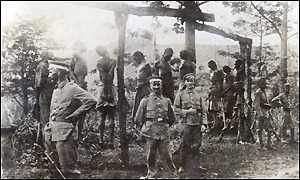
1698: The Streltsy executions begin

This entry in our Corpses Strewn series on the October 1698 extirpation of the Streltsy is courtesy of the diaries of Austrian diplomat Johann Georg Korb, an eyewitness to the events.

To this exhibition of avenging justice the Czar’s Majesty invited all the ambassadors of foreign fovereigns, as it were to aflert anew on his return that fovereign prerogative of life and death which the rebels had disputed with him.

The barracks in Bebraschentsko end in a bare field which rises to the summit of a rather steep hill. This was the place appointed for the executions. Here were planted the gibbet stakes, on which the foul heads of these confessedly guilty wretches were to be fet, to protract their ignominy beyond death. There the first scene of the tragedy lay exposed. The strangers that had gathered to the spectacle were kept aloof from too close approach; the whole regiment of guards was drawn up in array under arms. A little further off, on a high tumulus in the area of the place, there was a multitude of Muscovites, crowded and crushing together in a dense circle. A German Major was then my companion; he concealed his nationality in a Muscovite dress, besides which he relied upon his military rank and the liberty that he might take in consequence of being entitled by reason of his being in the service of the Czar to share in the privileges of the Muscovites. He mingled with the thronging crowd of Mufcovites, and when he came back announced that five rebel heads had been cut off in that spot by an axe that was swung by the noblest arm of all Muscovy. [i.e., Peter’s own] The river Jaufa flows pall the barracks in Bebraschentsko, and divides them in two.

On the opposite fide of this stream there were a hundred criminals set upon those little Muscovite carts which the natives call Sbosek, awaiting the hour of the death they had to undergo. There was a cart for every criminal, and a soldier to guard each. No priestly office was to be seen; as if the condemned were unworthy of that pious compassion. But they all bore lighted tapers in their hands, not to die without light and cross. The horrors of impending death were increased by the piteous lamentations of their women, the sobbing on every fide, and the shrieks of the dying that rung upon the sad array. The mother wept for her fon, the daughter deplored a parent’s fate, the wife lamenting a husband’s lot, bemoaned along with the others, from whom the various ties of blood and kindred drew tears of sad farewell. But when the horses, urged to a sharp pace, drew them off to the place of their doom, the wail of the women rose into louder sobs and moans. As they tried to keep up with them, forms of expression like these bespoke their grief, as others explained them to me: “Why are you torn from me so soon? Why do you desert me? Is a last embrace then denied me? Why am I hindered from bidding him farewell?” With complaints like these they tried to follow their friends when they could not keep up with their rapid course. From a country seat belonging to General Schachin [Shein] one hundred and thirty more Strelitz were led forth to die. At each side of all the city gates there was a gibbet erected, each of which was loaded with six rebels on that day.

When all were duly brought to the place of execution, and the half dozens were duly distributed at their several gibbets, the Czar’s Majesty, dressed in a green Polish cloak, and attended by a numerous suite of Muscovite nobles, came to the gate where, by his Majesty’s command, the imperial Lord Envoy had flopped in his own carriage, along with the representatives of Poland and Denmark. Next them was Major-General de Carlowiz, who had conducted his Majesty on his way from Poland, and a great many other foreigners, among whom the Muscovites mingled round about the gate. Then the proclamation of the sentence began, the Czar exhorting all the bystanders to mark well its tenor. As the executioner was unable to dispatch so many criminals, some military officers, by command of the Czar, came under compulsion to aid in this butcher’s task. The guilty were neither chained nor fettered; but logs were tied to their legs, which hindered them from walking fast, but still allowed them the use of their feet. They strove of their own accord to ascend the ladder, making the sign of the cross towards the four quarters of the world; they themselves covered their eyes and faces with a piece of linen (which is a national custom); very many putting their necks into the halter sprang headlong of themselves from the gallows, in order to precipitate their end. There were counted two hundred and thirty that expiated their flagitious conduct by halter and gibbet.

On this day..

1968: Pierre Mulele, hoodwinked

On this date in 1968,* Congolese revolutionary Pierre Mulele was shot by firing squad in Kinshasa.

The anti-colonialist (French link) Mulele served as Minister of Education in the leftist government of Patrice Lumumba, overturned by a western-backed coup in 1961.

Trained up in Maoist doctrine in China, Mulele took to the country to launch a strange insurrection from Kwilu, then fled to neighboring Republic of the Congo (aka Congo-Brazzaville, after its capital city) when that project collapsed.

Mulele was lured back to his home Congo in late September of 1968 under an amnesty extended by the Mobutu regime.

In retrospect, it might have been better not to trust Mobutu.

Foreign Minister Justin Bomboko … personally escorted the former rebel across the Congo River from the neighboring Congo Brazzaville, while Mobutu was on a private visit to Morocco. On his arrival, Mulele was feted over champagne and caviar. But Mobutu had hardly returned to Kinshasa when he announced that Mulele was not covered by the amnesty and that he would be tried as a war criminal.

He got a 15-hour military trial on October 8, with execution the very next day. Though the press reports aver merely that he was shot, Michela Wrong’s In the Footsteps of Mr. Kurtz: Living on the Brink of Disaster in Mobutu’s Congo** reports a quite more grisly spectacle.

tortured to death by soldiers. His eyes were pulled from their sockets, his genitals ripped off, his limbs amputated one by one as he slowly expired. What remained was dumped in the river.

That sounds … unsanitary.

As a result of this state perfidy — “an act of kidnapping and of international piracy” against an “authentic heir to the ideal which inspired Patrice Lumumba,” in the undiplomatic official statement† — Congo-Brazzaville broke off diplomatic relations with Congo-Kinshasa.

* Some sources have Mulele’s execution on Oct. 3, but the contemporary newspaper reports make clear that Mulele was tried on the 8th and shot on the 9th. Oct. 3 appears to be the date Mobutu publicly announced that Mulele would not be covered by amnesty.

** This site has been in the footsteps of Mr. Kurtz as well.

† London Times, Oct. 10, 1968.

On this day..

1295: Thomas Turbeville, undercover knight

As related by Bartholomew Cotton’s Historia Anglia:


A certain knight, Thomas Turbevile by name, who had been taken by the French at the siege of Rheims, and detained in prison by the said King of France, came over to England with traitorous designs, and said that he had escaped from the prison of the said King of France; whereupon, he was kindly received by our lord the King of England, and much honoured. But after he had remained some little time in the Court of our lord the King of England aforesaid, he attempted to send a certain letter to the King of France; whereupon, his messenger carried the same to our lord the King of England, and gave him a full and open account of the treachery of his employer. The traitor, suspecting this, took to flight, but was taken shortly after. The tenor of his treasonable letter was as follows:

“To the noble Baron and Lord Provost of Paris, sweet Sire, at the Wood of Viciens, his liege man at his hands, greeting. Dear Sire, know that I am come to the Court of the King of England, sound and hearty; and I found the King at London, and he asked much news of me, of which I told him the best that I knew; and know, that I found the land of Wales in peace, wherefore I did not dare to deliver unto Morgan the thing which you well wot of. And know that the King has fully granted peace and truce; but be you careful and well advised to take no truce, if the same be not to your great advantage; and know that if you make no truce, great advantage will accrue unto you, and this you may say to the high Lord. And know that I found Sir John Fitz-Thomas at the King’s Court, for the purpose of treating of peace between him and the Earl of Nichole as to the Earldom of Ulvester [Ulster]; but I do not yet know how the business will turn out, as this letter was written the day after that the Cardinals had been answered; wherefore I did not dare touch at all upon the business that concerns you. And know that there is little watch kept on the sea-coast towards the South; and know that the Isle of Wycht is without garrison; and know that the King is sending into Almaine [Germany] two earls, two bishops, and two barons, to speak to, and counsel with, the King of Almaine as to this war. And know that the King is sending into Gascoigne twenty ships laden with wheat and oats, and with other provisions, and a large amount of money; and Sir Edmund, the King’s brother, will go thither, and the Earl of Nichole, Sir Hugh le Despenser,* the Earl of Warwyk, and many other good folks; and this you may tell to the high Lord. And know that we think that we have enough to do against those of Scotland; and if those of Scotland rise against the King of England, the Welsh will rise also. And this I have well contrived, and Morgan has fully covenanted with me to that effect. Wherefore I counsel you forthwith to send great persons into Scotland; for if you can enter therein, you will have gained it for ever. And if you will that I should go thither, send word to the King of Scotland, that he find for me and all my people at their charges honourably; but be you well advised whether you will that I should go thither or not; for I think that I shall act more for your advantage by waiting at the King’s Court, to espy and learn by enquiry such news as may be for you; for all that I can learn by enquiry I will let you know. And send to me Perot, who was my keeper in the prison where I was; for to him I shall say such things as I shall know from henceforth, and by him I will send you the matters that I fully ascertain. And for the sake of God, I pray you that you will remember and be advised of the promises that you made me on behalf of the high Lord, that is to say, one hundred livres of land to me and to my heirs. And for the sake of God, I pray you on behalf of my children, that they may have no want so long as they are in your keeping, in meat or in drink, or in other sustenance. And for the sake of God, I pray you that you be advised how I may be paid here; for I have nothing, as I have lost all, as well on this side as on the other; and nothing have I from you, except your great loyalty, in which I greatly trust. Confide fearlessly in the bearer of this letter, and shew him courtesy. And know that I am in great fear and in great dread; for some folks entertain suspicion against me, because that I have said that I have escaped from prison. Inform me as to your wishes in all things. Unto God [I commend you], and may he have you in his keeping.”

The said Thomas was seized on the Saturday next before the Feast of Saint Michael [29 September], and taken to the Tower of London; and on the Saturday next after the Feast of Saint Faith [6 October] he had his trial, and departed in manner underwritten:

He came from the Tower, mounted on a poor hack, in a coat of ray [a striped coat], and shod with white shoes, his head being covered with a hood, and his feet tied beneath the horse’s belly, and his hands tied before him: and around him were riding six torturers attired in the form of the devil, one of whom held his rein, and the hangman his halter, for the horse which bore him had them both upon it: and in such manner was he led from the Tower through London to Westminster, and was condemned on the dais in the Great Hall there; and Sir Roger Brabazun pronounced judgment upon him, that he should be drawn and hanged, and that he should hang so long as anything should be left whole of him; and he was drawn on a fresh ox-hide from Westminster to the Conduit of London, and then back to the gallows; and there is he hung by a chain of iron, and will hang, so long as anything of him may remain.

* Father of the more famous Hugh Despenser, lover of Edward II.

On this day..

1536: Sebastiano de Montecuccoli, poisoner of the heir?

On this date in 1536, Italian nobleman Sebastiano de Montecuccoli was torn apart at the Place de la Grenette in Lyons for poisoning the dauphin Francis, heir to the French throne.

Sebastiano de Montecuccoli was a knight from Ferrara who had arrived in France in the train of the Catherine de’ Medici when she was married off to the no. 2 French prince Henri. He was fast friends with the royal princes, but his proximity to the family horribly turned against him when the 18-year-old Francis played a game of tennis, then caught ill and dropped dead. The last thing poor Francis had done was ask Montecuccoli for a glass of water.

In an era of forensics-by-guesswork, a sudden and unexplained death inevitably drew suspicions of poison — all the more so in a France gone security bonkers in the wake of the Affair of the Placards.

So just was in that glass of “water,” eh?

Sebastiano, upon his arrest, was found to possess a tome of poisons. This was a common enough interest among his class. (Catherine de’ Medici also had an interest in poison.) Nevertheless, it was great material for tunnel-vision investigators, and the young Italian soon provided a corroborating self-incrimination under torture: Sebastiano had offed the crown prince on orders from France’s longtime rival Charles V, who also just happened to be fighting a war with France over the duchy of Milan at that very moment.

Sebastiano attempted to recant this confession once he was off the rack, but to no avail. Many 16th century contemporaries could descry the eventual consensus of posterity that Sebastiano was a naif, and not an assassin. (Francis likely died from a disease.) Less generous by far was the judgment of the Lyonnaise citizenry who fell upon and ravaged Sebastiano’s body after it had been torn apart by horses.

Thanks to the unexpected death of the heir that triggered this horrible punishment, Francis’s brother Henri advanced to the crown prince seat and eventually became Henri II of France (until Henri’s own unfortunate sporting mishap) … and that Italian bride Catherine de’ Medici became Queen of France.

On this day..

1648: Alice Bishop

(Thanks to Meaghan Good of the Charley Project for the guest post. -ed.)

On this date in 1648, 32-year-old Alice Bishop was hanged on the gallows in Plymouth Colony, Massachusetts for the murder of her young daughter — an apparently motiveless crime which must have shocked her fellow settlers.

Almost nothing is known about Alice’s early life. She probably, although not definitely, came over on the Mayflower. The prevailing theory is that her parents were Mayflower passengers Christopher Martin and Marie Prower. They died within a week of each other in January 1621, before the actual settlement of Plymouth even began.

If that’s the case, Alice had been an orphan for the better part of a year by the time the first Thanksgiving rolled around. She was presumably raised by one of the other families. She would marry twice and have three daughters: Abigail, Martha and Damaris.

By 1648, Alice was living with her second husband, the Plymouth newcomer Richard Bishop, who was Damaris’s father. The family seems to have been unexceptional, just another household trying to eke out a living in a harsh and unforgiving environment.

Somewhere along the line, something went very wrong.

On July 22, 1648, while Richard Bishop was away from home, family friend Rachel Ramsden dropped by the Bishops’ residence and spent some time with Alice. Alice’s four-year-old middle child, Martha Clark, was asleep in bed in the loft, which was accessible by ladder. (Where the other two children were has not been recorded.)

At some point, Alice gave Rachel a kettle and asked her to go fetch some buttermilk from a neighbor’s house.

When Rachel returned, she noticed blood on the floor beneath the ladder. Alice was “sad and dumpish,” and when Rachel asked her what was going on, she wordlessly pointed up at the loft.

Rachel climbed up to have a look: there was blood everywhere; Martha’s mattress was drenched in it.

Rachel fled the house in a panic, found her parents and told them she thought Alice had murdered her daughter. Her father rushed to find the colonial governor. A posse of twelve armed men assembled and went to the Bishop house. By the time the men arrived, Alice was in hysterics.

Ascending to the loft, they found Martha’s body. The child was lying on her left side, “with her throat cut with divers gashes crose wayes, the wind pipe cut and stuke into the throat downward, and the bloody knife lying by the side.” Nothing could be done for her.

Alice freely admitted she had murdered her daughter and said she was sorry for it, but she claimed she had no recollection of the crime. When they asked her why she’d done it, she had no answer for them.

She was the fifth person hanged in the Plymouth Colony, and the first woman.

We will never know why Alice Bishop killed her daughter Martha, and why she did it in such a ferocious manner. One of her descendants has a website about her that attempts to answer that question.

Severe mental illness, perhaps post-partum psychosis, is an obvious answer, but not the only one. The site notes another potentially significant fact: both of Alice’s parents died when she was four years old, and she killed her daughter at the same age.

Richard Bishop survived his wife by nearly a quarter-century. As for the children: youngest child Damaris Bishop grew up, married and had three sons, but Abigail Clark, Alice’s oldest child, vanishes from history after her mother’s execution.

On this day..

1904: Herero prisoners, at the command of Lothar von Trotha

My initial plan for the operation, which I always adhered to, was to encircle the masses of Hereros at Waterberg, and to annihilate these masses with a simultaneous blow, then to establish various stations to hunt down and disarm the splinter groups who escaped, later to lay hands on the captains by putting prize money on their heads and finally to sentence them to death.

-German General Lothar von Trotha (pdf source)

On this date in 1904, von Trotha did a little of that executing bit, further to doing a whole lot of genocide. It was the very day after von Trotha’s Vernichtungsbefehl, or extermination order, against the Herero people.

We give the narrative here to Jan-Bart Gewald’s “Colonization, Genocide and Resurgence: The Herero of Namibia 1890-1933”, from a collection of papers at a German symposium. Gewald’s complete text is available in scanned pdf form here.

Gewald:


Pocketed by the desert and the German patrols the Herero chiefs and their followers congregated along the Eiseb river. Around the first of October 1904, General Lothar von Trotha, who was actively taking part in the pursuit, and his retinue had reached the waterhole Osombo-Windimbe. During the afternoon of the following day, Sunday 2 October 1904, after the holding of a field service, General von Trotha, addressed his officers. In his address Trotha declared that the war against the Herero would be continued in all earnestness, and read out the following proclamation:

I the great General of the German troops send this letter to the Herero people.

The Herero are no longer German subjects. They have murdered and stolen, they have cut off the ears, noses and other bodyparts of wounded soldiers, now out of cowardice they no longer wish to fight. I say to the people anyone who delivers a captain will receive 1000 Mark, whoever delivers Samuel will receive 5000 Mark. The Herero people must however leave the land. If the populace does not do this I will force them with the Groot Rohr [cannon]. Within the German borders everyHerero, with or without a gun, with or without cattle, will be shot. I will no longer accept women and children, I will drive them back to their people or I will let them be shot at.* These are my words to the Herero people.

The great General of the mighty German Kaiser.

At dawn the following morning, Herero prisoners, who had been sentenced to death by a field court-martial, were hung in the presence of about 30 Herero prisoners, women and children amongst them. After the hanging, Trotha’s proclamation was read out to the prisoners in Otjiherero. Printed copies of the text in Otjiherero were distributed amongst the Herero prisoners. The prisoners were then turned loose and driven out into the Omaheke. [i.e., the western Kalahari desert -ed.]


In a letter the next day, Oct. 4, to the general staff, von Trotha reported on his order the day’s executions, in the context of a detailed tactical and philosophical justification of destroying the entire Herero nation. It’s quoted at length in Absolute Destruction: Military Culture and the Practices of War in Imperial Germany:

For me, it is merely a question of how to end the war with the Herero. My opinion is completely opposite to that of the governor and some “old Africans.” They have wanted to negotiate for a long time and describe the Herero nation as a necessary labor force for the future use of the colony. I am of an entirely different opinion. I believe that the nation mustbe destroyed as such, or since this was not possible using tactical blows, it must be expelled from the land operatively …

Because I neither can treat with these people, nor do I want to, without the express direction of His Majesty, a certain rigorous treatment of all parts of the nation is absolutely necessary, a treatment that I have for the present taken and executed on my own responsibility, and from which, as long as I have command, I shall not detour without a direct order. My detailed knowledge of many Central African tribes, Bantu and others, has taught me the convincing certainty that Negroes never submit to a contract but only to raw force. Yesterday before my departure, I had the warriors who were captured in the last several days [and who were] condemned by court-martial, hanged, and I have chased all the women and children who had gathered here back into the desert, taking with them the proclamation to the Herero people. This proclamation (enclosed), which will unavoidably bcome known, will be attacked … accepting women and children, who are mostly ill, is an eminent danger to the troops, and taking care of them is impossible. Therefore, I think it better that the nation perish rather than infect our troops and affect our water and food. In addition, the Herero would interpret any kindness on my side as weakness.They must now die in the desert or try to cross the Bechuanaland border. This uprising is and remains he beginning of a race war, which I already predicted in 1897 in my reports to the chancellor on East Africa … Whether this uprising was caused by poor treatment [of the Africans] remains irrelevant to its suppression.


It should be added that this explicitly genocidal policy was neither unique to German colonies, nor, as von Trotha himself notes, uncontested within Germany itself.

German Christian missionaries logged a piteous catalog of horrors, “skeletons with hollow eyes, powerless and hopeless,” and their reports of same to their home offices led to church pressure to brake the atrocities.

Gewald also quotes one of von Trotha’s subalterns, undisguisedly revolted at what he was involved in.

Cattle which had died of thirst lay scattered around the wells. These cattle had reached the wells but there had not been enough time to water them. The Herero led ahead of us into the Sandveld. Again and again this terrible scene kept repeating itself … the water became ever sparser, and wells evermore rare. They fled from one well to the next and lost virtually all their cattle and a large number of their people. The people shrunk into small remnants who continually fell into our hands, sections of the people escaped now and later throug the Sandveld into English territory. It was a policy which was equally gruesome as senseless, to hammer the people so much, we could have still saved many of them and their rich herds, if we had pardoned and taken them up again, they had been punished enough. I suggested this to General von Trotha but he wanted their total extermination.

Technically, complete destruction of the Herero was reversed as German policy a few months after von Trotha began implementing it, and the general himself recalled from South West Africa before the end of 1905 — leaving only a “softer” genocide of disease-ridden concentration camps through 1908. Although firm numbers are hard to come by, it’s thought that well over half the Herero population died during this period.

Yet neither was von Trotha a lone butcher. Diary entries of settlers and regular soldiers well before the extermination order record many instances (pdf) of the most cavalier slaying of Herero prisoners and noncombatants, abuses which continued long after von Trotha’s departure.

It’s difficult not to see in the racial ideology and the eliminationist military doctrine prefiguring (pdf) later and better-publicized brutalities. Indeed, even some of the personnel are the same:

  • Hermann Goering‘s father Heinrich was Germany’s first Reichskommissar in South West Africa, plopping his home down right on a Herero burial site.
  • Eugen Fischer, a eugenicist who availed the Namibian concentration camps’ ready supply of subjects to produce career-making research that would influence German race law and make Fischer a big brain in Nazi intellectual circles
  • Franz Ritter von Epp, one of von Trotha’s officers, formed in the aftermath of World War I one of the far-right Freikorps paramilitaries, with many subsequently-influential Nazis among its membership, including Ernst Roehm (who may have cribbed the SA “brown shirt” look from colonial Schutztruppe khakis) and Adolf Hitler himself

* He meant, shooting over their heads to run them off. “I assume absolutely that this proclamation will result in taking no more male prisoners, but will not degenerate into atrocities against women and children,” Lothar explained. “The latter will run away if one shoots at them a couple of times. The troops will remain conscious of the good reputation of the German soldier.”

On this day..

1567: Pietro Carnesecchi, Florentine humanist and heretic

On this date* in 1567, Florentine humanist Pietro Carnesecchi was burned after beheading at the Ponte Sant’Angelo in Rome.

Carnesecchi (English Wikipedia entry | Italian) was born to a wealthy Florentine merchant family allied with the Medici; as a child, Carnesecchi probably dandled the infant Cosimo, the future ruler of the city. His education was patronized by the Medici cardinal who went on to become Pope Clement VII.

All these friends in high places would prove in time to be a poisoned chalice.

But the young man was in his glory in his twenties at Clement’s papal court, as notary and protonotary, excelling in his lucrative sinecures on the curial cursus honorum.

To his grief and/or glory, he met along the way the Spanish reformer Juan de Valdes, who had taken refuge in Naples from the Spanish Inquisition, and the spellbinding pulpit orator Bernardino Ochino, who was by the late 1530s to trend towards outright apostasy.

Intellectual curiosity was a quality dangerous to its owners during the Reformation. Carnesecchi had his own insider’s view of the Church’s warts to add to the influences of these brilliant associates, and by the 1540s was obliged by his affinities to seek his safety in the more liberal religious environment of Venice … and later, after a close first brush with the Roman Inquisition, to leave Italy altogether.

He wasn’t on the run per se, but his was a contingent life: a few years in a place, with the ever-present peril that a shift in the political winds could see him or his friends to the scaffold. He returned from France to Venice in 1552, spurned a summons to justify himself once more to the Inquisition under the furiously anti-Protestant Pope Paul IV, and was even able to move back to the Eternal City with the accession to St. Peter’s Throne of another Medici cardinal as Pope Pius IV. The Inquisition, nevertheless, drug its feet when it came to acquitting Carnesecchi once again.

“Nothing progresses!” he cries in one of his letters, for the Inquisitors “will not judge as right and duty dictate, for they suggest scrupulous hesitancy where there is no ground for it, and interpret that prejudicially which, rightly apprehended, is good and praiseworthy.” In other words: prosecutors.

As Popes are said to alternate fat with thin, and old with young, here they traded zealot of the faith with mellow humanist. When Pius IV died, the pendulum swung back against Pietro and the relentlessly orthodox** Pius V took charge.

Carnesecchi took refuge in his native Florence, governed by that baby Cosimo de’ Medici, all grown up now into an authoritarian state-builder. Cosimo had welcomed him before, and interceded on his behalf in the last go-round with the Inquisition; Florence, moreover, had a long-running rivalry with Rome in peninsular politics. Carnesecchi would have supposed himself as safe there as ever he had been in his peregrinations.

“But how did Ghislieri’s [Pope Pius V’s given name] reckless energy paralyse others!” as this book puts it. “Cosimo, too, was destined to feel its influence.”

Carnesecchi was a guest at his sovereign’s table when the friar Tomaso Manrique, the Master of the Papal Palace, was announced, as sent on a special mission to Florence, and desiring an interview with the Duke. The Pope had furnished his messenger with a letter bearing date June 20th, 1566, in which, after greeting Cosimo with the Apostolic Benediction, ‘he was called upon, in an affair which nearly affected obedience to the Divine Majesty and to the Catholic Church, and which the Pope had greatly at heart, as being of the highest importance, to give to the bearer of this letter the same faith as though His Holiness were present conversing with him.” Manrique claimed in the Pope’s name the delivering over of Carnesecchi into the hands of the Inquisition. The Duke made his friend and guest rise from the table and surrender himself on the spot to the Papal messenger. And he abjectly added, that, “had His Holiness — which God forfend — called upon him to surrender his own son for the same motive, he would not have hesitated one moment to have him bound and surrendered.”

Thanks, buddy.

Hauled immediately to a Vatican dungeon, Carnesecchi spent his last 15 months in prison, under interrogation, and sometimes on the rack.

“They would fain have me say of the living and of the dead things which I do not know, and which they would so fain hear,” Carnesecchi pleaded in (futile, intercepted) letters to old associates from the Curia. He admirably refused to incriminate anyone, but was convicted in September 1567 on 34 counts of obstinate heresy. They can all be read here — headlined by that hallmark of rank Protestantism, justification by faith alone.

Carnesecchi was stripped of his ecclesiastical ranks and his property, and turned over to the secular arm — the latter hypocritically “beseech[ed] … to mitigate the severity of your sentence with respect to his body, that there may be no anger of death or of shedding of blood,” which was, of course, the very intent and the effect of turning him over. Carnesecchi met his fate sturdily; his Catholic confessor complained that he was more interested in bantering ideas than penitence for his wrong opinions, and showed no proper fear of death.

In 1569, Pius V bestowed the title of Grand Duke of Tuscany on Cosimo.

Carnesecchi, long obscure to posterity, was exhumed almost literally when the Napoleonic Wars gave anti-clerical factions the opportunity to ransack secret Roman Inquisition archives. His meter-long file passed into a succession of private hands and was finally published in the mid-19th century, and as a result there are several public-domain volumes about the heretic in addition to the one we have already cited. Some of the original documents, with English translation, can be read in this volume; Italian speakers might give this one a go.

* There are a few citations out there for October 3. I can’t find a definitive primary source, and it may be that the original records are themselves ambiguous, so I’m going with the bulk of the modern and academic citations in favor of October 1.

** Anglos may recognize Pius V as the pope whose bull explicitly releasing Catholics from their allegiance to Queen Elizabeth put English followers of the Old Faith in an untenable position, much to the grisly profit of this here blog.

On this day..

1981: Mustapha Danso

On this date in 1981, Mustapha Danso was executed for an attempted coup in Gambia.

Gambia (or “The Gambia”: we’re going to dispense with the article here) is a sliver of a country hugging the Gambia River, entirely surrounded (save the coast) by Senegal.

It became independent of Great Britain in 1970 under the leadership of Dawda Jawara, who held the Gambian presidency democratically from that time until 1994. Mustapha Danso, our date’s principal, was one of a coterie of disaffected Gambian junior officers who were scheming a coup against Jawara as the 1980s got underway.

In October 1980, Danso walked up to the deputy commander of the Gambia Field Force, Eku Mahoney, and coolly shot him dead. “Although the first speculations blamed the constable’s action on possible illicit drug influence,” notes a book about Gambia’s subsequent, and successful, 1994 junior officers’ coup, “Mustapha Danso’s unresentful attitude after the incident convinced many people that there was more to it than what met the eye.” Mahoney may have been killed because he was viewed by the prospective coupists as an obstacle.

Danso caught a death sentence, but since Gambia never actually executed anyone, it was essentially symbolic.

That is, until July 1981, when Jawara was in London to attend the wedding of Prince Charles and Lady Diana. Danso’s former comrades in the Field Force seized the opportunity to join a coup mounted by leftist politician Kukoi Samba Sanyang against the “corrupt, tribalistic, and despotic” Jawara in favor of “the dictatorship of the proletariat.”

From London, Jawara summoned Senegalese aid: Gambia’s neighbor and sometime rival dispatched troops who successfully crushed the rebellion within a week. Some 500 people lost their lives during the turmoil, and its leaders fled abroad. (Kukoi Sanyang died a few months ago as of this writing, but his version of the “people’s revolution under my able leadership” can be perused here.)

While the coup itself was suppressed, Jawara went pretty easy (as these things go) on his actual or perceived enemies. Danso was the only party to the plot who was executed, and Jawara went out of his way to declare normalcy instead of using a national security emergency to smash up everything.

“In the aftermath of this threat to our internal security some have asked whether it would be appropriate at the time to consolidate both the power of the State and the power of the executive. Let me state categorically and unequivocally that the system of democracy that has always existed will prevail. There will be no dictatorship in The Gambia — neither by the President, nor by the Government, nor by the proletariat.” (Source)

Danso was the first and, for 30 years the only, person executed in Gambia; the country has retained the death penalty in law, but was long considered de facto abolitionist. That changed suddenly in August 2012 when current president Yahya Jammeh unexpectedly ordered nine condemned prisoners put to death on a single day.

On this day..

1893: Scuffletonians in Mt. Vernon, Georgia

From the Crittenden Press, Marion, Ky., Oct. 5, 1893, page 1 (pdf).

ON ONE SCAFFOLD.

Five Murderers Executed In Public at Mt. Vernon, Georgia

Three Killed a Merchant, the Fourth a Child and the Fifth a Companion.

Mt. Vernon, Ga., Sept. 29. — Five murderers were executed upon one scaffold at this place at 2:05 p.m. today. They were Hiram Jacobs, Hiram Brewington, Lucien Manuel, Purse Strickland and Weldon Gordon. All were commonly called negroes, but the first four named were descendants of the Crowatan Indians of North Carolina, and locally were known as “Scuffletonians,” from the name of the community from which they came. Three of them murdered Alexander Peterson, a rich merchant, last July, the fourth killed a five-year-old child and the fifth murdered a negro companion.

Over ten thousand people, white and black, witnessed the executions. Every incoming train deposited its load of human freight and steamboats on the Oconce and Attamba rivers ran a daily schedule. Thousands of women viewed the spectacle without a shudder.

The condemned men spent their last night on earth without any perceptible dread. This morning in the jail several colored ministers offered prayer for their spiritual salvation, exhorting them to be firm and courageous. At 1:30 p.m. the march to the scaffold was begun. The sheriff and prisoners were seated in a hack surrounded by a score of armed guards. They stood side by side on the scaffold. They were requested to make a statement if they desired.

Manuel said: “I have every reason to believe that I am going to meet the angels above. I fear nothing, my sins are forgiven and I shall go to heaven. I tell you my friends, to put your trust in God — good-bye.”

The others followed in the same strain. Strickland shed tears, while the vast throng sang, “A Charge to Keep I Have.” The Rev. Mr. Ross, a colored minister, prayed fervently. Then Sheriff Dunham adjusted the black caps and a photographer took their pictures.


Image from here, which appears to misdate the execution.

At this moment Sheriff Dunham bid them farewell, shaking each other by the hand, saying: “May God have mercy on your souls.”

At 2:05 p.m. the trap was sprung. There were no signs of a struggle, and the bodies hung straight and motionless. Half an hour later the bodies were cut down and deposited in pine coffins.

Update: Here’s a lovely wrap-up of the whole sordid affair.

On this day..

1926: Sataro Fukiage, serial killer

On this date in 1926, serial killer Sataro Fukiage (English Wikipedia entry | Japanese) was hanged at Ichigaya prison for rape-murder.

Most of what’s out there about Sataro Fukiage is in Japanese (like this book). Born in 1889, his hardscrabble upbringing saw him enter the workforce at age nine. He was not a model apprentice, alternating escape attempts with evictions for bad conduct; stealing from his master to procure a prostitute landed him in Kyoto prison at the tender age of 12, and it was in his periodic incarcerations that, Oliver Twist-like, he learned the finer points of pickpocketing from yakuza. He would need those finer points to do the breadwinning for his penniless mother in between his stints behind bars.

His somewhat sympathetic childhood also included a voracious and deviant sexual appetite which was to blossom in time into a carnivorous pattern of abuse.

Fukiage committed his first murder in 1906, when he took an 11-year-old acquaintance to a remote location, then raped and strangled her, only avoiding the death sentence because he himself was still underage at that time.

Released in 1922, he immediately brought himself to widespread public notoriety for a 1922-23 rape spree with at least 27 victims — most of them, again, underage girls. He mixed at least six murders into the one-man crime wave.

He completed an autobiography in prison, but it was banned shortly after its publication.

On this day..