1657: Gian Rinaldo Monaldeschi, Queen Christina betrayer

On this date in 1657, the Italian marchese Gian Rinaldo Monaldeschi was put to summary death by the command of Queen Christina of Sweden, at her court in Fontainebleau.

Make that ex-Queen, for the singular sovereign had abdicated in 1654 so that she could convert to Catholicism and go gallivanting about Europe.

After a spell in Rome, 1656 finds her turning up in Paris to astonish high society by her forward, masculine presentation; the king’s cousin took Christina to the ballet where the visiting dignitary “surprised me very much — applauding the parts which pleased her, taking God to witness, throwing herself back in her chair, crossing her legs, resting them on the arms of her chair, and assuming other postures, such as I had never seen taken but by Travelin and Jodelet, two famous buffoons … She was in all respects a most extraordinary creature.”

She kept her own court here, which was both a tribute to her stature and a court in waiting for her intended installation by French arms upon the Neapolitan throne. This rethronement never came to pass, and one reason among several was that the event marked in this post destroyed her stature in Italy.

Our man the Marquis Monaldeschi was Christina’s master of horse but to the eyes of the queen better resembled a snake. Why? That part, we don’t quite know.

The details of Monaldeschi’s treason are tangled and obscure. One knows that he confessed; but one does not know what he confessed. One knows that he forged letters; but one does not know what was in the letters. One knows that he tried to throw the blame for his own misconduct on Francesco Santinelli; but the precise nature of that misconduct is wrapped in mystery, as are also the precise grounds of Santinelli’s quarrel with him. All that is clear is that neither of the two men merits much sympathy, and that the proceedings of both of them were tortuous …

[Seeking to implicate his rival Santinelli in some malfeasance, Monaldeschi] tried to make out too good a case by forging Santinelli’s handwriting, and offering the letters as proofs that Santinelli was a “traitor.” … What first led her to suspect Monaldeschi is uncertain. In any case, “information received” induced her to intercept and open his letters; and their contents seemed to her to furnish full proofs of his perfidy. The nature of that perfidy is not disclosed in her own account. (Source)

What is not obscure, for it shocked all of Europe, is the punishment she visited for said perfidy — for Christina gave it over to that very Francesco Santinelli, Monaldeschi’s greatest rival in the court whom he had intended to stitch up, to deliver the penalty on the spot and with his own hand. She had the entire right to pronounce such a sentence in her court, but the Game of Thrones-like barbarism of being summarily put to an adversary’s blade right on the palace stones was widely abhorred. When she returned to Rome the following year, the French were quite done with her and the Italians who would be her grudging hosts for most of her remaining years nowise pleased to welcome her.

On this day..

1716: Maria of Curacao, slave rebel

On this date in 1716, a woman named Maria was burned for leading a slave rebellion on the West Indies island of Curacao.

Maria was a cook owned by the Dutch West India Company itself who apparently instigated the slaves on her plantation to rise up and slaughter the white staff in September of 1716.

Whether Maria herself was Curacao-born or a recently captured import is not known, but her plantation of St. Maria held many of the latter category; Curacao was a major shipping nexus for the Dutch slave trade. It’s possible that this meant Maria’s newly-arriving peers were more liable to harbor that cocktail of hope and desperation needed to wager their lives on rebellion.

Whatever the case, the rising was quickly put down. Another slave named Tromp, Maria’s lover, told his torturers that she had sought revenge on a white overseer named Muller for killing her husband.

On this day..

1842: The prisoner-mutineers of the Governor Phillip

On this date in 1842, four men hanged in Australia for the mutiny on the Governor Phillip.*

In this abortive rebellion, a dozen prisoners being carried on the aforenamed brig off the coast of Norfolk Island capitalized on the inattention of their guards and attempted to commandeer the vessel. By every account it was an unpremeditated affair, simply an attack of opportunity when the prisoners realized they’d been carelessly left free on the deck with only two guards, who were speedily thrown into the drink. (One drowned.)

Their aspirations at this moment ran along the lines of Fletcher Christian: merely to escape.

“Captain Boyle, I want to make a proposal with you,” one of the mutineers shouted at the momentarily deposed skipper while the latter was barricaded in his cabin. “Give us provisions and sails, and we’ll take the boat and leave you.” No deal was struck; instead, within a matter of minutes, the crew and guards rallied and took back the ship. It was the least they could do since, as one news article put it, “it certainly says little for their vigilance or prowess that such an attempt could have been made with any chance of success by a handfull of unarmed men.”

Five prisoners and the one drowning guard died in the scrap.

The seven surviving mutineers were left to stand trial for piracy, four — John Jones, John Sayers, Nicholas Lewis and George Beaver — of them ultimately consigned to the gallows at Sydney. (Two reprieves and a non-prosecution spared the remainder.) They arrived thence “so firm, yet in so resigned and devotional a state of mind” for they had “gradually become aware of their awful situation and received … those aids and consolations of religion” whilst “fully acknowledging the justice of the law.”

* The ship was named for Arthur Phillip, who commanded the First Fleet that founded the first British penal colony in Australia in 1788 — the germ of the eventual city of Sydney. (Named for Phillip’s patron, the Viscount Sydney.)

On this day..

1810: Metta Fock, embroiderer

Metta Fock was beheaded in Sweden on this date in 1810.

Fock (English Wikipedia entry | Swedish), daughter to the just-hanging-on lesser nobility, got her surname from an impecunious dullard of a sergeant with whom she shared a small farm in Västergötland. At least, she did until Johan Fock and two of her four children suddenly got violently ill and died within days of one another in 1802.

Well might one imagine the rumors that swirled around the widow Fock in these days; she was already suspected of having a lover, so the inference of a libidinous deployment of arsenic was nigh irresistible. She said her family had been stricken by a measles outbreak.

Her contemporaries were as uncertain of the conclusion as is posterity; she was thrown in Carlsten Fortress but spared a death verdict absent a confession — an unusual legal artifact at the time that might have permitted her to live out decades in a dungeon with sufficient obstinacy.

Although she finally buckled and made that confession — under who knows what extremes of misery and resignation; she vainly attempted to retract it later — the most evocative judgment has always been the manifesto of innocence that she embroidered onto 27 strips of linen in 1805, complaining of her unfair treatment. (More conventional writing instruments were being withheld from her.) It’s given Metta Fock a permanent purchase on later sympathies.

There’s a recent historical novel by Ann Rosman, Mercurium, which also casts Fock as a railroaded innocent.

On this day..

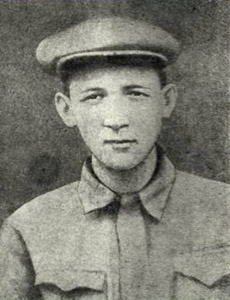
1941: Shura Chekalin, Hero of the Soviet Union

Sixteen-year-old partisan Alexander Chekalin earned his martyrs’ crown as a Hero of the Soviet Union when he was executed by the occupying Third Reich on this date in 1941.

“Shura” (English Wikipedia entry | the predictably better-appointed Russian) joined along with his father a unit of guerrillas in the vicinity of Tula just weeks into the terrible German onslaught.

The city of Tula, a transport hub 200 kilometers south of Moscow, was a key target for the German drive on the Soviet capital in those pivotal months; the Wehrmacht’s eventual inability to take it from determined defenders was crucial to thrwarting the attack on Moscow by protecting her from the southern tong of the intended pincer maneuver.*

Chekalin didn’t live long enough to see any of this come to fruition but in his moment he did what any one man could do: ambushes, mining, and other harassment of the occupation army in the Tula oblast (region) with his comrade irregulars. Our principal was found out by the Germans recuperating from illness in a town called Likhvin — see him defending his house of refuge against hopeless odds in the commemorative USSR stamp below — and then suffered the usual tortures and interrogations before he was publicly strung up on November 6. He hung there for 20 days before the Red Army took the town back and buried him with honors

In 1944, the tiny town of Likhvin was renamed in his honor: to this day, it’s still called Chekalin.

* Tula was recognized as a Hero City of the USSR for the importance of its defence.

On this day..

1849: Pierre Dudragne, avarice

On this date in 1849, Pierre Dudragne was guillotined at Chalon-sur-Saone.

He’d done a doubly dirty deed, choking out the 85-year-old widow Marechal in the course of burgling her Montmort home … and then also murdering the old lady’s servant, Claudine Bray. No honor among thieves: Bray was Dudragne’s own lover and accomplice in the heist, and his motive was the firm preference not to split the boodle with her.

On this day..

1913: Frederick Seekings, the last hanged in Cambridgeshire

The last man hanged in Cambridgeshire was Frederick Seekings on this date in 1913, for the drunken murder of his lover.

“Of limited intellect and a demon in drink,”* this Brampton laborer staggered out of Bell Inn on the 28th of July, 1913 with his eventual victim, Martha Beeby.** Both were deep in cups and argument, stumbling drunkenly to the ground as they vociferated until the innkeeper’s son helped steady them on their way.

Later that night, both were found sprawled out together alongside that same road: Frederick splayed over Martha, and Martha dead of a slashed throat. Frederick’s unconvincing claim that she’d done it to herself only confirmed his own guilty conscience; only the fact that he’d been drunk himself presented itself as a mitigating circumstance, but the Crown disputed his true degree of intoxication and the defence failed to persuade the jury to settle on mere manslaughter.

He was hanged by Thomas Pierrepoint in an execution shed at Cambridge County Gaol† in the city of Cambridge November 4, 1913, with little fanfare. There’s been no fanfare at all for 106 subsequent years, for neither city nor shire have since returned to the gallows in any capacity.

According to the Capital Punishment UK Facebook page (corroborated by its commenters), “The gallows from Cambridge was displayed in Madame Tussaud’s wax works in Blackpool in the 1980’s and consisted of two uprights with a crossbeam, bearing the Royal Coat of Arms, set over the double leaf trapdoors.” If there’s a photo of this relic available online, I have not been able to locate it.

* Quote is from the scholarly annotations to Malcolm Lowry‘s lost-then-rediscovered novel of Cambridge, In Ballast to the White Sea, which passingly alludes to the hanging.

** Frederick and Martha cohabited and she commonly went by his surname, Seekings — but they never married, and Martha actually had a never-annulled marriage to a different man.

† Tangentially, Cambridge-curious readers might enjoy this tour of the prison’s early 19th century executions.

On this day..

1740: Ned Darcy, of the Kellymount Gang

On this date in 1740,* Ned “Darcy, one of the Kellymount gang, was tried at Carlow, on the Proclamation; and, being proved to be the man, in ten minutes he was taken from the dock and hanged, and his head fixed on the Court House.”

The Kellymount gang — named for a County Kilkenny town it frequented — was a band of outlaws who were the terror of Leinster in 1740, a famine year due to a brutal frost.

Numbering as many as 30 strong, this troop had the boldness even to lay siege to manors and the ferocity to put gentlemen in mortal terror; we find our same principal just weeks before his execution going the full monster:

August 30 — Yesterday morning, one Ned Darcy went to the house of one Doran, in the County of Carlow, took him out of his bed and, naked as he was, put him on horseback, and in that manner carried him through part of the Counties of Carlow and Kilkenny; and being met by several, were asked where they intended to take him, to which they replied they were going to hang him, he having been the occasion of hanging a brother and a father of Darcy’s; and we have been since informed that, having taken him into Kellymount Wood, they cut out his tongue, cut off his ears, and pulled out one of his eyes, then desired him to go to Sir John, in Capel Street, give in his examination to him of their proceedings, and tell him they would serve him in the same manner were he in their power, as also Mr. Bush.

Mr. Bush, who came from Carlow three days ago, had one hundred men armed to guard him, and Mr. Gore, the same from Waterford; so by this you may see in what fear we travel in this country.

The Kellymount Gang was mostly busted up in these months with no small number of executions, but its remnants survived to launch the career of one of Ireland’s most celebrated bandits, James Freney — for a few years later, Freney, a failed tavernkeeper mired in debt, chanced to find himself neighbor to “one John Reedy, who had formerly been one of the robbers, commonly known by the name of the Kellymount Gang, but who had been pardoned for making some discoveries.” Reedy advised Freney in a moment of financial desperation that “there was a fair at hand, and that there was a number of drovers to be there; who, he said would have a great deal of cash; and told me, that my only remedy to extricate myself from my creditors, was to make to the highway, and that he would get three or four men to assist me.”

The former publican took up the offer to good effect, and proceeded to make his name and fortune on the roads.

We hope our readers will recognize this famous criminal from the stickup he perpetrates upon the title character in Thackeray‘s 1844 serial The Luck of Barry Lyndon, and likewise in Stanley Kubrick‘s masterpiece 1975 adaptation, Barry Lyndon. (He’s called “Feeney” in the film.)

* Julian date: the quoted blurb comes from Reilly’s Dublin News-Letter of November 8th, 1740.

** Much to the disadvantage of Executed Today, Freney/Feeney was the rare outlaw who was able to retire with his earnings, emigrating abroad and eventually returning to work as a customs official in Inistioge. The account of his criminal origins we have from Freney’s own memoirs.

On this day..

1842: William Caffee, Mineral Point spook

Mineral Point, Wisconsin’s historic Walker House inn and tavern hosted a public execution on this date in 1842 … and rumor has it that the hanged man hasn’t stopped hanging around ever since.

The Mystery Of The Pointing Dog is tween historical fiction set in Mineral Point on the day of the hanging.

William Caffee’s journey to the gallows began earlier that year at a different publick-house, which also still stands today: Berry Tavern of Shullsburg, where Caffee picked a fight at a dance and ended up shooting another man dead, straight through the heart.

Evidence at his trial indicated that he’d boasted earlier that evening that he would kill a man that night, which led to his conviction for first-degree murder. Unchastened by his situation, the hardened ruffian passed the weeks until his death muttering threats to his guards and to the judge who noosed him.

Five thousand people assembled in the peaceful and quiet village of Mineral Point to witness what! The agony and dying throes of a fellow man. Good God! What a curiosity.

The crowd was not made up of any particular class, but was composed indiscriminately of both high and low, rich and poor, men white with the frosts of age, and tottering upon the verge of eternity were here, young men in throngs were here. The pious and the good were here. The aged and discreet matron was here. The virgin, “chaste as the icicle that hangs on Dian’s temple,” were here. Infants, muling and puking in their nurse’s arms, were here by the acre. In a word, every age, sex, color and condition was fully represented here to-day.

The Execution took place upon the low ground below the town, surrounded by an amphitheatre of hills, which were literally covered by the eager multitude. The scaffold was constructed upon the old plan, and consisted of a square frame work, placed upon the ground, into which was inserted two upright posts about twelve feet high and four feet apart; across the top of these posts went a beam, with a large iron hook inserted, to which was attached the rope. Between the upright posts, and about six feet from the ground was fixed a platform or trap door, about four feet square, hung with hinges upon one side and kept in a horizontal position by a pin passing through one of the upright posts and under the edge of the platform. To this pin was attached a lever for the purpose of drawing it out and letting fall the trap. The ascent to the scaffold was by means of a flight of stairs.

Agreeable to the requisition of George Messersmith, Esq. Sheriff, Capt. Shaw attended from the South part of the county, with a company of thirty men, in uniform, armed with muskets, a company of Dragoons armed with pistols and sabres, was organized at Mineral Point, under Major Gray, a strong guard of citizens was also organized and stationed round the Jail during the fore part of the day, and were afterwards incorporated into Capt. Shaw’s company.

At 2 o’clock, P.M. the procession formed in front of the Jail in the following order:

Dragoons under Maj. Gray;
Infantry;
Waggon containing coffin;
Infantry;
Dragoons under Col. Sublett;

Prisoner was then led forth from the jail in a long white robe, with a white cap upon his head, and a rope round his neck, leaning upon the arm of the Sheriff; he walked to the wagon and stepped into it with little or no assistance, and seated himself upon the coffin; the Sheriff and his deputies took seats in the wagon; a dead march was struck up, and the procession moved forward to the place of execution. Here the military were stationed round the gallows at the distance of some thirty feet, to keep off the crowd. Prisoner was then assisted from the wagon, and with a firm step ascended with the Sheriff to the scaffold. The Rev. Mr. Wilcox, who was in frequent attendance upon the prisoner during his last hours, now ascended the scaffold and prayed with him for the last time; thePrisoner, in the meantime, leaning upon one of the posts of the gallows, and manifesting no emotion. Upon being asked by the Sheriff if he had any thing to say, he answered no, and requested that the rope might be adjusted “with a good long slack,” and his doom forthwith sealed. The Sheriff then adjusted the rope, drew the cap down over the prisoner’s face, and descended from the scaffold, putting his hand to lever, the fatal pin was drawn out, and prisoner launched into eternity.

From the time of prisoner’s arrest, down to the last moment of his existence, he maintained the utmost coolness; and manifested such a contempt of death, as to invest him with a sort of terrible grandeur; making good upon the scaffold his previous boast, that he could stare the grim messenger out of countenance.

North Western Gazette & Galena Advertiser, November 4, 1842

Present-day Mineral Point has not been above exploiting the famous hanging as a tourist attraction, but this is only fair considering that Caffee’s ghost has been reported to haunt the Walker House ever since. (Perhaps only one of several supernatural terrors menacing Mineral Point.)

On this day..

1929: Ilm Deen, blasphemy avenger

On this date in 1929, the Punjabi Muslim youth Ilm Deen was hanged for murdering a blasphemous publisher.

The Rangila Rasul is a pamphlet-length send-up satirizing the “widely experienced”, chortle chortle, Prophet Muhammad for his many wives; Muslim fury at its publication brought the Raj to legislate against “outraging the religious feelings of any class” — a law that’s still on the books in India.

However, there was no such law at the time of the naughty screed’s publication, and as a result the Hindu publisher, Mahashe Rajpal of Lahore, was acquitted of any charge in 1929.

‘Twas a temporary exoneration, for Ilm Deen (or Ilm-ud-din, or Ilmuddin), a 20-year-old carpenter, delivered his verdict extrajudicially by daggering Rajpal in the chest in a Lahore bazaar on April 6, 1929.

The assassin’s speedy trip to the Raj’s gallows thereafter only cinched his place as a sectarian, and later (for Pakistan) national, martyr; the poet Allama Iqbal exclaimed at the young man’s funeral that “this uneducated young man has surpassed us, the educated ones!” To this day, Ilm Deen’s solemn tomb is a place of pilgrimage and veneration.

The case remains a fraught precedent for latter-day sectarian tension, as well as a ready vein of propaganda as with Ghazi Ilam Din Shaheed, a 1978 film released under the Pakistani military government after overthrowing Zulfikar Ali Bhutto.

On this day..