1794: Maurice Joseph Louis Gigost d’Elbee, Vendean general

On this date in 1794, one of the great royalist generals of the Vendee revolt was shot by the French Revolution’s Republican forces at Nourmoutier.

The 1793 counterrevolutionary uprising in the Vendee had roused retired cavalryman Maurice Joseph Louis Gigost d’Elbee (English Wikipedia link | French), and he became the second commander of the Royal and Catholic Army upon the death of Jacques Cathelineau.

Unfortunately for d’Elbee, even with English support, the balance of force rather tipped in favor of Paris, and the Revolutionary government was obviously not shy about sealing its victories in blood.

D’Elbee suffered a grievous wound at the Battle of Cholet in October 1793, and for a couple of months was spirited one step ahead of the advancing Republicans.

As Charles MacFarlane writes in The French Revolution, Vol. 3, he ran out of room to run at the island of Noirmoutier.

D’Elbee was lying in bed between life and death; his wife might have escaped, but would not leave him: they were both taken. As Turreau’s soldiers entered their chamber the wounded royalist exclaimed, “Yes, here I am! Here is d’Elbee, your greatest enemy! If I had been strong enough to fight or stand upon my feet, you would not have taken me in my bed!” They kept him for five days, treating him with execrable barbarity, and then carried him in an arm-chair to the place appointed for fusilading the prisoners, and there shot him. His wife was fusiladed the next day, and her brother and brother-in-law perished in the same manner.


Mort du General d’Elbee, by Julien Le Blant, depicts the general shot with three other royalist officers. Not pictured: Hundreds of other Vendean prisoners massacred in the aftermath of the Battle of Savenay.

On this day..

1993: Westley Allan Dodd, child molester

Just after midnight this date in 1993, Washington state carried out the first legal hanging in the U.S. since 1965.

Pornstached child molester Westley Allan Dodd is the textbook “incorrigible sex offender” case study. That’s certainly how Dodd himself asked us to interpret him.

“I have said all along the system does not work,” he wrote of his long career in pedophilia, notoriously unrehabilitated by the criminal justice system. “I knew what I was doing, I knew it was wrong. I knew I could get the death penalty if caught.”

From the usual humble beginnings in teenage child-groping, and despite several arrests over the years, Dodd devolved into abducting young boys to actualize horrific fantasies he did not scruple to jot in his journal.

Incident 3 will die maybe this way: He’ll be tied down as Lee was in Incident 2. Instead of placing a bag over his head as had previously planned, I’ll tape his mouth shut with duct tape. Then, when ready, I’ll use a clothespin or something to plug his nose. That way I can sit back, take pictures and watch him die instead of concentrating on my hands or the rope tight around his neck — that would also eliminate the rope burns on the neck . . . I can clearly see his face and eyes now…

He suspects nothing now. Will probably wait until morning to kill him. That way his body will be fairly fresh for experiments after work. I’ll suffocate him in his sleep when I wake up for work (if I sleep).

In short: not the nicest guy, though also a monster as much pathetic as diabolic.

Dodd pleaded guilty to his three sex murders, and fought for his own execution. The state of Washington obliged him in a speedy three years.

Although the Evergreen State had lethal injection on the books, Dodd also availed his right to select its holdover alternative method, hanging.

Those kids didn’t get a nice, neat painless easy death. Why should I?

Which justification’s nobility (such as it is) is considerably more socially gratifying than, say, a hankering for the gallows’ post-mortem priapism.

(He didn’t get everything, though: they turned down his request to televise the hanging.)

Not content with his headline-grabbing mode of departing the world, Dodd had a hand in a statutory milestone, too. His stranger-danger nightmare case surfacing in the fall of 1989 was part of the background that drove Washington to pass the nation’s first sexually violent predator law, the Community Protection Act of 1990.*

Trutv.com’s Crime Library has a good deal more about the mind of this particular maniac.

* It was really Earl Shriner’s crimes more than Dodd’s that led most directly to the new law, which licensed indefinite “civil commitment” of sexually violent predators after the completion of their criminal sentences.

On this day..

1943: Jerzy Iwanow (Georgios Ivanof)

On this date in 1943, Polish-born Greek resistance hero Jerzy Iwanow-Szajnowicz was shot (or shot attempting to escape the Kaisariani execution ground, which amounts to pretty much the same thing) for a dramatic career fighting the occupation of Greece.

Iwanow (Polish) — or Georgios Ivanof — was the son of a Russian officer, but his parents divorced in his childhood, and mom married a Greek.

Jerzy was on his way to a cosmopolitan upbringing, mastering half a dozen languages and apparently just as many sports.

His athletic and linguistic prowess would both come in handy for derring-do missions (more Polish) in the Greek waters that saw him sink a German submarine and a destroyer with magnetic bombs. He even escaped the first two times he was captured.

Third time was a charm for the Nazis.

Sounds like celluloid material. As a matter of fact, a 1972 Polish film valorized Iwanow as Agent Nr. 1.

You can see the full movie on Veoh, if you’re prepared to install their viewing software.

On this day..

1645: John Hotham the Elder

On this date in 1645 — one day after the same fate befell his son — Sir John Hotham was beheaded by the English Parliamentarians for attempting to betray Hull to the Cavaliers in the English Civil War.

Part of the Daily Double: John Hothams.

On this day..

1645: John Hotham the Younger

On this date in 1645, John Hotham the Younger — former M.P., and (too) briefly an adherent of Parliament in the English Civil War, was beheaded as a traitor.

Part of the Daily Double: John Hothams.

On this day..

104 B.C.E.: Jugurtha

(Thanks to Daily Kos diarist “emperorhadrian” for licensing this guest post, originally published on that site June 24, 2007. -ed.)

The Jugurthine War was a key war in the final century of the Roman Republic.

Like the Americans in Iraq, Rome assumed that their war against Jugurtha, King of Numidia (a nation in north Africa), would be a cakewalk. They believed that Numidia was a nation of savages with a bizarre religion. They assumed that their own “shock and awe” attacks by the superior legions would decapitate and destroy the “evil doer” Jugurtha. They believed that in order to liberate the Numidians of their primitive ways, they had to impose the civilized will of the Roman state on this backward nation. Rome never expected that the Numidians would wage an insurgent war against their Roman occupiers. This war ended up dragging on for almost a decade. And in the end, it showed the depravity of the ruling party (the ultra-conservative republican Optimate party), which was sending the Roman Republic on its way to tyranny, empire and ruin.

In 148 BC, the King of Numidia, Masinissa, died. The Roman proconsul, Publius Cornelius Scipio Aemilianus, had been given authority by Masinissa to divide Masinissa’s estate. He divided it between Masinissa’s three sons, Micipsa, Gulussa, and Mastarnable. Soon after, Gulussa and Mastarnable died, leaving Micipsa as the sole King of Numidia. Around the year 134 BC, Micipsa sent Jugurtha (who was Masinissa’s grandson, but the son of another Numidian) to Spain with Scipio Aemilianius. Scipio was fighting the Celtiberians, who lived in a part of what is now Spain. Jugurtha was able to raise an army to help Scipio. Because of the valor of Jugurtha and his army at the Siege of Numantia, Scipio was able to win his war against the Celtiberians.

While fighting for Rome, Jugurtha worked alongside his future enemy, Gaius Marius. Jugurtha not only learned the superior Roman style of fighting, but he also learned of Rome’s weakness for money and thus bribery. Jugurtha described Rome as “urbem venalem et mature perituram, si emptorem invenerit” (“a city for sale and doomed to quick destruction, if it should ever find a buyer”). When Jugurtha returned to Numidia, Micipsa adopted Jugurtha, and decided to include Jugurtha in his will.

After the fall of Numantia, Jugurtha returned home with a letter from Scipio addressed to his uncle; in it, the commander praised Jugurtha’s exploits and congratulated Micipsa for having “a kinsman worthy of yourself, and of his grandfather Masinissa” (Sallust Iug. 9). On this recommendation the king formally adopted Jugurtha and made him co-heir with his own children

In 118, Micipsa died. He left his kingdom to Jugurtha and his two natural sons, Hiempsal and Adherbal. Shortly after Micipsa’s death, Jugurtha had Hiempsal killed. Adherbal fled to Rome. The Roman Senate sent a commission to Numidia to make peace. Jugurtha bribed the Romans on the commission, and thus the commission gave the better regions of the kingdom to Jugurtha.

In 113 BC, Jugurtha took his army and cornered Adherbal in his capital city of Citra. According to Sallust, Adherbal had the support of the people, but Jugurtha had the support of the best soldiers. A Roman Commission was sent to Numidia to forge a new peace. Jugurtha then bribed the Romans on this commission. The Romans thus allowed Jugurtha to storm Citra, and slaughter Adherbal and his supporters. Because Jugurtha slaughtered a number of Italian business people (including Roman Equites, or “Knights“), the Roman senate declared war on Jugurtha.

The Roman Senate sent an army under the command of the consul Lucius Calpurnius Bestia to fight Jugurtha. Bestia decisively defeated Jugurtha. But Jugurtha bribed Bestia, and thus was given unusually favorable terms. The Roman Senate viewed the favorable terms with suspicion, so it summoned Jugurtha to Rome. When Jugurtha arrived in Rome, he bribed two Tribunes, who thus prevented him from testifying. While in Rome, Jugurtha attempted to have his cousin and rival Massiva assassinated. Because of this, he was expelled from the city and returned to Numidia.

In 110 BC, the Roman Senate sent the praetor Aulus Postumus Albinus (who was the cousin of a consul for that year) to defeat Jugurtha. Because Jugurtha bribed key Romans involved in Albinus’ army (who then betrayed Albinus), Albinus was defeated.

The Roman Senate then sent the consul Quintus Caecilius Metellus to fight Jugurtha. At the Battle of the Muthul, a young Roman officer named Gaius Marius helped to reorganize Metellus’ legions, which then defeated Jugurtha. But Jugurtha was defeated because he forced his army to retreat before it could suffer heavy losses. The Romans did suffer their own heavy losses. Jugurtha disbanded his army, and had his soliders mount an insurgency to fight the Roman occupiers.

Marius returned to Rome. Dissatisfied with the slow pace of the war under Metellus, the Roman Military Assembly (one of the two Roman legislative assemblies, similar to the US Senate) appointed Marius consul (the Military Assembly, not the senate, appointed consuls). The Roman consuls had similar powers as the US President. The consulship was the highest constitutional office, and the consuls had imperium powers, which allowed them to command armies and conduct wars. The senate didn’t want Marius to be consul, because at this time it was dominated by an ultra-conservative republican party of aristocratic elites known as the Optimates. Marius belonged to the party that opposed the Optimates, the Populares. Partly because the senate didn’t like Marius, and partly because of the increasing difficulty Rome was having in recruiting armies, Marius was forced to raise his own army.

The capture of Jugurtha, from this French history of the Jugurthine War.

Marius took his army to Numidia to fight Jugurtha. But while Marius had been raising his army, Jugurtha allied with his father-in-law, Bocchus, the King of Mauretania. Marius defeated Jugurtha and Bocchus in several key battles. But much like with the American occupation in Iraq, Jugurtha’s strategy of insurgency warfare against the occupiers rendered all conventional victories irrelevant. Marius was playing a game of whack-a-mole. No matter how many times the Numidians were defeated, Jugurtha’s insurgents would regroup and keep fighting. It became clear that because of this, Rome could not defeat Jugurtha.

Marius sent his young Quaestor, Lucius Cornelius Sulla, to Bocchus. Sulla bribed Bocchus, and told him that Bocchus would be given a part of Numidia if he would betray Jugurtha. Bocchus then decided to give Jugurtha to Sulla. Sulla took Jugurtha to Rome, where Jugurtha was strangled in the Tullianum in Rome after marching in Marius’ January 1, 104 B.C. Triumph.


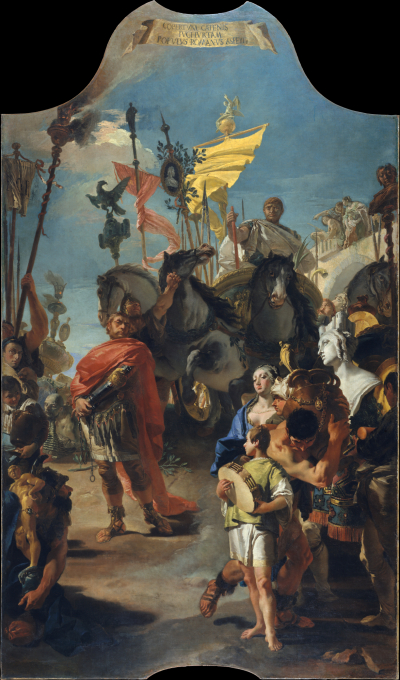
The Triumph of Marius (1729) by Giovanni Battista Tiepolo. The inscription in Latin reads “The Roman people behold Jugurtha laden with chains”.

The Jugurthine War was over. But in the process, several problems were exposed that would cause Rome serious pain in the future. Republicans in this country love to tell us that money in politics is harmless free speech. But as we saw in the Roman Republic during the Jugurthine War, money can be very corrupting. Rome almost lost the war because of money in politics, and the susceptibility of public officials to bribery.

In addition, this war saw the rise of two Romans who would play a key role in the events that directly preceded the fall of the Roman Republic. The first Roman made famous through this war was Gaius Marius. Gaius Marius would later hold the Roman Consulship an unconstitutional 7 times in 21 years (constitutionally, a Roman had to wait 10 years before being reelected consul).

The second Roman made famous through this war was Lucius Cornelius Sulla. Sulla and Marius would fight an unconstitutional civil war with each other several years after this war had ended. Sulla would illegally march his troops on Rome, and unconstitutionally legalize the mass killing of Marius’ supporters. Marius’ supporters in the senate would unconstitutionally prevent Sulla from fighting a war during one of Sulla’s consulships. Sulla would eventually seize absolute power for himself. Sulla would be the first Roman to be Dictator in almost 150 years. He would also be the first Roman in history to hold the dictatorship without the traditional six month term limit.

As dictator, Sulla would illegally change the Roman constitution to make himself and his party (the ultra-conservative republican Optimates) even more powerful. And most importantly, Sulla would set the example (of civil war on Romans, and then the seizing of absolute power) that the future tyrant Gaius Julius Caesar would follow.

In the end, the actions taken by key players in the war against Jugurtha would be repeated in the final destruction of the Roman Republic. The future triumvir Pompey would unconstitutionally hold multiple consulships in a short period of time. Crassus, another future triumvir, would illegally bribe politicians to get his way. And the future tyrant Julius Caesar would bribe, unconstitutionally hold the consulship, and become dictator for life (as Sulla had done). It was Caesar’s actions in this regard, as well as the similar actions of his adopted son and heir, Gaius Octavius (later Gaius Julius Caesar Octavianus, the Emperor Augustus) that would once and for all destroy the Roman Republic, and create the Roman Empire.

1. When when, and whenever death closes our eyelids,
2. Moving naked over Acheron
3. Upon the one raft, victor and conquered together,
4. Marius and Jugurtha together,
5. one tangle of shadows.

6. Caesar plots against India,
7. Tigris and Euphrates shall, from now on, flow at his bidding,
8. Tibet shall be full of Roman policemen,
9. And the Parthians shall get used to our statuary
10. and acquire a Roman religion;

11. One raft on the veiled flood of Acheron,
12. Marius and Jagurtha together.
13. Nor at my funeral either will there be any long trail,
14. bearing ancestral lares and images;
15. No trumpets filled with my emptiness,
16. Nor shall it be on an Atalic bed;
17. The perfumed cloths shall be absent.
18. A small plebeian procession.
19. Enough, enough and in plenty
20. There will be three books at my obsequies
21. Which I take, my not unworthy gift, to Persephone.

From Homage to Sextus Propertius, Canto VI by Ezra Pound

On this day..

1960: The assassins of Hazza Majali

On this date in 1960 — just two days after they had been sentenced — Saleh Safadi, Mohammed Hindawi, Lt. Husham Dabbas, and Karim Shaqra were hanged in Amman’s Hussein Mosque Square for assassinating Jordan’s prime minister earlier that year.

The marquee casualty of Jordan’s standoff against Nasserite Egypt, Hazza Majali might have just been a footnote to the story. According to King Hussein of Jordan: A Political Life,

[i]t may be that the bomb plot which cost Hazza Majali his life was also aimed at the King himself. The first bomb, which killed the prime minister, was followed by a second explosion at the scene less than forty minutes later. Had the King followed through on his initial intention to visit the bomb site, he might well have been caught in the second blast.

Though the bombings didn’t get King Hussein, they claimed 11 other lives besides Majali’s.

The assassins’ conspiracy traced back to neighboring Syria, which at that time was (briefly) unified with Egypt as the United Arab Republic. Syria and Jordan have found plenty of reasons to bicker over the years, and the former’s alliance here with Nasser‘s pan-Arabism added a pointed ideological critique of Jordan’s throwback Hashemite dynasty.*

Syria and the UAR were busily subverting U.S.-backed Jordan, and in this venture they enjoyed dangerously considerable popular support within Jordan; Majali in particular was “regarded by some Jordanians — and particularly Palestine refugees — as a virtual tool of the Western powers.” (New York Times, Aug. 30, 1960)

So it was a dangerous situation, and King Hussein did well to escape those years un-blown-up himself.

Several weeks of brinksmanship followed Majali’s assassination, with Jordanian troops massed on the Syrian border. Matters stopped short of outright war, but Nasser, Syria, and the UAR were all explicitly accused of this operation and others at the resulting trial of the assassins in December: the plot was supposed to have originated in Damascus, been paid for in Damascus, and used bombs shipped from Damascus.

Eleven in all were condemned to death, but seven of those sentences were given in absentia to suspects who had absconded to Nasser’s dominions.

* In response to the Egypt-Syria union, the kindred Hashemite rulers of Jordan and Iraq had formed the Arab Federation of Iraq and Jordan. That arrangement was even shorter-lived than the UAR, because the Iraqi Hashemites were almost immediately overthrown. You can get Jordan’s official take on those perilous years here.

On this day..

1957: Václav Mrázek, Czech serial killer

On this date in 1957, postwar Czechoslovakia’s most prolific serial killer was put to death at Prague’s Pankrac Prison.

Other than the mandatory Wikipedia entry, most information on Mrazek available online is in Czech.

But there’s little enough nuance to grasp. He was convicted of seven murders (and suspected in several others) to satiate his necrophiliac desires. In all over 100 crimes of sexual abuse and theft were laid at his door.

It was more pedestrian criminality that did him in; the serial killer was at work from 1951 to 1956, but somehow never caught. (This Czech site attributes it to the police force’s postwar prioritization of ideological reliability over investigative professionalism.)

Mrazek was nabbed by accident, rifling jacket pockets (more Czech) at a spa where he worked at an attendant: the subsequent search of his place turned up the evidence of far more villainous behavior, and led Mrazek to confess.

On this day..

2009: Akmal Shaikh, mentally ill drug mule

This morning, China confirmed (to London’s fury) the dawn execution of British national Akmal Shaikh.

As tweeted @executedtoday, Shaikh has been at the eye of a media firestorm the past week, though without himself being aware of his impending (and publicly announced) execution until family members who had raced to China to plead for mercy met with him within the past day.

“He was obviously very upset on hearing from us of the sentence,” said the clan’s post-meeting (under)statement.

The 53-year-old Shaikh had been homeless in Poland and apparently duped into schlepping some cargo to China as part of a wild goose chase to become a pop star and bring world peace.

In any case like this (and certainly on any blog like this), the mystery parcel invariably contains drugs, doesn’t it? In this instance, our courier was busted at Ürümqi airport with 4 kg of heroin, some 80 times China’s death-sentencing threshold. He swore he knew nothing about it.

If “carry suspicious package for shady central Asian contact to usher in Age of Aquarius” sounds a bit daft … well, mental illness was the basis of Shaikh’s family’s appeal for his life. Shaikh seems to have been severely bipolar and to “may also have … delusional psychosis.”

“Insufficient,” said China; it never gave him a formal psychological evaluation.

So this morning, Akmal Shaikh became the first European executed in China in some 50-plus years … and the lone casualty of a lonely quest to somehow save the world.

Update: China flexes its muscle in the diplomatic row: “We hope that the British side can view this matter rationally and not create new obstacles in bilateral relations.”

On this day..

c. 560 B.C.E.: Aesop, fabulist

On an unknown date around the 560s B.C.E., the storyteller Aesop is supposed to have been executed in Delphi by being hurled from the Hyampeia rock.

The semi-legendary fable-fashioner is not quite so irretrievable to history as, say, Homer, although assuredly many or all of the tales that have accrued under the heading “Aesop’s Fables” trace to origins other than this man.

Supposed to have lived from the late 7th to mid 6th centuries B.C.E., Aesop is first referenced by history’s first historian, Herodotus.

But by way of summation, we cannot improve upon Plutarch‘s succinct description of Aesop’s fate in his essay, “On God’s Slowness to Punish Evil”. (Available here; a different translation is free online here.)

I’m sure you know the story of how Aesop came here bringing gold from Croesus. He meant to make a magnificent offering to the god,* and also to give every inhabitant of Delphi four minas, but apparently he got angry and fell out with the locals; so he made the ritual offering, but sent the money back to Sardis, because he didn’t think that the people deserved a windfall. They then engineered a charge against him of temple robbery and executed him by pushing him from the famous cliff called Hyampeia.** Subsequently, the story goes on, divine wrath afflicted them with failed harvests and with all kinds of strange diseases, and as a result they used to visit all the festivals where Greeks were assembled and make an announcement inviting anyone who so wished to claim compensation from them for Aesop. Two generations later Idmon of Samos arrived at Delphi; not only was he not a relative of Aesop, but he was in fact a descendant of the people who had bought Aesop as a slave in Samos.† It was only when the Delphians had compensated him that their troubles ceased.‡ (We are also told that this incident was the reason for moving the place of punishment for temple robbers from Hyampeia to Aulia.)

There are many books and media under the Aesop’s Fables branding available for purchase, but you can also find the same content in the public domain at Gutenberg.org and elsewhere.

In any format, they’re timeless. “The Mischievous Dog”, for instance, could have been written especially for bloggers.

[audio:http://www.gutenberg.org/files/19616/mp3/19616-04.mp3]

* Referring to the sacred shrine occupied by the Oracle of Delphi, of course.

** When visiting Delphi, look for Hyampeia marked on your tourist map as “Phleboukos”, one of the Phaedriades surrounding the sacred site. Hyampeia/Phleboukos towers above the Castalian spring. It’s high.

† Besides being a slave, Aesop (at least, the Aesop as legend accumulated) was afflicted with other disadvantages suitable to elevate his mythological wisdom. According to The Life of Aesop:

AESOP (according to Planudes, Cameraius and others) was by Birth, of Ammorius, a Town in the greater Phrygia; (though some will have him to be a Thracian, others a Samian) of a mean Condition, and his Person deformed, to the highest degree: Flat-nos’d, hunch-back’d, blobber-lipp’d; a long mishapen Head; his Body crooked all over, big-belly’d, badger-legg’d, and his Complexion so swarthy, that he took his very Name from’t; for Aesop is the same with Aethiop. And he was not only unhappy in the most scandalous Figure of a Man, that ever was heard of; but he was in a manner Tongue-ty’d too, by such an Impediment in his Speech, that People could very hardly understand what he said.

Be sure to check The Life‘s account of Aesop’s demise, with the undiplomatic Aesop having enraged his hosts with his poor opinion of their digs … and the fables he tells in his defense falling very flat: “He was speaking on, but they pushed him off headlong from the Rock, and he was dashed to pieces with the Fall.”

‡ The Delphians’ search for compensation is directly described by Herodotus’ Histories, written little more than a century after Aesop’s death. Though the execution story itself could be apocryphal, its presence in Herodotus at least makes Greeks’ belief in the event as a real one of their recent past about as credibly documented as anything from 2500+ years ago.

That Aesop belonged to Iadmon is proved by many facts — among others, by this. When the Delphians, in obedience to the command of the oracle, made proclamation that if any one claimed compensation for the murder of Aesop he should receive it, the person who at last came forward was Iadmon, grandson of the former Iadmon, and he received the compensation. Aesop therefore must certainly have been the former Iadmon’s slave.

Evidently, Aesop’s reputation for sagacious wit was well-established in the 5th century B.C. Aristophanes makes respectful references to Aesop in his plays The Wasps, Peace and The Birds — in the latter, the birds’ ignorance is underscored because they haven’t read their Aesop.

On this day..