1959: Harvey Glatman, signature killer

On this date in 1959, serial sex killer Harvey Glatman was gassed in San Quentin.

The dweeby, jug-eared TV repairman manifested an early kinky streak when his parents discovered the rope burns he’d given himself practicing autoerotic asphyxiation.

In time, he would do it without that important prefix.

Paroled from Sing Sing for teenage molestation convictions, Glatman moved west — to Denver, and then to Los Angeles, spending several years in monklike isolation from the opposite sex.

“Then,” writes Carlton Smith in a book about the BTK killer, “one sweltering afternoon in July 1957, the dam broke.”*

Glatman began trolling the City of Angels’ famous seedy underbelly for young women to model for “detective magazines” shoots — an understood euphemism for snapping illicit bondage pics. This excellent cover not only enabled him to have his victims willingly put themselves at his mercy in private, it enabled him to take their pictures as trophies.

They were images of Glatman’s detailed methodology of murder, which showed a sequence of terror by re-creating the entire psychological arc of the crime. He first photographed each victim with a look of innocence on her face as if she were truly enjoying a modeling session. The next series represented a sadist’s view of a sexually terrorized victim with the impending horror of a slow and painful death etched across her face. The final frame depicted the victim’s position that Glatman himself had arranged after he strangled her.

-Robert Keppel, Signature Killers


Photos Glatman took of two of his victims, models Judy Ann Dull (top) and Ruth Mercado (bottom). Images via Murderpedia’s collection, at least one of which is very distinctly NSFW. Murderpedia also has, as per usual, a detailed writeup of the Glatman case.

Glatman killed two women this way and a third via a lonely-hearts club meeting,** while losing a few targets along the way who were put off by his aspect or wily enough to demand a male escort for the photography sessions.

He was only stopped in 1958 when a police officer chanced to encounter him while attempting the more daring enterprise of roadside kidnapping. The perp was only 30 years old at the time, a frightening mixture of predatory calculation and homicidal lust: if not for this fortuitous early detection, it’s not too hard to imagine 1957-58 Glatman standing at the outset of a serial rape-murder spree of Bundyesque dimensions.

Unlike that later conniving, spotlight-hogging monster, Glatman post-arrest retreated quickly back to reclusion. He made only a token effort to deny his crimes; as soon as detectives tricked him (by pretending they had it already) into coming clean about a hidden toolbox full of incriminating evidence, the confessions started gushing out of him — another dam burst. He was begging detectives for death well before trial and willingly pled guilty to speed his own steps to San Quentin’s gas chamber. It took less than a year, time Glatman mostly spent in self-imposed isolation from the society of the inmates and guards around him in prison.

“It’s better this way,” he once said near the end, of his imminent date with those noxious fumes. “I knew this is the way it would be.”

Glatman’s LAPD interrogator, legendary detective Pierce Brooks, would later serve as a consultant for the made-for-TV Dragnet 1966 movie. In that film, the serial kidnapper, bondage-photographer, and murderer of young models, “Don Negler”, is conned by police into revealing the location of his incriminating toolbox — just like Glatman was.

The full film is available on YouTube; the interrogation sequence begins about 1:23:56. It clinches with the nebbishy “Negler’s” pathetic self-explanation.

Negler: The reason I killed those girls is they asked me to. (pause) They did; all of ’em.

Joe Friday: They asked you to.

Negler: Sure. They said they’d rather be dead than be with me.

* Glatman is also a suspect in a never-solved Colorado murder from 1954. So maybe that dam had a few leaks.

** The personal-ad gambit led the press to start nicknaming Glatman the “Lonely-Hearts Killer,” which appellation was of course already spoken for.

On this day..

1767: Elizabeth Brownrigg

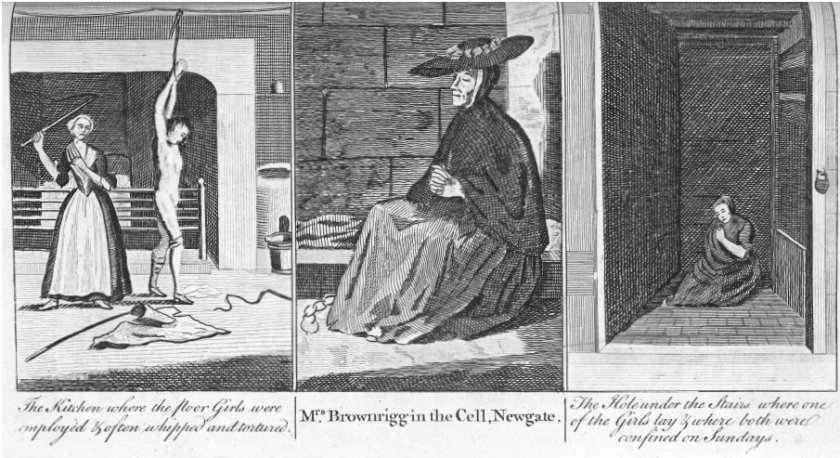
On this date in 1767, a jeering mob damning her to hell* saw Elizabeth Brownrigg hang at Tyburn.

“The long and excruciating torture in which this inhuman woman kept the innocent object of her remorseless cruelty, before she finished the long-premeditated murder,” says the Newgate Calendar, “more engaged the attention and roused the indignation of all ranks, than any criminal in the whole course of our melancholy narratives.” Hers is a very rich text.

As a middle-class midwife, Brownrigg mined the Foundling Hospital for young girls whom she would take on as apprentice domestic servants.

Brownrigg was far from the only one exploiting this ready pool of virtual slave labor, but it was her home’s marked sexualized sadism that really moved copy (pdf pamphlet). And Chateau Roissy it was not.

Elizabeth liked to keep the servants locked up, starving, usually naked, and would pinion their hands and inflict merciless corporal punishment for the least transgression against rules like “having any more bread”. The Old Bailey Online preserves one servant’s trial testimony:

Q. In what manner did she use to beat her?

M. Mitchel. She used to tie her up in the kitchen; when first she began to be at her, she used to tie her up to the water-pipe, with her two hands drawed up above her head.

Q. Describe that water-pipe.

M. Mitchel. That goes across the kitchen; the hooks that hold it are fastened into a beam.

Q. Had she used to have her clothes on when your mistress tied her up in this manner to beat her?

M. Mitchel. No, no clothes at all.

Q. How came that?

M. Mitchel. It was my mistress’s pleasure that she should take her clothes off.

Q. What had she used to beat her with?

M. Mitchel. She beat her most commonly with a horse-whip.

Q. How long did she use to beat her in this manner?

M. Mitchel. I cannot justly say, but she seldom left off till she had fetched blood.

This witness Mary Mitchel(l) was the lucky one of the Brownriggs’ last two Foundling Hospital charges: both girls had been stripped and horsewhipped so regularly that ulcerating, infectious sores — never able to heal before the next thrashing — pocked their bodies.

But Mary Mitchell at least survived. Her fellow-sufferer Mary Clifford was flat beaten to death, the body stuffed in the family coal-hole like so much rubbish. (In life, Mary Clifford was sometimes made to sleep there, too.)**


Detail view (click for a larger, three-panel image) of Elizabeth Brownrigg and her crimes illustrated in the Newgate Calendar.

For working-class Londoners struggling to navigate the dislocations of the Industrial Revolution, here was a villainess indeed. London was swelling, urbanizing, bustling with vulnerable orphans and abandoned children like our foundling Marys; all its working classes, for that matter, had reason to feel endangered in the face of fights for their lives against emerging commercial powers working hand in glove with the state — not excluding the ubiquitous threat of the gallows for pitiable property crimes.

And as Peter Linebaugh observes, “apprenticeship” by the 18th century “was less likely to involve the development of highly qualified, skilled labour power than to be the means of organizing the exploitation of young labour power.”† Like it’s not enough working your crappy dead-end unpaid internship; now, it comes with flogging?

Somehow, Brownrigg’s husband and son were convicted only of a misdemeanor and got off with a few months in prison, but Elizabeth bore all the hatred of Londoners more used to seeing apprentices swing than even the vilest master. The Murder Act which had appropriated even the corpses of London’s marginal people was applied to anatomize our former midwife; her skeletal remains were long displayed in a niche at the Royal College of Surgeons.

Oh, and the Foundling Hospital — which had cautioned the Brownriggs before about their excessive abuse of servants but not actually stopped sending them young girls to abuse — started finally instituting some oversight.


There’s a vicious and unsigned satire, “Elizabeth Brownrigge”, published in the September 1832 Fraser’s magazine. Over the years, it has occasioned a great deal of dispute among Thackeray scholars as to whether it might not have been an early creation of that master satirist’s pen. (Thackeray would have just turned 21 when it published.)

We’re not qualified to render judgment on the literary forensics, but the skewering of a murderess through the author’s mock-sympathy has a deliciously Thackerian flavor about it: the world was “incapable of understanding the height of her virtue.” It also underscores the continuing resonance of Elizabeth Brownrigg to Londoners 65 years after her execution.

The magnanimity of her soul, like Mr. Smeaton‘s pharos on the Eddystone, was firmly fixed upon the rock of the soundest principles, and diffused a light around it, for the guidance of those who were beating the waves upon the dark and troubled ocean of adversity, but was itself unshaken by the storm … [in prison] the fair and excellent Elizabeth adopted, as nearly as circumstances would allow, the same admirable disposition of her time to which she had been accustomed when inhabiting her own romantic bower in the village of Islington. She completed a large stock of baby-linen for the poor; she perused new publications of the day; and she composed an elaborate parallel between the characters of Socrates and Lady Jane Grey, after the manner of Plutarch. These are the two distinguished personages, in the whole range of authentic history, who in their strength of mind, purity of life, and extensive accomplishments, bore the strongest resemblance to herself; and to them, perchance, the attention of our heroine was more particularly directed in the quiet and retirement of her cell by the many points of similarity which subsisted between their destiny and her own.

Later, the fictional Elizabeth mounts a defense of such oblivious loathsomeness that it naturally impresses the judge:

“… punishment is a moral medicine. I may, perchance, actuated by too eager a desire for the rapid cure of my little and much-cherished patient, have dispensed my alternatives too liberally, and produced and untoward, an unexpected, and a most deeply-lamented consequence; but am I, therefore, to be condemned as guilty? In the analogous case of the physician, whose too-abundant anodynes may have lulled the sufferer to endless slumbers, or whose too copious phlebotomy may have let out the fever and the life at one and the same moment from the veins, would this most harsh and unmerciful measure be applied? … I demand from the justice of your lordship and a jury of my countrymen — as a matter not of mercy, but of right — the same impunity in my case which would be accorded, freely an unasked, under parallel circumstances, to the medical practitioner.”

Thackeray or whomever lay behind this pasquinade had a wider literary target in mind than simply Elizabeth Brownrigg(e)’s class. The short story is prefaced with a dedication to “the author of Eugene Aram“, meaning the popular novel published earlier in 1832 by Edward Bulwer-Lytton — a lifelong Thackeray bete noir. That novel concerned another renowned 18th century murderer, and it’s safe to say from the dedication that our satirist considered Bulwer-Lytton’s empathetic portrayal of the titular homicide a little, er, soft on crime.

I have been taught by Eugene Aram to mix vice and virtue up together in such an inextricable confusion as to render it impossible that any preference should be given to either, or that the one, indeed, should be at all distinguishable from the other … I had, indeed, in my dramatic piece, been guilty of an egregious and unpardonable error: I had attempted to excite the sympathies of the audience in favour of the murdered apprentices, but your novel has disabused me of so vulgar a prejudice, and, in my present version of her case, all the interest of the reader and all the pathetic powers of the author will be engaged on the side of the murderess.

* The Newgate Calendar: “On her way to the place of execution the people expressed their abhorrence of her crime in terms which, though not proper for the occasion, testified their astonishment that such a wretch could have existed: they even prayed for her damnation instead of her salvation: they doubted not but that ‘the devil would fetch her,’ and hoped that ‘she would go to hell.’ Such were the sentiments of the mob.”

** Elizabeth Brownrigg admitted to the Ordinary of Newgate the truth of Mary Mitchell’s horror testimony.

† Conversely, rogues who took to the highway and became working-class heroes were very often men who had absconded from their apprenticeship — for instance, Jack Sheppard and Dick Turpin.

On this day..

1943: Phillip Coleman, the last man hung in Montana

(Thanks to Meaghan Good of the Charley Project for the guest post. -ed.)

On September 10, 1943, multiple murderer Phillip “Slim” Coleman Jr. was hanged in Missoula, Montana.

The African-American Coleman would be the last man judicially noosed in that state, and Montana didn’t execute anyone else at all for more than fifty years. (Duncan P. McKenzie died by lethal injection in 1995 to end the drought.)

Coleman started his crime spree when he battered to death eighty-year-old Andrew J. Walton on July 3. The octogenarian was still alive when his sister found him the next morning, but he died in the hospital the next day without ever regaining consciousness.

With no witnesses or leads, the case quickly went cold.

On July 24, Coleman another man, Lewis Brown, were hired to work on the Northern Pacific Railroad thirty miles from Missoula. They had arrived at the train stop separately and it’s unclear whether they knew each other before, but on the same day they were chummy enough to start plotting to rob and kill their boss, Carl W. Pearson.

Late that night, Coleman went to Pearson’s home, woke him up and said Brown was ill and he had to come. Pearson grabbed a bottle of aspirin and headed out. There in the yard, Brown struck him on the head behind and left his body in the yard. Coleman went back inside, found Pearson’s wife Roslyn, and stabbed her to death in her bed.

The men spared the couple’s child, seven-year-old Richard; it was he who found the bodies the next day.

The murderers collected their loot, divided it between them and went their separate ways. Brown and Coleman were almost immediately identified as the prime suspects in the murder and picked up: Brown the day after the killings, and Coleman the day after Brown. Coleman was charged with Roslyn’s murder and Brown was charged in Carl’s death. Both were convicted, but Brown got only a life sentence and Coleman got the death penalty.

The condemned Coleman converted to Catholicism after his conviction, then, attempting to cleanse his soul, he summoned the sheriff and confessed to Andrew Walton’s murder. He had been a suspect since his arrest in the Pearson case, since the crimes were so similar, but had previously denied any knowledge of Walton’s death. Coleman got all of twelve cents, he said, from robbing Walton.

Amateur historian R. Michael Wilson, writing of the case, said, “He asked the sheriff to keep his confession secret in case the governor had a last minute change of heart and decided to grant a reprieve or communtation.”

Coleman’s hanging went off without a hitch.

On this day..

1929: Constantine Beaver, Alaskan native

On this date in 1929, Alaskan native Constantine Beaver hanged in Fairbanks, Alaska.

Described as a “woodsman”, Beaver shot his friend Egnatty Necketta during a drunken altercation the previous December.

Neither Beaver himself nor the several witnesses spoke or understood English, so much of the trial was conducted via interpreters. The jury, in finding him guilty, availed an option to remain silent as to the penalty, punting the decision to the judge — who went with hanging. Several jurors then protested, too late, that they hadn’t understood that was a possible outcome of their silent penalty decision.

In pre-statehood Alaska under federal governance, it was U.S. President Herbert Hoover 4,000 miles away in Washington who would have the final say in this affair — riding high, as it happened, at the very moment of the stock market peak right before the economic meltdown that would define his presidency.

Hoover said no.

Hopeful throughout the greater part of the night that a stay of execution would arrive Beaver bore himself with fortitude when informed that he must die. His only wish was that the intervening time might speed by so that his mental agony might be ended.

When Beaver reached the death chamber he broke into a tribal chant which continued until the floor opened beneath him.

It was “the saddest affair I’ve had to witness,” said a U.S. deputy who was present at the execution. And it was the last hanging ever conducted in Fairbanks.

Of possible interest: “American Indian Executions in Historical Context” by David V. Baker, a lengthy pdf.

On this day..

1821: Timothy Bennett, duelist

From the Oct. 12, 1927 Republican Herald recapping the Land of Lincoln’s hanging history on the occasion of its trendy switch to the electric chair.

Hanging has been the legal method of execution in the state of Illinois for 106 years, the first execution in the state being held at Belleville on September 3, 1821, when Timothy Bennett paid the penalty for murder resulting in a duel in which Timothy [sic — the rest of the article refers to the victim as “Alphonso”] C. Stewart was killed.

According to the account appearing in an old history of St. Clair county, now in the state historical library, Timothy Bennett and Alphonso C. Stewart became involved in an argument while under the influence of liquor, on February 8, 1819, at Belleville. Friends interfered and sought to effect a reconciliation, but their efforts were unavail[ing]. Finally it was agreed to arrange a sham duel in the belief that the ridiculous issue would bring the two participants to their senses.

“The duel was arranged,” the account reads. “Jacob Short and Nathan Fike acted as seconds. When the word was given and the rifles discharged, it was proven the ‘sham’ duel was fought with powder and lead-at any rate Alphonso C. Stewart fell to the ground mortally wounded.

Special Session in Court

“Timothy Bennett was arrested and so were the seconds, Short and Fike. A special term of the circuit court was held March 8, 1919 [sic], under a special law of the legislature to hold said term. The officers of the court, John Reynolds, judge; John Hay, clerk, and W.A. Beard, sheriff, were all appointed by Governor Shadrack Bond.

“The grand jury found true bills of indictments for murder against Bennett and the two seconds after hearing the testimony of Reuben Anderson, James Parks, James Kincade, James Reed, Daniel Million, Ben Million, Peter Sprinkle and Michael Tannahill.

“When the case was called for trial the sheriff reported that Bennett had broken jail and was at large. Short and Fike had their trial in June 1819, and were acquited [sic].

“Bennett was captured and jailed about July 1, 1821. A special term of court was held July 26, 1821. The grand jury found a new indictment against him for the same offense

Trial Starts Immediately

“Bennett was put on trial July 27, 1821, before Judge Reynolds and a jury. The jury rendered a verdict July 28, and found the presoner [sic] guilty. He had entered a plea of not guilty.

“The court then proceeded to pass sentence upon him in the following words:

“And it being demanded of him if anything for himself he had or knew to say why the court should not proceed to pass sentence upon him, he said he had nothing more than he had before said. Therefore it was considered by the court that he be hanged by the neck until he is dead, and that the sheriff of the county do cause execution of this judgment to be done and performed on him, the said Timothy Bennett, on Monday, the third of September, next, between the hours of ten in the forenoon and four in the afternoon at or near the town of Belleville.”

“Neither Bennett nor his friends believed that this awful sentence would ever be executed. The latter made strenuous efforts to have him pardoned. Failing in this, they tried to have the sentence commuted. But the governor remained firm and against all entreaty.

“On the day appointed for his execution, Bennett was hanged near West Belleville, near the site of the Henry Raab school. The execution was witnessed by a multitude of men, women and children.

On this day..

1887: Henri Pranzini, repentant?

On this date 125 years ago, a notorious French triple murderer was guillotined outside La Roquette Prison.

This condemned murderer, so infamous that anarchist bomber Ravachol planned to invoke his name as an emblem of crime in a suppressed courtroom speech, slaughtered a prostitute, her maid, and the maid’s child so that he could plunder the apartment’s jewelry.

Your basic sensational common butchery, given added legs by comparison to the next year’s apparition across the channel of the Whitechapel murderer.*

That’s just one of several more famous (or infamous) contemporaries for whom Pranzini was a sort of subplot character.

The artist Paul Gauguin — though he couldn’t quite remember the name right — suspected that this particular killer plotted his crime at the cafe that both he and Vincent Van Gogh frequented. (Van Gogh painted the proprietress, who was also possibly his lover.)

According to Van Gogh, the whole Pansini [Pranzini] affair, as well as many others, was hatched in this place … From this Pansini case sprang another case, also, according to Van Gogh, hatched in this famous cafe, the Prado case

We’ve noticed in these pages Gauguin’s disturbing severed-head jug, and its seeming inspiration from that other guillotinee, Prado.

While Gauguin’s meditations on the guillotine veered to the grotesque, a Norman teenager fresh off an apparition of Jesus Christ found spiritual sublimity in this villain. The woman eventually known as St. Therese of Lisieux later recollected

I heard talk of a great criminal just condemned to death for some horrible crimes; everything pointed to the fact that he would die impenitent…. I felt in the depths of my heart certain that our desires would be granted, but to obtain courage to pray for sinners I told God I was sure He would pardon the poor, unfortunate Pranzini; that I’d believe this even if he went to his death without any signs of repentance or without having gone to confession. I was absolutely confident in the mercy of Jesus. But I was begging Him for a “sign” of repentance only for my own simple consolation.

My prayer was answered to the letter! In spite of Papa’s prohibition that we read no papers, I didn’t think I was disobeying when reading passages pertaining to Pranzini. The day after the execution I found the newspaper “La Croix.” I opened it quickly and what did I see? Ah! my tears betrayed my emotion and I was obliged to hide. Pranzini had not gone to confession. He had mounted the scaffold and was preparing to place his head in the formidable opening, when suddenly, seized by an inspiration, he turned, took hold of the crucifix the priest was holding out to him and kissed the sacred wounds three times! Then his soul went to receive the merciful sentence of Him who declares that in heaven there will be more joy over one sinner who does penance than over ninety-nine just who have no need of repentance.

I had obtained the sign I requested.

Nameless citizens on the square when the blade fell settled for less exalted signs, like the ancient superstition of dipping into the spattered blood. (“Such scenes would disgust the black savages of Dahomey and the Gold Coast,” the London Times sniffed (September 1, 1887), and in vain urged the French government to take up legislation for private executions.)

* Pranzini found himself in Madame Tussaud’s for a spell.

On this day..

1890: Otto Leuth

(Thanks to Meaghan Good of the Charley Project for the guest post. -ed.)

On this date in 1890 at the Columbus Penitentiary in Ohio, a sullen German-American teenager named Otto Leuth (sometimes spelled “Lueth”) paid with his life for the brutal murder of his seven-year-old neighbor, Maggie Thompson.

John Stark Bellamy II, writing of the murder in his book The Corpse in the Cellar: And Further Tales of Cleveland Woe, noted how familiar the case sounds to modern ears:

[T]he sickening murder of an innocent child; yet another child accused for the dreadful deed; a sensational trial, replete with dubiously “expert” testimony, suspicious “confessions,” allegations of police “third-degree” methods, and charges of biased press; not to mention “latchkey” children, systematic child abuse, saccharine sympathy for the guilty, and charges of ethnic favoritism.

Yet it happened over a century ago.

Otto, sixteen at the time he killed little Maggie Thompson, had had a hard life, as Bellamy explains in his book. His mother, Lena, testified at his trial that she

went into veritably demonic fits of rage, during which she was in the habit of physically abusing her children, especially Otto. From an early age, she blandly admitted, she had pulled his hair, kicked him, beaten him, walked on him, and often hit him with any object that came to hand. Once, when Otto was eight, she had beaten him with a chair leg and, when [Otto’s father] Henry tried to intervene, stabbed Henry twice with a convenient butcher knife. Just a few months before Maggie Thompson’s murder, Lena had repeatedly slammed Otto’s head into a wooden door.

It speaks volumes of the difference between that century and this one that nobody who heard Lena’s testimony seemed to think this was in any way excessive, never mind cruel; on the contrary, one person praised her methods as being “good German discipline.”

On May 9, 1889, sixteen-year-old Otto was alone at his family’s home at 47 Merchant Avenue in Tremont, a suburb of Cleveland. He was used to being alone: his mother had been committed to a mental hospital some months before, his father was wrapped up in his cabinet-making business, and his older brother had moved out of the house.


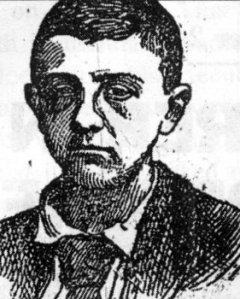
Otto (top) and his victim.

That morning, down the street at 24 Merchant Avenue, Maggie Thompson set off for school. Her mother, Clara, dropped her off at the front gate; it was the last time she would see her daughter alive.

Maggie attended the morning classes and, when school was dismissed for lunch at 11:15 a.m., started on the four-block walk home. En route, she vanished without a trace, as if “the sidewalk might have opened and swallowed the girl.”

Naturally there was a frantic search, lead by her devastated parents and the Cleveland Police Department, who tore the city apart looking for her.

But, although there were numerous false sightings and a few wild stories about Maggie’s disappearance, in spite of everyone’s efforts they couldn’t find her.

Otto participated in the search, along with most of the neighborhood. Nearly every day he would approach Clara Thompson and solicitously ask if she’d heard any news of her child.

In early June, Clarissa Shevel, the woman who lived with her husband in the back of the Lueths’ two-family house, asked Otto to do something about the terrible stench that pervaded the entire building. Otto suggested the odor was caused by a dead animal. He bought some chloride of lime and put it in the ventilation hole, then burned some sulfur, but it didn’t help.

Around that time he was witnessed carrying some badly stained bedding to the smokehouse at the back of the property.

On June 9, Otto’s mother Lena, who had by now been discharged from the mental hospital, became fed up with the smell and sent her husband Henry down to the cellar to investigate. He came back up a few minutes later, deeply shaken, and ran out to find a policeman.

In the Lueths’ cellar was the nude corpse of Maggie Thompson.

She was wrapped in one of Lena’s dresses and her own clothes lay underneath her. She had been beaten to death and her body was so badly decomposed that her parents had to identify her by scars on her hips.

The police promptly arrested everyone who lived at the house: Henry and Lena Lueth, Clarissa Shevel and her husband, and Otto, who was picked up on his way home from the ice cream parlor. All five suspects were separated and subjected to a serious “sweating,” but Otto was the prime suspect. He had a reputation as a bully, and he’d been at home alone for much of the previous month.

Bellamy records:

The climax came at 3:30 a.m., when an agonized female shriek resounded from the floor below the sweating room. “Who is that?” cried Otto to Detective Francis Douglass. “Your mother, I believe,” replied Douglass. “She had nothing to do with it!” blurted out Otto. “Who did?” queried Douglass. Otto: “I did it! I did it!” Douglass: “Did what, Otto?” “I killed her! I killed her! Please give me your revolver so I can kill myself!”

Resisting the temptation, the police instead took his verbal confession, wrote it down, had him sign it and escorted him to a cell.

Otto said he had been standing outside his parents’ home at about 11:30 a.m. on May 9 when he encountered Maggie. She asked him if he could donate any buttons to the “button-string” she was making, and he said he had four and would give them to her if she came inside.

Maggie obediently followed him in, and he led her upstairs to his bedroom, where he attempted to rape her. When she screamed, he hit her with a nearby hammer.

Otto said he thought he’d probably killed her with the first blow, but he kept striking her until her head was a pulp and the bed was covered in blood. After an unsuccessful attempt to have sex with her body, he fled the scene. He did go back to the house that night, but spent the next several days at his brother’s home.

Six days later, just before his mother was supposed to come home, Otto returned home to clean up. He carried Maggie’s corpse to the family cellar and left it lying there; he didn’t even bother to bury it or cover it up.

Given Otto’s confession, the circumstantial evidence and the revulsion his crime invoked in the city of Cleveland, his lawyer didn’t have much to work with. Not even trying for an acquittal, his defense instead claimed Otto was mentally impaired and/or insane.

Otto had a strange depression in his skull and his attorney suggested he was brain-damaged — which might very well have been true, given the abuse he had suffered at Lena’s hands. Several members of his family, including his mother and brother, had epilepsy, and his attorney suggested he might have had a seizure and committed his crime without even knowing what he was doing.

Such a scenario was possible. The problem was, though, that none of the medical experts who testified for the defense could diagnose Otto with epilepsy.

The claims of subnormal intelligence were contradicted by the testimony of Otto’s former teachers. Although his pathetic attempts to conceal Maggie’s body might indicate otherwise, his intellect seems to have been about average. Before he quit school at age 13, he had been an unexceptional student with some talent as a violinist.

Otto’s lawyer also said his client had not, in fact, attempted to sexually assault Maggie Thompson either before or after death, and Otto had invented that part of his confession because the police were pressing him to cough up an explanation for his motiveless crime. But given the fact that Maggie’s body was found naked, this claim didn’t carry much weight either.

It was no surprise that, when the trial concluded on December 27, 1889, the jury came back with a verdict of guilty without a recommendation of mercy. Perhaps the only surprising thing was that they actually bothered to deliberate for a whole four and a half hours.

Otto rapidly exhausted his appeals and was hanged eight months after his trial, alongside another killer, one John “Brocky” Smith of Cincinnati. Two other men had also been scheduled to die that night, but one got reprieved and the other’s execution was postponed.

Otto left behind a statement where he admitted he’d killed Maggie Thompson, but denied his previous claims that he’d tried to rape her. He died calmly and without a fuss, standing on the trap and saying simply “All right, let her go.”

On this day..

1987: Dale Selby Pierre, Hi-Fi Murderer

On this date in 1987, Utah executed Dale Selby Pierre for one of the most notorious crimes in that state’s history — the Hi-Fi Murders.

Pierre, along with two fellow airmen from the Hill Air Force Base, William Andrews and Keith Roberts, began an armed robbery of a hi-fi shop in nearby Ogden near closing time on the evening of April 22, 1974.

The night that unfolded would be a visit to an antechamber of hell not only for the two young clerks on duty at the time, but three other people who wandered into the store while the crooks were still in it — each of whom was added to the growing pen of hostages Pierre et al kept in the basement.

After plundering the shop of $25,000 worth of electronics, Pierre and Andrews went to get rid of their prisoners by making them drink liquid Drano.

This method of homicide, theoretically an elegantly quiet one which would facilitate a clean getaway, had been cribbed from a murder scene in the 1973 Dirty Harry movie Magnum Force.

The struggles of Cortney Naisbitt, one of the surviving victims, forms the subject of Victim: The Other Side of Murder — a classic of the true-crime genre and of the victim’s rights movement.

But human flesh is hardier than celluloid.

Unlike the poor prostitute in Magnum Force, Pierre and Andrews’s victims groaned and gurgled, their blistering mouths suppurating so much fluid that duct tape to quiet them down wouldn’t stick. And the Drano didn’t kill them, or at least it was sure taking its time.

“I remember the noise they were making, the sounds of pain they were making,” Pierre told his clemency hearing. “It was something greater than sad.”

Since they hadn’t got rid of their victims quite so cleanly, Pierre simply set about shooting them — and in the case of Michelle Ansley, a 19-year-old in her first (and last) week on the job at the Hi-Fi shop, raping her first. These execution-style murders had only mixed results, and one of the hostages — 43-year-old Orren Walker — being noticeably not dead, had a ball-point pen kicked into his ear in an attempt to finish him off.

Somehow, Walker still survived, as did 16-year-old Cortney Naisbitt, who suffered severe brain damage. (Both have since died.) Stanley Walker, Carol Naisbitt, and Ansley were not so “lucky.” But neither were the perps: since Andrews had openly talked at the Air Force base about boosting that very hi-fi shop and even killing anyone who “gets in the way,” suspicious fellow airmen soon turned them in.

The 21st century’s more polished and calculating strategic communications consultant probably would have advised keeping well clear of such an incendiary crime, but death penalty opponents actually pushed clemency hard in the Hi-Fi case.* For the NAACP, the sentences underscored racial disparity in the death penalty.

Rubbish, one might say, given the killers’ epically villainous conduct. But one member of the all-white jury was apparently passed a note by parties unknown reading “Hang the niggers.” And the NAACP noted that Utah gave death sentences to these guys, but not to a white supremacist who murdered two black men for jogging with white women.

None of this cut any ice with Utah. Years later, the killers themselves had a hard time fitting that monstrous night into any kind of comprehensible rationale. Pierre:

The crime took a course of its own. It wasn’t planned that way. People kept coming in and I just panicked. The only way to prevent what happened was to have been moved away from the Air Force entirely … Of course the alcohol and the pills I was consuming didn’t help — valiums, reds, black beauties and yellow jackets … I tell myself, “You have to accept responsibility for it — you did it, you were there. You can’t rationalize it.”


Dale Pierre pleads his case to the Utah clemency board.

Dale Pierre was the very first person put to death in Utah after its famously groundbreaking execution of Gary Gilmore in 1977. But in fact, the Hi-Fi killers had preceded the eager volunteer Gilmore on Utah’s death row, and Gilmore as he walked his last mile reportedly wisecracked to Pierre and Andrews, “I’ll be seeing you directly.”

Pierre’s accomplice William Andrews was also finally executed in 1992, after a then-unimaginable (and anything but “direct”) 18 years on death row — nearly half his life. Their fellow accomplice Keith Roberts didn’t personally take part in the cellar hecatomb and therefore avoided the death sentence: he was paroled in 1987.

* The clemency push was much stronger for William Andrews than for Dale Pierre, since Andrews was also making the argument that he hadn’t directly killed anyone and hadn’t intended to. As a matter of fact, the manipulative Andrews was and is widely doubted on that point — but any such claim was wholly unavailable to the acknowledged triggerman Pierre.

On this day..

1825: Stephen Videto, Indian giver

On this date in 1825, Stephen Videto was hanged in Franklin County, New York, for murder.

This History of Clinton and Franklin Counties misstates the execution date but otherwise sums the matter up nicely. Videto found himself yoked to an engagement he’d come to regard as disagreeable.

Rather than just break the thing off,* he arranged — so the jury found, though Videto always denied it — to kill the poor woman. (Literally poor. Her last husband had left her, abandoning her penniless.)

Videto contrived a whole scenario where the colored man was lurking around his house … the red-colored man, in this case. Scary Indians.

Claiming to be spooked by encounters with mysterious native prowlers, Videto armed himself up; sure enough, one night soon, an Indian shot into his bedroom and started a firefight. The perennially discarded Fanny Mosley was killed in the crossfire.

For the apparent calculation that went into this cover story, Videto was awfully careless about the details. As rudimentary as crime scene forensics were in 1825, it was still self-evident that the glass in the window had been shot outward, not inward; and, that the ball causing Mosley’s fatal wound had likewise originated from within the house, not without. And come to think of it, the “Indian footprints” outside that window looked an awful lot like Videto’s own. And nobody else had ever seen these Indian stalkers Videto was on about — not that night, nor in his buildup of the preceding days.

The evidence might be circumstantial, but those were a whole lot of circumstances. The jury took 15 minutes to convict him, although Videto maintained his innocence to the last — even waving a written declaration of such to the onlookers after the trap fell, while he was strangling to death.

We have a letter from a witness to this hanging, a Vermont silversmith named William Ransom Vilas:**

After a large concourse of people had assembled which was estimated at six or eight thousand, [Videto] was then taken from his place of confinement and conducted by the sherif and guard of seven independent companies to the place of his execution. Then, with 2 assistants, he ascended the gallows, where a discourse was delivered by Elder [Nathaniel] Culver from Luke 13th 23, in which he pointed out to him awful situation and then he protested his innocence of the crime alledged against him and likewise stated that he was no way accessory. Then after giveing a parting hand to each one of his attendants and to a Brother, which was all the relation of his present, his hands were then bound; the rope about his neck was then fastened, and the moment was at hand. The fatal stud was then nock-d out, and now, do not you see him in your imagination hung & strangling. O twas a solemn sight, but the laws must be put in execution.

Although he protested his innocence, it (is) generally believed that he was guilty but protested innocence on account of the conexions. Thus it is that we see man snached from the hand of existence by the Executioner, thus we may justly say “the wicked do not live out half their days.” He (had) a long trial and without doubt an impartial one. But we are frail mortals all hastening to our Mother, ____our joys are like the morning dew before the morning sun. They pass we know not where and we are led to reflection:

Mortals behold the hour glass.
And leave your wordly care
It shows how swift our minutes pass
And bids us all for death prepare.

* Possible motivation for preferring homicide to a breakup: his “beloved” was pregnant.

** As a Vermont Vilas, we suppose that this writer was probably related to politician Levi Baker Vilas and to his (future, at this point) son, eventual U.S. Senator and Secretary of the Interior William Freeman Vilas.

On this day..

1889: Auguste Neel, on St. Pierre

On this date in 1889, the only guillotine execution in North America took place on the tiny French remnant colony of Saint Pierre, just off Newfoundland.

August(e) Neel had capped a Dec. 30, 1888 drinking binge with fellow fisherman Louis Ollivier by breaking into a boat captain’s cabin they expected to find empty. Instead, they found the armed captain ready to defend himself … so they overpowered him and stabbed him to death.

And then, for some reason — “because we were sloshed and we wanted to find out how much fat the old seadog had in his body,” Neel told the court — the murderous sots dismembered the body.

While the murder was not particularly premeditated, it occurred during a perceived crime wave, and the post-mortem butcher’s act really grossed out the court. (They probably also didn’t do themselves any favors at the bar by having attempted to sail to Newfoundland.) All in all, a prime case for example-setting: Neel, as the lead culprit in the caper, was sentenced to the worst example possible. His partner got 10 years at hard labor.

Now, St. Pierre hadn’t had an execution and didn’t have the infrastructure for it. But French law didn’t let the locals in far-flung islands just do a practical straightforward thing like hang a bloke or shoot a bloke. And it wouldn’t do to have the colony send Neel somewhere where executions were a done thing. It was there in black and white that executions had to be conducted by guillotine, near the site of the crime. And so an old spare guillotine was disassembled, boxed up, and shipped up to St. Pierre from Martinique, expressly to sever Neel’s head.

Neel seems to have been the calmest man on the island, almost philosophically indifferent to the the head-chopper. The community he had aggrieved could not say the same: St. Pierre had to recruit a local petty criminal to serve as executioner, and the guy was so ostracized that he left for France afterwards. They hadn’t thought through the execution procedure to determine who would give the order to drop the blade, so after an uncomfortable pause, Neel himself shouted at the executioner to do it. By the time it hit bottom, human flesh was left grotesquely clinging to the dull imported blade.

The prosecutor vowed in the face of this dog’s breakfast never to seek another death sentence.

Never used again, this infamous device remains in St. Pierre to this day. It can be seen there behind the stairs at the Musée de l’Arche.


The St. Pierre guillotine. (cc) image from The Tedster, who also thoughtfully provides photos of the museum’s explanatory placards. 1, 2, 3, 4, 5, 6.

The Neel story was “re-imagined” — nigh rewritten — for the heavily fictionalized 2000 Juliette Binoche film La Veuve de St. Pierre.

The primary source for this account — apart from the museum placards linked in the caption above — is the invaluable Bois de Justice, an astonishingly encyclopedic resource on the history of the guillotine.

On this day..