1739: Michael Blodorn, “selvmordsmord”

On this date in 1739, Michael Blödorn was stretched out on a scaffold at Copenhagen’s beautiful Kongens Nytorv (King’s Square), where an executioner set about smashing his limbs with heavy wagon wheels.


A 1727 illustration of Danish prisoners broken on the wheel.

Scholar Tyge Krogh’s new book titled (and about) The Lutheran Plague of suicide-murder.

As he lay suffering, Blödorn sang vigorously — a joyful hymn to lift his soul to heaven.

That, indeed, was why he was being broken on the wheel in the first place.

Blödorn was part of an alarming trend in Lutheran countries that waxed especially strong in Denmark: a homicide-to-heaven loophole apparently licensed by the Reformation theology.

Crudely put, the scam is this: you have a sure ticket to salvation if you die with no un-repented sin on your soul. But the only real way to know when you’re going to die is to kill yourself … and since that’s a mortal sin, that’s even worse than risking the everyday mischance of life.

But do like Mike and kill a random stranger to incur a death sentence, and you get to check out pure as the driven snow: assured last-minute repentance with no suicidal downside. Everybody wins!

Um.

Actually carrying out this plan required what you might call a deep commitment to your theology: in an effort to discourage the practice without backing off the death penalty for murder, penalties for apparent suicide-by-executioner cases had been ramped up into an archaic bloody theater. Blödorn, a soldier, had already been suffering weekly floggings leading up to the execution. Civilian murderers could look forward to having the flesh ripped with red-hot tongs.


Ouch. A 1727 illustration of judicial penalties that might attend a suicide-murder: tearing with hot tongs, the breaking-wheel, and severed hands.

Still, selvmordsmord persisted (Danish link: or, here’s the same story in Norwegian).

At last in 1767, the Danes reversed course abandoned capital punishment for “melancholy and other dismal persons [who committed murder] for the exclusive purpose of losing their lives,” implementing instead sentences of humiliating hard labor: a punishment to fit the crime and also meet the larger society’s need for deterrence.

“This made Denmark a pioneer when it came to abolishing the death penalty,” said Danish academic Tyghe Kroghe, author of a new book about the suicide-murder phenomenon. “But it was not something they did proudly. The decision violated the religious understanding of the criminal system.”

Here’s Kroghe discussing his research … in Danish.

Crazy, right?

Executions of men and women who not only decline to fight their sentences, but even commit their capital crimes with the intent to engineer their own executions, are hardly confined to the foreign country that is the past.

Maybe you wouldn’t point the finger at Martin Luther any longer, but Denmark’s very last civil execution was of an arsonist so insistent about attempting murder that the authorities finally gave him the peace of the grave that he desired. We’ve seen in these pages the headsman courted by people motivated by depression and by romantic love.

And numerous more modern criminals right into the 21st century look every bit like selvmordsmord cases. For example:

  • Christopher Newton, who killed his cellmate to draw a death sentence and was executed in Ohio in 2007;
  • Daniel Colwell, who gunned down a couple randomly to “win” a death sentence in Georgia in 2003 but died before reaching execution;
  • Mamoru Takuma, the mentally disturbed author of Japan’s notorious Osaka school massacre, who committed the crime with no intent to escape and immediately demanded a death sentence (carried out in 2004).

On this day..

1928: Frederick Browne and Pat Kennedy, hanged by a microscope

On this date in 1928, Frederick Browne and William Henry “Pat” Kennedy hanged simultaneously (but at different prisons: Pentonville and Wandsworth, respectively) for murdering an Essex policeman.

Police constable George Gutteridge was found dead in September 1927 on a byway near Howe Green, dressed in his full police regalia, shot four times in the face while apparently in the process of writing up a miscreant motorist.


Frederick Browne (top) and Pat Kennedy.

Two of the shots had been through each of Gutteridge’s eyes, conceivably in deference to the ancient superstition that dead men’s eyes preserve the last image they beheld in life. If that was the reasoning, Frederick Browne, the triggerman, was living in the wrong century.

The “Gutteridge murder” investigation — a national sensation from the time the constable’s mutilated body was discovered — took several months to hone in on suspects Browne and Kennedy, known car thieves with some history of violence. But the real break in the case was, well, a case: a cartridge case from a .455 Webley recovered at the crime scene. It would be the most eloquent witness against Browne and Kennedy.

The now-familiar science of forensic ballistics was, though not quite brand new, still an occult art in Anglo courts of law. Just days before Gutteridge’s murder, Sacco and Vanzetti had been executed in the United States based in part on ballistics studies. That gun-barrel research had been continued in the post-conviction appeals and clemency investigation, and provided one of the clinching pieces of evidence against the anarchists, but it was also ferociously contested.

In Great Britain, it was the Gutteridge case that put this field on the map for the general public — courtesy of professional gunsmith and ballistics investigator Robert Churchill.

Churchill used microscope analysis of the recovered casing to match the bullet not only to a .455 Webley, but to the .455 Webley recovered from Browne’s car: to that gun, and no other.

Post-Browne and Kennedy, murderers given to gunplay became very well advised to dispose of weapons once they’d been used: this case served notice that individual handguns left a sort of fingerprint on the rounds they discharged, and could thereby incriminate their owners months or years after the fact.

This conclusion was not universally embraced, perhaps owing in part to the role of ballistics in the controversial Sacco and Vanzetti affair: according to Basil Thomson, George Bernard Shaw wrote to Browne’s family during the trial to express his skepticism, complaining of the crown’s “manufactured evidence.” In 1932, the renowned barrister Patrick Hastings successfully repelled Robert Churchill’s firearms evidence at the high-profile murder trial of Elvira Barney.

But the reason Churchill was on the stand on that occasion was because his damning testimony in 1928, explaining where a small fault in the Webley’s breech block had scarred the bullet as it launched, not only sufficed to hang Browne and Kennedy* — “hanged by a microscope”, in the words of The Sunday Dispatch — but also launched a star career for Churchill personally, and made the bones of firearm ballistics for modern criminal trials.

* More precisely, the forensic testimony hanged Browne — who stuck with a flat denial, which the ballistics associated with his own gun refuted. Kennedy lacked the wit to shut his mouth and in the course of trying to spin his story to throw all the blame onto Browne also just by the by confessed to his own involvement.

On this day..

1985: Marvin Francois, back to Africa

On this date in 1985, Florida electrocuted Marvin Francois (to the disappointment of this unknown anti-death penalty protester).

Francois’s last statement, via Last Words of the Executed:

“I am as a grain of sand on the beach of the black race. The black race has lost its pride and dignity and is slowly dying from within and without. My death ends my tears, and the fortune of watching my race slowly die. If there is such a thing as an Antichrist, it ain’t one man, but the whole white race.”

Francois had donned a mask and, with a couple of confederates, stuck up a drug house in 1977.

The mask slipped, exposing Francois’s face — and the home invaders decided to murder the eight prisoners to keep them from making the ID. All were shot in the head execution-style.

Somehow, two survived to identify Marvin Francois. It was an easy conviction. (A confederate, Beauford White, was executed for the same crime in 1987.)

Once the death sentence was on the books, appellate attorneys developed a genuinely sympathetic profile of Francois’s background, if not his crime. A federal appeals court on the day before Marvin Francois died could not help but agree that

[t]he proffered evidence shows that Francois was the product of a sordid and impoverished childhood environment. His parents were not married. His father was a habitual heroin addict who never worked, who brought other addicts into the home for the ingestion of heroin in front of Francois when a child, and who beat Francois because he would not fight with other children when he was a boy. Francois’ mother often worked as a prostitute and was of little benefit to Francois during his childhood. She married but Francois’ step-father abused him. Francois grew up as a child of the street. At the same time he was smart, and although not finishing school, he obtained his G.E.D.

The behavioral scientists in their affidavits posit that “… some offenders, like Marvin Francois, are themselves victims of circumstances that shape their lives in ways beyond their deliberate control.” They suggest that given Francois’ chaotic antisocial upbringing, “clear mitigation of punishment compellingly surfaces.”

Nevertheless, the panel concluded that, given the extent of the crime (and his existing history of violence), all this sob-story stuff “would not have affected the sentencing outcome in this case had it been submitted to the jury.”

That was that.

It was a touching parting for at least one good friend on death row with him. “We wanted to send him out on a high,” a fellow-prisoner later remembered of sharing a last cigarette with Francois while imagining it a joint. “It took a little out of me when they killed him. I’d grown real attached to him.”

According to David von Drehle’s Among the Lowest of the Dead, that disattachment was rather unusually distant: Marvin Francois’s final resting place is … the sea off Dakar, Senegal.

Francois had asked that his ashes be scattered in Africa. Susan Cary, the longtime activist … was determined that this last wish would be honored. But it was one thing to find bus fare for a condemned man’s family, and quite another to raise the money for a trip to Africa. Cary collected the cremated remains of Marvin Francois and put them in a shoebox in her closet, where they sat for two years while she tried to figure out how to get them across the ocean.

In 1987, Michael Radelet, Cary’s frend and fellow activist, announced that he was going to Senegal to visit a relative. Take Marvin, Cary suggested. Radelet was game, but there were rules — human remains can’t just be toted from country to country. Uncertain as to the relevant legalities, Radelet contacted John Conyers, a prominent black congressman from Detroit; Conyers strongly opposed the death penalty, he was well known in Africa, and he had offered more than once to help Florida’s anti-death penalty crusaders any way he could. The congressman pulled the right strings, and shortly before his trip Radelete received an official letter announcing that the Senegalese government would be happy to welcome “Brother Marvin” home.

… Radelet had a darkly comic view of the world. Traipsing around Senegal, shoebox in hand, he would place the box on the opposite chair at restauants and say things like “Marvin, would you like some water?” On sightseeing jaunts, he would take snapshots of the shoebox in front of important buildings and picturesque vistas. Finally, Radelet carried the box to a bluff outside Dakar, a lovely spot with the city in the distance and the Atlantic spread out below. He took one more snapshot – “Marvin at the seashore” — then opened the box and sprinkled the ashes on the sun glittered waves. As he gazed into the oceanic expanse, it occurred to him that this very water might have rocked and sloshed all the way from Florida; now, the waves lapped the shores of Africa, bearing the remains of Marvin Francois to his dreamland.

The aforementioned Michael Radelet — now at Colorado University, not Florida — holding forth on more up-to-date death penalty trends:

On this day..

1686: Paskah Rose, Jack Ketch interregnum

On this date in 1686, the English executioner Paskah (or Pascha) Rose was hanged at Tyburn for burglary — by his predecessor and his successor, the famed hangman Jack Ketch.

(c) image from Peter Herring, used with permission. Also see this illustration

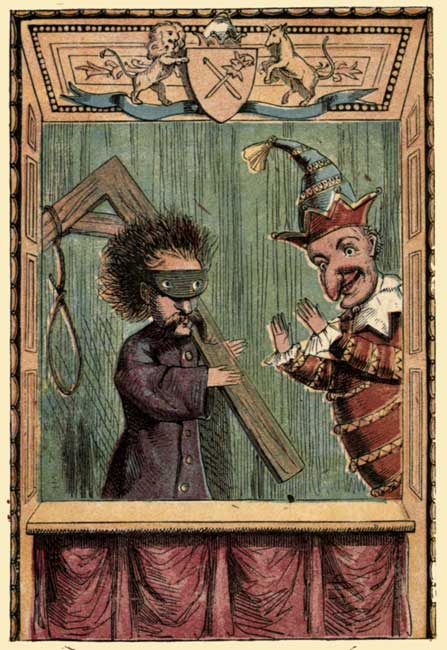
The “Jack Ketch” character from a Punch and Judy puppet show: traditionally, Punch gets the better of their meeting and hangs Jack Ketch.

The Irish immigrant Ketch is the first name in English executioners. Indeed, you can call any of his successors right down to Pierrepoint a “Jack Ketch” and be perfectly understood.

The immediate successor, however, was Ketch’s own assistant — who inherited top billing after Ketch went to jail for “affronting” a sheriff.

Jack Ketch had been trodding the scaffold-boards, hanging, beheading, and drawing-and-quartering for two-plus decades at that point: he’s thought to have been appointed in 1663, and he’d inserted himself into those performances rather more prominently than an executioner ought by botching some of Restoration England’s most high-profile executions.

There’s little reliable information about these early executioners, but it seems Ketch’s reputation for clumsiness had forced him to issue an “Apologie” justifying himself.

But the man unquestionably had longevity in his favor, which is more than Paskah Rose could say.

Within months of becoming the chief London executioner, Rose and another man were chased down in the act of burgling clothes from a house, “the Goods found in Rose’s Breeches.”

Rose and his co-defendant Edward Smith accordingly hanged along with three others at Tyburn this date — by Jack Ketch, now returned from his carceral retirement for one last tour.

Ketch died late that same year of 1686, but has lived on in any number of ballads, doggerels and broadsides immortalizing the name. He was surely aided in this by the less impressive caliber of many who succeeded him: it wasn’t long after Ketch dispatched Pascha Rose that another “Jack Ketch” — an ignoble profession that wouldn’t until centuries hence be drawn from the country’s respectable classes — also met Pascha Rose’s same fate.

There’s a now-public-domain Autobiography of Jack Ketch by 19th century English writer Charles Whitehead.

On this day..

1776: Benjamin Harley and Thomas Henman, Smugglerius?

On this date in 1776, smugglers Benjamin Harley and Thomas Henman were hanged at Tyburn for murdering a customs-house officer who had intercepted them trafficking tea on the Deptford turnpike.

One of these two gentleman might well be the flesh-and-bones person behind the ghoulish ecorche sculpture known as “Smugglerius”.

This beautifully ghastly item was commissioned of sculptor Agostino Carlini by the anatomist William Hunter: it is the cast of a hanged man, meticulously flayed of his skin to reveal the musculature for the convenience of future students’ sketches. Those students gave their subject the jocular nickname, since in life it was thought to be a smuggler.

For good measure, Carlini posed the corpse in the manner of the Hellenistic marble Dying Gaul.


Dying Gaul (known in the 18th century as Dying Gladiator), one of the world’s best-known classical sculptures. (cc) image from Tom Magliery.

Of the “Dying Gladiator”, Byron wrote:

He recked not of the life he lost, nor prize,
But where his rude hut by the Danube lay,
There were his young barbarians all at play,
There was their Dacian mother, — he their sire,
Butchered to make a Roman holiday; —
All this rushed with his blood; — Shall he expire,
And unavenged? — Arise! ye Goths, and glut your ire!


A copy of Agostino Carlini‘s bronze cast of “Smugglerius”, displayed in Edinburgh. (cc) image from Chris Hill.

So that is Smugglerius, an astonishing artifact. For decades, it (actually a copy of Carlini’s original, which is long lost) has been parked at the Edinburgh College of Art, translating thence into countless students’ anatomical sketch pads.


William Linnell‘s 1840 drawing of Smugglerius.

To trace the ecorche‘s origin, we have, to start with, this letter from John Deare … not the tractor guy, but a noteworthy Liverpool sculptor. At time of writing in 1776, he was a 15-year-old matriculating art student:

One of the men bid me tell you, that Mr. Carter would give me half-a-guinea, at least, a week, for the first part of my time, and fifteen shillings for the latter part; but you will write to him, and ask him what he proposes: he is, just as they say, a blustering fellow, but a good man. I have seen two men hanged, and one with his breast cut open at Surgeons’ Hall. The other being a fine subject, they took him to the Royal Academy, and covered him with plaster of Paris, after they had put him in the position of the Dying Gladiator. In this Hall there are some casts from Nature that are cut from the middle of the forehead down to the lower part of the body, one part excoriated, and the other whole.

With the direct reference to the Dying Gladiator/Dying Gaul pose, we seem very clearly to have a bead on the creation of Smugglerius, and the letter suggests that it was one man taken from a pair of hanging subjects. Conveniently (or inconveniently) there were just two such pairs of executions at Tyburn in the spring of 1776: those of Benjamin Harley and Thomas Henman on May 27; and, those of Samuel Whitlow and James Langar on April 12.

Now, artist Joan Smith and anthropologist Jeanne Cannizzo have recently, and very publicly, argued that Smugglerius is not Harley or Henman, but James Langar — a man from the earlier hanging pair. This claim even teased an exhibition carrying the perhaps unfortunate title Smugglerius Unveiled.

The case for Langar basically has two components:

  1. Deare dated his letter about the “Dying Gladiator” on May 1, so the executions must precede that date — which means that it’s one of Langar or Whitlow.
  2. It’s more likely that Langar, a soldier, would have had the outstanding physique to attract Hunter’s interest. (Whitlow was a domestic servant who robbed his master in an unrelated crime.)

Headlines aside, this sleuthing obviously falls well shot of airtightness.

Historian Tim Hitchcock, incidentally a moving spirit behind the creation of the invaluable Old Bailey Online database, doesn’t find James Langar a persuasive candidate. In private communication with this site (4 April 2012), he remained “still very much of the opinion that [Smugglerius] is either Thomas Henman or Benjamin Harley … I am even more convinced now than before.” Here’s the case for one of the Harley/Henman pair:

  1. Harley and Henman were smugglers. You know … like Smugglerius?
  2. Trial records indicate death-sentenced prisoners also condemned to anatomization, and they do not say that about Whitlow and Langar, who were merely thieves
  3. Harley and Henman, by contrast, had killed; they were therefore subject to the Murder Act, and accordingly sentenced “to be afterwards dissected and anatomized; which sentence was executed upon them”*

All things equal outside of the date on Deare’s letter, Harley and Henman look much the likelier source of Smugglerius. (If so, we seem to lack any good reason to prefer Harley as the Smugglerius model as against Henman, or vice versa. Flip a coin.)

The historiography for Langar depends inordinately upon the present-day interlocutor’s confidence in the “1 May” date a Georgian-era teenager slapped onto a bit of personal correspondence with, one can be sure, nothing resembling academic gravity. May 1 could be mistaken outright (maybe it was June 1, and he wrote “May” out of the previous 31 days’ habit); or, it could be only a reference to when Deare began a letter that he might have composed over several weeks; or, it could be that the author had some trivial reason of personal expediency to backdate.

Maybe so, maybe not. But who would have thought anyone would be interested in Harley or Henman (or Langar) going on two and a half centuries after their deaths.

Executed Today had occasion to discuss this fascinating object d’art and its discomfiting origin with one of Hitchcock’s collaborators, IUPUI Professor of British History Jason M. Kelly.

ET: What’s the background? Why is Smugglerius being produced at all in 1770s Britain?

JK: Well, 1768 marked the establishment of the Royal Academy of Arts. It took over 20 years to create.

The idea was to give Britain a school of art — of painting, sculpture, and architecture — to rival its continental peers. The French had established art academies in the previous century; they were among the premier art schools in Europe, if not the premier schools.

The British didn’t have anything comparable. And, in an age of rivalries, both political and cultural, artists and patrons alike saw the Royal Academy as central to British national identity.

The Academy hired William Hunter to be the professor of anatomy. He was an anatomist — a doctor — by training, not an artist, so he was very interested in teaching things like musculature, skeletal structure, and the circulatory system.

Smugglerius was not William Hunter’s only ecorche. He had made at least one other as a teaching aid, and he was proud to associate himself with it. He even poses for a portrait with a miniature version of it.


Miniature portrait of William Hunter holding a miniature bronze from Michael Henry Spang‘s reduction of an earlier ecorched figure. (The full-sized figure can be seen in the background of this sketch.)

What actually goes into producing an ecorche?

They had to get the body from the gallows to the art academy. Then they flayed it. In this case, somebody decided to pose the corpse as the Dying Gladiator.

They had some time prior to rigor mortis to get everything situated. in this case, they flayed him, posed him, then let him dry out, possibly overnight, so that they could make a mold of his body.

Beyond its immediate use as a teaching device, it’s also an art object for appreciation in its own right. How do you read that phenomenon?

This is very much a representation of the power of the state, the unrestrained power.

The execution itself is a display of power, but the government went further when in 1752 it passed the Murder Act allowing the College of Surgeons to get six bodies a year to dissect.

Ordinary people had no desire to have their remains used in this way. In the example of Smugglerius, the criminal was executed. Then, the body was desecrated — transformed into an art object for elite connoisseurs.

The sculpture was meant to represent ideal beauty as well as the terrifying strength of the state. The very people who were meant to appreciate the model of the Dying Gaul were the same people holding the reigns of power. In a sense, this image reinforced the elites’ view of the world, both aesthetically and politically.

Why pose the figure in this way, as the Dying Gaul or Dying Gladiator?

There’s one reading of Smugglerius to the effect that it was very subversive because the Dying Gladiator was seen as emblematic of the decline of Rome: the sculpture represented Rome’s decadence and corruption.

an inveterate abuse, which degraded a civilised nation below the condition of savage cannibals. Several hundred, perhaps several thousand, victims were annually slaughtered in the great cities of the empire; and the month of December, more peculiarly devoted to the combats of gladiators, still [in the early 5th century] exhibited to the eyes of the Roman people a grateful spectacle of blood and cruelty … which had so long resisted the voice of humanity and religion.

-Edward Gibbon in The Decline and Fall of the Roman Empire

So, you could speculate that this pose slyly represented contemporary executions under the Bloody Code in the same critical way.

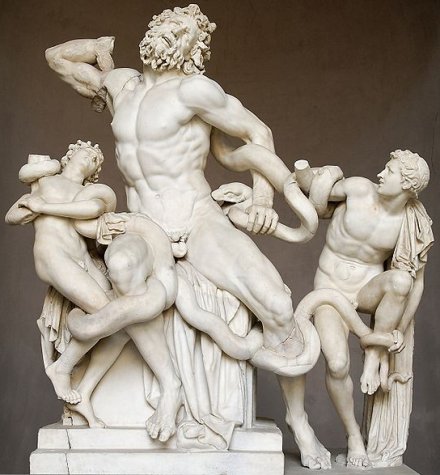
The Gladiator was also one of the best-known and -admired classical sculptures in all of Europe, along with the Laocoön.

In the 18th century they were compared as two examples of dignified dying. Contemporaries saw a certain stoicism in the sculptures — even though Virgil wrote that Laocoön cried out.

Ultimately, Smugglerius reminds us what happens when power is unrestrained. In a world where most people don’t have a voice, the state can ignore the rights and dignity of individuals. The real story here is the story of arbitrary authority and the importance of an enfranchised citizenry with the ability to put limits on those wielding power.

* Hanged felons not sentenced to anatomization could still wind up being taken apart in an operating theater, either as a result of their striking a direct bargain with the surgeons, or involuntarily via London’s growing trade in illicit corpses.

On this day..

1884: Mary Lefley, exonerated by a deathbed confession

On this date in 1884, Mary Lefley was hanged at Lincoln County Gaol for lacing her husband’s pudding with a lethal dose of arsenic.*

It was less than four months since William Lefley ate the rice pudding his wife Mary had left him in the oven while she called at a nearby town. This strange poisoning case is admirably covered by Capital Punishment UK, whose work we’ve featured here before. It’s one of the essential online sources on British execution history.

Shrieking in terror, Lefley had to be dragged to the gallows — still protesting her innocence. She’d never admitted to the crime, and they’d never been able to show that she purchased any arsenic.

There was some thought that William may have committed suicide: he’s known to have attempted it once before. But the more outlandish defense hypothesis that some unknown third party might have snuck in and poisoned the morsel gained unexpected credence in 1893 when a farmer made a deathbed confession to having done just that … over a wholly unrelated-to-Mary financial grudge.

* Mary Lefley knew the last notorious Lincolnshire poisoner, Priscilla Biggadyke — who hanged for poisoning off her husband in 1868. “They are hanging me for my past!” Lefley exclaimed when she was convicted. (Priscilla turned out to be innocent, too.)

On this day..

1892: Frederick Bailey Deeming, Bluebeard

(Thanks to Meaghan Good of the Charley Project for the guest post. -ed.)

On this day in 1892, Frederick Bailey Deeming was hanged in Melbourne, Australia for the murder of his second wife, Emily Mather. She was not his only victim; he’d also murdered his first wife, son and three daughters.

Deeming was born and raised in Ashby-de-la-Zouch in the UK. One of seven children, he was reportedly a “difficult” child. He later claimed he’d spent years in mental hospitals as a youth, something his brother disputed.

Deeming ran away to sea at sixteen and began committing crimes, mostly thefts. Wherever he went, he swindled and stole from people.

Deeming married Marie James in 1881 (his brother married Marie’s sister) and they moved to Australia. They went on to have four children.

In 1888, Deeming and his family moved to South Africa. His movements around that time are unclear, but he was definitely back in England by November 1889, and separated from his wife and children, who lived in another city.

Deeming bigamously married Helen Matheson in 1890, and deserted her shortly after the honeymoon. He visited his wife, gave her some money and told he was going to South America and would send for her and the children once he’d settled. Before he left he conned some jewelers in Hull; as a result, he was arrested upon his arrival in Montevideo, Uruguay and sent back to England to serve nine months in the clink.

In 1891, after his release from prison, Deeming took the name “Albert Williams” and leased a house in the village of Rainhill. A woman and several children were seen visiting him; he claimed they were his sister and her children.

The woman and children disappeared — off to an extended holiday, Deeming said. A short time later, complaining that the drains were defective, Deeming had the floor of his house re-concreted.

In fact, the “sister” was his first wife Marie and the “nieces” and “nephews” his own children — Bertha, 9, Marie, 7, Sidney, 5, and Leala, 18 months. And in fact, they were “vacationing” permanently, under the concrete floor. Authorities believe he killed them on or about July 26, 1891.

By that time, Deeming was already courting Emily Lydia Mather. They married on September 22 and by December 1891 had up and moved to Melbourne.

Emily didn’t make it past Christmas before Deeming had her entombed under the fireplace.

In January 1892, Deeming moved to Sydney. On the way he met a delightful young lady named Kate Rousenfell. He gave her several expensive gifts, including jewelry he’d stolen while he was in Melbourne, and proposed marriage. She agreed and said she would join him in Western Australia when he moved there.

But the course of true love never did run smooth, and Miss Rousenfell was cheated of her bridegroom by Deeming’s March 11 arrest for Emily’s murder.

Emily’s body had been discovered on March 3, after the house’s owner, investigating his new tenant’s complaints of a strange smell, raised the hearthstone. Her throat had been cut and her skull was fractured. When Deeming was taken into custody, he had some of her things with him, including her prayer book.

The murder case received extensive publicity and when those back in England heard of it, they decided to have a look at Deeming’s former home in Rainhill. There they dug up the bodies of Marie and the four children.

At his trial, Deeming claimed insanity and brain damage from epilepsy and tertiary syphilis, and said his dead mother’s spirit had ordered him to commit the murders.

He told the jury that Marie wasn’t dead and had, in fact, left him for another man. In the three weeks between the verdict and the hanging he penned his biography and some bad poetry. English publishers offered him £1,000 for the rights to his writings, but the Australian government had them all destroyed.

There have been suggestions, in Deeming’s time and ours, that he was the serial killer Jack the Ripper, who slaughtered and mutilated a handful of London prostitutes in 1888. The fact that evidence indicates Deeming was in South Africa at the time of the Jack the Ripper murders hasn’t stopped the speculation. He allegedly told his cellmates he was the Ripper, but when asked directly by the authorities, he refused to answer yes or no.

Deeming’s skull and death mask are still on display in the Old Melbourne Gaol Museum.

On this day..

1856: Casey and Cora, by the San Francisco Vigilance Committee

Gold attracts all kinds of people but has a particular allure to crooks and corrupt politicians. When gold was found in California they flowed in from all over the world. Soon the gamblers and thugs had the run of San Francisco. Politicians and judges were bought and paid for. Crime went unpunished. (Usually.)

At the same time San Francisco was growing fast, and was filled with the flimsiest, most flammable wooden buildings imaginable. By 1850 huge fires began to rake the city and while they leveled block after block criminals would loot the homes and businesses of the good citizens who were out trying to fight the flames.

The first vigilance committee formed in 1851 after the fifth fire simply because the city government would do nothing to protect the people. The committee, made up of most of the leading citizens and with the backing of almost every honest person, hung a few men and chased a lot more out of town. Within months things improved dramatically and the committee disbanded.

But it’s hard to keep crooks that are in cahoots with corrupt politicians under control for long and by 1855 things were in terrible shape once more. Gold production was down, voting fraud was rampant, banks and business failed, a city supervisor slipped out of town just before his imminent arrest for a major real estate scam involving city money and a pier we now know as Fisherman’s Wharf.

James King of William, a once well-known banker who had lost everything in the collapse of 1855 was now running a small newspaper, The Evening Bulletin, devoted to exposing the corruption in the city. King was fearless in his reporting and ruthless but impartial in his editorials.

Yet things were still a mess in 1856 when the gambler, Charles Cora, took his doxy, a high powered and wealthy Madame called Belle, to the theater. By her presence she offended the young and ambitious US Marshal Richardson and a heated dispute arose between the two men. Then, days later, after that dispute was resumed in a local saloon, Cora shot Richardson in the chest in cold blood at point blank range.

King denounced the city officials who were holding Cora for trial, saying that the man could not be found guilty of even such a blatant crime in a city as corrupt as San Francisco. And as King predicted, amid charges of bribery, the jury in the trial of Charles Cora could not reach a verdict and Cora had escaped his punishment for murder. King then went after James P. Casey, a city supervisor, and exposed him as having once been a prisoner in New York’s infamous Sing Sing prison.

Casey was incensed and on May 14th stormed into the offices of the Bulletin and protested loudly. King ordered him out. Casey went but waited just up the street. An hour later, when King left for the day, Casey walked up to him in the middle of Montgomery Street and shot him down with a Navy Colt.

The news spread fast. Tens of thousands of people soon gathered.

Casey, joined by his powerful friends, went straight to the jail where Cora was still held for his own protection. Soon the crowd arrived. The local militia was called in to guard the place and there was no trouble that night. The next morning members of the old Committee of Vigilance met and by the time King died on May 20th a new committee had been formed and already had 3,500 members.

By now most of the militia sided with the vigilantes, so when the committee marched in mass to the jail and surrounded it, the jailers soon were soon persuaded to turn Casey over. A short time later the committee returned for Cora. The prisoners were taken to the committee’s headquarters, known as Fort Gunnybags, on Sacramento Street and held there under guard.

Both men were appointed lawyers and put on trial by the vigilantes. Each was convicted with a unanimous verdict.

On May 22nd they were hanged from short platforms extending from second floor windows of Fort Gunnybags before an enormous crowd of San Franciscans who filled the streets, buildings and roof tops all around. The Committee of Vigilance continued to operate until they were convinced that all corrupt politicians and crooks had been purged from city. This resulted in a wholesale change of the political power in San Francisco.

John Putnam is the author of Hangtown Creek, an exciting tale of the early California gold rush. His rich history of that incredible era at can be found at mygoldrushtales.com.

On this day..

1881: Po’olua, “darkened in my mind”

This date in 1881 saw the hanging of a native Hawaiian named Po’olua for a homicide of domestic jealousy tinged by almost tragic remorse.

This case is described in the 1991 essay “A Short History of Hawaiian Executions, 1826-1947” by Joseph Theroux.

In 1881, the Hawaiian [Po’olua] grew enraged when his when his common-law wife, according to the papers, “paraded her infidelity” before him and slaughtered her with a “big butcher knife.” Then, in a fit of remorse, he draped his house in mourning with black crepe paper.

… The experts of the day — family doctors and preachers — were conducted in to interview the bewildered man. They questioned him and concluded that he was not insane. Po’olua himsel agreed that he was sane but “darkened in my mind.” … the Reverend H.H. Parker explained the man’s actions this way: “A Hawaiian would do many things which a white man would not.”

When it as found that Po’olua had a heart abnormality and that he would likely die soon anyway, letters of clemency were circulated on his behalf. But he was hanged on May 20, 1881. Permission was sought for a post mortem to investigate the state of his heart, but officials denied the request. The Advertiser remarked that it “should have been done. Being attended to, might have laid him quiet in his grave; but being forbidden, his spirit will rise up Banquo-like for many a day to come.”

On this day..

1998: Wissam Issa and Hassan Abu Jabal

On this date in 1998,* Wissam Issa and Hassan Jabal were shockingly hanged in public in Tabarja, Lebanon.

Executions hadn’t seen the outside of prison walls in that country for 15 years at that time — back when there was a civil war on.

But Issa and Jabal were condemned for a home burgling attempt gone wrong(er): when the owners unexpectedly returned, Issa fled — but Jabal gunned them down. They both answered for the murders.

Marched out onto a somewhat jerry-built hanging platform (Issa was stoic; Jabal, unmanned), the two died at dawn before a crowd of 1,500 to 2,000 spectators … and plenty of cameras. The grisly proceedings made the nightly news, of course.

“It was horrible,” one Tabarja woman remembered. “The kids were playing at hanging each other afterwards at school.”

Oddly enough, it was also the last hanging (private or public) for over five more years to come. Later in 1998, a staunch death penalty foe became Prime Minister, and refused to approve any execution warrants.

* Reports of May 25 instead of May 19 are out there, but that’s easily disproven by, e.g., this Robert Fisk dispatch on the hanging which saw print on May 21, 1998.

On this day..