1732: Pompey, poisoner of James Madison’s grandfather

On this date in 1732, a Virginia slave entered American presidential lore at the end of a noose.

The Madisons were “planters, and among the respectable though not the most opulent class”* resident in Virginia from the 1650s or so — and would in time bequeath the new American Republic its fourth president, James Madison.

We are concerned for today’s post with President Madison’s paternal grandfather, Ambrose Madison. Alas, concern will not necessarily translate to elucidation, for most of the Madison family’s records and correspondence were destroyed in the 19th century: the first Madison generations are shadowy historical figures. Ann Miller has pieced together the fragments in the short book “The Short Life and Strange Death of Ambrose Madison”, published by the Orange County (Va.) Historical Society, and that is the primary source for this post.**

Ambrose Madison was a local grandee of King and Queen County, with landholdings elsewhere in Virginia; it was Ambrose Martin who in the 1720s acquired (via his father-in-law, a land surveyor) the Orange County grounds that would become the great Madison estate Montpelier.

In 1732, Madison moved his family to the Montpelier property. By that time, he controlled 10,000 acres in present-day Orange and Greene Counties, and was gobbling up land elsewhere — like the new frontier of westward settlement, the Piedmont.

And of course, Madison owned human beings, too. The inventory of his estate from 1732 lists 29 black slaves by their first (sole) names: ten adult men, five women, and 14 children.

In the summer of 1732, Ambrose Madison took ill and started wasting away towards death. The fact was apparent to Madison and those around him; the last weeks of his life were taken up in settling affairs. (He made out a will on July 31.)

Shortly before Madison’s death on August 27, two of his slaves — a man named Turk and a woman named Dido — along with another slave, Pompey, property of a neighboring plantation, were arrested on suspicion of having poisoned Madison. No record survives to indicate how or why they would have done so.

If grievances can only be guessed-at, they are not difficult to guess. At the same time, for aught we know the trio might have been falsely accused: there had never been a murder in the vicinity, but Madison’s death came just months after a gang of slaves committed a series of armed robberies and shot at three white people.† As we have seen from later and better-documented slave resistance, southern whites were prone to great paranoia where the prospect of servile rebellion was concerned. And as Madison was a healthy fellow in his mid-thirties, attributing his unexpected death to poison was a natural move.‡

As Miller notes,

It is likely that Ambrose Madison’s case sent ripples of fear — even panic — through the region … the court [appeared] eager to have a quick trial (and, perhaps, to make quick examples of those found guilty and hopefully deter any other slave rebellions).

All three slaves were convicted together on September 6 of “feloniously Conspiring the Death” of Ambrose Madison. Pompey hanged the next day — after he’d been appraised (at £30) to compensate his owner for the destruction of property. Turk and Dido were only found to be “concerned in the said felony but not in such a degree as to be punished by death but … by Whipping.” They suffered 29 lashes apiece “on their bare backs at the Common Whipping post, and thereafter to be discharged”.

We must deny the fact, that slaves are considered merely as property, and in no respect whatever as persons. The true state of the case is, that they partake of both these qualities: being considered by our laws, in some respects, as persons, and in other respects as property … Let the compromising expedient of the Constitution be mutually adopted, which regards them as inhabitants, but as debased by servitude below the equal level of free inhabitants, which regards the slave as divested of two fifths of the man.

-(Future President) James Madison awkwardly defending the three-fifths compromise in the Federalist #54

Madison’s principal heir was his only son, James — a nine-year-old boy at the time of the events in this post.

The family brush with slave revolt did not deter this future Col. Madison from resuming (once he came of age) the family trade in land acquisition. He had 108 slaves of his own by the time that he died in 1801.

Col. Madison’s more famous son, the U.S. “founding father” and eventual president also named James, had slaves in the White House but was deeply conflicted about the horrid institution.

“He talked more on the subject of slavery than on any other, acknowledging without limitation or hesitation all the evils with which it has ever been charged,” a slavery abolitionist who visited Madison (post-presidency) reported of the evening’s tete-a-tete. “Mr. Madison spoke strongly of the helplessness of all countries cursed with a servile population, in a conflict with a people wholly free.” Madison eventually came to support the fantastical solution of resettling U.S. slaves to an African colony; still, beset by debts, he never quite saw his way to manumitting his own slaves — not even in his will.

Whether the fate befalling his grandfather ever entered into President Madison’s considerations on the subject is left to posterity’s imagination; the documents surviving in his hand never mention anything about grandpa Ambrose.

* Per James Madison, Sr., Ambrose Madison’s son and the U.S. president’s father.

** Since the primary sources available are so scarce, there seems to be little that can be said with confidence of Ambrose Madison’s personality. Miller suspects him a skinflint, on the basis of a merchant’s exasperated correspondence: “I am sorry to find you complain of the cost of the Goods I sent you” … and the same man again two years later: “have Ship’d the Goods you ordered … I don’t expect that you’ll like the Cotton, you order the Cheapest.”

† A slave named Jack, owned by Mildred Howell, was hanged on May 2, 1732 for this affair. The fate of his seven compatriots history passes over in silence.

‡ Miller notes in an appendix several other trials of slaves for poisoning in 18th century Virginia, including some that resulted in acquittal — possibly militating against the railroading hypothesis.

On this day..

1789: Thomas Phipps the elder and Thomas Phipps the younger

From the Newgate Calendar (with thanks to frequent guest poster Meaghan Good of the Charley Project for the find):


These malefactors were father and son; and their final exit from this life was attended by circumstances of the most heart-rending and melancholy description.

The father was a man of good property, and lived on his own estate at Llwyney Mapsis, in Shropshire; and he and his son were indicted for uttering a note of hand for twenty pounds, purporting to be that of Mr. Richard Coleman of Oswestry, knowing the same to have been forged.

It was proved on their trial that Mr. Coleman never had had any transactions with Mr. Phipps that required the signing of any note whatever; that about the Christmas before, Mr. Coleman was served with a copy of a writ at the suit of Mr. Phipps the elder, which action Mr. Coleman defended, and for want of further proceedings on the part of the plaintiff, a non pros. was signed, with two pounds three shillings costs of suit against Phipps.

Upon this an affidavit was drawn up and sworn by Phipps the elder, Phipps the younger, and William Thomas, their clerk, for the purpose of moving the Court of Exchequer to set aside the judgment of non pros. and therein they swore that the cause of action was a note of the said Coleman’s for twenty pounds, which was given as satisfaction for a trespass by him committed in carrying some hay off the land of one of Mr. Phipps the elder’s tenants.

The Court thereupon granted a rule to show cause why the judgment should not be set aside; but Mr. Coleman insisting that the note was a forgery, the present prosecution was instituted against the father, son, and Thomas.

After a full hearing at the assizes at Shrewsbury, the father and son were pronounced “Guilty of uttering and publishing the note, knowing it to be forged;” and William Thomas was found “Not Guilty.”

Though convicted on the fullest evidence, the unhappy men, until the morning of their execution, persisted in their innocence; but when about to leave the jail, young Phipps made the following confession: “It was I alone who committed the forgery: my father is entirely innocent, and was ignorant of the note being forged when he published it.”

They were taken in a mourning-coach to the place of execution, accompanied by a clergyman and a friend who attended them daily after their condemnation.

On their way to the fatal tree the father said to the son, “Tommy, thou hast brought me to this shameful end, but I freely forgive thee;” to which the son made no reply. It being remarkably wet weather, their devotions were chiefly performed in the coach.

When the awful moment arrived, Mr. Phipps said to his son, “You have brought me hither; do you lead the way!” which the youth immediately did, and in the most composed manner ascended the ladder to a temporary scaffold erected for the purpose of their execution, followed by his father.

When their devotions were finished, and the halters tied to the gallows, this most wretched father and son embraced each other, and in a few moments the scaffold fell, and they were hand-in-hand launched into eternity, September the 5th 1789, amid a vast concourse of pitying spectators.

The father was forty-eight, and the son just twenty years of age.

On this day..

1783: William Wynne Ryland, court engraver

On this date in 1783, British engraver William Wynne Ryland hanged at Tyburn* before a throng of gallows-voyeurs such as “had not been seen on a like occasion since the execution of Dr. Dodd.” (Morning Chronicle and London Advertiser, Aug. 30, 1783)

“[H]is evil genius prompted him, for gold, to debase his talents in engraving,” the Newgate Calendar opined. “By one fatal act, he entirely ruined his reputation as a man: but his name as an artist will ever stand in the highest estimation.”

French- and Italian-trained, Ryland was a premier court artist in his day, noted for importing stipple engraving from the continent to England. He earned a royal pension for his portraits of Hanoverian elites.


Some Ryland portraiture, from the National Portrait Gallery: King George III and his queen, Sophia Charlotte.

Although Ryland’s first attempt to parlay his draftsmanship into a print-selling business had gone bankrupt in 1771, he does not seem to have been entirely neglected by the muse of business acumen, either. Over the subsequent decade he had discharged all his previous debts and stockpiled assets to the amount of £10,000. “I am rich beyond temptation,” he protested to the jurors who tried him for his life. The Crown could produce little in the way of an immediate motive for the forgery. (“It is impossible for us to penetrate so far into the heart of man as to know what his inducements are.”)

But lucre is its own motivation, and the facts of the case weighed heavily against Ryland.

He had come into (legitimate) possession of £200 bill of exchange issued by the East India Company and dated October 5, 1780. Somehow it transpired that Ryland then exchanged two copies of this bill — one on September 19, 1782 with the banker Sir Charles Asgill, and then once again on November 4, 1782 to a banking firm with the Dickensian name of Ransom & Co.

Both bills were identical to every inspection, with the same amount, date, and cheque number, and Ryland the expert engraver could give no convincing account of the second note’s provenance. In the public’s mind, the fact that he had fled the indictment and then dramatically attempted suicide when his capture was imminent surely cinched the case.

Ryland’s attempts to inspire in the jurors a sufficient doubt as to whether the East India Company might not have accidentally circulated two identical bills was fatally undone when it turned out that a difference between the two bills could be found after all — by the paper manufacturer, who proved to the court that the second bill was inscribed on paper whose watermark established that did not exist on its purported date of issue.

this sheet of paper was made at the mill, on that particular mould, it has a defect on it; on the 21st of January, 1782, of the same mould of which this note is now shewn me, I made this sheet of paper; there is a defect of the mould, either by an injury it has received, or in consequence of the quantity of paper made on it, the bill has the same defect; and there is likewise a defect which the bill has not, so that the sheet of paper on which the bill was written, was made from that mould. This could not happen in the same places, and situations in any two moulds.

The jury needed only half an hour to convict him.

By the Morning Chronicle and London Advertiser‘s account, he was London’s star attraction on his hanging day.

At half past nine a man on the steps of newgate called out, “Mr. Ryland’s coach,” upon which a mourning-coach, that was standing opposite the Sessions-house, drew up to the door of the prison, and in about two minutes after the unhappy man walked down the steps at a brisk pace, and entered the vehicle; presently after which [fellow condemned prisoner John] Lloyd went into another mourning coach. The Ordinary of Newgate, another clergyman, a gentleman in mourning, (said to be a relation of he convict’s) and a sheriff’s Officer, went in the coach with Mr. Ryland …

These coaches, which immediately followed the Sheriffs’ carriages, having drawn a few yards from the door of the prison, two carts were drawn up; [James] Brown, [Thomas] Burgess, and [John] Edwards were tied in the first, as was [James] Rivers in the last cart …

The gallows was fixed about 50 yards nearer the park wall than usual. About five minutes before 11 o’clock, Ryland’s coach drew on the right of the gallows, as did Lloyd’s on the left; and between them the cart; soon after which a violent storm of thunder, lightning, and rain came on, when the Sheriffs gave orders for a delay of the execution. When the storm had subsided, and some time had been employed in prayer, Rivers was lifted from one into the other cart, which backing to Lloyd’s coach, he alighted therefrom, and entered the vehicle, and after the ropes had been fixed about the necks of these unfortunate men, Ryland stepped from the coach to join his unhappy fellow sufferers. After a conversation of at least ten minutes between Ryland and Mr. Villette, Ordinary of Newgate, and the same time employed in an earnest discourse between Lloyd and Burgess, all the malefactors joined in singing the hymn, called, “The Sinners Lamentation”


Editor’s note: I’m not certain whether this is the hymn alluded to.

Ryland was the object that attracted the general attention, from Newgate to Tyburn, the sound that reverberated from every quarter, amidst the immense multitude was, “Which is ryland? There, that is Ryland in the first coach!” Exclusive of the usual accommodations, a vast number of temporary stages were erected; and gentlemens and hired carriages were innumerable. Some rooms, for accommodating private companies, were actually let at the enormous rate of from six to ten guineas.

Notwithstanding the vast press of the crowd, amidst the astonishing number of horsemen, carriages, and people on foot, we have not heard that any body was materially hurt, though many were forced down and trod on.

Ryland was in mourning, and wore a tail wig … Through the whole of this trying scene [he] conducted himself with remarkable serenity and fortitude, strongly indicating that he was prepared for, and perfectly reconciled to his fate.

The wheel of fortune turning against the mighty — especially when they should hazard their lives for a needless pittance — being irresistible to other artists, Ryland is the title character of a a comedic play.

* One of the very last hangings at Tyburn.

On this day..

1824: Johann Christian Woyzeck, non compos mentis?

Johann Christian Woyzeck was publicly beheaded on this date in 1824 for fatally daggering his lover in a jealous wrath.

He was a rudderless orphan to whom the Napoleonic Wars gifted the stopgap profession of soldiering, but once the fighting stopped, Woyzeck wandered back to his native Leipzig and gave rein to his many vices.

Suicidal, drinking heavily, and unable to hold down steady work, Woyzeck frequently abused his special lady friend, the widow Johanna Christiane Woost. He would later say that he was often urged by voices in his mind to slay her — and on the night of June 21, 1821, after she canceled a rendezvous, he did so at last.

A pathetic exit from life turned out to be an entrance into judicial and literary history.

There was no question but that Woyzeck’s hand had taken Woost’s life, but proceedings against the killer dragged on for three years as courts vacillated on his mental competence. Woyzeck had been wildly depressed and owned to hallucinations and unbalanced moods that his contemporaries could readily recognize as falling near the pall of madness.

Nevertheless, Woyzeck had initially been slated for execution in November 1822 based on the evaluation of celebrated Leipzig physician Johann Christian August Clarus, but another doctor — academics will recognize the irksome intervention of reviewer no. 2 here — horned in with a missive questioning the conclusion.

That stay invited an 11th-hour stay and five more examinations worth of billable hours for Dr. Clarus, who studied up his man again and came to the same conclusion: that Woyzeck, though disturbed, was cogent enough to bear responsibility for his actions. It was in the end by this verdict that the executioner’s sword-arm swung.

The lost soul’s end on a Leipzig scaffold on this date would eventually inspire the writer Georg Buchner to pen the play Woyzeck. Though left unfinished when Buchner died young, the play has been frequently staged down to the present day, and even adapted for the silver screen by Werner Herzog:

On this day..

1851: Samuel Whittaker and Robert McKenzie lynched in San Francisco

On this date in 1851 — mere hours after a similar exercise of summary justice took place in Sacramento — the San Francisco Vigilance Committee strung up two accused crooks.

This was the throes of the California Gold Rush — and San Francisco was its epicenter.

San Francisco entered the gold rush an unassuming port of perhaps a thousand souls … but she exited it as one of the American West’s leading cities.

It made an unruly adolescence for the boom town as penniless treasure-hunters poured in from every quarter of the globe. “Turbulent, gold-hungry men,” wrote Herbert Asbury in his The Barbary Coast: An Informal History of the San Francisco Underworld “transformed the once peaceful hamlet of San Francisco into a bawdy, bustling bedlam of mud-holes and shanties.” Suddenly, San Francisco had a huge crime problem — not to mention the conflagrations* that repeatedly devastated the fast-growing tangle of tinderworks shacks.


San Francisco in 1850

In an effort to sustain some measure of order, a number of the city’s respectable citizens banded together to create a famous or infamous Vigilance Committee.

Sworn in their published constitution of June 9, 1851 “to do and perform every lawful act for the maintenance of law and order,” the Committee declared itself “determined that no thief, burglar, incendiary or assassin shall escape punishment, either by the quibbles of the law, the insecurity of prisons, the carelessness or corruption o the Police, or a laxity of those who pretend to administer justice.”

Two days later, they proved their chops by hanging on no authority but their own emigre from Australia named John Jenkins for stealing a safe. A month later, James Stuart, also late of Sydney, was lynched at the Vigilance Committee’s hands, too.

Detail view (click for full image) of Whittaker and McKenzie’s lynching.

Though not the first Vigilance Committee hangings, Samuel Whittaker and Robert McKenzie might be the best-known.

Like their predecessors, Whittaker and McKenzie had arrived from Australia** — which had aptly bequeathed to gold rush San Francisco a criminal colony of its own in the form of a network known as the Sydney Ducks. Scrambling to save his own neck, Stuart had informed on a number of these confederates.

Whittaker and McKenzie were arrested based on Stuart’s information, as the Vigilance Committee tried to smash up the Ducks. Though extrajudicial, the Committee’s investigations were at least as meticulous as one might expect from the law at this moment in time, and the minutes of its witness interviews can be read here.

In the end, the two were basically convicted not so much for any individual crime as for their lengthy careers of robbery, often violent — for “divers offences, whereby the safety of Lives and property have been endangered” (as read the executive report on Whittaker) that rendered each “a hardened offender, and dangerous to this community … it would be unsafe to hand him over to the Authorities or mete out to him a less Penalty than Death” (as read the report on McKenzie).

Such an arrangement of juridical powers, exercised in lieu of “unsafe” Authorities, can scarcely persist long-term. Here, the governor of California, John McDougall determined to intervene in order that the fracturing of the Australians’ vertebrae would also vindicate the majesty of the law.

McDougal arrived to San Francisco and secured a writ to seize the suspects from the Vigilance Committee’s hands, tucking them away in the county jail.

Although in principle this orderly and lawful prosecution of malefactors was exactly what the Committee wanted to see happen, Gov. McDougal’s intervention when they were on the brink of consummating their own process left everyone with a frustrating sensation of justice interruptus.

And so that next Sunday — August 24, 1851 — when prisoners were removed from their cells to a chapel for the salvation of their souls and the jail’s guard detail was reduced by the proportion of gendarmes attending services of their own, a party of 36 Vigilance Committee men barged into the jail, overpowered all concerned, and seized their prey.

“Never before was San Francisco so excited,” editorialized the Steamer Alta California (Sept. 1, 1851).

Through every street, in all directions, the hurrying crowd of humanity rushed with the utmost precipitation — no one knew whither, no one knew for what. The bell of the Vigilance Committee had sounded its alarum note — and instantly the streets were living, swaying masses of human beings — uncertainty and conflicting fears and hopes ruled the hour … with a sweep like the rushing of a torrent of lava they bend their course towards the Rooms of the Vigilance Committee. Almost instantly California street, Battery street, and all their approaches, are filled with one dense mass of human beings. From lip to lip the news flies that the two criminals, Mackenzie and Whittaker, have been taken by force from the jail, by an armed posse of the Vigilance Committee. On the eager and excited multitude press toward the Rooms. On, on, on — the crowd becomes denser and broader. Wonder is stamped on every face — a solemn, almost awful silence pervades the thousands who are anxiously gazing up at the building, when quickly the doors are opened — a moment of preparation — and the numberless multitude holds its breath as the two malefactors are seen suspended by the neck — a struggle or two, a spasmodic heaving of the chest — and each spectator feels a thrill of terror coursing his veins as he involuntarily utters — dead, dead, dead!

Yes, they were dead! The two men — Whittaker and Mackenzie — who were taken from the hands of the Vigilance Committee a few nights since, by virtue of a write of habeas corpus, had been torn from the ail by force, in the middle of the day, and at the risk of life, hurried to the Committee rooms, and executed without scarcely a moment’s preparation. It is a most terrible tragedy! Well, indeed, might one exclaim, “I have supped full with horrors!”

Such are the terrible effects of misrule — these are the fruits of maladministered laws — these the results of official corruption, neglect and malfeasance. Well may the patriotic and the good turn in sadness and grief from the contemplation of such horrors. The timid may shrink from beholding them — the quiet desire an end to them; but neither fear, regret, nor desire will accomplish our security. It must go abroad over the land that this community possesses the power and the will to protect itself against every species of wrong, and that it is resolved to do it at all hazards.

Whilst we regret that the Vigilance Committee have by this act, been brought into direct collision with the constituted authorities, we cannot but approve their course in executing the two criminals. This condition of affairs was not sought by the committee; it was rather forced upon them by the action of the authorities. True, the authorities acted rightly in rescuing the men; but the course they took has proved to be unnecessary and injudicious. No one doubts the guilt of the men executed, and no one believes but that they deserved the punishment they received. The Vigilance Committee felt this, and believing that the public welfare would be promoted by the act, they had resolved to execute Whittaker and Mackenzie. But the officers of the law, with unusual adroitness, prevented the decision from being carried into effect. The Vigilance Committee have now redeemed their honor, and carried out their original determination, by recapturing the prisoners and executing them. The line of division between the legitimate civil power and the Vigilance Committee is therefore plain, broad and unmistakable.

And what is to result? We see nothing disheartening or dispiriting in the prospect. On the contrary, we think we perceive that settled determination on the part of the body politic to have justice done, which is to be the great lever of our salvation. When crime is convinced, as it must now be, that nothing is capable of preserving it from speedy and avenging punishment — when the abandoned feel, as they will now feel, that there is no safety for them here — when all bad men shall understand, as they may now understand, that their unworthy acts will surely be visited with condign reward — then will the country rise above its tribulations and its sorrows.

But this is a dreadful storm! If we did not know the ship, the crew and the passengers, we might despair of our reaching port. As it is, we speak confidently. We feel that there is gloom around us, but there is nothing to alarm the honest and patriotic. The guilty may, and ought to, flee before the gale of popular indignation; but it is through such trials that our voyage is ultimately to become a prosperous and fortunate one. Through the watches of the night of darkness which now surrounds us, there is a gentle voice whispering “Be firm, be calm, be just, and the welcome daylight will soon come!”

The Vigilance Committee disbanded itself a few weeks later. Its last act in 1851† was to prevent the lynching of a sea captain by sailors angered at his brutality, an expression of class solidarity in the definition and punishment of crime as timeless as America herself. (Source)

* These fires were widely feared to be the product of arson motivated by the opportunity to loot. This is likely a reversal of cause and effect. One inclines here to reckon with Tolstoy that cities have a natural tendency to kindling fire, and those fires are liable to blaze out of control in inverse proportion to the city’s administrative faculties.

The late San Francisco police officer and amateur historian Kevin Mullen puts together an argument here that merchants opportunistically torching excess stock to sustain gold rush price gouging was also a contributing factor.

** Both men were born in England; many of the Sydney Ducks hailed originally from the British Isles.

† Like Batman, the Vigilance Committee later emerged from retirement to fight crime again, in 1856.

On this day..

1899: Armstead Taylor and John Alfred Brown, horribly

From the Wilkes-Barre (Pa.) Times, Aug. 18, 1899:

ROCKVILLE, Md., Aug. 18 — Armstead Taylor and John Alfred Brown, negroes, were hanged here this morning for the murder of Mr. and Mrs. Rosenstein at Slidelle in March last.

The drop fell at 10:15[?]. The hanging was a horrible botch. the knot did not slip but the drop was long enough. The men writhed, groaned and uttered inarticualate [sic] sounds for nearly ten minutes.

The murders for which they were convicted and sentenced to be hanged were committed at Slidelle, a little station two miles north of Boyds, Md. on March 13 last.

Louis Rosenstein, the postmaster of the hamlet[,] lived with his aged parents in the rear of the post office. They were said to have plenty of money. Early one morning they were attacked and the man’s skull was crushed and the woman’s head pounded with some blunt instrument.

The store was ransacked and a little over $3,000, a pair of shoes and several articles were taken.

Louis Rosenstein died the day after of his injuries and Mrs. Rosenstein lingered until May when she succumbed in a hospital at Baltimore.

Taylor went to Washington and soon attracted attention by spending money in a lavish manner in Georgetown. Suspicious neighbors gave the police the information that led to his capture.

Before Taylor was arrested, however, Sergeant Fritz Bassau of the Washington police force gave up his life. Taylor shot him down as he was climbing the stairs to arrest him, where he was concealed in the house at Georgetown. He also shot Officer Gowon in the hand.

Taylor was taken back to Montgomery county, but did not stand trial for injuring the policemen. His trial was begun at Frederick on July [?] and Brown’s a week later. Both were convicted and sentenced to be hanged August 18.

Strong efforts were made to have Brown respited, it being believed by many that he was only an accessory after the fact.

The men mounted the scaffold at 10:15. They were both calm and exhibited nerve. As they were placed on the door the sheriff asked if they had anything to say. Taylor made a rambling statement in an almost inaudible voice. He appeared weak and swayed upon his feet. He said:

Gentlemen, I done both the killings myself. My Uncle Brown is not guilty. I am the guilty man, but I expect to go to heaven.

Brown refused to make any statement beyond that he had forgiven his enemies and had found salvation.

The deputies then adjusted the rope, before placing the black caps on their heads. Both men smiled and Brown said good-bye to some friends in the crowd who spoke to him.

Sheriff Thompson tok [sic] a board about six feet in length, walked over to the side of the scaffold, reached down and inserted the end of a plank in the wire ring and sprung the trap.

The bodies fell through simultaneously and began to writhe and sway in a horrible manner. Taylor seemed to be conscious and appeared to be trying to speak.

The priests pronounced it the most horrible execution they had ever seen.

On this day..

1915: Leo Frank lynched

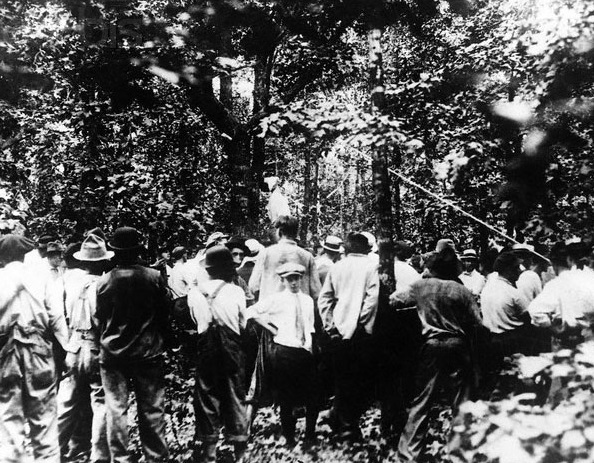
One hundred years ago today, Leo M. Frank was lynched to an oak tree at Marietta — one of the most notorious mob murders in American history.

Methodically extracted hours before from the Midgeville State Penitentiary by an Ocean’s Eleven-style team of coordinated professionals, Frank’s murder was as shocking in 1915 as it reads in retrospect.

The well-heeled Jewish Yankee was factory superintendent at the National Pencil Company in Atlanta when a 13-year-old girl in his employ was discovered in the factory’s basement — throttled and apparently raped. That was in 1913; for the ensuing two years, the prosecution of Mary Phagan’s boss as her murderer would play out in sensational press coverage.
Frank is today widely thought innocent of the crime, although the Georgia Board of Pardons and Paroles has balked at issuing an unconditional pardon since so little of the original evidence survives. (A 1986 pardon came down “without attempting to address the question of guilt or innocence” in recognition of the slanted trial and the failure to protect Frank from lynchers.) But this was much more than a courtroom drama; the Frank affair crackles with the social tensions of early 20th century America. Industry and labor; integration; sexual violation; sectional politics; race and class and power.

Populist Party politician Thomas E. Watson, whose magazines made a dishonorable intervention by openly agitating for (and then celebrating) Frank’s lynching, captures the Zeitgeist for us as he fulminates against the nationwide campaign to grant the convicted murderer a new trial: “Frank belongs to the Jewish aristocracy, and it was determined by the rich Jews that no aristocrat of their race should die for the death of a working-class Gentile.” Frank came to enjoy (if that’s the right word) the editorial support of most of the country’s major papers, but the meddling of northern publishers, and of fellow Jews in solidarity,* arguably led Georgians to circle wagons in response. Present-day Muslims called upon to disavow every bad act by every other Muslim would surely recognize this no-win position.

But then we must also add that Watson himself, a lawyer, had been approached by Frank’s defense team hoping to enlist his bombast to defend their man at trial. The white supremacist demagogue would have been perfect for the job, for the legal battle pitted the credibility of a black janitor named Jim Conley against that of Frank.

Here amid the nadir of American race relations Frank’s team made its own ugly and unsuccessful pitch for racial solidarity with his neighbors. When formulaically asked by the court that had convicted him for any statement to mitigate the impending sentence, Frank replied that

my execution will make the advent of a new era in Georgia, where a good name and stainless honor count for naught against the word of a vile criminal; where the testimony of Southern white women of unimpeachable character is branded as false by the prosecution, disregarded by the jury and the perjured vaporings of a black brute alone accepted as the whole truth.

This violent collision of two vulnerable minorities each with the keen sense that one or the other of them was being outfitted for WASP America’s nooses makes for riveting and sometimes bizarre reading. Newspapers could hardly fail to note that the all-white jury (Leo Frank’s defense team struck all the blacks) had, as Frank complained, privileged the account of just the sort of “black brute” that Southern courts were accustomed to scorn, or railroad. Thus we have the NAACP organ The Crisis taking umbrage that “Atlanta tried to lynch a Negro for the alleged murder of a young white girl” but “a white degenerate has now been indicted for the crime.” It was likewise reasoned by some that since Conley was a young black man with a criminal record who was a potential suspect in the Deep South in the murderous sexual assault of a little white girl, “the mere fact that Conley did not long ago make his exit from this terrestrial sphere, via a chariot of fire is convincing proof that he, at least, is not the man who committed the deed.”** (New York Age, Oct. 29, 1914.)

In the end it was a zero-sum game between Jim Conley and Leo Frank: one of them was the murderer; each accused the other. Their respective desperate interests permeated to their respective communities. After Frank’s lynching, hundreds of Jews left Georgia; many who remained took pains to downplay their Jewishness.

By whatever circumstance police zeroed on Frank and the white community’s passion followed — tunnel vision that would eventually manifest itself in a circus courtroom atmosphere where the prosecuting attorney was cheered and defense witnesses hooted at and the ultimate outcome more demanded than anticipated. The judge feared that an acquittal would result in the summary lynching of not only Frank but his defenders.


Mary Phagan was killed on Confederate Memorial Day, the “holiday” this ballad alludes to.

Unusually for the time, appeals on the case reached the U.S. Supreme Court which declined to intervene — although two justices filed a dissent citing the egregious trial atmosphere.

Mob law does not become due process of law by securing the assent of a terrorized jury …

This is not a matter for polite presumptions; we must look facts in the face. Any judge who has sat with juries knows that in spite of forms they are extremely likely to be impregnated by the environing atmosphere … we think the presumption overwhelming that the jury responded to the passions of the mob …

lynch law [is] as little valid when practiced by a regularly drawn jury as when administered by one elected by a mob intent on death.

But that mob would still have its say. On the eve of Frank’s scheduled June 22, 1915 hanging, outgoing governor John Slaton commuted the sentence.

“Feeling as I do about this case, I would be a murderer if I allowed this man to hang,” the governor said. “It may mean that I must live in obscurity the rest of my days, but I would rather be plowing in a field than feel for the rest of my days that I had this man’s blood on my hands.”†

Frank was spirited away to the penitentiary under cover of darkness; it was hoped that the remote and reinforced edifice would deter any reprisal. It turned out that the furies who hunted Franks could not be dissuaded by mere inconvenience: a committee calling itself the Knights of Mary Phagan formed with the open object of organizing the intended mob vengeance — and indeed it was almost superseded in July of that year by a fellow-prisoner who slashed Frank’s throat as he slept.

Frank survived that murder attempt only to await the next one. Who knows what fancies frequented him in those weeks when he ducked from the shadow of the gallows to that of the lynching-tree, object of pity or hatred. He had time on the last day to savor his impending fate when the Knights methodically cut their way into the penitentiary — snipping the phone wires and disabling the vehicles — and marched their man out with nary a shot fired. Then, a convoy of automobiles “sped” (at 18 miles per hour) all the way back to a prepared execution-site at Marietta. The drive took seven or eight hours over unpaved country lanes, and for every moment of it Frank surely knew how it would end.

* Frank was a chapter president of the Jewish fraternal organization B’nai B’rith; the Anti-Defamation League of B’nai B’rith was founded in 1913 as a direct outgrowth of the Frank campaign.

As a contrasting response, the American Jewish Committee declined to participate in the Frank campaign for fear of lending counterproductive credence to charges such as those voiced by the New York Sun (Oct. 12, 1913):

The anti-Semitic feeling was the natural result of the belief that the Jews had banded to free Frank, innocent or guilty. The supposed solidarity of the Jews for Frank, even if he was guilty, caused a Gentile solidarity against him.

** Maurianne Davis’s Strangers and Neighbors: Relations between Blacks and Jews in the United States has a trove of interesting editorial comment from Frank’s contemporaries in the black press, and the Jewish press. Conley was actually the confessed accessory, and served a year in prison for it: he said that he complied with Frank’s order to hide the body for fear that his “white” boss could easily get Conley lynched for the crime. Conley also wrote (under Frank’s directive, he said) the preposterous “murder notes” found with the body that purported to be Mary Phagan’s dying indictment of Newt Lee, the African-American night watchman.

† The allusion to political suicide suggests Slaton’s mind was on the precedent of Illinois Gov. John Altgeld, whose career was destroyed by pardoning some of the Haymarket anarchists. If so, Slaton was quite correct; he actually had to flee Georgia altogether and could not return to the state for more than a decade.

On this day..

1817: Not Hall or Read, prosecuted for blood-money

Miscarriages of justice perpetrated by actors in a position to extract private benefit from generating criminal prosecutions is a story as old as the hills. This one, as reprinted in the London Morning Chronicle, Aug. 25, 1817, at least has a happy ending:

EXTRAORDINARY CIRCUMSTANCE

Two soldiers, named Hall and Morrison, were on the 26th July tried for a highway robbery at the Stafford Assizes, before Baron Garrow, convicted, and ordered to be executed. They were prosecuted by a man named Read, a bricklayers labourer, who swore that they knocked him down and robbed him of a shilling and a penny, in a church-yard at Wolverhampton, on the 23d July. The evidence of the woman in whose house the prisoners resided, went to prove that they did not sleep at home on the night of the imputed robbery. To those two witnesses the evidence was confined, and against it there appeared nothing upon the trial, except the declarations of the prisoners, containing facts which were afterwards sworn to be others, and which, after the utmost labour of a few benevolent persons, were the means of saving the innocent prisoners from a death which appeared to all to be inevitable.

The two soldiers were, upon the 23d of July, drinking at an hour too late for admission at their lodging at Wolverhampton, and, after applying in vain to be allowed to go into the guardroom to sleep, walked about the village to kill time.

In loitering through the church-yard they met a man who seemed to be in want of work, and, like themselves, without a lodging for the night. A conversation ensued, and the stranger told them his name was Read; that he was a bricklayer’s labourer out of employment, and a Hertfordshire man.

It happened, that in his description he hit upon the part of the country from which one of the prisoners came. A jesting dialogue took place between them, and at length it was agreed that they should wrestle.

Hall was the friendly opponent of Read upon the occasion, and he was thrown in the first round of wrestling. In the second, however, Hall was more successful in the feat of activity, but his triumph nearly robbed him of his life. The vanquished man dropped a shilling and a penny from his pocket. Morrison immediately picked up the money, said it would do for beer, and put it into his pocket. The soldiers quizzed Read about his loss, and were heard by a watchman near the spot acknowledging that they had the shilling, and would certainly dispose of it in the most convivial way.

Read growled about his money, and showed a disposition to quarrel, but did not utter a word about his being robbed of it. About five o’clock in the morning the three were seen near the market-place by another watchman, and the soldiers were bantering Read upon the same subject.

The good humour of Read, however, at this time, appeared quite broken up; he spoke of having the soldiers taken into custody, but was answered by a laugh from them. A grocer, named Powis, saw them all under similar circumstances, and heard Read complain of no attempt at robbery, but saw that he was not pleased at being laughed at.

The grocer soon after met a man named Roberts, the keeper of the House of Correction at Wolverhampton, and mentioned to him that Read said two soldiers had got his money. The answer of Roberts, which did not strike the grocer as extraordinary at first, was, “I must see that man; this is a good job.”

The event, however, soon explained the language. Roberts immediately inquired after Read, questioned him upon the loss he had sustained, and in a very short time apprehended the two soldiers upon the charge of robbing Read in the highway of a shilling and a penny. Before the magistrate, Read swore that the soldiers knocked him down and robbed him of his money in the church-yard. Their commitment was immediately made out, and they were sent to the Assizes of Stafford, where, on the Saturday following they were tried and condemned for the capital offense.

The inhabitants of Wolverhampton knew nothing of the intention of Read upon the interference of Roberts in this transaction. It was generally concluded amongst them that the angry state of mind in which Read appeared, would have influenced him to swear a common assault, but nothing at all serious was apprehended from the wrestling bout. There was consequently no interference upon the part of those who were acquainted with many of the circumstances; and the matter died away until the village was struck with horror at an account in the Stafford paper of the proceedings of the Assizes. An old man was reading the paper in an ale-house to a number of politicians, who were not much affected at any thing they heard until he came to that part which stated the number of persons left for execution. Amongst the names were those of Hall and Morrison. The whole population of Wolverhampton instantly showed how they felt upon an occasion so dreadful.

The Rev. Mr. Guard, one of the most venerable characters in that part of the country, who officiates in the village where Hall’s family resides, upon hearing the event of the trial, set out for Wolverhampton, where he found the people already meeting and acting upon this subject. The men were to be hanged this day (Saturday last), and not a moment was to be lost. Mr. Guard, who had known Hall from his infancy, and would have staked his life upon the integrity of the young man, made a quick but deep inquiry into the facts, and having found every thing confirmatory of his innocence, followed Baron Garrow on his circuit to state what he had learned from the very best authority, and obtain a respite.

He saw Mr. Baron Garrow, but his Lordship appeared to see no reason to alter the opinion which he had formed from hearing the trial. The worthy Clergyman, however, was so well convinced of the truth of his own information, that he could not help exclaiming, with more zeal than discretion, “I see you are determined to hang these poor men.”

Mr. Baron Garrow was naturally offended at this intemperate observation, and an eminent Barrister remarked, that Mr. Guard’s object was wholly defeated by the use of it.

Mr. Guard was not, however, to be turned from the endeavour to save the lives of the two soldiers; there was another quarter to which he could apply. He immediately came to town, and went without ceremony to Lord Sidmouth, to whom he obtained an easy access. He remained in conversation with his Lordship between three and four hours, and Lord Sidmouth afterwards declared, that he never in his life saw such an interest taken in the fate of men who were not related by domestic ties to the individuals whom he was labouring to save. This meeting gave Mr. Guard hopes; though Lord Sidmouth had observed, that in cases of this kind the Judge was necessarily better acquainted with all the bearings of the evidence than the Secretary of State, and therefore his power was seldom interfered with, except under circumstances of strong fact.

Mr. Guard posted back to Wolverhampton the moment after he parted from the Secretary. A meeting of the inhabitants was called, at which Mr. Mander, and all the other respectable residents of Wolverhampton attended.

The witnesses were sworn, and a Petition to the Prince Regent was signed and delivered into the hands of Mr. Guard, who, accompanied by Mr. Charles Mander, very soon after arrived in town. These two gentlemen went, with Mr. Pearsall, of Cheapside, to Lord Sidmouth, and put into his hands the evidence of the innocence of the soldiers. His Lordship requested that Mr. Pearsall would relate the circumstance.

That gentleman repeated the manner in which Read and the two soldiers had acted in the presence of the watchmen and the grocer. Lord Sidmouth was just going up with the Recorder’s Report, and said, that upon his return he would examine the affidavits, and act upon them. Mr. Pearsall observed, that the men were ordered for execution on Saturday, but was assured by his Lordship that their case should not be neglected, and that the affidavits should be laid before the Attorney-General.

Upon the next meeting, Lord Sidmouth said there had been no necessity for laying the affidavits before the Attorney-General. The case, he observed, was one of the most interesting that ever came before him.

Indeed, such was the effect of the affidavits upon him, that he was not only immediately convinced that the soldiers should not be executed, but, in the absence of his clerks, he wrote the dispatch for their respite with his own hand, and sent it to the Sheriff; “because,” said his Lordship, “I could not endure the thought that the soldiers should have one hour more of unnecessary anxiety.”

Mr. Pearsall said there was no doubt that the men had no intention of felony; it would also appear, at another time, that the prosecutor had no intention of indicting them, until he was instigated by Roberts, with the view of gaining the reward called “Blood-money,” which was accordingly pocketed by Read and the keeper of the prison, to the amount of 80l.

Lord Sidmouth declared, that, under such circumstances, an immediate investigation should take place. He coincided in the opinion of the impropriety of Roberts’s conduct, and said a pardon would be instantly granted to the soldiers. He also complimented, in the warmest manner, the conduct of Mr. Guard and the other gentleman, who had exerted themselves. In the course of his observations to Lord Sidmouth, Mr. Guard said he would give up half his fortune to save the life of Hall, so convinced was he of his honesty.

While these operations were going forward in London, affidavits, copied from those handed to the Secretary, were brought to Mr. Baron Garrow by Lieut. Buchanan, of the same regiment as the soldiers, and a respite was instantly granted by his Lordship when he read them.

The Officer stated, that Baron Garrow, upon reading the affidavits, said, if the facts had been known before, their respite should have been granted; and asked whether they would, upon being pardoned, be taken into the regiment again? Lieutenant Buchanan immediately replied, that they would be most gladly received.

On this day..

1817: Four arsonists in the rain

Account from the Derby Mercury, Aug. 21, 1817:

THE EXECUTION OF
John Brown, Thos. Jackson, Geo. Booth & John King.

The above unfortunate men were arraigned at our late Assizes for setting fire to certain hay and corn stacks, the property of Winfield Halton, Esq. of Southwingfield, in this county, and after a long and impartial trial were found guilty on the most satisfactory evidence, by a very respectable jury of their fellow countrymen. The awful sentence of the law was passed upon them in the most impressive manner by the Judge, who endeavoured to prepare them for the fate which awaited them by assuring them that the heinous nature of their offence precluded all hopes of mercy.

For some days after their condemnation, however, they cherished a hope that pardon or at least a mitigation of their sentence might be extended to them. Under this impression they persisted in asserting their innocence of the crime for which they were about to suffer, and even when this delusion could no longer influence their conduct, their denial of all participation in the offence of which they had been convicted was repeatedly made in the most solemn manner. The faithful exhortations of the Chaplain, and also of a Dissenting Minister, who at their own request attended Brown and Booth, failed to draw a confession of the fact from them. Still they did not appear unimpressed by certain religious convictions which might have been expected to lead to contrition. But in the midst of their profession of forgiveness towards their prosecutor and the witnesses who appeared against them, there was a manifest irritation of mind and a vindictive expression of feeling which justified a doubt of the sincerity of their repentance.

This was particularly the case with Brown and Booth, who were confined together. Jackson exhibited a calmer state of spirit, but still protested that he was not guilty. King shewed the most absolute submission to the fate which awaited him, and his assertions of innocence seemed to be made more in deference to the wishes of his fellow criminals, than to arise from another cause. Indeed he had made a confession of the offence before his trial, but was led subsequently to retract what he had admitted.

It was vainly hoped that at the place of execution they would prove by their confession that their general professions of contrition were sincere. But they had previously stated that they should die with the protestations of innocence on their lips, and not even the dread prospect of that eternity on which they were about to enter was able to produce a charge in this determination.

They were brought out upon the scaffold about a quarter before one o’clock, and seemed but little affected by the sad solemnities by which they were surrounded. After the Chaplain had concluded his devotions, in which they appeared to unite with some degree of fervour, they sang a hymn, all joining in it except King, whose manner expressed a firmness bordering on indifference, and a high disdain of the enthusiastic fervours by which the others seemed to be sustained. Booth and Brown addressed the immense multitudes who were assembled before them; the former expressing himself in unwarrantable terms against individuals whom he named, and the latter exhorting the croud to religious faith and practice.

They, as well as Jackson spoke familiarly to their acquaintances who came to witness their tragical end, and their whole behaviour betrayed an insensibility to their real situation which it was painful to observe, and would be difficult to account for, were not their previous abandoned characters sufficient to furnish the solution. The drop fell from under them about five minutes after one o’clock, and they seemed to die almost without a struggle.

Such was the deportment of these wretched men; even in the closing scene of their lives, aggravating the heavy criminality of their former conduct, by their continued protestations of innocence. Many circumstances tended to produce this. The state of the prison in which they were confined did not, unfortunately, admit of their being in solitary cells, and their intercourse with each other seems to have given them hardihood to deny what had been so clearly proved against them, by evidence which has not been in the slightest degree affected by any circumstances that have subsequently transpired. Indiscreet communications from their friends, by which they were assured that their innocence was believed by their neighbours, farther tended to make them persevere in their first protestations. They seemed unwilling to destroy the sympathy which they believed they had succeeded in exciting.

Still it appears incredible to many that guilt should be so bold, and the professions of religion loudly made by two of the criminals are thought by some to be greatly in favour of their sincerity. Nothing however is more common than protestations of innocence even at the place and hour of execution; nor is it wonderful, where all moral feeling has been outraged during a long course of years that it should not be displayed in a nice regard to truth even in the most awful moments.

The professions of religion made by men who have not been brought by penitence to confession, may well be regarded with suspicion, and such conduct would be inconceivable were we not aware that a species of fanaticism is abroad in the world which separates religion from morals, and substitutes mere profession in the place of practice.

As every fact which may tend to illustrate the principles of human action deserves notice, it is worth observing, that a heavy shower happening, whilst the men were singing the hymn, two of them deliberately retreated to the shelter of an umbrella which was expanded on the drop, and a third placed himself under cover of the door way. The inconvenicne of being wet was felt and avoided by men who knew they had not five minutes longer to live!! The whole of the scene now recorded was one of great horror, increased by the conduct of the criminals themselves. The many thousands of spectators behaved with great decorum, but retired from the spectacle apparently little impressed with sympathy towards men who had evinced so much insensibility to the real nature of their own unhappy condition.

On this day..

1895: Minnie Dean, the only woman hanged in New Zealand

On August 12, 1895, Willamina “Minnie” Dean became the only woman executed in New Zealand’s history.

An immigrant from Scotland, Dean married an innkeeper making bank in a gold rush boom town. If only the mines had not played out!

After they did, the Deans fell on hard times; Charles kept pigs instead of inns, and Minnie kept unwanted children. This “baby farming” industry carved out a curious niche in the Victorian heart of darkness — the domestic heart of darkness, not the colonial one.

Between the dearth of contraception and the stigma attached to unwed mothers, there was a ready market of unwilling parents hoping someone would whisk their little angels away. The “Winton baby-farmer” did just that — for a fee.

The question, then as now, is whether the many infants who died in Dean’s care perished because of calculated homicide, or because of the staggeringly high infant mortality rate of the era. Since baby farmers took one-time fees to take in children whom they would thereafter have to maintain, their incentives were to turn over the stock as quickly as possible — either by placing the child with an adoptive parent or … well …


This report (from the Aug. 14, 1895 Daily Telegraph) alludes to a fictitious lady-in-waiting of legend, whose shadowy inspiration in fact was a real-life Scottish expatriate beheaded for infanticide by Peter the Great.

Police surveilled and investigated Minnie Dean’s operation off and on for more than five years before her June 1895 capital trial: inquests after children’s deaths in 1889 and 1891 attributed them to natural causes but also noted deplorable sanitary conditions. Police found that she had attempted to take out life insurance policies on at least some of the kids.

Fearful of the attention (but still needing the income), Dean became more furtive, and this only made her look the more guilty. As greatly as the circumstances have changed, Dean’s case and others like it mirror the difficulty present-day judiciaries still have in drawing a bright line around childhood fatalities that can be convincingly attributed to abuse.

In the end it wasn’t the coroner who undid Dean, but an eagle-eyed railway attendant who noted the woman boarding a train with a baby and a hatbox … and later leaving the train with a hatbox but no baby. Now the investigation closed in on the Winton baby-farmer quickly: when Dean could not produce the infant granddaughter a woman claimed to have given up to her, police put a spade to her garden and turned up three corpses in the topsoil. The three-year-old boy had an undetermined cause of death, but the two infant girls had perished from suffocation and a laudanum overdose. One of them was the missing infant granddaughter. Murder charges ensued.

Her attorney was Alfred Charles Hanlon, who would go on to a brilliant career at the bar but was here defending his very first homicide — and was unable to interest the jury in an alternative configuration of the incriminating circumstances, namely that Dean had covered up accidental deaths fearing just that they would be taken for murders. (A 1985 TV series about this attorney, Hanlon, explored the case in its first episode, which can be seen online here.) Still less did that angle interest gawkers crowding the courtroom and the hustlers who sold them hatboxes carrying grotesque baby dolls.

Dean maintained her innocence on the scaffold (at least “as far as intention and forethought was concerned”)

As an appropriate postscript, a boy trying to eyeball the macabre proceedings from the roof of a building overlooking the gaol fell off of it, fracturing his skull.

On this day..