1745: Martha Stracey, whore and reprobate-creature

Martha Stracey or Tracey hanged at Tyburn on this date in 1745 for assaulting a man named Will Humphreys and robbing him of one single guinea a few months before.

Stracey, about 18 or 20 years old, was a prostitute and pickpocket — “a perverse, vicious Girl, void of all good Dispositions, and wholly untractable and unadviseable, giving herself up to the vilest Company on Earth, both of Men and Women,” the Newgate Ordinary judged. The Ordinary’s accounts are a reliable feast of purple prose and do not disappoint in discoursing on the young bawd and her fall.

Having no interest in honest work and “renounc[ing] every thing resembling Goodness or Virtue,” she “went idling her Time away on the Streets with her hellish wicked Companions, who induc’d her to commence Whore, upon which she turn’d a meer reprobate-Creature” and “became known to all the Constables, and inferior Officers of Justice in that End of the Town.” Stracey, says the Ordinary, “own’d she was naturally inclined, and not over-persuaded by others, as some of them may or do alledge in Extenuation of their Guilt.”

During the night of Dec. 22-23, Humphreys testified, Stracey and Humphreys met on the Strand. According to Humphreys, she approached him unbidden, and when Humphreys insulted her, two men clobbered him as Stracey skillfully went through his pockets in a few seconds and plucked out the gold coin.

Stracey claimed the affair began when Humphreys “pulled me into an alley, and wanted to be concerned with me.”

No other eyewitnesses could testify to the substance of their rendezvous, but Humphreys’s story about the mysterious male accomplices who after thumping him went on their own way and left Stracey alone with him mid-robbery has the definite whiff of a cover story. The jury — perhaps searching for some grounds to avoid sending the woman to the gallows* — even asked the arresting constable, William Dunn, whether Humphreys’s clothes were really dirty, since he claimed to have been knocked down in the scuffle. (The constable didn’t know.)

But the simple fact was that Stracey did have Humphreys’s gold guinea, whether she achieved by main force or plucked it during a roadside assignation. With the convenient disappearance of her supposed goon squad, Humphreys was now able to seize the hustler on the spot and drag her to the watch. Constable Dunn had someone “search her behind and before (I ask pardon, my Lord)” and finally found the guinea under Martha’s profane tongue.

Before her execution, Stracey did confess that she had stolen the gold piece, under the circumstances that Humphreys’s shady account might lead one to infer:

Martha own’d the Fact she died for, that meeting a Man in the Street in the Evening, about Nine or Ten o’Clock, they speedily came to speak of an Agreement about a certain Affair; and as they were adjusting Matters, Martha thought fit to examine the Gentlemen’s Pockets, and amongst other Things, finding a Guinea, she robb’d him of it, as he Swore against her, and upon this she was convicted of a Street-robbery, one of the greatest Crimes in the Eye of the Law. She did not well remember the Circumstances of this robbery, as being very Drunk, which all of them generally are, when attempting to perpetrate so soul and black Crimes in an audacious manner.

Martha owned her committing of several robberies of this Kind before, she being a constant Street-walker , but did not well remember the Circumstances of the Robbery, she died for, nor the others which were conceal’d, it being impossible to recollect them, for the was always dead Drunk when they were committed. She was very ignorant of Religion, and what Things pertained to the state of her Soul; I endeavoured to instruct her, as the Brevity of Time allow’d, but she was of a mean Capacity and slow of Understanding, and had been so accustomed to do Evil, that she could scarce do any Thing that was good.

* The denomination of the stolen coin made “pious perjury” impossible.

On this day..

1899: Cordelia Poirier and Samuel Parslow

On this date in 1899, Cordelia Poirier was hanged in Ste. Scholastique, Quebec with her lover Samuel Parslow.*

Cordelia Viau by her maiden name, the femme fatale in this transaction found that in her marriage to one Isidore Poirier she was much the sturdier spirit.

“She was a masterful woman,” this old public-domain text on insurance crimes muses, “and Poirier seems to have been a man of very common mould. He was not great or strong enough to make his wife admire or respect him, yet was too obstinate to yield to her domination.”

Cordelia soon turned this gap in magnetism to good effect on Mr. Parslow, a local carpenter, to the considerable scandal of their village, Saint-Canut.

An intolerable domestic situation drove Isidore Poirier to the bottle, and Cordelia Poirier to the insurance underwriters — from whom she obtained two separate $1,000 policies on the life of her spouse. Much to the discredit of her agents (and, one must suspect, to the commission wage model), the wife’s blunt inquiries as to whether a death by assassination woud void the policies were met with simple affirmations rather than a summons to the constable.

Sure enough, Isidore Poirier suffered just such a death on November 21, 1897: after vespers (Cordelia was an organist at the church), she and Parslow barged in on the intoxicated Isidore at his home and Parslow slashed him to death with a butcher knife. The body was discovered the next day, and it wasn’t hard to put means to motive and clap the adulterers in gaol.

Having perhaps not thought this venture through, Samuel Parslow and Cordelia Poirier promptly began informing on one another in hopes of avoiding the rope. Their confessions would only cinch one another’s fates. By the time of trial, Parslow had to feebly accuse Mrs. Poirier of hypnotizing him.**

Her cynical domestic crime and vampish reputation earned her an extreme level of disapprobation: her behavior obviously inverted and betrayed the model of domestic virtue whose penumbra of sentimentality has often been counted on to save female murderers from the gallows. Cordelia Poirier was actively hated.

“The crowd inside the jail jeered [Cordelia Poirier],” it was reported — “but even then her nerve did not desert her, and at the suggestion of the executioner she turned and faced the Jeerers, and stood erect and prayed to the last.”

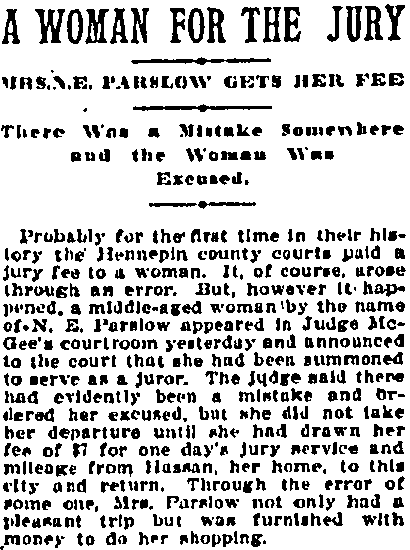
* Thanks to the wonders of database searches, research for this post also revealed a completely different legal drama off the same era related to a competely different Parslow. This story is from the Feb. 4, 1898 Minneapolis Journal.

** All reports do paint Cordelia Poirier as the stronger will in her adulterous relationship, as well as her marital one, and the instigator of the murder.

On this day..

1715: Lips Tullian, outlaw and comic hero

On this date in 1715, the legendary outlaw Filip Mengstein was broken on the wheel in Dresden’s marketplace, along with four henchmen.

With the wiseguy nickname “Lips Tullian”, our cutthroat’s gangland derring-do cuts a truly timeless profile. But it happens that Lips did his cutting in the environs of Saxony and Bohemia, exploiting for many years lax domestic security in the Holy Roman Empire occasioned by the preoccupations of the Great Northern War. Legend has it that he was a former dragoon forced to take to the road around 1702 when he slew a comrade in a duel.

From wilderness haunts — there’s still a “Lips Tullian Hill” in Saxony’s Tharandt Forest — Tullian’s “Black Guard” gang sallied into towns to raid prosperous homes and churches. When caught, he had a knack for the dramatic breakout, returning again and again to his gang.

Alas, it was an unsuccessful escape attempt in 1713 that finally caused his captors of the day to realize who they had and put him to torture and, eventually, the brutal breaking-wheel execution.

Immortalized in subsequent folklore, especially in Bohemia, Lips Tullian is best noted recently as the subject of a popular 1970s Czech comic published (until Communist authorities suppressed it) by Mlady Svet. The illustrator Kaja Saudek based his Lips Tullian on the romantic 19th century interpretation of Kvidon de Felses — presenting him as a gold-hearted rogue with an impressively chiseled physique.

On this day..

1884: Two abusive husbands

On this date in 1884, a Louisiana man named Noah Jackson was hanged at Lake Providence for beating in the brains of his 15-year-old wife during a fit of jealousy. (She’d been only 13 years old when they married.)

Meanwhile, in Corsicana, Tx., Harrison Williams hanged for murdering his sister-in-law Ada Sallard.

“The particulars in the murder case,” reported the Dallas Weekly Herald on June 28, 1883, “are as follows:”

Munroe Sallard and Harrison Williams, two colored men living on adjoining farms about five miles from town, married sisters. Williams has been abusing his wife ever since their marriage; on Monday morning Williams beat his wife in a brutal manner, and on being remonstrated with by her sister, Mrs. Sallard, told her that if she said a word he would kill her. Mrs. Sallard started for town on horseback to have him arrested, and when near the fairgrounds on her way home was way-laid by Williams, who took her from her horse, tied a handkerchief around her throat and then mashed her head to a shapeless mass with his boot heel. He then secreted her body in the woods, and went to her house and occupied the same bed with her husband, leaving yesterday morning [meaning June 26]. Since then he has not been seen. Her body was discovered in the woods yesterday evening, and last night an armed posse of negroes went in search of the murderer. If caught he will certainly dangle.

He sure did.

On this day..

1852: “Brown”, lynched in California

In extending [Cesare] Beccaria‘s views on capital punishment to the history of lynching in the West, one begins to see that the “violent passions” of the mob were regularly invoked to justify their actions, but as Beccaria predicted, these passions were often little more than a ruse to justify the cold-blooded — and often premeditated — lynching of an accused criminal. Taken as a whole, the case list demonstrates that by and large, lynching had as much to do with vengeance as with the pursuit of justice.

The frequent invocation of San Francisco’s vigilance committees in many of the case records is clearly intended to link extrajudicial execution to “tradition,” an essential element found in the Tuskegee definition of lynching.* On a formal level, well over 50 percent of lynching cases that give a time, record that the lynching took place between midnight and 2 a.m. when the accused was usually encouraged to confess his or her crimes before being strung up. Sometimes they were allowed to make a statement, to smoke a cigarette, or confess to a priest, and after it was over, the bodies would usually be left to hang through the night. This public display of the body can be found in every case, with the shortest times usually lasting around thirty minutes, and the longest, until the bodies decayed.

In one instance, in the small village of Newtown, an African American man known only as “Brown” was apprehended for stealing money. The evidence was completely circumstantial but he was found guilty and sentenced to be hung by the mob on March 4, 1852. Unfortunately for Brown, the rope was a little too long, and once he was hanged to the tree, the branch slowly gave way — until his legs dangled to the ground. Struggilng in agony, the poor man was cut down in order to be properly hanged. Once he was fully revived, he was tied to a higher branch and the whole process was repeated. When he was finally cut down, a physician was asked to examine the body, at which point he annunced that if Brown’s body was left above ground for five minutes that he would regain consciousness. As a result, “he was therefore hastily dumped into a grave that had been dug and was half full of water, and quickly covered from sight.” Whether completely true or not, it’s hard to imagine that anyone could argue that this killing really served the greatest good.

* The Tuskegee lynching definition: “there must be legal evidence that a person has been killed, and that he met his death illegally at the hands of a group acting under the pretext of service to justice, race, or tradition,” where “a group” connotes three or more persons.

On this day..

1882: Bob Jones and Billy Miller, murderers on the open road

Bob Jones and Billy Miller were hanged together on this date in 1882 for the murder of three sons of Judge J.P. Walker.

The Walker boys had been traveling together for an Arkansas plantation to which their prosperous Alabama father was relocating the family. They “encamped three miles west of Aberdeen [Mississippi], and on Sunday evening some persons passing by found them lying on mattresses, covered with quilts, each with his head split open as though with an axe.”

Miller, a black man, was picked up “under suspicious circumstances” and at the point of lynching he was forced to confess the crime. When he later attempted to disavow it, Judge Walker visited him in his cell, and (per the New Orleans Times-Picayune of Dec. 8, 1881) made the following chilling-but-practical appeal:

I am the father of these murdered boys. I can assure you that you will certainly be hung, if you don’t meet a worse death. It will do you no good to die with a lie on your lips about this matter. I came to get the truth, and you can gain nothing by telling me a lie, for your doom is sealed. Tell me all about the murder of my sons.

According to to the newsmen, Miller then proceeded to tell all. There’s just something persuasive about the grief of a father with a lynch mob at his back.

Per Miller’s confession, he happened by the camp of the Walkers, whose party was actually a foursome. The other white man with them, also just a chance fellow-traveler, pulled Miller aside as he rested by the campfire and indicated that the Walkers, schlepping a wagon full of effects from the Alabama plantation to the Arkansas one, were worth the trouble to put out of the way: “There’s big money in this.” They then axed the trio as they slept.

Miller said that the white man took all the money they could find, giving Miller only a bogus promise to meet him to divide it, and then absconded. The two would next lay eyes on each other in late December, when Jones was apprehended. It had been a job to get him; descriptions of him were shaky and Miller himself didn’t know anything about his accomplice — so random tramps, strangers, and solo sojourners were grabbed and interrogated willy-nilly for some weeks until Jones’s own brothers finally supplied the tip that he had met the Walkers and come back with a gold watch.

Once located, Jones too confessed — in his case, we are assured, “without a semblance of violence and by kind argument.” Surely there was some semblance of violence, since both men were reportedly “in great fear of lynching” even by that time, a month after the murders.


Columbus (Ga.) Daily Enquirer, Dec. 29, 1881.

Four thousand people were reported to have turned up in Aberdeen to witness these accidental confederates hang for their opportunistic crime. Jones fainted away as he was being arranged on the scaffold; Miller bore it better and swung off with a sad dirge on his lips.

On this day..

1996: Antonio James, final judgment

On this date in 1996, Antonio James downed a last meal of fried oysters and crab gumbo, then went to the death chamber of Angola Prison to suffer lethal injection for the murder of Henry Silver.

Silver was a 70-year-old fellow whom James shot dead in a New Orleans robbery way back in 1979. (Net return: $35.) A few weeks later, he bungled another robbery and ended up shot with his own gun … and under arrest. It was his second murder conviction. Although James dodged 13 death dates and was the senior figure on the state’s death row when his time came, his was pretty unremarkable as death penalty cases go.

This did chance to be the first execution in Louisiana after the film Dead Man Walking (which is set in that state) was released, and it got a bit of additional media coverage as a consequence.

James’s last hours became the subject of the ABC Primetime Live documentary Final Judgment (or Judgment at Midnight). It’s a little hard to come by clips of this program online, but here’s one review, and here’s another. In it, the warden Burl Cain* described James’s execution.

Well, he was laying there, and then he kind of grabbed my hand, so I held his hand, and then I told him, ‘He’s waiting for us. Get ready, we’re going for the ride.’ And I said, ‘The angels are here.’ He kind of smiled, and he said, ‘Bless you.’ That’s the last words he said. And then I nodded my head to go ahead. He was holding my hand real tight. And then after a couple of minutes, he took about three or four deep breaths, and then he relaxed my hand. I do believe right now his soul is in heaven, and he’s OK. And since I believe that, it makes it easier.

* In the Angola memoir In the Place of Justice: A Story of Punishment and Deliverance by onetime Louisiana death row habitue turned prison journalist Wilbert Rideau, Cain comes off as a real camera-hound.

On this day..

1786: Joseph Rickards, aspiring milkman

(Thanks to Meaghan Good of the Charley Project for the guest post. -ed.)

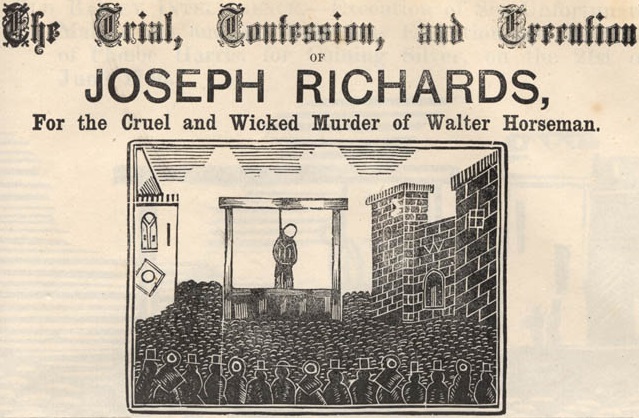
On this day in 1786, Joseph Richards or Rickards was executed in Kentish Town, London for the murder of his former employer, Walter Horseman, whom he attacked on February 11.

Graham Jackson and Cate Ludlow described the crime in the most graphic terms in their book A Grim Almanac of Georgian London:

At around 2:00 a.m., Mary Horseman of Kentish Town was woken by the sound of her ten-year-son calling out that his father, London milkman Walter Horseman, needed her… Mary found her husband sitting on his bed. By the light of the moon, which was flooding through the large bay windows, she could see that he was quite black with blood, which covered him from his face to his waist. “Lord bless me,” he said. “Something has run over my face!”

“Run over your face?” she responded. “Why, you are nothing but blood!” She ran for a candle, and when she returned, the light revealed a truly hideous sight: her husband was cut to pieces, his forehead, eyes and nose smashed. His skull, which was broken, was described in court as “cut and mangled in a desperate manner.” The two sections of the skull had broken apart, and his eye sockets had been smashed into shards.

There was nothing to be done for Walter, but amazingly, he lingered until the 19th, over a week after the assault. Due to his head injuries and the fact that he’d been attacked while he was sleeping, he wasn’t able to provide any useful information as to what happened.

The murder weapons were left behind at the crime scene: they proved to be a wooden hedge stake and an iron bar, which was “jellied” with gore.

Only a few farthings were missing from the house. The Horsemans’ four-year-old daughter, who was sleeping in the same room as her father, was not harmed. Suspicion quickly fell on Rickards, the Horsemans’ former apprentice, whom they’d recently sacked for laziness. He had no alibi for the night of the murder, a night watchman saw him near the Horsemans’ home about an hour after the attack, and Mary identified the hedge stake as one he had cut several days before the attack.

Nevertheless, he seemed confident and didn’t bother to leave the area. In fact, in an incredible display of chutzpah, he actually visited his ailing former master and shook his hand before Walter died. Perhaps his cockiness — or obliviousness — was a product of his immaturity; in an age of doubtful record-keeping, we can’t be sure of Joseph Rickards’s age but he was certainly quite young. Mary Horseman speculatively pegged the ex-apprentice as an 18-year-old; the London Times (Feb. 24, 1786) thought that he did “not appear to be more than sixteen years of age.” Although even 16 would be quite old enough to hang in Bloody Code London, the magistrate felt constrained on account of the boy’s age to caution his jurors against excess confidence in the confession he ultimately produced:

I should not for one, though he is very near the state of manhood, chuse to rest singly and merely on his confession, as he is not at full age, though he is above that age of discretion, which the law assigns to be at the age of fourteen years, and certainly it is near the time that human reason is supposed to be mature.

On the 20th, the day after Walter’s death, Rickards was arrested. Within a day he had admitted to concealing himself in a large cupboard in one of the bedrooms in order to beat his former boss to death in his bed. (The trial records are here.) He tried to shift some of the blame to Mary Horseman, claiming they had frequently kissed and he had “laid hold of” her breasts, and that she had told him she wished her husband was dead.

He was hanged in a field across the way from the Horseman family’s dairy — a pathetic spectacle, to judge by the account of the Public Advertiser (Feb. 28, 1786), during which he recanted his allegations against the milkman’s widow.

In his way to the place of execution, the convict appeared to be in a state of mind bordering upon stupefaction: He had no book, nor did he employ the short remnant of time in those preparations for eternity which his miserable situation rendered so indispensably necessary.

Before being turned off, the prisoner desired to see the widow of the deceased; she was sent for to her house, but was gone to London: he declared he had no accomplice in the fact, and that he was induced to the perpetration thereof by the supposition, that after the decease of his master he should succeed to his business as a milkman. Just before coming to the village, he burst into tears, and when he came to the place of execution wept bitterly; his expressions of sorrow and contrition being only interrupted by fervent appeals to Heaven for mercy till the last moment of his existence. He desired his hat might be given to one, and his buckles to another man; and he also made some other trifling dispositions.

One of the Sheriffs, and a great number of their officers on horseback and on foot, attended on the above occasion. Considering the nature of the criminal’s offence, and the disposition of the English to behold spectacles of horror, the crowd was not near so great as might have been expected, owing, no doubt, to the fall of snow, and going so early. The body of the malefactor was conveyed from Kentish Town to Surgeons Hall for dissection, without a shell, and covered only with a coarse cloth, which by the motion of the cart was frequently so removed, that the head and different parts of the body were frequently seen by the passengers on the road and in the streets.

The anatomization, and accompanying public lecture on the late Rickards’s thorax, was performed by a “Dr. Cooper” (General Evening Post, Feb. 28-Mar. 2, 1786); this would appear to be the budding anatomist Astley Cooper who was only 17 years old himself at this time — just at the outset of a scintillating medical career.


THE TRIAL.

Old Bailey, February 24th, 1786.

Joseph Richards was arraigned for the wilful murder of Walter Horseman, milkman, in Kentish Town. The deceased’s widow deposed, that the prisoner was formerly a servant to her husband; that he was discharged for negligence; that he had frequently threatened vengeance on the deceased; that on the morning the murder was committed, she was awakened by a noise, and on entering the room her husband slept in, she found him sitting up in the bed, and as far as his waist in blood; that a stick which the prisoner had cut some time before, lay in the room, and an iron bar, covered with blood; that her husband was mangled in a shocking manner: — he lingered a few days, and died a shocking spectacle.

Four other witnesses were examined, whose testimony proved certain corroborating circumstances; such as, being from his lodging the night the murder was committed, being seen to melt lead, and to pour it into the stick that was found in the deceased’s room, &c.

The prisoner confessed the murder to one of the magistrates who committed him for trial; but pleaded Not Guilty at the bar.

The jury, after a few minutes’ consideration, brought in their verdict Guilty.

Mr. Recorder pronounced judgment. He said the voice of innocent blood cried to heaven for vengeance. He dwelt upon the atrociousness of the crime of murder, observing, that the Divine Law had ordained, that whoever sheddeth man’s blood, &c., and then expatiated on the peculiar circumstances of the murder, the murder of an innocent master, to whom he owed duty and reverence.

The sentence was then passed as usual, that he be hanged till dead, and anatomized; and an order of Court was made out, to execute him on Monday, at Kentish Town, as near as possible to the house of the deceased.

THE EXECUTION.

Joseph Richards, a youth about eighteen, who was convicted on Friday last, for the wilful murder of Walter Horseman, with whom he lived servant, was executed at Kentish Town, opposite the house where the horrid fact was perpetrated. The malefactor came out of Newgate about twenty minutes before eight o’clock, and with some alertness stepped into the cart, which conveyed him through Smithfield, Cow Cross, and by the two small-pox hospitals to the spot, where he was removed from that society of which he had proved himself a most unworthy member, at a time of life when such atrocity of guilt as he possessed has been seldom known to degrade humanity. In his way to the place of execution, the convict appeared to be in a state of mind bordering upon stupefaction; he had no book, nor did he employ that short remnant of time in those preparations for eternity which his miserable situation rendered so indispensably necessary.

Before being turned off, the prisoner desired to see the widow of the decreased; she was sent for to her house, but was gone to London; he declared he had no accomplice in the fact, and that he was induced to the perpetration thereof by the supposition, that after the decease of his master he should succeed to his business as a milkman. Just before coming to the village, he burst into tears and when he came to the place of execution, wept bitterly; his expressions of sorrow and contrition being only interrupted by fervent appeals to Heaven for mercy till the last moment of his existence.

On this day..

1785: Barbara Erni, the Golden Boos

Tiny Liechtenstein last conducted an execution 230 years ago today: Barbara Erni — the legendary “Golden Boos”.

Nicknamed for her strawberry blond hair, the Golden Boos had an ingenious scam that required every bit of her Bunyanesque strength: she would wander the countryside and check into inns with a large chest or pack. Intimating that the parcel contained something of great value, she would insist upon its overnight safekeeping in a very secure room.

Once the inn had tucked in for the night, a diminutive accomplice would emerge from the trunk, plunder the lonely room of its valuables, and the two would escape into the night. Evidently, secure rooms in 18th century Liechtenstein were never secured from the inside.

She admitted to 17 such thefts. Liechtentein, whose population at the present time numbers fewer than 40,000 souls, had to import the executioner to chop off Barbara Erni’s Golden Boos on a public scaffold in Vaduz on February 26, 1785.

Liechtenstein officiall abolished the death penalty in 1987.

On this day..

1848: Harriet Parker, crime of passion

(Thanks to Meaghan Good of the Charley Project for the guest post. -ed.)

On this date in 1848, Harriet Parker was publicly hanged in front of the Debtors’ Door at Newgate for the murder of her lover’s two young children.

The sad story is described in Nicola Sly’s In Hot Blood: A Casebook of Historic British Crimes of Passion.

Harriet was a widow. Her partner, Robert Henry Blake, was legally married to another woman, but they were separated and he lived with Harriet and two of his children by his wife: Amina, age seven, and Robert Jr., age five.

Despite residing at Cupid’s Court in London, their relationship was far from blissful. Robert was an inveterate womanizer who openly flaunted his affairs. It all came to a head on New Years’ Eve, 1847, when Robert told Harriet he was going to the theater without her. He’d made plans with a friend, Stephen Hewlett, and she wasn’t invited.

Harriet was furious and suspected, rightly, that Robert was actually going to be with another woman. She followed him as he left their home and tagged along behind him wherever he went, telling him he’d better get used to it because she would be with him all night.

Robert did meet up with his friend Stephen and complained of Harriet’s jealousy. “If I was to kiss that post,” he said, “she would be jealous of it.” Eventually he was able to give Harriet the slip, though, and went immediately to a prostitute’s house, where he stayed the night.

Harriet, meanwhile, angrily searched for her errant lover for hours, saying darkly that Robert would regret his actions for the rest of his life.

“I will do something that he shall repent and will die in Newgate,” she told Stephen Hewlett. She added, “I have something very black in mind … You will hear of me before you see me.”

He didn’t take her seriously. He should have.

A few hours after midnight on New Years’ Day, witnesses saw Harriet walking the city streets with little Amina, still asking people if they’d seen Robert. The next time anyone saw her was at 4:00 a.m. She was alone, and knocked frantically at her neighbor’s door. The neighbor opened the bedroom window and looked out, and asked what on earth was wrong.

“Oh, Mrs. Moore, I have done it,” Harriet said. She added that Blake had “met a little strumpet” and left her last night, and hadn’t come home. “A pretty spectacle is there for him when he does come home,” she added. “I shall go and deliver myself up to a policeman.”

Her neighbor asked why and she replied, “I have murdered the two children.”

That got Mrs. Moore’s attention and she sent her husband to find a police officer. Harriet herself went looking and found one, and asked to be arrested, but she didn’t disclose the reason until they were on the way to the station house. Finally she unburdened her secret:

I have murdered the children to revenge their father. They were innocent — through my vindictiveness I have done the deed.

A look in at the Blake/Parker house showed Harriet was telling the truth: Amina and Robert Jr. were lying in bed, quite dead. They had been smothered and their bodies were still warm. Harriet’s clothes were stiff with dried blood, but it wasn’t the children’s; it was her own blood, from a beating Blake had given her a few days before.

Harriet had to be persuaded not to plead guilty to her crimes from the outset. At her trial, which was presided over by two judges, her defense was that of provocation. Her attorney argued that Robert’s horrible treatment of her had driven her out of her mind and she was not a “responsible agent” at the time of the murders.

The jury was out for only ten minutes before returning with a verdict of guilty of willful murder. The automatic sentence was death, but the jurors included a strong recommendation of mercy because of the provocation Harriet had received. (Even after the murders Robert had boasted of all the women he’d seduced during the time he lived with Harriet.)

Judge Baron didn’t agree with the jury, pointing out that “the children gave her no provocation at all.”

Nevertheless, he promised to pass the recommendation on to the Home Secretary. When the two judges passed their sentence on the convicted woman, they emphasized that she had no right to take her feelings about Blake out on two “unoffending children” who were “in a sweet, innocent sleep.”

Harriet cried out, before being lead from court, “God forgive you, Robert. You have brought me to this.”

The Home Secretary did receive the jury’s recommendation of mercy, but didn’t act on it. The widespread perception was that if Harriet had murdered her louse of a partner rather than his children, she would gotten off with a lesser verdict of manslaughter. But the deaths of two small children, killed for the actions of their father, could not be countenanced.

Harriet spent her last days dictating letters to people. In one of several letters sent to Blake, she wrote, “Awful as my fate is, I would rather die than live again the wretched life I have done for the last twelve months.” She sent him a Bible and a pair of cuffs she’d knitted, and advised him to return to his wife and forsake drinking, bad company and other women.

The crowd of persons assembled to witness the awful scene was immense, and far exceeded in number those present at any execution of late — their conduct, also, we regret to add, was worse than usual, the yells and hootings which prevailed for some time previous to the culprit making her appearance being perfectly dreadful.

London Times, February 22, 1848

Mrs. Moore visited her in her cell and found her surprisingly at ease. “I have received more kindness in Newgate than ever since I left my mother’s home,” Harriet told her former neighbor.

Harriet was hanged by one of Britain’s most famous executioners, William Calcraft — although it was never the tidiness of his executions that he was famous for. Calcraft didn’t handle Harriet all that well, either: according to one account, Harriet’s “muscular contortions and violent motion of the hands and arms … were truly dreadful” as she choked to death. Her frame was so slight that the fall didn’t break her neck.

On this day..