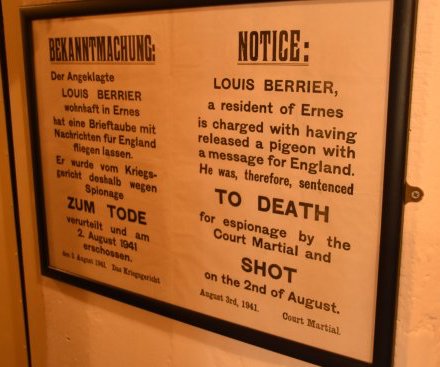
1941: Louis Berrier, messenger pigeoner

Notice: Louis Berrier, a resident of Ernes is charged with having released a pigeon with a message for England. He was, therefore, sentenced to death for espionage by the court martial and shot on the 2nd of August.
From the Channel Island Military Museum on the Channel island of Jersey; image courtesy of Trip Advisor.

On this day..

1819: Robert Watkins, Hang Day Fayre

Today is the bicentennial of the day in the national limelight for the Wiltshire village of Purton Stoke: the July 30, 1819 execution of Robert Watkins for an infamous robbery-murder.

Watkins, an impecunious bare-knuckle pugilist, murdered coal merchant Stephen Rodway to steal his boodle only to find that the diligent bourgeois had marked his banknotes as a failsafe making it possible to trace their subsequent circulation back to Watkins’s red hands.

So notorious was the crime in its day that ten to fifteen thousand people crowded into the small settlement to see the man pay his penalty, and on minimal notice: it occurred only two sleeps after Watkins’s conviction.

At an early hour of the morning, and at the time of the execution, the number of persons in the road and neighbouring fields was immense. That which was not seen in the prisoner, was evident in most of them — a fearful and breathless anxiety, a solemn stillness, and a deep expression of melancholy thought. There was in him a composure and resignation worthy of a better cause; and were not the proofs of his guilt striking, almost beyond example, his firmness of soul must have extorted compassion in all, and a conviction of his innocence. He was earnestly and feelingly entreated by the chaplain, and by some who were deemed likely to make an impression on him, to disburden his soul of part of its guilt by confession; but he was decisive in his denials of any participation in the deed, and only allowed that he was close to the spot where the murder was committed; in every other respect than that of confession, his behaviour was proper and becoming. Near to the fatal spot, the cart passed his wretched mother; he looked steadfastly at her for some moments, and with a gentle inclination of head and great expression of feature, seemed to take an external farewell of her; but soon after, on the cart stopping from some obstruction, she came up again, and he shook hands with her without losing any of his composure. On the scaffold he joined in earnest prayer with the same unsubdued firmness, and at his own desire, read aloud the 108th Psalm, “O God, my heart is ready;” and afterwards said to the crowd. — “God bless you all.” On the hangman’s adjusting the rope, he observed, that it could only “kill the body;” the action of his lips and hands showed that he was absorbed in prayer till the moment of his death. He was launched into eternity exactly at a quarter past 2 o’clock, and he died without a struggle. Almost at that instant of time, and before the last convulsions were over, a loud clap of thunder burst over the spot where the innumerable multitude had collected, and for half an hour afterwards, redoubled peals reverberated awfully through the heavens. The crowd, who behaved throughout with great propriety, then quietly dispersed.

London Times, Aug. 1, 1819

From the lordly vantage of some idiot execution blogger, this all seems like a pretty mundane crime two centuries later. But it’s still a lively enough memory in Purton Stoke, where the former site of the gallows is still known as Watkins Corner, that the town held a commemorative Hang Day Fayre in 2007, complete with a Watkins execution re-enactment.

On this day..

1955: Frederick Arthur Cross, “not a bit sorry for myself”

“I made up my mind to do away with myself and bought a tin of rat poison, but hadn’t the courage to do it. When I saw the man in the public house I got the idea that if I killed him I would be hanged. I’m not a bit sorry for myself, but I am sorry for him and I wish I’d known before this that he was married.”

Frederick Arthur Cross, depressed after his wife left him, insisting to his judge on pleading guilty to the capital murder of a stranger in a ‘suicide by executioner’ case. Cross was hanged on July 26, 1955.

On this day..

1775: Not Richard Carpenter, strong swimmer

20th [July 1775]. Mr. Carpenter was taken by the night Patrole — upon examination he had swum over to Dorchester and back again, was tried here that day and sentence passed on him to be executed the next day, — his coffin bro’t into the Goal-yard, his halter [noose] brought and he dressed as criminals are before execution. Sentence was respited and a few days after was pardoned.

-from the diary of Boston selectman Timothy Newell

On or around this date in 1775, an immigrant wig-maker was faux-executed by the British garrisoned in a besieged Boston.

Richard Carpenter was not a figure of decisive importance to the onrushing American Revolution but the excellent and venerable blog Boston 1775 by J.L. Bell has made a wonderful little microhistory of the man by cobbling together his appearances across different sources from his first 1769 business advert until his 1781 death in a British prison hulk.

Carpenter swam across Boston harbor to escape to patriot lines, then swam back into Boston; the Brits who captured him naturally took him for an enemy agent who could have been hanged … but from multiple reports (sometimes with muddled dates) this fate was “merely” visibly prepared for him only to be abated shortly before execution. In Bell’s speculation, hostilities were still not yet fully matured and “neither side had the stomach for such fatal measures. The executions of Thomas Hickey and Nathan Hale were still several months away.”

For an extraordinary snapshot of this revolutionary everyman, click through the full series:

On this day..

1909: William Hampton, Cornwall ghost

The last man executed in Cornwall, William Hampton, hanged in Bodmin on this date in 1909.

Hampton was in the awkward position of making time with a 16-year-old girl whose mother he was boarding with, and then having the girl break things off with him.

Probably a change of lodgings would have suited all best, but Hampton moved to Bodmin Jail by throttling poor Emily Tredea to death one night that May. The exact trigger for the murder was never clear, as the eventual murderer had been living amicably in the house for a spell even after Tredea’s breakup. The jury recommended mercy for Hampton on account of his youth, his lack of previous criminal record, and a crime that appeared to be at least somewhat heat-of-the-moment. The judge made the contrary recommendation on account of Hampton’s having spent several minutes to choke out his ex-girlfriend, then fled from the law, showing some degree of intent and mens rea. The judge’s recommendation carried the day with the Home Office.

Apparently his revenant spirit has been captured on camera haunting Bodmin Jail.

On this day..

1743: The Black Watch mutineers

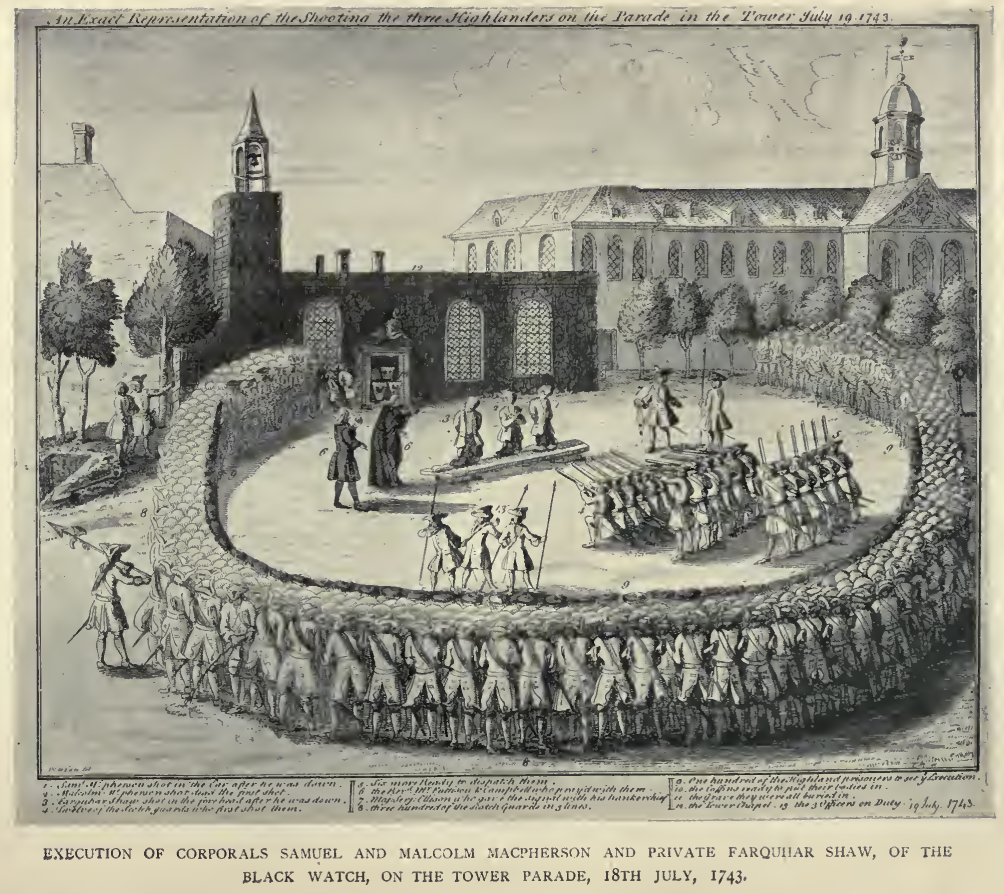
On this date in 1743, three leaders of the Scottish “Black Watch” were shot in the Tower of London for mutiny.

The recruits of the 43rd Highland Regiment of Foot* had been assured that their service would remain in-country only, and given that there was continental war raging at the time this was valuable assurance indeed — or would have been, if not for the propensity of military recruiters to lie wantonly.

The Black Watch were inveigled to London on the premise that they were to be reviewed by His Majesty King George II.

Once there, they caught wind of an actual or rumored plan to ship them on to the continent … or worse, to swelter in the West Indies. About a hundred of their number upped sticks and set off back for native hearth and heather. Alas for them, they were intercepted by General George Wade** and returned to London for court-martial as mutineers. Save for three perceived ringleaders, Corporals Malcolm McPherson and Samuel McPherson, and private Farqhuar Shaw, who were shot in the Tower, the rest had sentences commuted … to punitive overseas deployments from Gibraltar to the aforementioned dreaded West Indies.

As for the remaining, un-deserted corps of the regiment? It got shipped off to Flanders, just as it feared.

* Later renumbered as the 42nd Regiment — hence this musical tribute to the “Forty Twa'”:

** Wade’s renown in defeating the imminent Jacobite rebellion of 1745 would earn him tribute in an impolitic stanza of “God Save the King” that is rarely performed.

Lord, grant that Marshal Wade
May, by thy mighty aid,
Victory bring.
May he sedition hush
And, like a torrent, rush
Rebellious Scots to crush.
God save the King.

On this day..

1591: Ralph Milner, Roger Dickenson, and Laurence Humphrey

(Thanks to the English Catholic Alban Butler for the guest post on three martyrs during Elizabethan England. This entry originally appeared in Butler’s hagiographical magnum opus Lives of the Saints which is in the public domain, although updated recent editions are also to be had from the usual booksellers. July 7 is the feast date for all three men described in this post; Dickenson and Milner were actually put to death on that date, while Humphrey’s execution date appears to be unrecorded. -ed.)

In this year [1591] there suffered at Winchester, on July 7, BB. Roger Dickenson and Ralph Milner, and on a date unknown Bd Laurence Humphrey.

Milner was a small farmer, or even a farm-labourer, and brought up a Protestant. Upon contrasting the lives led by his Protestant and Catholic neighbours, to the great disadvantage of the first, he put himself under instruction and was received into the Church; but on the very day of his first communion he was committed to prison for the change of religion. Here he was kept for a number of years, but his confinement was not strict and he was often released on parole, when he would obtain alms and spiritual ministrations for his fellow prisoners, and also use his knowledge of the country to facilitate the movements and work of missionary priests. In this way he made the acquaintance of Father [Thomas] Stanney, s.j., who afterwards wrote a memoir of him in Latin, and with the same priests assistance a secular priest, Mr Roger Dickenson, came to live in Winchester. He was a Lincoln man, who had made his studies at Rheims, and for several years he worked in the Winchester district, helped by Milner.

The first time Mr Dickenson was arrested his guards got so drunk that he was able to escape, but the second time, Milner being with him, they were both committed for trial: Dickenson for being a priest, Milner for “relieving” him. At the trial the judge, being somewhat pitiful for Blessed Ralph, who was old and had a wife and eight children looking to him, recommended him to make one visit as a matter of form to the Protestant parish church, and so secure his release. But, says [Richard] Challoner, Milner answered, “Would your lordship then advise me, for the perishable trifles of this world, or for a wife and children, to lose my God? No, my lord, I cannot approve or embrace a counsel so disagreeable to the maxims of the gospel.” As Father Stanney states that Milner was entirely illiterate, we must assume that this is a paraphrase of his reply. These two suffered together, one of the most moving couples in the whole gallery of English martyrs.

At the same assizes seven maiden gentlewomen were sentenced to death for allowing Bd Roger to celebrate Mass in their houses, but were immediately reprieved; whereupon they asked that they might die with their pastor, seeing that they undoubtedly shared his supposed guilt and should share also in his punishment: but they were returned to prison.

Laurence Humphrey was a young man of Protestant upbringing and good life who, having undertaken to dispute with Father Stanney (referred to above), was instead himself converted. Father Stanney in a brief memoir speaks very highly of the virtues of his neophyte and his energy in instructing the ignorant and relieving the needs of those in prison for their faith. But Humphrey being taken seriously ill, he was heard to say in delirium that “the queen was a whore and a heretic”; his words were reported to the authorities, and before he was well recovered he was committed to Winchester gaol. At his trial he confessed his religion, but denied memory of ever having spoken disrespectfully of the queen; he was nevertheless condemned, and hanged, drawn, and quartered in his twenty-first year.

On this day..

1791: Joseph Wood and Thomas Underwood, children

A sad selection from the Newgate Calendar:

JOSEPH WOOD AND THOMAS UNDERWOOD

Two Fourteen-year-old Boys, executed at Newgate, 6th of July, 1791, for robbing another Boy

Court to William Beadle. What age are you?

Fifteen.

Are you acquainted with the nature of an oath; supposing you do not speak what is true now, in the testimony you are going to give against the prisoners at the bar, what will become of you?

I shall go to hell, my Lord.

On the 17th of May, did you see the prisoners at the bar, or either of them?

Yes, I saw them both; I was on the other side of London-bridge; I never was in London before, I was asking for a lodging, and they brought me over to Saltpetre-bank, it was past six in the evening; then they knocked me down, took my money out of my pocket, and took my clothes which I had in a bundle; I lost five-pence: the clothes consisted of a jacket, a waistcoat, a shirt, and a pair of trowsers; I am very sure of the prisoners, I never saw them before, I never was in London before; my clothes were found on Joseph Wood , he was in a shop selling them in Rosemary-lane; a gentleman went and caught him, I was in the shop, and saw them there myself.

Old Bailey records

All the parties in this case were mere children, the malefactors being but fourteen years of age each, and the prosecutor no more than twelve!

Though of this tender age, yet were the two prisoners convicted as old and daring depredators. So often had they already been arraigned at that bar where they were condemned that the judge declared, notwithstanding their appearance (they were short, dirty, ill-visaged boys), it was necessary, for the public safety, to cut them off, in order that other boys might learn that, inured to wickedness, their tender age would not save them from an ignominious fate.

The crime for which they suffered was committed with every circumstance of barbarity. They forcibly took away a bundle, containing a jacket, shirt and waistcoat, from a little boy, then fell upon him, and would probably have murdered him had they not been secured. They had long belonged to a most desperate gang of pickpockets and footpads; but they were so hardened and obstinate that they would not impeach their companions, though the hopes of mercy were held out to them if they would make a confession, so that the villains might have been apprehended.

They were executed at Newgate, the 6th of July, 1791, apparently insensible of their dreadful situation.

On this day..

1450: James Fiennes, Baron Saye and Sele

Messenger. My lord, a prize, a prize! here’s the lord Say, which sold the towns in France; he that made us pay one and twenty fifteens, and one shilling to the pound, the last subsidy.

Cade. Well, he shall be beheaded for it ten times. — Ah, thou say, thou serge, nay, thou buckram lord! now art thou within point blank of our jurisdiction regal. What canst thou answer to my majesty, for giving up of Normandy unto monsieur Basimecu, the dauphin of France? Be it known unto thee, by these presence, even the presence of lord Mortimer, that I am the besom that must sweep the court clean of such filth as thou art. Thou hast most traitorously corrupted the youth of the realm, in erecting a grammar-school: and whereas, before, our forefathers had no other books but the score and the tally, thou hast caused printing to be used; and, contrary to the king, his crown and dignity, thou hast built a paper-mill. It will be proved to thy face, that thou hast men about thee that usually talk of a noun, and a verb; and such abominable words as no Christian ear can endure to hear. Thou hast appointed justices of peace, to call poor men before them about matters they were not able to answer. Moreover, thou hast put them in prison: and because they could not read, thou hast hanged them; when, indeed, only for that cause they have been most worthy to live.

Cade. Ye shall have a hempen caudle then, and the pap of hatchet.

Dick. Why dost thou quiver, man?

Say. The palsy, and not fear, provokes me.

Cade. Nay, he nods at us; as who should say, I’ll be even with you. I’ll see if his head will stand steadier on a pole, or no: Take him away, and behead him.

Say. Tell me, wherein have I offended most?
Have I affected wealth, or honour; speak?
Are my chests fill’d up with extorted gold?
Is my apparel sumptuous to behold?
Whom have I injur’d, that ye seek my death?
These hands are free from guiltless blood-shedding,
This breast from harbouring foul deceitful thoughts.
O, let me live:

Cade. I feel remorse in myself with his words: but I’ll bridle it; he shall die, an it be but for pleading so well for his life. Away with him! he has a familiar under his tongue; he speaks not o’ God’s name. Go, take him away, I say, and strike off his head presently; and then break into his son-in-law’s house, sir James Cromer, and strike off his head, and bring them both upon two poles hither.

All. It shall be done.

Say. Ah, countrymen! if when you make your prayers
God should be so obdurate as yourselves,
How would it fare with your departed souls?
And therefore yet relent, and save my life.

Cade. Away with him, and do as I command ye. [Exuent some, with Lord Say.] The proudest peer in the realm shall not wear a head on his shoulders, unless he pay me tribute…

-Shakespeare, Henry VI, Part 2

On this date in 1450, Jack Cade’s rebellion — momentarily in full control of London — visited popular justice on James Fiennes, Baron Saye and Sele.

Distant ancestor of the Amon Göth actor, our ancient Fiennes was the Lord High Treasurer and one of the principal supports of King Henry VI‘s increasingly shaky throne.

The men of Kent who had marched on London had experienced from these years the material and psychological injuries of the realm’s reversals. Their Proclamation of Grievances assailed not the sovereign himself but “the traitors about him.”

Item. They ask gentlemen’s goods and lands in Kent and call them rioters, and traitors and the king’s enemies, but they shall be found the king’s true liege men and best friends with the help of Jesus, to whom we cry day and night with many thousand more that God of His grace and righteousness shall take vengeance and destroy the false governors of his realm that has brought us to naught and into much sorrow and misery.

Item. We will that all men know we blame not all the lords, nor all those that are about the king’s person, nor all gentlemen nor yeomen, nor all men of law, nor all bishops, nor all priests, but all such as may be found guilty by just and true inquiry and by the law.

#Notalllords

The baddies are not named in the proclamation but it’s a sure bet that Lord Saye knew he wouldn’t be in the rebels’ good graces, given their demand for the expulsion from royal favor of “all the false progeny and affinity of the Duke of Suffolk.” Suffolk was one of Saye’s closest allies, or had been until Suffolk had been butchered at sea a few weeks prior. And so

the said captain again entered the citie, and caused the Lord Say to be fet [fetched] from the Tower to Guildhall, where he was arraigned before the maior, and other the king’s justices; and Robert Horne, Alderman before-named, should have been likewise arraigned, but that his wife, and other friends, for five hundred marks, got him restored to his libertie. The Lord Say desiring he might be tried by his peeres, was by the rebels forceably taken from the officers, and brought to the standard in Cheape, where they strake off his head, pight it on a pole, and bare it before them; and his body they caused to be drawne naked at a horse taile, upon the pavement, from Cheape into Southwarke, to the said captaines inne.

Also a squire, called Crowmer, that was then sherife of Kent, that had wedded the said Lord Saies daughter, by commandement of the captain, was brought out of the Fleete, that was committed thither for certain extortions that he had done in his office, and led to Mile-end without London, and there, without any iudgement, his head was smit off; and the Lord Saies head and his were borne upon two long poles unto London-bridge, and there set up; and the Lord Saies body was quartered.


Lord Saye and Sele brought before Jack Cade 4th July 1450, by Charles Lucy.

Jack Cade himself would be expelled from London within days, and dead by July 12.

On this day..

1915: Carl Frederick Muller, fluent in languages but not in espionage

57 year old Carl Frederick Muller was a fluent linguist, able to speak English, Russian, German, Dutch and Flemish. In October of 1914 he was living in Antwerp in Holland and had German soldiers billeted in his house. He was recruited into the German Secret Service in late 1914.

-From the June 23, 2019 Facebook post of the Capital Punishment UK Facebook page. Click through to find out how Muller’s abortive attempt to put his gifts to use for spycraft saw him standing in front of a British firing squad by June 23, 1915. He was the second of 11 German spies to meet that fate during the Great War.

On this day..