1680: William Howard, Viscount Stafford

(Thanks to Scottish Enlightenment titan David Hume for the guest post on William Howard, 1st Viscount Stafford — a Catholic peer who fell victim to the hysteria of Titus Oates‘s “Popish Plot”. It takes some time to build into the execution itself, since Hume in his History of England narratively locates it in the proto-Whig party’s frustrated parliamentary efforts to exclude from the succession the king’s Roman Catholic brother, the eventual King James II who at this time was the Duke of York. -ed.)

Besides friendship for his brother, and a regard to the right of succession, there were many strong reasons which had determined Charles to persevere in opposing the exclusion. All the royalists and the devotees to the church, that party by which alone monarchy was supported, regarded the right of succession as inviolable; and if abandoned by the king in so capital an article, it was to be feared that they would, in their turn, desert his cause, and deliver him over to the pretensions and usurpations of the country party. The country party, or the whigs, as they were called, if they did not still retain some propensity towards a republic, were at least affected with a violent jealousy of regal power; and it was equally to be dreaded that, being enraged with past opposition, and animated by present success, they would, if they prevailed in this pretension, be willing, as well as able, to reduce the prerogative within very narrow limits.

All menaces, therefore, all promises were again employed against the king’s resolution: he never would be prevailed on to desert his friends, and put himself into the hands of his enemies. And having voluntarily made such important concessions, and tendered, over and over again, such strong limitations, he was well pleased to find them rejected by the obstinacy of the Commons; and hoped that, after the spirit of opposition had spent itself in fruitless violence, the time would come, when he might safely appeal against his Parliament to his people.

So much were the popular leaders determined to carry matters to extremities, that in less than a week after the commencement of the session, a motion was made for bringing in an exclusion bill, and a committee was appointed for that purpose. This bill differed in nothing from the former, but in two articles, which showed still an increase of zeal in the Commons: the bill was to be read to the people twice a year in all the churches of the kingdom, and every one who should support the duke’s title was rendered incapable of receiving a pardon but by act of Parliament.

The debates were carried on with great violence on both sides. The bill was defended by Sir William Jones, who had now resigned his office of attorney-general, by Lord Russel, by Sir Francis Winnington, Sir Harry Capel, Sir William Pulteney, by Colonel Titus, Treby, Hambden, Montague. It was opposed by Sir Leoline Jenkins, secretary of state, Sir John Ernley, chancellor of the exchequer, by Hyde, Seymour, Temple. The arguments transmitted to us may be reduced to the following topics.

In every government, said the exclusionists, there is somewhere an authority absolute and supreme; nor can any determination, how unusual soever, which receives the sanction of the legislature, admit afterwards of dispute or control. The liberty of a constitution, so far from diminishing this absolute power, seems rather to add force to it, and to give it greater influence over the people. The more members of the state concur in any legislative decision, and the more free their voice, the less likelihood is there that any opposition will be made to those measures which receive the final sanction of their authority. In England, the legislative power is lodged in King, Lords, and Commons, which comprehend every order of the community: and there is no pretext for exempting any circumstance of government, not even the succession of the crown, from so full and decisive a jurisdiction. Even express declarations have, in this particular, been made of parliamentary authority: instances have occurred where it has been exerted: and though prudential reasons may justly be alleged why such innovations should not be attempted but on extraordinary occasions, the power and right are for ever vested in the community. But if any occasion can be deemed extraordinary, if any emergence can require unusual expedients, it is the present; when the heir to the crown has renounced the religion of the state, and has zealously embraced a faith totally hostile and incompatible. A prince of that communion can never put trust in a people so prejudiced against him: the people must be equally diffident of such a prince: foreign and destructive alliances will seem to one the only protection of his throne: perpetual jealousy, opposition, faction, even insurrections will be employed by the other as the sole securities for their liberty and religion. Though theological principles, when set in opposition to passions, have often small influence on mankind in general, still less on princes; yet when they become symbols of faction, and marks of party distinctions, they concur with one of the strongest passions in the human frame, and are then capable of carrying men to the greatest extremities. Notwithstanding the better judgment and milder disposition of the king, how much has the influence of the duke already disturbed the tenor of government? how often engaged the nation into meaures totally destructive of their foreign interests and honour, of their domestic repose and tranquillity? The more the absurdity and incredibility of the popish plot are insisted on, the stronger reason it affords for the exclusion of the duke; since the universal belief of it discovers the extreme antipathy of the nation to his religion, and the utter impossibility of ever bringing them to acquiesce peaceably under the dominion of such a sovereign. The prince, finding himself in so perilous a situation, must seek for security by desperate remedies, and by totally subduing the privileges of a nation which had betrayed such hostile dispositions towards himself, and towards every thing which he deems the most sacred. It is in vain to propose limitations and expedients. Whatever share of authority is left in the duke’s hands, will be employed to the destruction of the nation; and even the additional restraints, by discovering the public diffidence and aversion, will serve him as incitements to put himself in a condition entirely superior and independent. And as the laws of England still make resistance treason, and neither do nor can admit of any positive exceptions; what folly to leave the kingdom in so perilous and absurd a situation, where the greatest virtue will be exposed to the most severe proscription, and where the laws can only be saved by expedients, which these same laws have declared the highest crime and enormity.

The court party reasoned in an opposite manner. An authority, they said, wholly absolute and uncontrollable is a mere chimera, and is nowhere to be found in any human institutions. All government is founded on opinion and a sense of duty; and wherever the supreme magistrate, by any law or positive prescription, shocks an opinion regarded as fundamental, and established with a firmness equal to that of his own authority, he subverts the principle by which he himself is established, and can no longer hope for obedience. In European monarchies, the right of succession is justly esteemed a fundamental; and even though the whole legislature be vested in a single person, it would never be permitted him, by an edict, to disinherit his lawful heir, and call a stranger or more distant relation to the throne. Abuses in other parts of government are capable of redress, from more dispassionate inquiry or better information of the sovereign, and till then ought patiently to be endured: but violations of the right of succession draw such terrible consequences after them as are not to be paralleled by any other grievance or inconvenience. Vainly is it pleaded that England is a mixed monarchy; and that a law assented to by King, Lords, and Commons, is enacted by the concurrence of every part of the state: it is plain that there remains a very powerful party, who may indeed be outvoted, but who never will deem a law, subversive of hereditary right, any wise valid or obligatory. Limitations, such as are proposed by the king, give no shock to the constitution, which, in many particulars, is already limited; and they may be so calculated as to serve every purpose sought for by an exclusion. If the ancient barriers against regal authority have been able, during so many ages, to remain impregnable; how much more those additional ones, which, by depriving the monarch of power, tend so far to their own security? The same jealousy too of religion, which has engaged the people to lay these restraints upon the successor, will extremely lessen the number of his partisans, and make it utterly impracticable for him, either by force or artifice, to break the fetters imposed upon him. The king’s age and vigorous state of health promise him a long life: and can it be prudent to tear in pieces the whole state, in order to provide against a contingency which, it is very likely, may never happen? No human schemes can secure the public in all possible imaginable events; and the bill of exclusion itself, however accurately framed, leaves room for obvious and natural suppositions, to which it pretends not to provide any remedy. Should the duke have a son, after the king’s death, must that son, without any default of his own, forfeit his title? or must the Princess of Orange descend from the throne, in order to give place to the lawful successor? But were all these reasons false, it still remains to be considered that, in public deliberations, we seek not the expedient which is best in itself, but the best of such as are practicable. The king willingly consents to limitations, and has already offered some which are of the utmost importance: but he is determined to endure any extremity rather than allow the right of succession to be invaded. Let us beware of that factious violence, which leads to demand more than will be granted; lest we lose the advantage of those beneficial concessions, and leave the nation, on the king’s demise, at the mercy of a zealous prince, irritated with the ill usage which he imagines he has already met with.

In the House of Commons, the reasoning of the exclusionists appeared the more convincing; and the bill passed by a great majority. It was in the House of Peers that the king expected to oppose it with success. The court party was there so prevalent, that it was carried only by a majority of two, to pay so much regard to the bill as even to commit it. When it came to be debated the contest was violent. Shaftesbury, Sunderland, and Essex argued for it; Halifax chiefly conducted the debate against it, and displayed an extent of capacity, and a force of eloquence, which had never been surpassed in that assembly. He was animated, as well by the greatness of the occasion, as by a rivalship with his uncle Shaftesbury; whom, during that day’s debate, he seemed in the judgment of all to have totally eclipsed. The king was present during the whole debate, which was prolonged till eleven at night. The bill was thrown out by a considerable majority. All the bishops, except three, voted against it. Besides the influence of the court over them; the church of England, they imagined, or pretended, was in greater danger from the prevalence of presbyterianism than of popery, which, though favoured by the duke, and even by the king, was extremely repugnant to the genius of the nation.

The Commons discovered much ill humour upon this disappointment. They immediately voted an address for the removal of Halifax from the king’s councils and presence for ever. Though the pretended cause was his advising the late frequent prorogations of Parliament, the real reason was apparently his vigorous opposition to the exclusion bill. When the king applied for money to enable him to maintain Tangiers, which he declared his present revenues totally unable to defend; instead of complying, they voted such an address as was in reality a remonstrance, and one little less violent than that famous remonstrance, which ushered in the civil wars.

All the abuses of government, from the beginning almost of the reign, are there insisted on; the Dutch war, the alliance with France, the prorogations and dissolutions of Parliament; and as all these measures, as well as the damnable and hellish plot, are there ascribed to the machinations of Papists, it was plainly insinuated that the king had, all along, lain under the influence of that party, and was in reality the chief conspirator against the religion and liberties of his people.

Portait of William Howard as a young man by Anthony van Dyck, ~1638-1640. Howard was born in 1614, and beheaded at the age of 66.

The Commons, though they conducted the great business of the exclusion with extreme violence and even imprudence, had yet much reason for the jealousy which gave rise to it: but their vehement prosecution of the popish plot, even after so long an interval, discovers such a spirit, either of credulity or injustice, as admits of no apology. The impeachment of the Catholic lords in the Tower was revived; and as Viscount Stafford, from his age, infirmities, and narrow capacity, was deemed the least capable of defending himself, it was determined to make him the first victim, that his condemnation might pave the way for a sentence against the rest. The chancellor, now created Earl of Nottingham, was appointed high steward for conducting the trial.

Three witnesses were produced against the prisoner; [Titus] Oates [conjurer of the Popish Plot panic -ed.], [Stephen] Dugdale, and [Edward] Turberville.* Oates swore, that he saw Fenwick, the Jesuit, deliver to Stafford a commission signed by De Oliva, general of the Jesuits, appointing him paymaster to the papal army, which was to be levied for the subduing of England: for this ridiculous imposture still maintained its credit with the Commons. Dugdale gave testimony, that the prisoner at Tixal, a seat of Lord Aston‘s, had endeavoured to engage him in the design of murdering the king; and had promised him, besides the honour of being sainted by the church, a reward of five hundred pounds for that service. Turberville deposed, that the prisoner, in his own house at Paris, had made him a like proposal. To offer money for murdering a king, without laying down any scheme by which the assassin may ensure some probability or possibility of escape, is so incredible in itself, and may so easily be maintained by any prostitute evidence, that an accusation of that nature, not accompanied with circumstances, ought very little to be attended to by any court of judicature. But notwithstanding the small hold which the witnesses afforded, the prisoner was able, in many material particulars, to discredit their testimony. It was sworn by Dugdale, that Stafford had assisted in a great consult of the Catholics held at Tixal; but Stafford proved, by undoubted testimony, that at the time assigned he was in Bath, and in that neighbourhood. Turberville had served a noviciate among the Dominicans; but, having deserted the convent, he had enlisted as a trooper in the French army; and being dismissed that service, he now lived in London, abandoned by all his relations, and exposed to great poverty. Stafford proved, by the evidence of his gentleman and his page, that Turberville had never, either at Paris or at London, been seen in his company; and it might justly appear strange that a person, who had so important a secret in his keeping, was so long entirely neglected by him.

The clamour and outrage of the populace during the trial were extreme: great abilities and eloquence were displayed by the managers, Sir William Jones, Sir Francis Winnington, and Serjeant Maynard. Yet did the prisoner, under all these disadvantages, make a better defence than was expected, either by his friends or his enemies: the unequal contest in which he was engaged was a plentiful source of compassion to every mind seasoned with humanity. He represented, that during a course of forty years, from the very commencement of the civil wars, he had, through many dangers, difficulties, and losses, still maintained his loyalty: and was it credible that now, in his old age, easy in his circumstances, but dispirited by infirmities, he would belie the whole course of his life, and engage against his royal master, from whom he had ever received kind treatment, in the most desperate and most bloody of all conspiracies: He remarked the infamy of the witnesses; the contradictions and absurdities of their testimony; the extreme indigence in which they had lived, though engaged, as they pretended, in a conspiracy with kings, princes, and nobles; the credit and opulence to which they were at present raised. With a simplicity and tenderness more persuasive than the greatest oratory, he still made protestations of his innocence, and could not forbear, every moment, expressing the most lively surprise and indignation at the audacious impudence of the witnesses.

It will appear astonishing to us, as it did to Stafford himself, that the Peers, after a solemn trial of six days, should, by a majority of twenty-four voices, give sentence against him. He received, however, with resignation the fatal verdict. God’s holy name be praised! was the only exclamation which he uttered. When the high steward told him, that the Peers would intercede with the king for remitting the more cruel and ignominious parts of the sentence, hanging and quartering, he burst into tears: but he told the Lords that he was moved to this weakness by a sense of their goodness, not by any terror of that fate which he was doomed to suffer.

It is remarkable that, after Charles, as is usual in such cases, had remitted to Stafford the hanging and quartering, the two sheriffs, Bethel and Cornish, indulging their own republican humour, and complying with the prevalent spirit of their party, ever jealous of monarchy, started a doubt with regard to the king’s power of exercising even this small degree of lenity. “Since he cannot pardon the whole,” said they, “how can he have power to remit any part of the sentence?” They proposed the doubt to both Houses: the Peers pronounced it superfluous; and even the Commons, apprehensive lest a question of this nature might make way for Stafford’s escape, gave this singular answer: “This House is content that the sheriffs do execute William, late Viscount Stafford, by severing his head from his body only.” Nothing can be a stronger proof of the fury of the times than that Lord Russel, notwithstanding the virtue and humanity of his character, seconded in the House this barbarous scruple of the sheriffs.

In the interval between the sentence and execution, many efforts were made to shake the resolution of the infirm and aged prisoner, and to bring him to some confession of the treason for which he was condemned. It was even rumoured that he had confessed; and the zealous party-men, who, no doubt, had secretly, notwithstanding their credulity, entertained some doubts with regard to the reality of the popish conspiracy, expressed great triumph on the occasion. But Stafford, when again called before the House of Peers, discovered many schemes, which had been laid by himself and others for procuring a toleration to the Catholics, at least a mitigation of the penal laws enacted against them: and he protested that this was the sole treason of which he had ever been guilty.

Stafford now prepared himself for death with the intrepidity which became his birth and station, and which was the natural result of the innocence and integrity which, during the course of a long life, he had ever maintained: his mind seemed even to collect new force from the violence and oppression under which he laboured.

When going to execution, he called for a cloak to defend him against the rigour of the season: “Perhaps,” said he, “I may shake with cold; but I trust in God, not for fear.” On the scaffold he continued, with reiterated and earnest asseverations, to make protestations of his innocence: all his fervour was exercised on that point: when he mentioned the witnesses, whose perjuries had bereaved him of life, his expressions were full of mildness and of charity. He solemnly disavowed all those immoral principles, which over-zealous Protestants had ascribed, without distinction, to the church of Rome: and he hoped, he said, that the time was now approaching, when the present delusion would be dissipated; and when the force of truth, though late, would engage the whole world to make reparation to his injured honour.

The populace, who had exulted at Stafford’s trial and condemnation, were now melted into tears at the sight of that tender fortitude which shone forth in each feature, and motion, and accent of this aged noble. Their profound silence was only interrupted by sighs and groans. With difficulty they found speech to assent to those protestations of innocence which he frequently repeated: “We believe you, my lord! God bless you, my lord!” These expressions, with a faltering accent, flowed from them. The executioner himself was touched with sympathy. Twice he lifted up the axe, with an intent to strike the fatal blow; and as often felt his resolution to fail him. A deep sigh was heard to accompany his last effort, which laid Stafford for ever at rest. All the spectators seemed to feel the blow. And when the head was held up to them with the usual cry, This is the head of a traitor! no clamour of assent was uttered. Pity, remorse, and astonishment, had taken possession of every heart, and displayed itself in every countenance.
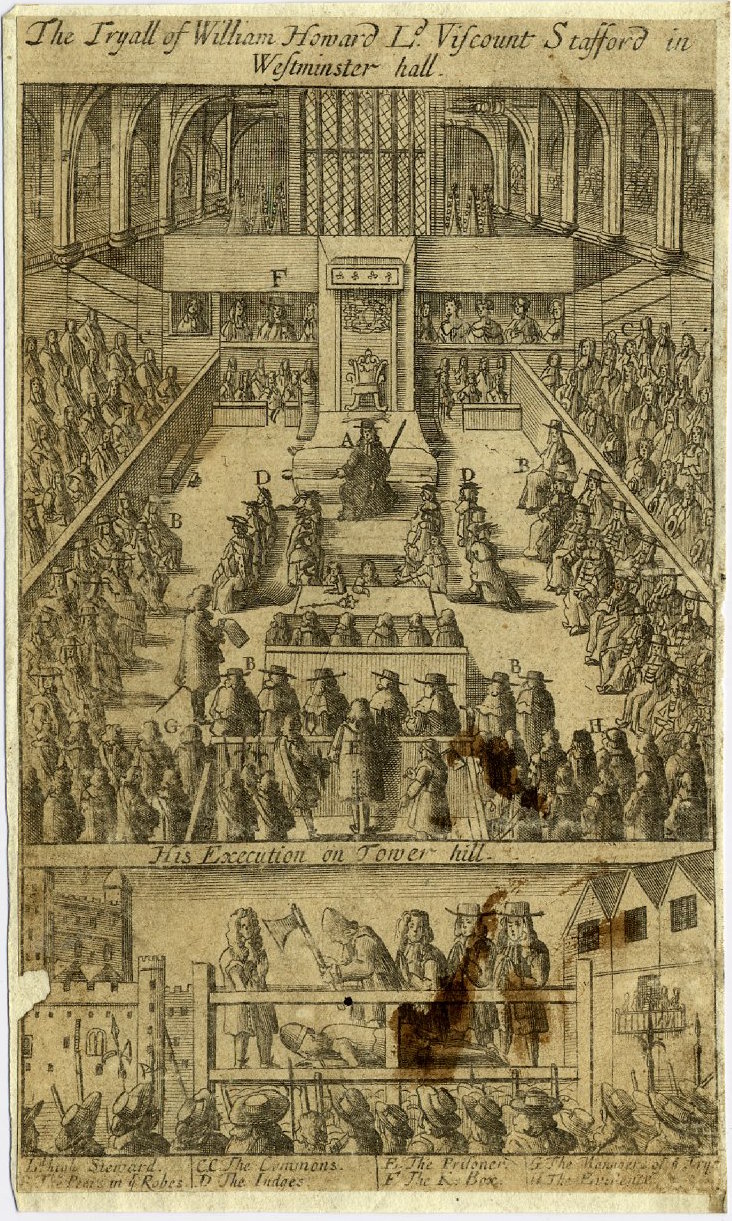

Detail view (click for the full image) of an engraving of the trial and execution of Viscount Stafford. (via the British Museum).

This is the last blood which was shed on account of the popish plot: an incident which, for the credit of the nation, it were better to bury in eternal oblivion; but which it is necessary to perpetuate, as well to maintain the truth of history, as to warn, if possible, their posterity and all mankind ever again to fall into so shameful, so barbarous a delusion.

The execution of Stafford gratified the prejudices of the country party; but it contributed nothing to their power and security: on the contrary, by exciting commiseration, it tended still farther to increase that disbelief of the whole plot, which began now to prevail.

* Channeling Jacques de Molay, Stafford prophesied that Turberville, the perjured witness against him, would not outlive him by so much as a year. Turberville obligingly dropped dead of smallpox late in 1681, after falling out with his former Popish Plot conspirator Titus Oates.

On this day..

1763: John Brannon, Joseph Jervis, Charles Riley, and Mary Robinson

On this date in 1763, four thieves hanged at Tyburn to great public indifference.

They were of such scanty account that one is hard-pressed to find a newspaper report of the executions; even the Ordinary of Newgate didn’t bother to publish on them until weeks later, when he could combine them with a pair of February hangings. (Perhaps because, as he notes in his account, three of the four were Catholic and so gave the Anglican minister short shrift on the confessional front.)

Two of the men — and also one prosecutor, the victim Peter Manchester, who was robbed of his prize money — appear to have been recently from royal service in the just-concluded Seven Years’ War: early avatars of the crime wave that would engulf London as demobilized soldiers and seamen swamped its labor market.

six persons were capitally convicted and received sentence of death, for the several crimes in their indictments set forth, viz.

John Brannon, John Edinburgh, Joseph Jervis, Charles Reiley [Riley -ed.], Mary Robinson, and Mary Williams.

And on or about Friday the 16th of December the report of the said malefactors being made to his Majesty, by Mr. Recorder, two of them were respited, namely, John Edinburgh, for horse-stealing; and Mary Williams, for being concerned with Charles Reily and Mary Robinson in the robbery of Peter Manchester; and the remaining four ordered for execution on Wednesday December the 28th, and were accordingly executed.

1. John Brannon was indicted, for that he, on the King’s highway, on Thomas Worley did make an assault, putting him in corporal fear and danger of his life, and stealing from his person one pair of silver shoe-buckles, value 10s. his property; and Jane Blake, otherwise Buckley, spinster, for receiving the same, well knowing them to have been stolen, October 17.

The prisoner Brannon was one of five in a desperate gang, who attacked the prosecutor Worley, and another, John Paget, in Church-lane, White-chapel, about 12 at night. Having searched them and found no money on them, they took a pair of silver buckles from each, and a handkerchief from Paget: Mean time Esq. Gore’s chariot passing by, they fired two pistols at it, because the coachman would not stop. Brannon was positively sworn to, as one of the two first that came up to the prosecutor, and held a pistol to him while he was robbed. He was detected and taken the next day by means of Jane Blake offering the buckles to a pawn-broker, Mr. Samuel Spencer, who stopped them, secured her, and sent constables to search her lodgings, where they took Brannon, found the other pair of buckles and the handkerchief before mentioned, and also a pair of horse pistols loaded.

His behaviour after sentence was in general such as became his unhappy condition; but being under the influence and direction of the church of Rome, he gave no account to me of his accomplices, or any other fact: Nor did he pretend to deny this, either at his trial or afterwards, as indeed there was no room for it. He appeared to be about thirty years of age, was born in Dublin, was by trade a Carver, and had served six years in the Royal Navy.

2. Joseph Jervis was indicted, for that he, on the 14th day of November, about the hour of two in the night, on the same day, the dwelling house of Joseph Hill did break and enter, and steal one silver spoon, value 1s. the property of the said Joseph in his dwelling.

This convict lived in King-street, Spitalfields; but how he supported himself there, whether by any honest labour, doth not appear either by his own confession, or the evidence of several witnesses for him, who gave only a negative character, that they never heard any ill of him. And supposing he had practised this wicked scheme of breaking into houses, and plundering them in the hour of deep sleep undiscovered for a time, ’tis hard to imagine how they could hear any ill of him, however criminal. As to the present fact, he had prowled away as far as Kingsland, a mile or two, at midnight, to perpetrate it. But here, luckily for the publick safety, he was mistaken in his mark, and fell upon a house well inhabited by a master Carpenter and his workmen: The former, awakened by the noise of wrenching open the frame of a cellar window, alarmed two or three of his men, who came upon him, and with some difficulty seized and secured him; in effecting of which, by means of his resisting and endeavouring to escape in the dark, he had received two unlucky strokes, one with a pistol and another with a hanger, both on the head; by which he was wounded, and made more deaf and stupid than he was before, for he laboured under both those defects during the time between sentence and execution. After he was apprehended, he was found to be furnished with a tinder-box, a dark-lantern, a candle, and an iron bar flatted at one end. A silver spoon was also found upon him, the property of Mr. Hill, the prosecutor.

He had the artifice to plead on his trial, that he was non compos, out of his mind, and knew not what he did. But being reminded by the Court that his situation was very serious, and no proof of this assertion being offered, it was urged no farther. After conviction and sentence passed, he still appeared to be very hard of hearing and dull of apprehension; so that it was a difficult task to instruct and prepare him, whether this was real or partly affected. He said he was born at Hertford, where he learned to read and write, and then was brought up to the trade of dressing flour, which he afterwards followed for several years in London, in or near Houndsditch; he was now about forty-five years of age.

After he had been daily visited, assisted with prayers, and the plainest instructions, he was now and then questioned what progress he had made in his preparation for an awful change; but could give very little satisfaction in that matter, only said, he would trust to Providence; meaning, that he would give no farther account of his past life, nor confess any other facts; tho’ he did not pretend to deny he was guilty of any other.

When he found himself included in the Death-warrant, it did not much affect him, as he seemed to expect it. Endeavours were renewed to prepare him for the holy communion; but with no better success; he pleaded he had lost his memory, as well as his apprehension; and that what he read or heard made little impression, and was quickly gone from him; so that he seemed incapable of celebrating that sacred act of remembrance. However, there seemed to be a greater want of disposition than capacity. To arouse and quicken him, therefore, to a sense of his duty in this respect, he was permitted to be present, and very near, at the administration of the communion in the chapel, the day before he suffered; so as that he could hear and see all that was spoken, or done, without admitting him to partake of it. Several intelligent good neighbours were present now, and on other occasions, who took opportunities to speak familiarly to him before and after service, in order to bring him to a better disposition. But neither did these means kindle in him that desire, which we hoped. He still continued in a languid indifference. As he could still read, and as his last evening was now come, a brief but excellent little tract on spiritual communion was put into his hands, to assist and raise his thoughts this last night of his life. He returned it to me the next morning, and said he had read it. Being asked whether he understood it, and applied it to himself? he replied, he did, as well as God gave him leave; his usual answer to such questions.

3, 4. Charles Reiley, labourer, and Mary Robinson, and Mary Williams, spinsters, were indicted for that they, in the dwelling house of Francis Talbot, near the King’s high-way, on the body of Peter Manchester did make an assault, putting him in corporal fear and danger of his life, and stealing from his person four guineas and one half-guinea, his property, against his will, October 18.

The prosecutor, Peter Manchester, was a sailor, come to town about a week, and had received five guineas prize money the very day of this robbery. Passing along Salt-petre Bank, he was forced into this house by Williams and Robinson, shut in, and his purse violently taken from him by these two women, assisted by Charles Reiley. He was also beaten by the women, while Reily threatened to cut off his hand, if he did not let go the purse to him; by which means Reily got it, containing four guineas and a half, and he and Robinson ran off with it. The prosecutor pursued, but missed them; he then applied to two of his shipmates and a constable to assist him. By help of these, and others, the two women were found out, and apprehended the same night. Robinson being searched, had two guineas and a quarter found concealed upon her. The two guineas she confessed before the Justice next day to be the property of the prosecutor, and that they were given to her by Charles Reily, one for herself, and one for Mary Williams, to reward them for their trouble; and that he kept two guineas and a half, the remainder of the money. But luckily for Williams she had not fingered the guinea; which circumstance, together with her not being able to follow Reily, to get her share from him, seem to be the distinguishing considerations, which might turn the scale for a respite to one of these three, rather in her favour. As for Reily he was caught in the very trap for such creatures of prey. The prosecutor being at Hicks’s-hall next day, to prefer a bill of indictment against them, had intelligence that Reily was then drinking at Newgate, only as a voluntary visiter, went directly and found him there; and tho’ he fled, and had a long run for it, from thence to St. Dunstan’s church, he was there taken, detained in the cage at St. John’s, Wapping, examined, and committed, having confessed the fact, but said it was the first.

Being all three convicted the 10th of December, they came up to chapel the 11th, being Sunday morning, tho’ they professed all to be of the church of Rome. Yet Reily, to my surprize, joined in the service, made his responses, read his part in the Psalms and the Liturgy very distinct and intelligible, as if well acquainted with it. On questioning him, after divine service, he let me know, that he was brought up in an hospital for children on a Protestant foundation in a great city, where he received a common share of good learning and the principles of Christianity, but was now determined to die in the faith of the church of Rome; for which he could give no better reason, than that his father died in that persuasion. Endeavours were used to reason him out of this very groundless and weak resolution, and proper books put into his hands for that purpose, particularly a Protestant Catechism and a New Testament, both which he soon after returned, without suffering them to make any good impression upon him. As to the fact for which he was convicted, he said, he was not in the house when the fray began but, having his lodging there, came in, in the midst of it, and so was drawn in.

He was bred up to the sea from a lad, served his time in the Merchants service, in the New York trade; and between six and seven years since, entered into the King’s service, a volunteer, at Cork, in which he has continued ever since, till discharged about six months before from the Orford of 70 guns, in which he had been at the taking of the Havanna, from whence he came home in her; and had also a share in two Spanish prizes, the St. Jago and St. Charles, taken by the Orford in company with the Temeraire and the Alarm, a little before the peace extended thither. After he was a prisoner in Newgate, he was told that a dividend of 3l. 17s. a man was paid the 26th of October, which he did not receive, and believed he had much more due to him. In the same ship, he said, he was at the taking of Cape Breton and Quebeck, for both which he received some prize money. — He was about 30 years of age.

4. Mary Robinson was much about the same age of thirty, and had passed thro’ various scenes, in her way, which was none of the best. She had been at the cities of Bath and Bristol for five years, to which she came from Dublin, where she was born. She had left her husband there, having sold his goods and quitted him, because, as she said, he had used her ill. While she was under sentence, she owned she had been a wicked sinner in all respects, except the crime of Murder.

The Morning of EXECUTION, Dec. 28.

OF the four convicts, there being only Jervis who adhered to the church of England, he went up and attended to the duties of the chapel, as well as his imperfect state of sensibility and attention would permit. He was sincere and sensible enough to acknowledge the justice of his sentence; and also owned expressly that this was not his first offence of this nature; but would give no particulars of time, place, or persons. For, either he could not be convinced it was his duty, or else he could not be persuaded to comply with it; still persisting to say, that his memory was so bad he could not recollect any fact, or he did not see what use or satisfaction it could give the world, or any injured person, to confess it. To set this in a strong light before him, a plain case was put; Suppose you had been robbed, would it not give you satisfaction to know who did it? And what is become of him? Whether living or dead? Whether hardened and going on still in his wickedness, or penitent and reformed, at least past the power of offending any more. Would it not be a great ease and benefit to you to put an end to your doubts and suspicions? Would it not be the same to innocent persons, who might be suspected, to be cleared of those doubts and suspicions? Surely it might, to the saving of their character, their liberty, and their livelihood. Reason and justice, no less than our rational religion and our excellent church, join in requiring this mark of sincere repentance from dying criminals: And let those who teach, or think, or act otherwise, see to it.

There is the more reason to speak thus freely, because this duty is too often made a stumbling-block to several unhappy persons under sentence, whose preparation is obstructed, and rendered more difficult, by the contrary poisonous principles sown in the prison by some disguised enemy; tho’ it must be owned there is no need of this, while the native pride and corruption of the human heart, unmortified, are sufficient to harden it against this duty, and every act of self-abasement.

In a word, I could form no apology in my own mind for this criminal not complying with this duty, but his defect of apprehension and memory before-mentioned.

We used the Litany, and other proper acts of devotion in the chapel, in which he joined tolerably well for the most part. After which he was directed to meditate on proper subjects, or read in the way to the place. When he went down from the chapel, which was about twenty minutes before nine, he was asked, Are you resigned? He answered in the affirmative. Do you find peace and hope in your breast, on a sure foundation? He replied faintly in the same manner.

The other three convicts of the church of Rome, were kept ready in their cells, not in the Press-Yard, or Little hall, as usual, for what reason, as I did not enquire, so I did not learn. But all were detained about an hour later than usual, till after ten, on account, as it was said, of some necessary part of the apparatus not being provided in time.

After the Sheriff was set off in his chariot, preceded by proper officers on horseback, then followed the first cart with Charles Reily and Mary Robinson; and in the second were John Brannon and Joseph Jervis. In a little more than an hour they arrived at the place, where they read and repeated their prayers very earnestly, with an audible voice; the last offices of prayer were performed for Jervis, while the others were exercised in their own devotions. They were all greatly affected, the woman wept and bewailed herself much, till the cart being driven away, they all resigned their lives.

On this day..

1856: Three Italian seamen in Hampshire

On this date in 1856, Neapolitan sailors Giuseppe Lagava, Giovanni Barbaolo and Matteo Pettrici* were hanged at Hampshire for a murderous mutiny aboard the British barque Globe.

In an incident to thrill the Euroskeptic, the Alloa-based barley hauler had become a Bosphorus donnybrook one Monday in July when five Italian soldiers (our Neapolitans, along with a Venetian and a Triestine) turned against the English half of the crew (comprising the master, the mate, two sailors, and a ship’s boy). Alerted by the sound of the Italians murdering the two sailors, the boy and the two senior officers were able to barricade themselves in the master’s cabin.

After a tense negotiation, the sailors contented themselves with the two lives they had already taken as well as all the valuables they could load into a skiff, and lowered into the sea intending to disappear into the Turkish coast. But the Globe was able to limp into harbor with her surviving crew, and a quick scrambling of British and Turkish pursuit forces captured three of the five rebels.**

Hauled to England and condemned on foreign soil, the Italians kept mum about the event until hours before the execution when Lagava broke down and confessed, claiming to have dragooned his confederates into the task “trascinarsi per i capelli” (by the hair of their heads).

We tap the hanging report from the London Reynolds’s Newspaper of Dec. 28, 1856.

The drop had been erected over the entrance gateway of the gaol on the previous day, and all the preparations having been completed at five minutes to eight o’clock, Mr. Hasfield, under sheriff, acting for Mr. E. R. Bradshaw, of Fairoak-park, high sheriff of the county of Hants, formally demanded the bodies of the culprits for execution. They were then brought out of the cells in which they had been separately confined, and marshalled in the procession appointed to convey them to the gallows. The governor led the way, followed by the Rev. Mr. Rogers, and then came Peetrisi [sic], resting one arm upon Signor Ferretti and another upon the officer of the gaol. Lagava came next — supported by two officers and accompanied by Dr. Faa and Mr. Stone; and was in turn followed by Barbaolo, who was led by two turnkeys and attended by Bishop Grant and Dr. Baldassoni. A more painful sight than was presented by this procession as it crossed the court-yard lying between the prison and the entrance gateway cannot possibly be imagined. There was nothing of bravado in the manner of any of the culprits — though all of them walked without assistance.

Arrived at the entrance-gateway, the culprits were conducted by a narrow stone staircase to an apartment about forty feet above the basement floor, where the process of pinioning was gone through. Previously to this the unhappy men were permitted to embrace each other, which they did with great apparent affection, and also bade farewell to the chaplain and governor, and the priests, Lagava and Barbaalo, requesting the latter to accompany them to the scaffold. Resigning themselves into the hands of Calcraft they were now severally pinioned. During the whole time this was going on, Lagava and Barbaalo repeated aloud the “Kyrie Eleison,” and other prayers.

At one period Lagava directed the attention of Pietrici to the priest, but the latter replied, “The priest did not die for me; Christ died for me.” Pietrici was the first to be led on to the scaffold. As soon as Calcraft had placed him under the fatal beam, the most painful excitement was occasioned among the crowd assembled in front of the gaol by the culprits exclaiming in a loud shrill voice, which resounded across the valley overlooked by the prison, “Gesu Cristo, piglia l’anima mia!” (Christ have mercy upon my soul!) and other phrases of a similar character, which, not being understood by the multitude, were believed to be cries of distress and protestations of innocence. Lagava was brought up next, and no sooner had he been placed near his fellow-culprit than his voice was raised in protestations to the Virgin Mary, and all the saints of the calendar. Terrible as was the scene up to this point, it was infinitely more painful where Barbaalo appeared on the drop. This wretched youth was greatly excited, and could not be induced to submit himself quietly to the executioner. He appealed to the priests, and these reverend men, in their anxiety to give the dying man consolation, placed themselves in positions which obliged Calcraft to call upon them to remove, or it would be impossible for him to perform his office. This as done in a tone loud enough to be heard by the crowd below, from whom a murmur of “Shame” arose, probably as much from the length of time already occupied in affixing the nooses and splicing the ropes round the cross-beam — a clumsy operation, which, with the improved example of the metropolitan prison in Newgate open to them, is a disgrace to all the country justices who tolerate it — as from any other cause. At length, after thirteen minutes had elapsed from the period of Pietrici appearing on the scaffold, during the whole of which time the culprits were exclaiming in Italian at the top of their voices, and in tones which created the most painful excitement among all who heard them, the drop fell, and in a few moments the bodies of the wretched men were hanging lifeless.

There were very few spectators present; probably at no period more than a thousand, and as soon as the drop fell most of them dispersed.

The bodies were cut down after hanging an hour, and before noon they were buried in one of the court-yards of the gaol.

The visiting justices, with Lord Henry Cholmondely in the chair, had a meeting at ten o’clock on Tuesday morning. It is understood that one of the subjects under discussion was the great inhumanity of requesting a culprit about to be executed to descend between seventy and eighty steps, which is the number from the basement of the entrance gateway to the drop at Winchester.

It may be interesting to add that Pietrici was a Dalmatian, and has been in England before, having sailed in a vessel which traded between the Levant and Liverpool. Lagava and Barbaalo were both Sicilians. The former sailed in both French and English transports during the late war, and was flogged while in the English service. Lagava it should be stated, is an assumed name; his real name is Francisco Libresti, but having deserted from the Sicilian service, he changed his name to avoid detection. Barbaalo was of better birth than his comrades, being the son of a law agent; he was brought up in the Marine School of Naples, and carried certificates of good seamanship.

* Also given in various reports as Pietrici or Pettrich. Barbaolo is also alternately given as Barbalalo or Barbalano.

** Summary via Lloyd’s Illustrated Newspaper, July 27, 1856.

On this day..

1717: Five at Tyburn

The Ordinary of Newgate His Account of The Behaviour, Confessions, and Last Speeches of the Malefactors that were Executed at Tyburn on Friday the 20th of December, 1717.

The melancholy Papers relating to the Criminals executed in this County, having, the Session before this, receiv’d a happy Interruption, through an extraordinary Accident, which then happen’d, and is well known to the Publick; They now come out again, to give an Account of such of the Malefactors, lately condemn’d, as are the sad Subject of them.

At the general Sessions held at Justice-hall in the Old-bailey, on Wednesday, Thursday, Friday, and Saturday, the 4th, 5th, 6th, and 7th days of December, 1717; Eleven Persons, viz. Nine Men, and Two Women, that were Try’d for, and Convicted of, several Capital Crimes, receiv’d Sentence of Death: But the Two Women’s Judgment being respited for their Pregnancy, and Four of the Men repriev’d by His Majesty‘s most gracious Mercy (which I hope they will take due Care to improve) Five of them only are now order’d for Execution.

While they lay under this deplorable State of Condemnation, I constantly visited them, and had them, twice every day, brought up to the Chapel in Newgate; where I pray’d with them, read, and expounded the Word of God to them, and instructed them in those Points of Religion, which were most proper for them both to know and to practise; endeavouring to make them sensible, and to repent, of their past Sins and Follies, and to pray for that Grace, by the Divine Power whereof they might be happily rescued from under the Slavery of Sin and Satan, and admitted into the Glorious Liberty of the Children of GOD. This was the Drift and Purpose of my daily Admonitions to them, both in publick and private. And,

On the Lord’s Day, the 8th instant, I preach’d to those Condemn’d Persons, and many others there present, both in the Forenoon and Afternoon, upon Luke 21. 27. being part of the Gospel appointed for that Day, and the Words these: And then shall they see the Son of Man coming in a Cloud, with Power and great Glory.

From this Text and Context, first explain’d in general, and illustrated by parallel Places, I shew’d in particular,

  1. The Certainty of Christ’s Coming to Judge the World. And,
  2. The Uncertainty of the Time when He shall come.

    To which I added,

  3. ult. The weighty Consideration of the nearer or more visibly approaching Judgment, which is privately pass’d on the Soul of every Man at his Death, and will be publickly confirm’d (and extended to his Body also) at the Last Day, when Christ shall come, attended with Myriads of Angels, to raise the Dead.

Again, on the last Lord’s Day, the 15th instant, I preach’d likewise to the Condemn’d, &c. and my Text was Numb. 35. 31. Moreover ye shall not take Satisfaction for the Life of a Murderer, which is guilty of Death: But he shall be surely put to Death.

After a general Explanation of these Words, I shew’d from them in particular,

  1. The heinous Nature of the Crime of Murder; the irreparable Evil of it, and what has a near Relation to it, and may well be comprehended under it.
  2. The Severe Punishment due to it.
  3. & lastly, The great Necessity of that Man’s sincere and hearty Repentance, who is Guilty of this, or of any other Sin whatsoever, according to the Degree thereof.

Having enlarg’d upon all those Points, I concluded every Sermon I then preach’d to the Condemn’d with proper Admonitions to them: And here shew’d them particularly, That any wicked Act wilfully committed, whereof the Consequence might be the shedding of Blood, was Murder in the Sight of God; and that (according to the Apostle’s Conclusion) Whosoever hateth his Brother is a Murderer; adding these peremptory Words, Ye know, that no Murderer has Eternal Life abiding in him, 1 Joh. 3. 15.

From which Consideration, I endeavour’d to make them sensible of the absolute Necessity there was for them (and accordingly exhorted them) to search their own Heart to the bottom, that they might find out their Sins (the Cause of their Troubles and Fears) and so truly repent of all they had done amiss, and of whatever Mischief their Crimes might have further been attended with, in this World; as to prevent their dismal and dreadful Effects in the World to come.

To these Exhortations they seem’d very attentive; and in my private Examinations of them, they gave me the respective Accounts following.

1. Thomas Bingley, convicted upon 3 Indictments, for assaulting, wounding and robbing, on the King’s Highway near Acton, these 3 Persons, viz. 1st, Silvester Proud; 2dly, Jonathan Chapman; and, 3dly, John Blackwell, on the 11th of November last: On which Day, at the very same Time and Place all these Facts were committed by him, with the Assistance of two others hereafter nam’d. He said, he was 25 Years of age, born at Doncaster in Yorkshire: That while he liv’d with his Father (a Malster and Distiller ) he serv’d him in his Business: But upon a Difference happening between his said Father and him, about a Twelvemonth ago, he then came up to London, where he had not been long, before he was listed in the first Regiment of Guards, under the Command of Colonel Townshend. He freely confest the Facts he now stood condemn’d for; but said he had done no such things before, and that those (which were his first) would be also his last, were he to live never so long. When I told him of his Barbarity to the Person of Mr. Proud, whom he violently assaulted, being not contented only to rob him, but using him most cruelly, even to his endeavouring the taking away of his Life: He answer’d, That in his Heat and Haste (being under Fear) he knew not well what he did, but now considering what he had done, he was very sorry, and begg’d his Pardon for it, thanking God, that the Wounds he had given him, proved not Mortal. Here he said, That though he never was a Robber before, yet he had been otherwise a very bad Young-man, he having liv’d a loose Life, and been very extravagant, a great Spendthrift, and withal a most undutiful Son, who had given his Father a great deal of trouble: All which he now was very much griev’d at, being sensible of the Evil and Misery his Follies had justly brought upon him in this World, and of the greater Punishment he deserv’d to undergo in the next: And therefore earnestly pray’d to God for Mercy, and his Father, and all others he had offended, for Pardon; and wish’d all Young-men might take Warning by him, and be more dutiful to God and their Parents, than himself had been; and so avoid such a sad and untimely End, as this he was now come to. When Yesterday the Death-Warrant was come down, and he found by it, that there was no hope at all for him to live much longer in this World, he then (upon my exhorting him to make a full Confession of his Sins, and clear his Conscience) own’d (though he had deny’d it before) that within these 4 or 5 Months he had committed several (but no great) Robberies on the Highway, sometimes about Paddington, and at other times in and about Whitechappel, as also in other Places further from London; and, That once he had begg’d a Furlow of his Officer, under pretence of seeing his Friends in the Country for a few Days; but it was upon no such occasion; his only Design being then to have more Time and Opportunity to do Mischief (as he did) to honest Men: Which wicked Course of Life is now a great trouble to his Soul, who heartily wish’d he had not been so wicked. He implor’d again and again God’s Mercy and their Pardon whom he had any ways injur’d: And that was all the Satisfaction he could make.

2. Joseph Sherrier, condemn’d with the ‘foresaid Tho. Bingley, for being concern’d with him in the 3 Facts above specified, He said, he was 22 Years of age, born at Alresford in the County of Suffolk, and a Lock-Smith by Trade: That since his coming up to London, which was in May last, he work’d with a Smith near Drury-lane, when he had time to work, he being in the same Service, and in the same Regiment and Company with Bingley, who (he said) was the Man that put him upon these Facts, which he would never have thought to commit, had he not been enticed thereto; adding, That when he saw the said Bingley had so barbarously (as he had) cut the poor Man’s Head in diverse places, he cry’d to him, Why have you done that? And he further told me, he was very sorry to
See original Click to see original

see it, and if he could, would have prevented it; but standing then at some distance, he could not. At first he said, this was the only time he ever engag’d in such wicked Facts as these were, which the said Bingley induced him to, and that were he to live never so long in this World, he would not be guilty of the like, or any other Crimes; but afterwards he confess’d, That about June or July last, Bingley perswaded him to go upon the Highway; and, That within that time he had committed several small Robberies with him, for which (to his great Grief) he could now make no Satisfaction, but thank’d God he had never shed Blood. He seem’d to be very Sensible and Penitent.

3. Edward Motte, alias Popham (the former being his right Name) condemn’d with the two former, viz. Thomas Bingley and Joseph Sherrier, for being an Assistant to them in the Facts before mention’d. He said, he was 21 Years of age, born at Boxted in Suffolk: That he was a Blacksmith by Trade, and wrought at it ever since he came up to London, when his Service in His Majesty’s Foot-Guards (in which, and in the same Company, he was with Bingley and Sherrier) permitted it. He own’d his Guilt of the Facts he stood condemn’d for, and said, That Bingley had brought him into the commission of them; and, that he had no hand in the Personal Hurt that Mr. Proud receiv’d, and wish’d he could have hinder’d Bingley from doing a thing of that nature; for himself abhorr’d such Cruelties: Neither would he, of his own accord, have gone in this manner upon the Highway; but the said Bingloy forced him to it. He acknowledg’d his Crime was great, in complying with that wicked Man’s Solicitations; and said, this was the first time he had offended the Law; but when the Death-Warrant was come, he acknowledg’d, That within these five months past he had been engag’d with the said Bingley and Sherrier in some Robberies on the Highway, he could not tell how many; yet hoped, that tho’ he was to suffer by it in this World, yet he should find Mercy in the next, for he heartily repented.

4. James Dickenson, alias Robinson (the former his right Name) condemn’d for breaking open the House of Mr. Thomas Bevis, and stealing thence Linnen to the value of 30 s. on the 31st of October last. He said, he was about 26 Years of age, born in Goodmans-Fields, in the Parish of St. Mary White-Chapel, and by his Occupation a Packthread-Spinner, by which he could maintain himself and Family well enough; but not being contented with that honest way of living, he fell into that which prov’d at last his Shame and Ruin. At first (indeed) he stifly deny’d the Fact he stood condemn’d for; alledging this common and worn-out Excuse, That the stoln Goods found on him, were given him by an unknown Hand, to carry to a certain Place: But at last he confess’d himself Guilty. And he also acknowledg’d (upon my putting him in mind of it) That he had formerly committed other ill Facts, and was once burnt in the Hand, and sent to the Bridewell in Clerkenwell, there to be kept at hard Labour for a Twelve-month; and yet (as it prov’d) this Correction did not cure him of his Thievish Distemper; who own’d, That he had committed several ill Facts, which were never found out, and which he cannot now to any purpose discover, nor make any Satisfaction for. He was a poor ignorant Person, who knew nothing of Religion, could not read at all, nor so much as say the Lord’s Prayer.

5. John Monstieurs, condemn’d for the Murder of John Henrick Rule, on the 17th of October last. He said, he was 27 Years of age, of good Parentage, and born at Enwegen in Gelder-land: That he had been brought up in the Business of Merchandizing ; and the chief Commodities he commonly dealt in, were Wines and Brandy, which he bought in the Low-Countries, and imported into England. The Religion he profess’d was that he call’d the Roman Catholick . As to the Fact he was Try’d and Condemn’d for, he at first stifly deny’d it, and would fain have perswaded me, that he was perfectly ignorant and innocent of it; and that he was a Person of a good Life and good Reputation in his own Country. Upon which, I told him, That tho’ I could not charge him with other Crimes (as having no knowledge of him before) yet this, for which he now stood condemn’d, was so evident, and so fully prov’d upon him, that I wonder’d he durst deny it; considering (too) that such a Denial could not clear him before God, nor before Men, neither would be of any the least avail to him as to his present State in this World, but should greatly aggravate his Sins and Condemnation in the Sight of God, and make him infinitely the worse as to his future State in the other World. Being inform’d that some time ago he intended to have marry’d a Dutch-woman, a Protestant; and that one of the Conditions of the Contract to be made between them, was; That he should leave the Church of Rome, and embrace the Protestant Religion; I ask’d him, Whether it was so: To which he reply’d, It was. Then asking him further, Whether he was still in the same mind; that is, Whether he would now (as to this Change) do for the good of his Soul what he promis’d to perform for his Love’s sake, and would be a Protestant whether he liv’d or died? He answer’d at first, That he would; but sometime after this, said, That as he suppos’d both Religions were good, and he was to die so soon that now he had neither time, nor indeed any proper or free Disposition of mind (under his present distraction and disquietude) to attend to any Instruction relating to those Points or Principles, wherein they differ’d the one from the other, and considering also that he was born in the Roman Communion: So he thought it not fit to renounce it, and embrace another; which (for ought he knew) he might have done, were he to have liv’d longer in this World; for he was inclinable enough, from the Instructions he had receiv’d of me, since his Confinement in Newgate (both before and after his Condemnation) to believe, That of the two, the Protestant Religion was the better. He so far agreed with me, that he profess’d, He rely’d on the alone Merits of Jesus Christ for the Pardon of his Sins; and, that he look’d upon Him as the only Mediator between God and Man, and hoped to be sav’d by Him. Here (after some further Instructions to set him forward in the right way) I press’d him to a free Confession, as of all his Sins in general, so particularly of this enormous Crime of Murder, which had brought him to this shameful and untimely Death. Whereupon he (tho’ he had positively deny’d it before) now own’d, that He was Guilty of it; but said, That the Deceased having first began a Quarrel with him, they both (by consent) went out together, to decide the Difference by dnt of Sword: This he alledging for his Pretence as a legal (or at least allowable) Way, to ask and receive Satisfaction for Affronts and Injuries given; was presently shewn his great Mistake herein, and his indispensable Duty and Interest to repent. Besides, I old him, That if that was a Duel, I greatly suspected him to be the Aggressor; but indeed could not think other, but that this Murder was by him committed without Provocation, and with all the Aggravation of Baseness and Barbarity imaginable. To which he said little or nothing but this, I am now to satisfie the Law for it, and pray God to have Mercy on my Soul. Then I went on, exhorting him to Repentance; and such a Repentance too, as might be proportionable to his high Crime, crying with David, Ps. 51. 12. Deliver me from Blood-guiltiness, O God! &c. Before I parted at that time, when I had a long private Conference with him (which was the next day after I had preach’d (chiefly) against Murder) and I found he was something mov’d, and seem’d to relent, I desir’d him for God’s sake, and for his Soul’s sake, to tell me what Crimes of that nature, or what other heinous Sins, he had committed before, either in his own Country or any where else. To which he reply’d, that he had formerly fought several Duels with Officers and other Gentlemen, wounding some of ’em, but never kill’d any; and that, as to other Matters, he had liv’d like other young Gentlemen, not so well (he must needs confess) as he should have done; for which he implor’d God’s Mercy and Pardon. Being not fully satisfied with his Confession, I further desir’d him to declare freely and ingenuously, what was the true Cause of his committing that Murder. To which he giving no Answer, his Silence put me upon asking him this plain Question, which I press’d him to answer positively one way or other, viz. Whether he did not kill the Deceased with an intent of having his Money and other his Goods? Whereto he made this only Reply, Sure enough; and would say no more, nor express that Sorrow he should have had for the great Evil he had done, and the Guilt he thus had contracted by his Commission of such an inhumane and bloody Fact. I endeavour’d all I could to make him throughly sensible of his Sin and Misery. How affected he was with what I said, and what were his inward Thoughts, I know not: But his outward Appearance discover’d his not being much concern’d. And this hard Temper I was afraid would continue with him to the time of his Death; but thro’ God’s great Mercy it did not; for at the nearer approach of that King of Terrors I found that what had been laid before him to bring him to Repentance, began to make some impression on, and mollify, his obdurate Heart. Then he exprest his Grief for all his Sins, and particularly the heinous Crime that had brought this severe (but condign) Punishment upon him; and he fully confest, That he was Guilty of wilful Murther: That the Person he kill’d had not in the least provok’d nor challeng’d him to it; and, That out of a covetous, malicious, and cruel Heart he did it; thinking to find with the Deceased a great deal of Gold, Money, &c. but he was disappointed therein, for he found but little of that about him. The manner of his committing that barbarous Murther (which he said none but himself knew any thing of, or was concern’d in) was by a Hammer he carry’d in his Pocket for that wicked Purpose, and with which he struck him in divers places on the Head, and other Parts. When he had made an end of this his Confession, I represented to him the horrible nature of that Fact, and the greatness of his Guilt; earnestly exhorting him duly to consider it, and take it to Heart, to the end he might so repent of it, as to obtain God’s Pardon for it; without which he must be eternally miserable.

With such Exhortations as I thought most proper to move him, I endeavour’d to reclaim him out of his dangerous State. And this I did till he was carry’d to the Tree; where I attended him, and the rest of the Dying Criminals, for the last time; and after the usual Performance of my Ministerial Office to their Souls, I left them. When I was withdrawn from them, and they had desir’d the Standers-by to take Warning by them, and pray for their departing Souls, they apply’d themselves to their private Devotion, for which they had some Time allotted them: Then the Cart drew away; and they were turn’d off; while each of them was earnestly calling upon God for the Pardon of his Sins, and the Salvation of his Soul, in these and the like Ejaculations: Lord! have Mercy upon me! Lord, save me! Lord Jesus, receive my Spirit!

This is all the Account here to be given of these Malefactors, by me,

PAUL LORRAIN, Ordinary.
London, Friday, Dec. 20. 1717.

On this day..

1650: Not Anne Greene, miraculously delivered

(Thanks to Meaghan Good of the Charley Project for the guest post. -ed.)

On this date in 1650, 22-year-old Anne Greene was hanged for infanticide.

A maidservant, she had been seduced by her master’s teenage grandson and became pregnant. Anne stated stated she had no idea she was pregnant until the baby suddenly fell out of her while she was “in the house of office” — that is, the outhouse. But when the body was found she was arrested for murder.

Medical evidence supported Anne’s claim that the baby was stillborn. It was premature, born at only 17 weeks gestation, and only nine inches long, and the midwife said she “did not believe that it ever had life.” Nevertheless, Anne was convicted of murder and condemned to death.

After Anne was hanged, she dangled for half an hour while her friends pulled down on her body and thumped on her chest with a musket butt, trying to hasten her death. After half an hour she was cut down, put in a coffin and carted off to the anatomist, Dr. William Petty.

The good Dr. Petty soon realized she wasn’t quite dead.

The story is told in a 1982 article in the British Medical Journal, titled “Miraculous deliverance of Anne Green: an Oxford case of resuscitation in the seventeenth century.” Petty and his assistant immediately set about reviving his patient through various means:

William Petty and Thomas Willis abandoned all thoughts of a dissection and proceeded to revive their patient. They caused her to be held up in the coffin and then by wrenching open her teeth they poured in her mouth some hot cordial which caused her more coughing. They then rubbed and chafed her fingers, hands, arms, and feet, and, after a quarter of an hour of this with more cordial into her mouth and the tickling of her throat with a feather, she opened her eyes momentarily. At this stage the doctors opened a vein and bled her of five ounces of blood. They then continued administering the cordial and rubbing her arms and legs. Ligatures, presumably compressing bandages, were applied to her arms and legs. Heating plasters were put to her chest and another apparently inserted as an enema, “ordered an heating odoriferous Clyster to be cast up in her body, to give heat and warmth to her bowels.”

When Anne regained consciousness, she was unable to speak for twelve hours, but after 24 hours she was speaking freely and answering questions, although her throat was bruised and hurt her. Dr. Petty put a plaster on the bruises and ordered soothing drinks.

Anne’s memory was spotty at first; it was observed that it was “was like a clock whose weights had been taken off a while and afterwards hung on again.” Within two days the amnesia disappeared, although — perhaps mercifully — she still had no memory of being hanged. Within four days she could eat solid food again, and within a month she had made a full recovery.

The Journal of Medical Biography also has an article about Anne Greene, titled “Intensive care 1650: the revival of Anne Greene”. The abstract notes,

A combination of low-body temperature and external (pedal) cardiac massage after her failed execution, it is suggested, helped to keep her alive until the arrival of the physicians who had come to make an anatomical dissection but serendipitously won golden opinions.

Anne Greene was subsequently pardoned; the authorities said God had made His will clear on the matter, and furthermore, her dead baby “was not onely abortive or stillborne but also so imperfect, that it is impossible it should have been otherwise.” She became a celebrity, and tributary poems in her honor circulated widely.


This 1651 pamphlet contains 20-odd poems about Anne Greene’s remarkable survival, ranging in style from very reverent (“Thou Paradox of fate, whom ropes reprieve, / To whom the hangman proves a gentele Shrieve”) to very not (“Now we have seen a stranger sight; / Whether it was by Physick’s might, / Or that (it seems) the Wench was Light”). One of them was a classics-heavy number submitted by 18-year-old Oxford student Christopher Wren, later to set his stamp upon the city’s architecture after the Great Fire.

Wonder of highest Art! He that will reach
A Streine for thee, had need his Muse should stretch,
Till flying to the Shades, she learne what Veine
Of Orpheus call’d Eurydice againe;
Or learne of her Apollo, ’till she can
As well, as Singer, prove Physitian.
And then she may without Suspension sing,
And, authorized, harp upon thy String.
Discordant string! for sure thy foule (unkinde
To its own Bowels’ Issue) could not finde
One Breast in Consort to its jarring stroake
‘Mongst piteous Femall Organs, therefore broke
Translations due Law, from fate repriev’d,
And struck a Unison to her selfe, and liv’d.
Was’t this? or was it, that the Goatish Flow
Of thy Adulterous veines (from thence let goe
By second Aesculapius his hand)
Dissolv’d the Parcae‘s Adamantine Band,
And made Thee Artist’s Glory, Shame of Fate,
Triumph of Nature, Virbius his Mate

She left the area for awhile to stay with friends in the country, taking her coffin with her, “as a Trophy of her wonderful preservation.” She subsequently married and bore three children before dying in 1659, nine years after her hanging.

In 2009, author Mary Hooper wrote a novel based on Anne Greene, titled Newes From the Dead.

On this day..

1747: Serjeant Smith, deserter

By this time in 1747, England’s season of crowd-pleasing spectacular punishments for the Jacobite rising of 1745 had all but run its course; indeed, the very previous day, one of the last of the rebels had been disappointingly disposed of via exile instead of scaffold.

But, reports London in the Jacobite Times,

there was an exulting crowd the next day [December 11, 1747], lining the road from the barracks and military prison, in the Savoy, to the parade, St. James’s Park, and from the latter place to Hyde Park, where savages had come ‘in their thousands,’ and assembled round a gibbet in the centre of the Park.

From the Savoy was brought a stalwart sergeant, in gyves, marching, without music, and eagerly gazed at as he passed on his way to the Parade. He was a good soldier, something of a scholar, knew several languages, and was utterly averse from serving any other sovereign than King James or his friend King Louis.

Sergeant Smith had deserted, had been caught, and was now to suffer, not a soldier’s death by shooting, but the ignominious one of a felon. On the Parade, he was received by his own regiment, in the centre of which he was placed, and so guarded went slowly on to Hyde Park, to a dead roll of the drums.

He was dressed in a scarlet coat, all else white. In token of his Jacobite allegiance, he wore, and was allowed to wear, a rosette of tartan ribbons on his bosom, and similar bunches of ribbons on each knee. The sergeant went on with a smile. His self-possession made the hangman nervous, and Smith bade his executioner pluck up a spirit and do his duty. And so he died; what remains of him may perhaps still lie in the Park, for the Jacobite sergeant was buried beneath the gibbet.

The quality of the newspaper reporting at this time is illustrated by the fact that, in some of the journals, Jacobite Smith is said to have been shot.

In December 1747, a new paper was started, called the ‘Jacobite’s Journal.’ It was eminently anti-Jacobite, and was adorned with a head-piece representing a shouting Highlander and his wife on a donkey, to whose tail is tied the shield and arms of France; and from whose mouth hangs a label ‘Daily Post;’ the animal is led by a monk with one finger significantly laid to the side of his nose. The journal joked savagely at the idea of the above-named Sergeant Smith, being compelled to listen to his own funeral sermon in the Savoy Chapel, and hoped there was no flattery in it. As to the gay rosettes of tartan ribbons which he wore, the journal was disgusted with such a display on the part of a traitor.

Smith seems to have been a restless soul whose desertion to rebel colors in ’45 had followed a career of flexible loyalty in German service. The Newgate Calendar says of Smith that he “was a man of extraordinary abilities, and as vicious in his principles,” who had by his wandering life acquired several languages and thereby earned a lucrative appointment as an interpreter for officers and the rank of paymaster-serjeant. “A man thus caressed must be truly a villain who could be base enough to desert his duty; but Smith was of a roving turn, and could not keep long in a place, the excuse he gave for his crimes.”

On this day..

1591: Edmund Geninges

Catholic priest Edmund Geninges (also Gennings, or Jennings) was executed on this date in 1592, along with the layman Swithburne Welles, whose home played host to Geninges’s final Mass. At least, that’s according to The life and death of Mr. Edmund Geninges priest, crowned with martyrdome at London, the 10. day of November, in the yeare M.D.XCI., by .

Despite the title, the text within that volume correctly places events on “fryday the 10 day of December” — per the Julian calendar still in use in England at that time. The book was even by the priest’s brother, John Gennings: m must have just been a typeset-o on the frontispiece.

As merchants of the grim we excerpt the portion of that tract focusing on Geninges’ death. A fuller summary of the hagiography can be enjoyed on Early Modern Whale.

When the happy houre of his passion was come being 8 of the clocke on fryday the 10 day of December, M. Plasden, M. White, and the rest were carryed to Tyborne, & there executed. Mistresse Welles to her great grief was reprived, and died in prison. M. Edmund Geninges, and M. Swythune Welles, as is aforesayd, were condemned to be executed in Grayes Inne fieldes on the North side of Holborne, over agaynst his owne dore: When they were brought thither, after a few speaches of a Minister or two that were there present, M. Geninges was taken of the sledd, whereon he lay. In the meane time he cryed out with holy S. Andrew: O bona Crux diu desiderata, & iam concupiscenti animo preparata, securus & gaudens venio ad te; ita & tu exultans suspicias me discipulum eius qui pependit in te! O good gibbet long desired, and now prepared for my hart much desiring thee, being secure and ioyfull I come unto thee, so thou also with ioy, I beseech thee receyue me the disciple of him that suffered on the Crosse.

Being put upon the ladder naked to his shirte, many questions were asked him by some standers by, wherto he answered still directly. At length M. Topliffe being present cryed out with a loud voyce, Geninges, Geninges, confesse thy fault, thy Popish treason, and the Queene by submission (no doubt) will grant thee pardon. To which he mildly answered, I knowe not M. Topliffe in what I have offended my deare annoynted Princesse, for if I had offended her, or any other in any thing, I would willingly aske her, and all the world forgivenesse. If she bee offended with me without a cause, for professing my fayth and religion, because I am a Priest, or because I will not turne Minister agaynst my conscience, I shalbe I trust excused and innocent before God: Obedire (sayth S. Peter) oportet Deo magis quam hominibus, I must obey God rather than men, and must not in this case acknowledge a fault where none is. If to returne into England Priest, or to say Masse be Popish treason, I heere confesse I am a traytour; but I thinke not so. And therefore I acknowledge my selfe guilty of these thinges, not with repentance or sorrow of hart, but with an open protestation of inward ioy, that I have done so good deedes, which if they were to do agayne, I would by the permission and assistance of Almighty God accomplish the same, although with the hazard of a thousand lives.

Which wordes M. Topliffe hearing, being much troubled therwith, scarce giving him leave to say a Pater noster, bad the Hangman turne the ladder, which in an instant being done, presently he caused him to be cut downe, the Blessed martyr in the sight of all the beholders, being yet able to stand on his feete, & casting his eyes towardes heaven, his senses were very little astonished, in so much that the Hangman was forced to trippe up his heeles from under him to make him fall on the blocke. And being dismembred, through very payne, in the hearing of many, with a lowde voyce he uttered these wordes, Oh it smartes, which M. Welles hearing, replyed thus: Alas sweete soule thy payne is great indeed, but almost past, pray for me now most holy Saynt, that mine may come. He being ripped up, & his bowelles cast into the fire, if credit may be given to hundreds of People standing by, and to the Hangman himselfe, the blessed Martyr uttered (his hart being in the executioners hand) these words, Sancte Gregori ora pro me, which the Hangman hearing, with open mouth swore this damnable oath, Gods woundes, See his hart is in my hand, and yet Gregory in his mouth, o egregious Papist! Thus the afflicted Martyr even to the last of his torments cryed for the ayde & succour of Saynts, and especially of S. Gregory his devoted patron, and our countries Apostle that by his intercession he might passe the sharpnes of that torment.

And thus with barbarons [sic] cruelty our thirce [sic] happy Martyr finished the course of his mortall life, and purchased no doubt a crowne of immortality in the glorious Court of heaven. Wherfore now he triumpheth with all unspeakeable ioy, and [b]eatitude amongst the number of those blessed martyrs who have in this world suffered all torments of persecution, and have withstood Princes and Potentates, lawes and lawmakers, for the honour and glory of theyr Lord and Saviour, and therfore have found true the confortable saying of holy David, Qui seminant in lachrymis, in exultatione metent: They who sow in teares, shall reape in ioy. Now so much the more is our Saynt glorifyed, by how much the more he was tormented, according to that saying of S. Cyprian: Quo longior vestra pugna hic, corona sublimior, presens tamen confessio quanto in passione fortior, tanto clarior & maior in honore. By how much your combat is the longer, by so much your crowne shall be the higher, so that by how much stronger the present confession is in suffering, so much more glorious and greater it shall be in honour.

On this day..

1531: Rhys ap Gruffydd

On this date in 1531, a Welsh nobleman whose grandfather had been instrumental in raising the Tudor dynasty up caught the downswing of the Tudor dynasty’s axe.

Gruffydd ap Rhys ap Thomas (“son of Rhys, son of Thomas”) was the Welsh patriarch of an illustrious house who had taken the Lancastrian side during the English Wars of the Roses.

When the Lancastrians lost, he took the necessary oaths to the likes of Richard III but his reputed promise to defend Wales for his king with such ferocity that an invader must needs “make his entrance and irruption over my belly” was discharged in a ceremony equally literary and lawyerly — when he stood under a bridge while his invading ally, the Welsh-descended Henry Tudor, marched over it.


There’s always a loophole when one fails to insist on direct language.

Together the two would win the crown for Henry — and in a sense very much win it for Wales — at Bosworth Field, where Gruffydd is sometimes credited personally with the blow that felled King Richard.

He lived on to 1525, a loyal supporter of Henry VII and his son Henry VIII. But the reciprocal gratitude of the kings did not outlive Gruffydd’s passing, for the Welsh offices that he designed to pass to his grandson Rhys ap Gruffydd were instead foisted on Water Devereux, Baron Ferrers.*

The consequent hostility would set Rhys on his way to the block. In 1529, our man drew a blade on Devereux, and their respective bands of retainers skirmished violently with each other over succeeding months.

Attempting to elevate his frustrated political claim by assuming the name “Fitz Urien” — in reference to a half-legendary ancient Welsh king — finally got him clapped in the Tower. His subsequent trial on a fanciful charge of conspiring with Scotland to form a Celtic league against the English asserted the central royal authority against a noble loose cannon who also happened to be part of the Catholic, anti-Anne Boleyn faction; at a stretch it could arguably** be read to make him one of the earliest victims of the still-nascent English Reformation. Be that as it may, his countrymen did not much mourn the fall of a vaunting and greedy line, however spurious the grounds.

And indeed many men regarded his [Rhys’s] death as Divine retribution for the falsehoods of his ancestors, his grandfather, and great-grandfather, and for their oppressions and wrongs. They had many a deep curse from the poor people who were their neighbours, for depriving them of their homes, lands and riches. For I heard the conversations of folk from that part of the country that no common people owned land within twenty miles from the dwelling of Sir Rhys ap Thomas, that if he desired such lands, he would appropriate them without payment or thanks, and the disinherited doubtless cursed him, his children and his grandchildren, which curses in the opinion of many men fell on the family, according to the old proverb which says — the children of Lies are uprooted, and after oppression comes a long death to the oppressors. (Source)

* An ancestor of Elizabethan loverboy Robert Devereux, Earl of Essex.

** That argument is made by Ralph Griffiths in Sir Rhys ap Thomas and his Family: A Study in the Wars of the Roses and Early Tudor Politics.

On this day..

1736: James Matthews and Elizabeth Greenley

Little primary documentation about these hangings appears to be conveniently available absent a visit to Williamsburg’s archives, but the bare outline of murder in the colonial servants’ quarters lifts the eyebrow. Was our Bess’s crime connected to the horse thief’s, leaving the shades of two star-crossed lovers in death like Bess and her highwayman of verse?

And still of a winter’s night, they say, when the wind is in the trees,
When the moon is a ghostly galleon tossed upon cloudy seas,
When the road is a ribbon of moonlight over the purple moor,
A highwayman comes riding—
   Riding—riding—
A highwayman comes riding, up to the old inn-door.

Over the cobbles he clatters and clangs in the dark inn-yard.
He taps with his whip on the shutters, but all is locked and barred.
He whistles a tune to the window, and who should be waiting there
But the landlord’s black-eyed daughter,
   Bess, the landlord’s daughter,
Plaiting a dark red love-knot into her long black hair.


Virginia Gazette, Nov. 5, 1736.


Virginia Gazette, Nov. 26, 1736.

On this day..

1901: Willie Louw, Boer commando

Field-Cornet Willie Louw, a guerrilla in the Second Boer War, was shot by the British on this date in 1901.

A nephew to the Scots-descended Dutch reform minister Andrew Murray, William Hofmeyer Louw was a Colesberg farmer when that area — part of the British Cape Colony — was invaded by guerrillas from the neighboring independent Boer states.

Questions of the right allegiance out on the frontiers of empire were the very heart of the conflict. Louw sought advice from a judge, who advised him that as the Boer Republics claimed his district, he could join them on commando with a clear conscience.

British law did not see it the same way; Louw pleaded guilty to the consequent treason charge, putting himself on the mercy of a tribunal which was more keen on setting examples. The socialist politician (and future Prime Minister) Ramsay MacDonald, who visited South Africa in 1902, complained that “Willie Louw has been shot upon the verdict of a court which did not understand the first elements of justice and had not the faintest idea when a statement was proved.”

A letter from Willie’s sister to her parents the following morning, published that Christmas in the Manchester Guardian, detailed the commando’s peacable frame of mind as he faced in his last hours his “short journey to the long home.” (via To Love One’s Enemies: The work and life of Emily Hobhouse compiled from letters and writings, newspaper cuttings and official documents)

When we got home we heard that a sentence was to be promulgated on the market square at 11.30. All were eager to know who the prisoner was and we watched to see the procession pass. Bravely like a man he walked, erect with firm and steady step, his face ruddy and beautiful. It took a very few minutes to read the sentence and when he walked back the colour had not left his face nor the vigor his form — he was unchanged.

…

At about 2 o’clock we were there (at the goal) and found him quietly putting a few little things he had used together to be borne home on a tray by Boezak. The tray away, I put my arms around the strong neck while he bent over me and with his head on my shoulder I said, ‘Als ging ik ook dal der schaduz des doods ik sal geen kwaad vreezen, want Zyt met my, U stock en U staf die vertroosten my.’ (When I walk through the valley of the shadow of death I will fear no evil, for thou art with me, thy rod and thy staff comfort me.) We then sat down, my husband at his right side and I at his left. All that was spoken by him bore unspeakably sure evidence of his trust in Jesus’ merit, of his preparedness to meet his God, of his hope of glory. He told us how thankful he was that he had twenty-nine days to prepare for this — how he had not been alone — how he had been strengthened, wonderfully strengthened … he was so sorry for you Dear Father and Mother and for George and then for us all — but we were to try and be brave and bear this. He had prayed to God to strengthen us and poor cousin Hanni as well.

Willie’s own last letter to his mother struck a similarly pious note (this via Innocent Blood: Executions During the Anglo-Boer War)

Saturday 23/11/1901

My dearest Mother,

I am returning your last letter to you because I am departing to a better world where there is no grief and sorrow. It is stipulated that I will depart this afternoon. It is God’s sacred will. He cannot make mistakes. May He always be close to you and dearest Daddy and all our loved ones. May He strengthen you all. Yes, God has promised me that he will strengthen you all, now there is nothing, virtually nothing, that worries me or will hold me back. Oh, I wish I could have done more work for Him. What value there is in a single soul. God, our Father, has allowed it all for the glory and honour of His name. Adieu! Until we meet again my own, dearest Mother.

Willie

On this day..