1513: Edmund de la Pole, rearguard pretender

Today we wish a happy 500th deathday to Edmund de la Pole, 3rd Duke of Suffolk.

Poor Suffolk’s head was born for the chop: alas, the poor House of York.

Just like the Princes in the Tower, Edmund was a nephew to hunchbacked Shakespeare villain Richard III.


Richard III in better days, before he wound up under a car park.

At the time Richard came to grief at Bosworth Field, Edmund’s older brother John was the official (as designated by Richard) heir to the throne. John instead submitted to the victorious Henry VII, only to try his hand at Lambert Simnel’s ill-fated 1487 rebellion. John de la Pole died in battle.

Edmund de la Pole was about 15 years old at that point … and he had just become the potential leading Yorkist claimant.

Many years of on-again, off-again civil strife over the English throne had preceded this, and nobody in 1487 could say with confidence that many more such years might not lie ahead. Henry VII was proceeding cautiously, trying to keep former Yorkists in the tent.

But although the king permitted Edmund to succeed to his brother’s attainted Dukedom, the title was later stripped — leading Edmund to flee for the continent in 1501, and the fate of the knockabout pretender.

Sadly, his exile would end not in a tragically glorious failed invasion, nor a dastardly conspiracy foiled at the last moment. No, Edmund de la Pole wound up on the scaffold this way:

  1. He was riding shotgun on the boat of the Holy Roman Emperor Maximilian, en route to Spain on a journey having nothing to do with the Yorkist cause;
  2. A gale forced the boat into an English port;
  3. Henry VII forced Maximilian to give up Edmund de la Pole as his exit fee from that English port, although Maximilian extracted the promise that the Yorkist pretender would not be harmed, only confined;
  4. Henry VII died and his hotheaded young successor Henry VIII decided that he wasn’t bound by dad’s promises.

This is the way the world ends
Not with a bang but a whimper.

On this day..

1680: John Marketman, jealous chirurgeon

On this date in 1680, an unusual public execution took place in West Ham.

John Marketman (Manchetman) was a ship’s surgeon, which he spelled “chirurgeon” because it was olden days. Being away at sea gave him a lots of time to picture how his wife Mary Snerlin back home might be cuckolding him, and when he arrived back one time to apparent corroborating information, he went a little nutso.

According to the trial record from the spring 1680 Chelmsford Assizes,

the circumstances of the bloody Deed was sworn to as followeth, the Prisoner being newly come on Shore, having been at Sea for a considerable time, was informed that she had been over lavish of her Favours to a Neighbour of hers, being by profession a Shoemaker; he being newly come from Sea and coming home as it is said surprized her too familiar with the said Shoemaker, whereupon he in a Rage threatned [sic] her, yet notwithstanding the Rage of Jealousie, he seemed reconciled, but to the contrary retaining an inward hatred, which she perceiving, fled to a neighbours house, thinking to stay whilst his Anger was overpast, yet he with a seem’d Reconciliation, came to invite her home, and came up to her as if he would imbrace her, but with his bloody hands he stab’d her with a Knife under her Right Breast, about four inches deep,* of which Wound she in a little time died, only confessing her innocence, at his Trial he did not deny the Fact, and after his being convicted did confess his Rashness in proceeding on such Cruelty, without the least remorse, after he was found Guilty of wilful Murder and received Sentence of Death, he seemed exceeding Penitent, and did bewail his cruel Crime, shedding many Tears, that he had given himself over to the suggestions of the Prince of darkness, and so continued to the utmost.

There are somewhat different twists on the underlying facts of the case from different sources — like the profession of the alleged lover, and the question of whether Marketman caught them in flagrante delicto or merely heard town gossip, and the matter of whether he took revenge with cold calculation or in more of a drunken fury. Fill it out however you like; in outline we have one of the stock classics of homicide.

But at receiving his sentence, Marketman did something remarkable: he asked the judge to alter the sentence and be hung not at the usual execution spot in Chelmsford, but in West Ham — “the town where he did perpetrate the wicked act.”

Marketman, you could say, really went all-out from that very first moment to put on a full-dress, no-holds-barred scaffold performance par excellence. He should have been in the business of scripting deaths.

Besides hanging in West Ham, Marketman had his mother (“poor Soul drowned in Sorrow,” in the words of a pamphlet titled “True Narrative of the Execution of John Marketman”**) lead him personally to the gallows. There a minister preached on 2 Corinthians 7:9, “I rejoice, not because you were grieved, but because you were grieved into repenting” — demonstratively comforting Marketman that his imminent strangulation would stand “a monument to divine justice … in and thorow you, God sheweth the consequences of a sinful and wicked life.”

This was the evolving principle of executions as exemplary deterrence, and Marketman was ready to play the part in his final turn. He spoke for a long time, with the swooning mother right there as evidence, on how he

had been very disobedient to his too indulgent parents, and that he had spent his youthful days in profanation of the Sabbath and licentious evils of debaucheries beyond expression, and that he had been over penurious in his narrow observance of his wive’s ways, desirous that all should pray to the Eternal God for his everlasting welfare, and with many pious expressions ended this mortal life.

In focusing on the theatrical aspects of Marketman’s execution, we don’t mean to suggest that the sea-chirurgeon’s encounter with his death was in any way insincere: present-day executions too comprise a ritualized performance in which a good many dying prisoners are very willing to participate. (Modern American executions behind prison walls don’t map to the take-warning-from-my-fate discourse, but it’s quite common for those on the gurney to offer victims’ witnesses the “closure” shibboleth.)

The early-modern condemned were widely expected to give a pedagogical account of themselves before execution, and widely complied with the expectation. Marketman simply underscores the surprising extent to which a fellow will not only comply but actively assert his part in his own death. Marketman wanted his hanging to embody redemption, instruction, and the majesty of the law that hanged him. Maybe in his heart of hearts he even wanted that before he knifed poor Mary Snerlin.

The chirurgeon went so far as to write a prison letter to his supposed rival: “As for the injury you have done me, I freely from my heart forgive you, begging God to give you grace that you may unfeignedly repent of all your sins, that God may have mercy on your soul.”

See J.A. Sharpe, “Last Dying Speeches: Religion, Ideology and Public Execution in Seventeenth-Century England,” Past & Present, May 1985.

* Say what you will about chirurgeons, they know about killing.

** This source also says his wife was pregnant, which must have added some vinegar to Marketman’s cuckoldry suspicions.

On this day..

1749: Richard Coleman, solemnly declaring

On this date in 1749, five men were hanged at Kennington Common.

We wish well the restive shades of Patrick Rena, Thomas Dobbings, Thomas Walker, and Arthur Gibbons; the former two died for a violent robbery upon the roads, and the latter two for a violent robbery upon the Thames.

But our attention for this date is to the fifth man. Richard Coleman also drew the attention of those present, both for the monstrous crime he was accused of, and for his steady assertion of innocence. The minister assigned to salvage these wrongdoers’ souls, which was also a not entirely reputable marketing business in selling scaffold exclusives, knew a lead story when he saw one.

Coleman was executed for being part of a gang of three men who raped to death a woman named Sarah Green on the night of July 23, 1748. He was in no way implicated in this horrific crime for well over a month, a time when the victim lay precariously in hospital.

But by the next April, well … he was the man as far as the law was concerned. Coleman protested his innocence in vain, via Rev. Wilson; the latter’s hanging-day chapbook made Coleman the distinct feature attraction.

The following Paper was delivered to me at the Place of Execution, by Richard Coleman, which he earnestly desired I would publish.

To all Christian People.

The dreadful Sentence passed upon me, I shall meet with Cheerfulness, being in no Degree conscious of the least Guilt of that most inhuman and most unnatural Crime that I have been found guilty of.

I am very sensible that it is not in my Power to make the incredulous World believe me innocent. I leave the following Account with the Rev. Mr. Wilson, who I am very greatly obliged to, and return him my hearty Thanks, for the comfortable Relief I have received from him in a Preparation for a future State of Bliss, and I hope he will cause it to be published for m Satisfaction, that it may pass the impartial Examination of all Persons.

Here Coleman proceeds to give a detailed, almost hour-by-hour account of his activities on the night of the murder … and the activities of those around him.

Coleman was at pains to do this not only to assert his own innocence, but to decry a particular witness who ought to have supported his alibi but instead made it known “that if he was subpoenaed he should do me more Harm than Good … The Occasion of expressing himself in that severe Manner, I suppose, was owing to his being unluckily found by me with Mrs. B—t in very indecent Actions soon after her Husband’s Death; and having been often detected by me in the same Manner, it has caused ill Blood between us.”

Whether this man’s testimony would have made the difference one can only guess. At any rate, Coleman insisted,

On Monday the 25th of July I heard that a Woman had been used very ill by three of our Men, but no-body was taken up for it till a Quarrel happened between me and one [Daniel] T[rotma]n, at the Queen’s Arms Alehouse in Bandy-Leg Walk, which was as follows:

— On the 27th of August last … I was very much in Liquor; we had a Pint of Bumbo in the publick Room; and as I was stirring it with a Spoon, Trotman, an entire Stranger to me, very abruptly asked me what was done with the Pig, (meaning a Pig that our Men had taken and killed belonging to a Neighbour, and had been in Custody for it.) … I said to Trotman, Damn the Pig, what is it to me. He damn’d me, and I him; we gave each other very bad Language, and because it had been reported that three or four of our Men committed the Cruelty on Sarah Green, he made use of the following aggravating Words, namely (says he) Don’t you know Kennington Lane. I reply’d yes, I do, damn you, what of that? He said again don’t you know the Woman that was so cruelly treated, Yes, said I, Damn you what of that? Said he, was not you one of the Persons concerned in doing it; I reply’d if I was, you Dog what then, and immediately threw the Spoon at him. He returned it in the same Manner at me, and had it not been for the Persons present we should have fought.

…

The Morning after the Quarrel happened I called at the Queen’s Arms Alehouse; and Mr. C—t, who keeps the House, said to me Mr. Coleman you was silly last Night … and he repeated the Discourse aforesaid, and told me I did not consider what Advantage bad People might make of such unguarded Expressions. I reply’d that I was much in Liquor, and did not remember what I said.

But as prophesied, the offended Daniel Trotman and a woman in the pub who witnessed the exchange did indeed proceed on the basis of this “admission” to swear out an oath against Coleman who

was carried to the poor Woman in St. Thomas’s Hospital, to see if she knew any Thing of me; and when I came before her I was particularly pointed out by Mr. C— P—e, who laid his Hand on me, and said, is this one of the Men; which was not fair, for she should [not] have fixed upon me without being dictated. Upon that she said I believe he is one. I said to her consider well what you say, for my Life is at Stake. Will you swear I am one of the Persons. She reply’d, No I won’t, and likewise said if I was one of them we walked a good Way, and talk’d of indifferent Things, and you behav’d much like a Gentleman; but when she was assaulted, I ran away, which was not behaving like a Man.

Coleman’s story was that he wasn’t with Sarah Green as friend or foe at all that night. The justice of the peace clearly thought little enough of Green’s sketchy witness guesstimate that Coleman was released on his own word to return for more questioning.

The next scene at Sarah Green’s bedside begins with Coleman outside the room, and the victim asked

what sort of a Man Mr. Coleman was. She reply’d that he wore his Hair, and had a Carroty Beard. As to having my own Hair she was mistaken, for I have not wore it these 14 Years.

His Worship asked the Deceased if she could swear that I aided or assisted in the Assault. She said No, I cannot, for it was dark.

I was called in, and she made the following Information.

This Informant on her Oath says, that on Saturday Night the 23rd of July last between the Hours of 11 and 12 o’Clock, as she was going thro’ Newington Church-Yard to her Lodging in Bandy-Leg-Walk, she was assaulted and cruelly beaten by two Men to her unknown, and that R. Coleman was present in her Company at the Time she was assaulted and cruelly treated.

Coleman would say in his last publication that he believed Sarah Green was coached. Being conscious of innocence — we’ll come to that — the evidence aligning against him must have struck the young man as the product of an evil hand. Maybe it was just a lot of circumstantial stuff and half-mistaken witnesses falling into a terrible pattern.

The next mischance to befall the accused was that his victim/accuser succumbed to her injuries prior to the formal September 19 hearing.

This made the charge against him murder. Well, rape was already a capital crime, so no real change for Coleman … except that he had now lost the chance to confront openly a witness whose testimony sounds from the hospital interviews like it was eminently impeachable. Now, Green’s last affidavit was going to her final word on the matter.*

Coleman fled the warrant consequently taken out for him, which was read as evidence of guilt by neighbors who had the luxury of not reckoning their own survival odds upon a jury-box. Coleman says he tried to place an advertisement which a lily-livered editor rejected, reading

I, Richard Coleman, seeing myself advertised in the Gazette as absconding on Account of the Murder of Sarah Green, knowing my self not any ways culpable, do assert, that I have not absconded from Justice, but will readily and willingly appear at the Assizes, knowing my Innocence will acquit me.

Ha.

From some combination of partiality, malice, and groupthink, some additional eyewitness testimony — people who think they might have seen him that night, people who swear they talked to Coleman and Green together but never thought to bring it up to the authorities until he was arrested, and alibi witnesses of his own whom jurors disbelieved — Coleman was judged guilty and doomed to the noose.

Basically, the evidence against him was that he’d popped off to Daniel Trotman while in his cups, Sarah Green (mostly) ID’d him, and some people thought he’d been seen with her in the dark that night while some of Coleman’s own friends and relatives claimed otherwise. There isn’t exactly going to be crime lab evidence here, nor was there an explicit threshold for jurors to require near-certainty to convict. It probably looked to the court like a pretty darn good case.

Coleman had no recourse but to commit his futile self-vindication to posterity.

I do also most solemnly protest, that I am not in any Manner of Degree guilty of that most inhuman Murder of Sarah Green, neither was I at Newington, or in Kennington-Lane that Night that the cruel Fact was committed on Sarah Green.

This I declare as a dying Man, and I sincerely believe (as the Rev. Mr. Wilson told me several Times) if I was either directly or indirectly guilty of that Murder, and should go out of the World with denying it, that eternal Damnation would be my Portion.

… I have the Satisfaction to declare myself to the World (as I have often done to the Rev. Mr. Wilson) that I never was so serene in Mind, or so easy in my Conscience in my Life, as I am at this Time, and I heartily wish that every wicked Sinner may have the Opportunity of so good a Divine as the Rev. Mr. Wilson has been unto me, which must be a great Means to the Enjoyment of eternal Bliss.

It is an inexpressible Pleasure to me, that I am soon to leave this very wicked World; and I hope that GOD Almight of his infinite Mercy and Goodness, will, through the Merits and Intercession of my blessed Redeemer, his only Son our Saviour Jesus Christ, pardon all my Sins, and receive my Soul into eternal Happiness …

There is nothing that gives me so much Concern as the Distress that I leave my poor Wife and two Infants in. She has been very good to me under my unhappy Misfortune and so have my poor afflicted Brothers. I hope that the Almighty will be the Guardian of my Wife and Children.

Oops

We’ve been speaking of Coleman as categorically innocent but presented only conflicting and doubtful witnesses.

The resolution of the matter did not come until two full years after Coleman serenely strangled to death. The rest of the story was incautiously blabbed by a gentleman named James Welch to a companion as they walked the road to Newington Butts.

“Their conversation,” says the Newgate Calendar, “happened to turn on the subject of those who had been executed without being guilty; and Welch said: ‘Among whom was Coleman. Nichols, Jones and I were the persons who committed the murder for which he was hanged.'”

Maybe he should have chatted about the weather.

In the course of conversation Welch owned that, having been at a public-house called Sot’s Hole, they had drunk plentifully, and on their return through Kennington Lane they met with a woman, with whom they went as far as the Parsonage Walk, near the churchyard of Newington where she was so horridly abused by Nichols and Jones that Welch declined offering her any further insult.

Welch’s companion informed on him, but upon arrest there was no better evidence against Welch, Nichols, and Jones than there had been against Coleman. Actually, this later case was much weaker: one guy’s alleged hearsay statement.

In a classic prisoner’s-dilemma scenario, John Nichols was finally persuaded to turn crown’s evidence on the other two before they turned on him, and his testimony to the vile end of Sarah Green got his former mates hanged.

“The poor woman was treated in a manner too shocking to be described,” our correspondent relates. And “it appeared that at the time of the perpetration of the fact the murderers wore white aprons, and that Jones and Welch called Nichols by the name of Coleman — circumstances that evidently led to the conviction of the unfortunate man of that name.”

Mistakes Happen…

The hangings in the case of Sarah Green — both the right ones and the wrong one — occurred at the acme of Britain’s “Bloody Code” days.

It’s instructive to note that the reality of wrongful executions seems to have been widely accepted. In the case at hand, the Newgate Calendar does not mince words in describing Richard Coleman as innocent.

And while doubt about individual defendants’ guilt often led jurors to acquittals or the ad hoc “pious perjury” downgrading of potentially capital charges, the existence of this or that wrongful execution in no way imperiled the capital statutes as a whole. It was merely another risk in a brutal world all too full of them.

Just a few months after Welch and Jones went to the gallows, another woman controversially on trial for her life received from one of her correspondents a lament that “We see nothing more frequent than Persons confessing the Crimes that others had suffer’d for before.”

* Although Green’s case was a bit different since she actually had time to swear a statement, the legal footing of “dying declarations” vis-a-vis the usual right of a defendant to confront an accuser has long remained a jurisprudential sticky wicket.

On this day..

1430: Seven Parisian conspirators, during the Hundred Years War

In the early 15th century, France had stacked upon the woes of the Hundred Years War those of a civil war — between Armagnacs and Burgundians.

Burgundy, doughty duchy of Nibelungenlied renown, stretched to the Low Countries and was a gestating wealthy merchant state that perhaps had more in common with the English than with feudal, agrarian France. What Burgundy and England demonstrably had in common from 1419 was an alliance. Together, they bossed the northern half of what is now France during the endless Hundred Years War.

Thanks to this timely arrangement, the English came to occupy Paris — in Burgundian possession since 1418, when said party had bloodily ejected the French royalist Armagnacs.

Into this very low ebb of Valois fortunes entered Joan of Arc.

It is true that the king has made a truce with the duke of Burgundy for fifteen days and that the duke is to turn over the city of Paris at the end of fifteen days. Yet you should not marvel if I do not enter that city so quickly. I am not content with these truces and do not know if I will keep them.

-Joan of Arc, in a letter to Reims

Late in the 1420s, the illiterate farm girl somehow reversed the failing fortunes of the southerly French court. Joan, of course, will die at an English stake … but it is the Burgundians who will capture her.

At any rate, in 1429, Joan showed up and the French suddenly began going from victory to victory, knocking English and Burgundian heads in north-central France and culminating with having Charles VII crowned at Reims … which is actually north (well, northeast) of Paris.

Although Joan’s attack on Paris failed, advancing French arms put the fear of Holy Maid in the city and also cut off quite a lot of its rural food supply. “The capital itself was in a frightful state. As a result of interrupted communication and exposed supply routes, together with harassment by brigands and peasants, many Parisians were starving.”

Good times.

This naturally led some of the Armagnac-inclined citizens of Paris to think about ways to give the city back up to the French. We take up the narration of Anatole France, on a plot revolving around the “Seigneur de l’Ours,” or Jaquet Guillaume. (From here (HTML), or here (PDF).)

He was not of gentle birth and his arms were the sign of his hostelry. It was the custom in those days to give the title of Seigneur to the masters of the great Paris inns. Thus Colin, who kept the inn at the Temple Gate, was known as Seigneur du Boisseau. The hôtel de l’Ours stood in the Rue Saint-Antoine, near the Gate properly called La Porte Baudoyer, but commonly known as Porte Baudet, Baudet possessing the double advantage over Baudoyer of being shorter and more comprehensible. It was an ancient and famous inn, equal in renown to the most famous, to the inn of L’Arbre Sec, in the street of that name, to the Fleur de Lis near the Pont Neuf, to the Epée in the Rue Saint-Denis, and to the Chapeau Fétu of the Rue Croix-du-Tirouer. As early as King Charles V’s reign the inn was much frequented. Before huge fires the spits were turning all day long, and there were hot bread, fresh herrings, and wine of Auxerre in plenty. But since then the plunderings of men-at-arms had laid waste the countryside, and travellers no longer ventured forth for fear of being robbed and slain. Knights and pilgrims had ceased coming into the town. Only wolves came by night and devoured little children in the streets. There were no fagots in the grate, no dough in the kneading-trough. Armagnacs and Burgundians had drunk all the wine, laid waste all the vineyards, and nought was left in the cellar save a poor piquette of apples and of plums.

The Seigneur de l’Ours … was the proprietor of the house with the sign of the Bear (l’Ours). He held it by right of his wife Jeannette, and had come into possession of it in the following manner.

Fourteen years before, when King Henry with his knighthood had not yet landed in France, the host of the Bear Inn had been the King’s sergeant-at-arms, one Jean Roche, a man of wealth and fair fame. He was a devoted follower of the Duke of Burgundy, and that was what ruined him. Paris was then occupied by the Armagnacs. In the year 1416, in order to turn them out of the city, Jean Roche concerted with divers burgesses. The plot was to be carried out on Easter Day, which that year fell on the 29th of April. But the Armagnacs discovered it. They threw the conspirators into prison and brought them to trial. On the first Saturday in May the Seigneur de l’Ours was carried to the market place in a tumbrel with Durand de Brie, a dyer, master of the sixty cross-bowmen of Paris, and Jean Perquin, pin-maker and brasier. All three were beheaded, and the body of the Seigneur de l’Ours was hanged at Montfaucon where it remained until the entrance of the Burgundians. Six weeks after their coming, in July, 1418, his body was taken down from gibbet and buried in consecrated ground.

Now the widow of Jean Roche had a daughter by a first marriage. Her name was Jeannette; she took for her first husband a certain Bernard le Breton; for her second, Jaquet Guillaume, who was not rich. He owed money to Maître Jean Fleury, a clerk at law and the King’s secretary. His wife’s affairs were not more prosperous; her father’s goods had been confiscated and she had been obliged to redeem a part of her maternal inheritance. In 1424, the couple were short of money, and they sold a house, concealing the fact that it was mortgaged. Being charged by the purchaser, they were thrown into prison, where they aggravated their offence by suborning two witnesses, one a priest, the other a chambermaid. Fortunately for them, they procured a pardon.

The Jaquet Guillaume couple, therefore, were in a sorry plight. There remained to them, however, the inheritance of Jean Roche, the inn near the Place Baudet, at the sign of the Bear, the title of which Jaquet Guillaume bore. This second Seigneur de l’Ours was to be as strongly Armagnac as the other had been Burgundian, and was to pay the same price for his opinions.

Six years had passed since his release from prison, when, in the March of 1430, there was plotted by the Carmelites of Melun and certain burgesses of Paris that conspiracy which we mentioned on the occasion of Jeanne’s departure for l’ÃŽle de France. It was not the first plot into which the Carmelites had entered; they had plotted that rising which had been on the point of breaking out on the Day of the Nativity, when the Maid was leading the attack near La Porte Saint-Honoré; but never before had so many burgesses and so many notables entered into a conspiracy. A clerk of the Treasury, Maître Jean de la Chapelle, two magistrates of the Châtelet, Maître Renaud Savin and Maître Pierre Morant, a very wealthy man, named Jean de Calais, burgesses, merchants, artisans, more than one hundred and fifty persons, held the threads of this vast web, and among them, Jaquet Guillaume, Seigneur de l’Ours.

The Carmelites of Melun directed the whole. Clad as artisans, they went from King to burgesses, from burgesses to King; they kept up the communications between those within and those without, and regulated all the details of the enterprise. One of them asked the conspirators for a written undertaking to bring the King’s men into the city. Such a demand looks as if the majority of the conspirators were in the pay of the Royal Council.

In exchange for this undertaking these monks brought acts of oblivion signed by the King. For the people of Paris to be induced to receive the Prince, whom they still called Dauphin, they must needs be assured of a full and complete amnesty. For more than ten years, while the English and Burgundians had been holding the town, no one had felt altogether free from the reproach of their lawful sovereign and the men of his party. And all the more desirous were they for Charles of Valois to forget the past when they recalled the cruel vengeance taken by the Armagnacs after the suppression of the Butchers.

One of the conspirators, Jaquet Perdriel, advocated the sounding of a trumpet and the reading of the acts of oblivion on Sunday at the Porte Baudet.

“I have no doubt,” he said, “but that we shall be joined by the craftsmen, who, in great numbers will flock to hear the reading.”

He intended leading them to the Saint Antoine Gate and opening it to the King’s men who were lying in ambush close by.

Some eighty or a hundred Scotchmen, dressed as Englishmen, wearing the Saint Andrew’s cross, were then to enter the town, bringing in fish and cattle.

“They will enter boldly by the Saint-Denys Gate,” said Perdriel, “and take possession of it. Whereupon the King’s men will enter in force by the Porte Saint Antoine.”

The plan was deemed good, except that it was considered better for the King’s men to come in by the Saint-Denys Gate.

On Sunday, the 12th of March, the second Sunday in Lent, Maître Jean de la Chapelle invited the magistrate Renaud Savin to come to the tavern of La Pomme de Pin and meet divers other conspirators in order to arrive at an understanding touching what was best to be done. They decided that on a certain day, under pretext of going to see his vines at Chapelle-Saint-Denys, Jean de Calais should join the King’s men outside the walls, make himself known to them by unfurling a white standard and bring them into the town. It was further determined that Maître Morant and a goodly company of citizens with him, should hold themselves in readiness in the taverns of the Rue Saint-Denys to support the French when they came in. In one of the taverns of this street must have been the Seigneur de l’Ours, who, dwelling near by, had undertaken to bring together divers folk of the neighbourhood.

The conspirators were acting in perfect agreement. All they now awaited was to be informed of the day chosen by the Royal Council; and they believed the attempt was to be made on the following Sunday. But on the 21st of March Brother Pierre d’Allée, Prior of the Carmelites of Melun, was taken by the English. Put to the torture, he confessed the plot and named his accomplices. On the information he gave, more than one hundred and fifty persons were arrested and tried. On the 8th of April, the Eve of Palm Sunday, seven of the most important were taken to the market-place on a tumbrel. They were: Jean de la Chapelle, clerk of the Treasury; Renaud Savin and Pierre Morant, magistrates at the Châtelet; Guillaume Perdriau; Jean le François, called Baudrin; Jean le Rigueur, baker, and Jaquet Guillaume, Seigneur de l’Ours. All seven were beheaded by the executioner, who afterwards quartered the bodies of Jean de la Chapelle and of Baudrin.

Jaquet Perdriel was merely deprived of his possessions. Jean de Calais soon procured a pardon. Jeannette, the wife of Jaquet Guillaume, was banished from the kingdom and her goods confiscated.

Joan, for her part, had taken a noble prisoner named Franquet d’Arras. Anatole France says that after the plot was discovered, she attempted to exchange that hostage for Jaquet Guillaume. Having no affirmative reply, Joan proceeded to execute Arras shortly before her capture in May 1430 — a fact that was used against her at her trial.

Burgundy lost her political independence a few decades later.

On this day..

1752: Mary Blandy, “forgiveness powder”

(Thanks to Meaghan Good of the Charley Project for the guest post. -ed.)

On this date in 1752, 32-year-old Mary Blandy was hanged for the murder of her father, Francis. He had died in agony on August 14 the previous year, having been sick for months.

That Mary had poisoned her father with arsenic was not in dispute; the evidence proved it and she admitted it herself, even before he died.

The question was as to her motive, and her intentions. Mary conceded she had caused Francis’s death, but denied having ever meant to harm him.

The events that lead to Francis Blandy’s demise at the age of 61 began in 1746. Mary was Francis’s beloved only child and an old maid by the standards of day. They lived in Henley-Upon-Thames, Oxfordshire, UK.

Although scarred from a bout with smallpox, she was well-educated, witty and intelligent, and advertised a dowry of £10,000. But she had never been able to find a suitor her father approved of, until Captain William Henry Cranstoun came along.

Cranstoun was several years older than Mary, short, ugly, a compulsive gambler and not terribly bright, but he was a member of the Scottish aristocracy, the younger son of an earl. When he proposed in 1747, both father and daughter happily said yes.

Unfortunately for the two lovers, Francis Blandy soon learned that Cranstoun was already encumbered with a wife and child back in Scotland. Cranstoun swore (falsely) that he was not legally married to the woman and she’d only ever been his mistress; smitten Mary believed him, but Francis didn’t take kindly to the deception and he showed his would-be son-in-law the door.

Cranstoun, however, was not going to let a £10,000 dowry slip through his fingers so easily.

While he tried (unsuccessfully) to annul his existing marriage, he remained in touch with Mary for years and told her about a special powder made by wise women in Scotland, which caused those who took it to forgive their enemies.

Mary was skeptical, but Cranstoun swore it really worked and said he’d taken it once himself and felt its effects. He obtained some of the powder and convinced Mary to start slipping it into her father’s food and tea, so his heart would soften and he would allow his daughter to marry the man she loved.

Such was Mary’s story, at any rate, and she stuck with it until her dying day.

She swore she did not realize the magic powder was toxic. Sure, Francis rapidly became sick with heartburn and stomach pains, but he had suffered these symptoms before. Then his condition worsened. He vomited constantly and all of his teeth fell out. Mary finally summoned a doctor.

By then it was too late, for both father and daughter. The family servants became suspicious after several of them got violently sick when they drank tea intended for Francis.

One of them noticed a white grainy substance in the bottom of a bowl of gruel Mary had fed her ailing father. The servants took the substance to Francis’s doctor, who determined it was arsenic. Around the same time, another servant saw Mary throw a bundle of Cranstoun’s letters into the fire. She also tried to burn a packet which the servant rescued from the flames; it contained white powder identical to the arsenic that was rapidly burning through the old man’s entrails from the inside out.

When he was informed his daughter had poisoned him and guessed why, Francis refused to be angry with her, saying, “Poor love-sick girl! What will a woman not do for the man she loves?”

As he lay in extremis, Mary rushed to his bedside and begged her father to forgive her. An indulgent parent to the very end (or perhaps the “forgiveness powder” really had worked), he blessed his wayward child and told her he would “pray to God to bless thee, and to amend thy life.” He blamed Cranstoun for everything.

A few days later he was dead.

Mary ran from the house after his death, pursued by an angry mob, and took refuge in the Little Angel Pub. Eventually she was persuaded to surrender herself to the authorities. On August 17, she was arrested.

When Francis’s estate was settled, its worth was determined to be only about £4,000. Cranstoun would have never gotten that £10,000 dowry: it didn’t exist.

James C. Whorton discusses her trial in his book The Arsenic Century: How Victorian Britain was Poisoned at Home, Work and Play:

‘A vast concourse of people’ gathered for the trial, including many students from the university (whom one prosecutor could not resist lecturing ‘See here the dreadful consequences of disobedience to a parent’). The proceedings lasted but a single day, albeit a long one, running from eight in the morning till nine at night. Conducting herself ‘with more than masculine firmness’, Mary continued to insist that she was the victim of a cruel deception (‘What women can withstand the arguments and persuasions men will make of us?’), but the jury would have none of it. Devoting only five minutes to deliberation, not even retiring from the courtroom, they pronounced the defendant guilty.

Just before her execution, Mary wrote out her side of the story, which can be read in full online. Whorton records her death:

The prisoner was hanged five weeks later, on 6 April 1752, still avowing her innocence: ‘May I not meet with eternal salvation,’ she declared from the scaffold, ‘nor be acquitted by the almighty God, in whose awful presence I am instantly to appear,’ if guilty. Then, ‘without shedding one tear,’ Mary Blandy pulled her handkerchief over her face and dropped into eternity.

Her last words were, “For the sake of decency, gentlemen, don’t hang me high.”

There was a lot of public sympathy for Mary, particularly after her execution, but none for Captain Cranstoun.

The Newgate Calendar called him a “profligate wretch” and “a disgrace to the noble blood from which he derived existence.” He escaped the grip of British justice by the skin of his teeth, going into hiding in the Continent when he found out about his fiancee’s arrest.

In the end, however, he got what was coming to him: nine months after Mary’s death, in Belgium, he was stricken by an unspecified intestinal ailment and met much the same end as Francis Blandy.

There was plenty of news coverage about Mary’s case, which had all the hallmarks of a morality play, and which was, in fact, made into one titled The Fair Parricide: A Tragedy in Three Acts. On top of this was the controversy over Mary’s intentions: was she was a conniving and ruthless little minx, a lovesick and pathetically naive girl, or something in between? The Newgate Calendar summed it up thusly:

With regard to Miss Blandy, the public have ever been divided in opinion on her case. Those who have presumed on her innocence have tacitly acknowledged that she was very weak, which contradicts the accounts we have of her genius and mental acquirements. On the contrary, those who have insisted on her guilt, have made no allowances for the weakness of the female mind; nor considered the influence of an artful man over the heart of a girl in love.

Her solemn declaration of her innocence would almost tempt one to think that she was innocent; for it is next to impossible to suppose that a woman of her sense and education would depart this life with a wilful lie in her mouth.

Be all this as it may, an obvious lesson is to be learnt from her fate. — Young ladies should be cautious of listening to the insidious address of artful love as they know not how soon, and how unsuspectedly, their hearts may be engaged to their own destruction, founded on the violation of all their nobler duties.

Mary Blandy was buried between her parents in the Henley Parish Church. There is no trace of her grave today, but her ghost is said to haunt the Little Angel Pub and also the site of her execution, which is the present-day Westford shopping center.

She would be remembered for hundreds of years after her death. Scottish lawyer and true crime writer William Roughead published an examination of her case, The Trial of Mary Blandy, in 1914; it is available free online here. Roughead concluded Mary had deliberately murdered her father. The case was made into a BBC miniseries, and in 1950, Joan Morgan published a novel based on the story, called The Hanging Wood, later retitled simply Mary Blandy.

Update: Because you can find anything on the Internet: the story of Mary Blandy in shadow puppetry.

On this day..

1586: Saint Margaret Clitherow, pressed Catholic

(Thanks to historian Courtney Thomas for the guest post. -ed.)

On March 25, 1586 Margaret Clitherow, the wife of a York-based butcher, was subjected to one of the more obscure forms of capital punishment in early modern England: she was pressed to death, the mandated form of punishment for those who refused to enter a plea to a legal charge.*

Margaret was a victim of increasingly stringent attitudes toward recusants in the second half of Elizabeth I’s reign (1558-1603): Margaret was pressed to death just a year before the execution of Mary Queen of Scots for her role in a Catholic plot to overthrow the Elizabethan regime and two years before the 1588 Spanish Armada.

The two officials who were tasked with carrying out the sentence allegedly employed several beggars to perform the job instead and Margaret was taken to the toll-both on the bridge that straddles the river Ouse where she was stripped and had a handkerchief tied over her eyes as a blindfold. She was then placed upon a rock roughly the size of a baseball or an adult’s fist and a large panel of wood (roughly the size of a door) was put on top of her and slowly loaded with 700-800 pounds of rocks and stones.

In theory the smaller rock beneath her would break her back when the heavy rocks were piled on.

Witnesses report that she expired within about fifteen minutes. Other victims of this punishment were not typically so lucky. For example, Giles Corey, executed in Salem in 1692, had weights slowly piled on him for a period of several days (being asked daily before more weight was added if he wished to enter a plea to the charge that he was a warlock) before he expired.

Margaret was born Margaret Middleton in 1552/3, the daughter of a wax-chandler named Thomas and his wife Jane, the daughter of Richard Turner, an innkeeper. One of four children, she was born during the reign of Mary I (who has gone down in history with the unfortunate (but not entirely undeserved) appellation “Bloody” attached to her).

A bit of background on the process of the various reformations in England is necessary to understand why Margaret’s Catholic beliefs were treated so harshly.

Having broken with the Roman Catholic Church and founded the Anglican Church in the 1530s through a legislative reformation designed to assist him in securing the dissolution of his marriage to Catherine of Aragon so that he could wed Anne Boleyn, Henry VIII saw many of his religious policies undone by his heirs.

He was succeeded on the throne in 1547 by his son (with his third wife, Jane Seymour), Edward VI, who made England into a more recognizably Protestant state than Henry appears to have intended (while Henry was interested in reforming stances, he appears to have identified most strongly with Catholic principles and geared his reformation toward abolishing the authority of the Pope in English ecclesiastical affairs, rather than changing beliefs and practices).

Edward was, however, a short-lived king, having died in 1553 after but six years on the throne. He was succeeded by his half-sister Mary (daughter of Henry’s first wife Catherine of Aragon) who was a devout Catholic and spent much of her reign steering England back into the port of Catholicism — a task which involved martyring approximately three hundred of her subjects for their Protestant sympathies.

Mary, in turn, was succeeded by Elizabeth, the daughter of Henry’s second wife, Anne Boleyn. Elizabeth was of a Protestant mindset and reinstituted the Anglican Church. Though initially reluctant to persecute people for their beliefs (she expressed herself as having no desire to “make windows into men’s souls”), political circumstances involving a plethora of plots on the part of Catholics (both real and perceived) against the Queen resulted in a hardening of attitudes.

While fines and penalties were in place for non-attendance at Church of England services, the regime also began to enforce strict penalties against those found guilty of sheltering priests and Jesuits. And it was to these laws that Margaret fell victim.


On July 1, 1571, when she was about eighteen years old, Margaret wed John Clitherow, a local York butcher and a widower with two sons. The number of children borne by Margaret to her husband is unknown; in addition to her stepsons William (1563-1636) and Thomas (d. 1604), she bore Henry (b. 1572) and Anne (1574-1622) and there is mention of other pregnancies but the details do not survive.

In 1574, when she was twenty one, Margaret experienced a spiritual awakening and converted to Catholicism.

While her husband did not join her in converting, members of his family also held Catholic sympathies and he was not unsupportive of her conversion, with the exception of one recorded incident when he railed against Catholics while drunk at a banquet.

Margaret soon became highly involved in northern England’s underground Catholic community. She regularly held masses in her home in the Shambles (where she assisted her husband with his business) and her son, Henry, traveled to Rheims (a Jesuit centre) to train for the priesthood. Inside her home, Margaret created a series of architectural features to facilitate the concealing of priests, including a priest hole and a hole which was cut between the attics of her house and the adjoining house which could be used by a priest to escape in the event that the house was searched.

Inevitably Margaret’s involvement with the local Catholic community drew official censure, and from 1576 onwards, John Clitherow incurred regular fines for her refusal to attend Church of England services with him. She was also imprisoned several times for her refusal to conform, serving three separate terms in York Castle as a recusant (August 1577 – February 1578; October 1580 – April 1581; March 1583 – winter 1584).

Once released, despite her efforts at concealment, on March 10, 1586 Margaret was arrested for harbouring priests (which, in 1585 had been made a capital offense). In a search of her house, a frightened child had revealed the location of a secret room containing Catholic paraphernalia and designed to shelter a priest.

After her arrest, Margaret was jailed and on March 14 she appeared at the assizes. Although she was repeatedly asked to plead, she refused a trial by jury and thereby incurred the penalty of peine forte et dure: being crushed or pressed to death. Margaret maintained that her refusal to plead was a measure to prevent her children and servants having to testify against her and also served to protect the souls of the jury which would find her guilty. It is very likely that she also wanted to protect other local recusants who had assisted her and desired to prevent the revealing of their identity, which a trial would have uncovered. However, many contemporaries simply thought her mad and wondered at her seeming indifference to her husband and children — and Margaret’s willingness to abandon them for martyrdom.

Yet, despite her imminent death, Margaret allegedly did not forget her family in her final days and reportedly sent her hat to her husband and her hose and shoes to her daughter, Anne. Some people, including her father-in-law, engaged in scurrilous mongering and postulated that Margaret’s willingness to die stemmed from guilt over an illicit encounter with her confessor, whose child she now carried. Such views, however, did not attain much popularity.

After her sentencing, she was visited by several local Protestant preachers and kin, who endeavoured in vain to persuade her to plead guilty and throw herself on the mercy of the assize justices. She also appears to have been pregnant at the time as many people urged her to publicly admit her condition and thereby obtain a stay of execution.

Margaret steadfastly refused to consider any of these things; she had embraced martyrdom. After her death, local family and friends (one of whom, John Mush, later authored a biography that remains the primary source for her life) found her corpse (buried anonymously as a criminal) and reinterred her in an unknown location in accordance with Catholic rites.

After his wife’s death, John Clitherow married for a third time and remained a convinced Protestant until his own death. The couple’s children, however, embraced their mother’s Catholic faith. Anne Clitherow was briefly imprisoned in 1593 for her refusal to attend Church of England services and eventually became a nun at the convent of St. Ursula’s in Louvain in 1598. Henry (the son who had traveled to Rheims) studied first to be a Capuchin (he joined that order in 1592) and then to become a Dominican. He died, possibly insane, without having firmly settled on an order. Margaret’s stepson, William, became a priest in 1608, and her other stepson, Thomas, a draper, was imprisoned for his recusancy. He died in Hull prison in 1604.

Margaret’s work for the English Catholic community and her martyrdom resulted in her canonization in the twentieth century. She was beatified in 1929 and canonized in October of 1970 — one of the Forty Martyrs of England and Wales. After her execution, somebody apparently chopped off her hand to preserve as a relic at the Bar Convent in York. Margaret’s feast day in the current Roman Catholic calendar, together with that of the other thirty-nine English martyrs, is May 4 — although in England it is celebrated on August 30.

A few books about Margaret Clitherow

* Editor’s note: the trial could not begin without a guilty/not-guilty plea, so pressing was a means of forcing a mum defendant to the bar. Brute force often succeeded in extracting the necessary plea; however, because death by pressing preceded trial or conviction, a defendant hardy enough to undergo that fate could use it as a means to skip to the “execution” without suffering the other pains of criminal conviction. In Margaret’s case, she avoided the potential implication of other furtive Catholics at trial; in Giles Corey’s case, he avoided forfeiting his property upon the inevitable witchcraft conviction, and passed his estate to his heirs instead.

On this day..

1662: Rose Cullender and Amy Denny, Bury St. Edmunds witches

On this date in 1662, two elderly women were hung at Bury St. Edmunds for bewitching various neighborhood children.

This trial, the second notable witch trial at Bury St. Edmunds in the mid-17th century, got going when a well-off merchant, Samuel Pacy repeatedly declined to buy herring from Amy Denny (also spelled Deny or Duny in various accounts). Denny was heard muttering something indistinct as she left the house, and soon Pacy’s daughter Deborah was seized by the “most violent fits, feeling most extream pain in her Stomach, like the pricking of Pins, and Shreeking out in a most dreadful manner like unto a Whelp, and not like unto a sensible Creature.”

Actually, Deborah had already been hit with “”was suddenly taken with a Lameness in her Leggs, so that she could not stand” even before Amy Denny’s visit. Nonetheless, she apparently called out Amy Denny’s name during her throes of this most recent affliction. When an area doctor couldn’t diagnose the situation, Pacy finally filed a witchcraft complaint.

That was Oct. 28, 1661, when Amy Denny was clapped in irons. Two days later, the heretofore unperturbed eldest daughter (age: 11) came down with the same stuff. Anyone with a bit of experience in multiple-child is probably conjuring up an alternative hypothesis right this moment.

Both girls now commenced a litany of woes, coughing up pins, and reporting visions of evil little witches’ familiars like mice and flies, and having dreams “that Amy Duny and Rose Cullender would appear before them holding their Fists at them, threatning, That if they related either what they saw or heard, that they would Torment them Ten times more than eve they did before.”

Rose Cullender was another local widow of advanced age. Like Denny, Cullender had a pre-existing reputation as a witch.

By the time these two crones went on trial on March 10 — a week before their hangings — three other teenage girls were rocking the same symptoms. They even showed up to court, where they “fell into strange and violent fits, screeking out in a most sad manner, so that they could not in any wise give any Instructions in the Court who were the Cause of their Distemper.” Yet another woman deposed that Amy Denny had, several years before, bewitched both of her children, killing one of them: she said she caught a toad lurking around her ailing child, threw it in the fire, and the next day Denny was covered with burns. She didn’t say why she hadn’t mentioned any of this before.

The scientist Thomas Browne turned up to provide expert testimony that witchcraft did exist and that “the Devil” could exacerbate otherwise natural illnesses arising from an imbalance of the four humours.

stir up and excite such humors, super-abounding in [human] Bodies to a great excess, whereby he did in an extraordinary manner afflict them with such distempers as their bodies were most subject to, as particularly appeared in these children; for he conceived, that these swooning fits were natural, and nothing else but that they call the Mother, but only heightened to a great excess by the subtlety of the devil, cooperating with the malice of these which we term witches, at whose instance he doth these villanies.

Despite the court’s confidence as to the existence of witchcraft (The judge — more on him in a bit — instructed the jury that there could be no question on this point, only as to whether the children at hand were indeed bewitched at the defendants’ hands), it did its best impression of skepticism, trying to verify the sorcery by means of whatever tests it could. Unfortunately, the era’s forensics left something to be desired.

Samuel Pacy’s daughters’ reactions to Amy Denny were tested in a few different ways. For instance, as they sat near-comatose with fists clenched, nobody in the court could pry open their stubborn hands … but they popped right open when Amy Denny touched them. Elizabeth once broke out of her torpor to scratch and claw wildly at Amy Denny.

This little girl failed a more plausible test, however. When she was blindfolded and touched by two different women, she had the same reaction to both Amy Denny and the control contact. This embarrassing result was waved off by the widespread conviction in the courtroom that nobody “should counterfeit such Distempers, being accompanied with such various Circumstances, much less Children; and for so long time.” By the time of the trial, it was fully five months since Amy Denny had tried to get the Pacys to buy her darn herring.

In the end, none of the six still-living children supposedly affected by the witches testified directly. Their creepy presence in court did the talking for them. Within the hour after jurors handed down convictions for both women, all the children were freed of their symptoms. Both women, however, refused the many imprecations to confess and set their souls right before execution on March 17.

Noted jurist Matthew Hale heard the case (he was fresh off an assignment trying Charles I‘s regicides). Hale later became Chief Justice of the King’s Bench.

And his authority in this case survived his death in 1676. In the 1680s there was a (slightly misdated) pamphlet published, “A Tryal of Witches at the Assizes Held at Bury St. Edmonds for the County of Suffolk; on the Tenth day of March, 1664”.

Hale’s reputation gave the weight of juridical precedent to his witchcraft superstition.

Across the pond in New England, the Salem witch trials judges would refer to this very case when determining to admit so-called “spectral evidence” from the shitty little fabulistspossessed children who accused various townsfolk of enspelling them.

Witch trials apologist Cotton Mather dedicated a whole chapter (under the title “A Modern Instance of Witches, Discovered and Condemned in a Tryal, before that Celebrated Judg, Sir Matthew Hale”) to the authority established by the Cullender-Denny trial.

It may cast some Light upon the Dark things now in America, if we just give a glance upon the like things lately happening in Europe. We may see the Witchcrafts here most exactly resemble the Witchcrafts there; and we may learn what sort of Devils do trouble the World.

The Venerable Baxter very truly says, [“]Judge Hale was a Person, than whom no man was more Backward to condemn a Witch, without full Evidence.[“]

Now, one of his latest Printed Accounts about a Tryal of Witches, is of what was before him … it was a Tryal, much considered by the Judges of New-England.

… [Mather spends several pages outlining the investigation and trial] …

The next Morning, the Children with their Parents, came to the Lodgings of the Lord Chief Justice [i.e., Hale, although he was not Chief Justice in 1662], and were in as good health as ever in their Lives; being restored within half an Hour after the Witches were Convicted.

The Witches were Executed, and Confessed nothing; which indeed will not be wondered by them, who Consider and Entertain the Judgment of a Judicious Writer, That the Unpardonable Sin, is most usually Committed by Professors of the Christian Religion, falling into Witchcraft.

We will now proceed unto several of the like Trials among our selves.

On this day..

1726: William “Vulcan” Gates, Black Act casualty

March 14, 1726, was the hanging date of five men* at the gallows of Tyburn.

We’ll come to the other four of them presently, but our featured case among the group is one Bill Gates — not the Microsoft billionaire, obviously; this fellow was, rather, a victim of the plutocracy.

William Gates was a blacksmith by trade, presumably the source of his outstanding nickname or alias “Vulcan”.

But he also liked to hunt, and that’s how he ended up having his neck pinched.

It was only logical in the early 18th century for hunters like Vulcan to take quarry from the common lands. But these longtime traditional rights were under long-term attack; just a few years before, the “Black Act” dramatically escalated penalties and enforcement mechanisms for “poaching”.

Among other things, the Black Act permitted a suspect to be accused by reading out charges “on two Market Days, and in two Market Towns in the County, where the Offence is committed.” If the named party failed to turn himself in within 40 days, he stood convicted — no trial necessary.

This was Vulcan’s situation exactly. He’d been accused of “being one of the Men that entered Enfield Chace, killed two Deer,” and took some potshots at the gamekeepers. Having not given himself up, the entirety of the short proceeding once Gates was taken was to establish his identity. (A potentially tricky affair in those days, but not in this instance.)

Frequent death-blog litterateur Charles Dickens glossed this story for the literary magazine he founded, All the Year Round, quoting in Vol. 18 the account of the Ordinary of Newgate when Gates and the four who were doomed to die with him “took it into their foolish heads that they would not be hanged.” (I’ve added line breaks to the Dickensian version, for readability.)

The day on which they were executed, when I [the Ordinary] came to Newgate to give them their last exhortations and prayers, they would not allow any person to come near them, having got an iron crow into the prison, with which they had forced out stones of a prodigious bigness, and had made the breach two feet deep in the wall.

They had built up the stones at the back of the door of the condemned hold, so that nobody could get at them. The keepers spoke to them through the door, but they were inflexible, and would by no entreaties yield. I spoke to them also, representing to them how that such foolish and impracticable projects interrupted their repentance, and the special care they should have taken in improving those few moments to the best advantage; but they seemed inexorable.

I said that I hoped they had no quarrel with me. They answered, ‘No, sir, God bless you; for you have been very careful of us.’ Bailey said, that they would not surrender till they either killed or were killed.

It was twelve at night before they began this enterprise; and, to conceal their purpose from the keepers, while part of them were working, the rest sung psalms, that the noise might not be heard.

Sir Jeremiah Morden, one of the present sheriffs of London and Middlesex, came with proper attendance, and, desiring them to open the door, they refused it; upon which they [not the prisoners, but the sheriff and his men] were obliged to go up to the room over the hold, where there is a little place that opens, which is made in case of such disturbances.

This shutter they opened, but the prisoners continuing obstinate, they [the sheriff’s assistants] fired fifteen pistols with small shot among them, not to kill, but to wound and disable them. They retired to the remotest part of the room where the shot could not reach them, yet Barton and Gates, the deer-stealer, were slightly wounded in the arm.

At last Sir Jeremiah Morden spoke seriously to them through the little hole above, desiring them to surrender. Barton asked, ‘Who are you?’ Sir Jeremiah answered, ‘I am one of the principal sheriffs.’

‘Show me your chain,’ says Barton. Sir Jeremiah was so good as to show him his gold chain through the little hole, upon which they consulted, and agreed to surrender.

After this they removed the stones for the back [of the] door, and, the keepers entering, Barton snapped a steel tobacco–box in the face of one of them, which made a little noise like the snapping of a pocket-pistol, and then gave him the box” [saying ‘D-me, you was afraid.’ -Dickens omits this taunting clincher (ed.)]

After this the unctuous Ordinary tried to dog the intended escapees out of any parting sacrament on the grounds that their souls were not adequately prepared, to which the mutineers justly replied that they “been busied otherwise; they said it was only out of a desire of self Preservation … upon which account they desired to be excused.”

The Ordinary is vague on whether he excused them so far as to grant a last absolution. They were never to be excused from the rope.

While we’ve mentioned the singular case of Vulcan Gates, the other four were a more prosaic bunch of convicted burglars. Three of the four denied their guilt to the last. And while it’s nigh-impossible to judge credibility from the few second-hand words of an interlocutor religiously convinced of their culpability, it’s quite an affecting testimony to the scant circumstances needed to doom a fellow under the Bloody Code.

More than likely we’re a little skeptical of Benjamin Jones, who said that he chanced to stumble upon some silver plate in the darkness when stumbling out drunk from his tavern to pick up a whore. Was it just a bit of mutual aid among thieves that Jones accused a different prisoner, one Frazier, who was sick on his deathbed? The Ordinary said that he “ask’d Frazier, if this account was true? who said that it was, and that he had written the full Narrative thereof to Persons of the highest Quality.”

Hmm.

Francis Baily was doomed by the detailed testimony of a fellow-inmate in his same boarding house. He did admit to being a professional robber whose real crimes were quite enough to stretch his neck, but that his particular condemnation was thanks to the perjury of “one of the most infamous, wicked Women in the World who had sworn away his life, as she had the Life of some others, besides several there whom she had got transported and whipp’d &c. Baily pointed the finger at the absconded landlord of the house, the aptly named Matthew Wildman, who was his frequent burglarious partner.

Maybe.

The saddest of the self-proclaimed innocents was William Swift. He was accused along with another man, Lawrence Simpson, of having been part of a gang of highway robbers who committed a couple of muggings one evening. Although it was dark, one woman claimed to have been able to recognize Swift’s face by the light of “a Lamp about 6 Yards off,” and this was enough to seal his fate. Simpson hadn’t been glimpsed so clearly, so he was acquitted.

As for the last fellow at Tyburn that March 14, John Barton didn’t claim any species of innocence at all. Instead, he announced at the scaffold, “I am the Man, who in Company with two or three others, whom he named, particularly one Capel [Bob Cable], who committed the Robbery for which Swift dies.” (Barton had been set to testify at the Swift-Simpson trial, but was disallowed on account of his own pending burglary charges.)

* Seven were originally condemned to die this date; two petty thieves received the crown’s mercy.

On this day..

1872: Sher Ali Afridi, assassin of the viceroy

On this date in 1872, Sher Ali Afridi was hanged at Viper Island for knifing to death the British Viceroy of India 32 days before.

Richard Bourke, the 6th Earl of Mayo, had stopped off to visit the convict settlement at the Andaman Islands.

Little remembered today, Great Britain shipped tens of thousands of Indian convicts to that Bay of Bengal archipelago in the latter half of the 19th century (and continuing into the 1930s).

One of them was Sher Ali.

This former cavalryman in the UK’s Indian military forces had murdered a relative in a private feud, and was dispatched to the prison colony for his trouble. Evidently he nursed a terrible grudge at being judicially punished for what, in his opinion, was no crime at all. The standard story* is that he dreamed of wreaking revenge on the person of “some high British official.”

They don’t come much higher than the Viceroy to India.

So despite his sterling conduct record as a prisoner, Sher Ali was ready with an opportunistic blade when Lord Mayo took the wrong pause at the wrong spot.

Notwithstanding the enormity of the blow — the Viceroy of India was literally one of the most powerful figures in the British Empire — the incident was relatively downplayed, perhaps to avoid stoking any wider sectarian martyr-making or conveying the impression of colonies in turmoil. Arrested on the spot, Sher Ali was condemned quickly and hanged with little fanfare.

An Indian paper quoted by the April 15 London Times reported the assassin’s last hours thus:

I had a long interview with the prisoner the evening previous to his execution. He talked quite freely, and appeared to think he had done a fine thing. He had been told about an hour before I saw him that he was to be hanged next morning. We got up steam early next morning and went to Chatham, passing him with his police guard in a boat on the way. As soon as we were moored we got over to Viper Island, where the gaol is. There was no unusual preparation for the affair, and the convicts were at work as usual. Indeed, it was not generally known that it was to be. There were from 30 to 40 Europeans present, no natives except the police and sepoys, and no European soldiers. About a quarter to 8 the fellow was led out. He was smiling and quite collected. The police officer who came down to investigate the affair, as he ascended the steps leading up to the scaffold, asked him a question. He shook his head with a smile, as he said nahin sahib. As soon as he got up he asked the hangman to turn his face towards Mecca, and then began to pray very loudly and quickly. He said two prayers, and kept on repeating the Mussulman’s creed. The drop fell at seven minutes to 8 o’clock exactly. The knot slipped round to the back of his neck, and although he had nearly seven feet of a drop, his neck was not broken, so he died very hard. He was hanging about ten minutes before he ceased to struggle. As he was scantily clothed, and his legs and most of his body naked, his struggles were distinctly visible. We were quite close to the scaffold. After he was dead we adjourned, and returned to see him cut down at 9. His face was not distorted in the least, but wore an expression of pain. We afterwards went to see the post mortem examination. There were only eight persons present. The prisoner’s lungs, liver, heart, &c., were taken out and weighed. The top of his head was cut off, and his brain taken out: the latter weighed 47 ounces.

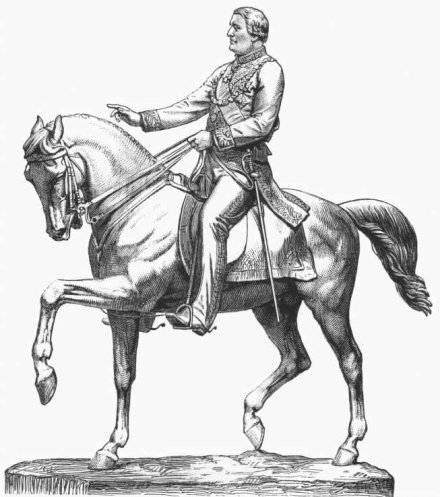
Despite not making a particularly big deal about Lord Mayo’s murder, the Empire did favor its Indian subjects with a Calcutta equestrian statue of the assassinated viceroy.


This monument and other former public memorials from the British imperial period now squirreled out of view in independent India can be found on a fun Flickr gallery, Forgotten Statuary of the British Raj. Brits can find the Earl of Mayo in marble closer to home in Cockermouth.

Mayo was also the namesake of the Mayo School of Arts in Lahore, present-day Pakistan (it’s now known as the National College of Arts). The school’s first principal was Lockwood Kipling, and this man was able to hook his 16-year-old son up with an assistant-editorship at a Lahore newspaper … from which young Rudyard Kipling launched his literary career.

* The “lone nut with a grudge” version has been latterly disputed with attempts to reconstruct Sher Ali as an Islamic revolutionary.

On this day..

1777: James Aitken, aka John the Painter, terrorist of the American Revolution

This date in 1777 saw the public execution of “John the Painter” — a Scotsman who had been christened “James Aitken” at his birth less than 25 years before, but who had run through countless aliases in his adult life as a (mostly) petty thief.

But this man was not a hapless victim of England’s Bloody Code, although he often enough offended the capital statutes against petty property crime.
Rather, the scraggly redhead with the thick Scottish brogue was the author of a stunning act of domestic terrorism, in England, in freelance support of the rebellious American colonies an ocean away.

“So dangerous an individual to the kingdom as this man perhaps never existed,” in the judgment of the Newgate Calendar, who knew him as “John Hill” — just one of Aitken’s many aliases. “and whose confession and repentence can hardly soften the abhorrence felt on the contemplation of the extent of his crimes.”

James Aitken, aka John Hill, aka John the Painter — for this last was, unfortunately, the unprofitable occupation of his apprenticeship training — fired the Portsmouth dockyards on December 7, 1776, then followed that up with an attack on the Bristol dock and city shortly after the New Year, as well as an unsuccessful attempt to ignite the Plymouth quay.

There are ready reasons we imagine men to undertake terrorist activities. James Aitken did not have them, according to Jessica Warner’s John the Painter: Terrorist of the American Revolution (review).

Although he was well-read for his class, he was not ideological, not a zealot of any creed religious or secular.

He was not American himself even in the loose sense that term could hold for the immigrant proto-nation. His only brush with that land was brief and unedifying: fearing his many thefts had made London a bit too hot for him, he signed on as an indentured servant and shipped out to the colonies in 1773 and slave-like labor in the fields. He escaped his master in 1775 and immediately shipped back to Europe, leaving no evidence of any revolutionary contacts.

And he wasn’t a madman. Just lonely, as evidenced, Warner says, by the “sad and always desperate invitations” to drink with which he plied the newest of acquaintances, to their discomfort. “He asked complete strangers to drink with him because he was lonely, and loneliness overrode his reason. His invitations always came too quickly, and his conversation and his manner always just a little off.” He even invited this indiscreet attention when on the incendiary job.

James Aitken reads like an Enlightenment version of the disaffected loser “going postal” on a world that could barely see him to tread upon him. His fondest desire from childhood was that classic Scots aspiration, the army commission. The closest he came was a series of short-term army enlistments to pocket the enrollment bonus, each of which he deserted as soon as practicable. (He did dream that his terrorism spree would earn him an appointment in the Americans’ Continental Army.)


Back in Britain after his unsuccessful foray in the colonies, Aitken conceived a disordered affinity for the burgeoning patriotic cause of the colonies he had recently fled. (Warner thinks he read Thomas Paine‘s Common Sense.) Only accidentally, when he overheard boozers at an Oxford pub chatting about the importance of the dockyards to the British Navy, did the heretofore aimless Aitken animate his wanderings with a new revolutionary purpose: he, scorned nobody, could win the War of Independence by crippling these facilities.

I spent two days in the contemplation of this malicious design, and promised myself immortal honour in the accomplishment of it. I beheld it in the light of a truly heroic enterprise, such as never would have been equalled to the end of time. I was persuaded it would entitle me to the first rank in America, and flattered myself with the ambition of becoming the admiration of the world! (Source)

Aitken was not a criminal mastermind, but there was a plausibility to the plot that fluttered the Admiralty’s heart once the details emerged. The dockyards were critical. They were also — Aitken readily perceived this as he began to case them — scarcely guarded; at Portsmouth, Aitken came and went as he pleased, freely schlepping his materiel in and out. (His attempt at Portsmouth set the subsequent facilities more on guard; the man’s initial plan to hit five different dockyards in sequence would ultimately have been as self-defeating as the 9/11 hijackers planning to commandeer a different plane on five consecutive days … but this was the way Aitken had to conceive it since he lacked the charisma or leadership aptitude to form a cell of fellow-travelers for a coordinated attack.)

Before launching himself into history, Aitken made an autumn 1776 visit to Paris to call upon the American representative there, Silas Deane.

Deane’s own recounting says he was struck by the wildness of Aitken’s scheme. But he was sufficiently taken with the prospective payoff to lend it his blessing, and “sponsor” it to the extent of giving the Scotsman a little pocket money to make his way back to England. He would later defend himself against “respectable persons,” presumably British ones, who “[regard] me equally criminal with the actor.”

[S]upposing me to be the liege subject, not of Great Brittain, but of a foreign independant Nation, at the Time at War with Great Brittain, and that imagining that I had found a favorable opportunity, & met with a proper Agent to destroy, at one blow, the Fleet & armaments preparing to carry, and to spread devastation, and bloodshed in my Country, and that I improved the favorable moment, and attempted through this agency, to effect this great object; on this view of the case I am confident that every one of common sense & impartiality must acquit me, nay more though they rejoice at the defeat of the enterprize they must approve of the motives, which influenced me to engage in it, motives no less than a desire to weaken a declared Enemy, and to preserve my Country, by every means in my power, from the horrors, and distress of Fire and desolation.

… if it was a noble, and most honorable Action in Lord Rodney to defeat the Count de Grasse, would not the Man who at equal hazard of his Life, had set fire to the Count’s Squadron in Brest, & thereby have equally defeated his expedition, been entitled (at least in the Court of Common sense) to the same Honors?

This was certainly good enough to convince Aitken that he torched in the name of Liberty, and he made his way back to set his plan in motion.


After botching his first attempt at Portsmouth and getting locked in the rope house — he pounded on the door until he got someone to open up, then bluffed his way out of the situation — Aitken got the least mileage possible from a superficially successful attack.

At about 3:30 p.m. on Saturday, December 7, Aitken fired three homemade incendiaries in the rope house and slipped away in what witnesses would later reconstruct as an evident state of agitation. The flames soon gutted the brick building (the damage would eventually reckon to £20,000) but he was this close to an exponentially more impressive bit of sabotage.

To begin with, many of his matches failed to start up Aitken’s jerry-built fuses. (This is also what caused his initial arson attempt to abort.) Having been once bitten by finding himself locked into the rope house at night, Aitken made his next trip earlier in the afternoon: that ensured that plenty of dockhands would still be in the vicinity to contain the fire to the one building. It also meant that the tide was in, and the nearby brig swollen with two thousand pounds of gunpowder could be easily put out to sea and away from danger as soon as the alarm went up.*

Admiralty investigators weren’t even sure at first that it was arson. Yards in the era of wood ships and wood buildings had a lot of flammable materials lying around. Fires happened.

Aitken soon dispelled any possible confusion.

Finding the Royal Navy dockyards at Plymouth too vigilant for his machinations, Aitken settled on an ambitious, and again somewhat plausible, scheme to engulf the densely-populated port of Bristol — dockyard and city alike. Repeatedly his blazes petered out or were suppressed. They did little consequential damage, but raised a rapidly-escalating panic at revolutionary incendiaries abroad, and it did not take long to link them to Portsmouth. (Copycat attempts and crackpot anonymous letters threatening same also started popping up elsewhere in the realm.)

“I have not the least doubt that the late fires have been the effects of premeditated malice,” wrote Bristol’s M.P. — the political philosopher Edmund Burke. Naturally this only had the effect of silencing potentially considerable pro-American sentiment in Bristol and throughout the realm. Lord Germain exploited the terrorist panic to push through a February 1777 Treason Act aimed at the American colonies. It authorized detention of suspected rebels without habeas corpus protection at His Majesty’s pleasure.

Aitken himself, though, was at the end of his own fuse. At Sir John Fielding‘s urging, the Admiralty posted an eye-popping £1,000 reward for the terrorists’ (multiple attackers were presumed, owing to the quantity of fires) capture. The arsonist was in irons with a week; a gaoler had noticed him and recognized Aitken’s fit to the description of the unknown Scotsman who had been seen in the vicinity of some of these blazes which Fielding had published in his crime clearinghouse periodical, Hue and Cry.** That man rode off after the suspect and overtook him in the village of Odiham,† where an exhausted and by now fatalistic Aitken surrendered without a fight.


The mizzenmast of the docked HMS Arethusa was removed and set up on land to hang this enemy of the navy outside the walls of the damaged Portsmouth dockyard.

Upon it, they would hang their man as high as Haman: after being turned off, a team of workmen hoisted Aitken’s still-strangling body 60 feet into the air. It’s reportedly the highest gallows ever known to be erected in England, and for the benefit of anyone who didn’t get a good enough look at the spectacle, his body remained conspicuously suspended in chains for years thereafter at Fort Blockhouse, overlooking the Portsmouth harbor as it rotted away.

One might expect that a man who had turned his face against king and country to such an extent would make his end defiantly. James Aitken, once again, defies expectations here, sounding submissive and contrite in the officially reported last words.

I asked John the Painter author Jessica Warner what it was that the state hoped a prisoner like Aitken would say from the scaffold. How did condemned prisoners typically come to shape their last words in (usual) conformity to the expected models? Was it usually necessary for somebody to convince them to do so?

JW: I can only speak for eighteenth-century England. The so-called “dying speeches” of the condemned follow a pretty predictable pattern: the condemned man expresses contrition for his crime, warns others against following his example, and says, in so many words, that he is reconciled with his Creator. That’s the official version, and really two things are going on here: the prisoner is in effect upholding the state’s right to take his life while also upholding the moral order of the Ancien Regime, its laws as much as its religious teachings. I say “official” because just about all dying speeches were penned by other people, the most notorious being the succession of chaplains (ordinaries) who presided over the condemned prisoners at Newgate. It was a bit of a standing joke that dying speeches were printed before they were delivered. The irony is that shorthand was used in the eighteenth century, and so theoretically it was possible to take down exactly what prisoners said.

Popular expectations, to the extent that they can be penetrated, also expected the condemned to make a good end, a good end being measured in terms of bravery bordering on contemptuous indifference to one’s fate. It’s hard to reconcile this indifference with the regret the prisoner was supposed to express.

ET: Did the fact that Aitken was a hated state criminal, rather than an everyday felon, alter anything about the role he was expected to play in the execution ritual?

JW: I don’t think so. The various accounts of his last moments read suspiciously like those you find in other dying speeches. Given the fact that he was a Scot who had poor social skills and who was also more than a little off his head, it beggars belief that he would have performed his part so well and in so conventional a fashion. I don’t doubt, though, that he made a brave end of it.

* The original Portsmouth plan was to start with a diversionary fire in the city itself, and then burn the dockyard while fire engines were occupied with the previous blaze. Again, his imagination outstripped his reach as a lone wolf: the attempt to kindle this preliminary fire just got him run out of his boarding-house and made the landlady a later witness against him.

** For more on Fielding’s criminal investigation reforms, see this post.

On this day..