1865: Paul Bogle

On this date in 1865, Baptist deacon Paul Bogle was hanged at the Morant Bay courthouse for his part in that locale’s eponymous rebellion.


Third World’s “1865 (96 degrees in the shade)” celebrates Paul Bogle: “Today I stand here a victim the truth is I’ll never die”

Bogle helped lead of the protests-cum-riots that became that rebellion.

Baptists played an essential role in the affair, which has led some to call it the “Native Baptist War”. And indeed, Baptism had long intertwined with underclass resistance: Jamaica’s most famous slave rebel, Samuel Sharpe, was also a Baptist deacon. A previous royal governor in Jamaica had once warned that “the worst evil which hangs with a menacing aspect over the destinies of this island is the influence exercised with baneful effect by the majority of Baptist missionaries.”

From the standpoint of the powerful in Jamaica and Britain, 1865 would vindicate that warning.

A (white) Baptist missionary named Edward Underhill had penned a January 1865 letter bemoaning the miserable condition of most Jamaicans and starkly disputing received wisdom that blacks were just too lazy to work: “The simple fact is, there is not sufficient employment for the people; there is neither work for them, nor the capital to employ them.” (Underhill later wrote a book on the events, The tragedy of Morant Bay, a narrative of the distrubances in the Island of Jamaica in 1865.)

Underhill’s letter got into public circulation and as a result there were a number of “Underhill meetings” perhaps comprising an “Underhill movement” on the island in 1865 — essentially a going social campaign that rooted deeply in Jamaica’s native Baptist communities. Though “native Baptists” is a vague term, it distinguishes not only black from white but, in the words of Mary Turner, a whole “proliferation of sects in which the slaves developed religious forms, more or less Christian in content that reflected their needs more closely than the orthodox churches, black or white.”

William Gordon had switched his religious allegiance to native Baptist and was known to speak at Underhill meetings: that’s part of what got him hanged.

Likewise, our day’s focus, Paul Bogle, was a native Baptist minister, in the St. Thomas-in-the-East parish — and it was the protest of Bogle and his supporters against an unjust prosecution that started the whole rebellion off.


Statue of a militant Paul Bogle (that’s a sword in his hands) outside the Morant Bay courthouse where all the trouble started. (cc) image from dubdem sound systems.

There was, accordingly, an immediate reward out on Bogle’s head, and an immediate demonization in the respectable English press. There, he was “the notorious Paul Bogle,” in the words of one letter to the editor (London Times, Nov. 18 1865), in whose Baptist chapel rebellious “panthers” wantonly “drank rum mixed with gunpowder and the brains of their victims.”

By the time that letter had been dispatched, Bogle’s purported orgies had long since been interrupted: captured by Maroons, he was delivered to custody, instantly tried, an hanged that very day in a batch of 18 rebels.

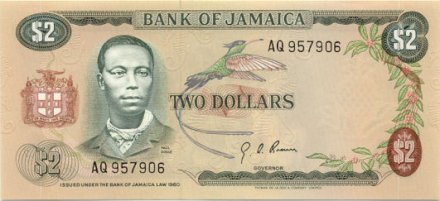
A horror to Victorian planters, Bogle has won the reverence of posterity as a freedom fighter and national hero.


Paul Bogle on the (now out-of-circulation) Jamaican two-dollar bill.

On this day..

1865: George William Gordon, Jamaican politician

“No incident of the dreadful story” of Morant Bay, wrote Edward Underhill, “produced a more painful impression than the arrest, trial, and execution of Mr. G.W. Gordon” this date in 1865.

The son of a white planter and a mulatto slave, George William Gordon was an able businessman and became a Jamaican assemblyman.

In that capacity, he was a vocal critic of British colonial maladministration, an advocate for blacks, and a political foe of Jamaica’s governor, Edward John Eyre. He’d already had government commissions canceled because of his politics.

Gordon had nothing to do with the Morant Bay outbreak. He was away from the disturbance altogether, in Kingston, when it broke out.

But he was regarded by many white elites as a class enemy, and Eyre did not intend to miss this opportunity to eliminate him. A few years later, a French tribunal would express the rationale as it cracked down on the Paris Commune: guilty or no, “a prudent and wise Government must rid itself [of troublemakers] when it finds a legitimate occasion to do so.”

Accordingly, Gordon was arrested by civil authorities in Kingston — he actually turned himself in when he heard there was a warrant out on him — and then transferred into the hands of the drumhead military tribunals that were operating in the conflict zone, obviously with the intent of terminating a gadfly.

This extra-legal act is discussed in greater detail here, but the long and short of it was tartly summarized by no less than the sitting Lord Chief Justice:

[Kingston authorities] were not the ministers or apparitors of the martial authority, and did not possess the power to take up Mr. Gordon for the purpose of handing him over to the martial law. Nevertheless, they did it. They did it by the exercise of the strong hand of power, because it was thought that a conviction could not be got at Kingston. It was altogether unlawful and unjustifiable. To Mr. Gordon it made the difference of life or death.

Gordon, in his last letter to his wife, took it all in an understandably contemptuous stride:

General Nelson has just been kind enough to inform me that the court-martial on Saturday last has ordered me to be hung, and that the sentence is to be expected in a hour hence, so that I shall be gone from this world of sin and sorrow.

I regret that my worldly affairs are so derranged: but it cannot be helped … I never advised or took part in any insurrection. All I ever did was to recommend the people who complained to seek redress in a legitimate way … It is however the will of my heavenly Father that I should thus suffer in obeying His command, to relieve the poor and needy, and to protect, as far as I was able, the oppressed …

do not be ashamed of the death your poor husband will have suffered. The judges seemed against me; and from the rigid manner of the Court, I could not get in all the explanations I intended. … It seemed that I was to be sacrificed.

Much of what Governor Eyre did in those desperate days skirted, at best, the edges of what might be legally colorable. But at least those instances, in the main, were directed at people alleged to have been actual rebels or rioters. Eyre could safely expect wide latitude where the security of the realm was at stake.

In Gordon, however, there was a man whose crime was nothing other than to have sympathized with the real and crushing plight of the lower orders and advanced their cause politically. Eyre’s magistrates made that fact alone into sedition, and twisted the rules of their own courts-martial to pin it on Gordon.

Given the exceptionally lawless nature of this scenario — and Gordon’s own visibility as a colonial elite — his became the lightning-rod case for English liberals incensed at Eyre’s behavior. John Stuart Mill, Charles Darwin, Herbert Spencer, and others demanded Eyre’s prosecution for the affair, Thomas Huxley writing for the faction,

the killing of Mr. Gordon can only be defended on the ground that he was a bad and troublesome man; in short, that although he might not be guilty, it served him right.

I entertain so deeply-rooted an objection to this method of killing people — the act itself appears to me to be so frightful a precedent, that I desire to see it stigmatised by the highest authority as a crime.

It can hardly surprise the reader, versed as we are by this late date in official impunity, that not Eyre nor any lieutenant was ever thus stigmatised.

While Eyre evaded due punishment, Gordon could not escape the plaudits of posterity. He’s been honored as a Jamaican National Hero, and the very building where the present-day parliament sits is called the Gordon House in his honor.

On this day..

1865: Johnson Speed, arson bystander

The line between a snap military tribunal with a preordained outcome, a summary execution in the field, and simple murder blurs over in this affair where the word of any armed man in a British uniform had virtual color of law.

This account of one poor sod flogged within an inch of his life and then summarily shot when his captor soldiers took it into his heads that he might have had something to do with some fire comes from Illustrations of Martial Law in Jamaica: Compiled from the Report of the Royal Commissioners, and Other Blue Books Laid Before Parliament.


On [October] the 22nd four white soldiers were taken by Mr. Christopher Codrington to his house at Rose Garden, where they had dinner. When they returned in the evening to David Mayne’s shop, at Long Bay, two constables were there with two prisoners, James Sparkes and Johnson Speed.

They tied the former to a tree, and gave him 100 lashes.

They then tied up Johnson Speed, and gave him eighty-five lashes, when the cat broke.

One of the soldiers ran into the shop and brought a horsewhip, but another one interfered as it was not a thing to beat a man with. Another looker-on was here asked whether Johnson Speed had done anything during the disturbance, and he replied that when Mr. Hinchelwood’s house was burning Speed was there. Then the soldier said, “Where is my rifle?”

The man cried out, “Lord, I don’t do nothing, and I am going to dead.”

The soldier fired, but his rifle had no ball in it, or he had missed. He loaded the gun afresh, and hit the man in the middle of the back as he was tied to the tree. Another one went up, as he dropped writhing to the ground, and put a rifle to his ear and blew out his brains. These were soldiers of the 2nd Battalion of H. M. 6th Regiment of Foot. Mr. Christopher Codrington, a Justice of the Peace, was present.


The above is one of the very last accounts in a tome heavy with atrocities destined never to be punished in this world.

It seems apt both for the subject matter of this site and for laying bare the biases of the source to include the very last few paragraphs that follow.


David Burke was shot at Manchioneal. The soldiers ordered him to go before and point out rebels. “He was a big stout young man,” said a witness, ” and he walked quite lumber-like, and they said he was a rebel too, and shot him dead”.

Andrew Clarke was shot in his own house, at Manchioneal, under the following circumstances, as described by his widow :—

I was sitting with the baby, and I saw a black soldier, and he asked Andrew Clark, “Where are all the men’s goods you have ? Please bring them out.” Clarke said, “I have been sick three months, and I did not interfere.” The soldiers searched and found nothing. Then I was sitting down, and three soldiers came in, and a man named Saunders came in with them, and I explained that it was John Murray’s house, and the soldier dropped him, and he dropped on his side and bawled for mercy. The soldier told me, “Take yourself right out,” and I came out, and another soldier said, “Put another bullet into that fellow’s head,” and they blew out his brains. They burnt the house with fire from the kitchen.

These are samples of the scenes enacted in the beautiful island of Jamaica under pretence of repressing disturbances. My task has not been undertaken in vain if it tends to deepen the resolve of my countrymen to resist at all hazards, the preposterous pretensions of Colonial Governors and military officers, to deal with human life and property as they please, without responsibility to the laws which bind society together, or to the nation which places the sword in their hands for the purposes of justice and mercy.

On this day..

1865: An unnamed Obeah man

From William James Gardner’s (public domain) A History of Jamaica:

On the 21st a circumstance occurred which created much controversy. A reputed Obeah-man was tried by court-martial and convicted. One of the favourite assertions of these people has been that “Buckra can’t hurt them.” Colonel Hobbs directed him to be placed on a hill-side, about four hundred yards from the firing party. The bullets caused almost instantaneous death, and it is stated that the effect on the minds of the prisoners was so great, that the colonel felt at liberty to release a considerable number then in his camp, many of whom were heard to say they never would believe in Obeah again.

On this day..

1865: William Grant, evidently a ringleader, a persuader, and adviser

The account below of a forgotten saddler hastily attainted a participant “in the background” in the Morant Bay rebellion comes from Illustrations of Martial Law in Jamaica: Compiled from the Report of the Royal Commissioners, and Other Blue Books Laid Before Parliament.


Another victim was William Grant, saddler, of Morant Bay. The following record of the proceedings in his case is probably unique in the history of judicial or quasi-judicial investigations :—

October 20th, 1865.
Drum-head Court Martial.

President:—Lieut. H. Brand, E.N.
Members:—Lieut. Errington, K.N., Ensign Kelly, 4th W.I.R.

William Grant, charged with being one of the ringleaders and originators of this rebellion.

The Provost sworn states :—

About four or five days ago I was informed that this man was the originator and founder of the party who raised the rebellion, that he was not likely to be seen himself, but makes the others. He keeps a saddler’s shop, where the secret meetings took place. On the road from St. Thomas-in-the-East to the Guinness (Ginnep) tree, where placards had been posted, calling secret meetings, I searched the house of Chisholm, also a confederate, and in the presence of Mr. Jones, E.A., I took a blue card, as an admission ticket to a Society of Friends, printed William Grant, Founder. That card I sent to the Governor.

The prisoner Duncan Stuart, in his defence, when called upon by Captain Astwood, voluntarily made this statement. He had previously made it in the presence of Mr. Miller, J.P., whose signatures I here produce. “Grant called Bogle at Dr Alveranga’s, and said, ‘Don’t pull this down, wait a little, don’t join with the Volunteers, when you see what they do, run in.’ Grant said, ‘Now is the time to vindicate.’ ”

Mr. Miller, Justice of Peace, for St. Thomas-in-the-East, sworn:—

That statement was voluntarily given and sworn to before me.

Geo. F. Judah, Sergeant-Major of Volunteers:—

I gave the prisoner my rifle to repair on the morning of the riot, and he has kept it, and I have never seen it since.

The prisoner in his defence merely states that he never knew anything about the riot before it actually broke out. He has acknowledged to having corresponded with Mr. Gordon, but that, he states, was quite private, about some land.

This man was evidently a ringleader, a persuader, and adviser, and did his utmost to keep in the background and push the ignorant on to rebel.

Found Guilty, October 20th, 1865. Sentence, Death.

H. Brand, President,
Lieutenant E.N.
Approved and confirmed,

A. A. Nelson,
Brig. Genl. Commanding Field Force.

[The proceedings of the Courts-martial were retained by the Commissioners, and they refused to exhibit them to the Counsel for the parties complaining of the measures of suppression. General Nelson and others were therefore not cross-examined in reference to these trials.]

The first witness, Ramsay, the Provost-Marshal, told the Court only of what he had been informed — the great crime of the prisoner apparently being that he was the founder of a Society of Friends, and had actually a blue card of membership in his house.

The witness, Duncan Stewart, was not called. He had already been tried and was under sentence of death, and was duly hanged the same evening along with Grant. (See List). A so-called statement of this man was produced in writing. It will be noticed he spoke only of “Grant” having used certain words. Three Grants were hung at Morant Bay, and a William Grant was convicted by a Special Commission at Kingston, while the Royal Commissioners were sitting, and sentenced to penal servitude for life. It is clear from the evidence then given that the William Grant alluded to by Duncan Stewart was the one who was then sentenced. John Dickenson, on being examined by the living William Grant at that trial said:— “There was a William Grant, a saddler, who is hung. You are left. You are the man.” (No. 355 of Papers laid before the Royal Commissioners by Mr. Eyre).

Ramsay had evidently a strong interest in the conviction of this prisoner. He sent the following letter to Captain Luke, on 16th October, 1865:— “I also personally apprehended William Grant, the founder of the Society of Friends. I hope I may not be thought seeking for pecuniary benefit alone in claiming the rewards for information against G. W. Gordon at large, seizure of Chisholm, Grant, and Miles.”

Brand, the President of the Court-Martial, seems to have felt the evidence was weak, and he supplemented it by the following statement of his own. “This man was evidently a ringleader, a persuader, and adviser, and did his utmost to keep in the back ground and push the ignorant on to rebel.” The Judge having thus convinced himself, by his own conclusive testimony, adds “Found guilty. Sentence, death,” and, as a matter of course, the experienced officer of Her Majesty’s Service, who was the revising officer, adds:—”Approved and confirmed. A. A. Nelson, Brig.-Genl., Commanding Field Force, Morant Bay, 20th October, 1865.”

It is unnecessary to add that in the list of the executed is to be found the name “William Grant, under date of the 20th October. Charge, ringleader of rebellion!”

On this day..

Daily Quintuple: The Morant Bay rebellion

In 1865, British-controlled Jamaica faced an economically-driven revolt that altered its history.

Though slavery had been abolished in the British empire during the 1830s, emancipation had not come with land reform. Ex-slaves and their descendants remained desperately poor. Indeed, Britain’s near-simultaneous liberalization of the sugar trade had cratered prices for Jamaica’s top export — and with it, cratered most of the Caribbean economy.

To a petition early in 1865 for access to crown lands to relieve these dire conditions, Queen Victoria had extended a familiar classic of cruel and condescending economic catechism: shut up and work.

“The prosperity of the Labouring Classes, as well as of all other Classes,” quoth the piece that would be published as “The Queen’s Advice”,

depends, in Jamaica, and in other Countries, upon their working for Wages, not uncertainly, or capriciously, but steadily and continuously, at the times when their labour is wanted, and for so long as it is wanted; and if they would use his industry, and thereby render the Plantations productive, they would enable the Planters to pay them higher Wages for the same hours of work than are received by the best Field Labourers in this country; and as the cost of the necessaries of life is much less on Jamaica than it is here, they would be enabled, by adding prudence to industry, to lay by an ample provision for seasons of drought and dearth; and they may be assured, that it is from their own industry and prudence, in availing themselves of the means of prospering that are before them, and not from any such schemes as have been suggested to them, that the must look for an improvement in their condition; and that her Majesty will regard with interest and satisfaction their advancement through their own merits and efforts.

So your average Jamaican fieldhand’s “merits and efforts” became so much dry tinder accumulating, just waiting for the spark. (Note: Princeton has an album of photographs from this period here.)

In October 1865, flint struck steel with the prosecution of a poor black laborer for trespassing onto unused land.

The ensuing protest mushroomed into the Morant Bay rebellion: a scuffle with police, leading to proscriptions, leading to a more confrontational mob, an outnumbered and trigger-happy militia, and a full-fledged riot that seized the town of Morant Bay and proceeded to attack nearby plantations.

Dreadful reports, more terrifying for their scantiness and uncertainty, went abroad in those days, of “atrocities revolting to human nature.” That’s the New York Daily News, which ran a letter from Kingston, Jamaica, reporting “the whites who have fallen into the hands of these savages have been doomed to slaughter without distinction of age or sex. They tear out the tongues of their victims, cut off the breasts of women, strangle and mutilate little children.”*

Fearing a Haiti-like general revolution, Jamaican Governor Edward John Eyre — once an Australian explorer, which is why you can find his name on a New South Wales wine label — bloodily crushed the uprising.

Hundreds were put to death, either summarily in the field or after proceedings that would have wanted twice the deliberation to rise to the level of perfunctory. Hundreds more, including pregnant women, were flogged. Being in the wrong place at the wrong time without a demonstrable alibi ready to hand was liable to be worth a body’s life.

We note over the next five days two famous cases and three obscurities that may give a sense of how things were in those days — though Morant Bay depredations could in fact sustain several numbing weeks in these pages. For instance, a missive dated October 19 reports in passing the capture of “a number of prisoners from the rebel camp. Finding their guilt clear, and being unable either to take or leave them, I had them all shot. The constables then hung them upon trees, eleven in number.”

One officer** who showed excessive (read: any) exactitude for process was ordered in writing to emulate a comrade “doing splendid service … shooting every black man who cannot account for himself.”

Nelson at Port Antonio hanging like fun by court martial. I hope you will not send any black prisoners.

All this “fun” would put Governor Eyre in the eyre of a storm back in the home country.

These executions — but most especially that of colonial assemblyman George William Gordon — had little or no color of law, and spurred many English liberals to demand Eyre himself be prosecuted for murder. Nor was this merely an elite predilection: English working classes then in the midst of their own push for representation rallied in support of the Jamaicans, even burning Gov. Eyre in effigy. British Tories and propertied Jamaicans called Eyre a hero.

Ultimately, this furious “Eyre Controversy” proved insufficient to generate an actual criminal procedure against an agent of the empire, which would have entailed clearing a very high bar indeed. Recourse to the civil courts produced a landmark 1870 decision, Phillips v. Eyre whose upshot was to validate a law Eyre had the Jamaican assembly hastily enact retroactively legalizing his behavior and thereby rule out the prospect of a tort claim.

That Jamaican assembly was spooked enough that in 1866 it renounced its own power and made Jamaica into a Crown Colony directly governed by its British executive.

But if the need of the moment was to suppress the uprising, the need of history was to celebrate it — and the hero for posterity would not be Governor Eyre. The Morant Bay insurgents, a bare few of whom we will meet over the next days, have been valorized as slave rebels even if they weren’t quite literally slaves, and generally occupy an honored place in Jamaica.

* Cited in London Times, Nov. 13, 1865 — by which time the actual revolt was well over.

** That reluctant officer complied with his orders, but threw himself into the sea when recalled to England for subsequent the parliamentary inquiry.

On this day..

1749: Bosavern Penlez, whorehouse expropriator

To the memory of the unfortunate
BOSAVERN PEN LEZ
Who finished a Life, generall well reported of,
By a violent and ignominious Death.
He was the Son of a Clergyman,
To whom he was indebted for an Education, which he so wisely improv’d
As to merit the Love and Esteem of all that knew him.
But actuated by Principles, in themselves truly laudable
(When rightly directed, and properly restrain’d)
He was hurried by a Zeal for his countrymen,
And an honest Detestation of Public Stews
(The most certain Bane of Youth, and the Disgrace of Government)
To engage in an Undertaking, which the most Partial cannot defend,
And yet the least Candid must excuse.
For thus indeliberately mixing with Rioters, whom he accidentally met with,
He was condemn’d to die:
And of 400 Persons concerned in the same Attempt, he only suffer’d,
Tho’ neither Principal, nor Contriver.

How well he deserved Life, appears
From his generous Contempt of it, in forbidding a Rescue of himself;
And what Returns he would have made to Royal Clemency,
Had it been extended to him, may fairly be presumed
From his noble Endeavours to prevent the least Affront to that Power,
Which, tho greatly importun’d, refused to save him.

What was denied to his Person, was paid to his Ashes,
By the Inhabitants of St. Clement Danes,
Who order’d him to be interr’d among their Brethren,
Defray’d the Charges of his Funeral,
And thought no Mark of Pity or Respect too much
For this Unhappy Youth,
Whose Death was occasioned by no other Fault
But a too warm Indignation for their Sufferings.

By his sad Example, Reader be admonish’d
Of the many ill Consequences that attend an intemperate Zeal.
Learn hence to respect the Laws — even the most oppressive;
And think thyself happy under that Government
‘That doth truly and indifferently administer Justice,
‘To the Punishment of Wickedness and Vice,
‘And to the Maintenance of God’s True Religion and Virtue.’

On this date in 1749, Bosavern Penlez — surely one of the all-time great names to hang on a gibbet — was put to death to the sorrow of all of England. You know how they say that horse thieves are not hanged for stealing horses, but that horses might not be stolen? Bosavern Penlez was hanged that whorehouses might not be torn down by mobs of angry sailors.

(Fourteen other less remarkable folk were hanged for less remarkable crimes at the same time. Just another mass execution day at Tyburn.)

A petition of over 300 St. Clement Danes residents for sparing the two men condemned in the riots. (From the General Advertiser, Oct. 11, 1749.) John Wilson received the solicited pardon; Bosavern Penlez did not.

On the first three days of July in 1749, the Strand in London saw a running series of riots after a mob of angry sailors descended on a whorehouse where some of their brethren had been robbed and abused. Those sailors pulled down that bordello and then moved on to the nearby bawdy-houses, eventually also ransacking the Star Tavern owned by a character named Peter Wood.

Gendarmes had to be called out to control the situation (and this done without proper legal authorization), but somehow not the mob’s ringleaders nor its inciters nor its most enthusiastic wreckers wound up in legal jeopardy.

Only two faced death: John Wilson, a journeyman shoemaker. And Bosavern Penlez, a young wig-maker who’d been out drinking in the neighborhood. And both of these seemed to have just been caught up accidentally or opportunistically in events.

They were comprehensively damned by the testimony of Peter Wood, the aggrieved procurer of Star Tavern, and his wife — disreputable people of whom a neighbor remarked, “I would not hang a dog or a cat upon their evidence.” But then, besides the eyewitness testimony, Bosavern Penlez was also apprehended with a bundle of linens he had evidently liberated from the Wood’s devastated cathouse, linens whose source he unconvincingly claimed not to remember. So the picture one has is that Wilson was perhaps little more than a passerby … but Penlez was a distinct, if minor, participant who could more or less be shown to have got himself tanked and treated the mayhem like it was a gift certificate to Bed, Bath & Beyond.

Not exactly saintly but also not a cardinal sin. Public sentiment for these fellows’ clemency was intense, starting right with the jury that convicted them but also recommended mercy.

Only Wilson was spared, however.

According to the Newgate Calendar, George II was mightily disposed to pardon both, but justice John Willes, who heard the case personally, vigorously opposed the royal mercy for “no regard would be paid to the laws except one of them was made an example of.”

Penlez, in the end, was the one made example of.

His hanging this date in 1749 would bleed into an election held later that same autumn, almost dealing a serious setback to the sitting Pelham government. Those events are detailed in Malvin Zirker’s introduction to this out-of-print volume.

And the resultant fusillade of pamphlets and public protests asserting a maximalist take on Penlez’s purity induced novelist Henry Fielding to enter the fray with a manifesto of his own strongly supporting the young man’s execution.

Readers of Fielding’s fiction might start at the rigidity of his editorial line.

Penlez’s defenders couldn’t really argue that he was completely innocent. Still, they contested the justice of the death penalty for such a character whose involvement in the whole thing was so tertiary and happenstance, not to mention influenced by drink. Doubly so that it was attested by the word of such a villain as Peter Wood. In the words of one pro-Penlez polemic, Wood would “run at every one, like a mad Dog, … indifferent who it was he hang’d by his Oath.”

Fanny Hill author John Cleland entered the fray on the side of the accused; his The Case of the Unfortunate Bosavern Penlez is aghast at “shedding the Blood of this young Man for the Example-sake … such a Severity being too much for the Nature of the Guilt actually chargeable on him, [and] will serve rather to confound and destroy all Ideas of Right and Wrong.”

Penlez was convicted not as a thief — which charge would have given the jury leave to find that the value of his linens amounted to less than the threshold necessary to hang him — but under the Riot Act which directly mandated death for “unlawfully, riotously, and tumultuously assembled together, to the disturbance of the publick peace.” Wood’s eyewitness testimony to the effect that Penlez (and Wilson, too) smashed up windows and furniture in his house and threatened him was essential to establishing a part in the tumultuous assembly.*

As this level of guilt was popularly doubted, our friend Henry Fielding — himself the very magistrate** who had engineered the suppression of the disturbance, having returned on the third day of it from a weekend away from London — took up his pen post-hanging to support the government’s handling of Penlez from arrest all the way to the scaffold. His A True State of the Case of Bosavern Penlez produces the witness accounts sworn before him as magistrate during the riots themselves, and reproves those Penlez supporters whose anger at his execution made the “malefactor” into “an object of sedition, when he is transformed into a hero, and the most merciful prince who ever sat on any throne is arraigned of blameable severity, if not of downright cruelty, for suffering justice to take place.”

If, after perusing the evidence which I have here produced, there should remain any private compassion in the breast of the reader, far be it from me to endeavour to remove it. I hope I have said enough to prove that this was such a riot as called for some example, and that the man [Penlez] who was made that example deserved his fate. Which, if he did, I think it will follow, that more hath been said and done in his favour than ought to have been; and that the clamour of severity against the government hath been in the highest degree unjustifiable.

* The Ordinary of Newgate reported that Penlez, who long remained cagey on the point, admitted in the end entering the bawdy-house during the riot, but disavowed any attack upon its owner. Wilson, for what it’s worth, always denied having entered the house and insisted Wood had misidentified him.

** Henry Fielding was the half-brother of magistrate and policing pioneer John Fielding. The Fieldings’ mutual roles in the creation of London’s first professional investigators to supplant the problematic “thief-taking” system of private, rewards-driven prosecution, is the subject of The First English Detectives: The Bow Street Runners and the Policing of London, 1750-1840.

On this day..

1772: John Jones, John Sunderland, John Chapman, and John Creamer

The Old Bailey Online site — “A fully searchable edition of the largest body of texts detailing the lives of non-elite people ever published, containing 197,745 criminal trials held at London’s central criminal court” — is one of the scaffold-chaser’s most outstanding resources and well worth perusing by anyone whose interests even remotely touch English crime and law from the Bloody Code to the eve of World War I.

Today’s post touches four such men, very distinctly non-elite fellows all sharing the same common Christian name, all hanged together at Tyburn for burglary. (Technically, John Creamer was hanged for returning from transportation, but he was transported in the first place for burglary.)

We begin as is our wont at the unhappy end. Here the Ordinary of Newgate — that “great Bishop of the Cells”, whose business was salvaging the souls of men whose flesh was forfeit — details the last hours of the doomed. Theirs is typical, even forgettable among scores of such accounts.

The condemned array themselves in various cuts of pathos, contrition, resignation. (Only Creamer somewhat objects to his sentence; this is almost beside the point.)

The clock ticks inexorably.

They’re turned off in the passive voice — who turned them? — crying out to God.

The prisoners were brought down from their cells about a quarter before seven. Their behaviour was every way becoming their unhappy situation.

The appearance of Sunderland and Jones was really moving and affecting by reason of their late illness of a bad fever, of which Sunderland was never expected to have recovered: He was so weak and low that he could scarcely support himself.

Chapman, while his irons were unloosing, said, ‘Ah! these will soon fall to the lot of some poor unhappy fellow!’ Sunderland and Jones were not fettered, the low and sickly condition they were in not requiring it.

Being now ready they went up to chapel, except Creamer, who was of the Catholic persuasion: Sunderland went up first: it was a few minutes before Jones and Chapman followed. In this short interval of time Sunderland said, ‘O how cold am I! I am now as cold as I have been lately hot and distracted with a fever, when I was so light-headed, that nothing run in my mind but a respite was come down, and wondered at their keeping me in my cells. Once upon a time little did I think of coming to this untimely end!’

When Jones came up (who had occasion to wait a little behind) he, with a very decent and christian-like behaviour, fell on his knees to ask God’s blessing.

After being severalty spoken to and prayed with, they were admitted to the Lord’s table, of which they partook, ’tis hoped, to their everlasting comfort.

They were then again recommended in prayer to the mercy of Christ; desiring them stedfastly to look to him as crucified for them, and to be sensible that their sentence was just, but that he, the innocent and immaculate Lamb of God, suffered, the Just for the unjust, and was treated with the greatest shame and ignominy, to take away their curse. They were once more reminded to look unto him, and to let nothing, that might pass on their way, divert their attention from him.

The clock striking eight, Sunderland listed up his hands and said, “We have not three hours more to live in this world.”

Service being ended, they went down from chapel to be made ready. Creamer, while the halter was fixing about him, wrung his hands and wept bitterly, and said, at going out, “God forgive them that have taken away my life for returning back to my own country!”

They arrived at the place of execution at half past ten; and when tied up, I went to perform the last office to them. They behaved with decency. And having again acknowledged that their sentence was just, except Creamer, who thought it rather hard, as he had committed no robbery since his return; but he was told to remember, that he had deserved to die before, and had received mercy: “True, says he, it is so; well, God forgive every one.”

They were once more recommended in prayer to the mercy of God, and then soon were turned off, crying out, Lord, receive our spirits.

Four burglars gone to the Tyburn tree.

In the period after the Seven Years’ War, housebreaking was a boom industry — there was a jaw-dropping eightfold increase in documented burglaries in London from 1766 to 1770. “The material civilization of the urban bourgeoisie became more refined, its belongings — ever increasing in variety and number — became arranged with a view to display and security.” (Linebaugh) Said period also corresponded to the demobilization of some 100,000 soldiers, blithely dumped from the late global war into an economy destitute of social welfare buttressing.

Each veteran “must return to some vocation which he has forgot, or which is engrossed by others in his absence,” lamented The Gentleman’s Magazine. “He must sue for hard labour, or he may starve. If human nature cannot submit to that, cannot he lie down in a ditch and die. If this disbanded brave man should vainly think he has some right to share in the wealth of his country which he defended, secured, or increased, he may seize a small portion of it by force — and to be hanged.”

For the enterprising criminal, the growing quantities of plunder available from a domestic raid exceeded by orders of magnitude the coppers one might riskily expropriate in the streets by main force or dextrous digits.

Entrepreneurial thieves accordingly developed an astonishing felicity for breaking and entering, often (as was the case with all this day’s hanged Johns) penetrating occupied domiciles where the soon-to-be-dispossessed owners dozed.

The blind magistrate and police reformer Sir John Fielding was at this time leading the uphill struggle to control the breaking-and-entering epidemic. (His testimony to Parliament is the source of those “octupling burglary rate” figures.)

Fielding’s anti-burglary agenda included strengthening the city’s embryonic policing, as well as killjoy social measures like shuttering taverns and suppressing the Beggar’s Opera; that very year of 1772, he debuted a (still-extant) magazine to circulate the descriptions of wanted fugitives. And trying to force pawnbrokers and other potential fences into monitoring their inventory sources, Fielding successfully prevailed on Parliament to expose the receivers of stolen goods to the same criminal sanctions as the thieves themselves. (See The First English Detectives: The Bow Street Runners and the Policing of London, 1750-1840)

All these would have limited effect against London’s ingenious burglars. But our four Johns were the kind of men Fielding meant to put out of business.

John Jones and John Sunderland were a team. Six weeks before their hanging, they broke into a home and bent their backs under an entire wardrobe’s worth of booty: “one silver saucepan, value 10 s. one pair of silver knee buckles, value 4 s. and one pair of silver-garter buckles, value 2 s. the property of the said Aaron Franks, Esq; one gold watch-chain, value 20 s. two seals set in gold, value 10 s. six linen stocks, value 3 s. eight pair of silk stockings, value 30 s. two silk pocket handkerchiefs, value 4 s. five other pocket handkerchiefs, value 5 s. five linen-shirts, value 40 s. one pair of pocket pistols, value 40 s. one flannel waistcoat, value 5 s. and one pair of laced ruffles, value 40 s. the property of Jacob Franks, Esq; one cloth coat, value 20 s. one cloth waistcoat, value 5 s. two other linen shirts, value 4 s. one cornelian seal set in silver, value 2 s. one pair of silk stockings, value 1 s. and one pair of thread stockings, value 6 d. the property of Joseph Grover; four other shirts, value 16 s. two pair of worsted stockings, value 3 s. the property of Phineas Ghent, and one thickset frock, value 15 s. the property of Richard Varley , in the dwelling house of the said Aaron Franks, Esq.” (Grover and Ghent were servants. Everyone got cleaned out … and nobody woke up.)

The tricky and essential part of the burglary business, as Sir John Fielding recognized, was getting rid of the loot. Jones and Sunderland were shopped by a suspicious man to whom they attempted to sell some of the clothes.

John Chapman jimmied open the shuttered and barred window of a St. George in the East residence while its owner slept upstairs and emptying the place of “a silk handkerchief, and two linen handkerchiefs, value 2 s. four China bowls, value 20 s. one earthen bowl, value 6 d. one pair of gold weights and scales, value 1 s. one leather box, value 1 s. and thirty-six half-pence.” The theft was only discovered in the morning when a neighbor noticed the broken window and raised the alarm; Chapman was traced when one of the China bowls later turned up, but by that time he’d already notched another successful midnight home invasion. He drew death sentences in both cases.

His 17-year-old accomplice turned crown’s evidence, and described the method in that latter instance:

John Chapman had a chissel in his pocket, a long chissel, a rusly one; he bid me look out that no-body came by; I stood within a yard or two of him; he put his shoulder to the bolt, and pulled very hard, and broke it open; after we had broke it open, the watchman came by to call the hour, past one; we put the shutters to and went a little further down a turning, till he went to his box again. When the watchman went to his box we got in; John Chapman struck a light; we both went in, and shoved the window up; we pulled the window shutter to again, and he had a key that he pulled out of his pocket, or was in the bureau; he pulled the door open; he had a candle in his pocket, wrapped up in a bit of paper, and a tinder box and matches, and pulled the drawers open, one at a time, and took out what was in them; there was a blackish gown, and some cotton to make shirts of, some striped cotton, and a great large table cloth flowered; there were a great many more things I cannot justly mention.

Bonanza.

we went on three or four steps the same side of the room, where there was a good deal of china; we saw the pepper castor with some pepper in it, and a silver spoon; one spoon bigger than a tea spoon; there were two bottles with liquor, one wine I believe; Chapman drank, and then said to me drink; I did; we laid the things upon the ground. I went backwards and searched where the coppers were, there I found half a dozen of tea spoons, in a cupboard where was victuals; the handles of the spoons did not turn up, they went downwards.

…

We looked down upon the ground, there was a great deal of copper saucepans and some shoes; I took some of the buckles of …

We tied them up in bundles, and brought them over the fields; he carried me down Old Gravel-lane, to (I believe the place is) Broad-street where Mrs. Nimmy lives; he carried them up stairs, and I lay with him all night … Chapman carried the things away in the morning; I got the cotton to make some shirts of; I brought it to Mrs. Nimmy; I knew her very well; she asked me whose they were; I said my brother bought them for me; I said I was going apprentice, and my mother would pay her, when they were made; I cannot tell where any of the other things were carried; Chapman gave me 12 s. for my share; he sold the things.

John Creamer‘s hanging crime was returning from transportation, but that transportation had been imposed in 1769 for yet another burglary.

Creamer’s was the least impressive heist of the bunch, perhaps little more than a crime of opportunity. Short on cash to pay for a pot of beer late one night at his lodging-house, he went upstairs, broke into a fellow-lodger’s room while the fellow-lodger slept, and absconded with 8 3/4 guineas. He not only paid for the beer, he went right out that night carousing and spending freely in the sight of many witnesses. He was traced because one of the coins he parted with had a distinctive “white spot like silver”; the victim, who suspected Creamer to begin with, was able the next day to track down that coin where it had been spent and tie it back to the miscreant.

On this day..

1901: Johannes Lotter, Boer War “rebel”

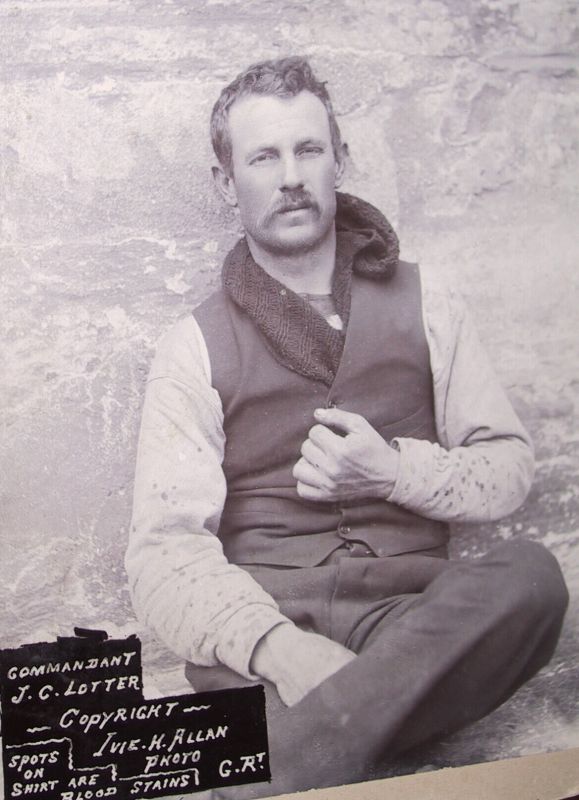
On this date in 1901, Commandant Johannes Lotter was shot at Middelburg.

Along with Gideon Scheepers, Lotter is one of the most famed Boer guerrillas from the Second Boer War.

Regarded by the British as one of their most nettlesome adversaries in that dirty guerrilla war, Lotter was captured in a bloody early September ambush when matters were well into an unpleasant scorched-earth endgame.

This was cause for much slapping of backs among the Union Jack set, and earned for his captor an immediate promotion.


Lotter’s captured men being jubilantly escorted into Graaff-Reinet.

Lotter almost immediately found himself in the dock for — well, all the things one does in a dirty guerrilla war.*

And one other thing: sedition.

The British charged Lotter as a rebellious subject of the British Cape Colony — rather than a resident of one of the independent neighboring Boer states — who owed allegiance to the British crown; upon this premise things like “killing troopers in war” became “murdering troopers”.

Lotter’s trial hung on his papers.** The defendant “pleaded that he was a Free State burgher, and, as such, entitled to the usage of civilised warfare and a legal combatant’s privileges.”

But he was in a bit of a pickle when it came to proving that the “Commandant Lotter” the British discovered on voting rolls for the Cape Colony city of Colesburg was a different guy. Innocent Blood: Executions During the Anglo-Boer War (its title telegraphs its Boer sympathies) summarizes:

his Free State citizen document was in a small case, which was lost or destroyed theday of surrender. Witnesses for the defence gave evidence that they had seen these papers. British intelligence stated that it could find no proof of his Free State citizenship in Bloemfontein. Lotter responded by asking how he could prove his citizenship when all his witnesses were still on commando and that he had been granted no time to call upon them.

Hey, the guy had six whole weeks from capture to execution to sort it all out.

A “Chair Monument” — there’s a picture of it on this page — commemorates Lotter and his fellow commando Pieter Wolfaardt at the place outside Middelburg where they were shot together on Oct. 12, 1901.

A number of additional prisoners from Lotter’s command taken with him in that same ambush were also eventually executed.

* Specifically: murdering two native spies; killing three British soldiers; blowing up railway lines; and sjamboking loyalist civilians.

** When the British later captured Scheepers, who was unquestionably not a Cape rebel, they simply charged his similar conduct as war crimes to the same capital effect.

On this day..

1637: William Schooler and John Williams

(Thanks for the guest post to Robert Wilhelm, author of the Murder By Gaslight historic crime blog, and of the book Murder And Mayhem in Essex County. Executed Today readers are sure to enjoy Wilhelm’s detailed investigations into long-lost historic crime. -ed.)

On September 28, 1637, two men convicted on separate counts of murder in the Puritan colony north of Boston — in what is now Essex County — were executed on the same gallows. The first was William Schooler, convicted a year earlier of killing Mary Scholy on the path to Pascataquack; the second was John Williams convicted of killing John Hoddy near Great Pond in Wenham.


Original (c) image from Murder And Mayhem in Essex County, used with permission.

In the autumn of 1636, an Agawam Indian walking through the Winnacunnet woods, north of the town of Newbury, found the body of a young white woman, lying in a thick swamp about three miles north of the Merrimack river. From the condition of the body, he could tell that the woman had been dead for several months. She lay naked, with her clothing still in a pile not far from the body. The Indian took the news to Newbury, and led the Englishmen to the spot so they could see for themselves.

The woman’s name was Mary Sholy. She was identified more by the circumstance than by appearance, since the flesh had begun to rot. Mary had left Newbury several months earlier, traveling north to her home at the English settlement at Pascataquack. The people of Newbury were also fairly certain who had killed her; they believed she had been ravished and murdered by the man she had hired to guide her journey home, an outsider named William Schooler.

In London, England, William Schooler had been a vintner with intemperate habits. Schooler was, by his own admission, a common adulterer. After wounding a man in a duel he fled to Holland to escape the law; then, leaving his wife behind, he traveled to New England. In 1636 he was living in a shack by the Merrimack River within the limits of Newbury but outside the boundaries of sanctioned Christian behavior.

Mary Sholy, a servant girl, was looking for someone to guide her to Pascataquack, to return to her master. Pascataquack — now Portsmouth, New Hampshire — was a small settlement, about twenty-three miles north of Newbury. It is not known why Mary Sholy had come to Newbury; it is unlikely that her master would have sent her there without providing a guide back. The journey from Newbury to Pascataquack would have been too perilous for a young woman to take alone, first crossing the Merrimack River in a canoe, then following the route to Pascataquack, which was described as little more than a path through the woods. In 1636, even the well-traveled path between Ipswich and Newbury was too narrow for a horse cart. In addition to the possibility of losing her way and becoming hopelessly lost in the woods between the two settlements, there was a very real danger of being attacked by wild animals or hostile Indians.

Seeing an opportunity to make a little money, William Schooler sought out Mary and offered to guide her home for fifteen shillings. He did not tell her that he himself had never made the trip to Pascataquack before. Two days after their departure, William Schooler was back in Newbury alone. When asked why he had returned so soon Schooler replied that he had guided Mary to within two or three miles of Pascataquack, where she stopped, saying she would go no further. Schooler left her there and returned to Newbury.

The people of Newbury remained suspicious and Schooler was questioned by the magistrates in Ipswich. When he returned from the trip he had blood on his hat and a scratch on his nose the “breadth of a small nail.” He explained that the blood was from a pigeon he had killed and the scratch on his nose was from walking into some brambles. He was released, as there was no evidence then that a crime had been committed.

The following year the Pequod tribe took up arms against the English colonists and Schooler was drafted to serve in the militia. He deemed this service to be an oppression and publicly spoke out against it. His outspoken opposition was considered “mutinous and disorderly,” and the governor issued a warrant against him. When he was arrested, Schooler assumed it was about Mary Sholy and began to vehemently defend himself against the charge of her murder. Schooler;s behavior made the magistrates suspicious and, since they now knew Mary Sholy had been murdered, they decided to reopen the case.

Newbury residents who knew him came forward to volunteer information on Schooler’s character. In a Puritan court the character of the accused was as important as the physical evidence against him.

Schooler denied that he murdered Mary Sholy but the jury found him guilty and he was sentenced to hang. The court and the clergy tried desperately to persuade Schooler to confess but he would not. Schooler was contrite, saying he had told many lies to excuse himself, but vehemently denied that he had killed or ravished Mary Sholy. Some ministers argued that the evidence against him was not sufficient to take away his life, but Governor Winthrop denied Scholler a reprieve, saying: “but the court held him worthy of death, in undertaking the charge of a shiftless maid, and leaving her (when he might have done otherwise) in such a place, as he knew she must needs parish, if not preserved by means unknown.”


John Williams was a ship carpenter who had recently come to America from England. In 1637, he was in prison in Boston for theft. Williams and another prisoner, John Hoddy, escaped from the jail and traveled north. They had gone beyond Salem and were on the road to Ipswich, on the east end of the Wenham Great Pond when they had a falling out. The two men had a fight that ended with the death of John Hoddy.

There are two versions of what happened next. In one story John Hoddy’s dog held Williams at bay until the noise drew the attention of enough residents of Wenham to apprehend Williams and take him to jail in Ipswich. The more likely story says that Williams took everything belonging to Hoddy, including his clothes, and buried his body under a pile of stones. Williams proceeded to Ipswich where he was apprehended, after having been recognized as a criminal. Though his clothes were bloody when arrested, he would confess to nothing until a week later, when the body of John Hoddy was found. Cows at a farm near Great Pond smelled the blood and made such a “roaring” that they got the attention of the cow keeper, who on investigation found Hoddy’s naked body under a heap of stones.

Around the same time the justice of the peace in Ipswich learned that both Williams and Hoddy were escaped prisoners. Williams was indicted for the murder of John Hoddy and tried by the Court of Assistants in Boston. Though he confessed to the murder, the court insisted on enforcing Williams’s right to due process, and tried the case before a jury. Williams was, of course, found guilty and sentenced to death.

The double hanging, on September 28, 1637, took place on Boston Common, where all executions in the Massachusetts Bay Colony were held.

Get Murder and Mayhem in Essex County here.

On this day..