1783: Mutinous prisoners of the Swift

On this date in 1783, six men were hanged at Tyburn for “returning before expiry” from convict transportation.

This was a neat little euphemism covering a very desperate act at the sundering of the American colonies from their mother country.

We’ve previously covered in these pages the underappreciated extent of convict transportation from the British Isles in populating the future United States. Anthony Vaver, who blogs at Early American Crime, in his recent book Bound With An Iron Chain pegs convicts as the second-largest bloc of American “immigrants,” (after African slaves) to the tune of 50,000 souls in the 18th century.

The American Revolution put a halt to that human traffic.

In time, London would transition to dumping its criminal cargo on Australia.

But at the moment the colonies broke free, the Down Under wasn’t yet fulfilling that role, and policymakers faced a conundrum. The judicial machinery continued to sentence thieves to transportation; without an outlet, those unfortunates accumulated cheek to jowl aboard stinking prison hulks on the Thames.

What to do? In 1785, a Parliamentary committee looked back wistfully on the good old days:

That the old system of transporting to America answered every good purpose that could be expected from it; that it tended directly to reclaim the objects on which it was inflicted, and to render them good citizens; that the climate being temperate, and the means of gaining a livelihood easy, it was safe to entrust country magistrates with the discretionary power of inflicting it … that it tended to break, in their infancy, those gangs and combinations which have since proved so injurious to the community; that it was not attended with much expense to the public …

(cited in Botany Bay: The Real Story)

Well, it so happened that this effective and affordable solution, though interrupted by war, was not legally barred in the new United States.

So Britain did what any cost-conscious imperial power would do: sent out a ship with some convicts to see if they couldn’t still be gifted to labor-hungry America. “Perhaps a greater insult to any Nation could hardly have been offered,” griped one Founding Father afterwards.

The gallows held little terror for some prisoners sentenced to convict transportation, who might even have preferred execution. London’s Public Advertiser reported this never-implemented threat on March 24, 1785:

We hear that one of the respited capital convicts, who received sentence of transportation at the adjourned session at the Old Bailey, told the Recorder, in his own name and those of his companions, that they did not esteem the being pardoned, on condition of transportation to Africa, as an act of mercy, but had much rather be hanged at home; and that they were determined to endeavour to sink either the lighter which is to convey them to Gravesend (to which place they are to be guarded by 30 of the militia) or the ship which is to carry them over.

Alright, America. You don’t have to be that way about it.

The ship detailed for this insulting mission was the Swift, and its passage was troubled long before it sighted the Chesapeake. The “cargo” of the Swift mutinied and ran the ship aground in England.

Thirty-nine escapees were recaptured and most sentenced once again to transportation, but six swung at Tyburn on this date. They really were at the end of an era, and not only of North American convict transportation: Tyburn itself hosted its last public execution just a few weeks later.

Nothing daunted, the owners of the Swift reassembled a slate of captives and made another run, reaching Annapolis, Md. on Christmas eve: fortuitous timing, because irritated state legislators weren’t in session and therefore couldn’t block the ship’s unwanted merchandising. The problem was, it was little better wanted by its intended market. According to Vaver, “[o]nly 30 of those on board were sold by mid-January … [the shippers] managed to sell most of the convicts by the spring, but they incurred serious losses after having to provide food, clothing, and medicine for those who languished on board the ship until they could be unloaded.”

They were the last British convicts sold in her rebellious colonies. One last ship made another voyage in 1784 and was turned away flat by every U.S. port, finally managing to offload in British Honduras.

Ere the decade was out, London had established a new penal colony at Botany Bay and set about transferring this particular “special relationship” from the United States to Australia.

On this day..

1895: The Vegetarian perpetrators of the Kucheng Massacre

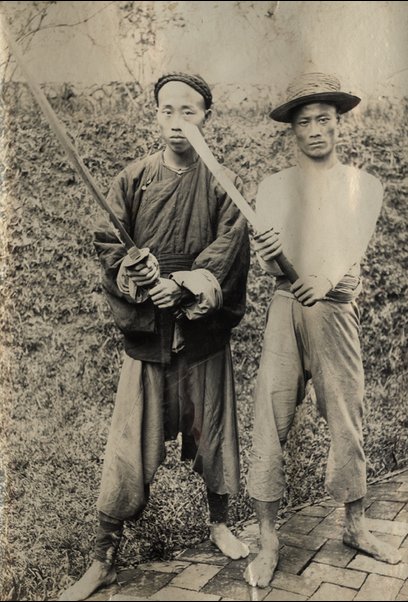
On the morning of September 17, 1895, in the presence of the British and American consuls, seven perpetrators of a Chinese massacre of western Christian missionaries were beheaded at Foochow.

Anticipating the better-known Boxer Rebellion by four years, the Kucheng Massacre (there are many other transliterations of “Kucheng”) was likewise a response to the Celestial Empire’s frustrating second-class status as against European interlopers.

Christian missionaries had been a point of friction in China for decades. Though their rights to proselytize had been guaranteed in a hated treaty dictated to China by force of arms, they often met resentment or worse on the ground.

“You bring incense in one hand, a spear in the other;” one evangelist reported being told: that is, however honorable the immediate intentions of many individual missionaries, their presence looked like a stalking horse for less reputable western interventions like the opium trade. (That’s how it looked to many Chinese. Professional western diplomats themselves found the impolitic preachers a hindrance to their statecraft, according to Ian Welch’s 2006 paper “Missionaries, Murder and Diplomacy in Late 19th Century China: A Case Study” (pdf).*)

On August 1, 1895, these frustrations unleashed a river of blood at the village of Huashan in Gutian County, where a Buddhist secret society — known as “Vegetarians” in the western press for their characteristic dietary vow — fell upon a group of vacationing British Anglican missionaries still abed at dawn and ruthlessly slaughtered eleven of them. (There are some 1890s books paying tribute to the fallen available online: Robert and Louisa Stewart: In Life and in Death, and The sister martyrs of Ku Cheng : Memoir and Letters of Eleanor and Elizabeth Saunders (“Nellie” and “Topsie”) of Melbourne.)

“The attack came,” said a physician from a nearby town who was summoned to the bloody scene, “like a thunderbolt from a clear sky, not one of the victims having received the slightest intimation of the intended assault.”

Word of the carnage struck western powers with similar force.

Incensed newspaper-readers literally demanded** gunboat diplomacy, and literally got it, especially when Chinese authorities drug their feet on the condign punishment the missionaries’ countrymen were clamoring for.

All this put British diplomacy on a sticky wicket, which Welch (pdf) deals with in detail. To satisfy the domestic audience, the government had to be seen to be taking a hard line on avenging the outrages; at the same time, London was wise to the Chinese state’s shakiness and wary that a “barbarous holocaust” perpetrated against the Vegetarians would trigger a mass backlash and bring the whole thing down.

An obdurate Chinese viceroy impeded the quick resolution everyone was after by making inflammatory public proclamations against Christians, and releasing without explanation six of the thirteen men who had initially been condemned to death in the month of August. The seven who were executed on this date were therefore only the vanguard of 26 humans ultimately put to death for their involvement in the atrocity.

Some of the execution photographs that follow are Mature Content. They’re obtained via Visual Cultures in East Asia; some also available at USC Digital Library.


Raids and investigations to bring the Vegetarian movement to heel continued for several months thereafter, and the whole affair ultimately was quelled without doing any of the wider damage that might have been feared — not even to missionaries who continued pouring into China.

And that, effectively, kicked the can down the road on the anti-foreigner sentiments afoot in the land … sentiments that would find much costlier expression a few years later when another secret society kicked off the Boxer Rebellion.

* I’ve relied heavily on Welch for this post. He’s also collected a massive trove (over 1,200 pages) of primary documents from this incident available in a series of pdfs (some quite large) from the Australian National University website:

** This was not universally so. The wife of missionary Stephen Livingston Baldwin, who knew some of the victims of the attack, urged a “charitable” response and sensitivity that “the Chinese feel that all the world is against them, and they are not far from right.” (New York Times, Aug. 10, 1895) In letters responding to intemperate coverage elsewhere, she acidly compared (pdf) western editorialists’ high dudgeon to their look-forward-not-back dismissal of recent stateside anti-Chinese violence.

It was ten years yesterday since more Chinese were killed, and burned alive and left to die wounded, in one hour, at Rock Springs, Wyoming (the very same Territory in which the recent massacre occurred) than have been Americans and English in China in the thirty-four years I have personally known that land, being a resident there twenty years and closely connected with it ever since. Ten years yesterday since that awful Rock Springs massacre, and up to date no one arrested, much less punished! The anti-Chinese papers of the town and neighbourhood gloating over the awful details and assuring all that there would be “no Congressional investigation,” and no waste of “enterprising newspaper eloquence” over the woes of the Chinese, “though their blood flow like rivers, as they had no votes and no friends.” In less than four weeks after the Ku-Cheng massacre, arrest, investigation and execution have all taken place for the Ku-Cheng massacre. Would that our colored, red and yellow brethren, so helpless in our so-called civilized and Christian land, had some power behind them to bestir Ministers Plenipotentiary, wave flags, and run gunboats to the front, to bully, if necessary, our pusillanimous Government into some sort of civilization — I will not say Christian justice!

On this day..

1767: Elizabeth Brownrigg

On this date in 1767, a jeering mob damning her to hell* saw Elizabeth Brownrigg hang at Tyburn.

“The long and excruciating torture in which this inhuman woman kept the innocent object of her remorseless cruelty, before she finished the long-premeditated murder,” says the Newgate Calendar, “more engaged the attention and roused the indignation of all ranks, than any criminal in the whole course of our melancholy narratives.” Hers is a very rich text.

As a middle-class midwife, Brownrigg mined the Foundling Hospital for young girls whom she would take on as apprentice domestic servants.

Brownrigg was far from the only one exploiting this ready pool of virtual slave labor, but it was her home’s marked sexualized sadism that really moved copy (pdf pamphlet). And Chateau Roissy it was not.

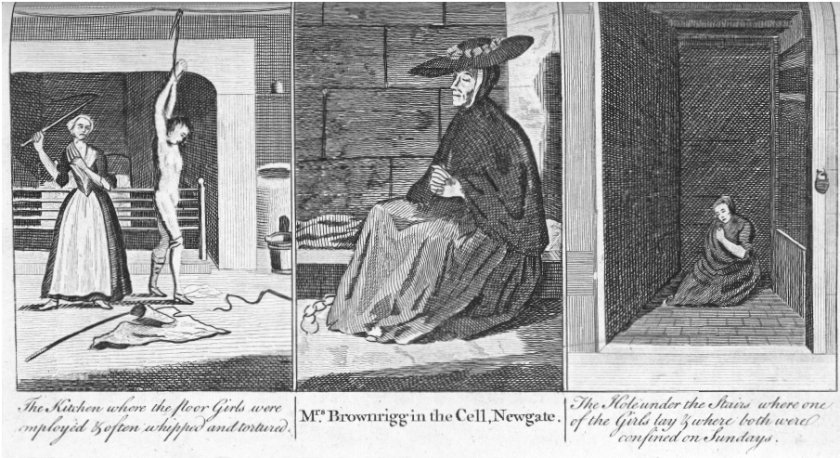
Elizabeth liked to keep the servants locked up, starving, usually naked, and would pinion their hands and inflict merciless corporal punishment for the least transgression against rules like “having any more bread”. The Old Bailey Online preserves one servant’s trial testimony:

Q. In what manner did she use to beat her?

M. Mitchel. She used to tie her up in the kitchen; when first she began to be at her, she used to tie her up to the water-pipe, with her two hands drawed up above her head.

Q. Describe that water-pipe.

M. Mitchel. That goes across the kitchen; the hooks that hold it are fastened into a beam.

Q. Had she used to have her clothes on when your mistress tied her up in this manner to beat her?

M. Mitchel. No, no clothes at all.

Q. How came that?

M. Mitchel. It was my mistress’s pleasure that she should take her clothes off.

Q. What had she used to beat her with?

M. Mitchel. She beat her most commonly with a horse-whip.

Q. How long did she use to beat her in this manner?

M. Mitchel. I cannot justly say, but she seldom left off till she had fetched blood.

This witness Mary Mitchel(l) was the lucky one of the Brownriggs’ last two Foundling Hospital charges: both girls had been stripped and horsewhipped so regularly that ulcerating, infectious sores — never able to heal before the next thrashing — pocked their bodies.

But Mary Mitchell at least survived. Her fellow-sufferer Mary Clifford was flat beaten to death, the body stuffed in the family coal-hole like so much rubbish. (In life, Mary Clifford was sometimes made to sleep there, too.)**


Detail view (click for a larger, three-panel image) of Elizabeth Brownrigg and her crimes illustrated in the Newgate Calendar.

For working-class Londoners struggling to navigate the dislocations of the Industrial Revolution, here was a villainess indeed. London was swelling, urbanizing, bustling with vulnerable orphans and abandoned children like our foundling Marys; all its working classes, for that matter, had reason to feel endangered in the face of fights for their lives against emerging commercial powers working hand in glove with the state — not excluding the ubiquitous threat of the gallows for pitiable property crimes.

And as Peter Linebaugh observes, “apprenticeship” by the 18th century “was less likely to involve the development of highly qualified, skilled labour power than to be the means of organizing the exploitation of young labour power.”† Like it’s not enough working your crappy dead-end unpaid internship; now, it comes with flogging?

Somehow, Brownrigg’s husband and son were convicted only of a misdemeanor and got off with a few months in prison, but Elizabeth bore all the hatred of Londoners more used to seeing apprentices swing than even the vilest master. The Murder Act which had appropriated even the corpses of London’s marginal people was applied to anatomize our former midwife; her skeletal remains were long displayed in a niche at the Royal College of Surgeons.

Oh, and the Foundling Hospital — which had cautioned the Brownriggs before about their excessive abuse of servants but not actually stopped sending them young girls to abuse — started finally instituting some oversight.


There’s a vicious and unsigned satire, “Elizabeth Brownrigge”, published in the September 1832 Fraser’s magazine. Over the years, it has occasioned a great deal of dispute among Thackeray scholars as to whether it might not have been an early creation of that master satirist’s pen. (Thackeray would have just turned 21 when it published.)

We’re not qualified to render judgment on the literary forensics, but the skewering of a murderess through the author’s mock-sympathy has a deliciously Thackerian flavor about it: the world was “incapable of understanding the height of her virtue.” It also underscores the continuing resonance of Elizabeth Brownrigg to Londoners 65 years after her execution.

The magnanimity of her soul, like Mr. Smeaton‘s pharos on the Eddystone, was firmly fixed upon the rock of the soundest principles, and diffused a light around it, for the guidance of those who were beating the waves upon the dark and troubled ocean of adversity, but was itself unshaken by the storm … [in prison] the fair and excellent Elizabeth adopted, as nearly as circumstances would allow, the same admirable disposition of her time to which she had been accustomed when inhabiting her own romantic bower in the village of Islington. She completed a large stock of baby-linen for the poor; she perused new publications of the day; and she composed an elaborate parallel between the characters of Socrates and Lady Jane Grey, after the manner of Plutarch. These are the two distinguished personages, in the whole range of authentic history, who in their strength of mind, purity of life, and extensive accomplishments, bore the strongest resemblance to herself; and to them, perchance, the attention of our heroine was more particularly directed in the quiet and retirement of her cell by the many points of similarity which subsisted between their destiny and her own.

Later, the fictional Elizabeth mounts a defense of such oblivious loathsomeness that it naturally impresses the judge:

“… punishment is a moral medicine. I may, perchance, actuated by too eager a desire for the rapid cure of my little and much-cherished patient, have dispensed my alternatives too liberally, and produced and untoward, an unexpected, and a most deeply-lamented consequence; but am I, therefore, to be condemned as guilty? In the analogous case of the physician, whose too-abundant anodynes may have lulled the sufferer to endless slumbers, or whose too copious phlebotomy may have let out the fever and the life at one and the same moment from the veins, would this most harsh and unmerciful measure be applied? … I demand from the justice of your lordship and a jury of my countrymen — as a matter not of mercy, but of right — the same impunity in my case which would be accorded, freely an unasked, under parallel circumstances, to the medical practitioner.”

Thackeray or whomever lay behind this pasquinade had a wider literary target in mind than simply Elizabeth Brownrigg(e)’s class. The short story is prefaced with a dedication to “the author of Eugene Aram“, meaning the popular novel published earlier in 1832 by Edward Bulwer-Lytton — a lifelong Thackeray bete noir. That novel concerned another renowned 18th century murderer, and it’s safe to say from the dedication that our satirist considered Bulwer-Lytton’s empathetic portrayal of the titular homicide a little, er, soft on crime.

I have been taught by Eugene Aram to mix vice and virtue up together in such an inextricable confusion as to render it impossible that any preference should be given to either, or that the one, indeed, should be at all distinguishable from the other … I had, indeed, in my dramatic piece, been guilty of an egregious and unpardonable error: I had attempted to excite the sympathies of the audience in favour of the murdered apprentices, but your novel has disabused me of so vulgar a prejudice, and, in my present version of her case, all the interest of the reader and all the pathetic powers of the author will be engaged on the side of the murderess.

* The Newgate Calendar: “On her way to the place of execution the people expressed their abhorrence of her crime in terms which, though not proper for the occasion, testified their astonishment that such a wretch could have existed: they even prayed for her damnation instead of her salvation: they doubted not but that ‘the devil would fetch her,’ and hoped that ‘she would go to hell.’ Such were the sentiments of the mob.”

** Elizabeth Brownrigg admitted to the Ordinary of Newgate the truth of Mary Mitchell’s horror testimony.

† Conversely, rogues who took to the highway and became working-class heroes were very often men who had absconded from their apprenticeship — for instance, Jack Sheppard and Dick Turpin.

On this day..

1944: Noor Inayat Khan, SOE operative

(Thanks to Meaghan Good of the Charley Project for the guest post. -ed.)

On either September 12 or (as we’re going with here) the early hours of September 13* in 1944, 30-year-old French spy Noor Inayat Khan (also known as Nora Baker, or by her code name Madeleine) was executed at Dachau for her activities on the behalf of the Resistance in Nazi-occupied France.

Noor, the first woman radio operator to be sent into France, came from a rather unusual background: her father was a Sufi religious leader descended from Indian royalty, and her mother an American from New Mexico.

Born in Russia, raised in England and France, Noor studied psychology and wrote poetry and a book of Buddhist-inspired short stories before the war intervened and her she and her family fled to England.

Although Noor had strong pacifist leanings, she decided to join in against Nazi Germany. Because she was fluent in French and English and was a good radio operator, they decided to send her to France. She went in June 1943.

Many of those who had trained her had grave doubts about her suitability as a spy. As part of her Sufi upbringing she had been taught that lying was the worst of all sins. Leo Marks, who taught her cryptography, later wrote his initial impressions of her in his book Between Silk and Cyanide:

She was cycling towards her ‘safe-house’ to practice transmitting when a policeman stopped her and asked what she was doing.

“I’m training to be an agent,” she said, “here’s my radio — want me to show it to you?” She then removed it from its hiding place and invited him to try it. […]

She’d been so startled by an unexpected pistol-shot that she’d gone into a Sufi-like trance for several hours, and finally emerged from it to consult a Bible.

Once in France, however, she displayed lion-like courage.

Even when the Nazis were making mass arrests of the French agents she associated with and the British forces offered to let her come home, she refused to desert her post.

After three and a half months she was betrayed, and pacifism notwithstanding she fought so furiously on arrest that her Nazi guards were afraid of her. In spite of considerable pressure (and we know what that means) she refused to provide them with any information about herself or her Resistance colleagues. On top of all that, she also made two escape attempts.

They decided to send her to Germany to better keep an eye on her.

Noor spent the rest of 1943 and most of 1944 in prison in KahrsruleKarlsruhe, subject to repeated interrogations by the Gestapo. She never gave anything away. In September 1944 she was sent to Dachau and shot to death with three other female agents — Yolande Beekman, Madeleine Damerment, and Eliane Plewman — their bodies cremated.

Her last word? “Liberté.”

After her death she was awarded with the French Croix De Guerre and the British George Cross, and made a Member of the Order of the British Empire. Shrabani Basu published her biography, Spy Princess, in 2007 … and there’s a memorial in the works for her for London’s Gordon Square.

* Not everyone buys these dates or the story of these SOE agents’ execution.

On this day..

1778: Patrick McMullen, repeat deserter

On this date in 1778, Patrick McMullen was hanged on the Philadelphia commons for deserting, repeatedly, the Continental Army.

This poor fellow had started off (promisingly enough for the colonies) by deserting the British.

Such documentation as remains easily accessible isn’t very detailed about his pre-war background; the British had recently passed a Recruiting Act authorizing press gangs to shanghai Scotsmen into the royal army, but that measure was only 99 days old at this time. There were also many Scots-Irish who had already immigrated to the Pennsylvania colony or thereabouts.

This Irishman, however, enlisted pre-1775 in the British 38th Regiment of Foot, deserted, presumably served in a Continental Army unit at some point thereafter, and then by 1778 was back in British colors for the Battle of Monmouth, after which he deserted once again. Maybe he even changed teams four times, instead of twice.

Don Hagist is the author of the forthcoming book British Soldiers, American War.

This sort of “treachery” was not at all unusual.

“A good number of men switched sides, some several times, during the war,” said Don Hagist of the fascinating British Soldiers, American Revolution blog. “For many of them it did not impugn their reputations as soldiers; for example, many British prisoners of war escaped from captivity, joined in the American army as a means to get close to the front lines, then deserted again to rejoin the British army.

“At least, that is the story they’d give when brought to trial. Even when acquitted, sometimes these same men deserted yet again. When McMullen returned to the British army, he may have given the popular story that he was kidnapped by Bostonians and carried away from the garrison. This happened to a number of British soldiers in 1774 and early 1775; some turned up years later and gave their stories in court.”

McMullen had the bad luck to have to give this story to a court in Philaelphia at the time of that patriotic city’s maximum hostility following the British occupation.

Philadelphia’s Revolutionary military governor at this time was Benedict Arnold — still two years from his infamous betrayal, but even now finding himself stressed by the revolutionary extremism of his charges. Never a fire-eater himself, Arnold personally wrote to the Continental Congress with his own pitch for showing McMullen a bit of brotherly love, vouchsafing the view that our deserter’s culpability “is in his [Arnold’s] opinion insufficient” to warrant execution.

A Congressional committee respectfully disagreed, judging McMullen “a person of a most atrocious character” and directed that the hanging proceed.

Short review of these volumes about Revolutionary War desertion.

On this day..

1887: Israel Lipski

(Thanks to Meaghan Good of the Charley Project for the guest post. -ed.)

On this day in 1887, 22-year-old Israel Lipski was hanged at Newgate Prison for the murder of Miriam Angel.

His trial and execution were well-publicized in their day, and were the subject of a 1984 book, The Trials of Israel Lipski: A True Story of a Victorian Murder in the East End of London by Martin L. Friedland.

But Lipski has been largely forgotten now … except as a footnote in a much more famous unsolved murder.

Lipski was of Polish-Jewish origin. His real name was Israel Lobulsk; he changed it when he moved to the UK.

He lived in a boardinghouse and worked as an umbrella and walking-stick salesman. Miriam, who was also Jewish, lodged at the same address, 16 Batty Street.

Miriam was found dead in her bed June 28 of that year. She’d been killed in an unusual way: she was forced to consume nitric acid, also known as aquafortis, a strong corrosive chemical now used in rocket fuel. She was six months pregnant at the time of her death.

Lipski was found hiding under her bed. He too had consumed nitric acid and the inside of his mouth was burned. Investigators later determined he’d purchased an ounce of the chemical that very morning. They theorized he had killed Miriam during a rape attempt.

Lipski, for this part, insisted he was innocent of any crime and told an extraordinary story: he stumbled across two co-workers in Miriam’s room rifling through her things. Miriam was already dead at this point. The two men attacked and robbed him, poured the nitric acid down his throat and threw him under the bed, where he fainted.

The judge’s summing-up to the jury, described by one news account as “lucid and temperate,” went with the rape theory:

… that the murderer of Miriam Angel entered her room under the influence of unlawful passion; that, balked in this design, his passion turned to homicidal fury; and that in a reaction of shame and terror he had taken a dose of the same poison that he had given to his victim. If that theory was probable, continued the judge, the murder was much more likely to have been the work of one man than two.

The climate of pervasive anti-Semitism in East London during this time sealed Lipski’s fate. London’s Jewish population, largely impoverished Polish and Russian refugees, was ever liable to blame for a wide variety of social problems. On top of everything else, Lipski’s legal defense was abysmal and the judge clearly biased. He might have been guilty, but the fairness of his trial is questionable.

Following Lipski’s conviction and death sentence there was worried speculation that he might, after all, be innocent. Several prominent people, including members of Parliament and investigative journalist William Stead, petitioned the Home Secretary for a reprieve or commutation. (Stead referred to Lipski as “the young martyr” and the “much injured young exile.”) The wind went out of their sails, however, after Lipski’s confession was published:

I, Israel Lipski, before I appear before God in judgment, desire to speak the whole truth concerning the crime of which I am accused. I will not die with a lie on my lips. I will not let others suffer even in suspicion for my sin. I alone was guilty of the murder of Miriam Angel.

I thought the woman had money in her room, so I entered, the door being unlocked and the woman asleep. I had no thought of violating her, and I swear I never approached her with that object, nor did I wrong her in this way. Miriam Angel awoke before I could search about for money, and cried out, but very softly. Thereupon I struck her on the head and seized her by the neck, and closed her mouth with my hand, so that she should not arouse the attention of those who were about the house.

I had long been tired of my life, and had bought a pennyworth of aquafortis that morning for the purpose of putting an end to myself. Suddenly I thought of the bottle I had in my pocket, and drew it out and poured some of the contents down her throat. She fainted and, recognizing my desperate condition, I took the rest. The bottle was an old one which I had formerly used … The quantity of aquafortis I took had no effect on me.

Hearing the voices of people coming upstairs, I crawled under the bed. The woman seemed already dead. There was only a very short time from the moment of my entering the room until I was taken away.

Even before his execution, “Lipski” became a part of Londoners’ vocabulary. It was used as both a slur against Jews and as a verb, the way a certain kind of suffocation murder still known as “burking” was named after William Burke of “Burke and Hare” fame.

A year after Israel Lipski’s execution, the name “Lipski” once again came under scrutiny after a murder suspect yelled it out in front of a witness, leaving scholars and true-crime buffs to speculate about its meaning for the next 120 years and counting.

The victim in that case was a prostitute named Elizabeth Stride. The suspect is known only by his trade name, Jack the Ripper.

But that’s another story.

On this day..

1612: The Pendle Witches

You have heard of mother Nottingham, who for her time was pretty well skilled in casting of waters: and after her, Mother Bombye; and there is one Hatfield in Pepper-Alley, hee doth prettie well for a thing that’s lost. There’s another in Coleharbour, that’s skilled in the Planets. Mother Sturton in Goulden-lane, is Fore-speaking: Mother Phillips of the Banke-side is for the weaknesse of the backe: and then there’s a very reverent Matron on Clarkenwell-Green, good at many things: Mistris Mary on the Banke-side is for recting a Figure: and one (what doe you call her) in Westminster, that practiseth the Booke and the Key, and the Sive and the Shears: and all doe well, according to their talent. For myselfe, let he world speake.

-Title character in Thomas Heywood’s The Wise Woman of Hogsdon (1638)

This date marks the 400th anniversary of the Pendle witches‘ hanging — perhaps the most notorious witchcraft execution in English history.

Eight women and two men — Alizon Device, her brother James Device, and their mother Elizabeth Device of the Demdike family; Anne Whittle and her daughter Anne Redferne of the Chattox family; Jane Bulcock and her son John Bulcock; Alice Nutter; Katherine Hewitt; and Isabel Robey* — hanged together this date at Lancaster’s Gallows Hill after being tried over the preceding 48 hours; they, along with a woman named Jennet Preston hanged at York on July 29, comprise the Pendle Witches.

It’s an extraordinarily sad case.

The prosecution of the Pendle witches bubbled out of a witches’ brew of circumstances particular to early-17th century England. There was, to begin with, a new(ish) English king, James I and the guy had a major jones for hunting those early modern supernatural terrorists, witches.** The guy even wrote his own book, Daemonologie, to establish “that such divelish artes have bene and are … [and] what exact trial and severe punishment they merite.” A 1604 law had accordingly broadened the reach of the death penalty for supposed instances of sorcery.

Coming as this did in the aftermath of the Tudor Reformation, the nebulous concept of “witchcraft” was handy as well for clamping down on any excessively Catholic practices that might strike the right authorities as subversive, intransigent, or impious. Lancashire where we lay our scene was just such a Catholic-leaning zone.

Lancashire also had, as almost everywhere in the Isles, its share of “cunning folk” — workers of everyday folk magic whose widely tolerated practices could also be taken by a hostile viewer as Catholic superstition and/or hard-core infernal trafficking.

So, these are the brew’s ingredients. Add wool of bat and tongue of dog, stir vigorously … and serve with a length of hemp.

Curses

The Pendle witches brew started bubbling with a freak incident: a cunning woman named Alizon Device (you’ll recognize her name from the list of the hanged, above) tried to beg some needles from a passing peddler. The latter refusing her, Alizon cursed him, just like you do when you’re cut off in traffic.

Except in this case, the peddler promptly suffered a stroke.

Everyone was spooked at this apparent effusion of transmundane malevolence, nobody more so than Alizon herself. She became the first arrestee, and in the end would go the gallows convinced of her own sorcery.

She also started accusing others of occult involvement, either from a sense of panicked guilt or a blithe ignorance that the new legal regime would be interpreting folk spells as capital crimes. This led her bizarre instance of passing-peddler-popping to become a full-on witch hunt.

Alizon Device came from a whole family, the Demdykes or Demdikes, of cunning-women, and she implicated her own grandmother for having taught her the witchy ways. (Grandma would be spared the ignominy of hanging because she suffered the ignominy of dying in the filthy dungeon.) Alizon also accused a rival family, the Chattoxes, themselves well-known as “witches”, and she also implicated the matriarch of that family, Anne Whittle. The dreadful progress of the ensuing investigation, in which the feuding locals hanged each other with the aid of an ambitious local magistrate, is widely available — thanks to the record one lawyer witness to the proceedings set down in his credulous 1613 chapbook The Wonderfull Discoverie of Witches in the Countie of Lancaster.

Foiled Again

Once these initial arrests were in the books, Alizon’s mother Elizabeth apparently convened a solidarity meeting at a hut with the diabolically menacing name of Malkin† Tower. Dining on stolen mutton, and on Good Friday no less, they may have worked out a plan to liberate the prisoners from Lancaster Castle (at least, the Demdike prisoners). But the magistrate got wind of this confabulation and burst in to arrest those participants, too. As these secondary circles were pulled into the investigation, so too were past years of community gossip about these “witches”, of various folk who had died unexplained and various mishaps that befell people whom the witches didn’t like.

These superstitions seem to have been shared by the witches themselves, at least many of them. The Demdikes and Chattoxes used clay figures, human remains, and little effigies of victims with the intent of hurling evil at their enemies. Causality aside, Alizon Demdike did curse the peddler. “Witches think sometimes that they kill, when they do not, and are therefore as culpable, as if they did,” said their contemporary, pastor John Donne.

To augment the assorted confessions and counter-accusations among the accused, Elizabeth Device’s nine-year-old daughter Jennet Device (little sister of the original peddler-curser Alizon) was summoned up to provide coached testimony against her siblings Alizon and James, against her mother, and against those at the Malkin Tower meeting. Several of these latter would be convicted of non-capital crimes or even acquitted outright, but little Jennet’s testimony doomed her own family.

Although not the first time a child had provided evidence, it was a landmark in normalizing minors’ accusations — jurisprudence advocated by James’s Daemonologie. “Children, women and liars,” the sovereign announced, “can be witnesses over high treason against God.”

These witnesses would cast an evil pall well after Pendle.

In later life, Jennet appears to have been caught up in the same trap, when she was accused of witchcraft by a 10-year-old boy. A judiciary grown more cautious by then did not put her to death … but she (unless it was a different person also named Jennet Device) died in prison.

And the acceptability of this sort of children’s testimony, duly documented for country JP’s in Michael Dalton’s Country Justice, containing the Practice, Duty, and Power of Justices of the Peace, would be the lethal linchpin of the witch trials 80 years later across the Atlantic — in Salem, Massachusetts.

This miserable event has informed any number of artistic productions from the 17th century stage to the present-day Pendle Sculpture Trail. Pendle and Lancashire, as bywords for witch superstitions, now trade handsomely on the unfortunate fame.

Many there have also pushed (thus far unsuccessfully) for an official posthumous pardon of the hanged witches.

And the nearby village of Roughlee even erected a statue in 2012 to the hanged Alice Nutter … a gentlewoman (i.e., of considerably higher class standing than her fellow condemned) whose reason for attending the Malkin Tower meeting remains mysterious.


Alice Nutter statue at Roughlee. Image (c) Burnley & Pendle Ramblers and used with permission.

* Isabel Robey is an outlier case; as of this writing, she’s not even named as one of the Pendle witches on the Wikipedia page as it seems she was not associated directly with the Malkin Tower crowd — merely a bystander who got caught up in the storm of denunciations. She was, however, hanged on Gallows Hill for witchcraft on August 20. There’s a lengthy attempt at reconstructing her story in the face of scant documentation here (pdf).

** All well and good for us moderns to pooh-pooh James’s supernatural obsessions, but the man’s security concerns were very real.

† The BBC documentary has Malkin as slang for “shit”; this page proposes that the word can signify a cat, a bindle, a scarecrow, or “an awkward woman.”

On this day..

1469: Richard Woodville, father of the queen

On this date in 1469, Richard Woodville, the father of the queen, lost his head.

Though he died as Earl Rivers, Woodville started life as a commoner.

As a retainer to the Duke of Bedford, Woodville drew escort duty for the mistress of the house when the master died suddenly. Not one to waste an opportunity, Woodville soon made the merry widow his merry wife: at the time, he was around 30 and she around 20, while the late husband had kicked off at age 46.

For this impertinent and unauthorized union, the couple paid a fine … and their descendants enjoyed royal power. Well-behaved women and knights-errant seldom make history, right?

Marrying nobility put Woodville into the War of Roses game of throne, where he again proved a deft hand with sneaky conjugation.

In 1464, he secretly married his widowed daughter Elizabeth to the young king Edward IV. Elizabeth Woodville became thereby the first commoner in history to marry an English king.

She also became a lightning-rod.

The Earl of Warwick, so powerful that he was known in this era of uneasy-resting crowns as “The Kingmaker”, was embarrassingly undercut by the Woodville match in his own machinations to pair Edward with a French princess. A stunned Privy Council castigated Edward when it found out — “however good and however fair she might be,” they grumbled “she was no wife for a prince such as himself; for she was not the daughter of a duke or earl” — but the young king stood by his lady.

A love match? We leave that question for the poets and the novelists.

From left to right, Philippa Gregory‘s books about Richard Woodville’s wife, daughter, and granddaughter. Gregory also wrote a nonfiction companion to this bestselling series, The Women of the Cousins’ War: The Duchess, the Queen, and the King’s Mother.

But politically, the Woodville marriage certainly upset the game board. Richard Woodville got promoted to Earl Rivers and others of the tribe profited likewise: this made good sense for Edward because these people would owe their positions, and loyalty, to him.

Contrast with the independent, arrogant aristocrat set like Warwick, who soon proceeded — and what part l’affaire Woodville plazed in his defection is up for speculation, although it was part of his own publicly asserted justification — to desert Edward’s Yorkist cause for the Lancastrian claimant.

Warwick’s rebellion succeeded in overthrowing Edward in 1469, and it was in the glow of this victory that Warwick had the obnoxious arriviste Richard Woodville beheaded as a traitor, together with the man’s son John.

Unfortunately for Warwick, it was but a moment.

Unable to govern, Warwick had to release his royal prisoner, and the sides slid back into open conflict. Edward decisively crushed the Lancastrians at the Battle of Tewkesbury, conveniently killing Warwick in the process.

Duly returned to her station, Elizabeth Woodville produced two sons for her husband, the boys history remembers as the Princes in the Tower — which is where the last LancastrianYorkist king Richard III is thought to have murdered them. In Shakespeare’s Richard III, Queen Elizabeth is quite the bummer.

Ay me, I see the ruin of my house!
The tiger now hath seiz’d the gentle hind;
Insulting tyranny begins to jet
Upon the innocent and aweless throne.
Welcome, destruction, blood, and massacre!
I see, as in a map, the end of all.

But her house wasn’t quite ruined after all: Elizabeth Woodville also produced a daughter, also named Elizabeth. This latter “Elizabeth of York” married another descendant of a commoner, who carried the Lancaster standard: this fellow of doubtful lineage would finally resolve the War of the Roses and reign as Henry VII. (Father, namesake, and predecessor, of course, to this site’s patron head-chopping monarch Henry VIII: Richard Woodville’s great-grandson.)

On this day..

1908: Khudiram Bose, teenage martyr

The investigations following upon the recent raids on Anarchist dens here prove the existence of a revolutionary plot on a vast scale and show that there was a systematically organized “college” … where bombs were manufactured and instruction in explosives was given … The prisoners talk freely of their “heroic conduct” and “noble design,” while refusing to impart any informaton incriminating those working behind the scenes and furnishing the funds. They all confess, however, that their minds have been fired by writings in the Press and speeches on platforms.

–London Times

It’s a timeless story, really; with a tweak here or there, the excerpt above could do for reportage on seditious movements by the hundredfold. As it happens, its dateline is May 11, 1908 — Calcutta.

Separatist stirrings on the subcontinent were then manifesting themselves in the explosive revolutionary language of the day, and the chief magistrate of that ancient city of Calcutta — Kingsford by name, as in charcoal — was a character notorious for his harshness toward the movement. The year before, he’d had a 15-year-old flogged for trying to stop a British soldier beating Indian activists.

Among the more militant types excited to wrath against Kingsford was an 18-year-old Bengali who would have the privilege of martyrdom for the cause of national self-determination.

Khudiram Bose sought the judge out in Muzaffarpur and, with another young revolutionary, attempted to assassinate him in April 1908 by tossing a couple of bombs into Kingsford’s carriage.

Minor problem: it was the wrong carriage.

Instead of popping the nefarious judge, the bombs killed the wife and daughter of a barrister.

The other assassin committed suicide when cornered by police, but Bose would meet his end via the judiciary.

Bose played his patriotic martyr’s role to the hilt in the few brief weeks before his hanging, and found himself on the leading edge of a growing movement of anti-British bombers. “People are prepared to do anything for the sake of swarajya [home rule] and they no longer sing the glories of British rule,” one contemporary newspaper (quoted here) put it. “They have no dread of British power. It is simply a question of sheer brute force.” The editor was convicted of seditious libel.

One can now find plentiful Khudiram Bose hagiographies celebrating the youthful freedom fighter … regardless of his target selection.

On this day..

1759: Eugene Aram, philologist

On this date in 1759, Eugene Aram was hanged at York for murder.

Aram was the son of a gardener, but taught himself Latin and Greek and made himself a respected schoolteacher.

Aram had a special gift for languages, and began research on a never-completed comparative lexicology of the Celtic tongue — correctly intuiting, if not the identity of the distant common mother tongue, the concept of what is now understood as the common progenitor of the related Indo-European languages.

the ancient Celtae, by the numberless vestigaes left behind them, in Gaul, Britain, Greece, and all the western parts of Europe, appear to have been, if not the aborigines, at least their successors, and masters, in Gaul, Britain, and the west; — that their language, however obsolete, however mutilated, is at this day discernible in all those places which that victorious people conquered and retained: — that it has extended itself far and wide, visibly appearing in the ancient Greek, Latin, and English, of all which it included a very considerable part; and, indeed, it still unquestionably, forms a most important ingredient in all the languages of Europe. (Source at archive.org | Google books)

His might have been an illustrious name in linguistic history. Instead …

In 1745, when Aram was already 40 and teaching in Knaresborough, a strange event occurred: a friend of Aram’s named Daniel Clark made the rounds of local merchants “buying” (on credit) a variety of portable valuables … and then promptly disappeared. Aram was suspected of some part in this sketchy affair and detained using the expedient of an outstanding debt pending investigation that would yield a more satisfactory charge.

Aram, however, paid off his arrears in cash. Since no real grounds existed to hold him, he walked away, and immediately left Knaresborough.

There the matter rested for 13 years, time that Aram spent immersed in his language work.

Justice delayed was not to be denied, however. Finally, in 1758, the accidental discovery of a body in Knaresborough rekindled interest in the case (even though the body turned out not to be Clark’s). Thirteen years on, the matter unlocked with amazing ease; Aram’s wife (left behind in Knaresborough when our man blew town) had her suspicions, which led to a mutual friend of Aram’s and the victim, who gave authorities the correct location of Clark’s theretofore undiscovered body. (Namely, St. Robert’s cave.) Upon that considerable credibility the mutual friend (Houseman by name) accused Aram of the murder. Since the wife was also prepared to swear she had heard all these men, and Clark among them, conspiring shadily together, Aram was in the stew.

As a proper Enlightenment man, learner of languages, inquirer of science, writer of poetry, and author of dark and vengeful deeds, Aram didn’t bother with a barrister but defended himself, and very ably in the judgment of his observers.

“His defense was an ingenious plea of the general fallibility of circumstantial evidence,” records this encyclopedia. But he had to stick to generalities because (as he admitted after conviction) he was actually quite guilty, and Aram “seemed really more carried away by the abstract philosophy of his argument, than impressed by the terrible relation it bore to his fate.” The lengthy Newgate calendar entry on his case preserves some of these sorties.

He would eventually ascribe his own motive not to greed of gold but suspicion of cuckoldry. Houseman, who was probably just as involved (and probably in his part for greed) appears to have escaped the noose.

Aram became a potent literary reference for his countrymen as a partially sympathetic, Janus-faced creature: the thoughtful scholar encumbered by his guilty conscience, or one whose potential gift to all mankind is undone by his injury to one man.

Edward Bulwer-Lytton wrote a novel about Aram. In Thomas Hood‘s poem “The Dream of Eugene Aram”, the titular killer is tormented by the recollection of what he has done.

“Oh God! that horrid, horrid dream
Besets me now awake!
Again — again, with dizzy brain,
The human life I take:
And my red right hand grows raging hot,
Like Cranmer‘s at the stake.

“And still no peace for the restless clay,
Will wave or mould allow;
The horrid thing pursues my soul —
It stands before me now!”
The fearful Boy looked up, and saw
Huge drops upon his brow.

That very night while gentle sleep
The urchin’s eyelids kissed,
Two stern-faced men set out from Lynn,*
Through the cold and heavy mist;
And Eugene Aram walked between,
With gyves upon his wrist.

Wodehouse, Orwell, W.G. Wills all also dropped Eugene Aram literary references in their day.

* The town in Norfolk where Aram was hanging his hat when he was finally arrested.

On this day..