On this date in 1645, John Hotham the Younger — former M.P., and (too) briefly an adherent of Parliament in the English Civil War, was beheaded as a traitor.
This morning, China confirmed (to London’s fury) the dawn execution of British national Akmal Shaikh.
As tweeted @executedtoday, Shaikh has been at the eye of a media firestorm the past week, though without himself being aware of his impending (and publicly announced) execution until family members who had raced to China to plead for mercy met with him within the past day.
“He was obviously very upset on hearing from us of the sentence,” said the clan’s post-meeting (under)statement.
The 53-year-old Shaikh had been homeless in Poland and apparently duped into schlepping some cargo to China as part of a wild goose chase to become a pop star and bring world peace.
In any case like this (and certainly on any blog like this), the mystery parcel invariably contains drugs, doesn’t it? In this instance, our courier was busted at Ürümqi airport with 4 kg of heroin, some 80 times China’s death-sentencing threshold. He swore he knew nothing about it.
So this morning, Akmal Shaikh became the first European executed in China in some 50-plus years … and the lone casualty of a lonely quest to somehow save the world.
Update: China flexes its muscle in the diplomatic row: “We hope that the British side can view this matter rationally and not create new obstacles in bilateral relations.”
On this date in 1777, crying out “Stand clear! Look to yourselves! I am the first hypocrite in Sion!”, a clerical schoolmaster was hanged at Tyburn for raping one of his charges.
Ann (or Anne) Mayne testified that the reverend had raped her when she was 9 and 10 years old (the girl was only 10 at the time of the trial). Russen ducked similar charges leveled by three other girls. Rachael Davis, for instance,
said, he lay upon her; but she did not declare, that he entered her body: I told the parties, that no one need be bound over, for it did not appear capital, as she did not say her body was entered.
Result: acquittal. (I’m sure you’ll feel good about entrusting your Bethnal-Green charity school child to Rev. Russen after that.)
Three acquittals out of four ain’t bad.
But it only took one conviction to hang him.
The Old Bailey Online record of Russen’s trial is full of dickering over penetration degrees, and of course, hymen breakage (or lack thereof).
According to thisTreatise of the Pleas of the Crown,* the judge in the Mayne case
left it to the jury whether any penetration were proved; for if there were any, however small, the rape was complete in law. The jury found him guilty, and he received judgment of death. But before the time of execution, the matter being much discussed, the learned Judge reported the case to the other judges for their opinions, whether his direction were proper. And upon a conference it was unanimously agreed … that the direction of the Judge was perfectly right. They held, that in such cases the least degree of penetration is sufficient, though it may not be attended with the deprivation of the marks of virginity. It was therefore properly left to the jury by the Judge, and accordingly the prisoner was executed.
* Part of Edward Hyde East’s project in this Treatise is to argue against a standard still used in some jurisdictions that ejaculation was required to constitute a rape. See Passion and Power: Sexuality in History.
That Katharine, queen of England, formerly called Kath. Howerd, late of Lambyth, Surr., one of the daughters of lord Edmund Howard, before the marriage between the King and her, led an abominable, base, carnal, voluptuous, and vicious life, like a common harlot, with divers persons, as with Francis Derham of Lambeth and Hen. Manak [Manox] of Streteham, Surr., 20 and 24 May 32 Hen. VIII., and at other times, maintaining however the outward appearance of chastity and honesty. That she led the King by word and gesture to love her and (he believing her to be pure and chaste and free from other matrimonial yoke) arrogantly coupled herself with him in marriage. And the said Queen and Francis, being charged by divers of the King’s Council with their vicious life, could not deny it, but excused themselves by alleging that they were contracted to each other before the marriage with the King;* which contract at the time of the marriage they falsely and traitorously concealed** from the King, to the peril of the King and of his children to be begotten by her and the damage of the whole realm. And after the marriage, the said Queen and Francis, intending to renew their vicious life, 25 Aug. 33 Hen. VIII., at Pomfret, and at other times and places, practised that the said Francis should be retained in the Queen’s service; and the Queen, at Pomfret, 27 Aug. 33 Hen. VIII., did so retain the said Francis, and had him in notable favour above others, and, in her secret chamber and other suspect places, spoke with him and committed secret affairs to him both by word and writing, and for the fulfilling of their wicked and traitorous purpose, gave him divers gifts and sums of money on the 27 Aug. and at other times.
Also the said Queen, not satisfied with her vicious life aforesaid, on the 29 Aug. 33 Hen. VIII., at Pomfret, and at other times and places before and after, with Thos. Culpeper,† late of London, one of the gentlemen of the King’s privy chamber, falsely and traitorously held illicit meeting and conference to incite the said Culpeper to have carnal intercourse with her; and insinuated to him that she loved him above the King and all others. Similarly the said Culpeper incited the Queen. And the better and more secretly to pursue their carnal life they retained Jane lady Rochford, late wife of Sir Geo. Boleyn late lord Rochford, as a go-between to contrive meetings in the Queen’s stole chamber and other suspect places; and so the said Jane falsely and traitorously aided and abetted them.
On this date in 1541, Thomas Culpeper and Francis Dereham paid the penalty for their indiscretions; the former queen would see her lovers’ severed heads mounted on pikestaffs on London Bridge as she was rowed to the Tower.
The onetime court favorite Culpeper was beheaded for cuckolding the royal person, and that’s no more than one would expect. But the political pull-less Dereham — who had slept with (and possibly “pre-contracted” to wed) the willing young Kate before she meant anything to the king — enjoyed the full measure of the traitor’s torture: hanged, emasculated, eviscerated, and dismembered, all of it basically for having failed to anticipate that his little conquest would one day grow up to turn the monarch’s head.
* Catherine Howard’s confessional letter to Henry VIII … desperately attempting to limit her indiscretions to the time before her marriage:
I, your Grace’s most sorrowful subject and most vile wretch in the world, not worthy to make any recommendation unto your most excellent Majesty, do only make my most humble submission and confession of my faults. And where no cause of mercy is given on my part, yet of your most accustomed mercy extended unto all other men undeserverd, most humbly on my hands and knees do desire one particle thereof to be extended unto me, although of all other creatures I am most unworthy either to be called your wife or subject.
My sorrow I can by no writing express, nevertheless I trust your most benign nature will have some respect unto my youth, my ignorance, my frailness, my humble confession of my faults, and plain declaration of the same, referring me wholly unto Your Grace’s pity and mercy. First, at the flattering and fair persuasions of Manox, being but a young girl, I suffered him a sundry times to handle and touch the secret parts of my body which neither became me with honesty to permit, nor him to require. Also, Francis Derehem by many persuasions procured me to his vicious purpose, and obtained first to lie upon my bed with his doublet and hose, and after within the bed, and finally he lay with me naked, and used me in such sort as a man doth his wife, many and sundry times, and our company ended almost a year before the King’s Magesty was married to my Lady Anne of Cleves and continued not past one quarter of a year, or a little above.
Now the whole truth being declared unto Your Majesty, I most humbly beseech you to consider the subtle persuasions of young men and the ignorance and frailness of young women. I was so desirous to be taken unto your Grace’s favor, and so blinded by with the desire of worldly glory that I could not, nor had grace to consider how great a fault it was to conceal my former faults from your Majesty, considering that I intended ever during my life to be faithful and true unto your Majesty ever after. Nevertheless, the sorrow of mine offenses was ever before mine eyes, considering the infinite goodness of your Majesty toward me from time to time ever increasing and not diminishing. Now, I refer the judgment of my offenses with my life and death wholly unto your most benign and merciful Grace, to be considered by no justice of your Majesty’s laws but only by your infinite goodness, pity, compassion and mercy, without which I acknowledge myself worthy of the most extreme punishment.
** Early the next year, parliament declared, “to avoid doubts in future” — read: “retroactively legislated” — that “an unchaste woman marrying the King shall be guilty of high treason.” This also made anyone who knew about said unchastity guilty of (at least) misprision of treason for failing to report it.
I heartily recommend me unto you, praying you to send me word how that you do. It was showed me that you was sick, the which thing troubled me very much till such time that I hear from you praying you to send me word how that you do, for I never longed so much for a thing as I do to see you and to speak with you, the which I trust shall be shortly now. That which doth comfortly me very much when I think of it, and when I think again that you shall depart from me again it makes my heart die to think what fortune I have that I cannot be always in your company. It my trust is always in you that you will be as you have promised me, and in that hope I trust upon still, praying you that you will come when my Lady Rochford is here for then I shall be best at leisure to be at your commandment, thanking you for that you have promised me to be so good unto that poor fellow my man which is one of the griefs that I do feel to depart from him for then I do know no one that I dare trust to send to you, and therefore I pray you take him to be with you that I may sometime hear from you one thing. I pray you to give me a horse for my man for I had much ado to get one and therefore I pray send me one by him and in so doing I am as I said afor, and thus I take my leave of you, trusting to see you shortly again and I would you was with me now that you might see what pain I take in writing to you.
Yours as long as life endures,
Katheryn.
One thing I had forgotten and that is to instruct my man to tarry here with me still for he says whatsomever you bid him he will do it.
Though this letter is far from conclusively inculpatory, Culpeper confessed that he “intended and meant to do ill with the queen and that in like wise the queen so minded to do with him.”
Possibly England’s last medieval peasant rising, and possibly its first modern revolt, Kett’s Rebellion pitted the agrarian feudal commons against the proto-capitalist world taking shape.
Impelled by the profitable wool export business, landlords began “enclosing” formerly open arable land for pasture, thereby destroying the communal and quasi-communal agricultural models of the middle ages.
Karl Marx
For Marx, among many others, this revolution in agricultural production — and the attendant proletarianization of the former peasantry — marks the dawn of the capitalist epoch, when
great masses of men are suddenly and forcibly torn from their means of subsistence, and hurled as free and “unattached” proletarians on the labour-market. The expropriation of the agricultural producer, of the peasant, from the soil, is the basis of the whole process …
Although, therefore, the English land, after the Norman Conquest, was distributed in gigantic baronies, one of which often included some 900 of the old Anglo-Saxon lordships, it was bestrewn with small peasant properties, only here and there interspersed with great seignorial domains. Such conditions, together with the prosperity of the towns so characteristic of the 15th century, allowed of that wealth of the people which Chancellor Fortescue so eloquently paints in his “Laudes legum Angliae;” but it excluded the possibility of capitalistic wealth.
The prelude of the revolution that laid the foundation of the capitalist mode of production, was played in the last third of the 15th, and the first decade of the 16th century. A mass of free proletarians was hurled on the labour-market by the breaking-up of the bands of feudal retainers, who, as Sir James Steuart well says, “everywhere uselessly filled house and castle.” … In insolent conflict with king and parliament, the great feudal lords created an incomparably larger proletariat by the forcible driving of the peasantry from the land, to which the latter had the same feudal right as the lord himself, and by the usurpation of the common lands. The rapid rise of the Flemish wool manufactures, and the corresponding rise in the price of wool in England, gave the direct impulse to these evictions. The old nobility had been devoured by the great feudal wars. The new nobility was the child of its time, for which money was the power of all powers. Transformation of arable land into sheep-walks was, therefore, its cry … As Thornton rightly has it, the English working-class was precipitated without any transition from its golden into its iron age. (Capital, volume I, chapters 26–27)
It did not suffer its precipitation quietly.
Thomas More
Enclosures were a predominant social problem in England throughout the century, and if contemporaries could hardly descry the shape of the economic revolution taking shape, they worriedly noticed the poverty, the vagabondage, and the depopulated villages.
your sheep, which are naturally mild, and easily kept in order, may be said now to devour men and unpeople, not only villages, but towns; for wherever it is found that the sheep of any soil yield a softer and richer wool than ordinary, there the nobility and gentry, and even those holy men, the abbots! not contented with the old rents which their farms yielded, nor thinking it enough that they, living at their ease, do no good to the public, resolve to do it hurt instead of good. They stop the course of agriculture, destroying houses and towns, reserving only the churches, and enclose grounds that they may lodge their sheep in them. As if forests and parks had swallowed up too little of the land, those worthy countrymen turn the best inhabited places into solitudes; for when an insatiable wretch, who is a plague to his country, resolves to enclose many thousand acres of ground, the owners, as well as tenants, are turned out of their possessions by trick or by main force, or, being wearied out by ill usage, they are forced to sell them; by which means those miserable people, both men and women, married and unmarried, old and young, with their poor but numerous families (since country business requires many hands), are all forced to change their seats, not knowing whither to go; and they must sell, almost for nothing, their household stuff
Commissions studied enclosure; edicts forbade and reversed them; commentators denounced them — all to no effect.
Robert Kett
Robert Kett, from a larger painting (click to see it) by Samuel Wale.
Henrician England had plenty of violent social transformation on its plate, of course, and plenty of violent tools to manage it. When the philandering tyrant kicked the bucket in 1547, he left the unfolding social catastrophe to the weakened protectorate government of his sickly nine-year-old heir.
In East Anglia in the summer of 1549, a peasant riot against an enclosure caught a spark. Unexpectedly, when the mob moved to throw down the enclosures put up by Robert Kett (another small landowner), he committed himself to the peasant cause and ably steered the rebellion for six heady weeks.
Kett was the man for his time and place: proving a natural leader, he marshaled the inchoate rage of his countrymen into an orderly, disciplined force.
Kett’s peasant army marched on Norwich, and stunningly captured England’s second city, thereupon petitioning the crown upon a variety of economic grievances (the petition is available on Wikipedia).
And Kett meant business, as this fiery (perhaps slightly fatalistic) oration suggests; he well knew that he had committed his own person to glory or destruction.
Now are ye overtopped and trodden down by gentlemen, and put out of possibility ever to recover foot. Rivers of riches ran into the coffers of your landlords, while you are pair’d to the quick, and fed upon pease and oats like beasts. You are fleeced by these landlords for their private benefit, and as well kept under by the public burdens of State wherein while the richer sort favour themselves, ye are gnawn to the very bones. You tyrannous masters often implead, arrest, and cast you into prison, so that they may the more terrify and torture you in your minds, and wind our necks more surely under their arms. And then they palliate these pillories with the fair pretence of law and authority! Fine workmen, I warrant you, are this law and authority, who can do their dealings so closely that men can only discover them for your undoing. Harmless counsels are fit for tame fools; for you who have already stirred there is no hope but in adventuring boldly.
Alas, like the enclosures themselves, the matter was to be resolved against the peasantry by main force. [bits and bobs on the daily progress of skirmishes and battles in this pdf] Though the rebels actually defeated the first force sent against them, they were decisively beaten at Dussindale on Aug. 27.
“We were promised ynoughe and more then ynoughe. But the more was an hawlter.”*
Promises of clemency induced the survivors to surrender peacably; though wholesale punitive bloodletting seems not to have been imposed, the leaders, of course, had to be made an example of.
Robert Kett and his brother, William, were convicted of treason and hanged.
Smoothly leveraging his dispatch in handling the rebellion, John Dudley, Duke of Northumberland, overturned the national political leadership of the Lord Protector the Duke of Somerset, who was accused of having triggered the rising with an excess of sympathy for the dispossessed peasant class. (Both Somerset and Northumberland would end up on the chopping block themselves.)
* Quote from a survivor of the rebellion, cited by Diarmaid MacCulloch in “Kett’s Rebellion in Context,” Past & Present, No. 84 (Aug., 1979).
On this date in 1945, Heinz-Wilhelm Eck and two of his former subordinates on the UnterseebootU-852 were shot in Hamburg for killing the survivors of a sunk target.
The defendants in the U-852 trial. From left to right: Eck, August Hoffmann, Walter Weisspfennig, Hans Lenz, Wolfgang Schwender. The leftmost three were executed.
On March 13, 1944, in the South Atlantic en route to the Indian Ocean, U-852 torpedoed the Greek-flagged Peleus.
The submarine commander Eck feared the steamer’s debris would be observed by a passing airplane, and give enough information to Allied reconnaissance to enable it to find his ship. He therefore surfaced and attempted to have the debris field eliminated by machine-gunning and grenading it into the watery deep.
This seems a rather curious expedient, but evidently it was a common one.
U-Boat ace Adalbert Schnee was called (German link) to testify that blasting away at ship wreckage actually was an effective practice. But on prosecution’s cross-examination, Schnee was deftly trapped — lest he incriminate himself in a potential war crime — into disavowing (pdf) the killing of survivors who happened to be clinging to that debris.*
Q. What would you have done if you had been in Eck’s position?
A. I would under all circumstances have tried my best to save lives, as that is a measure which was taken by all U-boat commanders; but when I hear of this case, then I can only explain it as this, that Captain Eck, through the terrific experience he had been through, lost his nerve.
Q. Does that mean that you would not have done what Captain Eck did if you had kept your nerve?
A. I would not have done it.
Survivors of torpedo attacks usually had problems enough without the sub crew taking pains to attack them. Eck claimed that he worried that the survivors’ rafts might have communications equipment that would call out the sub-hunters tout de suite, but a standing German directive forbade U-boat captains assisting their prey.
No attempt of any kind should be made at rescuing members of ships sunk, and this includes picking up persons in the water and putting them in lifeboats, righting capsized lifeboats and handing over food and water. Rescue runs counter to the rudimentary demands of warfare for the destruction of enemy ships and crews … Be harsh, having in mind that the enemy takes no regard of women and children in his bombing attacks of German cities.
An unpleasant reality of sub warfare, as depicted in the classic submarine film Das Boot:
But in this case, some of the Peleus crew managed to survive the mop-up operation, and then the open ocean, long enough to tell their tale.
The British military tribunal sentenced Eck to death, his plea of “operational necessity” (i.e., “I had to shoot the survivors to sink the debris to save my ship”) rejected; also condemned were the ship’s doctor Walter Weisspfennig, who wasn’t supposed to be involved in gunplay at all, and August Hoffmann. Both of them had taken the “only following [Eck’s] orders” line.
Hans Lenz, who had opposed Eck’s order but ultimately complied with it, drew a life sentence. Wolfgang Schwender, who seems to have shot generally at debris but not (he said) at human beings, and then got bumped off his gun by the reluctant Lenz, got off the easiest at 15 years.
Despite the predictable “victor’s justice” dynamic — American and British sub personnel, and even Japanese I-boat officers, evidently skated on similar conduct — Eck was the only U-boat commander in World War II to draw a war crimes conviction. That was surely due in part to the overwhelming majority of them having simply failed to survive the perilous undersea campaign long enough to see the inside of a war crimes court.
* Part of the past-is-prologue contest for this case was the World War I sinking of the Llandovery Castle by a German submarine, which had then proceeded to hunt down the lifeboats. It resulted in (non-death penalty) war crimes convictions for some of the U-boat officers involved. The existence of this precedent helped to defeat the “superior orders” defense of the junior officers, since they could be held to have known that Eck’s command was illegal.
Beginning this day in 1781, the captain of the slave ship Zong began throwing his cargo overboard in a still-notorious case combining the horrors of the Middle Passage with the cruel rapacity of capital.
The Liverpool-based ship was en route from Africa to Jamaica, there to exchange its human chattel for New World produce bound for the European market.
Characteristically for slave ships, it was inhumanly packed: more economical for a slaver to overcrowd its captives and write off the ones who died than to maximize slaves’ chances of survival. And on this particular ship, malnutrition and disease claimed more than 60 slaves (as well as seven crew members).
Underwater sculpture off Grenada commemorating slaves thrown overboard during the Middle Passage.
With many more in danger of expiring, Captain Luke Collingwood reasoned that the cargo would be a loss if it succumbed, but that shippers’ insurance would reimburse the firm “when slaves are killed, or thrown into thrown into the sea in order to quell an insurrection.” Over a three-day span beginning Nov. 29, 1781, Collingwood had 133 still-living but sick slaves cast overboard;* “the last ten victims sprang disdainfully from the grasp of their executioners, and leaped into the sea triumphantly embracing death.” (Source)
This gave the ship’s owners — the good captain himself was not among them — the chance to attempt an insurance scam.
This historical-philosophical book (review, a pdf) analyzes the Zong affair as the emblematic “inauguration of a long twentieth century underwritten by the development of an Atlantic cycle of capital accumulation.”
When the Zong landed having lost in total more than half of its original 440 slaves (and Collingwood himself, that fastidious servant of his shareholders), its owners did indeed attempt to recoup the many who had been intentionally killed. Smelling fraud, the insurer refused to pay.
There followed the signal case of Gregson v. Gilbert, a dry insurance trial that also became a beacon of the slave system’s blood-chilling jurisprudential logic.
After a jury sided with the claimant shippers against the insurers, the matter hit a wide public on appeal before Lord Chief Justice Mansfield when abolitionist activists Granville Sharp and Olaudah Equiano seized upon its conscience-shocking quality.
While Sharp and Equiano agitated unavailingly for a homicide investigation, the insurer — which was itself in the very same business of human bondage as the shipper — self-righteously posed “as counsel for millions of mankind, and the cause of humanity in general.” (Source) Its interests, after all, would be served by the least possible indemnity for slaves murdered in passage.
Solicitor-General John Lee — “the learned advocate for Liverpool iniquity,” in Sharp’s estimation — successfully insisted upon limiting the case to its commercial considerations.
What is this claim that human people have been thrown overboard? This is a case of chattels or goods. Blacks are goods and property; it is madness to accuse these well serving honourable men of murder. They acted out of necessity and in the most appropriate manner for the cause. The late Captain Collingwood acted in the interest of his ship to protect the safety of his crew. To question the judgment of an experienced, well-travelled captain held in the highest regard is one of folly, especially when talking of slaves. The case is the same as if horses had been thrown overboard. (Quoted here; Wikipedia has it “as if wood had been thrown overboard.”)
Lord Mansfield agreed, “(though it shocks one very much) that the case of slaves was the same as … horses,” and simply found with the insurers that no liability attached them since the killings were voluntary rather than necessary.
Nobody was ever prosecuted.
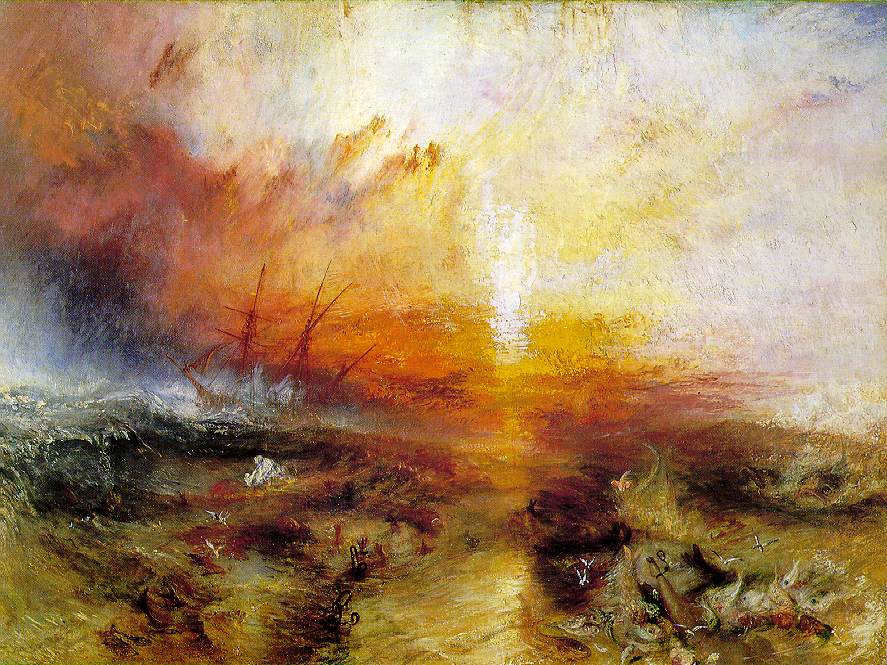
The disturbing 1840 Turner seascape “Slavers throwing overboard the Dead and Dying – Typon [sic] coming on”, also known simply as “The Slave Ship”, is widely thought to have been inspired by the Zong episode. The allusion would have been well-known to his contemporaries.
* One of the 133 survived by climbing back aboard the ship.
On this date in 1326, the power behind Edward II’s throne — and the presumed lover in his bed — was hanged, drawn and quartered and pointedly emasculated in a grisly public execution as the Queen and her lover took control of England.
(Wince.)
The younger Despenser, being carved up in an illustration from Froissart.
Poor King Edward — that’s the swishy princeling gay-baited in Braveheart — would suffer a horrid demise of his own a few weeks later. He’s the one most conveniently read as a gay martyr.
An upstart knight who unexpectedly lucked into a jackpot inheritance when his wife’s brother died at Bannockburn — that’s the rumble Robert the Bruce starts at the end of Braveheart — Hugh the younger parlayed his newfound position of feudal magnate into the still better gig of royal favorite.
That job was open because its occupants had a distressing tendency to get dead, a fate obviously ordained for Hugh Despenser as well.
But whereas Edward’s childhood pal Piers Gaveston, the murdered former fave, aroused mostly personal pique among rival nobles, Hugh Despenser meant to use his favor to rule.
Despenser exploited his position to build up his wealth and control the king; with his father (you’ll never guess that he went by “the elder”), he became the de facto if never the de jure ruler of the realm.
At one point, his rivals in the nobility turned the tables and got him exiled. Hugh became a pirate in the English Channel while he maneuvered his way back onto dry land in his customary most-favored-consigliere position.
So although the British barons who wanted Despenser’s head were undoubtedly a distasteful lot themselves, and certainly capable of all manner of depravity in pursuit of their own crass self-interest, it doesn’t take a backwards view of human sexuality to get why Hugh Despenser would raise an early 14th century Briton’s hackles.
But you have to give England this: its politics back then were a damn sight more interesting than you get today. Anyone who uses the term “bloodsport” for the modern electoral charade ought to cross cutlasses with the likes of the dread pirate Despenser.
And it gets better. Meaning, for Hugh Despenser the Younger, worse. Much.
Queen Isabella — that’s Sophie Marceau’s hot-for-barbarian imported princess in Braveheart — became estranged from her Hugh-lovin’ husband,* and established herself back in France with her lover Roger Mortimer.
Then, the lovebirds invaded England.
Edward and Hugh were so unpopular at this point that “their” nobles who should have repelled the incursion went in a landslide for the invading adulterers.
Hugh Despenser’s father had already been hanged for his trouble by the time The Younger was taken; the latter tried to cheat the executioner by refusing all food and drink for days, truly a spartan image of desperate self-mortification in a rough day and age.
When you get a load of the death his royal captors had worked out for him — and which they were obliged to deliver to their starving captive hurriedly in Hereford rather than more ceremoniously back in London — you can understand why. After a perfunctory trial that same morning, they tore the former favorite apart.
When the feast was over sir Hugh, who was not beloved in those parts, was brought before the queen and knights assembled; the charges were read to him – to which he made no reply; the barons and knights then passed the following sentence on him: first, that he should be drawn on a hurdle, attended by trumpets and clarions, through all the streets in the city of Hereford, and then conducted to the market-place, where all the people were assembled; at that place he was to be bound on a high scaffold, in order that he might be more easily seen by the people. First, his privates were cut off, because he was deemed a heretic, and guilty of unnatural practices, even with the king, whose affections he had alienated from the queen by his wicked suggestions. His private parts were cast into a large fire kindled close to him; Afterwards, his heart was thrown into the same fire, because it had been false and traitorous, since he had by his treasonable counsels so advised the king, as to bring shame and mischief on the land, and had caused some of the greatest lords to be beheaded, by whom the kingdom ought to have been supported and defended; and had so seduced the king, that he could not or would not see the queen, or his eldest son, who was to be their future sovereign, both of whom had, to preserve their lives, been forced to quit the kingdom. The other parts of sir Hugh thus disposed of, his head was cut off and sent to London.**
It’s reported that Isabella and Mortimer feasted and made merry as they beheld this hideous spectacle. Now that’s bloodsport politics.
Hugh the younger Despenser and his life and times are covered in amazing detail by a couple of active-posting enthusiasts of this particular period who have already been linked elsewhere in this post: the aptly-named Edward II blog (dig his biography of Hugh Despenser, among many other such dramatis personae; also his account of the execution, already cited); and, Lady Despenser’s Scribery (whose entire sidebar is pretty much all about our day’s principal; for the quick tour, see her biography and posts on the “trial” and execution).
* The reason for said estrangement can be situated anywhere one likes along the personal-political spectrum; one recent historical novel speculates (upon no authority but dramatic license) that Hugh raped the queen.
** Remains reportedly discovered last year were speculatively identified as Hugh Despenser’s; the litany of injuries to the body testify to the ghastly death-ritual its owner underwent.
Pleaseth it your lordship to be advertised, that … the same 15th day [of November] the late abbot of Glastonbury went from Wells to Glastonbury, and there was drawn through the town upon a hurdle to the hill called the Torre, where he was put to execution; at which time he asked God mercy and the king for his great offences towards his highness, and also desired my servants then being there present to see the execution done, that they would be meane [communicate] to my lord president and to me that we should desire the king’s highness of his merciful goodness and in the way of charity to forgive him his great offences by him committed and done against his grace, and thereupon took his death very patiently, and his head and body bestowed in like manner as I certified your lordship in my last letter. And likewise the other two monks [John Thorne and Roger James, executed with Richard Whiting] desired like forgiveness, and took their death very patiently, whose souls God pardon.
And whereas I at my last being with your lordship at London moved your lordship for my brother Paulett, desiring your lordship to be a mean that he might have the surveyorship of Glastonbury, which I doubt not but he will use and exercise the said office to the king’s most profit and advantage, and your lordship’s goodness herein to him to be shown he shall recompense to his little power, I assure your lordship he hath been very diligent, and divers others by his means, to serve the king at this time, according to his duty and right…
the late abbot of Glastonbury, afore his execution, was examined upon divers articles and interrogatories to him ministered by me, but he could accuse no man but himself of any offence against the king’s highness, nor he would confess no more gold nor silver nor any other thing more than he did before your lordship in the Tower …
Once one of the greatest religious houses in England (and the legendary burial place of King Arthur), Glastonbury Abbey today is a picturesque ruin. Cornell University has published some 19th century photos of the abbey’s remains in a less manicured, more gorgeously overgrown situation.
Pollard had just a few weeks before exonerated the monastery of any profligacy, and the abbot seems perhaps not to have even been properly charged or attainted … but as one can discern in Pollard’s cloying appeal to keep the surveying position in the family, the practical henchman had no qualms as events unfolded about taking a commercial position on the end of the Abbot of Glastonbury.
On this date in 1942, British merchant sailor Duncan Scott-Ford was hanged at London’s Wandsworth Prison for giving German agents sensitive information about ship movements.
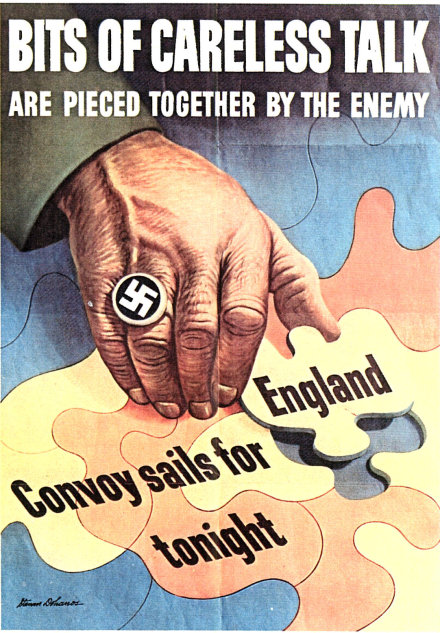
This, of course, was just the sort of thing everyone was trying to discourage.
… and a version to keep young soldiers on the pull Mata Hari-conscious:
For a case that so handily underscored the posters, the Scott-Ford affair made great copy … but not until a day after the hanging itself. Having kept everything secret, the papers were finally allowed on Nov. 4 to announce
that a British subject was executed for treachery at Wandsworth Prison yesterday morning.
…
Scott-Ford was paid 1,800 escudos by the enemy. This sum, which in English currency is equivalent only to about £18, was all that Scott-Ford in fact received from the enemy, though promises were held out to him which lured him deeper and deeper into the blackmailing clutches of the enemy. Thus when Scott-Ford returned on his second visit to Lisbon with the information which he had collected the Germans, instead of honouring their promises, threatened that they would expose him to the British authorities unless he continued to perform further services, to collect more valuable information and to undergo greater risks in their interest.
Some of the information which Scott-Ford gave to the enemy related to his own ship, and thus imperilled the lives of his own shipmates.
…
The moral to be drawn from this case is that British and allied seamen when visiting neutral ports should be constantly on their guard against strangers who may frequently approach them for apparently innocent purposes. Such strangers are apt to be enemy agents … (London Times, Nov. 4, 1942)

 As tweeted