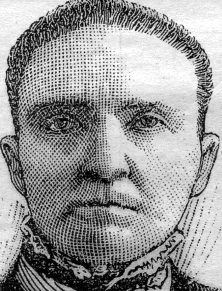
1950: Eugene LaMoore, the last hanged in Alaska

Thanks to Melissa S. Green for giving Executed Today permission to reprint this summary of Alaska’s last execution. It appeared as a section of Green’s longer history of the death penalty in the state, first published here.

For the first (proper, juridical) execution in Alaska, see here. -ed.


Austin Nelson and Eugene LaMoore, both black, were separately convicted and executed for the same crime, the December 1946 murder of a 52-year-old (white) Juneau storekeeper named Jim Ellen. Ellen’s store had also been robbed. Ellen had immigrated to the U.S. from Greece as a boy in 1909. He was a World War I veteran who held memberships in the American Legion and the Juneau Elks Lodge.

Austin Nelson, a 24-year-old who did odd jobs around Juneau, was arrested for the murder after a check written by him to Jim Ellen was found on the store counter following the robbery/murder. He was represented at trial by Henry Roden and Joseph A. McLean. Nelson was convicted on circumstantial evidence, including that of a witness who reported seeing him in the victim’s store on the night of the murder. No one witnessed the actual murder, nor was a murder weapon found, not even the straight-edged razor witnesses testified that Nelson had once owned. Nelson lacked money to pay for an appeal and there was no provision for a public attorney in post-conviction proceedings, His execution was set for July 1, 1947.

Eugene LaMoore, a 42-year-old fisherman with a Tlingit wife and two children, was originally an alibi witness at Nelson’s trial. He testified that he had spent much of the evening with Nelson on the night of the murder, including along the avenue where the victim’s store was located. LaMoore’s credibility with the jury was apparently eroded when he initially denied a felony robbery conviction of twenty years before. Although LaMoore returned to the stand the following day to correct his testimony, he was arrested by U.S. Marshal William Mahoney on a charge of perjury and held on a bond of $10,000 — a high bond in 1947 — which LaMoore could not pay. He was held in a cell in the federal jail, shackled in leg irons and, later, in a ball and chain. He was repeatedly questioned by the local FBI agent and other local law enforcement authorities about the murder of Jim Ellen. Shortly before Nelson’s scheduled execution, Nelson was brought to visit LaMoore in his cell. According to later testimony by LaMoore, Nelson pled with LaMoore to help save his life.

On July 1, 1947, the date of Nelson’s scheduled execution, LaMoore signed a typed confession stating that he had participated in a robbery of Jim Ellen’s store with Austin Nelson and that Nelson had killed Ellen during the robbery.

LaMoore was charged with first degree murder. Nelson’s execution was delayed because he was now considered a material witness against LaMoore.

LaMoore was represented at trial by Henry Roden and Joseph A. McLean, the same court-appointed attorneys who had represented Nelson. The only significant evidence offered at trial to suggest LaMoore’s involvement in the murder was the typed confession he had signed while in jail. At trial, LaMoore retracted the confession, stating it had been made on the advice of a prominent Juneau attorney, Herbert W. Faulkner, who had been persuaded by Deputy Marshal Walter Hellan to come and talk with him (LaMoore had had no lawyer at the time).

LaMoore testified that Faulkner agreed to advise him, though Faulkner denied having done anything except typing up what LaMoore wanted to say in the confession. LaMoore also stated that the confession had been prompted by a desire — especially after Nelson’s visit to his cell — to delay Nelson’s execution. Despite his retraction and the lack of other significant evidence, LaMoore was convicted by the jury and sentenced to death.

Nelson, who had been kept alive during LaMoore’s trial but was never called to testify, was executed on March 1, 1948, a month after LaMoore’s trial ended. LaMoore was executed on April 14, 1950 after an unsuccessful appeal. He reportedly took 13 minutes to die.

His was the last execution to be held in Alaska.

Sources:

Lerman, Averil. (1994). “Death’s double standard: Territorial Alaska’s experience with capital punishment showed race and money mattered.” We Alaskans [Sunday magazine of the Anchorage Daily News], May 1, 1994.

Lerman, Averill. (1998). “Capital Punishment in Territorial Alaska: The Last Three Executions.” Frame of Reference [Alaska Humanities Forum] 9(1): 6-9, 16-19, April 1998.

On this day..

1942: Four Jews from Bedzin and Sosnowiec

(Thanks to Meaghan Good of the Charley Project for the guest post. -ed.)

On this date in 1942, two Jewish men were hanged in the city of Sosnowiec (pronounced sos-no-vitz) in Nazi-occupied Poland, and two more were hanged in the nearby city of Bedzin (pronounced ben-jin).

These executions were witnessed by thousands of people and carefully choreographed, as historian Mary Fulbrook records in her book A Small Town Near Auschwitz:*

The hangings in Bedzin and Sosnowiec had been orchestrated in advance, in meticulous detail, by the Police President in Sosnowiec. The execution in Bedzin was to take place one hour later than the one in Sosnowiec. As much thought was given by the police authorities to questions of security and seating arrangements as might be appropriate for a modern open-air musical concert: this was not to be a simple punishment for an individual offense, as had happened innumerable times, but rather a mass spectacle, intended to have a major impact on the audience…

The identities of the executed Jews in Bedzin have been lost to history. (Correction: Per Yad Vashem, they were Jehuda Warman and “Feffer” (no first name).) They were hanged at the old Jewish cemetery on the corner of Zawale Street, before a crowd of about 5,000, at 5:00 p.m. Jewish workers in the Bedzin Ghetto had their work identity cards confiscated that day and were let out of work early, at 4:00 p.m., and ordered to watch the hangings. Only after they witnessed the executions did they get their work cards back. The bodies remained hanging on the scaffold until 7:30 p.m.

The condemned men in Sosnowiec were 30-year-old Mayer Kohn and his father, Nachun or Nahum.

Nachun (left, with wife) and Mayer.

They’d been caught trading on the black market, probably trying to feed their families, as no one could live long on the official rations. But as Fulbrook points out, the actual offense didn’t matter much to the Nazis:

These coordinated public spectacles of mass hangings do not seem … to have been in direct response to a particular crime; it seems there was a policy of ‘any Jew will do’, although infringements of German rules (including not only black market dealings but also very trivial ‘offenses’) were adduced as the ostensible ‘reason’ for these executions.

Thousands of people, both Jews and Germans, watched Mayer and Nachun Kohn die, then quietly went home.

Although virtually the entire Kohn family perished at the hands of the Nazis, Mayer and Nachun Kohn can claim a bit of immortality by virtue of being mentioned in Maus, Art Spiegelman’s famous graphic novel about the Holocaust: the author’s father, Vladek, hailed from Sosnowiec.

* The author of A Small Town Near Auschwitz is interviewed in this New Books In History podcast.

On this day..

1749: Richard Coleman, solemnly declaring

On this date in 1749, five men were hanged at Kennington Common.

We wish well the restive shades of Patrick Rena, Thomas Dobbings, Thomas Walker, and Arthur Gibbons; the former two died for a violent robbery upon the roads, and the latter two for a violent robbery upon the Thames.

But our attention for this date is to the fifth man. Richard Coleman also drew the attention of those present, both for the monstrous crime he was accused of, and for his steady assertion of innocence. The minister assigned to salvage these wrongdoers’ souls, which was also a not entirely reputable marketing business in selling scaffold exclusives, knew a lead story when he saw one.

Coleman was executed for being part of a gang of three men who raped to death a woman named Sarah Green on the night of July 23, 1748. He was in no way implicated in this horrific crime for well over a month, a time when the victim lay precariously in hospital.

But by the next April, well … he was the man as far as the law was concerned. Coleman protested his innocence in vain, via Rev. Wilson; the latter’s hanging-day chapbook made Coleman the distinct feature attraction.

The following Paper was delivered to me at the Place of Execution, by Richard Coleman, which he earnestly desired I would publish.

To all Christian People.

The dreadful Sentence passed upon me, I shall meet with Cheerfulness, being in no Degree conscious of the least Guilt of that most inhuman and most unnatural Crime that I have been found guilty of.

I am very sensible that it is not in my Power to make the incredulous World believe me innocent. I leave the following Account with the Rev. Mr. Wilson, who I am very greatly obliged to, and return him my hearty Thanks, for the comfortable Relief I have received from him in a Preparation for a future State of Bliss, and I hope he will cause it to be published for m Satisfaction, that it may pass the impartial Examination of all Persons.

Here Coleman proceeds to give a detailed, almost hour-by-hour account of his activities on the night of the murder … and the activities of those around him.

Coleman was at pains to do this not only to assert his own innocence, but to decry a particular witness who ought to have supported his alibi but instead made it known “that if he was subpoenaed he should do me more Harm than Good … The Occasion of expressing himself in that severe Manner, I suppose, was owing to his being unluckily found by me with Mrs. B—t in very indecent Actions soon after her Husband’s Death; and having been often detected by me in the same Manner, it has caused ill Blood between us.”

Whether this man’s testimony would have made the difference one can only guess. At any rate, Coleman insisted,

On Monday the 25th of July I heard that a Woman had been used very ill by three of our Men, but no-body was taken up for it till a Quarrel happened between me and one [Daniel] T[rotma]n, at the Queen’s Arms Alehouse in Bandy-Leg Walk, which was as follows:

— On the 27th of August last … I was very much in Liquor; we had a Pint of Bumbo in the publick Room; and as I was stirring it with a Spoon, Trotman, an entire Stranger to me, very abruptly asked me what was done with the Pig, (meaning a Pig that our Men had taken and killed belonging to a Neighbour, and had been in Custody for it.) … I said to Trotman, Damn the Pig, what is it to me. He damn’d me, and I him; we gave each other very bad Language, and because it had been reported that three or four of our Men committed the Cruelty on Sarah Green, he made use of the following aggravating Words, namely (says he) Don’t you know Kennington Lane. I reply’d yes, I do, damn you, what of that? He said again don’t you know the Woman that was so cruelly treated, Yes, said I, Damn you what of that? Said he, was not you one of the Persons concerned in doing it; I reply’d if I was, you Dog what then, and immediately threw the Spoon at him. He returned it in the same Manner at me, and had it not been for the Persons present we should have fought.

The Morning after the Quarrel happened I called at the Queen’s Arms Alehouse; and Mr. C—t, who keeps the House, said to me Mr. Coleman you was silly last Night … and he repeated the Discourse aforesaid, and told me I did not consider what Advantage bad People might make of such unguarded Expressions. I reply’d that I was much in Liquor, and did not remember what I said.

But as prophesied, the offended Daniel Trotman and a woman in the pub who witnessed the exchange did indeed proceed on the basis of this “admission” to swear out an oath against Coleman who

was carried to the poor Woman in St. Thomas’s Hospital, to see if she knew any Thing of me; and when I came before her I was particularly pointed out by Mr. C— P—e, who laid his Hand on me, and said, is this one of the Men; which was not fair, for she should [not] have fixed upon me without being dictated. Upon that she said I believe he is one. I said to her consider well what you say, for my Life is at Stake. Will you swear I am one of the Persons. She reply’d, No I won’t, and likewise said if I was one of them we walked a good Way, and talk’d of indifferent Things, and you behav’d much like a Gentleman; but when she was assaulted, I ran away, which was not behaving like a Man.

Coleman’s story was that he wasn’t with Sarah Green as friend or foe at all that night. The justice of the peace clearly thought little enough of Green’s sketchy witness guesstimate that Coleman was released on his own word to return for more questioning.

The next scene at Sarah Green’s bedside begins with Coleman outside the room, and the victim asked

what sort of a Man Mr. Coleman was. She reply’d that he wore his Hair, and had a Carroty Beard. As to having my own Hair she was mistaken, for I have not wore it these 14 Years.

His Worship asked the Deceased if she could swear that I aided or assisted in the Assault. She said No, I cannot, for it was dark.

I was called in, and she made the following Information.

This Informant on her Oath says, that on Saturday Night the 23rd of July last between the Hours of 11 and 12 o’Clock, as she was going thro’ Newington Church-Yard to her Lodging in Bandy-Leg-Walk, she was assaulted and cruelly beaten by two Men to her unknown, and that R. Coleman was present in her Company at the Time she was assaulted and cruelly treated.

Coleman would say in his last publication that he believed Sarah Green was coached. Being conscious of innocence — we’ll come to that — the evidence aligning against him must have struck the young man as the product of an evil hand. Maybe it was just a lot of circumstantial stuff and half-mistaken witnesses falling into a terrible pattern.

The next mischance to befall the accused was that his victim/accuser succumbed to her injuries prior to the formal September 19 hearing.

This made the charge against him murder. Well, rape was already a capital crime, so no real change for Coleman … except that he had now lost the chance to confront openly a witness whose testimony sounds from the hospital interviews like it was eminently impeachable. Now, Green’s last affidavit was going to her final word on the matter.*

Coleman fled the warrant consequently taken out for him, which was read as evidence of guilt by neighbors who had the luxury of not reckoning their own survival odds upon a jury-box. Coleman says he tried to place an advertisement which a lily-livered editor rejected, reading

I, Richard Coleman, seeing myself advertised in the Gazette as absconding on Account of the Murder of Sarah Green, knowing my self not any ways culpable, do assert, that I have not absconded from Justice, but will readily and willingly appear at the Assizes, knowing my Innocence will acquit me.

Ha.

From some combination of partiality, malice, and groupthink, some additional eyewitness testimony — people who think they might have seen him that night, people who swear they talked to Coleman and Green together but never thought to bring it up to the authorities until he was arrested, and alibi witnesses of his own whom jurors disbelieved — Coleman was judged guilty and doomed to the noose.

Basically, the evidence against him was that he’d popped off to Daniel Trotman while in his cups, Sarah Green (mostly) ID’d him, and some people thought he’d been seen with her in the dark that night while some of Coleman’s own friends and relatives claimed otherwise. There isn’t exactly going to be crime lab evidence here, nor was there an explicit threshold for jurors to require near-certainty to convict. It probably looked to the court like a pretty darn good case.

Coleman had no recourse but to commit his futile self-vindication to posterity.

I do also most solemnly protest, that I am not in any Manner of Degree guilty of that most inhuman Murder of Sarah Green, neither was I at Newington, or in Kennington-Lane that Night that the cruel Fact was committed on Sarah Green.

This I declare as a dying Man, and I sincerely believe (as the Rev. Mr. Wilson told me several Times) if I was either directly or indirectly guilty of that Murder, and should go out of the World with denying it, that eternal Damnation would be my Portion.

… I have the Satisfaction to declare myself to the World (as I have often done to the Rev. Mr. Wilson) that I never was so serene in Mind, or so easy in my Conscience in my Life, as I am at this Time, and I heartily wish that every wicked Sinner may have the Opportunity of so good a Divine as the Rev. Mr. Wilson has been unto me, which must be a great Means to the Enjoyment of eternal Bliss.

It is an inexpressible Pleasure to me, that I am soon to leave this very wicked World; and I hope that GOD Almight of his infinite Mercy and Goodness, will, through the Merits and Intercession of my blessed Redeemer, his only Son our Saviour Jesus Christ, pardon all my Sins, and receive my Soul into eternal Happiness …

There is nothing that gives me so much Concern as the Distress that I leave my poor Wife and two Infants in. She has been very good to me under my unhappy Misfortune and so have my poor afflicted Brothers. I hope that the Almighty will be the Guardian of my Wife and Children.

Oops

We’ve been speaking of Coleman as categorically innocent but presented only conflicting and doubtful witnesses.

The resolution of the matter did not come until two full years after Coleman serenely strangled to death. The rest of the story was incautiously blabbed by a gentleman named James Welch to a companion as they walked the road to Newington Butts.

“Their conversation,” says the Newgate Calendar, “happened to turn on the subject of those who had been executed without being guilty; and Welch said: ‘Among whom was Coleman. Nichols, Jones and I were the persons who committed the murder for which he was hanged.'”

Maybe he should have chatted about the weather.

In the course of conversation Welch owned that, having been at a public-house called Sot’s Hole, they had drunk plentifully, and on their return through Kennington Lane they met with a woman, with whom they went as far as the Parsonage Walk, near the churchyard of Newington where she was so horridly abused by Nichols and Jones that Welch declined offering her any further insult.

Welch’s companion informed on him, but upon arrest there was no better evidence against Welch, Nichols, and Jones than there had been against Coleman. Actually, this later case was much weaker: one guy’s alleged hearsay statement.

In a classic prisoner’s-dilemma scenario, John Nichols was finally persuaded to turn crown’s evidence on the other two before they turned on him, and his testimony to the vile end of Sarah Green got his former mates hanged.

“The poor woman was treated in a manner too shocking to be described,” our correspondent relates. And “it appeared that at the time of the perpetration of the fact the murderers wore white aprons, and that Jones and Welch called Nichols by the name of Coleman — circumstances that evidently led to the conviction of the unfortunate man of that name.”

Mistakes Happen…

The hangings in the case of Sarah Green — both the right ones and the wrong one — occurred at the acme of Britain’s “Bloody Code” days.

It’s instructive to note that the reality of wrongful executions seems to have been widely accepted. In the case at hand, the Newgate Calendar does not mince words in describing Richard Coleman as innocent.

And while doubt about individual defendants’ guilt often led jurors to acquittals or the ad hoc “pious perjury” downgrading of potentially capital charges, the existence of this or that wrongful execution in no way imperiled the capital statutes as a whole. It was merely another risk in a brutal world all too full of them.

Just a few months after Welch and Jones went to the gallows, another woman controversially on trial for her life received from one of her correspondents a lament that “We see nothing more frequent than Persons confessing the Crimes that others had suffer’d for before.”

* Although Green’s case was a bit different since she actually had time to swear a statement, the legal footing of “dying declarations” vis-a-vis the usual right of a defendant to confront an accuser has long remained a jurisprudential sticky wicket.

On this day..

1912: Tom Miles lynched

From the Montgomery Advertiser (April 10, 1912)

Lynched After Acquittal

SHREVEPORT, La., Apr. 9 — Tom Miles, a negro, aged 29, was hanged to a tree here and his body filled with bullets early today. He had been tried in police court yesterday on a charge of writing insulting notes to a white girl, employed in a department store, but was acquitted for lack of proof.

On this day..

1752: Mary Blandy, “forgiveness powder”

(Thanks to Meaghan Good of the Charley Project for the guest post. -ed.)

On this date in 1752, 32-year-old Mary Blandy was hanged for the murder of her father, Francis. He had died in agony on August 14 the previous year, having been sick for months.

That Mary had poisoned her father with arsenic was not in dispute; the evidence proved it and she admitted it herself, even before he died.

The question was as to her motive, and her intentions. Mary conceded she had caused Francis’s death, but denied having ever meant to harm him.

The events that lead to Francis Blandy’s demise at the age of 61 began in 1746. Mary was Francis’s beloved only child and an old maid by the standards of day. They lived in Henley-Upon-Thames, Oxfordshire, UK.

Although scarred from a bout with smallpox, she was well-educated, witty and intelligent, and advertised a dowry of £10,000. But she had never been able to find a suitor her father approved of, until Captain William Henry Cranstoun came along.

Cranstoun was several years older than Mary, short, ugly, a compulsive gambler and not terribly bright, but he was a member of the Scottish aristocracy, the younger son of an earl. When he proposed in 1747, both father and daughter happily said yes.

Unfortunately for the two lovers, Francis Blandy soon learned that Cranstoun was already encumbered with a wife and child back in Scotland. Cranstoun swore (falsely) that he was not legally married to the woman and she’d only ever been his mistress; smitten Mary believed him, but Francis didn’t take kindly to the deception and he showed his would-be son-in-law the door.

Cranstoun, however, was not going to let a £10,000 dowry slip through his fingers so easily.

While he tried (unsuccessfully) to annul his existing marriage, he remained in touch with Mary for years and told her about a special powder made by wise women in Scotland, which caused those who took it to forgive their enemies.

Mary was skeptical, but Cranstoun swore it really worked and said he’d taken it once himself and felt its effects. He obtained some of the powder and convinced Mary to start slipping it into her father’s food and tea, so his heart would soften and he would allow his daughter to marry the man she loved.

Such was Mary’s story, at any rate, and she stuck with it until her dying day.

She swore she did not realize the magic powder was toxic. Sure, Francis rapidly became sick with heartburn and stomach pains, but he had suffered these symptoms before. Then his condition worsened. He vomited constantly and all of his teeth fell out. Mary finally summoned a doctor.

By then it was too late, for both father and daughter. The family servants became suspicious after several of them got violently sick when they drank tea intended for Francis.

One of them noticed a white grainy substance in the bottom of a bowl of gruel Mary had fed her ailing father. The servants took the substance to Francis’s doctor, who determined it was arsenic. Around the same time, another servant saw Mary throw a bundle of Cranstoun’s letters into the fire. She also tried to burn a packet which the servant rescued from the flames; it contained white powder identical to the arsenic that was rapidly burning through the old man’s entrails from the inside out.

When he was informed his daughter had poisoned him and guessed why, Francis refused to be angry with her, saying, “Poor love-sick girl! What will a woman not do for the man she loves?”

As he lay in extremis, Mary rushed to his bedside and begged her father to forgive her. An indulgent parent to the very end (or perhaps the “forgiveness powder” really had worked), he blessed his wayward child and told her he would “pray to God to bless thee, and to amend thy life.” He blamed Cranstoun for everything.

A few days later he was dead.

Mary ran from the house after his death, pursued by an angry mob, and took refuge in the Little Angel Pub. Eventually she was persuaded to surrender herself to the authorities. On August 17, she was arrested.

When Francis’s estate was settled, its worth was determined to be only about £4,000. Cranstoun would have never gotten that £10,000 dowry: it didn’t exist.

James C. Whorton discusses her trial in his book The Arsenic Century: How Victorian Britain was Poisoned at Home, Work and Play:

‘A vast concourse of people’ gathered for the trial, including many students from the university (whom one prosecutor could not resist lecturing ‘See here the dreadful consequences of disobedience to a parent’). The proceedings lasted but a single day, albeit a long one, running from eight in the morning till nine at night. Conducting herself ‘with more than masculine firmness’, Mary continued to insist that she was the victim of a cruel deception (‘What women can withstand the arguments and persuasions men will make of us?’), but the jury would have none of it. Devoting only five minutes to deliberation, not even retiring from the courtroom, they pronounced the defendant guilty.

Just before her execution, Mary wrote out her side of the story, which can be read in full online. Whorton records her death:

The prisoner was hanged five weeks later, on 6 April 1752, still avowing her innocence: ‘May I not meet with eternal salvation,’ she declared from the scaffold, ‘nor be acquitted by the almighty God, in whose awful presence I am instantly to appear,’ if guilty. Then, ‘without shedding one tear,’ Mary Blandy pulled her handkerchief over her face and dropped into eternity.

Her last words were, “For the sake of decency, gentlemen, don’t hang me high.”

There was a lot of public sympathy for Mary, particularly after her execution, but none for Captain Cranstoun.

The Newgate Calendar called him a “profligate wretch” and “a disgrace to the noble blood from which he derived existence.” He escaped the grip of British justice by the skin of his teeth, going into hiding in the Continent when he found out about his fiancee’s arrest.

In the end, however, he got what was coming to him: nine months after Mary’s death, in Belgium, he was stricken by an unspecified intestinal ailment and met much the same end as Francis Blandy.

There was plenty of news coverage about Mary’s case, which had all the hallmarks of a morality play, and which was, in fact, made into one titled The Fair Parricide: A Tragedy in Three Acts. On top of this was the controversy over Mary’s intentions: was she was a conniving and ruthless little minx, a lovesick and pathetically naive girl, or something in between? The Newgate Calendar summed it up thusly:

With regard to Miss Blandy, the public have ever been divided in opinion on her case. Those who have presumed on her innocence have tacitly acknowledged that she was very weak, which contradicts the accounts we have of her genius and mental acquirements. On the contrary, those who have insisted on her guilt, have made no allowances for the weakness of the female mind; nor considered the influence of an artful man over the heart of a girl in love.

Her solemn declaration of her innocence would almost tempt one to think that she was innocent; for it is next to impossible to suppose that a woman of her sense and education would depart this life with a wilful lie in her mouth.

Be all this as it may, an obvious lesson is to be learnt from her fate. — Young ladies should be cautious of listening to the insidious address of artful love as they know not how soon, and how unsuspectedly, their hearts may be engaged to their own destruction, founded on the violation of all their nobler duties.

Mary Blandy was buried between her parents in the Henley Parish Church. There is no trace of her grave today, but her ghost is said to haunt the Little Angel Pub and also the site of her execution, which is the present-day Westford shopping center.

She would be remembered for hundreds of years after her death. Scottish lawyer and true crime writer William Roughead published an examination of her case, The Trial of Mary Blandy, in 1914; it is available free online here. Roughead concluded Mary had deliberately murdered her father. The case was made into a BBC miniseries, and in 1950, Joan Morgan published a novel based on the story, called The Hanging Wood, later retitled simply Mary Blandy.

Update: Because you can find anything on the Internet: the story of Mary Blandy in shadow puppetry.

On this day..

1882: Stepan Khalturin, Winter Palace bomber

On this date in 1882* Stepan Khalturin** was hanged in Odessa, Ukraine … but not for his most (in)famous crime.

Khalturin (English Wikipedia entry | Russian) came from a well-off peasant family near the city of Vyatka (today, Kirov; it was renamed for an assassinated Bolshevik). As a young carpenter in 1870s St. Petersburg, he fell in with revolutionary circles and became a distinguished propagandist and organizer. Khalturin helped found the first political labor labor organization in Russia, the “Northern Russian Workers’ Union”.

He’s said by other leftist agitators who knew him to have “persuaded his student workers with tears in his eyes to continue propagandizing, but in no event go down the path of terror. From this, there is no return.”

If that used to be his sentiment, Khalturin’s thinking … evolved.

By February 1880, Khalturin was for all intents and purposes in on the terrorism strategy. He took advantage of a workman’s gig at the Winter Palace to pack the cellar full of dynamite,† two floors below the imperial dining room.

But Tsar Alexander II and party had not yet returned when it blew. Eleven people, mostly guardsmen in the intervening room below the dining hall, died in the blast; dozens of others were injured.

Khalturin watched in frustration from the iron gates of the Winter Palace, and slipped away — never detected. His co-conspirator Zhelyabov consoled him with the prospects of mass recruitment sure to be unleashed by this spectacular propaganda of the deed. “An explosion in the king’s lair — the first attack on the autocracy! Your deed will live forever.” (Russian source)

The tsar, at any rate, was running out of luck.

A year later, Narodnaya Volya finally succeeded in assassinating Alexander II in St. Petersburg. Zhelyabov and five others hanged for that.

Khalturin wasn’t involved in that plot: he had escaped to Odessa.

There, he shot a police officer named Strelnikov. He was captured and hanged under a bogus alias, nobody realizing that they were also executing the mysterious Winter Palace bomber.

Unusually considering Lenin’s distaste for terrorism and Narodnaya Volya, Khalturin was elevated in post-Soviet times into an officially-approved revolutionary exemplar. The street Millionnaya running to the Winter Palace in St. Petersburg was cheekily renamed for him (it’s subsequently been changed back). Public monuments went up for the bomber, especially in the environs of his native soil around Kirov.


(cc) image from Zeder.

* April 3 by the Gregorian calendar; March 22 by the Julian calendar still in use in 19th century Russia.

** Appropriately given Khalturin’s Winter Palace work, khaltura is Russian for an item of shoddy construction. The word has no etymological connection to our man, however. (Linguistic tip courtesy of Sonechka.)

† He was able to manage the feat by bringing in explosives little by little and secreting them in the room where he bunked on-site.

On this day..

1897: Ernest and Alexis Blanc, brothers in blood

On this date in 1897, some 4,000 residents of Lafayette turned up to watch the hanging of two Parisian-born young men.

It had been nearly a full year since Martin Begnaud was discovered bound, gagged, and stabbed over 50 times in his general store at Scott, Louisiana, just outside Lafayette. That was on April 22, 1896.

The motive was self-evident: the prosperous late burgher had been plundered of several thousand dollars. But who did it?

The matter remained a mystery for many months, although two men were indicted for the deed — and blessedly never brought to trial.

But a few days after the murders, brothers Ernest and Alexis Blanc, teenage French orphans who were sharecropping on a plantation in April 1896 also abruptly disappeared without even bothering to sell their crop shares. This naturally raised suspicion as well, but their whereabouts were totally unknown and as months passed any hope of finding them had practically vanished.

Just after New Year’s 1897, the Blancs made a slight miscalculation: they turned up again in Scott and applied to work at their old plantation.

They were swiftly arrested and questioned separately. It did not take long for them to crack; indeed, full of guilt as they were, one might speculate whether these young Catholics didn’t return with the subconscious desire to purge themselves.

The older sibling Ernest explained that they had

secured the loan of a book treating of the daring deeds of Jesse James. From reading this book originated the idea and our plans for the murder. Seeing how poor we were, and how difficult to otherwise better our situation, we made up our minds to emulate the examples inculcated by the book.

(In those days, television was called ‘books’.)

The boys executed this plan with something less than the steel-hearted aplomb of a seasoned outlaw, however. Having gained access after hours to Begnaud and his store on the pretext of making a purchase, the brothers nervously bought tobacco … and then sardines … and then made small talk about mouse traps … all the while trying to screw up the nerve to do the deed, and get Begnaud to turn his back on them so they could have the advantage. When Ernest (as he claimed) finally murdered the shopkeep, “my hand trembled. The triangular instrument burned my hand. I shut my eyes.”

(Both of the previous two quotes are as per the January 9, 1897 Lafayette Advertiser.)

After that, they took off on a travel spree which ought to have carried them safely away from the scene of their crime for good. Instead they returned, like a dog to vomit, and gave up their lives to unburden their hearts. “We have talked too much,” Alexis said matter-of-factly to a reporter before their sentencing. “That is all. Had we kept the secret and not confessed, we would not be here.”

The fact that there was a sentencing at all was a bit of an achievement, and the Blancs have generally been considered the first legal hangings in Lafayette Parish. Actual or suspected malefactors were typically handled with more dispatch and fewer legal niceties previously (also making it something of a miracle that the original, wrongly-accused pair was still around to draw breath). Both Ernest and Alexis spent a good deal of their time jailed in New Orleans for their own protection.

But that protection ran out today.

The boys went to their death in good humor, never adding a failure of nerve to their account of sins. Ernest even joked on the platform at the sight of so many people scrambling up trees to catch a glimpse of the hanging that “There are some who will surely have their necks broken in advance of ours.”

The Lafayette Gazette scored a coup by securing a lengthy confessional from the hands of the doomed lads themselves, which ran on April 3 and reiterated the role of leisure reading in the crime spree.*

It was a life of tranquility, sweet and honest, which we regret having discarded to follow the evil promptings of ambition; the love of fortune, and the desire for gold which the devil suggested to us through the leaves of a book entitled the “James Boys.”** It was by reading this book we were lead to steal. Why work in the field? Why walk behind a plow? And at the end of the year receive not enough to buy clothes to put on our backs?

To rob one of his gold in a single night appeared to us much easier. The birds had eaten the crops and we were discouraged.

The murder itself, they said, had not been premeditated. But

[w]e were discussing the manner in which we would tie [Begnaud] so that he could not give the alarm before morning, when he said:

“Do not destroy my account books nor my private papers, without which I cannot make a living.”

In the silence of the night this sonorous voice appeared probably stronger than it really was and impressed us with a feeling impossible to express, and we rushed to his room and I (Ernest) stabbed Martin who was sitting on his bed. How many times I stabbed him I know not, nor did I ever know.

The Blancs logged some serious mileage in their months living on the Begnaud score. But Catholic guilt aside, it sounds as if their capture might really be attributed more to the country’s miserable economic situation.

After visiting Belgium and England we boarded a steamer for New York City arriving there on the 12th of July. We had already spent the greater portion of the $3,000 [stolen from Begnaud]. Then we commenced our journey across the United States, visiting Chicago, St. Paul, Helena, Portland, Sacramento, San Francisco, Los Angeles, El Paso, Salt Lake City, Ogden, Omaha, Council Bluffs and St. Louis. In the latter city we spent the remainder of our money. Each one having ten dollars, we took the Frisco line on foot, passing through Missouri, Arkansas, Indiana Territory and Texas, and followed the Texas Pacific as far as Mexico, where we rested a few days. All along the route we tried to get work, but failed. There was nothing for strangers to do. It is in this manner that we reached Lafayette on January 2, 1897. Knowing so many people there we thought it would be easy to find employment. We knew that we were risking our necks, but being so miserable, did not care very much.

And this decision to risk returning in preference to starvation is, after all, nothing but the same calculation of risk and reward that people at the economic margins have always made: to descend a lethal mine to feed one’s family; to seek one’s fortune on the treacherous seas; or if it should come to that, not to walk behind the plow but to follow the lead of the James boys and make one’s bread by banditry.

* According to No Spark of Malice: The Murder of Martin Begnaud, the Gazette cleverly obtained the full rights to all the Blancs’ prison writings, and were able to turn them into a 23-page French pamphlet La Vie, le Crime et les Confessions d’Ernest et Alexis Blanc; ou, L’Histoire d’un Crime Horrible. This sold like hotcakes after the hangings and would now be in the public domain; sadly, it does not appear to be available online as of present writing.

** There were probably several books of this title then, just as there have been several since. This volume has a 1911 copyright, but if it is not a version of the same book the Blancs read, it’s surely not too far distant.

On this day..

1883: Emeline Meaker, child abuser, first woman hanged in Vermont

(Thanks to Meaghan Good of the Charley Project for the guest post. -ed.)

On this day in 1883, Emeline Lucy Meaker was hanged for the murder of her nine-year-old sister-in-law and ward, Alice. She was the first woman executed in Vermont and almost the last; the only other one was in 1905, when Mary Mabel Rogers was hanged after killing her husband for his insurance.

Alice’s father died in 1873 and her impoverished mother sent her and her brother Henry to live in an overcrowded poorhouse. There, the little girl was reportedly sexually abused. Others noted that she was “a timid, shrinking child—of just that disposition that seems to invite, and is unable to resist—persecution.”

In 1879, Alice and Henry got a chance for a better life when their much older half-brother* Horace (described by crime historian Harold Schechter as a “perpetually down-at-heels farmer”) agreed to take them in for a lump sum of $400. However, Horace’s wife, Emeline, was unhappy at this extra burden. She referred to Alice as “little bitch” and “that thing.”

Schechter writes of the killer in his book Psycho USA: Famous American Killers You Never Heard Of:

Married to Horace when she was eighteen, forty-five-year-old Emeline was (according to newspapers at the time) a “coarse, brutal, domineering woman,” a “perfect virago,” a “sullen, morose, repulsive-looking creature.” To be sure, these characterizations were deeply colored by the horror provoked by her crime. Still, there is little doubt that … Emeline’s grim, hardscrabble life had left her deeply embittered and seething with suppressed rage — “malignant passions” (in the words of one contemporary) that would vent themselves against her helpless [sister-in-law].

Young Alice’s life, however difficult it may have been before, became hell after she went to live with her half-brother and his family.

She was forced to do more and heavier chores than she was capable of, and for the slightest reason, Emeline would beat her horribly with a broom, a stick or whatever else was at hand.

Soon Alice’s sister-in-law dropped the pretense of punishment and simply hit Alice whenever she felt like it. Emeline was quite literally deaf to the little girl’s screams, as she had a severe hearing impairment. So did Horace.

Some of the neighbors later said they could hear the child’s cries from half a mile away, and Emeline had no compunctions about abusing Alice in front of visitors. Everyone in in their small community of Duxbury was aware of what was going on, but no one bothered to do anything about it until it was too late.

Less than a year after Alice’s arrival, Emeline decided to do away with her. The crime is reported in detail in Volume 16 of the Duxbury Historical Society’s newsletter.

Emeline convinced her twenty-year-old “weak minded” and “not over bright” son, Lewis Almon Meaker, to help. He later said his mother had persuaded him that Alice would be “better off dead” and that “she wasn’t a very good girl; no one liked her.”

Emeline’s first suggestion was to take Alice out into the mountain wilderness and leave her there to die, but Almon thought this was too risky. Instead, on the night of April 23, 1880, Almon and Emeline woke up Alice, shoved a sack over her head and carried her to the carriage Almon had hired in advance. They drove to a remote hill and forced Alice to drink strychnine from her own favorite mug, which her mother had given her.

Twenty minutes later, the child’s death agonies ceased and Almon buried her in a thicket outside the town of Stowe.

Emeline and Almon, people who had been concerned about the riskiness of a previous murder plot, didn’t bother to get their stories straight about the unannounced disappearance of their charge, so when the neighbors asked where Alice had gone their contradictory explanations for her disappearance raised suspicions.

On April 26, a police officer subjected both mother and son to questioning. Almon didn’t last long before he broke down and confessed. He led the deputy sheriff to the burial site and they disinterred Alice’s remains, still visibly bruised from her last thrashing. Because the deputy’s buggy was small, Almon had to hold Alice’s corpse upright to keep it from falling out during the three-hour journey back to Roxbury.

That must have been some ride.

Emeline and Almon were both charged with murder. Each defendant tried to put as much blame as possible on the other, but both were ultimately convicted and sentenced to death. Almon’s sentence was commuted to life in prison, but Emeline’s was upheld in spite of years of appeals and a try at feigning madness.

Her violent tantrums, attempts at arson, and attacks on the prison staff didn’t convince anyone she was crazy — they merely alienated her family and others who might have otherwise supported her. Once she realized she wasn’t fooling anybody, she calmed down and passed her remaining days quietly knitting in her cell.

She was hanged at 1:30 p.m., 35 months after the murder.

On the day of her execution she asked to see the gallows. The sheriff explained to her how it worked and she declared, “Why, it’s not half as bad as I thought.” For the occasion — she had a crowd of 125 witnesses to impress — she wore a black cambric with white ruffles.

The not-half-bad gallows snapped Emeline Meaker’s neck, but it still took her twelve minutes to die. Emeline wanted her body returned to her husband, but Horace refused to accept it and it was buried in the prison cemetery.

Ten years after his mother’s execution, Almon died in prison of tuberculosis.

* Some reports say Alice was Horace’s niece rather than his half-sister.

On this day..

1811: Adam Lyal, highwayman

On this date in 1811, Adam Lyal was hanged as a highwayman in Edinburgh.

Adam Lyal went on trial with his brother John on January 3.

John’s counsel went with the insanity defense — you know, the classic; he’d been raving incoherently in prison and seemed not in his right mind. A doctor ruled that John “laboured under a state of idiotism … incapable of knowing the right hand from the left.”

So, despite the jailer’s suspicion that Lyal was simulating (he testified that John Lyal knew a hawk from a handsaw when he was first captured and didn’t start with the crazy talk for a few days), John Lyal was ruled unfit for trial.

That left Adam alone to answer for both. Maybe he should have requested a psychological evaluation too, because he was crazy to go on trial.

In that proceeding, he faced the detailed testimony of Matthew Boyd that on Oct. 25 previous, he was returning from the fair when the pair approached him.

On coming up, one of them laid his arm over the bridle, and having both pistols in their hands, they presented them, and desired him to deliver up his pocketbook, or they would blow his brains out.

Boyd boldly tried to bluff his way out of this at the risk of his life, but the robbers thrashed him until he coughed up a parcel of small notes … and then, most begrudgingly, another £100 of large notes he had stashed in his vest.

He’d relinquished his cash, for now, but this Matthew Boyd was an intrepid soul.

As he had been robbed in broad daylight, Boyd had plenty of time to get to Stirling, procure a warrant, and track Boyd’s assailants all the way to Edinburgh where the next day he finally found them in the streets and personally collared them.

Conclusion: do not rob Matthew Boyd.

Adam Lyal’s defense, considerably less effective than that of his brother, was to argue that the indictment charged a robbery in the shire of Perth, but it was actually done in the county of Stirling.

That … did not help.

Adam Lyal’s unfortunate fate has not precluded his latter-day career as an Edinburgh tour guide with an active Twitter account.

On this day..

1936: George W. Barrett, the first to hang for killing an FBI man

(Thanks to Meaghan Good of the Charley Project for the guest post. -ed.)

On this date in 1936, Kentucky native George W. Barrett was hanged in Lockport, Indiana.

A rather nasty but ordinary enough career criminal specializing in car theft, Barrett also dabbled in murder. According to Keven McQueen’s book Offbeat Kentuckians: Legends to Lunatics, in 1930 he shot to death his elderly mother and his sister (who lingered for an extended time before dying of pneumonia, the consequence of her wounds), but pleaded “self-defense.”

Two juries were unable to reach a verdict.

Minor detail: Barrett’s cousin, Frank Baker, was the prosecutor in that case, and observers noted he appeared rather less than zealous about convicting his relative; the judge even remarked that Baker sounded more like Barrett’s defense attorney.

After his 1931 murder trial, a decidedly ungrateful Barrett allegedly murdered Frank Baker.

At his 1933 trial in that case he got a hung jury again, in spite of the fact that the only relative of his involved in the trial was the victim.

FBI agent Nelson Klein: shot dead in Ohio, but his killer hanged in Indiana.

Third time’s the charm: Barrett finally got his just deserts on December 7, 1935, when he was convicted of murdering FBI Agent Nelson B. Klein. The jurors stayed out for two days, but supposedly they decided on his guilt long before then and only wanted a few more free meals.

Barrett had killed Agent Klein in a shootout on August 14, 1935; before dying, Klein shot back, hitting Barrett in the legs and crippling him. The other agent involved in the gunfight, Donald McGovern, was unscathed and arrested Barrett.

There was an interesting dispute as to which state had jurisdiction over the crime; the agents had been standing in College Corner, Ohio, but the killer fired his shots from a position 22 feet over the Indiana state line. In the end, Indiana got the honors.

A recent federal law had mandated the death sentence for anyone convicted of killing an FBI agent. Barrett was the first to die under the new law; another man who’d murdered two agents in 1934 got a life sentence in Alcatraz.

The leg wounds Barrett suffered in his last shootout never healed. He attended his trial in a wheelchair and ultimately had to be carried to the gallows.

On this day..