1756: Veronika Zeritschin, the last witch executed in Germany

When did Europe stop executing witches?

Early modern Europe’s witch hunt era wound down in the 18th century, but the precise milestone dates are surprisingly tricky to pin down. The superstition outlived the judicial machinery, and some of the last reputed “witches” — like Anna Göldi and Barbara Zdunk — don’t seem to have been formally charged with sorcery.

The clear “lasts” we do have are country by country, earlier or later depending on the vigor of the pushback witch-hunters could muster against the the onset of rationalism.

The last witch execution that can be documented in the Holy Roman Empire’s illustrious history took place on this date in 1756, in Landshut, during the age of Maria Theresa.* Its subject was a 15-year-old named Veronika Zeritschin, who was beheaded and then burned.

There is scant information readily available online as to how she came to that dreadful pass, perhaps because the distinction was long thought to be held by a woman named Anna Maria Schwegelin (English Wikipedia entry | German) — condemned for her Satanic intercourse in 1775. That sentence, it was only latterly discovered, was not actually carried out, leaving poor Anna to die in prison in 1781.

As one might infer, Veronika Zeritschin’s own distinction might not be entirely secure against subsequent documentary discoveries. But as of now, she appears to be the last person executed on German soil as a witch.


Salvator Rosa, Witches at their Incantations (c. 1646). “Rosa has a secret to tell us: how the romantic imagination feeds on terrors and beliefs that were once all too real.”

* Marie Antoinette‘s mother. Maria Theresa’s absolutism was not quite that of the Enlightenment; she was a staunch foe of the trend towards religious toleration:

What, without a dominant religion? Toleration, indifferentism, are exactly the right means to undermine everything … What other restraint exists? None. Neither the gallows nor the wheel … I speak politically now, not as a Christian. Nothing is so necessary and beneficial as religion. Would you allow everyone to act according to his fantasy? If there were no fixed cult, no subjection to the Church, where should we be? The law of might would take command. (Source)

On this day..

1555: Robert Ferrar, Bishop of St. David’s

The Martyrdom of Bishop Farrar [sic]

by Ted Hughes

Burned by Bloody Mary‘s Men at Caermarthen

“If I flinch from the pain of the burning, believe not the doctrine that I have preached.
 — His words on being chained to the stake.

Bloody Mary’s venomous flames can curl;
They can shrivel sinew and char bone
Of foot, ankle, knee and thigh, and boil
Bowels, and drop his heart a cinder down;
And her soldiers can cry, as they hurl
Logs in the red rush: “This is her sermon.”

The sullen-jowled watching Welsh townspeople
Hear him crack in the fire’s mouth: they see what
Black oozing twist of stuff bubbles the smell
That tars and retches their lungs: no pulpit
Of his ever held their eyes so still,
Never, as now his agony, his wit.

An ignorant means to establish ownership
Of his flock! Thus their shepherd she seized
And knotted him into this blazing shape
In their eyes, as if such could have cauterized
The trust they turned towards him, and branded on
Its stump her claim, to outlaw question.

So it might have been: seeing their exemplar
And teacher burned for his lessons to black bits,
Their silence might have disowned him to her,
And hung up what he had taught with their Welsh hats:
Who sees his blasphemous father struck by fire
From heaven, might well be heard to speak no oaths.

But the fire that struck here, come from Hell even,
Kindled little heavens in his words
As he fed his body to the flame alive.
Words which, before they will be dumbly spared,
Will burn their body and be tongued with fire
Make paltry folly of flesh and this world’s air.

When they saw what annuities of hours
And comfortable blood he burned to get
His words a bare honouring in their ears,
The shrewd townsfolk pocketed them hot:
Stamp was not current but they rang and shone
As good gold as any queen’s crown.

Gave all he had, and yet the bargain struck
To a merest farthing his whole agony,
His body’s cold-kept miserdom on shrieks
He gave uncounted, while out of his eyes,
Out of his mouth, fire like a glory broke,
And smoke burned his sermon into the skies.

On this day..

1401: William Sawtre, Lollard heretic

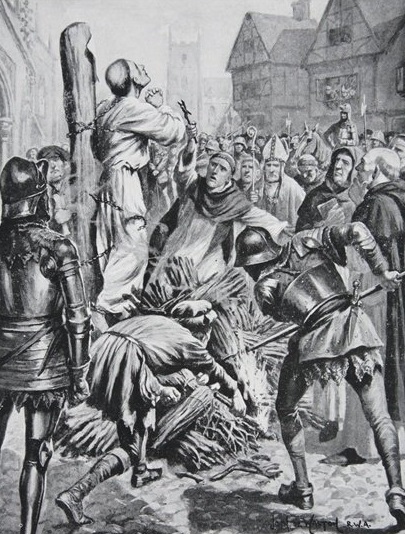
On this date in 1401, Lollard priest William Sawtre(y) was burned at Smithfield for heresy — the first known heresy execution in England.

The highlight of late 14th century English literature, Piers Plowman, was a great favorite of Lollards. Though this lengthy allegorical poem is not itself a Lollard text, it spawned a Piers Plowman tradition with many spinoffs that are overtly Wycliffite.

Witness Wycliffe, who told them the truth;
For in good nature he greatly warned
To mend their wickedness and sinful works.
Who these sorry men damned his soul
And overall lolled him with heretics’ works!

–Piers Plowman’s Creed*

Sawtre was a follower of John Wycliffe, the Biblical translator and church reformer 16 years dead as we lay our scene.

Wycliffe anticipated much of Luther’s later critique of the Catholic Church. His call to study Scripture directly without the intercession of doctors in Rome touched a spiritual thirst; his summons to apostolic poverty for the wealthy vicars of Christ was a message with a ready audience.

“From about 1390 to 1425, we hear of the Lollards in all directions,” notes this public domain history, “so that the contemporary chronicler was ale to say that of every two men found on the roads, one was sure to be a Lollard.”

Lollardy did not immediately manifest as an outlaw movement; it had many adherents among England’s elites and even the royal household. Although the papacy had declared various Wycliffe doctrines heretical in that prelate’s time, England had shown little appetite for calling an Inquisition — a step that would project papal authority into the kingdom.**

But with a ferocious ecclesiastical pushback and a change in the occupancy of the throne,† the English state gradually shifted over the course of the 1390s and 1400s towards recognizing Wycliffe’s principles as heresy — and towards treating that heresy into a capital crime. Through spectacles like Sawtre’s burning, Lollards were gradually made to understand that the price of their scruples might run all the way to martyrdom.

This was novel territory for English jurisprudence, and part of a centuries-long European transition towards treating doctrinal dispute as capital crime. There are only a bare handful of alleged quasi-precedents in English history, sketchily documented — like the unnamed apostate deacon burnt to ashes for Judaizing. It was only as late as William Sawtre that Old Blighty clearly established the practice and legal machinery for putting men and women to death for heresy.

Many Lollards capitulated as they came under pressure. This was true of our man Sawtre, a humble parish vicar. When put to questioning by the bishop in 1399, Sawtre initially recanted his unorthodox skepticism as to the transubstantiation of communion bread into Christ’s own literal body — a doctrinal mystery that would be a tougher and tougher sell to dissidents yet to come.

But upon moving from Lynn to London where he served at St. Osyth’s, Sawtre relapsed — and some stirring moved his soul to vindicate himself in the face of mortal peril.

Charged before Parliament, Sawtre now defended his heresies under close questioning by the Archbishop of Canterbury, Thomas Arundel. Arundel was even then pressuring this same Parliament for a statute, which he did indeed soon receive — one with the ominous title De Heretico Comburendo, at last elevating heresy to a death penalty offense and making the bishops themselves the decisive arbiters on the matter. It is overtly and all-but-explicitly aimed at the Lollards.

divers false and perverse people of a certain new sect, of the faith of the sacraments of the church, and the authority of the same damnably thinking and against the law of God and of the Church usurping the office of preaching, do perversely and maliciously in divers places within the said realm, under the color of dissembled holiness, preach and teach these days openly and privily divers new doctrines, and wicked heretical and erroneous opinions contrary to the same faith and blessed determinations of the Holy Church, and of such sect and wicked doctrine and opinions they make unlawful conventicles and confederacies, they hold and exercise schools, they make and write books, they do wickedly instruct and inform people, and as such they may excite and stir them to sedition and insurrection, and make great strife and division among the people, and other enormities horrible to be heard daily do perpetrate and commit subversion of the said catholic faith and doctrine of the Holy Church …

the diocesans of the said realm cannot by their jurisdiction spiritual, without aid of the said royal majesty, sufficiently correct the said false and perverse people, nor refrain their malice, because the said false and perverse people do go from diocese to diocese and will not appear before the said diocesans…

[let] none within the said realm or any other dominions subject to his Roval Majesty, presume to preach openly or privily, without the license of the diocesan of the same place first required and obtained, curates in their own churches and persons hitherto privileged, and other of the Canon Law granted, only except; nor that none from henceforth anything preach, hold, teach, or instruct openly or privily, or make or write any book contrary to the catholic faith or determination of the Holy Church, nor of such sect and wicked doctrines and opinions shall make any conventicles, or in any wise hold or exercise schools; and also [let] none from henceforth in any wise favor such preacher or maker of any such and like conventicles, or persons holding or exercising schools, or making or writing such books, or so teaching, informing, or exciting the people, nor any of them maintain or in any wise sustain, and that all and singular having such books or any writings of such wicked doctrine and opinions, shall really with effect deliver or cause to be delivered all such books and writings to the diocesan of the same place within forty days from the time of the proclamation of this ordinance and statute.

Any Lollard not so complying could be arrested on the say-so of the diocesan bishop and tried for the offending heterodoxy; if convicted, the clergy was then empowered to hand the unfortunate fellow over to the civil authorities who were obliged to carry out an execution without any further inquiry or say-so. Judge, jury, and (virtually) executioner … the same as the guy waiting for you in the confessional.

[I]f any person … do refuse duly to abjure, or by the diocesan of the same place or his commissaries, after the abjuration made by the same person be pronounced relapsed, so that according to the holy canons he ought to be left to the secular court … [then] after such sentence promulgate shall receive, and them before the people in an high place cause to be burnt, that such punishment may strike fear into the minds of others, whereby, nosuch wicked doctrine and heretical and erroneous opinions, nor their authors … be sustained or in any way suffered.

With such wicked doctrine and heretical and erroneous opinions afoot Sawtre was not suffered to live even the enactment of the law that killed him: De Heretico Comburendo was passed only on March 10, but Sawtre was eight days’ dead by that point. It’s a bit unclear how the sentence was legally effected, but it would seemingly have proceeded under canon, not civil, law.

Both the law and the execution were great victories for the Church. “The king and the archbishop hurried to burn their victim to show that they could send a heretic to the stake whenever they wished, without relying on statute” Leonard Williams Levy writes. “Parliament could neither give nor take the authority to burn a heretic. If the scepter supported the miter, canon law prevailed.”

Be that as it may, the victims of the Lollard-burning period were not nearly so numerous as the chilling language of De Heretico Comburendo might lead one to anticipate. The next Lollard to go to the stake was John Badby in 1410; two merchants were executed in 1415, and the Lollard rebel John Oldcastle was burnt “gallows and all” in 1417. Another handful suffered in the 1420s. It’s thought that about 50 people overall (Lollards and otherwise) were executed as heretics from the enactment of De Heretico Comburendo until Henry VIII broke with Rome 133 years later — an occasion that made heresy-hunting a whole different animal.

The History of England podcast covers Sawtre and Lollardy in episode 141.

* My artless rendering from the Middle English version given in D.A. Lawton in “Lollardy and the ‘Piers Plowman’ Tradition”, The Modern Language Review, Oct. 1981.

** Despite overall caution about the authority of Rome onto Albion’s soil, the English had no overall principled rejection of Inquisitors as such: they convoked such a tribunal to deal with Joan of Arc.

† The political situation in the realm was also been a factor: the usurper Henry IV had taken the crown only in 1399 by deposing, and later murdering, King Richard II. One readily supposes Henry’s keen interest in shoring up the loyalty of the church and keeping tabs on itinerant rabble-rousers, the latter of whom appear to have disproportionately skewed towards Richard’s faction. (All those heretics in the king’s household were in Richard’s household.)

On this day..

1526: Guillaume Jobert, Genevieve-blasphemer

Guillaume Jobert, one of the first Reformation martyrs in Paris, had his tongue bored through on this date in 1526,* then was burned at the stake at the Place Maubert.

Jobert, the young gentleman son of the avocat du roi of La Rochelle, incurred this ghastly punishment by making some impious cracks about the faith and in particular the devotions given St. Genevieve.

Genevieve was no one to be trifled with. She was supposed to have stopped Attila the Hun dead in his tracks with her prayerful intercession and saved Paris from the sack in 451, in remembrance of which feat she had become honored as the patron saint of Paris.

Genevieve’s cult really took off in the High Middle Ages, the period when a burgeoning Paris firmly established itself as the hub of all France. So powerful was the Parisian devotion to the saint (and the saint’s devotion to Paris) that her cult became a defining marker of the community — and when that community was ruptured by the Reformation, affinity for the cult came to mark the community’s boundaries. To the extent that Genevieve was identified with Paris, with France, with the sacraments, with the royal family — and she was identified with all these things — the Protestant skepticism of saints posing as divine intercessors with demigod-like spheres of influence positioned reformers in opposition to a good many things more than “merely” theology. There is a secular echo of this same critique from centuries later in Voltaire:

The girl that was born in the stubble fields of Nanterre,
Has become a saint that is implored by hollow and stupid people …
But a good citizen should be devout only to you.

As Moshe Sluhovsky notes in “The Politicizations of Sainte Genevieve”, a chapter of his Patroness of Paris: Rituals of Devotion in Early Modern France, the Protestant Reformation in particular

challenged the sacrality of Paris, the identity of France, and the cult of the saints. It was therefore necessary to reaffirm the city’s Catholicity by redefining it in opposition to heresy. Sainte Genevieve was used to delineate who should be included in the sacred social body and who should be excluded from it.

Overtly blaspheming Genevieve certainly put Joubert in the “exclusion” category.

While we have little specific detail about Joubert, some sense of the gravity of his offense might be gleaned from an event that ensued a decade after his tongue-boring execution, when the Affair of the Placards sparked a furious Catholic backlash against religious dissidents. One week later, six Protestants were burned at the stake following a monumental procession through the city meant to reaffirm France’s devotion to the Catholic faith.

For the occasion, St. Genevieve’s relics were removed from her sacred abbey and marched along with all that abbot’s canons and the king himself. These 1,000-year-old remains never appeared in these sorts of ceremonies “without grette and urgent causes,” an English Protestant observer remarked. Notably, accrding to Sluhovsky, the reliquary on this occasion crossed the Seine to the Right Bank for the first time ever.

* Date from this public-domain French journal.

On this day..

1527: Georg Wagner

On this date in 1527, apostate Catholic priest Georg Wagner went to the stake in Munich.

Called “Carpentarius”, Wagner renounced a comfortable pastorship in Emmeringen, espousing the unacceptable tenets that his office was not empowered by Scripture to forgive sins, nor to transubstantiate bread and wine into Christ’s own body, nor to perform baptism on infants. He’s claimed as a martyr both by Anabaptists and Lutherans.

Wagner was a worthy enough man in his time and place that the propaganda coup of his defection drew urgent efforts at re-converting him by his former co-religionists — and even, allegedly, the Duke of Bavaria himself. He spurned them all, insisting only “that, as long as I can open my mouth” in the fires that would devour him, “I will confess the name of Jesus Christ.”

The Martyrs Mirror account of Wagner’s martyrdom credits God with, hours after the execution, smiting dead the sheriff who brought Wagner to the pyre.

On this day..

1545: Cornelis Appelman and Willem Zeylmaker, Batenburgers

On this date in 1545, the leaders of the violent Anabaptist Batenburgers were burned at the stake in Utrecht.

We know Anabaptists best as peaceniks, but the Batenburgers were the dead-end trail to a wholly different reputation. Named for a former Dutch mayor named Jan Van Batenburg, these Zwaardgeesten (“sword-minded”) Anabaptists answered the annihilation of their brethren’s MĂĽnster commune by doubling down on revolutionary struggle.

Batenburgers rejected the blandishments of David Joris to lay down the impolitic swords. Their numbers and their philosophies are hard to know with certainty owing to their secrecy, but they’re thought to have maintained the radical Munsterite teachings on polygamy and property.

Van Batenburg himself was caught and executed in 1538, and with that the Batenburgers — who had been living secretly in regular Catholic and Protestant communities — took to the wilderness under the leadership of a Leiden weaver named Cornelis Appelman. For the next ten years or so (even outlasting Appelman’s own death) this band of a couple of hundred desperate men made their way as marauders. We’d probably just call them terrorists today.

Appelman was even more extreme than his predecessor, verging right into crazy cult leader territory with his dystopian insistence on being called “The Judge” and readiness to mete out the severest penalties for any breach of obedience — to say nothing of the arsons, the church-sackings, and the summary executions dealt out to unbelievers. He was finally caught and put to death with his aide Willem Zeylmaker. Batenburger remnants, however, persisted for several more years with at least one splinter continuing until around 1580.

On this day..

1601: Starina Novak, hajduk

On this date in 1601, Serbian-Romanian hajduk Starina Novak was slow-roasted in Cluj with two of his captains.

The hajduk in the Balkans was a romantic figure who mixed traits of the “social bandit” outlaw with those of anti-Ottoman guerrilla. Colorful characters answering the archetype persisted into the 20th century.

Novak, who was around 70 by the time of his death, is still celebrated for his feats of arms on the soldiering side of the ledger in a running conflict with the Ottomans. Most of the sites about Starina Novak are in Serbian, like this one.

He emerges as a commander of Serbian and Bulgarian auxiliaries fighting with Michael the Brave in the 1590s to carve out of the Ottoman realm a kingdom of Wallachia, Transylvania, and Moldavia — roughly, present-day Romania plus Moldova. The enterprise was as glorious as its destiny was tragic.

By 1601 an Italian officer aptly christened Giorgio Basta had had enough of his erstwhile allies and double-crossed hajduk and upstart king alike.

The former he shopped as a traitor to Michael’s Hungarian allies, who put him to the stake in Cluj and made sure to throw water on the burning partisan throughout in order to prolong the ordeal. (The charred corpses of Novak and his associates were then impaled.) A few months later, Basta had Michael the Brave assassinated, and placed himself at the head of Michael’s hard-won kingdom.


A statue of Starina Novak keeps vigil in the city where he died. (cc) image from Bogdan Pop.

Being a national hero means your prior career in brigandage gets a little Robin Hood elbow grease.

In the Serbian epic “Starina Novak and Knez Bogosava” — translated here by polyglot friend of the site Sonechka — Novak attributes his turn to banditry to the impositions of his rulers, specifically (and ahistorically) blaming the 15th century despot’s wife Jerina for overtaxing him.

Novak and Radivoj are imbibing wine
By the brisk waters of Bosna,
At a certain Prince Bogosav’s.
And having sated themselves with wine,
Prince Bogosav began to talk:
“Brother, Old Novak,
Tell me straight, as if confessing,
Why did you, brother, become a hajduk?
What compels you
To break your neck, to wander the forest
As a brigand, pursuing your ignoble employ,
Unto your senescence, when your time has passed?”

Replies Old Novak:
“Brother, Prince Bogosav,
When you ask, I answer in earnest —
It was truly not my wish.
If you could recollect
The time when Jerina was building Smederevo
And ordered me to toil.
I labored for three years,
I pulled the trees and carried stones,
All on my own cart and oxen.
And in three years term,
I gained not a dinar,
Not even opanci to put on my feet.
But that, brother, I would have forgiven!
Having built Smederevo,
She began to mount towers,
To engild the gates and windows,
And imposed the duty on the vilayet,
For each house – three measures of gold,
Which is three hundred ducats, brother!
Those who had, gave her the treasure;
Those who gave, stayed.
I was a pauper,
With nothing to give,
I took my pickax, which I toiled with,
And with this pickax I turned to banditry,
No longer could I linger anywhere
In the domain of cursed Jerina,
But ran away to the icy Drina,
Then reached stony Bosnia.
And when I neared Romania,
I met a Turkish wedding party –
Escorting a noble girl,
All passed in peace,
Save for the Turkish groom.
On the great dark brown steed,
He did not want to pass in peace.
He pulls his three-tail whip
(encumbered with three bolts of weight)
And lashes me across my shoulders.
I begged him thrice in the God’s name:
‘I beg you, Turk,
So blessed you with fortune and heroism,
And happy joviality,
Go on, proceed along your way with peace —
Do you see that I am a poor man!’
Withal the Turk would not budge.
And ache had grasped me,
And the anger grew,
I pulled my pickax from my shoulder
And struck the Turk, mounting on his brown steed.
The blow was so light
That it threw him off his horse,
I came upon him,
Hit him twice, and then again three times
While rending him asunder.
I rummaged through his pockets,
And found there three bags of treasure;
I stashed them in my bosom;
Untied his sword,
Having untied it from his belt, I have attached it to my own;
In place I left the pickax,
So that the Turks will have a tool with which to bury,
And thenceforth I mounted his brown steed,
And headed straight to the Romanian forest.
This all was witnessed by the wedding party
That dared not pursue me.
They wanted not or dared not.
It happened forty years back.
I grew more fond of my Romanian forest
Than, brother, of a palace;
Because I guard the mountenous road,
I wait for young Sarajevans
And take their gold, and silver,
And finer cloth, and satin;
I dress myself and the gang;
So I can come and flee,
And stay in horrid places —
I fear nothing but God.”

For Bosnian-Serbian-Croatian speakers with a lot of time on their hands, here’s a reading of the original:

On this day..

1745: Eve, her smoke visible throughout the country

On this date in 1745, Orange County, Virginia was darkened by the smoke from a stake where a slave named Eve died for poisoning her master, Peter Montague.

As accused, Eve, “not having God before her eyes nor considering the obedience to the said Peter Montague, her master, but led and seduced by the instigation of the Devil … with force of arms and her malice forethought, feloniously and traitorously did mingle and poison milk … did give it to the said Peter Montague, which he did taste, eat, drink and swallow down … and did languish until the 27th day of December. Eve falsely, traitorously and feloniously of her malice forethought with the poison … did kill, poison and murder.” (Quoted here.)

Eve asserted her innocence to no avail at her trial on January 23. The court condemned her to “be drawn upon a hurdle to the place of execution and there to be burnt.”

Upon the execution of that sentence — “the smoke of the burning of Eve was visible over a large extent of the country” — the Montague estate was compensated £50 by the Commonwealth of Virginia for the destruction of its human property.

On this day..

1679: “A number of poor people for the crime of witchcraft”

From the Domestic Annals of Scotland (see here or here):

A commission composed of country gentlemen and advocates sat in the Tolbooth of Borrowstounness to try a number of poor people for the crime of witchcraft. There was Annaple Thomson, who had had a meeting with the devil in the time of her widowhood, before she was married to her last husband, on her coming betwixt Linlithgow and Borrowstounness, when he, ‘in the likeness of ane black man, told you, that you was ane poor puddled body, and had an evil life, and difficulty to win through the world, and promised if you would follow him, and go alongst with him, you should never want, but have ane better life; and about five weeks thereafter the devil appeared to ye when you was going to the coal-hill about seven o’clock in the morning. Having renewed his former tentation, you did condescend thereto, and declared yourself content to follow him and become his servant.’ There were also women called Margaret Pringle, Margaret Hamilton (two of the name), and Bessie Vicker, besides a man called William Craw. ‘Ye and each person of you was at several meetings with the devil in the links of Borrowstounness, and in the house of you Bessie Vicker, and ye did eat and drink with the devil, and with one another, and with witches in her house in the night-time; and the devil and the said William Craw brought the ale which ye drank, extending to about seven gallons, from the house of Elizabeth Hamilton, and you, the said Annaple, had ane other meeting about five weeks ago, when you was going to the coal-hill of Grange, and he invited you to go along with him and drink with him in the Grange-pans.’ Two of the other accused women were said to have in like manner sworn themselves into the devil’s service and become his paramours, one eight years, the other thirty years ago. It was charged against Margaret Pringle, that ‘the devil took you by the right hand, whereby it was for eight years grievously pained, but [he] having touched it of new again, it immediately became hail;’ against Margaret Hamilton — ‘the devil gave you ane five-merk piece of gold, whilk a little after becam ane sklaitt stane.’ And finally, ‘you and ilk ane of you was at ane meeting with the devil and other witches at the cross of Muirstane, above Kinneil, upon the thretteen of October last, where you all danced, and the devil acted the piper.’

These poor people were solemnly tried by the commissioners before an assize of fifty persons, and, notwithstanding that the indictment charges scarcely any hurtful attempts against individuals, the whole were adjudged to be taken four days after to the west end of the town, and there worried at a stake and burnt.

On this day..

1323: Jean Persant, a black cat, and the body of Jean Prévost

From the French Grandes Chroniques. The numbered footnotes within the blockquote are verbatim from this text.

Moreover, it befel in this year [1323] that an abbey of the Cistercian Order was robbed of a marvellous great sum of money.

So they managed by the procuration of a man who dwelt at Château-Landon and had been provost there (for which cause he was still called Jean Prévost) that an agreement was made between him and an evil sorcerer, that they should contrive to discover the thieves and compel them to make restitution, in the fashion here following.

First, the sorcerer made a chest, with the help of the said Jean PrĂ©vost, wherein they clapped a black cat; and this they buried in a pit in the fields, right at a cross-way, and set three days’ meat for the cat within that chest, to wit bread steeped and softened in chrism and consecrated oils and holy water; and, in order that the cat thus interred might not die, there were two holes in the chest and two long pipes which rose above the earth thrown over that chest, by which pipes the air might enter therein and suffer the cat to breathe in and out.

Now it befel that certain shepherds, leading their flocks afield, passed by this cross-way as had ever been their wont; and their dogs began to scent and get wind of the cat, so that within a brief while they had found the place where she lay. Then began they to scratch and dig with their claws, for all the world as it had been a mole, nor could any man tear them away from that spot.

When the shepherds saw that their dogs would by no means depart thence, then they drew near and heard the cat mew, whereat they were much amazed. And, seeing that the dogs still scratched without ceasing, one who was wiser than the rest sent word of this matter to the justice, who came forthwith to the place and found the cat and the chest, even as it had all been contrived; whereat he was much astonished, and many others who were come with him.

And while this provost of Château-Landon pondered anxiously within himself how he might take or find the author of so horrible a witchcraft, (for he saw well that this had never been done but for some black art; but whereof or by whom he knew not) then it came to pass, as he thought within himself and looked at the chest which was newly-made, that he called all the carpenters of that town, and asked them who had made this chest.

At which demand a carpenter came forward and said that he had made it at the instance of a man named Jean PrĂ©vost; “But so help me God,” quoth he, “as I knew not to what purpose he had bidden me make it.”

Then within a brief space this Jean Prévost was taken upon suspicion, and put to the question of the rack: upon which he accused one Jean Persant as the principal author, contriver, and inventor of this cursed witchcraft; and afterwards he accused a monk of Cîteaux, an apostate, as the special disciple of this Jean Persant, and the Abbot of Sarquenciaux [Serquigny?] of the Order of Cîteaux, and certain Canons Regular,(2) who were all abettors of this wickedness. All of whom were taken and bound and brought before the Official of the Archbishop of Sens and the Inquisitor at Paris.

When they were come before them, men enquired of them — and of these more especially of whom they knew by report that they were masters in this devilish art — wherefore they had done this thing. To which they answered that, if the cat had dwelt three days long at those four crossroads, then they would have drawn him forth and flayed him; and from his hide they would have made three thongs, which they would have drawn out to their fullest extent and knotted together, so that they might make a circle within the compass whereof a man might be comprised and contained. Which when they had done, he who was in the midst of the circle would first nourish himself in devilish fashion with the meat wherewith this cat had been fed; without which these invocations would be null and of none effect. After which he would have called upon a devil named Berich, who would presently have come without delay, and would have answered all their questions and discovered the thefts, with all those that had been principal movers therein and all who had set their hands thereunto; and in answer to their questions he would have told them all the evil to be done.

Upon the hearing of these confessions and downright devilries, Jean PrĂ©vost and Jean Persant, as authors and principals in this accursed witchcraft, were adjudged to be burned and punished with fire; but while the matter was drawn out and delayed, Jean PrĂ©vost chanced to die; whose bones and body were burned to ashes in detestation of so horrible a crime, and the other, to wit Jean Persant, was bound to the stake with the cat around his neck, and burned to ashes on the morrow of St Nicholas’ day; after which the Abbot, and the apostate monk, and the other Canons Regular who had administered the chrism and other matters to this witchcraft, were first degraded and then, by all rules of law, condemned and put into prison for their lives.

(1) In the face of such abuses of things consecrated, the church Councils of the Middle Ages constantly insisted that the Pyx, the Chrismatory, and the Font must be kept under lock and key in all churches. The neglect of these precautions is one of the points most frequently noted by official visitors.

(2) Canons bound to the lifelong observance of a Rule; the best known are the Austin Canons and the Praemonstratensians. They were in fact practically monks, and are often so-called by medieval writers, though modern pedantry sometimes ignores this. Cf. Chaucer, Canon’s Yeoman’s Tale.

(3) Quasi-heraldic personal insignia, with motto; cf. Richard II, Act iii, Sc. I. [“From my own windows torn my household coat,/Razed out my imprese”]

On this day..