1865: Thomas King, heartstabber

From the public domain History of Siskiyou County, California Illustrated with Views of Residences, Business Buildings and Natural Scenery, and Containing Portaits and Biographies of its Leading Citizens and Pioneers.

THOMAS KING.

After lying in jail two years, and receiving two trials, hoping for a release from the extreme penalty of the law until a few weeks before his death, Thomas King was executed on the twenty-third day of June, 1865, for a heartless and causeless murder, for dealing a death-blow, unprovoked and unexpected. He was born in Ireland, and when about twelve years of age, left his home because his parents had punished him for some offense. For several years he roamed about the United Kingdom, the associate of bad characters, until for the commission of
some felony he was transported to Australia.

When the Crimean war was raging, a regiment was raised among the convicts, by order of Lord Raglan, the men being given their liberty at the close of the war. In this regiment King enlisted, and after the fall of Sebastopol received his discharge. He made his way to Halifax, and from there to California, and to this county. After mining at Humbug, Scott Bar and various other places, he went to the south fork of Scott river, where he committed the terrible crime, for which the law exacted the penalty of his life.

On the second of July, 1863, having already become considerably under the influence of liquor, he entered French’s saloon, and began flourishing a knife in a threatening manner, and was deprived of it by the barkeeper. Among others in the saloon was James Duffy, who had been drinking, and whom King accused of having his knife. The accusation was denied, and upon being informed where the knife was, King demanded it from the barkeeper and it was restored to him. Throwing the weapon upon the floor and striking a tragic attitude, he exclaimed: “There lays me dagger. Whoever picks it up, dies by me hand.”

Not dreaming of danger, Duffy stooped, picked up the weapon and laid it upon the counter, saying, “You wouldn’t kill me, your best friend, would you?” “Yes, I would,” he said, as he took up the knife and made several false motions, touching Duffy’s breast with the handle, while the victim stood there smiling, unconscious of danger. Suddenly King reversed the knife, and with a, quick, hard blow, buried it deep in Duffy’s heart, the murdered man sinking to the floor with the exclamation, “You have cut me.” King made a pass with the bloody weapon at the barkeeper, and then sprang to the door and fled. The horrified witnesses of the tragedy stood for an instant in blank amazement, and then hastened in pursuit of the murderer, whom they soon overtook and secured after a slight resistance.

He remained in jail until the following February, when, after a trial lasting three days, he was found guilty of murder in the first degree, and was sentenced by Judge E. Garter to be executed Friday, March 18, 1864. An appeal to the Supreme Court gained for the condemned man a new trial, based upon the construction of a statute, and not upon the merits of the case. He was again tried in September, and was sentenced to be hanged on Friday, November 4, 1864, but an application to the Supreme Court produced a stay of proceedings until the case could be reviewed by that body. While awaiting the decision of the court, on Saturday, the eighth of February, 1865, he made a bold, and for a time, successful attempt to regain his freedom. Confined in the jail, which was the old wooden building first erected by the county, were also George Foster and Robert Ferry, both under a sentence to the penitentiary for grand larceny, and McGuire, a deserter from the army. The last named was allowed in the corridor, and was in the habit of calling for water. About eight o’clock on the night in question Foster succeeded in getting out of his cell, and after releasing the prisoners from their cells, had McGuire call for water, as usual, and when Jailor McCullough opened the door he was seized, gagged, and bound, and the prisoners escaped, having their irons still upon them. They had been gone but twenty minutes when their flight was discovered. The town was aroused, and people started in all directions in search of the fugitives. About daylight Ferry was caught at Cherry creek by John Hendricks and others. having been unable to get rid of his irons. About two o’clock Sunday afternoon William Short and Charles Brown found King in a clump of manzanita bushes, near Deming’s old brickyard, but a short distance south-west of Yreka. His long confinement of nineteen months had so weakened him that he had been unable to proceed further or to remove the irons from his limbs, although one of them he had succeeded in sawing partially through. A party composed of Livy Swan, A.V. Burns, J. Babb, A.D. Crooks, Sherman, Stone, and Groots, in pursuit of Foster and McGuire, stopped Monday night at Cherokee Mary’s, a resort for thieves, nine miles from Yreka. About four o’clock Tuesday morning the two fugitives approached the house and were ordered to surrender, and upon attempting to escape were fired upon by Jesse Sherman, with a shot gun, and Foster was wounded in the head and captured, while McGuire escaped by flight. Foster had succeeded in removing his irons, and now, severely wounded, was conveyed again to jail, while McGuire went to Fort Jones, and, finding escape impossible, gave himself up. Foster and Ferry had the terms of their sentences increased, while McGuire, who would have been released in a few days, was sent to San Quentin for two years for his little exploit in jail-breaking.

George Foster, alias Charles Mortimer, alias Charles J. Flinn, was the leader in the jail delivery, a hardened and reckless felon, and ended his career upon the scaffold. He was first sent to San Quentin from San Francisco for three years, and when his term expired, went back, chloroformed a man and robbed him of $1,800, was arrested, and escaped from officer Rose, by knocking him senseless and nearly cutting his throat. He then came to Siskiyou county, and was soon sentenced to three years for grand larceny, which term was increased to seven years for his participation in the jail delivery. After his release he continued his career of crime, finally murdering a woman in Sacramento, September 19, 1872, for which act he paid the penalty upon the gallows, not, however, until his brother lost his life in a desperate attempt to release him from the jail in which he was confined while awaiting the day of his execution.

The Supreme Court having reviewed the case and sustained the decision of the lower court, King was brought before Judge Garter in May, and was sentenced to be hanged on Friday, June 23, 1865. Preparations were accordingly made by Sheriff A.D. Crooks by erecting a gallows in the jail-yard. King’s conduct during the trials had been one of bravado and defiance, and this he maintained to the last, being quite abusive while on the scaffold. He remarked as they were leading him from his cell to the place of his death, “I’m the handsomest man here, if I am going to be hung.” But few spectators were admitted within the jail walls to witness the last act of this terrible drama, which culminated at nine minutes to two o’clock. The murderer who thus received the just punishment for the crime, nearly two years after he had plunged the fatal knife into an innocent and unsuspecting bosom, was buried a little east of town, near the remains of Crowder and Sailor Jim, executed several years before.

On this day..

1894: William Whaley, “the horror of the situation”

This ghastly description of a botched hanging comes courtesy of the out-of-print The palace of death, or, the Ohio Penitentiary Annex: A human-interest story of incarceration and execution of Ohio’s murderers, with a detailed review of the incidents connected with each case by H.M. Fogle (1908):


Chapter 19

William Whaley
June 22, 1894

A negro robber who beat out the brains of Allen Wilson, near Yellow Springs, Ohio, with a dray pin. Hanged June 22, 1894

A Brutal Robber Meets a Just Fate


William Whaley, serial number 25,257, was executed in the Ohio Penitentiary Annex twelve minutes after the birth of a new day, June 22, 1894, for the brutal murder of Allen Wilson, a thrifty and hard working colored man.

The crime was committed near Yellow Springs, Greene County, Ohio, on the night of June 6, 1893. Robbery was the motive for the crime, and a dray pin the instrument of destruction. He sneaked upon his victim in the dark, and literally beat his brains out.

Whaley was a young man not over twenty-five years of age, and with perhaps one exception, was the most profane man that was ever incarcerated in the Ohio Penitentiary Annex. He refused all spiritual consolation, and cursed his executioners almost with his dying breath. He was a cowardly cur, and betrayed his cowardice while on the scaffold. Three times he sank to his knees as the noose was being adjusted. The attending Guards were compelled each time to assist him to his feet, and finally to hold him up by main strength until the rattle of the lever shot his body through the open trap. Being almost in a total state of collapse, the body instead of plunging straight through the opening, pitched forward, striking the side of the door, thus breaking the force of the fall. For this reason the neck was not broken, and death was produced by the slow and harrowing process of strangulation.

Reader, if you have never seen a sight of this kind you cannot understand or comprehend the horror of the situation. Time after time the limbs were drawn up with a convulsive motion, and then straightened out with a jerk. The whole body quivered and shook like one might with the ague; while the most hideous and sickening sounds came from the throat. This continued for eighteen minutes; but to one looking on it seemed an age. After eighteen minutes the sounds ceased; the body became perfectly still; the limbs began to stiffen; the heart-beats to weaken. In just twenty-six minutes after the drop fell the last pulsation was felt, and the doctor solemnly said: “Warden, I pronounce the man dead.”

The outraged law had been avenged, and a soul unprepared had been ushered into Eternity.

On this day..

1779: Henry Hare, Tory spy

On this date in 1779, American Revolution patriots hanged Henry Hare as a spy at Canajoharie in upstate New York.

In the first years of the revolution, this district was plagued (from the revolutionists’ standpoint) by raids of Tory loyalists and their allied indigenous Six Nations confederation: the latter had sided with the British against the land-hungry colonists in hopes of better retaining their rights against settlers.

An irritating situation became an intolerable one when loyalists and Mohawks descended on the village of Cherry Valley November 11, 1778, and massacred not only its defenders but about 30 non-combatants.


The slaughter of Jane Wells during the Cherry Valley Massacre. Engraving by Thomas Phillibrown from an original image by Alonzo Chappel (1828-1887).

In retaliation, Gen. George Washington ordered a retaliatory foray that history remembers as the Sullivan Expedition, after its leader, Gen. John Sullivan.

“The Expedition you are appointed to command is to be directed against the hostile tribes of the Six Nations of Indians, with their associates and adherents,” Washington instructed his man.

The immediate objects are the total destruction and devastation of their settlements, and the capture of as many prisoners of every age and sex as possible. It will be essential to ruin their crops now in the ground and prevent their planting more.

I would recommend, that some post in the center of the Indian Country, should be occupied with all expedition, with a sufficient quantity of provisions whence parties should be detached to lay waste all the settlements around, with instructions to do it in the most effectual manner, that the country may not be merely overrun, but destroyed.

But you will not by any means listen to any overture of peace before the total ruinment of their settlements is effected. Our future security will be in their inability to injure us and in the terror with which the severity of the chastisement they receive will inspire them.

But the first chastisements were issued to no Indian, but to Tory skulks.

Sullivan took command of one column, and ordered Gen. James Clinton to march another force down the Mohawk River Valley to Canajoharie. The following narration from the very specific chronicle History of Schoharie County, and border wars of New York gives us two Tory spies along with at least one patriot deserter all executed in those precincts; however, another Clinton letter dates only the Hare hanging specifically to Monday, June 21 (precise dates for the other two executions appear to be lost to history).

While Gen. Clinton was waiting at Canajoharie for his troops and supplies to assemble, and also for the construction of bateaus, two tories were there hung, and a deserter shot. The following letter from Gen. Clinton to his wife, dated July 6th, 1779, briefly narrates the death of the two former:

I have nothing further to acquaint you of, except that we apprehended a certain Lieut. Henry Hare, and a Sergeant Newbury, both of Col. Butler’s regiment, who confessed that they left the Seneca country with sixty-three Indians, and two white men, who divided themselves into three parties — one party was to attack Schoharie, another party Cherry-Valley and the Mohawk river, and the other party to skulk about Fort Schuyler and the upper part of the Mohawk river, to take prisoners or scalps. I had them tried by a general court martial for spies, who sentenced them both to be hanged, which was done accordingly at Canajoharie, to the satisfaction of all the inhabitants of that place who were friends to their country, as they were known to be very active in almost all the murders that were committed on these frontiers. They were inhabitants of Tryon county, had each a wife and several children, who came to see them and beg their lives.

The name of Hare was one of respectability in the Mohawk valley, before the revolution. Members of the Hare family were engaged for years in sundry= speculations with Maj. Jelles Fonda, who, as already observed, carried on an extensive trade with the Indians and fur traders at the western military posts; his own residence being at Caughnawaga [the region north of the Mohawk] Henry Hare resided before the war in the present town of Florida, a few miles from Fort Hunter. At the time he left the valley with the royalist party to go to Canada, his family remained, as did that of William Newbury, who lived about 3 miles from Hare, toward the present village of Glen.

If Hare had rendered himself obnoxious to the whigs of Tryon county, Newbury had doubly so, by his inhuman cruelties at the massacre of Cherry Valley, some of which, on his trial, were proven against him. Hare and Newbury visited their friends, and were secreted for several days at their own dwellings. The former had left home before daylight to return to Canada, and was to call for his comrade on his route. Maj. Newkirk, who resided but a short distance from Hare, met a tory neighbor on the afternoon of the day on which Hare left home, who either wished to be considered one of the knowing ones, or lull the suspicions resting upon himself, who communicated to him the fact that Hare had been home — and supposing him then out of danger, he added, “perhaps he is about home yet.” He also informed him that Newbury had been seen.

Hare brought home for his wife several articles of clothing, such as British calicoes, dress-shawls, Indian mocasons, &c., and on the very day he set out to return to Canada, she was so imprudent as to put them on and go visiting — the sight of which corroborated the story told Newkirk. The Major notified Capt. Snooks, who collected a few armed whigs, and in the evening secreted himself with them near the residence of Hare, if possible, to give some further account of him.

Providence seems to have favored the design, for the latter, on going to Newbury’s, had sprained an ankle. Not being willing to undertake so long a journey with a lame foot, and little suspecting that a friend had revealed his visit, he concluded to return to his dwelling. While limping along through his own orchard, Francis Putman, one of Snook’s party, then but 15 of 16 years old, stepped from behind an apple tree, presented his musket to his breast, and ordered him to stand. At a given signal, the rest of the party came up, and he was secured. They learned from the prisoner that Newbury had not yet set out for Canada, and a party under Lieut. Newkirk went the same night and arrested him. They were enabled to find his house in the woods by following a tame deer which fled to it.

The prisoners were next day taken to Canajoharie, where they were tried by court martial, found guilty, and executed as previously shown. The execution took place near the present village of Canajoharie. The influence exerted by the friends of Hare to save him would have been successful, had he declared that he visited the valley solely to see his family. He may have thought they dared not hang him; certain it is, that when he was interrogated as to the object of his visit, he unhesitatingly said that he not only came here to see his family, but also came in the capacity of a spy. A deserter, named Titus was shot at Canajoharie about the time the spies were hung, as I have been informed by an eye witness to all three executions. — James Williamson.

Deserters were shot for the first, second, or third offence, as circumstances warranted. Newbury and Titus were buried near the place of execution, and the bones of one of them were thrown out at the time of constructing the Erie Canal [which cut through the Mohawk Valley -ed.], by workmen who were getting earth for its embankment. The body of Hare was given to his relatives for interment. Previous to burial the coffin was placed in a cellar-kitchen, before a window, in which position a snake crawled over it. This circumstance gave rise to much speculation among the superstitious, who said “It was the Devil after his spirit.”

On this day..

1890: Elizabeth and Josiah Potts, wife and husband

On this date in 1890, an affectionate married couple hanged together in Elko, Nevada, for a murder they insisted they had not authored.

We obtain this headline and the associated (nationally circulated) story from the San Diego Union of June 26, 1890.

[Associated Press Dispatches.]

ELKO, Nev., June 20. — Elko is in a ferment of excitement, many parties pouring in to witness the execution of the Potts family for the murder of Miles Fawcett in January, 1888. Over sixteen women have already applied for permits to witness the execution, which were refused.

The conduct of Mrs. Potts during the past five days has been an alternation of hysterical crying, screaming and swearing at her husband, who mopes the time away in solitude. Yesterday morning at 5 o’clock she attempted to commit suicide, gashing her wrists and trying to smother herself. The vigilance of the death watch prevented further injury but she fainted from loss of blood. Both the Potts retired early last night in a nervous condition.

At 10:30 o’clock the Sheriff read the death-warrants to Josiah and Elizabeth Potts. The reading of the warrant took place in the doorway of the latticed cell, which Josiah has occupied for so long a period.

He stood in a despondent attitude, with his head bowed down against the iron bars, and not once during the reading of the warrant did he lift his head. His wife stood erect, clad in a neat muslin suit draped in black, with a red rose in her bodice. She was pale, but with a most determined aspect in every feature. During the reading of her own warrant only once did she show any emotion whatever, and she convulsively clutched her throat when her husband’s was being read, and when the words “hanged by the neck till you are dead” were reached, she gave a hysterical gasp and seemed to exhibit much feeling.

The reading of the warrants was finished at 10:30, and both the condemned people emerged from the jail, where they had been confined for eighteen months, and proceeded outside the door to the yard between the Courthouse and jail, in which the scaffold had been erected. The sunshine relieved in a measure the gruesome surroundings. During the readings of the warrants, and evidently owing to the intense nervous strain on every one, a Deputy Sheriff was so overcome that he had to call for a glass of water.

At the conclusion of the reading Mrs. Potts earnestly ejaculated:

I AM INNOCENT AND GOD KNOWS IT,

and Josiah Potts reiterated, “God knows we are innocent.” The gloomy procession led the way through a side door and with a bravery unexpected by the sixty-odd spectators, the condemned couple seated themselves on stools provided on the scaffold, while the deputies speedily proceeded to bind them with leather straps, Mrs. Potts helping to adjust them herself while Potts sat through it all in stolidity.

When everything had been properly adjusted, they were directed to rise and all of the attendants shook hands with the condemned unfortunates. The attendants held the strap attached to Mrs. Potts’ manacled wrists and Potts made several most earnest endeavors to clasp the hands of his wife but without accomplishing it. Finally a touch on her wrist caused her to turn her eyes toward his and a mute appeal of love caused their lips to meet. As the rope was stretched around Mrs. Potts’ neck she clasped her hands together, and lifting her eyes towards the sky, exclaimed “God help me; I am innocent.”

Her husband reiterated in a hollow tone, “God knows we are innocent,” as the black caps were drawn over their heads.

The words of the clergyman who had remained with them to the last broke the silence by saying: “Put your trust in God and He will see you righted,” and then the drop fell. Instantaneously,

MRS. POTTS WAS A CORPSE,

owing to her heavy weight. Her flacid [sic] flesh caused a rupture of the carotid artery and a stream of blood burst forth from under the chin of the dead woman, staining her white raiment. To the great surprise of all who had seen Potts’ emaciated condition his vitality was great, it being a fraction over fourteen minutes, as counted by the Associated Press reporter, before life was pronounced extinct by Drs. Meiggs and Petty.

At 11:08 the body of Mrs. Potts was cut down when it was seen that her excessive weight on the five foot and a half drop had almost dissevered her head from the trunk, the muscles in the back of her neck alone supporting the connection.

About nine minutes later Josiah Potts’ body was cut down and the body of himself and wife, in the absence of any claiming friends, were deposited in the potter’s field of the Elko grave yard half an hour later.

After the interment of the bodies of Mr. and Mrs. Potts, District Attorney Love, accompanied by an Associated Press reporter, placed in the potter’s field all the remains of the murdered Fawcett known to exist above the earth. The box of bones had been in the District Attorney’s office at the Courthouse from the time when he first started to search for the criminals.

THE CRIME

for which the couple was executed was the murder of Miles Fawcett, 70 years of age, at Carlin, January 1st, 1888, because he insisted on being paid some money due from Potts. He visited Potts and this was the last seen of him until his dead body was discovered some months after by a person who rented the house formerly occupied by Potts.


That’s the end of the Union article.

Despite the incriminating circumstances of Mr. Fawcett’s disappearance, many people found the Potts’s insistence upon their innocence persuasive … especially after a last message from Elizabeth Potts reached public ears.


Laramie (Wyoming) Daily Boomerang, June 24, 1624.

Innocent or guilty, Elizabeth Potts remains the first, last, and only woman ever legally executed in Nevada. As of this writing (mid-2018) the Silver State has not had any woman on death row since Priscilla Joyce Ford died in 2005.

On this day..

1944: Seisaku Nakamura, Hamamatsu Deaf Killer

(Thanks to Meaghan Good of the Charley Project for the guest post. -ed.)

On this date in 1944, nineteen-year-old serial killer Seisaku Nakamura was hanged for a series of horrific murders in wartime Japan. He killed at least nine people, perhaps as many as eleven, many of them while he was still a minor.

Nakamura, born deaf, was ostracized by both his family and society at large for his disability. Robert Keller, in his Asian Monsters: 28 Terrifying Serial Killers from Asia and the Far East,* notes:

It has been noted that many serial killers who suffer such ostracism retreat into a fantasy world, fueled most often by revenge fantasies. This was certainly the case with Seisaku Nakamura. He developed a near obsession with the Samurai culture and enjoyed watching movies where Samurai slaughtered their victims with lethal Katana swords.


The 47 Ronin (1941).

Yet on the surface all appeared normal. Seisaku was a bright boy who excelled at school. He was polite and deferential. He endured his condition without complaint. He’d grown, too, into a tall and strapping youth.

All was not normal, however.

According to Nakamura’s later confession, he committed his first two murders on August 22, 1938, when he was only fourteen. He tried to rape two women, he said, and murdered them after they resisted. This account has never been confirmed; perhaps he was boasting, or perhaps the murders did occur and the Japanese military government kept them out of the news.

Nearly three years passed before he committed another homicide: on August 18, 1941, Nakamura stabbed a woman to death and nearly killed another. Two days later, he stabbed and hacked another three victims to death. The police had a suspect description, but hushed up the information about the crimes for fear of causing a panic.

On September 27, Nakamura got into an argument with his brother at their parents’ home. The result was a bloodbath: he stabbed his brother in the chest, turned the knife on the rest of the family, stabbing and slashing his father, sister, niece and sister-in-law. Amazingly, only Nakamura’s brother died. Questioned by the police, the survivors refused to cooperate, saying they were afraid of retribution if they named their attacker.

Nearly a year passed with no bloodshed, but on August 30, 1942, Nakamura targeted another family. He saw a young woman on the street, followed her home, where her husband and three children were. Nakamura began his attack on the mother, and when her husband tried to defend her, he stabbed them both to death. He then slaughtered their two youngest children and turned his attention to the oldest, a girl. He started to rape her, then inexplicably broke off his assault and ran away, leaving her alive.

The survivor provided a good witness description to the police, who had their eye on Nakamura already; they had come to believe the reason his family wouldn’t say who attacked them the year before was because their attacker was one of their own.

The “Hamamatsu Deaf Killer” was arrested and quickly tried, found guilty, and sentenced to death in spite of his youth and the parade of witnesses ready to say he was insane.

Little is known about him and his crimes, as Japanese government suppressed most of the information.

* As we’ve previously noted, we cite the titles, we don’t write the titles.

On this day..

1797: Thomas Starr, penknife murderer

“Sermon preached at Haddam [Connecticut], June 14, 1797. On the day of the Execution of Thomas Starr, condemned for the murder of his kinsman Samuel Cornwell by seven wounds given him, by a penknife, in the trunk of his body, July 26th, 1796, of which he languished a few days and died; with a sketch of the life and character of said Starr,” by Enoch Huntington, pastor of the First Church of Christ of Middletown, Connecticut.


Also available online here.

The good minister was brother to the late governor of the state, and (eventually) maternal grandfather to abolitionist William Huntington Russell, co-founder of famed Yale secret society Skull and Bones. Russell was a personal friend of anti-slavery militant John Brown and received the honorary rank of Major General for his service organizing the Connecticut militia for the Civil War.

On this day..

1944: The Massacre of Tulle

On June 9, 1944, the 2nd SS Panzer Division hanged 99 habitants of the French town Tulle as revenge upon the French Resistance.

On June 7, the Communist Francs-Tireurs et Partisans (FTP) guerrillas launched a pre-planned attack on German and milice positions in Tulle. By the 8th, the FTP had liberated the town* … temporarily.

Come the evening of the 8th, the 2nd SS Panzer Division — which had been stationed in southern France but was rumbling north to fortify the German position in the wake of the Allied landing at Normandy — arrived at Tulle and re-occupied the city.

On the morning of the 9th, the Germans went door to door and detained nearly all the men in Tulle over the age of 16, an estimated three to five thousand potential hostages. By the afternoon these had been efficiently culled to 120 semi-random targets for exemplary revenge to cow the populace, people who looked too scruffy to the Germans and didn’t have an alert contact with sufficient pull to exclude them from the pool. The count was determined, as a poster announcing the executions explained, as the multiple of 40 German soldiers estimated lost* during the FTP action.

Throughout the afternoon, that threat was enacted with nooses dangled along lampposts and balconies on the Avenue de la Gare — although not to the full 120 but rather to the odd number of 99. It remains unclear why the hangings stopped early; certainly it was no excess of sentiment on the part of the Panzer division, which had been redeployed to France after giving and getting terrible casualties on the far bloodier eastern front.

“In Russia we got used to hanging. We hanged more than 1,000 at Kharkov and Kiev, this is nothing for us here,” a Sturmbannführer Kowatch remarked to a local official.

And so in batches ten by ten, before an audience of other prisoners and frightened townspeople peeping through shuttered windows and mirthful SS men, the hostages were marched to their makeshift gallows, forced up ladders with rifle-butt blows, and swung off to publicly strangle to death. The avenue’s unwilling gibbets were not suffered to discharge their prey until the evening, when the 99 were hurriedly buried in a mass grave. Afterwards, another 149 were deported en masse to Dachau, most of whom would never return.

The never-repentant commander who ordered the mass execution, Heinz Lammerding, was condemned to death in absentia by a French court; however, West Germany refused extradition demands,** and Lammerding died in 1971 without serving a day in prison.

This event remains a vivid civic memory in Tulle, as well as the namesake of the Rue du 9-Juin-1944; travelers might peruse a guide to the numerous memorials in the vicinity available here (pdf).

The 2nd SS Panzer Division proceeded the next day on its northerly route to Oradour-sur-Glane, and there participated in the mass murder of its inhabitants, an atrocity that is much better remembered today than that of Tulle. The journey and operations of this division are the subject of a World War II microhistory titled after the unit’s nickname, Das Reich: The March of the 2nd SS Panzer Division Through France, June 1944.

* The 40-to-50 German dead in Tulle include some summarily executed. For example, nine officers of the SD were shot in a graveyard after capture.

** Lammerding’s comfortable liberty became headline news in the 1960s, which was not long after Israeli commandos had kidnapped the fugitive Nazi Adolf Eichmann. France allegedly mulled such an operation to bring Lammerding to justice.

On this day..

1895: A day in death penalty around the U.S. (McTeague edition)


Headline from the Tacoma (Wash.) Daily News, June 7, 1895.

On this date in 1895, the hangman noosed for the cycle with single, double, and triple executions in three different U.S. states.

Arkansas

In Morrilltown, William Downs or Downes for criminally assaulting a woman called Pauline Bridlebaugh.

“On the scaffold Downs declared that he was guilty of part but not all he was charged with,” according to multiple newspaper reports. The eight-foot fall failed to snap his neck, and Downs strangled to death over 15 agonizing minutes.

Alabama

“Lee Harris and Abe Mitchell, colored murderers, highwaymen and thieves, were hanged here [Birmingham] today before 2000 people for the murder of Grocerymen Merriweather and Thornton. Both bodies were turned over to the undertakers, who purchased them several weeks ago for $18 from the men themselves.”


From the Oakland Tribune, June 7, 1895.

California

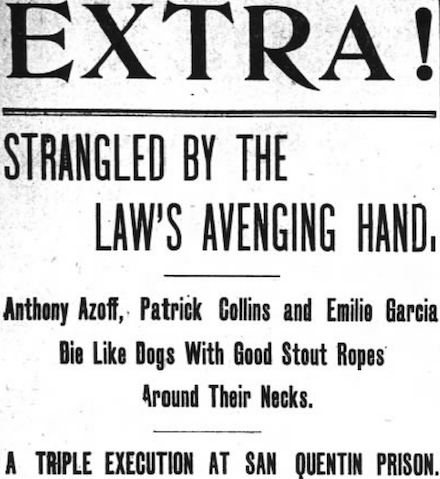
Three Californians hanged, sequentially, at San Quentin prison on the morning of June 7 in an affair timed to ensue the arrival of the 7:40 train from San Francisco, carrying about 100 official witnesses.

Emilio Garcia stabbed and slashed to death a San Bernardino old timer whom he believed to possess a hoard of gold.

Anthony Azoff fatally shot a Southern Pacific detective in the course of a botched robbery of that railroad firm’s offices; he was balked of a suicide attempt in the hours before his execution.

And Patrick Collins acquired more lasting infamy than any of his scaffold brethren by sensationally stabbing to death his estranged wife at the kindergarten where she worked when she refused his demand to hand over her wages.

Collins’s guilt was very apparent, so his trial gave the horrified public ample rein to sketch the brute in terms of the era’s crackpot racist typologies. In one Examiner article tellingly titled “He Was Born for the Rope,” it was postulated that “if a good many of Patrick Collins’ ancestors did not die on the scaffold then either they escaped their desert or there is nothing in heredity … Seeing him you can understand that murder is as natural to such a man when his temper is up as hot speech is to the anger of the civilized.”


Various newspaper images of Patrick Collins, from The Construction of Irish Identity in American Literature.

Be they ever so headline-conquering in their time, such crimes are like to fade speedily from the public memory. Collins, the man who slaughtered his tightfisted wife, and Collins, the savage ethnic archetype, have improbably survived his moment of notoriety, by imparting to literature the inspiration for San Francisco novelist Frank Norris‘s 1899 offering McTeague.

In McTeague, a vicious husband murders the wife he has abandoned when she refuses him money. The murderer here presents as an overpowering ancestral beast within — attributable, says Christopher Dowd, to Norris’s “study of criminal anthropology, particularly the school of thinking developed by Cesare Lombroso regarding atavism, hereditary criminality, degeneration, and criminal physiognomy. According to Donald Pizer, by the time Norris wrote McTeague, he had developed a ‘preoccupation’ with the themes of atavism and reversion, and ‘particularly with the role of heredity in causing either an obvious physical or mental devolution or a return to an earlier family condition’. Suddenly, Norris had a way to explain the behavior of his murderous protagonist — he was born a criminal, having inherited the degenerate traits and predilections of his Irish ancestors. Combined with the newspaper reports of the Collins murder, criminal anthropology gave Norris all the tools he needed to write, what Pizer calls, ‘that mythical creature of literature, a naturalistic tragedy'”. For example, Norris zooms through the disordered mind of McTeague as he struggles to control himself on one occasion.

He was disturbed, still trembling, still vibrating with the throes of the crisis, but he was the master; the animal was downed, was cowed for this time, at least.

But for all that, the brute was there. Long dormant, it was now at last alive, awake. From now on he would feel its presence continually; would feel it tugging at its chain, watching its opportunity. Ah, the pity of it! Why could he not always love her purely, cleanly? What was this perverse, vicious thing that lived within him, knitted to his flesh?

Below the fine fabric of all that was good in him ran the foul stream of hereditary evil, like a sewer. The vices and sins of his father and of his father’s father, to the third and fourth and five hundredth generation, tainted him. The evil of an entire race flowed in his veins. Why should it be? He did not desire it. Was he to blame?

McTeague does not exit upon the gallows as did his real-life inspiration; instead, having murdered and robbed his wife, the fugitive flees to the scorching desert of Death Valley where he faces a fight to the finish with a friend/rival who has pursued him. McTeague overpowers this foe, but the man’s dying act is to handcuff himself to McTeague — condemning the latter to sure death.

McTeague has long been in the public domain; it can be perused here; a Librivox audio reading of the book is available here. It’s also been adapted to at least two films in the silent era — including one of the genre’s greats — plus a more recent PBS radio drama, an opera, and miscellaneous other media.

On this day..

1900: Guzeppi Micallef, Maltese felon

This tale of a dreadful Maltese wife-murder arrives via the Times of Malta’s roundup of sensational hanging crimes on that Mediterranean island. Now independent, Malta was still British-controlled at the time of the events in this excerpt.

A marker outside Corradino Prison records the people hanged on its gallows, including Guzeppi Micallef

The murder of 19-year-old Roza Micallef is undoubtedly the most sensational uxoricide of the 19th century. Roza was precious for her husband, Guzeppi, but he was fearful of losing her. This fear was the result of jealousy.

The couple, who had been married only for a few months, lived in a farmhouse at Maghtab. Roza’s parents objected to the marriage as Guzeppi’s brother was married to Roza’s sister and their marriage was not a happy one. However, Roza did not take heed her parents’ warnings and married Guzeppi.

Roza and her husband used to work in the fields with her parents. She was a lively woman and enjoyed talking to relatives and friends. Her husband objected to this behaviour and warned her to be less talkative. Two days prior to the murder, she was seen waving to her uncle, Alessandro. This affectionate gesture triggered off the quarrel Guzeppi had with his wife on the night of the murder.

After sunset on October 8, 1899, Roza’s brother, Teofilio, heard his brother-in-law crying for help as his wife had been hit by a shot accidentally fired by his shotgun. According to Guzeppi, the shotgun was resting against the wall when he accidentally hit it with his foot. The firearm slid to the ground and was discharged accidentally, hitting Roza in her breast.

When the police were called, Teofilio told them that some time before he heard the shot he called on his brother-in-law, Guzeppi, to give him some money. Teofilio said that when he was at his sister’s house he was sure that something wrong was afoot; however, he chose not to interfere.

Regarding the shot, Teofilio said that when he heard the firing of a shotgun he thought that Guzeppi had shot his neighbour’s dog which was barking at that time.

The post-mortem examination revealed that the shotgun had been discharged from a high position and not from the floor as Guzeppi had affirmed in his statement. Moreover, court experts appointed to investigate the case further confirmed that Roza did not die as a result of an accident.

Guzeppi was charged with his wife’s murder and his trial opened on May 28, 1900. The prosecution produced witnesses who testified that the accused was very jealous of his wife. However, Dr Etienne Micallef, the defence counsel, maintained that the accused was jealous because he feared he might lose his wife’s love and had no intention of killing her.

As the accused was found guilty with a unanimous vote, he was sentenced to death.

Representatives of the Chamber of Advocates, the president of the Chamber of Commerce and the Council of Government petitioned the [Lord] Grenfell [Governor of Malta] to commute the sentence but he refused the appeal.

Micallef was hanged on June 6, 1900. He was only 20 years old and the only man in Malta since 1800 to have been hanged for uxoricide.

On this day..

1806: Dominic Daley and James Halligan, hated foreigners

On this date in 1806, immigrants Dominic Daley and James Halligan were hanged at Northampton, Massachusetts. In the words of one widely reproduced report, “They persisted in their innocence to the last moment, although there were perhaps not a single one of the numerous spectators present, which was presumed to amount to nearly 15,000, who entertained a doubt of their guilt.”

Today, nearly everyone thinks them innocent.

The case began, as many wrongful convictions do, with a particularly outrageous crime — a young farmer, Marcus Lyon, found dead in a Massachusetts creek en route to his home in Connecticut. He’d been shot through the chest and his brains battered out of his skull. The motive: robbery.

In the absence of substantive evidence, some witnesses with vague reports of strangers on the fatal turnpike furnished tissue for an entire theory of the case, and through the misapprehended focus of tunnel vision the strangers became Irishmen, and the Irishmen became Dominic Haley and James Halligan.

In the close aftermath of American independence, New England was still overwhelmingly Anglo-Saxon and Protestant. Most of the Irish people about at this moment were also Protestants: large-scale Irish Catholic immigration into the region only began in the 1820s and it panicked the normies when it came, with preachers and politicians railing against the insidious incursions of idolatrous papists.

So in 1805, when the hunt for strangers settled on two Irish-born Catholic immigrants … well, what was left to know? Just days later, a North Wilbraham Congregationalist minister thundered from the pulpit,

We see the evil attending a continued influx of vicious and polluted foreigners in this country. Many of the outrages we suffer proceed from this source. Who break open our homes in the unsuspecting hours of sleep? Who set fire to our large cities and towns for the sake of plunder? And who rob and commit murder on our highways? We are far from exculpating all of our own native citizens; we regret, indeed, that so many of them disgrace themselves and injure society by evil deeds. But these things notwithstanding, we are doubtless justified in saying, that a great proportion of the crimes above mentioned, together with many others which might be named, are committed by foreigners. And that atrocious deed which has so recently congealed all our blood with horror, in this place, is supposed to have been perpetrated by foreigners. Look at the annual reports of the overseers of the prisons and you will find them be principally occupied by foreigners

The first planters of this country were, generally speaking, men of pure lives and good morals and they were induced to come here for the sake of religion. And, for a long time, they maintained a wholesome and orderly state of society. But since the rapid increase of our commerce with other nations, and the great ingress of foreigners, many of whom are said to come here for the sake of escaping the retribution of justice in their own country; we have ripened apace in all the arts of vice and depravity. Some, who come among us from abroad, we readily acknowledge to be worthy and good men, and we cordially welcome their approach. But the number of these is comparatively small. The best and most useful citizens are cautiously retained, while the worst are readily parted with. Hence the rapid influx upon us, of late, of the most violent and abandoned of the human race. The late and present disturbances in foreign countries have greatly increased the calamity. The prisons of Europe and the West Indies are now disgorging themselves upon our shores; and this country is thus becoming the general asylum of convicts. This is a sore evil, and will furnish an increasing number of inhabitants for our prisons and victims for the halter.

The case in court would comprise 24 witnesses not one of whom had witnessed the crime; at most they could suggest that two strangers had taken the same well-trafficked public road on the same day as the victim, who was also a stranger in these parts. Even this much was not certain among the witnesses; their renderings were vague, tentative, contradictory — but witness recollections and prejudicial readings of circumstance soon shaped themselves around the shared understanding of events, and from so much smoke they wove the hemp.

The friendless immigrants’ court-appointed attorney, Francis Blake, who had been tasked with this first capital case of his life a bare 48 hours before the trial opened, made a vehement, eloquent, and futile address to the jury against “this illiberal, this inhuman prejudice” closing around the throats of his clients.

That the prisoners have, however, been tried, convicted, and condemned, in almost every bar-room, and barber’s-shop, and in every other place of public resort in the county, is a fact which will not be contested. That the sentence of the law has not been anticipated, and that they have not already suffered the penalty of death, may be ascribed rather to defect of power, than to lenity of disposition, in many of their accusers …

There is yet another species of prejudice, against the influence of which it is my duty to warn you. I allude to the inveterate hostility against the people of that wretched country, from which the Prisoners have emigrated, for which the people of New-England are peculiarly distinguished …

Pronounce then a verdict against them! Condemn them to the gibbet! Hold out an awful warning to the wretched fugitives from that oppressed and persecuted nation! Tell them that although they are driven into the ocean, by the tempest which sweeps over their land, which lays waste their dwellings, and deluges their fields with blood; — though they float on its billows upon the broken fragments, of their liberty and independence; — yet our inhospitable coast presents no Ararat upon which they can rest in safety; that although we are not cannibals, and do not feast upon human flesh, yet with all our boasted philanthropy, which embraces every circle on the habitable globe, we have yet no mercy for a wandering and expatriated fugitive from Ireland. That the name of an Irishman is, among us, but another name, for a robber and an assassin; that every man’s hand is lifted against him; that when a crime of unexampled atrocity is perpetrated among us, we look around for an Irishman; that because he is an outlaw, with him the benevolent maxim of our law is reversed, and that the moment he is accused, he is presumed to be guilty, until his innocence appears! …

The lives of the prisoners are now consigned to your disposal. Before you proceed to the performance of this awful duty, let me borrow the language of one of their countrymen, not degraded by the ignominious reproaches against his nation, but elevated to the highest rank among the orators of the elder world by the most splendid talents, the purest patriotism, and the most unsullied integrity. Let me beseech you to “remember that there is another than a human tribunal, where the best of us, will, on one day, have occasion to look back on the little good we may have done. In that solemn trial may your verdict on this day give assurance to your bones and afford you strength and consolation in the awful presence of an adjudging God!”

The words fell on deaf ears.

Daley and Halligan maintained their innocence from arrest to execution, but in the end they would require the offices of another foreign refugee, Father Jean-Louis de Cheverus, a French-born priest in Boston, who had fled the anti-clerical paroxysms of his own homeland. (Later, he would become the first Catholic Bishop of Boston.) It’s said that he stayed in jail with his charges, as no one in Northampton would suffer the papist priest to sleep under their own roof — and that his ministrations to them included the first Catholic mass said in that city.

Folklore cropped up around the 1830s to the effect that a local man had given a deathbed confession exonerating the hanged Irishmen … and that this murderer was the kinsman of one of the witnesses against Daley and Halligan. I cannot establish that this is any more than a just-so story, a fable, but even so it speaks to the continuing injury done by this execution to the now-growing Irish Catholic community. In time that demographic’s maturing numbers and political muscle flipped the story of Daley and Halligan from one of foreigners ripened in depravity to a sobering caution against bigotry and rush to judgment.

We have no real way, now, to access a definitive assessment of guilt or innocence; we can certainly say with confidence that the evidence was appallingly flimsy to hang a man even for the time. Both Daley and Halligan were posthumously exonerated by a writ of Massachusetts Gov. Michael Dukakis in 1984. Dukakis discussed that action, and history’s view of the Daley-Halligan railroading, in a 2011 panel available in podcast form here.

For additional resources, check this Historic Northampton page (already linked several times within this post). Below, you can read the entirety of an 1806 publication reporting the trial, from which the defense lawyer’s remarks have been drawn.

On this day..