Marine engineer George Johnson Armstrong on this date in 1941 was hanged at Wandsworth Prison … attaining an unenviable distinction as the first of five Britons executed under the Treachery Act of 1940.
One of the very first laws enacted by the incoming wartime government of Winston Churchill as the Wehrmacht overran France, the Treachery Act anticipated two potential difficulties in punishing various forms of aid that folk might thereafter attempt to extend to the Third Reich.
if we rely upon the Treason Act — the main Act, as I have said, is an Act of great antiquity — and other Acts which establish special procedure and special formalities, we shall have a much more complicated and cumbrous procedure than may, in existing circumstances, be justified.
There is also this further point. The law of treason in this country applies, of course, to every British subject wherever that British subject is living, because every British subject owes allegiance to the King. The law of treason also applies to aliens in so far as they owe to the King local allegiance — that is to say, as long as they are resident in this country and enjoying the protection of its laws. It is a very doubtful question indeed whether under the existing law of treason you could proceed against an alien who has come here suddenly, surreptitiously by air or otherwise, for the purposes of wreaking clandestine destruction or doing other acts against the safety of the real. In as much as treason is a crime committed by someone who owes allegiance, it might be well argued that such a person does not owe allegiance to the British Crown.
This act was handy indeed against enemy spies like Josef Jakobs, but it was also employed against five British citizens during and immediately following the war. (We’ve previously met a couple of them in these very pages: Theodore Schurch and Duncan Scott-Ford.) Johnson’s particular offense was to communicate an offer to a German consulate in the United States to help keep the then-still-neutral U.S. out of the war.
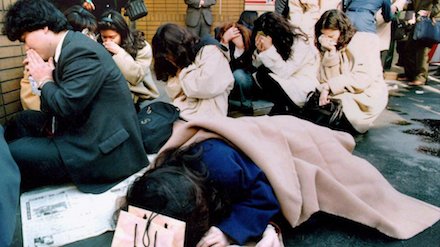
Thirteen people died and several thousand more were injured when members of this millenial sect deposited punctured bags of homemade liquid sarin on multiple rail lines of Tokyo’s subway during Monday rush hour.
It was only one of several gas attacks perpetrated by Aum Shinrikyo during the 1990s; just nine months previous, they had killed nine people in a sarin attack in Matsumoto. But it is by far the most notorious. Images of stricken commuters, blinded and suffocating under the nerve agent’s influence, sprawled on the transit platforms or outside them shocked orderly Japan in 1995, especially so since it came fast on the heels of the devastating January 1995 Kobe earthquake.
These comprised “two of the gravest tragedies in Japan’s postwar history,” according to Haruki Murakami’s Underground: The Tokyo Gas Attack and the Japanese Psyche. “It is no exaggeration to say that there was a marked change in the Japanese consciousness ‘before’ and ‘after’ these events.” Japanese Justice Minister Yoko Kamikawa struck a similar chord in announcing the hangings today: “These crimes … plunged people not only in Japan but in other countries as well into deadly fear and shook society to its core.”
Its mastermind Shoko Asahara, the first man executed this morning, emerged soon thereafter into public view a bedraggled and half-blind fanatic, almost the picture of an agent of chaos. Shockingly, his cult had been able to thrive in the early 1990s thanks in part to murdering an attorney who was investigating Aum Shinrikyo back in 1989.
Beyond the seven hanged on July 6, 2018, six additional members of the cult still remain under sentence of death in Japan for the Tokyo subway atrocity.
Scottish “border reiver” John Armstrong of Gilnockie was hanged on this date in 1530 with his followers at Caerlanrig, without benefit of trial.
The job description of the border reiver was to, well, reave the border. These mounted raiders exploited the wide gaps in sovereignty that opened along the ill-controlled England-Scotland border throughout the 16th century (their heyday) and indeed for centuries prior. They plundered vulnerable* farmers both north and south of the notional line. Sometimes the prize was livestock; other times, the “black rent” due your basic protection racket would suffice.
Their presence left an indelible imprint on the Anglo-Scottish marches, from the farmhouse fortresses called bastle houses to provisions in the “March Law” governing the manner of permissible counter-raiding.
Nettlesome as they were, they also stood useful mercenaries hired out for a number of the era’s battles; notably, English-hired reivers held off a much larger Scottish incursion in 1542. Only with the union of the crowns under James VI of Scotland/James I of England were the reivers finally suppressed.**
Johnny/Johnnie Armstrong, the younger brother of Thomas, Laird of Mangerton, is perhaps the most lasting legend among them — thanks to the signal boost he would later receive from Sir Walter Scott. Chief of a reiver band 160 strong, Armstrong made himself enough of a headache for English-Scottish diplomacy that the Scots king James V resorted to treachery to eliminate him. Having dialed up the frontier “prince” for a meeting, James simply had the sharp-dressed marauder arrested and summarily hanged when the reiver came to call. Thirty-six of his fellow reivers died with him.
Johnny Armstrong is the subject and the title of a notable child ballad (no. 169) whose lyrics can be perused in their entirety here; several renditions of its climactic third chapter can be found in the usual places.
John murdred was at Carlinrigg,
And all his galant companie;
But Scotlands heart was never sae wae,
To see sae mony brave men die.
Because they savd their country deir
Frae Englishmen; nane were sae bauld,
Whyle Johnie livd on the border-syde,
Nane of them durst cum neir his hald.
* “Vulnerable” mostly meant, neither in the ambit of a powerful protector, nor of the reiver’s own clan.
** A subsequent echo of the border reivers — in the same vein and the same region, but clearly distinct from them — emerged later in the 17th century in the form of the moss troopers.
Just before 6:00 a.m. on July 4, 1828, prison officers arrived at the cell of disgraced ensign John Burgh Montgomery in Newgate Prison‘s condemned hold.
They were there to escort Montgomery to his hanging. The 33-year-old would have been one of the last in England executed for for the crime of uttering forged notes — except that his wardens instead found him lying stone dead. With the aid of prussic acid, the counterfeiter had cheated the hangman of half his day’s prey, leaving his prospective gallows partner, thief William Rice, to face the hemp alone.
Although his guards had confiscated his razor and penknife as a routine precaution against suicide, no one had expected Montgomery to take his own life. He had pleadedguilty before the court and seemed resigned to his fate. In custody he was a model prisoner, spent his last days writing to his loved ones, and “addressed himself with great anxiety to his religious offices.”
Nobody was able to figure out how the condemned man came by enough poison to kill thirty people and how he kept it hidden, given that he and his cell were regularly searched.
was said to be a very respectable, well-educated man, who had once held a commission in the Army. However, after inheriting a considerable fortune, he frittered it away and resorted to passing phony banknotes to support his rather dissipated lifestyle. Given his pleasing looks, gentlemanly appearance and good manners, he was very successful, since nobody thought him capable of any wrongdoing. However, he was caught after becoming careless and making the mistake of committing frequent repeated offense in a small geographical area of London.
Montgomery left behind several letters, marked by expansive tragic romanticism but no hint of suicidal intent. One letter was for the prison surgeon, asking that his body be used for dissection. He said that by this he wanted to provide some positive contribution to the public to make up for his crimes. He asked that his heart be preserved in spirits and given to his girlfriend.
To the girlfriend he wrote,
My dear idolized L.,
One more last farewell, one more last adieu to a being so much attached to the unhappy Montgomery. Oh, my dearest girl. If it had been in the power of anyone to avert my dreadful doom, your kind exertions would have been attended with such success. Oh, God, so poor Montgomery is to die on the scaffold. Oh, how dreadful have been my hours of reflection, whilst in this dreary cell.
Oh, how tottering were all my hopes; the bitterness of my reflection is bitter in the extreme. This will be forwarded to you by my kind friend Mrs. D. I should wish you to possess my writing portmanteau. Oh, I wished to have disappointed the horrid multitude who will be assembled to witness my ignominious exit. Farewell forever,
P.S. Here I kiss fervently.
The jury on the inquest into Montgomery’s death recorded a verdict of felo de se, meaning that Montgomery had willfully and knowingly taken his own life whilst of sound mind. As such, his body was buried in the graveyard of St. Sepulchre-without-Newgate at night, and without any memorial service.
Catholic priest John Murphy was executed on this date in 1798 for his part in the Irish Rebellion of 1798.
The Black 47 jam “Vinegar Hill” celebrates Father Murphy, imagining him confronting and embracing the choice to rebel …
I return to my prayers
And reflect upon Your tortured lips
But not a word do I hear
Just a veil of silence around the crucifix
And I remember the Bishop’s words
“When faith is gone, all hope is lost”
Well, so be it
I will rise up with my people
And to hell with the eternal cost!
An exemplar of that rare type persuadable to follow his moral commitments all the way out of the safety of a status quo sinecure, Father Murphy initially eschewed the trend towards armed rebellion in 1798.
This outbreak was itself a response to a violent martial law-backed campaign of repression to crush Ireland’s growing United Irishmen movement for self-rule, republicanism, and Catholic emancipation — each of them scarlet fighting words to the Crown. The risings that finally broke out had only scanty success, weakened as they were by months of arrests.
By far the strongest rising occurred in Wexford, so much so that the Wexford Rebellion is nearly metonymous for the Irish Rebellion as a whole. And our man, John Murphy, was a priest in Wexford Town.
Giving due heed to Ecclesiastes, Murphy pivoted quickly from his previous counsel that prospective rebels surrender their arms once he saw an enemy patrol gratuitously torch some homes, a decision that would immortalize his name at the cost of greatly shortening his life.
During the brief existence of the Wexford Republic, the padre surprisingly became one of its prominent combat commanders, and also one of the signal martyrs after the rebels were shattered at the Battle of Vinegar Hill on June 21, 1798.*
Murphy escaped that tragic battlefield only to have his remnant definitively routed a few days later.
He had only a few days remaining him at that point, days of hiding out with his bodyguard, James Gallagher. At last they were captured at a farm on July 2, and subjected that same day to a snap military tribunal and execution delayed only by the hours required to torture him.
After hanging to death, Murphy was decapitated so that the British could mount his head on a pike as a warning.
This 1798 rebellion they were able to crush, but Murphy has survived into legend. He flashes for only an instant in the sweep of history, springing almost out of the very soil into the firmament as an allegory of revolutionary redemption, brandishing together (as Black 47 puts it above) both his missal and his gun.
At Vinegar Hill o’er the River Slaney
our heroes vainly stood back to back
And the yeos of Tullow took Father Murphy
and burned his body upon the rack
God grant you glory brave Father Murphy
and open heaven to all your men
The cause that called you may call tomorrow
in another fight for the Green again.
* There was a “Second Battle of Vinegar Hill” … comprising Irishmen but not in Ireland, for it was a convict rebellion in Australia in 1804. One of its leaders, Phillip Cunningham, was a survivor of the 1798 Irish Rebellion.
On this date in 1797, a president of the floating republic was put to death by an empire of the lash.
The occasion brings us to the era of Great Britain’s protracted war with Revolutionary France. That war’s essential factor from the British point of view was the navy — crewed in its turn by an immiserated working class, sometimes forcibly impressed, and drawing pay on a schedule that had been set in 1658.
In April 1797, after a wage grievance was dismissed out of hand by the Admiralty, the crew of the Channel Fleet mutinied at Spithead, near Portsmouth. For “mutiny” here, think less H.M.S. Bounty* and more labor strike: keeping discipline within their ranks, they used the leverage of refusing to put out to sea to successfully negotiate that pay rise, as well as the transfer of some distasteful officers who went otherwise unharmed. The Spithead mutiny contributes no execution to our pages.
This hostile caricature of the Spithead mutineers nevertheless depicts — however incredulously — the common sailors’ degree of organization.
However, in its waning days in May, a sympathy mutiny ensued at the fleet lying at an anchorage at the mouth of the Thames, called the Nore. These Spithead and Nore mutinies are generally taken together since they had the same grievances … but their resolutions were very different.
The Nore mutiny, less united and disciplined than that at Spithead, saw several ships at Nore mutiny and elect as their leader this post’s principle character, Richard Parker. Parker was an intelligent, veteran sailor with some history of sticking his neck out for better working conditions. He would always insist that he had no part of the mutiny’s planning and was appointed its leader by surprise; whether or not this was so, he exercised his newfound office, President of the Delegates of the Fleet, as best he could. It was a fraught situation; each ship had its own delegates (hence Parker’s title) who did not always agree, and there were radical and moderate factions, and a proclivity among ships inclining to the latter to slip away from the mutinied fleet even as their erstwhile comrades fired upon them.
But the most perilous function demanded of Parker was to present mutineers’ demands to the Admiralty, whose perspective was that the fleet’s complaints had already been disposed of via Spithead — especially when the Nore demands expanded to include peace with France. The mutiny collapsed, and Parker was marched to Maidstone Prison to the jeers of Londoners.
Even the Newgate Calendar, scold for the status quo, could not resist admiring Parker’s bearing, “throughout the whole of his trial … firm and manly; while he was before the Court, decent and respectful, and from the time he received his sentence, till his execution, resigned and penitent” even while abhorring his “wretched existence.”
After a solemn pause of nearly ten minutes the Lord Advocate rose and, with his head uncovered, read the awful sentence — viz. “The Court judges Richard Parker to suffer death, and to be hanged by the neck, on board any one of his Majesty’s ships, and at such time as the Lords of the Admiralty may think proper to appoint.”
The prisoner listened to the sentence without emotion, and addressed the Court as follows: — “I have heard your sentence; I shall submit to it without a struggle. I feel thus, because I am sensible of the rectitude of my intentions. Whatever offences may have been committed, I hope my life will be the only sacrifice. I trust it will be thought a sufficient atonement. Pardon, I beseech you, the other men; I know they will return with alacrity to their duty.”
The president then briefly addressed himself to the prisoner. He said that, notwithstanding the enormity of the crimes of which he had been found guilty, on the fullest and clearest evidence, yet the Court, in order to afford him the necessary time to expiate his offences, and to make his peace with God, would then not name any day for his execution, but leave that point to the determination of the lords of the admiralty. The prisoner then withdrew, and was soon put in irons.
The time of his execution was fixed for Friday, the 30th of June. 1797. At eight o’clock in the morning a gun was fired on board his Majesty’s ship L’Espion, lying off Sheerness garrison, Vice-Admiral Lutwidge‘s flagship, and the yellow flag, the signal of capital punishment, was hoisted, which was immediately repeated by the Sandwich hoisting the same colour on her foretop.
The prisoner was awakened a little after six o’clock, from a sound sleep, by the provost-marshal, who, with a file of marines, composed his guard; he arose with cheerfulness, and requested permission might be asked for a barber to attend him, which was granted. He soon dressed himself in a neat suit of mourning (waistcoat excepted), wearing his half-boots over a pair of black silk stockings. He then took his breakfast, talked of a will he had written, in which he had bequeathed to his wife a little estate he said he was heir to, and after that lamented the misfortune that had been brought on the country by the mutiny, but solemnly denied having the least connection or correspondence with any disaffected persons ashore; and declared that it was chiefly owing to him that the ships had not been carried into the enemy’s ports. [a threat to sail to France was part of Nore mutiny negotiations]
At half past eight he was told the chaplain of the ship was ready to attend him to prayers upon the quarter-deck, which he immediately ascended, uncovered: at his first entrance on the deck he looked a little paler than corn mon, but soon recovered his usual complexion; he bowed to t lie officers, and, a chair being allowed him, he sat down for a few moments: he then arose, and told the clergyman he wished to attend him: the chaplain informed him he had selected two psalms appropriate to his situation; to which the pris oner, assenting, said, “And with your permission, sir, I will add a third,” and named the 51st. He then recited each alternate verse in a manner peculiarly impressive.
At nine o’clock the preparatory gun was fired from L’Espion, which he heard without the smallest emotion. Prayers being soon after closed, he rose, and asked Captain Moss “if he might be indulged with a glass of white wine”: which being granted, he took it, and, lifting up his eyes, exclaimed, “I drink first to the salvation of my soul! and next to the forgiveness of my enemies!” Addressing him self to Captain Moss, he said, “he hoped he would shake hands with him”; which the captain did: he then desired “that he might be remembered to his companions on board the Neptune; with his last breath sent an entreaty to them to prepare for their destiny, and refrain from unbecoming levity.” His arms were now bound, and the procession moved from the quarterdeck to the forecastle, passing through a double file of marines on the starboard side, to a platform erected on the cat-head, with an elevated projection. Arriving there, he knelt with the chaplain, and joined in some devout ejaculations, to all of which he repeated loudly, “Amen.” Rising again, the Admiral’s warrant of execution, addressed to Captain Moss, was now read by the clerk, in which the sentence of the court martial, the order of the Board of Admiralty and his Majesty’s approbation of the whole proceedings were fully recited, which the prisoner heard with great attention, and bowed his head, as if in assent, at the close of it. He now asked the captain whether he might be allowed to speak, and immediately apprehending his intention might be misconceived he added: “I am not going, sir, to address the ship’s company. I wish only to declare that I acknowledge the justice of the sentence under which I suffer; and I hope my death may be deemed a sufficient atonement, and save the lives of others.”
He then requested a minute to collect himself, and knelt down alone, about that space of time; then rose up and said: “I am ready.” Holding his head up, he said to the boatswain’s mate: “Take off my handkerchief (of black silk); which was done, and the provost-marshal placed the halter over his head (which had been prepared with grease,) but, doing it awkwardly, the prisoner said rather pettishly to the boatswain’s mate, “Do you do it, for he seems to know nothing about it.” The halter was then spliced to the reeve-rope: all this being adjusted, the marshal attempted to put a cap on, which he refused; but, on being told that it was indispensable, he submitted, requesting it might not be pulled over his eyes till he desired it. He then turned round, for the first time, and gave a steady look at his shipmates on the forecastle, and, with an affectionate kind of smile, nodded his head, and said “Good-by to you!” He now said, “Captain Moss, is the gun primed?” — “It is.” — “Is the match alight?” — “All is ready.”– On this he advanced a little, and said, “Will any gentleman be so good as to lend me a white handkerchief for the signal?” After some little pause, a gentleman stepped forward and gave him one; to whom bowing, he returned thanks. He now ascended the platform, and repeated the same questions about the gun. He now ascended the platform. The cap was then drawn over his face, and he walked by firm degrees up to the extremity of the scaffold, and dropped a white handkerchief, which he had borrowed from one of the gentlemen present, and put his hands in his coat-pockets with great rapidity. At the moment he sprang off, the fatal bow-gun fired, and the reeve-rope, catching him, ran him up, though not with great velocity, to the yardarm. When suspended about midway his body appeared extremely convulsed for a few seconds, immediately after which no appearance of life remained.
It being ebb of tide, the starboard yard-arm pointed to the Isle of Grain, where scaffolding was erected for the spectators on shore; a considerable number of yachts, cutters, and other craft, surrounded the Sandwich. The last time the prisoner knelt with the chaplain at the cat-head, though he made his responses regularly, his attention was particularly directed the whole time to the armed boats of the fleet, which were plying round on duty. The whole conduct of this awful ceremony was extremely decorous and impressive; it was evident, from the countenances of the crew of the Sandwich, that the general feeling for the fate of their mutinous conductor was such as might be wished: not a word, and scarce a whisper, was heard among them.
The Newgate Calendar’s illustration of Parker’s execution.
Parker was not mistaken to warn his compatriots to brace for punishment, and his hope that his would be the only life paid in forfeit was sorely disappointed. Twenty-nine more men were hanged as Nore mutineers, in addition to a number of others imprisoned, flogged, or transported. (The Sydney, Australia suburb of Redfern is named for the transported Nore mutineer who once owned the land.)
* Speaking of the Bounty, its old notorious captain William Bligh in 1797 captained one of the mutinied ships at the Nore, on which occasion Bligh discovered “that his common nickname among men in the fleet was ‘that Bounty Bastard’.”
Don Francis de Sallesar y Corvetto, a native of Murcia, where his father was regidor, was on Friday publicly degraded at Madrid from the rank of nobility, had his tongue and his right hand cut off, and afterwards was hanged. His crime was assassinating some persons, and having formed the horrid design of laying his sacrilegious hands upon the king and the royal family.
On this date in 1685, Roundhead militant Richard Rumbold — known affectionately to his comrades from the English Civil War as “Hannibal”, since he shared with the great Carthaginian general the distinction of an eye lost on campaign — was beheaded at Edinburgh‘s Mercat Cross.
J.M.W. Turner watercolor of the Rye House circa 1793.
Rumbold was the owner of the Rye House in Hertfordshire, the manor which in the 1680s would become famous as a regicidal adjective: the titular epicenter of the Rye House Plot. Hannibal Rumbold had intended to station a force of armed men on his grounds with the intent to kidnap/assassinate King Charles II and his Catholic brother and heir presumptive, James as they returned to London from horse races at Newmarket. When fire struck Newmarket, the royal party’s plans changed and the plot never came off … but it was discovered some weeks later and yielded an ample harvest of heads. Rumbold escaped to the continent for a time but was none repentant about it when taken, saying “he did not neither durst repent for it, but on the contrair that if all the hair of his head were men, he would venture them all for the cause.”
In this instance, it also yielded some edifying scaffold oratory, and this man’s parting sentiment that “this is a deluded generation, veiled with ignorance … for none comes into the world with a saddle on his back, neither any booted and spurred to ride him” was of interest to British Whigs and American revolutionaries a century later. It plays much better lo these many years later with ellipsis in place of the “popery” stuff which occurs between, but judge for thyself: here follow Rumbold’s erudite owns in context via an open source volume which has the address titled “Against Booted and Spurred Privilege”
Gentlemen and Brethren: —
It is for all men that come into the world once to die; and after death the judgment! And since death is a debt that all of us must pay, it is but a matter of small moment what way it be done. Seeing the Lord is pleased in this manner to take me to himself, I confess, something hard to flesh and blood, yet blessed be his name, who hath made me not only willing, but thankful for his honoring me to lay down the life he gave, for his name; in which, were every hair in this head and beard of mine a life, I should joyfully sacrifice them for it, as I do this. Providence having brought me hither, I think it most necessary to clear myself of some aspersions laid on my name; and, first, that I should have had so horrid an intention of destroying the King and his brother … It was also laid to my charge that I was antimonarchical. It was ever my thoughts that kingly government was the best of all where justly executed; I mean, such as it was by our ancient laws; — that is, a King, and a legal, free-chosen Parliament, — the King having, as I conceive, power enough to make him great; the people also as much property as to make them happy; they being, as it were, contracted to one another! And who will deny me that this was not the justly-constituted government of our nation? How absurd is it, then, for men of sense to maintain that though the one party of his contract breaketh all conditions, the other should be obliged to perform their part? No; this error is contrary to the law of God, the law of nations, and the law of reason. But as pride hath been the bait the devil hath caught most by ever since the creation, so it continues to this day with us. Pride caused our first parents to fall from the blessed state wherein they were created, — they aiming to be higher and wiser than God allowed, which brought an everlasting curse on them and their posterity. It was pride caused God to drown the old world. And it was Nimrod‘s pride in building Babel that caused that heavy curse of division of tongues to be spread among us, as it is at this day, one of the greatest afflictions the Church of God groaneth under, that there should be so many divisions during their pilgrimage here; but this is their comfort that the day draweth near where, as there is but one shepherd, there shall be but one sheepfold. It was, therefore, in the defense of this party, in their just rights and liberties, against popery and slavery —
[Being here interrupted by drum beating, he said that they need not trouble themselves, for he should say no more of his mind on that subject, since they were so disingenuous as to interrupt a dying man. He then continued: –]
I die this day in the defense of the ancient laws and liberties of these nations; and though God, for reasons best known to himself, hath not seen it fit to honor us, as to make us the instruments for the deliverance of his people, yet as I have lived, so I die in the faith that he will speedily arise for the deliverance of his Church and people. And I desire of all you to prepare for this with speed. I may say this is a deluded generation, veiled with ignorance, that though popery and slavery be riding in upon them, do not perceive it; though I am sure there was no man born marked of God above another; for none comes into the world with a saddle on his back, neither any booted and spurred to ride him; not but that I am well satisfied that God hath wisely ordered different stations for men in the world, as I have already said; kings having as much power as to make them great and the people as much property as to make them happy. And to conclude, I shall only add my wishes for the salvation of all men who were created for that end.
After hanging, they quartered his parts and pinned them up as a warning.
It was a black hood for the Blackout Ripper on this date in 1942.
Charming Royal Air Force serviceman Gordon Frederick Cummins gave rein that February to a theretofore unarticulated inclination to femicide, attacking six women in the course of a single week, four of whom were killed by strangulation. The pattern of perverse post-mortem mutilations led one examiner to characterize the wanted man as “a savage sexual maniac”. This predator’s opportunistic use of the city’s protective cloak of air raid darkness reminds a similar spree perpetrated on the Berlin S-Bahn: truly, all men are brothers.
For a few days, this special horror gripped the wartime capital, so recently under enemy blitz. As fingerprint expert Frederick Cherrill, whose evidence would help to tie up Gordon Cummins’ noose, wrote in his now-out-of-print autobiography,
Women police in ordinary clothes strolled about the streets in the hope of being accosted by the unknown killer. So great was the terror which swept like a wave over the square mile in which these crimes had been committed that the regular street-walkers who haunted the area were too scared to venture out. [several of the victims were prostitutes -ed.] Small wonder, for nobody knew when or where the killer would strike again. That he would strike again seemed certain, for the lust of killing appeared to have siezed him in a merciless grip
Unlike his permanently elusive Whitechapel namesake, the Blackout Ripper was not long at his liberty once he loosed the beast within: crime scene forensics were still coming of age in this period, but the ample evolution of the bureaucratic state did for Cummins. On lucky Friday, February 13, Greta Hayward had fought off her attacker with the help of a passerby’s interruption. Cummins, when he fled, abandoned his RAF gas mask case … which was helpfully stamped with a serial number identifying its owner. He was arrested on February 16, just eight days after the start of his spree. (Scotland Yard, however, would later claim that his fingerprints connected him to two previous London murders, from October 1941.) It took a jury 35 minutes to convict him.



 An exemplar of that rare type persuadable to follow his moral commitments all the way out of the safety of a status quo sinecure,


 Charming Royal Air Force serviceman