1566: Agnes Waterhouse, the first witchcraft execution in England

On this date in 1556, Agnes Waterhouse became the first known woman executed for witchcraft in England.

“Mother Waterhouse” came accused as the matriarch of a whole clan of hags in the Essex village of Hatfield Peverel. Our record for events, a pamphlet titled The Examination and confession of certaine wytches at Chensforde [Chelmsford] in the countie of Essex: before the Quenes Maiesties judges, the xxvi daye of July, anno 1566.,* gives us Mother Waterhouse accused a sorceress along with her daughter, Joan (eventually acquitted), as well as Agnes’s sister, Elizabeth Francis. By accounts they had come by their necromancies via the guidance of a “hyr grand­mother whose nam was mother Eue of Hatfyelde Peue­rell.”

Tudor England had thus far been spared the witch persecutions that were multiplying on the continent, and even here the accusations ultimately invoked the supernatural as the means for actual material injuries: to sicken and kill both livestock and people.

Both Agnes Waterhouse and Elizabeth Francis confessed to a wide array of crimes, facilitated by a feline familiar unsubtly christened “Sathan”; a neighboring child gave evidence against Agnes. Elizabeth Francis would not be executed as a result of this trial — she faced new charges that would hang her in 1579 — but she directly copped to doing murders via the cat. We excerpt below from the “Examination and confession” pamphlet but as rendered into easier-on-the-eyes modern spellings, found here:

she desired to have one Andrew Byles to her husband, which was a man of some wealth, and the cat did promise she should, but that he said she must first consent that this Andrew could abuse her, and so she did.

And after when this Andrew had thus abused her he would not marry her, wherefore she willed Satan to waste his goods, which he forthwith did, and yet not being contented with this, she willed him to touch his body, which he forthwith did wherefore he died.

Item that every time that he did anything for her, she said that he required a drop of blood, which she gave him by pricking herself, sometime in one place and then in another, and where she pricked herself there remained a red spot, which was still to be seen.

Item when this Andrew was dead, she doubting [fearing] herself with child with Satan to destroy it, and he had her take a certain herb and drink which she did, and destroyed the child forthwith.

Item when she desired another husband, he promised her another, naming this Francis whom she now hath, but said he is not so rich as the other, willing her to consent unto that Francis in fornication which she did, and thereof conceived a daughter that was born within a quarter of a year after they were married.

After they were married they lived not so quietly as she desired, being stirred (as she said) to much unquietness and moved to swearing and cursing, wherefore she willed Satan her Cat to kill the child, being about the age of half a year old and he did so, and when she yet found not the quietness that she desired, she willed it to lay a lameness in the leg of this Francis her husband, and it did in this manner. It came in a morning to this Francis’ shoe, lying in it like a toad, and when he perceived it putting on his shoe, and had touched it with his foot, he being suddenly amazed asked her of what it was, and she bade him kill it, and he was forthwith taken with a lameness whereof he cannot healed.

After “fifteen or sixteen years” she traded the little agent of chaos to her sister for some cakes, and afterwards the cat did Agnes’s will instead.

when she had received him she (to try him what he could do) willed him to kill a hog of her own which he did, and she gave him for his labor a chicken, which he first required of her and a drop of her blood. And this she gave him at all times when he did anything for her, by pricking her hand or face and putting the blood to his mouth which he sucked, and forthwith would lie down in his pot again, wherein she kept him, the spots of all the which pricks are yet to be seen in her skin.

Also she sayeth that another time being offended with one father Kersey she took her cat Satan in her lap and put him in the wood before her door, and willed him to kill three of this Father Kersey’s hogs, which he did, and returning again told her so, and she rewarded him as before with a chicken and a drop of her blood, which chicken he ate up clean as he did all the rest, and she could find remaining neither bones nor feathers.

Also she confessed that falling out with one Widow Gooday she willed Satan to drown her cow and he did so, and she rewarded him as before.

Also she falling out with another of her neighbors, she killed her three geese in the same manner.

Item, she confessed that because she could have no rest (which she required) she caused Satan to destroy the brewing at that time.

Also being denied butter of another, she caused her to lose the curds two or three days after.

Item falling out with another of her neighbors and his wife, she willed Satan to kill him with a bloody slice, whereof he died, and she rewarded him as before.

Likewise she confessed that because she lived somewhat unquietly with her husband she caused Satan to kill him, and he did so about nine years past, since which time she hath lived a widow.

Also she said that when she would will him to do anything for her, she would say her Pater noster in Latin.

Latin! And here perhaps we find a hint — for details on the background and specific context of this prosecution are not to be found — that the shocks of the Reformation were one root of events. As Kate Dumycz observes

Mother Eve perhaps started practising her “craft” in the second half of the fifteenth century … a time when, although the existence of witchcraft was acknowledged and people consulted cunning men and women, there was no witchcraft act on the Statute books … this family would have lived through great upheaval that affected all parts of England because of the Reformation. Christopher Marsh comments that many rituals of the Catholic Church (such as charms, sorcery, enchantments) were banned in 1559 and this ruling was a “broader campaign to destroy the credibility of traditional religion by exposing its alleged superstition”. Rosen remarks “Bitterness, resentment and pain that can no longer be discharged through familiar religious channels will almost inevitably be turned upon others; and in their delusions, such women were aided by the learned and by the religious terms in which they continued to think.”

Agnes Waterhouse leaves us a tantalising clue about contemporary attitudes towards religion and those who practised outside the State dictated religion “she was demanded what praier she saide, she aunswered the Lordes prayer, the Aue Maria, and the belefe, & then they demaunded whether in laten or in englyshe, and shee sayde in laten, and they demaunded why she saide it not in engly[sh]e but in laten”. [note: this interrogation occurred during Agnes Waterhouse’s repentant gallows speech, not during the trial -ed.] So, Agnes Waterhouse at least, practised some of the “old ways” and perhaps had not converted to Protestantism and therefore operated outside the beliefs and “norms” of her society. Rosen comments that between 1534 and the time of this trial “there had been eight major religious changes requiring oaths from teachers, ministers and public officials with four total reversals of religious practice enforced by law and death sentence”. … Agnes Waterhouse’s ability to say her prayers in Latin would have been compulsory during Mary’s reign and yet a few years later this factor was used against her as an indication that she was practising witchcraft and thus, as a witch, was unable to say her prayers correctly in English.

Whilst it has long been established by modern day historians such as Keith Thomas that “in England witchcraft was prosecuted primarily as an anti-social crime, rather than as a heresy” Agnes Waterhouse’s case shows that religion must have played a small but significant part in her neighbours’ belief that she was a witch although she was executed as a murderer rather than a heretic.

Agnes Waterhouse, Joan Waterhouse, and Elizabeth Francis were the first of nine women (plus one man) from Hatfield Peverel prosecuted as witches between 1566 and 1589.

On this day..

1731: Captain Daniel McGuire, griller

We return today as we have done several times previously to James Kelly’s Gallows Speeches From Eighteenth-Century Ireland. The crime in question recalls similar tactics being employed around the same time by McGuire’s far more famous English contemporary, Dick Turpin.

The Whole Declaration and Last Speech, Confession and Dying Words of Capt. Daniel M’Guire

who is to be Executed near St. Stevens Green of Thomas Bryan in Fingal, and puting [sic] him on a hot Griddle to make him Confess his Money, the 18th of November last.

Good Christians,

Whereas the World may expect, as tis usual to those in my Condition; to give the Publick some satisfaction, for the many wrongs done to them; so may they now expect the same from me, who have not been, I acknowledge in the presence of God, and as I am a Dying Man, less Criminal then a great many who came to this shameful End; but why shou’d I thus speak, whereas no Death (tho’ never so Ignominious) ought to be regarded by me as shameful, for was I to Suffer a thousand times more, its what my Sins justly deserves; but my great hope is that these my Sufferings may in some measure appease the angry Frowns of an injured God, before whom I expect in some few Minutes to appear, and as I am a dying Man unworthy to approach so good a God, I shall give the World a true and brief account of my mis-spent Life, and do beg of the Same God, that these my words may mollify the Hearts of these who have been misled as I have been.

I was Born in the County of Farmanagh, where I lived till I came to the Years of Twenty, and acquired honest and credible Bread, by going to Fairs and other publick Places, my Employ was selling Merchandize, (but alas! as the unbridled conduct of Youth when they have not the Love and fear of God before their Eyes, are liable to several Misfortunes, such was my unfortunate state to my great Grief, not so much regarding my present state and Misfortune, as the offence I committed against my God, the severity of whose Judgment makes me tremble, but confiding in his infinite Mercy, I now reassume new Courage,) and thus did I continue in my lawfull Employ, till about two Years ago falling into the Company of one who never feared God lead me astray, and I must acknowledge tho’ I’ve been Guilty of several Enormous Crimes ever since, there is not any one of them gives me so great a concern, or loads my Soul with so much Grief, as the misfortune I had to accuse falsely honest Men, which I believe is a Crime of the blackest dye; (but my God whose Mercy surpasses all other thy Attributes, I hope you’ll Pardon all these my offences,) and which ought to be deeply considered by all our Gentlemen, before they wou’d Encourage me or any other of my kind to take away the Lives of honest Men; as I am a dying Man, and as I am to appear before the Tribunal of an unbyassed God, I never wou’d Accuse the undernamed honest Men, was I not encouraged by a certain Gentleman who promised me my Life for the said Discovery, (whose Name for a certain reason I do omit) I own in the sight and presence of God, and as I expect in some few Minutes to surpass the severity of his Judgment, I falsely Accused Dennis Kelly of Garishtown in the County of Dublin, Adam Ward, John Tyers, and his Wife of the said Town: I also declare as before, Michael Burk had no share nor knew nothing of the Robbery of Mr. Fottrel near Killsholachan, or of Councelor Smith’s Cloaths. I also falsely Accused James Murphy in the County of Caterlough, and Edward Hoy of the Parish of Crickstown in the County of Meath. But alas! as I am now going to appear before the Face of my God, I hope they will forgive me, as to the Fact I Dye for, the Evidence as it appeared were Injured, but I Dye in Peace with them and all the World, begging that all my Spectators may Pray for me, I prostrate myself at the Feet of my God, begging Pardon for my Sins, I Dye a Roman Catholick, in the 24th Year of my Age.

Daniel M’Guire.

N.B. The above is my true Speech delivered to the Printer hereof, in the Presence of the Reverend Father Andoe.

On this day..

1681: Donald Cargill, Covenanter rebel

Scottish Covenanter Donald Cargill ascended his Edinburgh gallows on this date in 1681 with the undaunted last words, “The Lord knows I go on this ladder with less fear and perturbation of mind, than ever I entered the pulpit to preach.”

This Cameronian radical had been a fugitive for many years, ever since he darkened a thanksgiving service for King Charles II’s restoration by voicing from the pulpit of his Glasgow parish what many feared in their hearts: that Presbyterians were about to get the rough end of the restoration pineapple.

We are not come here to keep this day upon the account for which others keep it. We thought once to have blessed the day wherein the king came home again, but now we think we shall have reason to curse it; and if any of you come here in order to the solemnising of this day, we desire you to remove.

That was the end of Cargill’s career as a licensed preacher. His remaining years were illicit services, ducking arrests, and a flight to the Netherlands; he was wounded in service of the Covenanter cause at the 1679 Battle of Bothwell Bridge.

Back in Scotland by 1680, Cargill’s Queensferry Declaration* dared an open case for rebellion in pursuit of “the overthrow of the kingdom of darkness, and whatever is contrary to the kingdom of Christ,” for

now it cannot be called a government, but a lustful rage, exercised with as little right reason, and more cruelty than beasts; and they themselves can no more be called governors, but public grassators, and public judgements, which all ought to set themselves against, as they would do against pestilence, sword and famine raging among them.

The grassators finally got him the following year.

There’s a short biography of our man, The Life of Donald Cargill, available in the public domain which remarks (discount accordingly for hagiographical perspective), that Cargill was memorialized by an associate as

affectionate, affable, and tender-hearted to all such as he thought had anything of the image of God in them, sober and temperate in his diet, saying commonly, ‘It was well won that was won off the flesh,’ generous, liberal, and most charitable to the poor; a great hater of covetousness, a frequent visitor of the sick; much alone, loving to be retired, but when about his Master’s public work, laying hold of every opportunity to edify; in conversation still dropping what might minister grace to the hearers. His countenance was edifying to beholders; often sighing with deep groans; preaching in season and out of season upon all hazards; ever the same in judgment and practice. From his youth he was much given to the duty of secret prayer for whole nights together wherein it was observed that, both in secret and in families, he always sat straight upon his kneesk with his hands lifted up; and in the posturel as some took notice, he died with the rope about his neck.

* The thrust of this militant manifesto is similar to the Sanquhar Declaration issued by Cargill’s ally Richard Cameron, also in 1680.

On this day..

1934: William Bayly, bad neighbor

New Zealand farmer William Bayly or Bayley hanged at Auckland’s Mount Eden Prison on this date in 1934 as the world’s worst neighbor.

They never did find the body of his victim, Sam Lakey, but the two sheep farmers “hated each other. ‘You won’t see the next season out, Lakey!’ yelled Bayly, which was just one of the dozens of dire threats they exchanged.” (This according to a True Crime Library profile.)

Lots of folks make tall talk when their blood is up but Bayly had the courage of his ill-considered machismo and not only offed Sam but Sam’s wife Christobel as well — staging a wife-murder + suicide hypothesis by dumping Mrs. Lakey and the murder weapon into a swamp, while incinerating Sam Lakey in a benzine drum. Unfortunately for him, the killer was such an obvious suspect* that his property became an immediate target for search, and human remains were found before all could be disposed of. Bayly would argue his innocence all the way to the gallows, but at trial he had no defense to present.

The Lakeys had no relatives to claim their remains; they were only properly reburied in 2015.

* There were also suspicions that Bayly might have killed his cousin years earlier.

On this day..

1857: John Dorsey

The public domain volume 1886 Professional Criminals of America might divert the devotee of classic true crime with its numerous vignettes from the latter 19th century, quite a few of them unsolved. Executed Today of course cottons to the section on executions at Manhattan’s The Tombs Prison, such as the following:

JOHN DORSEY (negro), a sailor, was executed in the Tombs prison for the murder of Ann McGirr, alias Ann Hopkins. The crime was committed at No. 3 Worth Street on March 10, 1857. The scene of the crime was a five-story tenement inhabited by colored prostitutes. Dorsey and the woman lived together, and on the night of March 10, 1857, he returned home under the influence of liquor. He met his mistress. Ann McGirr, in the alleyway. They had some words, and Dorsey becoming angry drew a razor from his pocket and cut the woman’s throat from ear to ear. Dorsey was convicted of murder in the first degree, in the Court of General Sessions, May 21, 1857, before Judge Abraham D. Russell. He was hanged on July 17, 1857.

On this day..

1714: Eleven at Tyburn, amid recidivism

On this date in 1714, the Tyburn gallows groaned with eleven felons … luckless small-timers, most of them (as we shall see) repeat offenders, whom Executed Today retrieves here in its repeatedly offending eleventh year.

As we sometimes do, we’ll be channeling the words of the Newgate Ordinary, friend of the site Paul Lorrain. His “ACCOUNT OF The Behaviour, Confessions, and Last Speeches of the Malefactors that were Executed at Tyburn, on Friday the 16th of July, 1714” can be enjoyed in full here.

Lorrain begins by noting that “Nineteen Persons, viz. Fifteen Men, and Four Women,” caught death sentences at the most recent sitting of the grim blackrobes, but “Seven of the Men, and One of the Women, having obtain’d HER MAJESTY‘s Reprieve (which I pray GOD they may have Grace duly to improve) Eleven of ’em are now order’d for Execution.”

Those fortunate eight, consider ’em the reserve army for future hangmen. Many of the remaining eleven had in their own time been recipients of such a reprieve and had failed to duly improve, as Lorrain notes repeatedly in his summations below (we’ve linked their antecedent crimes where we could find them in the invaluable Old Bailey Online.)

1. Ann Edwards, condemn’d for two Burglaries; viz. First, for breaking open and robbing the Lodgings of Mr. James Moody; and, Secondly, for doing the like in those of Mr. Emmanuel Francisco; taking out of the former a Pewter Dish, and 3 Plates; and out of the latter several Goods of Value; both which Facts she committed at the same time, and in the same House, on the 30th of May last. She said, she was 36 Years of Age, born at Preston in Lancashire; That she had, for these 15 Years past, liv’d in the Parish of St. James Westminster, and other Neighbouring Parishes, and there serv’d in the Capacity of a Cook (and sometimes in that of a House-keeper) in several good Families; That (besides the Facts she was now condemn’d for) she had done many ill things in her Life-time, and was about two Years ago burnt in the Hand, and order’d to the Work-house, where she remain’d a Twelvemonth, according to the Order of the Court; and being afterwards Discharg’d, but not Reform’d, she soon return’d to her former evil Course, and thereby brought her self to this Untimely and Shameful Death. She said, she heartily repented of all the Sins she ever committed, and desir’d me to pray to GOD for her poor Soul, overwhelm’d with Grief. This I promis’d her I would do, and withal instructed her to pray for her self, and pacify the Wrath of GOD, and obtain His Mercy; which (upon her true Repentance) she would certainly find, through the Merits and Mediation of the Saviour of all Men, especially of them that believe, as the Apostle tells us, 1 Tim. 4.10.

2. William Dyer, who pleaded to a Pardon at the Old-baily on the 12th of August, 1713, was now brought again under Condemnation for two new Facts by him committed, viz. First, for breaking open the House of Mr. John Palmer of Edmonton in Middlesex, taking thence a Gown and Petticoat, with other Goods, on the 13th of June last; and, Secondly, for doing the like in the House of Mr. John Blunt of the same Place, on the 23d of the same Month. He said, he was born in that Parish of Edmonton, and had been a Domestick Servant in several good Families thereabouts, and in London. He confess’d, he had robb’d some of his Masters, both while he liv’d with them, and afterwards; and that particularly since he had obtain’d his Pardon, instead of answering the easy Condition of it, which was, That he should transport himself out of the QUEEN’s Dominions in Europe,* within 6 Months after (which he had 2 or 3 times fair Opportunity to have done) he return’d to his wicked Practice of robbing Houses in his Neighbourhood, and elsewhere; so that, tho’ he pretended he would honestly apply himself to his Business of Carpentry (a Trade he had formerly serv’d part of his Apprentiship to) yet his chief Employment, ever since his Discharge out of Newgate in August last, had been Robbing and Stealing, and doing suchlike Mischiefs, to the great Prejudice of the Publick: And herein his Wickedness and Impiety advanc’d so far, as not to spare even the Curate of his own Parish, whose House he broke open and robb’d in January last, about which time also, he said, he stole a black Mare out of the Grounds of Mr. John Allen in that Parish, for which One William Huggins was try’d at the Old-baily in February following. This William Dyer could read well, and had been carefully instructed in the Principles of the Christian Religion, by those worthy Persons he had serv’d; but yet, for all that, he prov’d desperately Wicked, and was like to have committed Murder, in attempting to shoot the Man that apprehended him. He seem’d, in all his Carriage under this Condemnation, to be unsincere and obstinate; and I must needs say this of him, That he gave me very little Signs of true Repentance for a great while; for when I examin’d him in private, he refus’d to make a free Confession of the many ill things he had done, the discovery whereof might have been of Use and Satisfaction to those honest Persons he had so basely wrong’d; but instead of clearing his Conscience by such a Confession; he said, He had declar’d too much already, and would say no more. Being ask’d how Old he was, he answer’d me, That he could not exactly tell, but thought he might be about 28 Years of Age. As I was discoursing him in private, shewing him the Necessity of doing what I advis’d him to, in order to avoid the severe and terrible Judgments of GOD, and obtain his Mercy, and the Pardon of his Sins, I observ’d him to fleer and snigger, mixing Tears and Laughter together; wherein (as indeed in his whole Deportment) he discover’d both a great Weakness, and Indisposition of Mind; but at last his Confession to me seem’d to be sincere, and Repentance true.

NB. That the Facts for which this William Dyer was formerly condemn’d were, viz. the breaking open and robbing the House of Mrs. Elizabeth Wiser, taking thence a Silver Mugg, and a Spoon, on the 15th of February, 1711-12: And likewise for stealing Ribbons and other Goods out of the House of Mr. Charles King, on the 27th of June, 1712. Of both which Facts he was convicted at the Sessions held at the Old-baily in July following.

3. Margaret Stevenson alias Sarah Williams, alias Susan Rogers, alias Susan Lambeth, which last was her right Name; Condemn’d for Stealing a Piece of green Persian Silk of the value of 3 l. out of the Shop of Mr. John Johnson, on the 25th of May last. She said, she was near 28 Years of age, born at Hamersmith in Middlesex; That she coming to London young, was bound to a Seamstress in Chick-lane, with whom she serv’d the full time of her Apprentiship, viz. 7 years; That she afterwards work’d for her self, and for a great while together liv’d an honest Life; but at last falling into bad Company, was thereby corrupted, and enticed into the commission of several Things, which at first were very much against her Conscience, tho’ (thro’ Custom) became easie to it at last; but she now found by her woful Experience, that, soon or late, Sin brings always along with it unspeakable Sorrow and Misery. She own’d that she was justly condemn’d; and, that she had been so before, and receiv’d Mercy (which, to her great Grief now, she had taken no care to make good use of); for, she having formerly obtain’d the QUEEN’s Free Pardon, which she pleaded at the Old baily on the 12th of August last, under the Name of Sarah Williams, she did soon after return to her evil Course of Life, changing her Name indeed, but not her Manners. NB. The Fact for which she was formerly Condemn’d and Pardon’d, was, the Stealing 60 Yards of Persian Silk out of the Shop of Mr. William Ball, on the 8th of June, 1713.

4. Robert Cook, alias Hedgley, which was his right Name, Condemn’d for Breaking the House of Mrs. Mary Mellers, and stealing thence 8 Pewter-Dishes, 40 Plates, and other Goods, on the 13th of May last. He said, he was about 24 Years of age, born at Hoddesdon in Hartfordshire; and, That while in the Country, he was employ’d in Husbandry: Afterwards he came to London, and being prest to Sea, serv’d above 7 Years on board the Lenox, the Boyne, the Monmouth, and other Men of War. He confess’d, he had been a great Offender; That in May last was Twelve-month he was whipt for a Felony he had committed about that time; and, That the Sentence now pass’d upon him was very just, and he readily submitted to it, praying GOD to fit him for his great Change. He likewise confess’d, That he committed a Robbery in a House at Islington, about 9 months ago, taking thence some Pewter, a Coat, a Hat, &c.

5. Thomas Davis, Condemn’d for being concern’d in the same Fact with Robert Cook, last mention’d. He said, he was 23 Years of age, born at Shrewsbury: That he came up to London about 8 Years ago, and was bound Apprentice to a Waterman for 7 Years, which Time he serv’d faithfully; and being out of it about 6 months since, ply’d for himself. He confess’d the Fact for which he was condemn’d, but said it was his first; and I could not disprove it, but told him, ‘Twas pity he ever enter’d upon such a Course as this, which seldom fails of ending in Destruction.

6. George Horn, Condemn’d for a Robbery committed jointly by him and Thomas Perkins, on the Person of Mr. Thomas Gamball, from whom they took a Coat, a Hat, and a Shirt, with 11 s. and other Goods, upon the QUEEN’ Highway, between Clerkenwell and Islington, on the 25th of May last. He said, he was 23 Years of age, born in the Parish of Allhallows in Thames-street, London; and by his Trade was a Lighterman, that us’d to carry Corn, Wood, &c. He confess’d, That once he was burnt in the Hand for a Felony which he committed about 2 Years ago, and afterwards went to Sea , where he serv’d sometimes on board several Men of War, and at other times in Merchantmen. I found him of a very harden’d Disposition, that could not be brought, but with much difficulty, to a sense of his great Duty and Spiritual Interest, being at first regardless of his present miserable state, and of the Means of preventing his falling into that which is infinitely worse, viz. the State of the Damned. I did what I could to rouze him up to a due Consideration of the Danger he was in; to awaken in him a just Fear, and excite him to a sincere Love of GOD.

7. Thomas Perkins just before-mention’d, as being concern’d with the said George Horn in the Robbery committed on Mr. Gamball. He said, he was about 20 Years of Age, born in the Parish of St. James Clerkenwell: That he went to Sea, and was a Servant to a Commander of one of HER MAJESTY’s Men of War; and afterwards returning home, was bound for 7 years Apprentice to his own Father, a Smith; That his Father dying when he had but three Years to serve, he left off that Occupation, and went to Sea again; and there being employ’d for about 2 Years, he at last return’d to his Trade of Smithery, working Journey-work with One that had formerly serv’d his Father: That falling into bad Company, he (when in Drink) was perswaded to assist George Horn in the Commission of this Robbery he is now to die for: And tho’ he confest he had been an ill Liver, yet he said, he never was Guilty of any such Fact before.

8. James Powell, alias Ashwood, alias Bowen, alias Neale, which last was his right Name. This Malefactor had formerly receiv’d Sentence of Death, being then try’d by the Name of James Ashwood, and obtain’d a Pardon on condition he should (which he did not) transport himself out of the QUEEN’s Dominions in Europe, and pleaded to it accordingly on the 12th of August, 1713; and now was Condemn’d again for a Burglary, viz. for breaking open the House of Mr. Tho. Hulls, and taking from thence Two Guinea’s, and Thirty Shillings in Silver, on the 15th of May last. He said, he was about 20 Years of Age, born in the Parish of St. Martin in the Fields, and was bound Apprentice to a Perriwig-maker in that Parish; but his Master dying, and so being left to himself, presently fell into ill Courses, which he was now sensible he could not well have left off (so far he was engag’d in them) if this Death had not put a stop to his wicked Career.

9. Charles Goodall, alias Goodale. This Malefactor likewise had formerly receiv’d Sentence of Death, for stealing a Silver Cup and other Goods out of the House of Mr. John Beale, on the 6th of November, 1711, and obtain’d a Pardon on condition he should (but like the abovesaid James Powell did not) transport himself out of the QUEEN’s Dominions in Europe: Which Pardon he pleaded on the 6th of June, 1712; as he did to another (and that a Free one) on the 12th of August, 1713; and now was Condemn’d again for breaking open the House of Mr. Albion Thompson, and taking thence a Coat, and several other Goods of Value, on the 17th of May, 1714. He said, he was about 19 Years of Age, born in the Parish of St. Giles in the Fields; but, when very young, his Parents remov’d to that of St. Clement-Danes, and there he liv’d with them, and by them was brought up to School very carefully; but did not improve his Time as he might have done; for he betook himself to ill Courses, and so Corrupt he was, that tho’ after his Pardon he had resolv’d to lead a better Life, (which for a time he did, at his Father’s House) yet it was not long before he return’d again to his wicked Ways, that brought him to this his Untimely End: A Matter which, upon reflection, was a great Grief to him, and ought to be an effectual Warning to other loose Livers, as he had (and confest himself to have) been; for which he earnestly implor’d GOD’s Mercy, and the Pardon of all whom he had any ways offended.

10. Mary Billingsby, alias Brown, Condemn’d for trepanning Judith Favero, an Infant, into a By-place near Hoxton, and there stripping her, and putting her in fear of her Life. She said, she was about 18 Years of Age, born at Norwich, and had liv’d 3 Years in George-yard in Shoreditch, and was there imploy’d in Doubling of Worsted . At first she deny’d the Fact, but afterwards confest it, saying, That Poverty had driven her to it: Upon which I told her, This was a very bad Excuse; and, That if she had been an honest and diligent Person, she might have supply’d her Wants otherwise than by such unlawful Means, and such too as were most base and cruel. I found her very ignorant, not being able so much as to Read, nor give an Account of any Thoughts she had of the World to come, and what would become of her there; till she was taught, That by the Merits of CHRIST, embrac’d by Faith and Repentance, (which I particularly explain’d to her) she might be sav’d.

11. Robert Porter, alias Sandey, Condemn’d for breaking open the House of Mr. James Deluce, and taking thence a Wastcoat, two Wigs, and three lac’d Hats, on the 2d instant. He said, he was 16 Years of Age, born in the Parish of Stepney, and for some small time serv’d a Weaver there; but leaving his Master’s Service, went a pilfering. I found him very obstinate and untractable, unwilling to confess any ill thing he had done; yet when I told him, That he had formerly been convicted of a Felony, and for it order’d to the Work-house, out of which he made his Escape, he own’d all this to be true, but would say no more; nor at first receive such proper Instructions and Admonitions, as were given him, in order to bring him to Repentance and Salvation: But at last finding himself in the Death-Warrant, and so having no further Hope of Life here, he appear’d more concern’d for his Soul than before: I was not wanting in making Use of this Opportunity to bring him (if possible) to a thorough Sence of his past sinful Life, his present sad Condition, and his future Eternal State, from which he was not far off, and which would be a State either of Happiness or Misery to him, according as he did or did not sincerely repent of his Sins. This (with several pressing Exhortations I us’d to this purpose) seem’d to make some kind of Impression upon his obdurate Heart: But whether they melted it indeed into that true Repentance, which alone is available to Salvation, I shall not take it upon me here to determine: but advise them, who walk in the same wicked Paths, to repent sooner and better.

As was his wont (except perhaps with Catholic convicts who tended to give him a cold shoulder) the chaplain exercised his office all the way to Tyburn

to which they were this Day carried from Newgate in 4 Carts, [where] I attended them for the last time, and endeavour’d to perswade them throughly to clear their Consciences, and strive more and more to obtain GOD’s Grace, that they might make a good End in this World, and be receiv’d into that State of Bliss and Glory in the next, which shall have no End. To this purpose I earnestly spoke to them, and pray’d for them: Then I made them rehearse the Apostles Creed, and sing some Penitential Psalms; and finally recommending their Souls to the boundless Mercy of our Good and Gracious GOD, I withdrew from them, leaving them to their private Devotions, for which (and for their speaking to the People to take Warning by them) they had some little Time allow’d them: After this the Cart drew away, and they were turn’d off, calling all the while upon GOD, to have Mercy on their departing Souls.

Note, That William Dyer did particularly confess, That he had committed the following Robberies, viz. 1st, he robb’d a House and a Shop at Tottenham, 2dly, the Reverend Mr. Butto’s House; 3dly, Mr. Allen of a Mare at Edmonton in Middlesex; 4thly, Mr. Coward’s House at Waltham-stow; 5thly, Mr. Huvet’s House; and 6thly, Mr. King’s in the Parish of Greenstead; 7thly & lastly, the House of Mr. Reynolds at Stanford-rivers in Essex. These he said, were (as far as he could remember) all the Houses he had broken and robb’d, &c. (besides those he stood Condemn’d for) since his Discharge out of Newgate in August last; and, That he never robb’d on the Highways, nor ever committed Murder.

This is all the Account I here can give of these Malefactors; Four of of whom, together with Five others mention’d in my former Papers, make up Nine out of Fifty-four that pleaded the QUEEN’s Pardon in August last, who (by new-repeated Offences) brought themselves to this shameful End: Which I pray GOD may be such a Warning to those that remain, that they never return again to their Sins and Follies, but lead such a Course of Life as may be comfortable to them in this World, and (through Mercy) advance them to unspeakable Joys and Comforts in the World to come.

PAUL LORRAIN, Ordinary .

Friday, July 16. 1714.

* At the time, this was still a generic sentence of exile (note that the onus is on the prisoner to “transport himself” out of Great Britain). Our hanging-date, however, arrives barely three years distant from the opening of organized mass convict transportation to the Americas, which would continue until the American Revolution. This era is covered in detail by Early American Crime author and occasional Executed Today guest-blogger Anthony Vaver, author of Bound with an Iron Chain: The Untold Story of How the British Transported 50,000 Convicts to Colonial America.

On this day..

1857: Danforth Hartson, again

(Thanks to Robert Elder of Last Words of the Executed — the blog, and the book — for the guest post. This post originally appeared on the Last Words blog. Fans of this here site are highly likely to enjoy following Elder’s own pithy, almanac-style collection of last words on the scaffold. -ed.)

“For God’s sake, don’t do that again.”

Danforth Hartson, convicted of murder, hanging, California.
Executed July 15, 1857

Hartson (aka Sailor Jim) claimed self-defense in a fight that followed his argument with “estimable citizen” John Burke, whom he knocked to the ground and then shot in the chest. Burke was able to make a full statement, naming Hartson as the murderer, before he died.

Hartson’s last words came after he slipped through the noose and fell through the trap door.

On this day..

1683: Two lynched during the Ottoman siege of Vienna

Our “execution” this date is of the mob justice variety — said mob being panicked Viennese bracing for Ottoman investiture.

As is generally the case one has many ways to read this particular lynching; at least one victim has even been situated as a trans martyr. John Stoye in his The Siege of Vienna: The Last Great Trial between Cross & Crescent gives us the thread of causation, and it turns out that these two unfortunates owed their death to Vienna’s urban planning.

The military architecture of this period was designed to keep the besieger at a distance as long as possible. The ground in front of the main defences would be cleared of buildings, and even levelled — this was the ‘glacis’; along the outer rim or ‘counterscarp’ of the moat a well-protected walk, the covered way, was constructed — usually of timber spars and palisades — from which detachments of the garrison could command with their fire the open ground in front of them; and the covered way had to be laid out so that they could command it from a number of angles … Attackers on the glacis, those who reached the counterscarp, those even who got as far as the main wall, were all exposed to fire from artillery and marksmen on the bastions …

Clamped within the walls but expanding in numbers, the citizens of Vienna had tried to build upwards. They added an extra storey to some 400 out of 1,100 houses in little more than a century. But inevitably the suburbs also grew, spreading out into the countryside — and in towards the city. By 1680 there were large settlements in Leopoldstadt on the Prater island, by the right bank of the Wien on the east, round the hamlets of Wieden and St Ulrich south and south-west, and on the western side. Particularly here the new building approached very close to the fortifications. The government had over and over again ordered the demolition of dwellings within a given distance of the walls, but to little effect. If a maximum estimate of Vienna’s total population brings it to nearly 100,000 people, a sizeable proportion must have lived in these suburbs, which would in due course give accommodation and protection to a besieging army.

The foremost Ottoman raiders now appeared, and in the distance the smoke of burning villages in the neighbourhood rose skywards. [Vienna military governor Count Ernst Rudiger von] Starhemberg did not dare delay in performing one of his most disagreeable duties: the speedy and forcible clearing of the glacis. Since earlier demolition orders had not been obeyed, he began — on 13 July — to burn down everything in the area outside the counterscarp which would obviously hamper the garrison. Most of all he wanted to clear the ground west of the city, where suburbs came closest to the moat. More smoke rose skywards. The sparks flew. They flew over the walls as far as the roof of the Schotten monastery by the Schottengate, where a fire broke out in the afternoon of Wednesday, the 14th; and it almost altered the course of history. The wind blew sparks against the neighbouring buildings, an inn, and from the inn to a wall of the Arsenal, where supplies of every kind were stored, including 1,800 barrels of powder. Nearby, other powder magazines adjoined the New-gate. If the defence-works here were seriously damaged by explosion, or the stores lost, resistance to the Turks was hardly thinkable. The flames moved along a wooden gallery into the Arsenal. Townsmen and soldiers gathered, there was a muddle about keys which could not be found, but soldiers broke through a door and cleared the points of greatest danger. A hysterical mob, looking on, smelt treason at once and lynched two suspects, a poor lunatic and a boy wearing woman’s clothes. It also destroyed the baggage which an inoffensive mining official from Hungary, then in Vienna, was trying to get out of a second inn near the Arsenal; and it panicked at the sight of a flag flying unaccountably from a roof close to the fire, fearing some kind of a signal to the enemy. More effectively, the wind then veered. Flames swept towards and into aristocratic properties on the other side, away from the Arsenal, and proceeded to burn out the Auersperg palace where the ruins went on smouldering for days. The crisis had passed before the arrival of the Turks; but the danger of yet more fires, set off by Turkish bombs or by traitors and spies inside the walls, was to be a constant nightmare in Vienna later on.

Despite the nightmare, Vienna — scorched glacis, crazed mobs, and all — withstood the siege. It was indeed the siege’s Turkish military commander who was executed for his command failure before the year was out, after failing to complete the conquest.

On this day..

1515: Gio Batta, on the Capitoline Hill

You’ll not find the single execution (and its accounting of fees) that forms the very slim hook for this post until the very end of an extensively bloody tour of Renaissance and Early Modern Rome’s execution topography. This unauthorized appendix to your Rome tourism guide comprises excerpts of the public domain volume The Roman Capitol in Ancient and Modern Times, by Emmanuel Rodocanachi.


THE TARPEIAN MOUNT OR MOUNT CAPRINO.

In the Middle Ages nothing survived of what had constituted the splendour of the Tarpeian Mount of antiquity. Here and there only were a few scattered shafts of columns lying, a few sides of walls that had fallen, a few vestiges of foundations, while the other end of the Capitoline Mount was becoming the centre of municipal life, and a church, that of S. Maria Aracoeli, adorned it. Furthermore, this portion of the hill was soon chosen as the public execution place. In a chronicle of the thirteenth century, relating the legend of Pope Filigato (996 [sic]), we read: “… idcirco usque adhuc nullus papa venire vult in montem tarpeium ad arcen Urbis Romae scilicet in Capitolium ubi iste Johannes tormenta sustinuit. Ibi itaque semper ferebantur sententiae mortis contra sceleratos et contra adversarios Romanorum.”

To this spot the name platea of spianata was given, in translation of the word area, area capitolina (as opposed to arx), which had formerly designated it. This explains why the place of execution was often so called. Fra Montreale, who was condemned to death by Rienzo, was led “a lo piano” to be executed there. His head was cut off near the ruins of a tower.

The spot appointed for executions is fixed with accuracy by a curious document. In 1385, Giordanello degli Ilperini or Alberini, a nobleman of the Monti quarter, was cast into the prisons of the Capitol. Fearing the rage of the lords bannerets, furor presentium dominorum banderentium,” and not wishing to die without a will, he drew one up, forthwith, in the great hall where the assemblies of the people were held. Among other dispositions, he required his heirs to spend two florins in having a figure painted “ad imaginem gloriosissime virginis Marie,” in front of the gibbet and place of execution, “ante furcas et locum iustitie.” And, in fact, the figure was painted beneath the portico of a granary belonging to the Maffei family, in a spot indicated by Infessura thus: “in una costa di muro appresso santa Maria delle grazie di sotto a Campidoglio a piedi lo monte.” Thenceforward, criminals had a sight that consoled them in their last moments.

The custom of hanging people in this place was continued in the fifteenth century. In the Diario di Antonio Petri (1407) is the expression: “In loco iustitiae, videlicet in plano Capitolii.” The gallows is clearly visible in the Sienna plan. Somewhat later, documentary allusions become more frequent. An Act dated in 1457 bears on it: “in loco qui dicitur Monte Arpetio (Tarpeio) sive lo piano inter hos fines … ab alio via per quam itur ad furcas.” In another document, dated in 1473, and referring to the settling of a boundary, the following passage occurs: “ab alio tenet locus iustitiae qui dicitur lo piano.” This same document informs us that, behind the palace of the Conservators, lay a garden belonging to them, part of which exists to-day, while the other has been taken into the Caffarelli palace, which, at present, is the German embassy.

Executions were witnessed by the Senator. It was a duty incumbent on his office. He took up his position at the window in the palace situated in the southern tower. This window, as previously said, was ornamented in 1413 by the Senator Nicola of Diano.

Among the celebrated executions which took place on the gibbet of Mount Caprino was that of the accomplices of the Chevalier Stefano Porcari, who himself was hanged from the battlements of St. Angel’s castle in 1453. His accomplices were nine in number; and eight of them were hanged together. In 1490, a man accused of trying to poison Pope Innocent VIII, at the instigation of the Sultan of Constantinople, was beaten to the ground, on the ordinary execution place, by blows on his head with a club; then he was struck on the chest and stomach with an iron-covered fist, after which he was drawn and quartered. Hangings were numerous; in 1507, there were seven. The gibbet continued to be used in this spot until 1550, when the improvements that were undertaken in the surroundings brought about its suppression. Thenceforward, criminals were hanged on the Giudea square, at the entrance to the Ghetto.


A high gallows towers over Rome’s Piazza Giudia in this 1752 engraving by Giuseppi Vasi.

On occasion, use was made, as a prison, of the ruins standing on this potion of the hill, perhaps of some pits that will be spoken of further. Under the pontificate of Innocent III, the Romans confined their prisoners of war there.

The neighbouring quarters, suffering from the presence of the gibbet, remained deserted and neglected. Goats browsed in them, which soon caused the hill to receive the name of Mount Caprino, a name that it retained for a long time. The locality was almost a jungle. Gregory XIII, having remade, in 1582, the road that led to it, was justified in having inscribed on a stone that still exists in the Via di Monte Tarpeio these words: “Hinc ad tarpejam sedem et capitolia ducit. Pervia nunc olim silvestribus horrida dumis …”


The Piazza del Campidoglio atop Capitoline Hill, where beheadings took place. This is a view of its condition prior to Michelangelo’s 16th century makeover of the place, which changed it into this …

EXECUTIONS IN THE CAPITOLINE PALACE.

Whilst hangings took place on the gibbet of Mount Caprino, the beheadings were carried out on the Square of the Capitol [Piazza del Campidoglio -ed.], and even inside the palace. If Fra Montreale was beheaded at the foot of the Mount Caprino tower, it was by way of compromise, since he was considered as much a malefactor an an “enemy of the people” as a prisoner of war. Usually, executions in the Capitol took place on the great staircase, near the lion. It was there that, on the 3rd of March, 1398, the conspirators were beheaded who had attempted to re-establish the power of the bannerets, destroyed by Pope Boniface IX.

In the fifteenth century, executions were frequent. In 1405, Paolo Maracini, Giovanni Gnafri, and Motta were beheaded in the Capitol. In 1406, Antonio Carola was beheaded there also, as well as Giovanni Colonna, Jacovo de Nepi, “miles libertatis,” Ricardo Sanguineis, rebels against Pope Gregory XII. In 1497, Galleotto de Normanis was “decollatus, de mane, hora consueta, in loco institiae Capitolii, tanquam proditor Urbis.” Sometimes the execution was carried out in the evening: “De sero, hora completorii, fuit capta uxor Cole Cancellarii de Reg. Columne ac etiam Paulus de Cancellariis … omnes tanquam proditores Urbis et ducti per mercatum ad Capitolium et martirazti.” Before each execution, the condemned person had his sentence read to him, in the great hall of the Capitol. The bell rang thrice, and, at the third peal, he was put to death. In certain cases, the bell was not run; but this, as previously said, was when the execution was considered to be a murder. Occasionally the execution was inside the palace. We read that Lello Capocci was decapitated “Intus in palatio Capitolii ad pedem secunde columne ubi tenetur ratio.” The Square of the Capitol was also used as a place to expose criminals. Cardinal Vitelleschi shut up in three wooden cages, which were set there for the people to mock at, a triplet of thieves who had stolen the precious stones adorning the reliquary wherein were kept, at the church of St. John Lateran, the heads of St. Peter and St. Paul. The thieves were subsequently executed on the Square of the Lateran.

Now and again, hangings took place from the windows or arcades of the Capitoline loggia. On the 19th of December, 1458, Bernardo della Rosa was hanged from the window of the great staircase. At that time, however, hangings were not frequent. Infessura complains of it: “In Capitolio nulla vel saltem rara executio corporalis fit, nisi quod per curiam domini vicecamerarii aliqui nocte suspenduntur et mane suspensi reperiuntur apud turrim Nonae sine nomine et sine causa: et hoc ordine vivitur hodie in Urbe sedente Innocentio octavo” (1489).

EXECUTIONS IN THE SIXTEENTH CENTURY.

The hangings that Infessura, in his time, regretted were so few, as was seen in the previous chapter, were not long before they began again; and numerous ones took place on the Capitol during the sixteenth century, and in the few yers prior to it.

In the single year of 1497 were hanged from the windows of the Capitol: Matteo di Andrea, Francesco di Giacomo, Pietro Santi, Giordano della Scarpa. At the same time, hangings were also carried out on the gibbet of Mount Caprino.*

The expenses of executions were generally paid by the Governor, who deducted the necessary sums from the money furnished by fines, taxae maleficiorum. Under the date of the 13th of July, 1515, the executioner received three julii (about a hundred sols) for cutting off the head of a male servant, Gio. Batta; he received, besides, a salary of three gold ducats a month. The price paid for hangings was the same as for decapitations, three julii. It cost no more to have the criminal burned, after he had been hanged. However, it would seem that compensation was made for the wood, the chains, and the scaffold, when the criminal had been burned alive. Eighteen carlins were paid for the execution of a forger; and, for floggings, the executioner charged six carlins.

* A footnote here in the original helpfully explains that the executions referenced in this section come from “Archiv di Stato, Archivio di s. Giovanni Decollato, Busta XXIV. vol. 2″: “This brotherhood’s mission was to assist criminals; a regular register was kept of the executions at which the brethren of the order had been present.”

On this day..

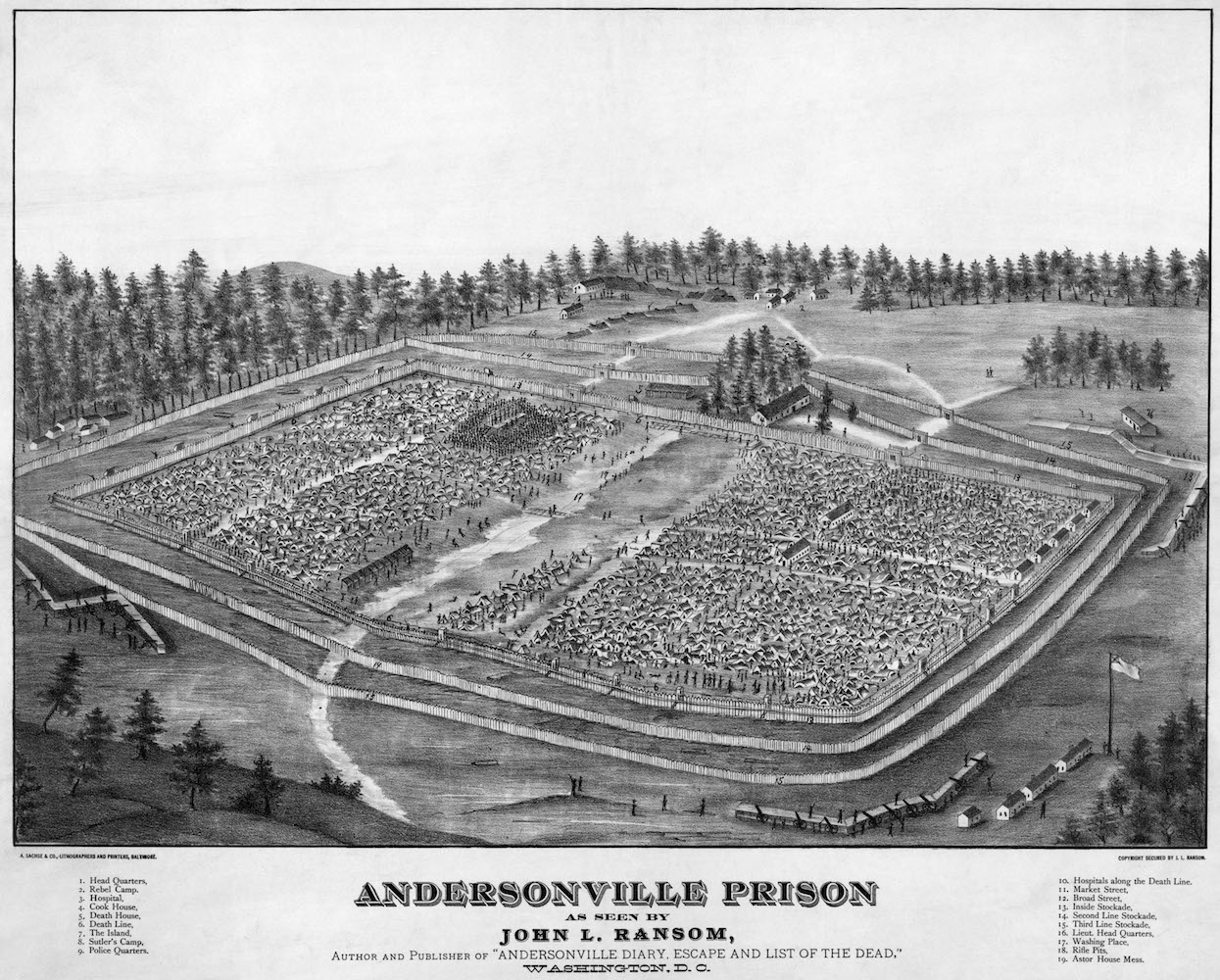
1864: The Andersonville Raiders

It’s not hard to understand why the Andersonville Raiders turned criminal. But on this day in 1864, the group was decapitated when six of its leaders were hanged in a quasi-legal action at the most inhospitable prisoner of war camp in the Confederacy.*

Andersonville Prison was opened in February 1864, 26.5 Georgian acres (about 0.1 square kilometers, or about the size of a square 4 city blocks on a side) of tightly-packed tents with a ditch of water flowing through its center. Its design population was 10-15,000 prisoners; its true population at one point was almost 30,000.** Some 45,000 Union soldiers went in, passing first the outer stockade, then the so-called “dead line” that demarcated the line outside of which they could be shot summarily, and finally into a mass of malnourished, often sickly humanity. Of these, 13,000 never emerged.

The Confederacy, you may recall, was not the war’s winner. As an aspiring nation, the CSA borrowed heavily to fund its arms, then found itself strapped for basic supplies as the war dragged on. By 1863 the nation was already economically depressed, and when a CSA-USA prisoner exchange agreement broke down, the Confederacy found itself with a lot of Union soldiers to house and nowhere to put them. Enter Andersonville: far enough from the North to be “safe”, easily defensible, and in the heart of slave labor to build it. All the Confederacy needed to build some basic housing was wood, which should be … oh wait … war update!…the Union controlled lumber supplies. Guess there won’t be housing.

Prisoners instead got lumped in with their brigade, and (at least initially) basic materials to make some sort of shelter.† New arrivals often showed up without being thoroughly checked over, so they might come in with food and supplies that weren’t already available to other internees.‡ Very quickly, the grounds were littered with Union POWs from around the country, people with vastly different backgrounds and goods. As the camp’s population breached 10,000 and then 20,000,§ there were, of course, inmates with designs on better living.

It’s not hard to see where this is going.

Sometime around May 1864, dozens of them assembled into a loose affiliation. The Raiders were headed by about a half dozen men: Charles Curtis, Patrick Delaney, John Sarsfield, William Collins (“Moseby”), a guy known only as “A. Munn”, and W.R. Rickson (or possibly Terry Sullivan; there’s an unusual disparity in diary accounts on the person’s name, but first-hand diary entries from the moment prefer Rickson) were considered the principal offenders. Each headed a small band of thieves who would trick new entrants, burgle tents, or use violence or threats of violence to amass “wealth” and keep themselves well-fed, well-clothed, and, most importantly to them in this hostile place, alive.

The Raiders had some huge advantages when they committed these crimes. Thanks to their amalgamated resources, they had good odds of being better armed and more fit than their victims — unless those victims were green, in which case they just knew the place better. The thieves started out as midnight raiders who turned tail at the first sign of genuine resistance unless they thought they could readily overpower the victim. By mid-June they were brazen, according to John Ransom: “Raiders … do as they please, kill, plunder and steal in broad day light, with no one to molest them.”

The victims were soldiers who, even if they weren’t killed, were left without resources in a deadly environment. Even the robberies and beatings were, in many cases, a prolonged form of murder, and Union inmates knew it. Indeed, Collins was thought by most to have never directly assaulted anyone, but he was known to steal blankets from the ill.

It’s unclear what the full Raider population was (estimates range from 100 to 500, but most people settle on the 100-200 range). What we can say definitively is that it was large enough to be a problem. Late in June of that year, a group called “the regulators” began taking police-like action against the perpetrators. Inmates brought their complaints to the group, which sought out and punished — usually through head shaving or other non-destructive means — those they found responsible.

On June 29, that problem started getting a real solution when the Raiders assaulted and robbed a prisoner now known only as Dowd. Dowd complained to the guards, and Andersonville’s overseer, Captain Henry Wirz, officially endorsed the Regulators as a police force/tribunal to maintain order. But first he announced an end to inmate rations until the Raiders were given up. (What a guy!)

The Regulators, headed by a man called “Lumber” (or maybe “Limber”) Jim, quickly had 80-100 inmates to deal with. Jury trials were implemented in the spirit of (but without most of the protections of) common law, and most punishments ranged from setting in the stocks to running the gauntlet.


Detail of a panorama sketch of Andersonville (click to see it) makes space for a certain well-attended sextuple hanging.

The ringleaders were also among this bunch. They were assembled on July 11 and executed at a hastily-erected gallows on the north end of camp. As far as the POWs were concerned, the ultimate crime of the Raiders was a violation of the soldier code of death before dishonor. Their bodies were buried separately from other inmates, and the US makes a point of placing no memorial flags at their graves.

To be clear, the Andersonville Raiders were, for most inmates, not the primary problem but an obviously controllable one. Remember that 30% of the interned died, and for the most part those deaths were borne of bad sanitation, hunger, and disease. The removal of the Raiders was a morale boost at best, as Andersonville was still a pee-pee soaked heckhole in which another 10,000 soldiers would die before liberation in May 1865, most of them before the summer’s end.

* It was also known as Camp Sumter, named after the county it resided in.

** The population density at peak was 330,000 people per square kilometer. For comparison, the world’s densest city is Manila, at about 71,000 people per square kilometer.

† It turns out the term “shebang” wasn’t widely-used camp lingo. Drawings and photos of the camp illustrate the variety of dwellings: open sleeping, simple V-tents, structured tents, lean-tos, huts, and shacks were all scattered about the grounds.

‡ They also came with new diseases.

§ The original camp was actually only 16.5 acres, and the population ballooned to 20,000 in early June and 33,000 in August of that year. Ransom notes that the stockade was “enlarged” on July 6. Fall transfers dropped the number to 1,500 and it bumped back up to 5,000 until war’s end. Sanitation issues persisted throughout.

On this day..