1954: Nikos Ploumpidis, Greek Communist

Singing the Internationale, Greek Communist Nikos Ploumpidis was shot by on this date in 1954.

A left-wing teacher who became a full-time cadre of the Communist Party of Greece (KKE) in the 1930s, Ploumpidis (English Wikipedia entry | the much more detailed Greek) spent the war years in resistance to the Nazi occupation, of course.

Postwar, Stalin abandoned Greece to the West and the reds lost a late-1940s civil war. Many Communists fled the country, but Ploumpidis stayed and transitioned to the administration of a new party, the United Democratic Left — which was essentially a cutout for the banned KKE.

He was still underground in 1952 at the time of the sensational trial of fellow-traveller Nikos Beloyannis, and produced a sensational intervention in that case when he sent the press an open letter (fingerprints enclosed to prove its authenticity) claiming responsibility for the illegal radios and forbidden Communist coordination for which Beloyannis had been death-sentenced.

This did not save Beloyannis but the intensified manhunt brought Ploumpidis into custody by the end of the year — suffering from an advanced case of the tuberculosis that had dogged him for many years. On Moscow’s insistence the KKE renounced him as a British agent, even going so far as to charge that his execution had been faked, and he’d been relocated to America “where he filled his days and pockets with the bitter price of betrayal.” This stuff was withdrawn and the man rehabilitated in 1958.

His son, Dimitrios Ploumpidis, is a University of Athens psychiatrist who has been active with the left-wing Syriza party.

On this day..

1838: Remexido, Liberal Wars holdout

José Joaquim de Sousa Reis, known simply as “Remexido” or “Remechido”, was executed by firing squad at the Campo da Trindade in Faro, Portugal on this date in 1838.

This fellow (English Wikipedia entry | Portuguese) was a partisan of absolutist King Miguel during a furious civil war, the Liberal War(s), that resulted in his deposition.

Remexido maintained a guerrilla resistance in the mountains of the Algarve for years after Miguel’s 1834 defeat. He’s noted for his ferocity, bequeathing the village of Albufeira the nickname of villa negra for the 74 executions he perpetrated upon its inhabitants after an 1833 assault.

Liberals answered stripe for stripe on the collective punishment front, torching his house, publicly flogging his wife, and murdering his 14-year-old son.

Needless to say, there would be no quarter when they finally caught him; allegedly, the Council of War even overrode the young post-Miguel queen’s attempted clemency to force his execution.

Nowadays he’s a colorful figure from a bygone time, and you can catch re-enactors doing Remexido cosplay and even proper city streets named for him, as this one in Estombar.

On this day..

1980: Winfried Baumann

East German frigate captain Winfried Baumann was shot on this date in 1980 as a spy.

He and a collaborator, Dr. Christa-Karin Schumann,* were caught by the prolific DDR mail surveillance program dropping messages for the West German Federal Intelligence Service. (This Bundesnachrichtendienst, originally founded in 1956, remains unified Germany’s intelligence agency today.) East Germany’s last executioner Hermann Lorenz carried out the sentence by shooting at Leipzig Prison.

On this day..

1821: Fulgencio Yegros, former Paraguay head of state

Fulgencio Yegros was executed on this date in 1821.

Yegros (English Wikipedia entry | Spanish) was one of the key conspirators in the 1811 mutiny that brought about independent Paraguay and subsequently the chief of the five-man Junta Superior Gubernativa — making him at least arguably Paraguay’s first head of state.

His run didn’t last long; by 1814, this career officer had been sidelined by a far more potent character, Jose Gaspar Rodriguez de Francia. Francia’s despotism drew resistance from Asuncion‘s Creole elites, including the retired Yegros, whose participation in an 1820 plot to overthrow the government was betrayed — and whose furious repression with dozens of executions initiates a period of absolute dictatorship marked as the “Franciato”, to terminate only with the man’s death in 1840.

Four days after his former 1811 revolution collaborator Pedro Juan Caballero committed suicide in prison — leaving scrawled on his prison walls the words “I know that suicide is against the law of God and man, but the Tyrant’s thirst for blood shall not be quenched with mine” — Yegros became part of the quenching. He and seven other conspirators, notably Dr. Juan Aristegui and Captain Miguel Montiel, were shot under an orange tree just outside Francia’s state residence, probably while the dictator himself watched. “Those not killed by the initial volley were dispatched by machete or bayonet, for the executioners, three in number, were permitted but one ball each per victim.” (Source)

On this day..

1945: Harold Pringle, the last Canadian military execution

The only Canadian soldier to be executed during (… actually well after!) World War II, Harold Pringle, caught a fusillade in Italy on this date in 1945.

A 16-year-old — he fibbed about his age — enlistee from small-town Ontario, Pringle joined the Hastings and Prince Edward Regiment.

Pringle and a mate in the Hasty P’s name of “Lucky” MacGillivray linked up with some British deserters to form a black market outfit in conquered Rome. The “Sailor Gang”* enjoyed several weeks of picaresque living in the lawless city. Unsurprisingly, as Allied military authorities got control of the place they were eager to make examples of these minor gangsters. (Major gangsters were a different matter.)

The shooting death of that mate MacGillivray gave military prosecutors the means to sink the Sailors. One of their number was induced by a sweetheart deal to finger Pringle as for murdering him. Pringle and his comrades all contended that “Lucky” had been shot by mischance during one of the outlaws’ frequent drunken bouts, and having died en route to the hospital, Pringle shot him up posthumously in hopes of making the body look like it had been prey to a gang hit.

Despite all the trouble taken to secure a very dubious conviction, the execution itself was carried out in great secrecy by a tiny rump contingent of Canadians — all their fellows had already been withdrawn from Italy — who were not to speak of it afterwards.

According to Andrew Clark, the author whose research revealed the event to the wider public in A Keen Soldier: The Execution of Second World War Private Harold Pringle, it all came down a political balancing act. Canadian Prime Minister William Lyon Mackenzie King faced a June 1945 election (followed by formation of a coalition government) that a controversial execution might complicate.

However, the British had executed two of their guys in the Sailor Gang case, and reciprocity was expected on a diplomatic level. So the solution was to do it as quietly as possible, and cover it with an official secret designation. Even Pringle himself didn’t find out his sentence was confirmed until the morning of the execution.

Book CoverBook Cover
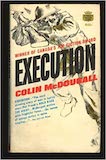
Left: The classic antiwar novel inspired by the Pringle case, which was the only novel published by Colin McDougall. Right: The 2002 nonfiction treatment that brought the affair to the public eye. Below: A 1955 episode of Four Star Playhouse also seems to be based on the Pringle case, and Colin McDougall is credited with the story.**

There’s a riveting audio interview here with a member of the Hastings and Prince Edward Regiment who had guard duty on the condemned youth on the last night of his life. “Just as brave as could be,” Orville Marshall reports.

* There’s another infamous troupe of deserter-gangsters operating in Rome in this same period, the Lane Gang. The said “Lane” — whose real name was Werner Schmiedel — was hanged by American authorities in June 1945.

** McDougall served in Italy up to the end of Canada’s involvement there, and that is surely how he came to know about the secret execution in a general sense; any more specific vector of information appears to be unknown. However discovered, Pringle clearly haunted McDougall: he took several years to write his magnum opus, and also published a short story in McLean’s in the early 1950s called “The Firing Squad”.

On this day..

1936: Saburo Aizawa, incidentally

Lieutenant Colonel Saburo Aizawa was shot on this date in 1936.

The Aizawa Incident — an assassination — emerged from the conflict between the Kodoha (“Imperial Way”) and Toseiha (“Control”) factions of the Imperial Japanese Army.

Both these philosophies were authoritarian, militaristic, and aggressively imperialist.

However, Kodoha officers — disproportionately younger junior officers — were more radically right-wing. Their leading light, General Sadao Araki, who had been War Minister in the early 1930s, espoused a philosophy that “linked the Emperor, the people, land, and morality as one indivisible entity, and which emphasized State Shintoism.”

Toseiha is described as the more moderate faction which in practice meant that they were a bit less totalizing and a bit more institutionally accommodating: in a word, it was just the mainline outlook of the army brass. According to Leonard Humphreys, Toseiha “was not really a faction … it really consisted only of officers who opposed the Kodoha.”*

Our day’s principal accused Toseiha bigwig Tetsuzan Nagata of putting the army “in the paws of high finance” when he forced out a Kodoha ally and Araki protege in 1935, following a failed Kodoha coup d’etat. And in revenge for this perceived betrayal, Aizawa dramatically murdered Nagata with a sword in his office on August 12, 1935.

However boldly struck, this blow bespoke the dwindling prestige of the ultras.

In the months while Aizawa’s sure fate was arranged through the proper channels, the desperate Kodoha faction again attempted to seize power — and was sidelined for good when it again failed. Aizawa had the displeasure of going to his death amid the ruin of his cause.

* fn 24 on page 206 of The Way of the Heavenly Sword: The Japanese Army in the 1920’s, citing several other scholars with the same view — and noting that the names for these tendencies were both conferred by Kodoha propagandists, so nobody self-identified using the pejorative “Toseiha”.

On this day..

1939: Toribio Martinez Cabrera

Spanish officer Toribio Martinez Cabrera was executed on this date in 1939 by Franco’s Spain.

An army lifer who had cut his teeth fighting in Cuba against Spain’s imperial dispossession, Martinez Cabrera (English Wikipedia entry | Spanish was one of the few brigadier generals to remain loyal to the Spanish Republic when his brethren launched the Spanish Civil War.

Despite entrusting him with command responsibility, his upper brass demographic profiled as a probable rebel and the Republic remained wary of his act; he was interrogated as a possible double agent after the fascists took Malaga, and defeated an outright treason charge after Franco occupied Gijon in 1937. It seems like he was destined to be shot by someone.

Having the honor of returning to an official capacity in the collapsing remains of the Republic, he supported Segismundo Casado‘s March 1939 coup against the Communist-allied Juan Negrin. The latter could get no negotiated terms from the fascists and so resigned himself, as he later remembered from exile, “to fight on because there was no other choice, even if winning was not possible, then to salvage what we could — and at the very end our self respect … Why go on resisting? Quite simply because we knew what capitulation would mean.” Unfortunately for Martinez Cabrera, Casado’s short-lived junta also got a cold shoulder from Franco and submitted to unconditional surrender.

Although most of its members evacuated abroad as the fascists triumphed, Martinez Cabrera declined to flee. He was shot at Paterna on June 23, 1939.

On this day..

1918: Captain Alexey Schastny

On this date in 1918, Captain Alexey Schastny received the cold thanks of the Bolshevik government for saving its Baltic fleet.

Icebound in the city of Helsingfors (Helsinki) across the Gulf of Finland from his Red homeland, Schastny (English Wikipedia entry | the more substantial Russian) orchestrated an emergency speedy breakout just ahead of a German incursion that seized the city in April and could have grabbed the Soviet Baltic fleet.

Schastny’s decisive action brought 236 vessels, including six battleships, across the frozen sea and safely home to Kronstadt.

The heroism of this operation at a moment of such low ebb for Russian prestige made Schastny a potentially dangerous element, should the onetime tsarist sailor choose to exercise his great prestige in the navy to the detriment of the Bolsheviks. This was the winter of the Russian Civil War, when White insurgents tore at the nascent Revolution.

Leon Trotsky, at this same moment scrambling to organize the Red Army to stabilize the situation, had Schastny arrested as a counterrevolutionary barely a month after the celebrated ice voyage. So grave a threat did this sea dog present that the Soviet state, having briefly abolished the death penalty, restored it in June 1918 specifically so that Schastny could be shot.

Schastny makes his appearance in the slick 2017 serial Trotsky, where he’s played by Anton Khabarov; the first half of episode 7 focuses heavily on Schastny’s arrest, court-martial, and execution.

On this day..

1863: William Lynch, suppressed mutineer

(Thanks to Edward Waldo Emerson, the son of transcendentalist chin-wagger Ralph Waldo Emerson, for the guest post. His account of the beloved Massachusetts cavalryman Charles Russell Lowell’s lethal suppression of a mutiny in his civil war regiment, as related to him by Lowell’s widow for his, Emerson’s, 1907 biography Life and Letters of Charles Russell Lowell. Lowell can’t speak for himself on this account because he was killed the next year at the Battle of Cedar Creek, after which he was posthumously promoted to Brigadier General.

Emerson does not directly narrate a death penalty story, but the image in the coda records the fate of one of the rebellious enlisted men. There were two others in legal jeopardy from this affair: Sylvester Riley died while awaiting his court-martial in Fort Independence in Boston Harbor; and, 16-year-old Francis Dew drew a death sentence which was commuted by President Abraham Lincoln on account of Dew’s youth. -ed.)

Mrs. Lowell, anxious that the exact facts be known, wrote for me this account of the

MUTINY IN BOSTON.

A very painful incident took place while Colonel Lowell was recruiting for the Second Cavalry, which impressed him very much.

Stopping as usual, at eight o’clock one morning, at the recruiting station, he found the small squad of new recruits who were to be transferred that day to the camp at Readville, in a state of mutiny. Hearing the noise on his arrival, he descended at once to the basement, and the Sergeant in command explained that he had ordered a man to be handcuffed, that the others had said it was unjust and should not be done, and had resisted. Colonel Lowell at once said: ‘The order must be obeyed.’ ‘No! No!’ shouted the men. He continued: ‘After it is obeyed, I will hear what you have to say, and will decide the case on its merits, but it must be obeyed first. God knows, my men, I don’t want to kill any of you; but I shall shoot the first man who resists. Sergeant, iron your man.’ As the Sergeant stepped forward with the irons, the men made a rush, and Colonel Lowell shot the leader, who fell at once. The men succumbed immediately, some bursting into tears, such was their excitement.

The whole incident was very painful to Colonel Lowell, especially because he had always regarded it as one of the privileges of an officer that he did not have to kill with his own hand.

The circumstances, however, turned out as fortunately as was possible in such a case. The man had no relatives, so far as could be discovered, and his record showed that he was a very bad man, and had previously been in the Regular Army, so that he knew very well what he was doing in resisting an order.

One of Governor Andrew‘s staff, who was present when Colonel Lowell reported his action, gave the following account, which I copy from Professor Peirce’s life of Lowell in the Harvard Memorial Biographies:

Entering his Excellency’s room, he made a military salute and said, ‘I have to report to you, sir, that in the discharge of my duty I have shot a man’; then saluted again, and immediately withdrew. ‘I need nothing more,’ said the Governor to a bystander, ‘Colonel Lowell is as humane as he is brave.’

On this day..

1996: Huugjilt, wrongful execution

On this date in 1996, a Chinese Mongol with the singular name of Huugjilt was executed by gunshot for rape and murder at Hohhot. With benefit of hindsight, it’s come to be viewed as “one of the most notorious cases of judicial injustice in China.”

Huugjilt discovered the body of a woman named Yang in a public toilet at a factory, on April 9, 1996 — just 62 days before the execution. She’d been raped and strangled, and that official tunnel vision common to wrongful conviction scenarios immediately zeroed in on Huugjilt himself. With conviction quotas to fulfill, authorities abused Huugjilt into a confession and an overhasty conclusion.

“It has not been rare for higher authorities to exert pressure on local public security departments and judiciary to crack serious murder cases,” China Daily editorialized. “Nor has it been rare for the police to extort confessions through torture. And suspects have been sentenced without solid evidence except for extorted confessions.”

This conviction unraveled in 2005 when a serial sex predator named Zhao Zhihong admitted the murder. (He was charged with many similar crimes besides.) The belated investigations ensuing from the resulting uproar cleared Huugjilt, even to the extent of holding a formal posthumous retrial that overturned the original verdict.

On this day..