1942: Mark Retiunin’s rebels of the gulag

On this date in 1942, the survivors of a remarkable rebellion in a Soviet gulag camp were shot.

The Ust-Usinsky rebellion in Russia’s northern Komi Republic unfolded in the first months of that same year, under the leadership of an Archangel-area peasant named Mark Andreevich Retiunin.

Retiunin wound up in the area in the usual way, sentenced to the work camps for a bank robbery. But he’d been released in 1938 as a model, industrious prisoner, and now as a non-inmate civilian he managed forestry at the “Vorkutlag” camps near the city of Vorkuta.*

“He was one of those peasant guys who were tried as bandits during collectivization,” another prisoner remembered of him.

He walked like a bear, his red-haired shaggy head was slightly tilted forward, and his eyes looked bearish, too. He was a romantic. In his hut, standing on high stilts, lay a volume of Shakespeare. When I took it and opened it, Retiunin exclaimed “Now there was a man!” and began to recite by heart:

Yet better thus, and known to be contemn’d,
Than still contemn’d and flatter’d. To be worst,
The lowest and most dejected thing of fortune,
Stands still in esperance, lives not in fear!**

“Do you understand? We live in hope, the rise is open! This is not given to every worm.”

From late 1941, pressure on the camp had increased frighteningly with the onset of open warfare against Germany: production quotas increased, and political purges pursued the supposed counter-revolutionary saboteurs that had been conjured by the preceding years’ purge trials. In hushed and furtive conversations, Retiunin marshaled fretful associates upon the incredible path of rebellion. “What do we lose if they kill us?” he reasoned. “We will die at labor tomorrow or in battle today. They will all kill one another in the camps, but first they will shoot all those convicted as counterrevolutionaries, including we civilian employees.” For a period of weeks, aided by a fortuitous vacancy in the local NKVD post, Retiunin and company organized their desperate bid to climb the open rise.

“Special Forces 41” named for either or both of the expiring calendar year, or the roster of their conspiracy, mounted their bid on January 24, speedily disarming flat-footed guards. About 50 camp prisoners joined them; many others fled for their lives. For a few impossible days they had the run of the area before word reached the capitals and a force dispatched by Beria arrived to suppress the revolt.

Retiunin himself was chased to ground with the surrounded remnants of Special Forces 41, and shot himself on February 2 after a furious all-day gunfight. Numerous other rebels were killed in combat over the course of those days; an official count has it 48 killed, 6 suicides, and 8 taken prisoner. But the captives were augmented in the months to come by escapees lurking in the wilderness or settlement fringes by ones and twos, rounded up gradually by a now all-too-attentive NKVD. On October 12, approximately 50 people convicted of involvement or complicity in the rebellion were shot en masse. To the extent anyone heard about the rebellion, they were officially slated with aspiring to “establish ties with either fascist Germany or Finland” although interrogations suggested that mere flight from the camps was the true objective of most, and some rebels actually dreamed of making their way to the Soviet front to earn their lives by establishing their patriotic bona fides.

* This city also gives its name to a completely distinct gulag revolt in 1953 — the Vorkuta uprising. Once a mining hub, latter-day Vorkuta has grown grimly depopulated as the coal veins have played out.

** The opening words of Act IV, Scene 1 in King Lear, spoken by Edgar — who will endure his outcast status to become king by the end of the play.

On this day..

1938: Vladimir Varankin, Esperantist

Russian writer Vladimir Varankin was executed on this date in 1938, during Stalin’s purges.

Varankin got interested in the international Esperanto language movement as a secondary school student in Nizhny Novgorod during the ecstatic months following the Bolshevik Revolution, and he founded an Esperantist club there that soon reached throughout the province.* This was the high-water moment for the Esperanto movement, now 30 years mature since its founding: World War I had shattered the international system and spawned small states and revolutionary governments shaping a new world on the fly. Esperanto would have been adopted by the League of Nations for official use but for the furious resistance of jealous France.

For the same reason that it interested visionaries and radicals, the language attracted the suspicion of authoritarians; in Mein Kampf Hitler denounced Esperanto as an insidious Semitic project.

the language spoken at the time by the Jew … is never a means of expressing his thoughts, but for hiding them. When he speaks French, he thinks Jewish, and when he turns out German poetry, he only gives an outlet to the nature of his people.

As long as the Jew has not become the master of the other peoples, he must, whether he likes it or not, speak their languages, and only if they would be his slaves then they might all speak a universal language so that their domination will be made easier (Esperanto!).

Esperantists became targets for political persecution in the Third Reich as a result.

In Soviet Russia, the utopian 1920s offered a far more congenial scene. These were the years Varankin came into himself and as he advanced in life, so did his enthusiasm for the artificial tongue. The late 1920s find him living in Moscow, teaching at the pedagogical institute and churning out a corpus of Esperanto books (Theory of Esperanto, the ideologically calibrated Esperanto for Workers) as well as study curricula. His magnum opus, the 1933 novel Metropoliteno, was also composed in Esperanto.

But Stalin’s purge years soon cast a pall over Esperanto and much else besides — even though Stalin actually studied a little Esperanto himself in his youth, according to Trotsky. (Pray, good reader, for Koba’s Esperanto instructors.) In about 1937 he abruptly reversed the Soviet Union’s formerly benign view of Esperanto; now, the movement’s internationalism would be held to affiliate it with the purported foreign cabals whose subversions furnished the pretext for demolishing so many lives. In Varankin’s case, and facilitated by an unauthorized visit he had made to an Esperanto conference in Germany many years before, the charge — unanswerable in those terrible days — was that his Esperantist circles comprised a network of fascist spies and saboteurs overseen by enemies abroad.

The verdict against him was posthumously reversed in 1957.

* The regional environs of present-day Nizhny Novgorod Oblast, of which the city Nizhny Novgorod is the capital; in Varankin’s youth, this was a gubernia, a regional unit held over from the deposed imperial administration. Russia’s “states” were greatly redrawn and redefined during the first decade of the Soviet experiment, and gubernias were abolished in 1929.

On this day..

1939: Javier Bueno, Asturian socialist newsman

Socialist journalist Javier Bueno was garotted by the fascists on this date in 1939.

Bueno (Spanish Wikipedia entry | Asturian), “instigator of the revolution,” was a newsman who became the editor of the newspaper Avance in the Asturian city of Gijon.

Through “the professional zeal and personal militancy of its director” (quoth historian David Ruiz) this paper emerged as an essential organ of the rising Asturian working class in the fraught years running up to the Spanish Civil War. Repeated bannings (of the newspaper) and imprisonments (of Bueno) only enhanced his stature; “you attract the pyrotechnic rays of our enemies,” Indalecio Prieto wrote him admiringly.

The revolutionaries freed him in 1936, two years deep in a life sentence, and Bueno went back to agitation in the pages of Avance before taking to the front lines himself. Franco’s victory in 1939 found him in Madrid, working at another radical paper, Claridad. Bueno faced a snap military tribunal with no more than a pro forma pretense of defense.

On this day..

1943: Amos Pampaloni, Captain Corelli’s Mandolin inspiration

Italian artillerist Amos Pampaloni, the real-life model for the title character of the novel and film Captain Corelli’s Mandolin, miraculously survived execution on this date in 1943.

It occurred at the outset of the Cephalonia Massacre on September 21, 1943, which began a dayslong slaughter on that Greek island by German soldiers of their former Italian comrades. With some 5,000 victims, it’s one of the largest POW massacres of the Second World War.

Captain Pampaloni was among 500-odd officers deployed with the 12,000-strong Acqui Infantry Division. This formation had been part of fascist Italy’s invasion of Greece in 1940-41; after victory in that campaign, the Acqui Division occupied several Greek islands over the succeeding years, where German troops were also stationed.

The Pact of Steel uniting these powers melted abruptly in early September of 1943, when the Allies forced Italy into an armistice. For Italian forces standing in the field cheek-by-fascist epaulette, this forced a sudden and dangerous reckoning. Some units had barely even heard of the new situation before they were under German guns; in a best-case scenario, they had to decide within a few hours or days between radically different attitudes towards their up-to-now comrades-in-arms.

The Acqui on the Ionian island of Cephalonia (Kefalonia) was a case in point. In the days following the Italian armistice, the much larger German force presented its commanders an ultimatum to decide among three alternatives:

  1. Continue fighting alongside the Germans
  2. Fight against the Germans
  3. Surrender, disarm, and repatriate

While the last of these might seem the obvious course, disarming was contrary to the Italian high command’s ambiguous order neither to initiate hostilities with Germans, nor to cooperate with them. Moreover, the Cephalonia division got some reports in those confused days that the Germans weren’t always repatriating units that surrendered. The soldiery was polled on the options, and went for resistance.

Unfortunately the Italians were thoroughly outgunned in this fight, and the Allies refused to permit dispatching reinforcements from Italy that might easily be captured by the Germans. Within days the Acqui had been roughly brought to heel.

Outnumbered and suffering under accurate mortar fire, Pampaloni decided to surrender. The captain protested that it was against the rules of war when his men were systematically robbed of their wallets and watches, only to be told by the German commanding officer that those rules applied to prisoners, not to traitors.

The officer then shot the captain through the back of the neck, and the rest of his men, including the wounded, were mown down with machine gun fire. Miraculously still alive, Pampaloni remained conscious as a German soldier removed his own watch from his apparently lifeless body.

Captain Pampaloni was not, in fact, the only soldier from his company to survive. “The mule handlers were spared, because every mule responds best to his own master,” he said. “Ten minutes after the massacre the German soldiers left, singing.”

Captain Pampaloni went on to fight for a year with the Greek resistance on the mainland. Having witnessed the brutality of the conflict on Cephalonia, he was still shocked by the sight of partisans slitting the throats of German prisoners with their daggers — ammunition was too precious to be wasted on executions.

Cefalonia – crimine di guerra 1 from Va.Le. Cinematografica 78 on Vimeo.

Cefalonia – crimine di guerra 2 from Va.Le. Cinematografica 78 on Vimeo.

Numerous summary executions disgraced the German victory. (There’s a monument to the victims in Verona.) Our man Amos Pampaloni faced his on the first day of the general massacre; according to a 2001 profile in the Guardian,

Outnumbered and suffering under accurate mortar fire, Pampaloni decided to surrender. The captain protested that it was against the rules of war when his men were systematically robbed of their wallets and watches, only to be told by the German commanding officer that those rules applied to prisoners, not to traitors.*

The officer then shot the captain through the back of the neck, and the rest of his men, including the wounded, were mown down with machine gun fire. Miraculously still alive, Pampaloni remained conscious as a German soldier removed his own watch from his apparently lifeless body.

Captain Pampaloni was not, in fact, the only soldier from his company to survive. “The mule handlers were spared, because every mule responds best to his own master,” he said. “Ten minutes after the massacre the German soldiers left, singing.”

Captain Pampaloni went on to fight for a year with the Greek resistance on the mainland. Having witnessed the brutality of the conflict on Cephalonia, he was still shocked by the sight of partisans slitting the throats of German prisoners with their daggers — ammunition was too precious to be wasted on executions.

In the novel Captain Corelli’s Mandolin, Pampaloni’s fictional imitator survives thanks to a noble comrade who hurls his body in front of the fusillade.

Pampaloni didn’t appreciate Mandolin all that much, owing to its hostile depiction of the Communist partisan movement that he joined after surviving his execution. For those seeking alternative literatures, there’s also a 1960s novelization of the Greek resistance on Cephalonia by Marcello Venturi; written in Italian (as Bandiera bianca a Cefalonia), it’s long out of print in English as The White Flag.

* Prior to the Italian armistice, the Italian forces on the island were working on an arrangement to obey German command structures; hence, the brutal treatment of Italian prisoners who could be conceived as not merely prisoners of war, but traitors or rebels unprotected by any law of war. A German directive had explicitly demanded as much: “because of the perfidious and treacherous behaviour on Kefalonia, no prisoners are to be taken.”

On this day..

1973: Charles Horman, American journalist in the Pinochet coup

Horman was interrogated at the military school and then transferred to the national stadium for further questioning. He was ordered shot and killed the evening of September 19. According to [redacted] the authorities at the stadium did not know that Horman was an American … the body was taken from the stadium and left at a location to create the idea that he had been killed in a firefight with the military. However, in the confused days following the coup, and after it was known that he was an American, the military sought to hide the fact that he was dead.

Declassified informant’s report (pdf) of the death of Charles Horman

On this date in 1973,* American journalist Charles Horman was extrajudicially executed by the Chilean coup junta of Augusto Pinochet.

Horman was a prizewinning U.S. journalist and filmmaker from the heyday of crusading, adversarial journalism: stateside, he’d made a documentary about napalm use in Vietnam and protested that war at the 1968 Democratic convention in Chicago.

With his wife Joyce, Horman had been living in the Chile of socialist president Salvador Allende since the spring of 1972, reporting freelance while working as a screenwriter. He was right there in the capital on September 11, 1973, to see Allende’s vision ground under tank treads when the Chilean military with U.S. support overthrew the elected civilian government and initiated a litany of horrors.

One of the most emblematic atrocities of Pinochet in his earliest hours was his regime’s commandeering the Santiago football stadium as a makeshift concentration camp for leftists whose blood would desecrate the facility’s recreational purpose.**

The putschists did not fear to extend their terror to subversive Yanks like Horman and (a few days after him) a fellow-journalist named Frank Teruggi — their murders secretly okayed by Pinochet’s CIA comrades.†

There’s a 1978 book investigating this affair, titled The Execution of Charles Horman; the book, and Horman’s fate, inspired the 1982 Costa-Gavras film Missing.

* There are some citations out there for September 17 (the date of Horman’s arrest) or September 19, and a good many general punts to only “September 1973” for this extrajudicial execution/murder. We’re depending for our part on the firm published findings of Chilean judge Jorge Zepeda:

the following day, September 18, 1973 at around 1:35 p.m., military officials took the remains of an unidentified male to the Servicio Medico Legal [Medical Legal Department], and this individual was later fingerprinted and identified as Charles Edmund Horman Lazar, in accordance with Protocol No. 2663/73; the Medical Legal Department concluded that his death had occurred on September 18 at approximately 9:45 a.m. The corresponding death certificate was issued on October 4, 1973 by Doctor Ezequiel Jimenez Ferry of the aforementioned Department.

** In November 1973, the Soviet Union honorably refused to set boots on this boneyard to contest a World Cup playoff and was disqualified as a result — although not before the hosts were made to take the pitch unopposed in a sham “match”.

Thanks to Chile’s consequent advance to the 1974 tourney, a Chilean player holds the distinction of being the first footballer red-carded at the World Cup finals.

† Post-Pinochet Chile unsuccessfully sought the extradition of the former American military mission commander for permitting these murders, when he as the delegate of the coup’s sponsor-empire presumably would have had the juice to forbid them.

On this day..

1915: Augusto Alfredo Roggen, World War I spy

Uruguay-born World War I spy Augusto Alfredo Roggen was shot in the Tower of London on this date in 1915.

Like most German-on-British agents during the Great War — at least, the ones we know about! — he didn’t have much of a run. Although this son of a German national did it by the book by arriving legally and properly registering as a foreigner, he whistled on the security services’ frequency by sending a couple of postcards to a known-to-be-suspect address in the wartime espionage hub of Rotterdam.* The cards were copied and their sender was flagged.

After a few weeks of quietly monitoring his movements, British cops raided his hotel room while Roggen was on “holiday” at Loch Lomond. He had in his possession a revolver and equipment for writing in invisible ink; apparently he’d been intending to photograph facilities at Arrochar Torpedo Range.

Instead, he was tried at Middlesex Guildhall where he gave no evidence and made no defense. The intervention of the Uruguayan embassy on behalf of its national was to no avail.

* The Netherlands’ wartime neutrality made Dutch citizens — who could travel throughout Europe — natural spy recruits. The best-known monument of that era is the executed exotic dancer Mata Hari, who was actually a Dutchwoman named Margaretha Zelle.

On this day..

1917: Private John Abigail

Private John Abigail of the Royal Norfolk Regiment was shot on this date in 1917 for World War I desertion, at the village of Esquelbecq on the French-Belgian border.

He was a four-time offender, the last occasion judiciously ditching his post just before he was ordered over the top into the Passchendaele bloodbath.

Abigail’s name surprisingly appears carved on a war memorial plaque at St. Augustine’s Church in Norwich that long predates the humane 21st century rehabilitation of those shot at dawn. (See it here, at the very top of the right panel.)

The BBC has a short program about him available here.

On this day..

1916: Yakub Cemil, Ottoman putschist

Ottoman officer Yakub Cemil was executed on this date in 1916 as an aspiring putschist.

A Circassian infantryman who served under Enver Pasha in the 1900s, Cemil was an early and ardent supporter of the Committee of Union and Progress. This onetime underground party ascended to national preeminence in 1908, after which Cemil became a sturdy “weapon of the organization”.
He did not shrink to imbrue his hands with blood; allegedly, he assassinated journalist Ahmet Samin Bey in 1910, and on campaign in Libya against the Italian invasion he privately murdered a black lieutenant out of some combination of suspected espionage and racial animus. His implacability was his great asset and his great liability; the eventual father of post-Ottoman Turkeuy, Ataturk is perhaps apocryphally supposed to have mused, “If I one day mount a revolution, Cemil is the first man I want by my side, and Cemil is the first man I will hang afterwards.”

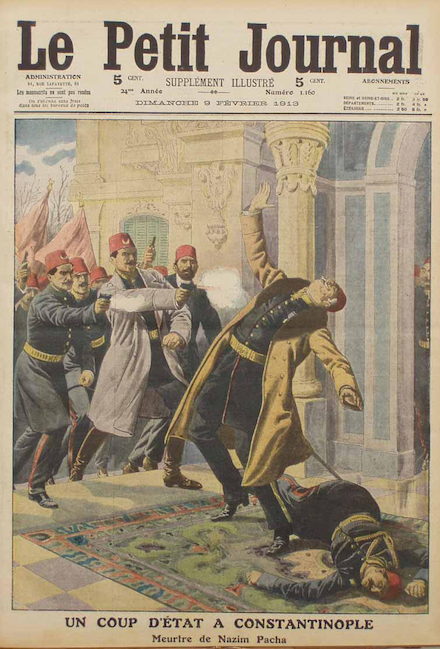
Such provincial homicides were but studies for the main deed of his days when in the 1913 Ottoman coup d’etat when he gunned down War Minister Nazim Pasha on the steps of the Sublime Porte as his CUP comrades barged in to force the resignation of the aging Grand Vizier and take the state firmly in hand.

It was an act that shook capitals around the world.


9 February 1913 edition of Le Petit Journal with a cover depiction of “un coup d’etat a Constantinople: muertre de Nazim Pacha”.

Ironically it was a desire for peace that brought his end. A couple of years deep into the catastrophe of World War I, Cemil rightly perceived the need to extricate his state from the conflict, and began making plans to topple the “Three Pashas” of the CUP whom he had helped to bring to power. His old friend Enver Pasha had no intention of approving the resulting death sentence — indeed, he had caught wind of it and tried persuasion to bring Cemil back onside — but when Enver Pasha was summoned to Berlin for a war council the fellow triumvir Talaat Pasha signed off on the execution with dispatch.

Rumors and legends abound concerning his death, such as shouting “Long live the Committee for Union and Progress!” before the firing squad opened up on him, and an agonizing half-hour bleed-out during which the expiring Cemil scrawled a patriotic slogan in the dirt with his own blood.

On this day..

1917: Albin Köbis and Max Reichpietsch, Wilhelmshaven mutineers

On this date in 1917, German sailors Albin Köbis and Max Reichpietsch were shot at the Wahner Heide proving ground near Cologne.

They’d been convicted at court martial of being “ringleaders” of a mutiny of increasingly militant anti-war seamen from the battleship Prinzregent Luitpold, who on August 2 had marched into the port of Wilhelmshaven to resist their continued participation in the futile bloodbath.

“Nobody wanted a revolution, we just wanted to be treated more like human beings,” said one of their number, sentenced by the same military tribunal to 15 years. But this was a bit coy, considering that Kobis wrote his parents that “I die with a curse on the German-militarist state.”

And why not? The Russian Revolution was in full swing at this moment, while the navy had become a center of radicalized anti-war and anti-imperialist sentiment. In a year’s time another sailors’ mutiny would set off the events that finally forced an end to the Great War — and after the armistice, sailors like Rudolf Egelhofer were again prominent in revolutionary ventures like the Munich Soviet. If there is one thing we can state with confidence about the Wilhelmshaven event, it’s that some participants most certainly aspired to a revolution.

Likewise the contemporary left-wing press recognized in Köbis and Reichpietsch heroes and fellow-travelers; they were saluted as martyrs in their own day, and after World War II, East Berlin had a Köbisstrasse appropriately near to the naval headquarters. While some Communist martyrs were persona non grata on the other side of the Berlin Wall, West German television also aired a dramatization in 1969, called Marinemeuterei 1917.


Memorial to Reichpietsch (left) and Köbis (cc) image from Gordito1869.

On this day..

2013: Sushmita Banerjee, Escape from the Taliban author

On the night of September 4-5, 2013, Afghan author Sushmita Banerjee was kidnapped and summarily executed by the Taliban.

Born Hindu to a Bengali Brahmin family in Kolkata, India, Banerjee secretly married a Muslim businessman named Janbaz Khan and moved with him to Afghanistan, converting to Islam in the process.

She ran a women’s clinic there until goons from the rising Taliban movement beat her up and held her prisoner in 1995. In danger of being executed by her captors, she managed to escape and return to Kolkata.

She made her mark publishing a memoir of her harrowing experience. Kababuliwalar Bangali Bou (A Kabuliwala’s Bengali Wife) was the nondescript title; Bollywood punched it up for the silver screen as Escape from the Taliban.

This was Banerjee’s claim to fame or — Taliban perspective — infamy, and it’s possible it was the eventual cause of her murder.

“She had no fear,” a sister remembered of her. Fearlessly, or even recklessly, she returned to Afghanistan in 2013 — daring even to live in the militant-dominated border province of Paktika and refusing to wear the burka.

A Taliban splinter group disavowed by the Taliban itself ultimately claimed responsibility for kidnapping Banerjee on the night of September 4, 2013 and depositing her bullet-riddled body to be discovered the following morning; their charge was that Banerjee was an “Indian spy”.

On this day..