Lithuanian anti-Soviet partisan Jonas Žemaitis was shot in Moscow’s Butyrka prison on this date in 1954. He’s one of the big names in the Forest Brothers movement that kept up a hopeless fight against Moscow from 1944 into the 1950s.
An artillerist of Polish ancestry who deserted the retreating Red Army and surrendered himself the Wehrmacht arriving in the summer 1941, Žemaitis is breezily credited in state histories (and as of this writing, both English and Lithuanian Wikipedia pages) of essentially taking the war years off because “he did not want to serve the Nazis.” That was sure considerate of the Nazis! Instead the fellow just mined peat since he preferred not to get involved.
One could turn here to Joseph Melamed, a survivor of the Kovno Ghetto who collected witness testimonies and published thousands of names of alleged Lithuanian “Jew-Shooters” (zydsaudys). Melamed has charged that Žemaitis put his Polish fluency to use facilitating genocide and “having proved his efficiency and diligence in murdering Jews, was rewarded by the SS and promoted to the rank of Colonel” in the Police Battalions, Lithuanian paramilitaries that worked hand in glove with Nazi executioners.*
Or alternatively, one could rely on the plain fact that Žemaitis was a trained, early-30s officer in a desperate war zone where everyone was being pressed into action, and that anti-Soviet fighters afterwards treated him as a General. That’s not the profile of a figure who simply kept his head down while the Great War raged past him.
The post-USSR independent state of Lithuania, which has not been shy about whitewashing Holocaust collaborators, absolutely rejects such inferences and has retroactively elevated Žemaitis to its officially recognized head of state during his postwar resistance; there’s a Vilnius military academy that’s named for him.
* Melamed is now deceased but during his latter years Vilnius accused him of slander. Modern Lithuania is ferociously determined about apotheosizing the Forest Brothers; officially, the Venn diagram between wartime genocidaires and the postwar anti-Soviet resistance consists of two different shapes on two different planets.
Angel Vicente Peñaloza — “Chacho” to friends and to history — was stabbed and shot to death on this date in 1863.
This caudillo was a casualty of Argentina’s long, long conflict between unitarians looking to centralize the state and federalists looking to hold power devolved to their own provinces. Chacho (English Wikipedia entry | Spanish) stood in the latter camp.
A career officer from a prosperous ranching family, Peñaloza had become the caudillo of his native La Rioja province by the 1850s — meaning he was also its key military leader when unitarian-federalist hostilities turned kinetic from 1858.
His skirmishes with the unitarian president Bartolome Mitre saw Chacho hopelessly outgunned, but an attempt between the rivals to conclude a peace treaty turned sour over a prisoner exchange — whose quota Mitre allegedly met with corpses rather than living fighters. Chacho rose again, for the last time, in March 1863, writing angrily to Mitre that his
governors are become the executioners of the provinces … they banish and kill respectable citizens without trial solely because they belong to the federal party.
That is why, Mr. President, that the people, tired of a despotic and arbitrary domination, have proposed justice, and all men who have nothing to lose would rather sacrifice their existence on the battlefield, defending their liberties and their laws and their most precious interests trampled by vile perjurers.
It was just the invitation Mitre needed to crush him: Peñaloza’s several thousand followers were simply outlawed, giving soldiers and militia carte blanche to murder them at discretion. Captured at the village of Olta, he was summarily killed later that same day by the commander in the field and they didn’t stop there: Chacho’s head was nailed up in the town square, and his widow made to sweep the streets of San Juan, manacled in disgrace.
His doomed rebellion has seen him to a heroic posthumous reputation, buttressed by the verse homage of poet Olegario Victor Andrade. There’s also a rampant equestrian monument to the martir del pueblo near Olta.
Christian villages, traditionally friendly or not unfriendly towards the Yishuv, were generally left in peace. An exception was ‘Eilabun, a mainly Maronite community, which fell to Golani‘s 12th Battalion on 30 October after a battle on its outskirts with the ALA [Arab Liberation Army], in which the Israelis suffered six injured and four armoured cars knocked out. The villagers hung out white flags and the Israelis were welcomed by four priests. The inhabitants huddled inside the churches while the priests surrendered the village. But the troops were angered by the battle just concluded and by reports of a procession in the village, a month before, in which a large number of inhabitants had participated, in which the heads of two IDF soldiers who had gone missing after the attack on 12 September on a nearby hilltop — ‘Outpost 213’ — were carried through the streets, or by the actual discovery in a house of one of the rotting heads. What happened next is described in a letter from the village elders to [Israeli Minister of Police Bechor-Shalom] Shitrit: The villagers were ordered to assemble in the square. While assembling, one villager was killed and another wounded by IDF fire.
Then the commander selected 12 young men and sent them to another place, then he ordered that the assembled inhabitants be led to [the neighbouring village of] Maghar and the priest asked him to leave the women and babies and to take only the men, but he refused, and led the assembled inhabitants — some 800 in number — to Maghar preceded by military vehicles … He himself stayed on with another two soldiers until they killed the 12 young men in the streets of the village and then they joined the army going to Maghar … He led them to Farradiya. When they reached Kafr‘Inan they were joined by an armoured car that fired upon them … killing one of the old men, Sam‘an ash Shoufani, 60 years old, and injuring three women … At Farradiya [the soldiers] robbed the inhabitants of I£500 and the women of their jewelry, and took 42 youngsters and sent them to a detention camp, and the rest the next day were led to Meirun, and afterwards to the Lebanese border. During this whole time they were given food only once. Imagine then how the babies screamed and the cries of the pregnant and weaning mothers.
Subsequently, troops looted ‘Eilabun.
Not all the villagers were taken on the trek to Lebanon. The four priests were allowed to stay. Hundreds fled to nearby gullies, caves and villages, and during the following days and weeks infiltrated back. The affair exercised the various Israeli bureaucracies for months, partly because the ‘Eilabun case was taken up and pleaded persistently by Israeli and Lebanese Christian clergymen. The villagers asked to be allowed back and receive Israeli citizenship. They denied responsibility for severing the soldiers’ heads, blaming one Fawzi al Mansur of Jenin, a sergeant in Qawuqji‘s army [i.e., the ALA].
The affair sparked a guilty conscience and sympathy within the Israeli establishment. Shitrit ruled that former inhabitants still living within Israeli-held territory must be allowed back to the village. But Major Sulz, Military Governor of the Nazareth District, responded that the army would not allow them back. He asserted, ambiguously, that ‘Eilabun had been ‘evacuated either voluntarily or with a measure of compulsion’. A fortnight later, he elaborated, mendaciously: ‘The village was captured after a fierce fight and its inhabitants had fled.’ The Foreign Ministry opined that even if an ‘injustice’ had been committed, ‘injustices of war cannot be put right during the war itself’.
However, Shitrit, supported by Mapam’s leaders and egged on by the village notables and priests, persisted. Cisling suggested that the matter be discussed in Cabinet. Shitrit requested that the villagers be granted citizenship (relieving them of the fear of deportation as illegal infiltrees), that the ‘Eilabun detainees be released and that the villagers be supplied with provisions. Within weeks, Shitrit was supported by General Carmel, who wrote that ‘in light of the arguments [about their mistreatment]’ and of the fact that the area was not earmarked for Jewish settlement, the inhabitants should be left in place ‘and accepted as citizens’. Within weeks, the inhabitants received citizenship and provisions, and the detainees were released. At the same time, Shitrit, as Minister of Police, persuaded Yadin, to initiate an investigation of the massacre. During the summer of 1949, the ‘Eilabun exiles in Lebanon who wished to return were allowed to do so, as part of an agreement between Palmon, head of the Arab Section of the Political Department of the Foreign Ministry, and Archbishop Hakim, concerning the return of several thousand Galilee Christians in exchange for that cleric’s future goodwill towards the Jewish State. Hundreds returned to ‘Eilabun.
The abortive attack on ‘Outpost 213’, bizarrely enough, triggered a second atrocity four days after the first massacre. On 2 November,vtwo squads of the 103rd Battalion were sent on a search operation to Khirbet Wa‘ra as Sauda, a village inhabited by the ‘Arab al Mawasi beduins, three kilometres east of the outpost. While one squad kept guard over the villagers, the other — led by Lt. Haim Hayun, veteran of the September assault — climbed up to the outpost, where it discovered ‘the bones of the soldiers lost in the previous action’. The bodies were ‘headless’. The troops then torched the village (and presumably expelled the inhabitants), taking with them to their HQ in Maghar 19 adult males. There, the prisoners were sorted out and 14 were determined to have ‘taken part in enemy activity against our army’. They were taken away and ‘liquidated’ (huslu). The remaining five were transferred to a POW camp.
‘Eilabun and ‘Arab al Mawasi were only two of the atrocities committed by the IDF during Hiram, which saw the biggest concentration of atrocities of the 1948 war. Some served to precipitate and enhance flight; some, as in ‘Eilabun, were part and parcel of an expulsion operation; but in other places, the population remained in situ and expulsion did not follow atrocities.
Details about most the atrocities remain sketchy; most of the relevant IDF and Israel Justice Ministry documentation — including the reports of various committees of inquiry — remain classified. But there is some accessible, civilian documentation — and a few military documents have escaped the censorial sieve. It emerges that the main massacres occurred in Saliha, Safsaf, Jish and the (Lebanese) village of Hule, between 30 October and 2 November. In the first three villages, Seventh Brigade troops were responsible. At Saliha it appears that troops blew up a house, possibly the village mosque, killing 60–94 persons who had been crowded into it. In Safsaf, troops shot and then dumped into a well 50–70 villagers and POWs. In Jish, the troops apparently murdered about 10 Moroccan POWs (who had served with the Syrian Army) and a number of civilians, including, apparently, four Maronite Christians, and a woman and her baby. In Hule, just west of the Galilee Panhandle, a company commander and a sergeant of the Carmeli Brigade’s 22nd Battalion shot some three dozen captured Lebanese soldiers and peasants and then demolished a house on top of them, killing all. Civilians appear to have been murdered in Sa‘saas well.
Walkiria (or Walquiria) Afonso Costa was summarily executed on this date in 1974.
Sickly and emaciated, the 27-year-old was the last guerrilla left in the field after the two-year campaign of the Brazilian dictatorship to suppress the Communist insurgency in Araguaia — or at least she was the last who was taken into custody.
A pedagogy student at the University of Minas Gerais, she had learned to shoot on forest rambles with her father and so perhaps came better prepared for the wilderness life than some comrades.
According to her sister, the sociology professor Valéria Costa Couto, the military had all but wiped out the guerrillas in a Christmas 1973 ambush, with only Walkiria and a couple of others managing to escape and hold out a few months longer.
There is a street named for her in her home city of Belo Horizonte, and an epigraph from her deceased father awaits if her remains are ever located for proper burial: “Do you think they killed me? They raised an ideal. Do you think they buried me? They planted a seed.”
Dictator Muammar Gaddafi (several alternate transliterations are familiar, such as Qaddafi and Gadhafi) was killed by his captors during the Libyan civil war on this date in 2011 — an act very much on the extrajudicial and summary side of the foggy borderlands defining an “execution”.
Libya’s despot since ejecting the British-supported King Idris way back in 1969, the wily colonel steered his state for 40-odd years; his blend of pan-Arabism, Islamic socialism, pan-Africanism, and direct democracy is known as the Third International Theory and expounded in Gaddafi’s own manual of political theory, The Green Book — which became required reading for generations of his subjects.
Eventually a figure of western vilification and a fixture in the United States’s enemy-of-the-month rotation, Gaddafi’s anti-imperialist credentials earned him respectful eulogies from Palestinians, black South Africans, and Latin American revolutionaries, all of whom he had at times aided. Whatever measure of genuine popular support he earned by measures like land distribution, Gaddafi did not hesitate to buttress with brutality. Internal regime opponents and dissident exiles alike had cause to fear him, and it’s not as if innocent bystanders could sleep easily either: a London constable was shot from the Libyan embassy during demonstrations in 1984, and only worldwide outcry prevented the execution of six foreign doctors who were scapegoated for an HIV outbreak in the early 2000s. Gaddafi’s government in 2008 paid $1.5 billion in compensation to settle a bundle of international terrorism incidents, including the 1986 West Berlin discotheque bombing and the 1988 Pan Am Flight 103 bombing over Lockerbie, Scotland.
Fitting that his own savage end might enter periodization historiography as the fin de siècle américain.
The ham-fisted NATO intervention into Libya’s Arab Spring-era civil war that brought about Gaddafi’s death might be the last that Washington will have undertaken in its purported “hyperpower” era, accountable to none but its own intentions; certainly it was (in the words of James Mann) “the apotheosis of the Obamian approach to the world.”
The chief advocate of the intervention within the Obama administration, Samantha Power of Strangelovian nomen and Bosnian war dreams, recently published her memoir, The Education of an Idealist and issued the enraging auto-exoneration, “We could hardly expect to have a crystal ball when it came to accurately predicting outcomes in places where the culture was not our own.” Merely being alive for the aftermath of the Iraq omnishambles might have done her the job of scrying; Power’s boss, at least, learned the lesson well enough to shy from the reckless regime-change commitments demanded (including by Power herself) for the Syria conflict that might have brought not only similar catastrophe to its immediate “beneficiaries” but the prospect of nuclear confrontation with Russia. More warfare is surely on humanity’s horizon as the 2020s approach, but with great power competition rising alongside the seas, the prospect that it will be undertaken with such careless self-regard in such a large and consequential state seems remote.
Nor will future Libyas be so vulnerable as Libya, if they can help it. In the years prior, Gaddafi had ostentatiously surrendered his nuclear ambitions in exchange for aid and diplomatic normalization. Other observers like North Korea have justifiably concluded that states armed with nukes don’t get invaded while those armed with Foggy Bottom IOUs are just the next Melos in waiting. They’ll have the horrific viral videos of a bloodied and pleading Gaddafi being brutalized by his captors to remind them.
On 19 October 2011, Qadhafi’s son Mutassim decided they should leave Sirte because the thuwar had encircled and entered the city, trapping Muammar Qadhafi and his men in District 2. On the morning of 20 October they set off in a heavily armed convoy of approximately 50 vehicles. The convoy consisted of Muammar Qadhafi; his son Mutassim who was already wounded; Defence Minister Abubakr Younis … and approximately 200 armed men. There were also women and children in the convoy. Some of the armed men evacuated their wounded colleagues from the hospital and these unarmed men were placed in cars with their bandages still on; some still had tubes in their bodies.
The convoy headed east on the main road but ran into a rebel ambush. Numerous cars were badly damaged in the ambush and a number of people were injured. They circled to the sea road and headed west. The convoy split up. At this point a Toyota Corolla in front of Muammar Qadhafi’s green Landcruiser was hit by a NATO airstrike, probably by a Predator drone, and exploded. The explosion set off the airbags in Qadhafi’s car. Muammar Qadhafi and switched cars. The front of the convoy started taking fire from thuwar positions near the power plant and so Muammar Qadhafi, and others took refuge in a house as some of their bodyguards engaged in a fire fight with the rebel positions.
Moments after Muammar Qadhafi entered the house, an airstrike hit the vehicles, setting off secondary explosions. The strike and subsequent explosions left many wounded lying on the ground. At this point the thuwar began shelling the house where Muammar Qadhafi was hiding. Mutassim Qadhafi took approximately 20 fighters and left to look for vehicles. Muammar Qadhafi reportedly wanted to stay and fight but was persuaded to escape. The group belly-crawled to a sand berm. On the way an electrical transformer was struck and electrical wires fell on Qadhafi, striking his head, but he was saved by his blue flak jacket and a Kevlar helmet which was knocked off. The group reached the berm and ran behind it to the road where there were two drainage pipes. The group crawled through the pipes and took up a defensive position on the west side of the road where the pipes terminated.
Muammar Qadhafi crouched outside and between the two pipes. Abubakr Younis was in the right pipe and two fighters took up a position by a berm facing south and the other fighters faced north. The group was sheltered from the road and was unseen by the rebels … [until it] decided the group would make a stand and opened fire on a passing rebel vehicle. There was a fire fight. One of the guards threw a grenade. The grenade hit the top of the cement wall above the pipes and fell in front of Muammar Qadhafi. The guard tried to pick up the grenade but it exploded, killing him … Qadhafi was wounded in the blast by grenade shrapnel that hit and shredded his flak jacket. He sat on the floor dazed and in shock, bleeding from a wound in the left temple.
At that point, one of the party fashioned a white flag from his turban and waved in surrender to the thuwar from the 501st Brigade. The thuwar laid the men on their faces and bound their wrists. Muammar Qadhafi was immediately surrounded by thuwar and beaten. Muammar Qadhafi was heard to ask, “What is going on?” The survivors were placed into vehicles and taken away. [Mutassim Gaddafi and Abu-Bakr Yunis were also killed that same day by their captors. -ed.]
This is where the eyewitness evidence received by the Commission ends. Videos of the scene show Muammar Qadhafi being roughly handled by the thuwar, many screaming “We are Misrata” to identify where they are from. He is apparently stabbed with a bayonet in the buttocks. He is placed on the hood of a vehicle, bloody but alive, before being placed in an ambulance. He clearly has one head wound from the grenade shrapnel, but is otherwise not wounded. This is the last time Muammar Qadhafi is seen alive.
A televised interview of one of those who accompanied Muammar Qadhafi in the ambulance gave an account of what happened next. The young man, who states he is from Benghazi but was travelling with men from the Misrata thuwar when the Qadhafi convoy was attacked, claims he was the one that found Muammar Qadhafi and got into the back of the ambulance with him and two men from the Misrata thuwar. The ambulance started to drive to Misrata. The young man claims there was an argument between himself and the men from Misrata on what to do with Muammar Qadhafi, with him wanting to bring Qadhafi back to Bengazi. He claims he shot Qadhafi in the head and abdomen.
The Commission is unable to verify his claims. Video shows he was in the ambulance when Muammar Qadhafi was placed in it. What is clear is that Qadhafi was alive when he was taken into custody and placed in an ambulance in Sirte by members of the Misrata thuwar and was seemingly dead when the ambulance arrived in Misrata …
According to news reports, the official autopsy states Qadhafi was killed by a gunshot to the head. The Commission was not provided access to the autopsy report despite numerous requests to the NTC. Photos of Muammar Qadhafi’s body were provided to the Commission by members of the medical committee of Misrata who participated in the external examination of Qadhafi’s body … Analysis of the photos of the abdominal wounds by the Commission’s forensic pathologist determined they were penetrating wounds in the epigastric area, the nature of which was difficult to determine from photographs. Interviews with journalists who saw the body indicate Qadhafi was shot once in the head and twice in the abdomen.
* Just months ago as of this writing, the German sea captain Carola Rackete was arrested for breaking an Italian blockade to dock in Sicily with some 40 migrants: they’d been rescued off the coast of Libya.
Brazil-born, German-descended businessman turned World War I spy Fernando Buschmann was shot for espionage at the Tower of London this date in 1915. Don’t believe us, Francis Woodcock Goodbody will vouch for the lethal effect of “gunshot wounds on the chest.”
Court martialled in September and unable to satisfactorily explain his dealings with known German agents, his woeful business record, trips to Southampton and Portsmouth, and the presence of invisible ink in his record books, he was found guilty. In his defence, he argued “I was never a soldier or a sailor, and I am absolutely ignorant of all military matters. I am not a good businessman as I am more wrapped up in my music than business.”
Buschmann was sentenced to death by firing squad and transferred to the Tower on 18th October. He was permitted the solace of his violin which he played throughout the night. The sentence was carried out at 7:00am on the 19th October at the Tower Rifle Range.
Above: Cristus Factus Est, composed by the black Venezuelan musician Juan Antonio Caro de Boesi. He was shot on this date in 1814 by the notoriously brutal royalist caudillo Jose Tomas Boves, for his support of independence.
There are oddly conflicting claims that he shared an orchestral martyrdom with Juan Jose Landaeta, the composer of Venezuela’s national anthem; however, most sources date this man’s death to as early as 1812, not in connection with a firing squad but an earthquake. This might be an instance where the unreliable narrator that is Clio has conflated the biographies of two similar figures.
For both of these and others besides from that generation of strife and birth, we submit Caro de Boesi’s Misa de Difuntos (Mass of the Dead).
China Communist revolutionary hero Chen Jue was executed on this date in 1928 by the nationalist Kuomintang.
Chen Jue with his wife Zhao Yunxiao or Yunqi are celebrated revolutionary martyrs for their respective sacrifices of life for the cause in Changsha.
They met pursuing studies of revolutionary praxis in Moscow in the mid-1920s, and returned as revolutionary cadres at just the moment that China fell to open civil war.
In April 1928 both were betrayed to the KMT. Zhao Yunxiao was pregnant; she would be suffered to carry her daughter Qiming to term before quaffing the same cup as her husband. The two swapped red tear-jerking missives before their death, that are preserved at an exhibit at the People’s Revolutionary Military Museum.
“We didn’t believe in ghosts before. Now I am willing to become a ghost,” the man wrote the wife before his execution. “We are here to save the parents, wives and children of the entire Chinese people, so we sacrificed everything. Although we die, our spirits remain with the comrades who yet live.”
“Little baby, your mother will be taken from you when you have no more than a month and a dozen days,” the wife wrote the child months later. “Little baby, I tell you very clearly that your parents were Communists … I hope that when you grow up, you read well and know how your parents died.”*
Their cause, of course, was destined for victory. If history records the destiny of their child, I have not located it.
* Both of these are my amateur-hour translations via online tours, unaided by any actual expertise in Chinese. Caveat emptor.
She was the Jewish Lithuanian wife of Alexander Poskrebyshev, who was Stalin’s longtime aide and Chief of Staff to the Special Section of Central Committee of Communist Party — an organ that coordinated other state bureaus in the implementation of party directives, often sensitive ones. Bronislava, for her part, had a non-political career, although this was scarcely any guarantee of safety during the years of the purges.
At a scientific conference in Paris in 1933, Dr. Poskrebysheva and her brother, Michael Metallikov, had met the communist non grataLeon Trotsky; before the decade was out, the mere fact of this meeting was sufficient to implicate them as spies of the alleged Trotskyite conspiracies forever bedeviling the Soviet Union. Metallikov would ultimately be executed himself in 1939 but while his life hung in the balance, Dr. Poskrebysheva made bold to apply to that dread minister Lavrenty Beria to plead for her brother. She must have spoken a little too loosely in this personal interview of the exile’s charms, for not only did she fail to save him — she was arrested herself.
And her incidental brush with Trotsky proved more harmful to her by far than her intimate relationship with Soviet elites was helpful.
In truth her husband’s position was not nearly so strong a card as one might assume; as the doctor’s own backfiring effort to save her brother proved, there were perils risked by intercessors as well, and this would have been only more true for a man as perilously close to Stalin as was Alexander Poskrebyshev. Even brand-name Bolsheviks found in those years that they could not necessarily shield family from political persecution: Mikhail Kalinin‘s wife Ekaterina was thrown into the gulag, as was Vyacheslav Molotov‘s wife Polina Zhemchuzhina. The best Poskrebyshev could do was to raise the couple’s daughters, Galya and Natasha, even as he labored loyally onward for the state that had put a bullet in his wife. (He eventually became a Politburo member.)
Bronislava Poskrebysheva and Michael Metallikov were both posthumously rehabilitated in the 1950s.

 An artillerist of Polish ancestry who deserted the retreating Red Army and surrendered himself the Wehrmacht arriving in the summer 1941, Žemaitis is breezily credited in state histories (and as of this writing, both English and Lithuanian Wikipedia pages) of essentially taking the war years off because “he did not want to serve the Nazis.” That was sure considerate of the Nazis! Instead the fellow just mined peat since he preferred not to get involved.
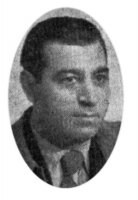 A longtime labor activist and (in 1910)
  This caudillo was a casualty of Argentina’s
 Sickly and emaciated, the 27-year-old was the last guerrilla left in the field after the
  Libya’s despot since ejecting the British-supported
