1850: Five Cayuse, for the Whitman Massacre

On this date in 1850, five Cayuse were publicly executed in Oregon City for the Whitman Massacre.

Beginning in earnest in the 1830s, Anglo settlement in the Oregon Country presented for the native inhabitants of the Pacific Northwest the same Hobson’s choice that had confronted tribes further east long before: resist or accommodate.

The New York-born couple Marcus and Narcissa Whitman* were two of the most notable figures among the hundreds, and then thousands, of settlers pouring into the territory every year. In 1836, they founded on the banks of the Walla Walla River a Christian mission to the nomadic Cayuse who roamed the territory. It’s in present-day Washington State, which was then part (with the current U.S. states of Oregon and Idaho) of a single frontier territory collectively known as Oregon.

The Whitmans’ early settlement, offering medicine, education, and (of course) proselytizing, proved a success at first; it would become for several years a waypoint on the developing Oregon Trail.

White diseases came with the settlers.

The Cayuse people had already dwindled (pdf) to just a thousand or two after the decimations of smallpox and other plagues swept the region in the decades preceding. Now, outbreaks of measles were ravaging those remaining.

Marcus Whitman, a doctor as well as a spiritualist, proved unable to check the new epidemic. Rumors went abroad that the missionaries were bewitching or poisoning the Cayuse, as the vanguard of a coming territorial conquest; the Whitmans themselves were very keen to the hostile feeling the situation had engendered and had even heard whispers that they were the targets of assassination plots. Bravely, they stayed.

“Perhaps God thought it for the best that your little child should be called away,” Narcissa Whitman said in strange consolation to the grieving mother of an Anglo child who also succumbed to measles in 1847. “It may calm the Indians to see a white child taken as well as so many natives, for otherwise we may all be compelled to leave within two weeks.” (pdf source, op. cit.; this document also reconstructs a detailed narrative of the unfolding tragedy)

But that remark was only days before the terrible November 29, 1847. On that cold autumn Monday, a small party of Cayuse led by a chief named Tiloukaikt fell on the mission and slaughtered both Whitmans plus another 11** inhabitants of the little compound.

Some 54 surviving women and children were taken hostage, and several of these died in custody as well. A Canadian official of the Hudson’s Bay Company hurried to ransom the captives at the price of 62 blankets, 63 cotton shirts, 12 muskets, 600 loads of ammunition, 37 pounds of tobacco, and a dozen flints.†

This quick response might have forestalled a worse tragedy for the missionaries — but as far as the Cayuse went, the die was already cast. A volunteer militia of Oregonians under Cornelius Gilliam soon mobilized to retaliate, driving many Cayuse into the Blue Mountains.

By mid-1848, spurred in part by the Whitman bloodbath, Congress officially incorporated the region as the Oregon Territory; arriving early in 1849, the new territorial governor Joseph Lane immediately opened negotiations with the Cayuse to hand over the perpetrators of the massacre. With federal troops arriving later in 1849, the Cayuse at last capitulated and gave up five warriors: Tiloukaikt, the leader; Tomahas; Kiamasumpkin; Iaiachalakis; and Klokomas. (There are numerous alternative transliterations of these names.)

They were tried in Oregon City, the territorial capital at the time — a town of 500 or so on the Willamette River Falls — in a landmark case: the first proper death penalty trial in the young territory.‡ This would fall a little short of modern standards, and not just because it was held in a tavern for want of a regular courthouse. The prosecution was not especially rigorous linking all the defendants to specific violent acts, but the defense’s recourse to Cayuse cultural practices that held shamans liable for the failure of their medicine conceded the point by implication. The judge‘s final instructions simply directed his jury to “infer” the defendants’ culpability by virtue of “the surrender of the Defendants by the Cayuse nation as the murderers, the nation knowing best who those murderers were.” So why even have the trial? Kiamasumpkin, against whom no evidence was ever individually presented, went to the gallows insisting that he didn’t even arrive to the Whitman Mission until the day after the massacre.

All five were condemned in the end, and executed by prominent early pioneer and lawman Joe Meek.§ “On the 3d of June an election and a hanging match took place at Oregon City,” ran the Aug. 22, 1850 story in the New York Tribune — for the Whitman massacre had been a matter of national interest. “The town was full of men and women, the former coming to see how the election resulted, and the latter to see how the Indians were hung.”

“Their tribe, the Cayuses, gave them up to keep peace with the whites. Much doubt was felt as to the policy of hanging them, but the popularity of doing so was undeniable.”

Fears that the quintuple hanging would stoke a running conflict with the Cayuse were not altogether misplaced, but over the subsequent years the dwindling tribe was simply dwarfed by over 30,000 newly arriving settlers lured by a congressional grant of free land. By 1855, the defeated Cayuse were forced onto the small Umatilla Reservation, ceding (along with the Umatillas and the Walla Wallas) 6.4 million acres to whites. The Cayuse tongue was extinct by the end of the century.
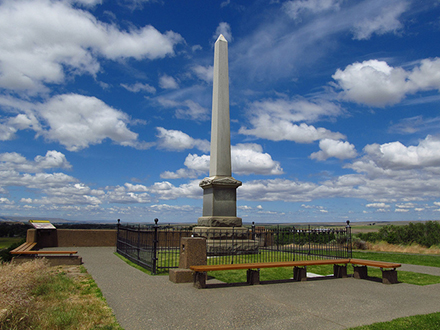

Present-day memorial obelisk at the site of the Whitman Massacre, now a national historic site. (cc) image from Jasperdo.

* Present-day Whitman College (Walla Walla, Wash.) is named for them.

** Figures of both 13 and 14 (inclusive of the Whitmans) are cited in various places for the Whitman Massacre’s body count; the discrepancy turns on whether one’s tally includes as a casualty Peter Hall, who escaped from the mission, fled to Fort Walla Walla, and then made a panicky attempt to reach The Dalles. Hall disappeared into the wilderness, and was never heard from again.

† Ransom covered gratis by the Hudson’s Bay Company.

The Espy file‘s index of U.S. executions lists only a couple of undated executions many years before under informal frontier justice.

§ Cousin to the recent First Lady Sarah Childress Polk.

On this day..

2000: Robert Earl Carter, exonerating Anthony Graves

On this date in 2000, Robert Earl Carter was executed in Texas for slaughtering six people at the home of his Somerville ex, after the latter filed a child support suit against him.

The ex herself, Lisa Davis, wasn’t home at the time. But Carter’s stabbing-and-shooting rampage slew Davis’s mother Bobbie, Bobbie’s 16-year-old daughter Nicole, Robert and Lisa’s son Jason (the subject of the support suit), and three other small children that shared the residence. After murdering them, Carter set the house on fire: the burns he suffered to his own face and arms in the process helped connect him to the crime.

Pressed by interrogators, Carter at first admitted only that he was present with someone else who carried out the murders. Over time, he broke down and admitted to the slayings himself.

But Carter’s supposed other party also became a character fixed in the story that investigators were looking to tell — and that party’s identity became fixed on a casual acquaintance whom Carter eventually accused: Anthony Graves.

No forensic evidence implicated Graves, but Carter provided damning testimony at Graves’s 1994 trial. On that occasion, Carter claimed to have shot the teenage daughter Nicole, while Graves committed the rest of the murders, testimony that sent Anthony Graves to death row as well. (Graves’s brother Arthur Curry testified that Graves had been at home sleeping.)

But Carter changed his story again after both men were convicted.

As he prepared for his execution, Carter was keen to clear Anthony Graves before he left this mortal coil. Weeks earlier, he provided a sworn 85-page statement insisting that “Anthony Graves did not have any part in the murders and was not present before, during or after I committed the multiple murders at the Davis home.”

Even in his last statement on this date, Carter went out of his way to exonerate his supposed accomplice. “I’m sorry for all the pain I’ve caused your family,” Carter said from the gurney in his last moments, addressing the execution witnesses from his victims’ family. “It was me and me alone. Anthony Graves had nothing to do with it. I lied on him in court.”

Anthony Graves had been on death row for six years at this point. With Carter’s retraction it had become discomfitingly apparent that there was practically nothing to associate him with that horrific night in Somerville … butit would still be another decade more before he was officially exonerated and released.

After an appeals court ordered a new trial, a different prosecutor’s investigation of the case turned up just how scanty the case against him was.

“After months of investigation and talking to every witness who’s ever been involved in this case, and people who’ve never been talked to before, after looking under every rock we could find, we found not one piece of credible evidence that links Anthony Graves to the commission of this capital murder,” announced former Harris County prosecutor Kelly Siegler in a statement officially exonerating Graves. “This is not a case where the evidence went south with time or witnesses passed away or we just couldn’t make the case any more. He is an innocent man.” Siegler had been hired as a special prosecutor, and would have been the one to re-try Anthony Graves.

That happened in 2010, by which point Graves at age 45 had spent 18 years in prison, 12 of them on death row.

Today, Anthony Graves — you can find him on twitter at @AnthonyCGraves — is an activist and motivational speaker. He’s been outspoken especially on the torture inflicted by long-term solitary confinement, which he also endured during his years in prison.

Graves’s original prosecutor Charles Sebesta — against whom Graves has sought disciplinary action — maintains a site of his own with a page casting doubt on Anthony Graves’s innocence. (It’s also a minor monument to the “Blog” of “Unnecessary” Quotation Marks.)

On this day..

1879: Troy Dye and Ed Anderson, estate salesmen

On this date in 1879, Sacramento County public administrator Troy Dye was hanged for murder, along with the Swedish goon whom he’d hired to do the dirty work.

A 36-year-old father of three, Dye was a prosperous tavern owner in the California capital who volunteered at the Sunday school. In 1877, voters entrusted him with the necessary public office of managing intestate estates.

In retrospect one can safely say that Dye was not cut out for the public trust.

The position entailed a percentage claim on the estate so handled, which meant in practice that it was a thankless burden for long periods when only paupers died without their wills made out, punctuated by rare jackpots when the occasional wealthy fellow kicked off without heirs.

San Francisco Bulletin, Aug. 16, 1878.

All Dye did was speed that cycle up a little, by arranging to murder a fifty-five-year-old bachelor in order to lay hands on his 650-acre farm and plunder the “rich old son of a bitch.”

Dye hired a Swedish sausage-maker named Ed Anderson and a young tough named Tom Lawton at three grand apiece to handle the labor.

For six hot summer weeks, Anderson and Lawton built a boat on Dye’s property with the one mission in mind. On July 30, they put it into the Sacramento River and rowed it downstream to the Grand Island orchards of their target, Aaron Moses Tullis. Under the guise of soliciting work, Anderson approached Tullis in his groves, and when the man’s back was turned, clobbered him with a blackjack. In the ensuing melee, Lawton, leaping into the fray from hiding nearby, shot Tullis through the throat, then felled him with a shot in the back, and finished him off with an execution-style coup de grace.

The two killers fled two miles down the river, where they ditched the boat. Their employer, signaling furtively by whistling, picked them up in a buggy and rode them back to Sacramento for celebratory oysters.

They wouldn’t be celebrating for long.

News of the murder puzzled the community as it got out. Tullis was wealthy all right, but his assailants had stolen nothing; he wasn’t known to have any enemies; and nobody had seen the riverborne assassins slip onto the property.

But within a few days, discovery of the abandoned boat led to the lumberyard that stamped its planks, and that led to the fellows who purchased it. Tom Lawton wisely used this tiny interval to leave California; Ed Anderson and Troy Dye stuck around and made national wire copy with their confessions before August was out.

Having spilled all the beans, Dye had only the feeblest of gambits remaining to avoid the noose.

At trial, Dye argued that the whole plan was the idea of the other two men, and he, Dye, was was just too damn weak-minded to say them nay.

At sentencing, Dye whined that the district attorney had induced him to confess by dint of a promise to let him walk.**

And during his appeals and clemency process he inconsistently shammed insanity, fooling nobody.

“A more pitiable object than Troy Dye, the assassin, never marched to the scaffold,” one observer noted of the pallid, stocking-footed figure whom the ticketed observers saw on execution day. (Quoted in this pdf retrospective on “one of the most shocking and melancholy episodes in the history of Sacramento.”)

Against Dye’s wheedling and quailing, Anderson cut a picture of manfulness. Even on the eve of the execution, while Dye was just this side of collapse, Anderson noticed the sheriff toting the hanging ropes and insisted on inspecting them, then shocked the lawman with a cool off-color joke.

But this was calm and not mere bravado. Time that Dye wasted in his simulated spasms was spent by Anderson with his spiritual counselor; his gracious last statement from the gallows confessed his guilt and begged forgiveness. “Troy Dye Dies, Anderson Ascends” ran the headline afterwards.

* A county clerk reached by the Sacramento Record-Union recalled a conversation that clouded suspiciously in retrospect: “he said that unless something turned up, that he would not make enough out of it to pay his expenses … I said to him: ‘You cannot tell when some one will die and leave a good estate.’ … he said he did not know of any one who was likely to die that was worth any amount except Mr. Tullis, down the river. He said he was an old man and drank a great deal, and was likely to die at any time, and that he was rich. If he should drop off and he got the estate, it would help him out.” (Reprinted by the San Francisco Bulletin, Aug. 15, 1878)

** That was indeed the case, as it seems that Dye’s confession revealed himself much more deeply involved than the prosecutor had previously assumed. This is why it’s much better to just shut up already.

On this day..

1994: Charles Rodman Campbell, hanged in Washington

(Thanks to Meaghan Good of the Charley Project for the guest post. -ed.)

On this date in 1994, an uncooperative Charles Rodman Campbell was lashed to a board to keep him upright, and hanged by the neck until dead at the Washington State Penitentiary in Walla Walla.

According to this Seattle Times timeline of his life and crimes, Campbell had been getting in trouble since he was a child, to the extent that by the time he was seventeen his mother had given up on him and never wanted him back home again. His crimes began with burglary and drug use but quickly escalated into violence.

True crime author Ann Rule wrote a chapter about Campbell in her book A Rose For Her Grave and Other True Cases:

Charles Rodman Campbell is a killer straight out of a nightmare. There should have been some way to keep him locked up forever. But he slipped through the loopholes of our justice system and he was allowed freedom to stalk his unknowing victims. If ever there was a case that pitted innocence against pure evil, it is this one. He was out of his cage, and he was aware of every facet of her life, and yet his potential prey felt only a chill premonition of danger. He was a man consumed with rage and the need for revenge. Because of a neglectful bureaucracy, Campbell was allowed to take not one life — but three.

The sordid story that lead to his execution began on December 11, 1974, when Campbell broke into the rural Clearview, Washington home of Renae Louise Wicklund. He held a knife to the throat of her baby daughter, Shannah, forced Renae to perform oral sex on him, then fled the scene.

It took over a year to arrest him, but Renae identified him as her attacker and in 1976 he was convicted of burglary, sodomy and first-degree assault and sentenced to thirty years in prison.

In an appalling oversight, Campbell was put on work-release for good behavior in 1981. His behavior in the Monroe Reformatory hadn’t been good at all: he’d racked up multiple infractions for drug trafficking and sexual and physical violence against his fellow inmates. A prison psychologist described him as “uncaring of others, conscienceless, malevolently intolerant of the social order which imprisons him, and imminently harmful to all who directly or indirectly capture his attention or interest.”

It wasn’t until much, much too late that the parole board discovered the Monroe Reformatory was not supplying them with full records of prisoners’ infractions. Hundreds of inmates, it turned out, had been released without a complete evaluation of their behavior in custody.

No surprise, Campbell’s behavior on work-release wasn’t good either. He displayed “poor attitude and behavior,” he was caught drinking alcohol, and his ex-wife claimed he slipped away from his job twice to rape her.

But somehow, the authorities neglected to return him to prison.

Renae Wicklund still lived in the Clearview home where she had been attacked in 1974, and she wasn’t notified when Campbell was let out of prison. In January 1982, he was transferred to a work-release residence less than ten miles from Clearview and he began staking out her house, planning his next move.

On April 14, Campbell went to her home and found her there with Shannah (now eight years old) and a neighbor, Barbara Hendrickson, who along with Renae had testified against him at the rape trial.

Campbell killed them all by slashing their throats. Renae got special treatment: she was also beaten, strangled, stripped naked and her genitals mutilated.

He’d finally committed an offense grave enough to revoke his work-release status.

Campbell was arrested almost immediately and, at his trial, had little to say for himself. It can’t have been hard for the jury to choose the death sentence. As a result of the triple homicide, Washington state passed a law requiring that victims of violent crime be informed when their attackers are released from prison.

The state of Washington allowed (and still allows — it’s the only state with an active gallows) a condemned inmate a choice in the manner of death: hanging, or lethal injection.

During his twelve years of appeals, Campbell refused to make the choice and argued that being made to choose meant the state was effectively forcing him to commit suicide. The default method at the time for a prisoner who refused to choose was hanging,* and Campbell further claimed that was cruel and unusual punishment.

His case actually made it up to the U.S. Supreme Court, but it declined to hear his appeal.

When his time came, the prison staff had to use pepper spray to persuade him to come out of his cell, strap him to a board and drag him to the scaffold, and even then he made things difficult by turning his head this way and that while they tried to secure the hood and noose. But he couldn’t delay the end for long. The prison guards would later find makeshift weapons in his cell, including a four-inch piece of metal in his cell that had been sharpened into a blade.

As of this writing, Campbell was the last man to be judicially hanged in Washington state (though not the last in the U.S.).

* In 1996, the default method of execution in Washington changed to lethal injection.

On this day..

1849: Washington Goode

America’s national debate over abolishing slavery in the decades leading up to the Civil War is well-known. Not as well remembered is a different group of “abolitionists” — for death penalty foes, too, took this name,* and mounted a vigorous challenge against capital punishment, too.

In the main, they did not attain their ultimate objective, although Michigan in 1847 did become the world’s first Anglo polity to abolish executions.** But their contemporary-sounding arguments against the morality and efficacy of capital punishment did help drive important reforms, especially in the Northeast: narrowing the scope of the death penalty towards murder alone, and removing the spectacle of public hangings to the privacy of prison walls. Anti-death penalty scholar Hugo Bedau terms this the “first abolitionist era.”

Alexis de Tocqueville’s American travels began in 1831 with a brief from the French government to investigate the prison system; in the classic Democracy in America that ensued, Tocqueville characterized Americans as “extremely open to compassion.”

In no country is criminal justice administered with more mildness than in the United States. Whilst the English seem disposed carefully to retain the bloody traces of the dark ages in their penal legislation, the Americans have almost expunged capital punishment from their codes. North America is, I think, the only one country upon earth in which the life of no one citizen has been taken for a political offence in the course of the last fifty years.

In Massachusetts, executions nearly ground to a halt … but they never quite got banned de jure. A committee headed by the very liberal legislator Robert Rantoul, who had cut his teeth as a young barrister defending an accused murderer in a death penalty trial, produced for Gov. Edward Everett a strong recommendation to take the death penalty off the books. The votes in the legislature never quite got there, but Gov. Everett would have signed it:

A grave question has been started, wheter it would be safe to abolish altogether the punishment of Death. An increasing tenderness for human life is one of the most decided characteristics of the civilization of the day, and should in every proper way be cherished. Whether it can, with safety to the community, be carried so far, as t permit the punishment of death to be entirely dispensed with, is a question not yet decided by philanthropists and legislators. It may deserve your consideration, whether this interestion question cannot be brought to the test of the sure teacher, — experience. An experiment, instituted and pursued for a sufficient length of time, might settle it on the side of mercy. Such a decision would be matter of cordial congratulation. Should a contrary result ensue, it would probably reconcile the public mind to the continued infliction of capital punishment, as a necessary evil.

Rantoul (and Edwards) had to settle for an 1839 law removing burglary and highway robbery from the ranks of potential capital crimes.

In practice, Massachusetts had not hanged anyone for mere theft in a number of years and by the late 1830s and throughout the 1840s scarcely hanged anyone at all.†

That tenderness of human life would meet what proved a decisive test with
Washington Goode‘s execution on May 25, 1849 for the murder of a fellow sailor over a romantic rivalry.

While philanthropists and legislators debated the merits of the rope in those years, Goode grew up at sea. There was a woman he called on when he made port in Boston, one Mary Ann Williams — married to someone else but kept by no man, Washington Goode included.

In 1848, Goode discovered in his lover’s boudoir a handkerchief given her by another seaman and soon enough started stewing over it. According to the circumstantial case that Goode’s jury ultimately accepted, he went out the next night, packing a wicked sheath knife and openly boasting to drinking buddies of his imminent revenge upon that Thomas Harding.

Later that night, the two rivals (plus Williams) all managed to run into each other in the same joint. Goode and Harding crossed words, then left that place one after another. Half an hour later, Harding had a sheath knife between his ribs. Nobody had actually seen it happened, but the identity of the murderer appeared self-evident.

However plausible the argument for Goode’s guilt and execution in the narrow case at hand, it could not help but be complicated by the execution-free years that had preceded him. Was this the most atrocious crime in Massachusetts of the 1840s? In 1845, a burgher named Albert Terrill had cut the throat of a prostitute on Beacon Hill, and set fire to her room; he had been spared execution.‡

Boston’s death penalty abolitionists mounted a furious clemency campaign, and again the arguments strike a familiar tone for present-day readers: the fallibility of the justice system (Goode maintained his innocence all the way to the gallows); the prospect that, were Goode indeed guilty, alcohol and passion had clouded his mind; and the manifest disproportionality between the extreme penalty that just so happened to be handed down to a poor black workingman when more atrocious crimes by better-connected Bostonians had lately merited far more lenient treatment. Thousands subscribed to petition, like this one, demanding mercy. Henry David Thoreau and Ralph Waldo Emerson fought to save Goode from the gallows.

But the Commonwealth was not moved.

Despairing, Goode slashed his veins during the night preceding the hanging in a vain bid for suicide. He would be hanged that day — after a physician stanched the bleeding and patched him so that Goode could die properly — seated in a chair. The fall broke his neck, and purpled some prose into the bargain.

The scene is past. A more fearful tragedy has never been enacted in our city. A more disgraceful scene never occured in any country. A stain has been made upon Massachusetts that ages can never wash away.

Ostensibly “private”, the jailyard hanging was readily visible from surrounding windows and rooftops in the neighborhood. Some shops in the vicinity even shut up their doors in protest, and hung up placards to make sure those arriving for a rented overlooking window knew it.

But the first abolitionist era was even now giving way to the rising section tension about to tear the country apart. Even people who cared deeply about the death penalty usually cared moreso about slavery … and the stain of Washington Goode’s hanging would be blotted out by the far bloodier years to come.

* The anti-death penalty and anti-slavery causes had a good deal of overlapping personnel, too: slavery abolitionists like Wendell Phillips, Lydia Child, and William Lloyd Garrison were prominent supporters of the Massachusetts Society for the Abolition of Capital Punishment. (See The Death Penalty: An American History.)

** Wisconsin and Rhode Island both followed Michigan’s lead. None of those three states has conducted an execution since the mid-19th century, although Rhode Island did put never-used death penalty statutes back on its books for most of the 20th century.

† According to the Espy file‘s survey of historical U.S. executions.

‡ Terrill was acquitted by his jury in two separate death penalty trials — one for the murder, one for the arson. The verdicts were commonly believed to be acts of nullification by juries unwilling to sully their consciences with a death sentence. (Terrill’s barristers resorted to the embarrassing somnabulism defense.) “We infer that no person will hereafter be convicted of murder in the courts of Massachusetts,” the Boston Courier editorialized. “There is prevalent in society such a feeling of horror [about capital punishment] … jurors will not hesitate to acquit.” But after Terrill, backlash against the verdicts inverted the horror — since it now appeared that the tender scruples of jurymen proposed to hand villains carte blanche.

On this day..

1991: Ignacio Cuevas, Huntsville Prison Siege survivor

This date in 1991 was the quiet coda of one of America’s most spectacular prison risings.

At the stroke of 1 o’clock on July 24, 1974, Federico “Fred” Gomez Carrasco, a life-sentenced heroin kingpin with more money than God, took control of the Huntsville Walls Unit‘s prison library with two henchmen — inmates Rudolfo Dominguez and Ignacio Cuevas. It is Cuevas’s eventual execution on May 23, 1991, that gives us occasion for this post — but the so-called Huntsville Prison Siege was all Carrasco’s show, starting with the guns he was able to smuggle into the stir.

With fifteen hostages in their power, a cordon of Texas Rangers blockading Walls Unit, and a legion of media camped round the clock, the audacious trio bargained for eleven tense and sweltering days — Eleven Days in Hell, by the title of a later account. The desperados won little amenities, like new clothes and toothpaste. The hostages braced for the worst, despite Carrasco’s considerable personal charm.

“I believe Carrasco made an attempt to be shown as a gentleman criminal,” a surviving hostage remembered. “He treated us with a great deal of respect and kindness — except, of course, when he’d tell us, ‘I’m going to shoot you in 20 minutes.’ And he did that three or four times a day.”

One inmate hostage was so afraid of Carrasco that he hurled himself out a glass window to get out from under his thumb. (It worked.) Two other inmates were freed after suffering heart incidents, one real and one feigned.

But Carrasco et al weren’t looking to move into the library permanently and make friends with their hostages. Their ultimate ask of negotiators was a biggie: an armored getaway car. Texas Gov. Dolph Briscoe approved it and had rolled up to the prison courtyard.

The plan, so Carrasco said, was to flee for Cuba.

That Cuba wasn’t, topographically speaking, a drivable destination didn’t really enter into the question: car or no, the authorities obviously had no intention of letting their inmates roll on out for the freedom of the open road. The inmates obviously knew that, too … but then, they hadn’t got all dressed up for nothing.

Shortly after 9 p.m. on August 3, the dramatic eleven-day standoff came to a suitably cinematic shootout conclusion.

The trio of would-be escapees made their way that night for the armored car in an improvised fortification dubbed by the press (with questionable taste) the “Trojan Taco”: rolling blackboards armored with 700 pounds of legal tomes and all the remaining hostages. Carrasco, Dominguez, and Cuevas each handcuffed himself to one of the hostages and hunkered down with his unwilling escort inside the blackboard walls; the others formed a human shield outside the makeshift tank.

It was a pretty good plan to blank the Rangers’ guns.

So the Rangers brought firehoses to the fight instead.

The whole bunch, hostages and all, got hammered as they made their way down a ramp towards the car by the water jets, although the sheer weight of the “Taco” and its law library kept the formation from toppling. A melee ensued, with the desperate inmates firing from little gun ports in the “Taco”, and also shooting their hostages within it. Two of those unfortunates, Yvonne Beseda and Judy Standley, bled out in the prison courtyard.

Cal Thomas, today a nationally syndicated columnist, was a young reporter at the time for a Houston television station. “It is a tragedy that two hostages died,” he would later write. “It is a miracle all the rest lived.”

The perpetrators did not fare as miraculously. Rudolfo Dominguez was shot dead in the exchange. And Carrasco himself, who had once vowed in vain never to be taken alive by U.S. law enforcement, now belatedly made good his resolution by taking his own life. Only Ignacio Cuevas survived it, and he only to face capital murder charges and draw a 1975 ticket to death row. He was finally put to death sixteen years later — just steps away from the scene of his most notorious crime.

On this day..

1824: Antonio Brochetti, galley-dodger

From Henry-Clement Sanson‘s memoirs:

On May 22 the scaffold was again erected for the execution of an Italian, a native of Rome, named Antonio Brochetti. He was imprisoned at Bicetre at the time of the murder, he having been previously sentenced to hard labour for life. He killed one of the turnkeys, with no other object than putting an end to his own life. Life in a prison or in the hulks seemed to him a much more severe punishment than death. His wish was fulfilled; he was condemned to death, and executed on the Place de Greve five days after, at four o’clock in the afternoon.

He went to the scaffold with eagerness. “I would rather die a thousand times than go to the hulks!” he exclaimed several times. Since Brochetti’s execution the severity displayed in French penitentiaries has increased; and his example has been followed by many.

“Galley slavery” in the antique Ben-Hur sense had been a mainstay of European navies since France got the bright idea to address a shortage of oarsmen by making press gangs out of magistrates. This idea was widely copied, and intensified.

At their peak in 1690, French galleys had 15,000 under oars — captured Turks, defeated Huguenots, slaves seized from Africa and North America, and, of course, criminals or anyone who could be construed as such.

Yet even by this time the galley was virtually obsolete as a military asset; Paul Bamford argues that they were maintained for pageantry and (internal) state-building for the French crown. Thus, as the 18th century unfolded, “galley” slaves were increasingly used for hard labor on the docks and in the arsenals — still-brutal punishment in a similar spirit, but no longer literally pulling an oar. By 1748, they were at last formally subsumed into a network of port prisons.

By this late date, however, usage had established the word galérien for convict galley-slaves so firmly that it persisted even now with the new redefinition.** (Italian still to this day has la galera for prison: the acme of seagoing Italian city-states coincided with that of the galley.)


Galleys’ greatest day: the Battle of Lepanto in 1571.

* Lionel Casson (in “Galley Slaves” from the Transactions and Proceedings of the American Philological Association, vol. 97 (1966)) dates this to a January 22, 1443 edict of Charles VII conferring on merchant Jacques Coeur the right to impress vagabonds into his fleet.

** Victor Hugo’s Jean Valjean (Les Miserables) was a galley-slave; he would have been by Antonio Brochetti’s time just a few years out of the galleys himself.

On this day..

2013: Five beheaded and crucified in Jizan

Last year on this date, to the impotent howls of human rights groups, five men were beheaded in Jizan, Saudi Arabia and then “crucified.” “In Saudi Arabia, the practice of ‘crucifixion’ refers to the court-ordered public display of the body after execution,” Amnesty UK noted, “along with the separated head if beheaded. It takes place in a public square to allegedly act as a deterrent.”

Here’s how these five deterred. If you look closely you’ll see the “along with the separated heads” bobbing near each decapitated corpse in little white bags … and if you’re still not convinced, click for a ghastly higher-quality close-up view.


Image via Twitter (see e.g. here, here, and here.

Jizan is a city being developed as a deep water shipping depot by Saudi Aramco in Saudi Arabia’s extreme southwest corner near Yemen; this was the ethnicity of the executed men as well. According to the Saudi Interior Ministry, brothers Khaled, Adel and Qassem Saraa as well as Saif Ali al-Sahari and Khaled Showie al-Sahari comprised a gang who carried out robberies in various different cities. They beat and strangled to death at least one man.

As an inducement to more legitimate folk to stay on the straight and narrow, the quintuple gibbet evidently graced the environs of Jizan’s university. Study hard, lads.

A sixth and unconnected Saudi was also beheaded on the same date in the nearby city of Abha.

On this day..

1871: Edward Rulloff

(Thanks for the guest post to Robert Wilhelm, author of the Murder By Gaslight historic crime blog, and author of the book Murder And Mayhem in Essex County. Executed Today readers are sure to enjoy Wilhelm’s detailed investigations into long-lost historic crime, including his more detailed exploration of Edward Rulloff. -ed.)

An 1871 biography of Edward Rulloff was entitled The Man of Two Lives. This was an understatement.

Rulloff — also known as James Nelson, E. C. Howard, James Dalton, Edward Lieurio, etc. — had been a doctor, a lawyer, a schoolmaster, a photographer, a carpet designer, an inventor, and a phrenologist. Most notably, Rulloff was a philologist, who could speak Latin, Greek and six modern languages and in 1870, was working on a manuscript, Method in the Formation of Language, which he believed would revolutionize the field. But the real dichotomy of Edward Rulloff’s life was the fact that he financed his research by theft and did much of his philological work in prison.

Rulloff started both sides of his life early, working in a law firm and spending two years in the penitentiary for theft, both before age twenty. In 1844 his wife and daughter disappeared and Rulloff was charged with their murder. He handled his own defense and managed to beat the murder charge but was convicted of abduction and spent ten years in Auburn Prison.

After being released, Rulloff divided his time between is intellectual and criminal pursuits, and saw the inside of a jail more than once. In 1870 he was living in New York City, working on his book and running with a gang of petty thieves.

The morning of August 17, 1870, Rulloff and two others broke into Halbert’s dry goods store in Binghamton, New York. A gunfight ensued which left night watchman Fred A. Merrick dead. Rulloff was captured in the manhunt that followed.

Rulloff’s trial for the murder Fred Merrick was sensational, receiving national press coverage and attracting thousands of spectators. Once again Rulloff handled his own defense but this time he was found guilty of murder and sentenced to hang on March 3, 1871.

Unsuccessful appeals delayed the hanging by two and a half months. While awaiting execution, the case became a subject of national debate. Some said it was wrong to take the life of such a learned man who may be on the verge of a great intellectual breakthrough. Horace Greely, owner of the New York Tribune wrote: “In the prison in Binghamton there is a man awaiting death who is too curious an intellectual problem to be wasted on the gallows.”

Others however believed that Rulloff was an intellectual fraud, among them Mark Twain, who satirized Greely’s position saying: “If a life be offered up to the gallows to atone for the murder Rulloff did, will that suffice? If so … I will bring forward a man who, in the interest of learning and science, will take Rulloff’s crime upon himself and submit to be hanged in Rulloff’s place.”

Edward Rulloff was hanged on May 18, 1871. Before his execution, he confessed to killing his wife by smashing her skull with a pestle he used to grind medicine. Rulloff requested that his body be put in a vault so it would not be desecrated, but his request was not honored. Before his lawyer could claim the body, it was placed on public display and the owner of a local art gallery made a plaster death mask. His lawyer gave the body to Dr. George Burr of the Geneva Medical College who promised to bury the body in a private cemetery if he could keep the head for study. After the body was buried it was dug up and stolen by medical students. Edward Rulloff’s brain still exists as part of the Wilder Brain Collection at Cornell University.

Visit Murder by Gaslight for more information on the life and crimes of Edward Rulloff.

On this day..

1866: Mokomoko and the Maori killers of Carl Volkner

On this date in 1866, five Maori men hanged for the murder of a German proselytizer.

Hesse-born Carl Sylvius Völkner* arrived in New Zealand as a Lutheran missionary in 1849; by 1861, he was directing an Anglican-run mission at Opotiki, the center of Maori Te Whakatohea territory.

Unfortunately for Volkner, his mission to win souls overlapped with the British mission to win land.

This same early 1860s period saw a sharpening of the European-Maori conflict on the North Island where Volkner kept his mission — the bloodshed in turn fostering the militant Pai Marire or Hau Hau faith in place of the settlers’. Though the Te Whakatohea weren’t directly involved in this war, they had felt its effects: refugees, food shortages, disease outbreaks.

Volkner, who was seen by Maori as a pro-government character and a British spy,** was warned that under the fraught circumstances he might be wise to extend his most recent trip to Auckland indefinitely and wait for things to simmer down.

He did not heed that warning.

On March 2, 1865, the day after Volkner’s return to Opotiki, a group of Pai Marire hanged the missionary to a willow tree outside his Church of St. Stephen, then butchered the dead body.

The Pai Marire leader Kereopa Te Rau then preached from the church’s pulpit with Volkner’s severed head at his side, in the course of which he tore the eyeballs from his grisly prop and, calling one “the Queen” and the other “Parliament”, theatrically devoured them. (Kereopa Te Rau is nicknamed “Kai whatu”, “the eyeball eater”.)

Old eyeball eater would eventually hang for this display as well, but he avoided capture until the 1870s — so this narrative takes its leave of him here.

The slaughter of the European evangelist at the very steps of the protomartyr’s church in turn fired the fury of white New Zealand.

The most immediate response was the government’s landing 500 soldiers in Opotiki in September 1865. From there they raided throughout Te Whakatohea territory (confiscating some 240,000 hectares that would feed white settlers’ surging demand for real estate) and put crops to the torch until the tribe surrendered up some 20 chiefs for punishment of the Volkner affair.

Five of those eventually hanged for their participation: Heremita Kahupaea, Hakaraia Te Rahui, Horomona Propiti and Mikaere Kirimangu … and a man named Mokomoko who was then and remains now the most controversial execution of the bunch.

Mokomoko’s guilt was sharply disputed by eyewitnesses who gave conflicting accounts of whether he was even present at the church on March 2. It was Mokomoko’s rope that strangled Carl Volkner, but the man himself insisted that he was not present. (The three witnesses who placed him on the scene said he carried the rope, suggesting participation far exceeding a bystander.)

Maori tradition preserved Mokomoko as an emblem of wrongful persecution, along with his song Tangohia mai te taura i taku kaki kia waiata au i taku waiata (Take the rope from my neck that I may sing my song):

Violent shaking will not rouse me from my sleep
They treat me like a common thief
It is true that I embrace eternal sleep
For that is the lot of a man condemned to die.

Shielded from the harsh light
With narrow eyes I reflect on the retribution taken at Hamukete
Remember how I was taken on board ship (chained)
The memory of it burns me with shame.

Bring me justice from distant lands to break my shackles
Where the sun sets is a government in Europe
It is for them to say that I must hang
Then shut me in my coffin box.

Under pressure from Mokomoko’s descendants, latter-day New Zealand has made a number of gestures of apology for Mokomoko’s hanging over the past 20-odd years, culminating in a posthumous pardon.

* A copse of rocks sprouting out of New Zealand’s Bay of Plenty is named for our man — the Volkner Rocks, also known as Te Paepae o Aotea.

** He sent reports to the government about subversive activity.

On this day..