1283: Dafydd ap Gruffydd, Prince of Wales

(Thanks to Jonathan Shipley of A Writer’s Desk for the guest post. -ed.)

Do not cross King Edward I.

If you cross “Longshanks,” as the regal man was called, you’re in for some serious pain. And then, eventually, you’ll die, like Dafydd ap Gruffydd did this day in 1283.

It is Dafydd, a Prince of Wales, who became the first prominent person in recorded history to have been hanged, drawn and quartered.

Yes, Dafydd’s death was particularly gruesome. Having fought alongside King Edward against Dafydd’s own brother and then returning to his brother’s side attacking King Edward’s Englishmen at Hawarden Castle, made the king rather peeved.

The English conquest of Wales: end of an era.

When Longshanks got the better of him, Dafydd was dragged through the streets of Shrewsbury attached to a horse’s tail. He was then hanged, but not enough to kill him, just enough to make it awfully uncomfortable.

More uncomfortable was the emasculation.

Perhaps more uncomfortable than being emasculated was when Dafydd was disemboweled and his entrails burned before his eyes.

Then they cut off his head, which must have been a relief.

Then they cut off his limbs.

Then they parboiled his head for later viewing.

(William Wallace met the same fate from the same king a couple of decades later.)

It wasn’t always so gruesome for Dafydd ap Gruffydd, the well-to-do Welshman. Things were going quite well there for a time -– as good as a bloody power struggle with your brother can be. Prince of Gwynedd, son of Gruffudd ap Llywelyn, grandson of the mightly Llweyln the Great, Dafydd ap Gruffydd was born in 1238 under the English King Henry III. In his teens, that wily rebel, Dafydd joined one brother (Owain Goch ap Gruffydd) to challenge another brother (Llywelyn ap Gruffydd) for power. Llwelyn won at the Battle of Bryn Derwin. In 1263 Dafydd tried again, joining King Henry against his brother. In 1274 he tried once again. This time with the new king, “Longshanks.”

Things were great. Dafydd was favored by the king. He married Lady Elizabeth Ferrers, daughter of the 5th Earl of Derby. He enjoyed a manor in Norfolk, before exchanging it for another in Northampton. Indeed, it was high society living for the Welshman.

But Wales wanted independence from England. In the spring of 1282 Dafydd, with his brother (the one he tried to defeat many times before, Llywelyn) attacked an English castle. Foolish. Compelled to help his brother yet not being prepared for all-out war, Dafydd crossed the king and the king, angered, pursued him with a vengeance. Troops marched out. Fortifications (Caernarfon Castle, Conwy Castle, Harlech Castle, etc.) were thrown up to squash any thoughts of any further Welsh rebellion, and seed the future Welsh tourist industry.

Come December of 1282, Llywelyn, Dafydd’s dear brother, was lured into a trap and killed. Dafydd became prince, for a brief and stressful span, what the pursuit of the Enligh army, and a king behind it all still fuming over being backstabbed by a Welshman.

Whenever the English caught up with him, he escaped. In April he went north to Dolbadarn Castle. In May he moved to Garth Celyn. Then to a bog. It was by Bera Mountain, in said bog, that Dafydd and his younger brother Owain were captured on June 22, 1284. Dafydd’s wife was taken prisoner, as were their seven daughters, and one niece. About a week later Edward proclaimed the last of the ‘treacherous lineage’ were now his. Dafydd’s fate was then discussed by parliament.

He was condemned to death, the first person known to have been tried and executed for what, from that time onwards, would be described as high treason against the King. And treasonous blokes don’t get off very easily when it comes to a peaceful execution. No, his entrails were burned before him for “his sacrilege in committing his crimes in the week of Christ’s passion.” His body was chopped up “for plotting the king’s death.” A gentlemen by the name of Geoffrey carried out the execution of the last native Prince of Wales. His payment? 20 shillings.

On this day..

1503: Anacaona and the caciques of Xaragua

Sometime around this date in 1503, the Spanish destroyed the independent territory of Xaragua on Hispaniola in a bloodbath of native caciques — capped with the ignominious public hanging of the Taino queen Anacaona.

The widow of the chief Caonabo (Spanish link), who had been captured and shipped to Spain by Christopher Columbus himself, Anacaona inherited leadership of one of the principle Taino realms of Hispaniola, present-day Haiti and Dominican Republic.

Spain had the werewithal to be extremely crappy to the Hispaniola “Indians”, but it would take a few years to have sufficient presence to conquer them all.

By 1503, after a decade’s slaughter and disease had decimated the native populace, villainous Spanish Governor Nicolas de Ovando was ready to dominate the whole island.

Calling a meeting with the Xaragua caciques, Ovando’s troops enjoyed the Taino hospitality. Bartolome de las Casas describes the festivities:

Xaraqua is the Fourth Kingdom, and as it were the Centre and Middle of the whole Island, and is not to be equalled for fluency of Speech and politeness of Idiom or Dialect by any Inhabitants of the other Kingdoms, and in Policy and Morality transcends them all. Herein the Lords and Peers abounded, and the very Populace excelled in in stature and habit of Body: Their King was Behechio by name and who had a Sister called Anacaona, and both the Brother as well as Sister had loaded the Spaniards with Benefits (pdf) and singular acts of Civility, and by delivering them from the evident and apparent danger of Death, did signal services to the Castilian Kings. Behechio dying the supreme power of the Kingdom fell to Anacaona: But it happened one day, that the Governour of an Island, attended by 60 Horse, and 30 Foot (now the Cavalry was sufficiently able to unpeople not only the Isle, but also the whole Continent) he summoned about 300 … noblemen to appear before him, and commanded the most powerful of them, being first crouded into a Thatcht Barn or Hovel, to be exposed to the fury of the merciless Fire, and the rest to be pierced with Lances, and run through with the point of the Sword, by a multitude of Men: And Anacaona herself who (as we said before) sway’d the Imperial Scepter, to her greater honor was hanged on a Gibbet. And if it fell out that any person instigated by Compassion or Covetousness, did entertain any Indian Boys and mount them on Horses, to prevent their Murder, another was appointed to follow them, who ran them through the back or in the hinder parts, and if they chanced to escape Death, and fall to the ground, they immediately cut off his Legs; and when any of those Indians, that survived these Barbarous Massacres, betook themselves to an Isle eight miles distant, to escape their Butcheries, they were then committed to servitude during Life.

Horror followed horror. Washington Irving‘s History of the Life and Voyages of Christopher Columbus:

Contemporary writers … have concurred in representing Anacaona, as remarkable for her native propriety and dignity. She was adored by her subjects, so as to hold a kind of dominion over them, even during the lifetime of her brother; she is said to have been skilled in composing the areytos or legendary ballads of her nation, and may have conduced much towards producing that superior degree or refinement remarked among her people … After the massacre ot Xaragua, the destruction of its inhabitants still continued. The favourite nephew of Anacaona, the cacique Guaora who had fled to the mountains, was hunted like a wild beast, until he was taken, and likewise hanged. For six months the Spaniards continued ravaging the country with horse and foot, under the pretext of quelling insurrections; for, wherever the affrighted natives took refuge in their despair, herding in dismal caverns and the fastnesses of the mountains, they were represented as assembling in arms to make a head of rebellion. Having at length hunted them out of their retreats, destroyed many, and reduced the survivors to the most deplorable misery and abject submission, the whole of that part of the island was considered as restored to good order; and in commemoration of this great triumph, Ovando founded a town near to the lake, which he called Santa Maria de la verdadera Paz. (St. Mary of the true Peace.)

Such is the tragical story of the delightful region of Xaragua, and of its amiable and hospitable people. A place which the Europeans, by their own account, found a perfect paradise, but which, by their vile passions, they filled with horror and desolation.

The martyred artist-queen continues to inspire art of her own.

(More — in Spanish — about this Cheo Feliciano song.)

On this day..

1898: The Six Gentlemen of the Hundred Days’ Reform

This afternoon in 1898, six liberals got the chop for their hopeless attempt to give a tottering empire the reforms it desperately needed.

The Hundred Days’ Reform — actually 103 days, from June 11 to September 21 — marked the attempt by China’s Guangxu Emperor to implement a far-reaching modernization programme backed by forward-thinking officials with a mind to correct China’s supine position vis-a-vis the West, and even vis-a-vis its neighbors.

“Reform has never come about in any country without the flow of blood. No one in China in modern times has sacrificed himself for the cause of reform, and because of this China is still a poor and backward country. Therefore, I request that the sacrifices begin with myself.” –Tan Sitong

The Wuxu Constitutional Reform still stands as the great attempt made by Chinese progressives who tried to follow the example of the modern powers in order to save China from extinction. Represented by Kang Youwei and Liang Qichao, the bourgeois reformists were imbued with the spirit of national salvation; they carefully set about designing a blueprint for a constitutional monarchy based on the example of Western countries. They advocated the establishment of parliament and a national conference, and wanted to see honest and fair-minded people with the courage to criticize authority installed in a position of power. National policies should be discussed by the monarch and the people. They also wanted a constitution to stipulate the rights and obligations of the monarch, officials, and the people. The constitution was to be the highest code for all people in the country. They also wanted to establish a system featuring a tripartite balance of forces: parliament was to legislate, the magistracy to deal with issues of justice, the government with administration. All of these would be under the monarch.

The constitutional reform was to take place with radical intellectuals submitting their memoranda to Emperor Guang Xu, who alone had the power to promulgate them. The feudal diehards being in a position of strength and the national bourgeoisie being weak, however, the new politics survived no more than 100 days or so. When the forces of reaction inevitably clamped down on the movement, the six reformists who had inspired the movement for constitutional reform met their deaths like heroes.

Although sincere in its aspirations, the reform movement was bound to fail, as it depended on a reform “from top to bottom”, which ultimately had to be enacted by the emperor. The Hundred Days’ Constitutional Reform, however, remains a landmark event in the modern history of China, its failure notwithstanding. The Chinese bourgeoisie in fact succeeded in spreading democratic and constitutionalist ideas widely, and this had a significant effect on future generations. The political and legal theory of the Western bourgeoisie could now take root in the soil of China.*

The emperor’s Machiavellian conservative aunt, the Empress Dowager Cixi, who had been the power behind the Chinese throne since 1861, made the sure reform didn’t see two hundred days with a “coup” that didn’t formally overthrow the Emperor — just made him irrelevant.

Troublemakers further down the food chain didn’t get off so easily.

Kang Youwei, the reform movement’s chief exponent, escaped to Japan. Six others suffered the wrath of the Dowager Empress: Kang Guangren (Kang Youwei’s brother), Lin Xu, Yang Shenxiu, Yang Rui and Liu Guangdi … along with the young reformer Tan Sitong, who notably refused imprecations to flee arrest.

The sword’s blade across my neck,
I look toward heaven — laughing.
-Etched on a prison wall, allegedly by Tan Sitong


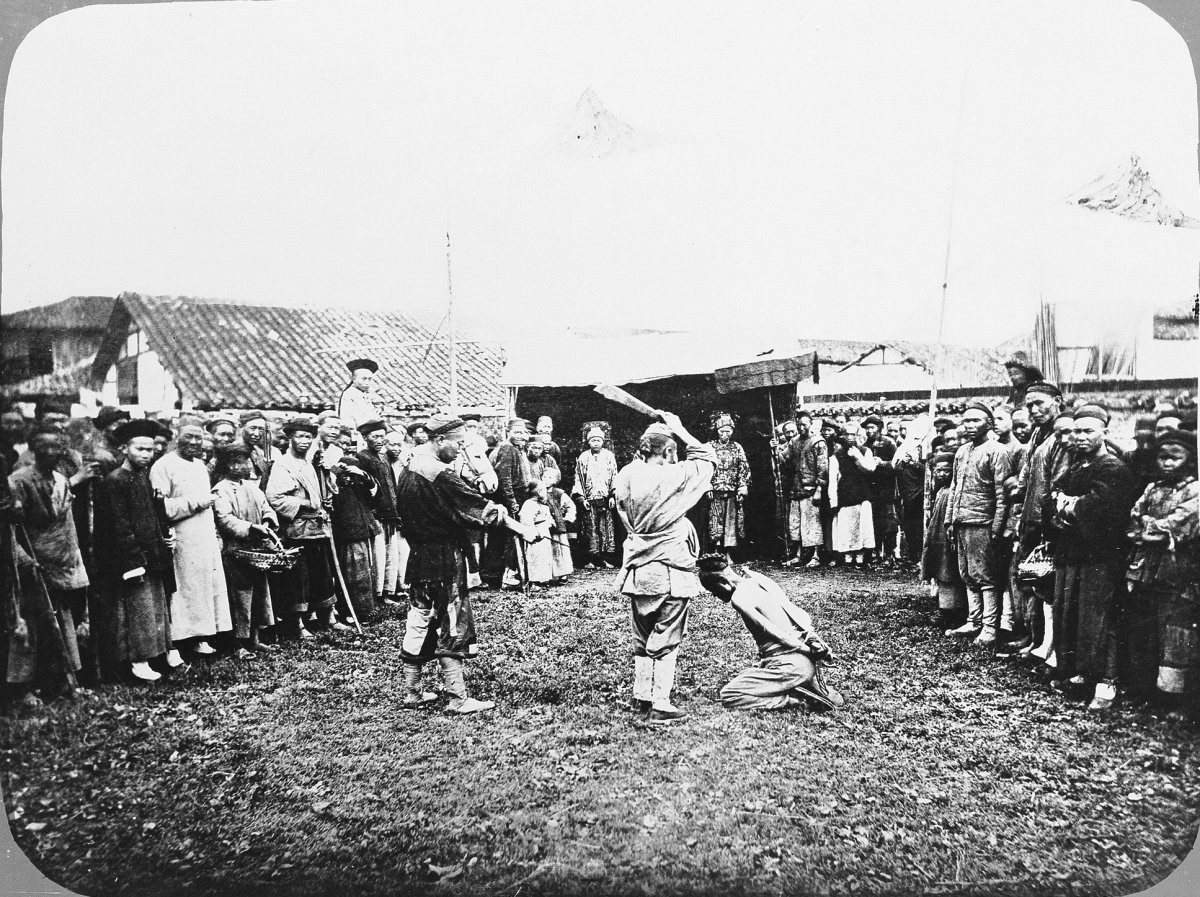
Photo of an unspecified 1867 Qing beheading in Canton.

* “The Chinese Legal Tradition and the European View of the Rule of Law” by Wu Shu-Chen in The Rule of Law History, Theory and Criticism, Part VI.

On this day..

1996: Dr. Mohammad Najibullah

On this date in 1996, the man who once ruled ruled Afghanistan under the aegis of a superpower succumbed to the tender mercies of his country’s fundamentalist insurgency.

Mohammad Najibullah was the last president of the Soviet-backed Democratic Republic of Afghanistan. Unfortunately for Najibullah, he was on the job when Moscow decided to throw in the towel on the Soviet-Afghan War.

After losing the subsequent civil war, the former President was trapped for a nervous few years in Kabul — blocked from joining his family in flight to India by the offices of former Soviet client and present-day American client Abdul Rashid Dostum.

When Kabul finally surrendered to the Taliban in 1996, the hated onetime Communist viceroy — whose stepping-stone to that post was heading the hated Afghan secret police — had a problem.

At the instigation of future Taliban second-in-command Mohammad Rabbani, Najibullah and his brother were hauled out of the U.N. compound where they had taken refuge, publicly beaten, tortured and castrated, and strung up on a traffic barricade.

There was a new sheriff in town.


On this day..

1764: Lt. Vasily Mirovich, for attempting to topple Catherine the Great

On this date* in 1764, one of history’s greatest monarchs cemented her still-uncertain hold on power by beheading a rebellious lieutenant.

Ivan VI: Born under a bad tsar.

Succession in the Russian Empire had been disputatious ever since Peter the Great went and killed off his last male son, eventually putting far-flung branches of the family into a contest for power.

To skip over much regal jockeying, Peter’s vicious niece Anna, who reigned in the 1730s, had installed her infant nephew Ivan VI as successor just before her own death.

The little Tsar of All the Russias was displaced before his second birthday by Peter the Great’s daughter Elizabeth, who clapped the former emperor in a dungeon in Schlusselburg fortress to grow up ignorant and alone, isolated from the parties who might scheme to bid for power in his name. Two Caesars are too many.

Into this dangerous scene stepped Sophia Augusta Frederica, better known to posterity by the name she took upon her politically savvy conversion to Orthodoxy: Catherine.

This Catherine immigrated to wed Elizabeth’s simpleminded heir, then overthrew him a few months into his reign.

Catherine had ultimate power, but she wasn’t yet “Catherine the Great”: as a foreigner with the late Romanov’s blood on her hands (if only indirectly), it was nowhere written that she would rule Russia for 34 brilliant years. And with the throne came its rival claimants … like Ivan, now an adult and potentially more “legitimate” than this imported German princess.

Ivan was held in Man in the Iron Mask-like secrecy, known only as “Nameless Prisoner Number One”; his warders had strict orders to murder him on the spot were any attempt made to liberate him.

Two years into Catherine’s reign, Lt. Vasily Mirovich, “a tormented young officer … with dreams of restoring his family’s fortunes,” attempted just that. As commanded, the guards put an end to Ivan’s troubles.

Those guards got cash rewards and promotions for their diligence. Mirovich got death. (Other soldiers whom he had rallied to his cause were condemned to run the gauntlet; I have been unable to ascertain if any were killed by this punishment.)

Mirovich was executed in St. Petersburg. When his head was held up to the crowd, it had a terrifying impact, the death penalty not actually having been exercised in Russia for 22 years.** Mirovich himself faced his execution calmly, convincing some of the bystanders that he was expecting to be pardoned at the last minute. His remains were left on public display until the evening, when they were burnt along with the gallows.

And so the first two years of the reign of Catherine II, who set so much store by reason and enlightened principles, had included two assassinations and an execution.

The woman of letters, the correspondent of philosophers, the Semiramis of the North … like the age’s other great enlightened despot, Frederick the Great, Catherine had to rule. She had not the luxury to dispense with statecraft’s cruel necessities.

Her admirers would have to be content with making her excuses. Fortunately, admirers always are.

“These are family matters with which I do not meddle,” wrote Voltaire. “Besides, it is not a bad thing to have a fault to repair; this engages her to make great efforts in order to force the public to esteem and admiration”

* September 26 (pdf) was the date on the Gregorian calendar then prevalent in Europe; it was September 15 by the older Julian calendar still used in Russia at the time.

** Not carrying out the death penalty had been a signature policy of Ivan’s usurper Elizabeth. The elimination of capital punishment in “backwards” Russia for an entire generation during the Age of Absolutism surely urges caution against any assumption that death penalty repeal is a one-way street.

On this day..

1864: Six of Mosby’s Rangers

It was on this date in 1864* that an infamous Union war crime took place in Front Royal, Virginia.

Union forces in the Old Dominion were bedeviled by John Singleton Mosby, whose bold and legendary guerrilla tactics are commemorated in Herman Melville’s “The Scout Toward Aldie”:

All spake of him, but few had seen
Except the maimed ones or the low;
Yet rumor made him every thing–
A farmer–woodman–refugee–
The man who crossed the field but now;
A spell about his life did cling —
Who to the ground shall Mosby bring?

In 1864, the “Gray Ghost” haunted the Shenandoah Valley, and his spooky brand of warfare eventually goaded the Union into crossing the streams.

Allegedly raging from the murder by Mosby’s troops of a surrendering northern cavalryman, the blues rounded up six captured Mosby men — actually only five, plus one 17-year-old civilian who had opportunistically joined the fray — and summarily executed them.

David Jones, Lucien Love and Thomas Anderson were shot. So was the aforementioned civilian, Henry Rhodes, under the eyes of his shrieking mother.

Then, two last unfortunates were hanged. William Thomas Overton spurned an offer of clemency in exchange for information on Mosby’s hideouts with the memorable parting, “Mosby will hang 10 of you for every one of us.”

Not quite so … but not an empty threat, either. Weeks later, Mosby would order the retaliatory executions of a like number** of randomly-selected Union prisoners of war, and communicate this intelligence to his foes along with his (successful) suit to resume more gentlemanly methods of killing one another.

* Some sources (including some cited in this post) claim September 22nd. The consensus of authoritative sources appears to be clearly September 23rd. The Gray Ghost himself may be one source of the confusion; according to Custer and the Front Royal Executions, “In his memoirs, which were published over 50 years after the event, Mosby got the date wrong, apparently based upon one of the newspaper accounts … [which] stated that the Front Royal incident occurred on September 22, not September 23, the date upon which it actually did occur.”

** Seven were condemned in retaliation, for these six plus a separate execution that occurred Oct. 13.

On this day..

1918: The 26 Baku Commissars

On this date in 1918, 26 Bolsheviks and Left SRs were shot in what is now Turkmenistan, their bid to establish Soviet power in Baku defeated — temporarily.


The Execution of the Twenty-Six Baku Commissars, by Isaak Brodsky (1925)

The 26 Baku Commissars were the men of the Baku Commune, a short-lived Communist government in 1918 led by the “Caucasian Lenin,” Stepan Shahumyan. (He was a good buddy of the Russian Lenin, Vladimir Ilyich Ulyanov.)

In a cauldron of ethnic violence and against the military interventions of Turkey and Britain, these worthies were tasked with extending Soviet writ to the stupendous Azerbaijani oil fields* — the predominant source of tsarist Russia’s oil, and destined to be the engine of Soviet industry as well.

The Baku Soviet was expelled by the British, who inherited the bloody fight against an advancing Ottoman army.

Shahumyan and his fellow commissars, meanwhile, fled by ship across the Caspian Sea to Krasnovodsk (now Turkmenbashi, Turkmenistan), where they fell into the hands of a the anti-Soviet factions — backed, once again, by the British — of a brand new locale’s incarnation of civil war.

The commissars’ “presence in Krasnovodsk was a matter of great concern to the [anti-Bolshevik] Ashkhabad Committee, the members of which were seriously alarmed that opposition elements in Transcaspia might take advantage of the presence of the Commissars to stage a revolt against the government.” Said concern was relieved by the expedient of escorting the Baku Soviet to the desert and shooting them en masse.

The Red Army recaptured Baku in 1920, this time for good, and Shahumyan and friends were raised to the firmament of Communist martyrology, and not only in the Azerbaijan Soviet Socialist Republic. Streets and schools throughout the USSR bore their names.

As with many Soviet icons, the commissars had a rough come-down after the Iron Curtain fell. Their monument in Baku stood untended for many years, its eternal flame extinguished … until it was finally (and somewhat controversially) torn down earlier this year.


The Baku Commissars’ monument and its dead eternal flame, prior to its early 2009 demolition. Image (c) denn22 and used with permission.

* The Nobel family, which established the Nobel Prize, had a significant presence in the Baku petrol industry.

On this day..

1989: Henri Zongo and Jean-Baptiste Boukary Lengani

This evening in 1989, the number two and three men in Burkina Faso’s military government were seized and summarily executed for allegedly plotting a coup of their own.


Lengani and Zongo

Henri Zongo and Jean-Baptiste Boukary Lengani certainly had the pedigree for it; they’d conspired along with Blaise Compaore in the 1983 putsch that brought Thomas Sankara to power … and then Zongo, Lengani and Compaore had overthrown Sankara four years later.

On this date, a triumvirate increasingly strained by personal rivalries and economic disagreements was unilaterally dissolved.

According to the official announcement, Zongo and Lengani planned to seize the airport while President Compaore was out of the country, shooting down his returning plane if necessary.

Whether accurate or pretext, their elimination (along with two other conspirators) helped Compaore consolidate his hold on Burkina Faso — a country he still governs to this day.

On this day..

1961: Adnan Menderes

On this date in 1961, the Turkish Prime Minister deposed in the previous year’s military coup was hanged at the island of Imrali.

Condemned at the same trial as his comrades in government,* Adnan Menderes delayed his execution with an unsuccessful suicide bid. Revived from a sleeping pill-induced coma, the gag about Istanbul was that he would soon be fit enough to hang.

Twenty-four hours and one involuntary stomach-pumping later, and he was.

The 62-year-old Smyrna/Izmir native had had a memorable run. He served in Ataturk’s army, then toppled Ataturk’s political party: Menderes won the first three free elections in Turkey in 1950, 1954, and 1957, a feat never since replicated. He was notorious for his temper and sensitivity to criticism, reportedly given to smashing things in his office and demonstrably given to firing ministers and aides for even trifling differences of opinion. Just months before his ouster, he’d survived a plane crash in England — “the former Premier,” observed the New York Times,** “might have gone down in Turkish history as a great patriot and champion of the people” if he had died in it.

His ignominious end didn’t blacken his name to posterity. Years later, he (and the officials who preceded him to the gallows) was posthumously pardoned and reburied in an Istanbul mausoleum. Today, he’s so far from public opprobrium that his name can be found on public accommodations like airports and ferries

There’s more information about Menderes available online in Turkish, including this biography and this film:

* Among the co-defendants also condemned but reprieved was Mahmut Celal Bayar, President of the Republic of Turkey. Bayar died in 1986 at age 103, supposedly the longest-lived head of state or head of government in all of history.

** September 17, 1961.

Part of the Daily Double: Turkey’s “Left-Wing Coup”.

On this day..

1961: Fatin Rustu Zorlu and Hasan Polatkan

On this date in 1961, two former Turkish ministers of state were hanged together on the island of Imrali.*

A ten-month trial on the island of Yassiada had ended just the previous day, condemning 15 to death; 12 sentences were commuted, leaving only the biggest fish to fry.

Zorlu, the former Foreign Minister, and Polatkan, late the Finance Minister, were both implicated in the financial crimes often characteristic of high office. Zorlu was also condemned for helping instigate a notorious 1955 anti-Greek riot. The two were helicoptered to Imrali for a pre-dawn hanging.

Zorlu, at least, was reported to have died game. He helped slip the noose over his own neck, and at his hanging “asked that he be allowed to kick away the chair himself. Permission was granted.” (Los Angeles Times, September 18, 1961)

* Tangentially, the prison on Imrali is the one American drug-smuggler Billy Hayes subsequently escaped from. Hayes went on to write Midnight Express, later adapted for the silver screen by Oliver Stone.

Part of the Daily Double: Turkey’s “Left-Wing Coup”.

On this day..