1463: David of Trebizond and his heirs

On this date in 1463, the last regal claimants of Byzantium’s last successor state were executed in Constantinople.

They were, by this time, two years deposed from actual power. David of Trebizond (aka David Comnenos) had inherited the enclave“empire” clinging to the Black Sea coast in 1459, and proved himself “a fit agent for consummating the ruin of an empire.”

Specifically, he cleverly set about needling the overwhelming Turkish power on his borders by vainly attempting to stir up another Crusade, and refused to pay the Mohammedan tribute.

Having recently reduced the impregnable fastness of Constantinople, Mehmed the Conqueror handily availed this provocation to overrun Trebizond.

David and kin made out okay by this calamitous extinction of the Byzantine candle, negotiating in the summer of 1461 an arrangement to settle in Adrianople under the sultan’s protection (and monitoring).

Two years later, David was reportedly caught plotting against the keeper of his gilded cage once more, and Mehmed had the former Emperor, his sons, a nephew and a brother-in-law beheaded, neatly extinguishing the last people with any lineal claim the late Greek imperium.

Theodore Spandounes, a Venetian of Byzantine refugee stock writing in the early 16th century,* claims this was a set-up by Mehmet, “ravenously thirsting for Christian blood,” and that the Komnenoi were given the chance to convert to Islam and atoned their poor statecraft with holy martyrdom.

Furthermore,

Mehmed confiscated all the property of the imperial family of Trebizond and condemned the Empress [Helen Kantakouzene or Cantacuzene] to pay 15,000 ducats within three days or be executed. Her servants, who were Mehmed’s prisoners in Constantinople, worked from dawn to dusk to raise the money and paid it … [but] she had no desire to remain in this world; and, clad in sackcloth, she who had been accustomed to regal finery, refused to eat meat any more and built herself a hovel covered in straw in which she slept rough. Mehmed had decreed that no one was to bury the bodies under pain of death. They were to be left for the dogs and ravens to devour. But the sainted Empress secretly acquired a spade and with her own delicate hands as best she could dug a trench in her hut. All day long she defended the corpses against the animals and at night she took them one by one and gave them burial. Thus did God give her the grace to bury her husband and her sons; and a few days later she too died.

* And writing, it should be observed, with the polemical intent of persuading western powers to go fight the Ottomans.

On this day..

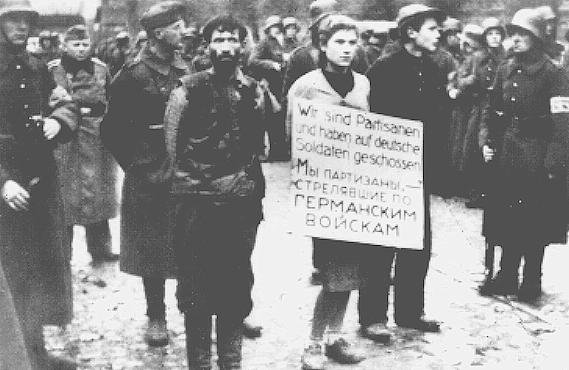
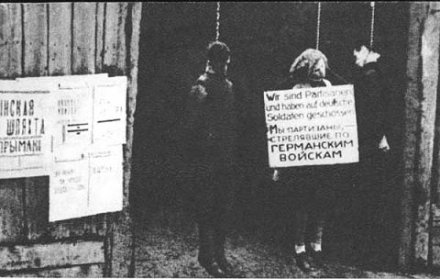
1941: Masha Bruskina, Kiril Trus, and Volodia Shcherbatsevich, partisans

On this date in 1941, the German occupiers of Minsk conducted an infamous public hanging of partisans — perhaps the first such salutary public execution of resistance members of the war.

Jewish* 17-year-old Maria (Masha) Bruskina was the central figure of the grim tableau, and wore the placard announcing “We are partisans and have shot at German soldiers.” Evidently, she also attracted the most attention** from the onlookers to whom the scene was addressed.

Before noon, I saw the armed German and Lithuanian soldiers appear on the street. From over the bridge they escorted three people with their arms tied behind their backs. In the middle there was a girl with a sign-board on her chest. They were led up to the yeast factory gate. I noticed how calmly these people walked. The girl did not look around … The first one led to the gallows was the girl.

She was hanged with bewhiskered World War I vet Kiril Trus and the 16-year-old Volodia Shcherbatsevich. The men were members of a partisan cell organizing anti-fascist resistance; Masha Bruskina was a nurse who had been caught aiding the partisans by providing civilian clothes and papers for wounded Red Army soldiers under her care to smuggle them back to the resistance.

The scene of their deaths was captured in a series of powerful photographs taken by one of the Lithuanian Wehrmacht collaborators.

(More images here and here.)

* Phototextualities: Intersections of Photography and Narrative claims that Bruskina lightened her hair and changed her name to prevent her Jewishness affecting her resistance work; even though she was a Minsk native, her initial identification didn’t happen until 1968. The men who suffered with her were named almost immediately after the war.

** Despite the eye-catching place of the girl, she was officially unidentified for decades even after the name Masha Bruskina surfaced. In “A Historical Injustice: The Case of Masha Bruskina,” (Holocaust Genocide Studies 1997, 11:3) Nechama Tec and Daniel Weiss argued that Soviet authorities, and later Belarusian ones, found her Jewishness problematic and resisted identifying her because of it — while an ethnically Russian female partisan like Zoya Kosmodemyanskaya could be more conveniently accepted as a heroine. Maybe, but bureaucratic inertia and simple precedence (since Zoya Kosmodemyanskaya was known immediately while Masha Bruskina was not) are also plausible contributing factors.

A plaque unveiled at the Minsk yeast factory in 2009 finally called her Maria Bruskina.

On this day..

1415: Bardolph, Hal’s friend

On this date in 1415, on the eve of the Battle of Agincourt, the young English King Henry V approved the execution of his onetime boon companion Bardolph in William Shakespeare’s Henry V.

The fictional Bardolph had been the ruddy-nosed friend of Henry’s in the Henry IV plays (Part 1, Part 2), where the hard-drinking, rabble-rousing young prince is a disappointment to the father who fears his heir will never merit the throne.

By Henry V, the boy has become the ruler, and launched an audacious incursion into France during the Hundred Years’ War.

Hal’s willingness to own the rough decisions of statecraft — in this case having his friend put to death further to his win-French-hearts-and-minds policy — is part of his coming of age as Henry V.

Whether that means Hal’s maturation into regal dignity or the corruption of his humanity by power is up to the reader.

KING

How now Fluellen, cam’st thou from the Bridge?

FLUELLEN

I, so please your Maiestie: The Duke of Exeter
ha’s very gallantly maintain’d the Pridge; the French is
gone off, looke you, and there is gallant and most praue
passages: marry, th’ athuersarie was haue possession of
the Pridge, but he is enforced to retyre, and the Duke of
Exeter is Master of the Pridge: I can tell your Maiestie,
the Duke is a praue man

KING

What men haue you lost, Fluellen?

FLUELLEN

The perdition of th’ athuersarie hath beene very
great, reasonnable great: marry for my part, I thinke the
Duke hath lost neuer a man, but one that is like to be executed
for robbing a Church, one Bardolph, if your Maiestie
know the man: his face is all bubukles and whelkes,
and knobs, and flames a fire, and his lippes blowes at his
nose, and it is like a coale of fire, sometimes plew, and
sometimes red, but his nose is executed, and his fire’s
out

KING

Wee would haue all such offendors so cut off:
and we giue expresse charge, that in our Marches through
the Countrey, there be nothing compell’d from the Villages;
nothing taken, but pay’d for: none of the French
vpbrayded or abused in disdainefull Language; for when
Leuitie and Crueltie play for a Kingdome, the gentler
Gamester is the soonest winner.

This is Laurence Olivier’s 1944 version of the scene, with the commoner Bardolph well off-camera:

… and Kenneth Branagh’s more pathos-laden 1989 interpretation, with the king wavering a moment as he locks eyes with his doomed subject, and flashing back to bygone scenes of conviviality before delivering his troop the stern lesson of his friend’s strangling:

Although Bardolph himself and his prior relationship with his sovereign are fiction, the action of the scene actually proceeds from reality. Shakespeare has (as is his wont) cribbed Holinshed, who relates that Henry’s army was under strict orders not to pillage the countryside, and observed that discipline to a man —

except one, which was, that a souldiour tooke a pix out of a church, for which he was apprehended, and the king not once remooved [i.e., he halted] till the box was restored, and the offendor strangled. The people of the countries thereabout, hearing of such zeale in him, to the maintenance of justice, ministered to his armie victuals, and other necessaries, although by open proclamation so to doo they were prohibited.*

* As quoted in the very apt 1992 “Shakespeare’s Henry the Fifth and the Law of War” by Theodor Meron, American Journal of International Law, vol. 86, no. 1.

Part of the Daily Double: Agincourt.

On this day..

1865: Mexican Republican officers, under the Black Decree

On this date in 1865, two Republican generals, four colonels, and various other officers captured earlier in the month were executed on the authority of Mexico’s notorious Bando Negro — the “Black Decree.”

Halfway into his ill-fated three-year reign as “Emperor,” Maximilian I was in a bad way against Mexican president-turned-guerrilla Benito Juarez.

On October 3, 1865, he authorized summary execution for captured Republicans … and for anyone else who ran afoul of a nearby military official without having speedy proof of his or her political bona fides.

All individuals forming a part of armed bands or bodies existing without legal authority, whether or not proclaiming a political pretext, whatever the number of those forming such band, or its organization, character, and denomination, shall be judged militarily by the courts martial. If found guilty, even though only of the fact of belonging to an armed band, they shall be condemned to capital punishment, and the sentence shall be executed within twenty-four hours.*

In signing the Black Decree, said Mexican essayist Carlos Fuentes, Maximilian “signed his own death warrant.”

But more immediately, of course, he signed a lot of other people’s death warrants.

Republican General José María Arteaga Magallanes (Spanish link), a man of famous chivalry (once, recovering the body of the Belgian Foreign Minister’s son, he returned the boy’s watch home to dad), and fellow General Carlos Salazar Ruiz (Spanish again) were the biggest fish; they and the others are honored today as the Martyrs of Uruapan. (Spanish yet again)


The square in Uruapan where this day’s victims were shot … now known as Plaza Mártires.

* The excerpted text is Article I of the Black Decree, whose entire (taken from here) follows:

THE BANDO NEGRO (BLACK DECREE) PROCLAMATION
OF EMPEROR MAXIMILIAN, OCTOBER 3, 1865

MEXICANS: The cause sustained by D. Benito Juarez with so much valor and constancy had already succumbed, not only before the national will, but before the very law invoked by him in support of his claims. To-day this cause, having degenerated into a faction, is abandoned by the fact of the removal of its leaders from the country’s territory.

The national government has long been indulgent, and has lavished its clemency in order that men led astray or ignorant of the true condition of things might still unite with the majority of the nation and return to the path of duty. The desired result has been obtained. Men of honor have rallied around the flag and have accepted the just and liberal principles which guide its policy. Disorder is now only kept up by a few leaders swayed by their unpatriotic passions, by demoralized individuals unable to rise to the height of political principle, and by an unruly soldiery such as ever remains the last and sad vestige of civil wars.

Henceforth the struggle must be between the honorable men of the nation and bands of brigands and evil-doers. The time for indulgence has gone by: it would only encourage the despotism of bands of incendiaries, of thieves, of highwaymen, and of murderers of old men and defenseless women.

The government, strong in its power, will henceforth be inflexible in meting ont punishment when the laws of civilization, humanity, or morality demand it.

Mexico, October 2, 1865.

Maximilian, Emperor Of Mexico : Our Council of Ministers and our Council of State having been heard, we decree:

Article I. All individuals forming a part of armed bands or bodies existing without legal authority, whether or not proclaiming a political pretext, whatever the number of those forming such band, or its organization, character, and denomination, shall be judged militarily by the courts martial. If found guilty, even though only of the fact of belonging to an armed band, they shall be condemned to capital punishment, and the sentence shall be executed within twenty-four hours.

Article II. Those who, forming part of the bands mentioned in the above article, shall have been taken prisoners in combat shall be judged by the officer commanding the force into the power of which they have fallen. It shall become the duty of said officer within the twenty-four hours following to institute an inquest, hearing the accused in his own behalf. Upon this inquest a report shall be drawn and sentence shall be passed. The pain of death shall be pronounced against offenders even if only found guilty of belonging to an armed band. The chief shall have the sentence carried into execution within twenty-four hours,—being careful to secure to the condemned spiritual aid,—after which he will address the report to the Minister of War.

Article III. Sentence of death shall not be imposed upon those who, although forming part of a band, can prove that they were coerced into its ranks, or upon those who, without belonging to a band, are accidentally found there.

Article IV. If from the inquest mentioned in Article II facts should appear calculated to induce the chief to believe that the accused has been enrolled by force, or that, although forming part of the band, he was there accidentally, he shall abstain from pronouncing a sentence, and will consign the prisoner, with the corresponding report, to the court martial, to be judged in accordance with Article I.

Article V. There shall be judged and sentenced under the terms of Article I of the present law:

I. All individuals who voluntarily have procured money or any other succor to guerrilleros.

II. Those who have given them advice, news, or counsel.

III. Those who voluntarily and with knowledge of the position of said guerrilleros have sold them or procured for them arms, horses, ammunition, provisions, or any other materials of war.

Article VI. There shall be judged and sentenced in accordance with Article I:

I. Those who have entertained with guerrilleros relations constituting the fact of connivance.

II. Those who of their own free will and knowingly have given them shelter in their houses or on their estate.

III. Those who have spread orally or in writing false or alarming news calculated to disturb order, or who have made any demonstration against the public peace.

IV. The owners or agents of rural property who have not at once given notice to the nearest authority of the passage of a band upon their estate.

The persons included in the first and second sections of this article shall be liable to an imprisonment of from six months to two years, or from one to three years’ hard labor, according to the gravity of the offense.

Those who, placed in the second category, are connected with the individual concealed by them by ties of relationship, whether as parents, consorts, or brothers, shall not be liable to the penalty above prescribed, but they shall be subject to surveillance by the authorities during such time as may be prescribed by the court martial.

Those included in the third category shall be sentenced to a fine of from twenty-five to one thousand piasters or to one year’s imprisonment, according to the gravity of the offense.

Article VII. When the authorities have not given notice to their immediate superior of the passage of an armed force in their locality, the superior authority shall inflict a fine of from two hundred to two thousand piasters or from three months’ to two years’ imprisonment.

Article VIII. Every inhabitant who, having knowledge of the passage of an armed band in a village or of its approach, has not notified the authorities shall be liable to a fine of from five to five hundred piasters.

Article IX. All inhabitants between the ages of eighteen and fifty-five years of age not physically incapacitated shall, when the locality inhabited by them is threatened by a band, take part in the defense of the place, under penalty of a fine of from five to two hundred piasters or of from fifteen days’ to four months’ imprisonment. If the authorities deem it proper to punish the village for nonresistance, they may impose a fine of from two hundred to two thousand piasters, which shall be payable by all those who have not taken part in the defense.

Article X. The owners or agents of country property who, being able to defend themselves, have not kept guerrillas and other evil-doers away from their estates or have not notified the nearest military authority of their presence, or who have received the tired or wounded horses of the guerrillas without advising the said authority, shall be punished by said authority by a fine of from one hundred to two thousand piasters, according to the gravity of the offense. In cases of extreme gravity they shall be arrested and brought before the court martial, to be judged in conformity with the rules laid down by the present law. The fine shall be paid to the principal administrator of the revenue of the district where the estate is situated. The provisions of the first part of the present article are applicable to the populations.

Article XI. All authorities, whether political, military, or municipal, who have not acted in accordance with the provisions of the present law against those who are suspected of or recognized as being guilty of the offenses with which it deals, shall be liable to a fine of from fifty to one thousand piasters; and when the omission implies acquaintance with the guilty, the delinquent shall be brought before the court martial, who shall judge him and inflict a penalty in proportion to the offense.

Article XTT. Plagiarios [kidnappers] shall be judged and sentenced under the provisions of Article I of the present law, without regard to the circumstances under which the abduction shall have been committed.

Article XIII. Sentence of death passed upon those guilty of the offenses enumerated by the present law shall be executed in the time fixed, and the benefit of appeal for mercy shall be refused to the condemned. When the accused has not been condemned to death, and is a stranger, the government, after he shall have undergone punishment, may make use with regard to him of its right to expel from its territory pernicious strangers.

i Kidnappers. The Minister of Foreign Affairs, intrusted with the Department

Article XIV. Amnesty is proclaimed in favor of all who, having belonged or still belonging to armed bands and having committed no other offense, shall present themselves to the authorities before the 15th of next November. The authorities shall take possession of the arms of those so surrendering themselves.

Akticle XV. The government reserves unto itself the right to fix the time when the provisions of the present law shall cease to be enforced. Each of our ministers is bound, as far as his department is concerned, to enforce the present law and to issue such orders as will secure its strict observance.

Issued in the Palace of Mexico, October 3, 1865.

Maximilian.

On this day..

1946: The Nuremberg Trial War Criminals

Victor’s justice was never better served than this date in 1946, when the brass of Third Reich hung for crimes against humanity during the late World War II.

[audio:http://www.stelzriede.com/ms/mus/nuremexe.mp3]

(From this page of original period audio files.)

The landmark legal proceeding* is covered well enough in many other sources for this humble venue to break new ground.

Apart from trailblazing international law, the trial was notable for the gut-punching film of German atrocities; this relatively novel piece of evidence is available for perusal thanks to the magic of the Internet. Caution: Strong stuff. An hour’s worth of Nazi atrocities.The climactic hangings in the predawn hours this day in Nuremberg were conducted by an American hangman who used the American standard drop rather than the British table calibrated for efficacious neck-snapping. As a result, at least some hangings were botched strangulation jobs, a circumstance which has occasionally attracted charges of intentional barbarism.

Media eyewitness Kingsbury Smith’s taut report of the night’s executions (well worth the full read) described just such an ugly end for propagandist Julius Streicher.

At that instant the trap opened with a loud bang. He went down kicking. When the rope snapped taut with the body swinging wildly, groans could be heard from within the concealed interior of the scaffold. Finally, the hangman, who had descended from the gallows platform, lifted the black canvas curtain and went inside. Something happened that put a stop to the groans and brought the rope to a standstill. After it was over I was not in the mood to ask what he did, but I assume that he grabbed the swinging body of and pulled down on it. We were all of the opinion that Streicher had strangled.

There were in all 12 condemned to death at Nuremberg; all hanged this day except Martin Bormann (condemned in absentia; it was only years later that his death during the Nazi regime’s 1945 Gotterdammerung was established) and Hermann Goering (who cheated the executioner with a cyanide capsule two hours before hanging). The ten to die this day were:

* Its resultant Nuremberg Principles comprise a lofty articulation of principles whose actual application, as Noam Chomsky has observed, would have meant that “every post-war American president would have been hanged.”

On this day..

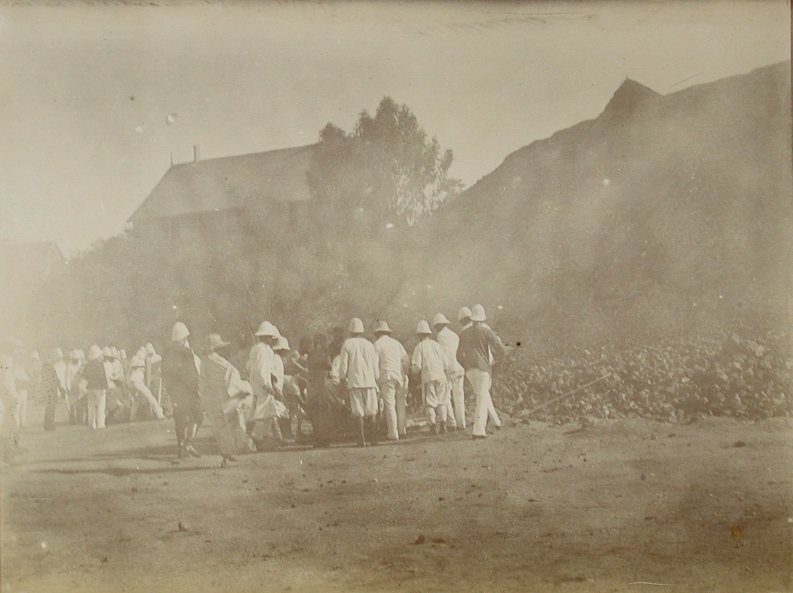
1896: Rainandriamampandry and Prince Ratsimamanga

On this date in 1896, two Malagasy movers and shakers were shot to help cement French colonial control of Madagascar.

Interior Minister Rainandriamampandry

Having conquered the island militarily by 1895, France immediately faced indigenous resistance.

According to Stephen Ellis*

One of the most puzzling and fascinating of all resistance movements is that known as the revolt of the menalamba. It occurred over a wide area of central Madagascar, mostly in the kingdom of Imerina, in the two years following the French invasion of Madagascar in 1895. The most mysterious aspect of the rising has always been the question of who, if anyone, was its leader. The official version, that reported by the French government in Madagascar, was that the movement was inspired or directed by a number of magnates at the old Merina court. The published evidence is so ambiguous as to have obliged every subsequent author to accept this version, although there was considerable doubt expressed as to its truth at that time.

Managing this drumhead tribunal was just-arrived “Resident-General” Joseph Simon Gallieni, who seems to have alit (fresh from an assignment in Indochina) with the certain conviction that examples must be made.

While more wholesale bloodletting was deployed in the field, Gallieni selected some suitably high-profile exemplars from the supine state’s ruling elite — “Ratsimamanga, a nobleman who had been unpopular for many years because of his financial extortions,” says Ellis, and “Rainandriamampandry because … he had no close political friends and might therefore be considered dispensable.”

The convenient loss of the tribunal paperwork, which renders evaluation impossible and colonial motivation suspect, hardly would have been well beside the point. As one periodical in Paris (where Gallieni’s pacification project received enthusiastic greeting) approvingly put it,

As a lesson to the rebels, two great figures who had sided with them, Prince Ratsimamanga and Minister of the Interior Rainandriamampandry have both been tried, convicted and shot, all with such rapidity as to inspire their accomplices to salutary reflections.

Below: Selected photographs of the execution from the University of Southern California Digital Library. Click for larger images.

An aside: Madagascar was also the scene of intensely sectarian competition in the soul-saving business, resulting in an execution-day travesty reported in An Empire Divided: Religion, Republicanism, and the Making of French Colonialism, 1880-1914:

Gallieni gave permission to both the cure of the Antananarivo cathedral and a local French pastor to be with [Rainandriamampandry] during his last hours. But … the two started quarreling almost at once. Gallieni was deeply disturbed by the image of two religious men fighting during “the final minutes of a condemned man.”

* “The Political Elite of Imerina and the Revolt of the Menalamba. The Creation of a Colonial Myth in Madagascar, 1895-1898,” The Journal of African History, vol. 21, no. 2 (1980).

On this day..

39: Gnaeus Cornelius Lentulus Gaetulicus, erotic poet

On an uncertain date likely around early October* in 39 A.D., former Roman Consul Gnaeus Cornelius Lentulus Gaetulicus (not to be confused with Publius Cornelius Lentulus) was executed at the order of Caligula for his part in some sort of plot long lost to history.

In his public life, Gaetulicus was a Machiavellian politician connected to the fallen Praetorian Guard captain Sejanus (their kids were at one point engaged to be married). He evidently survived the post-Sejanus purge with an adroit bit of written diplomacy to the Praetorian’s patron-cum-executioner the Emperor Tiberius, tactfully pointing out that the Emperor had made the same errant choice of alliance. Thus did Gaetulicus retain both his head and his career.

After a decade milking his German province, and Tiberius shuffled off the mortal coil and young Caligula now ruling the empire, Gaetulicus seemingly** involved himself in something treasonable with Marcus Aemilius Lepidus, the latter a recent fave of Caligula and briefly his designated heir.

Or, if you credit scandal-mongering Roman historian Cassius Dio‘s description of the Emperor’s deadly northward road trip, he did it out of some whim of rivalry or opportunity for pecuniary advantage.

Gaius had now spent practically all the money in Rome and the rest of Italy, gathered from every source from which he could in any way get it, and as no source of revenue in considerable amount or practicable to collect could be found there, and his expenses were pressing him hard, he set out for Gaul, ostensibly because the hostile Germans were stirring up trouble, but in reality with the purpose of exploiting both Gaul with its abounding wealth and Spain also. However, he did not openly announce his expedition beforehand, but went first to one of the suburbs and then suddenly set out on the journey, taking with him many actors, many gladiators, horses, women, and all the other trappings of luxury. When he reached his destination, he did no harm to any of the enemy — in fact, as soon as he had proceeded a short distance beyond the Rhine, he returned, and then set out as if to conduct a campaign against Britain, but turned back from the ocean’s edge, showing no little vexation at his lieutenants who won some slight success — but upon the subject peoples, the allies, and the citizens he inflicted vast and innumerable ills. In the first place, he despoiled those who possessed anything, on any and every excuse; and secondly, both private citizens and cities brought him large gifts voluntarily, as it was made to appear. He murdered some men on the ground that they were rebelling, and others on the ground that they were conspiring against him; but the real complaint was one and the same for the whole people — the fact that they were rich. By selling their possessions himself, he realized far greater sums than would otherwise have been the case; for everybody was compelled to buy them at any price and for much more than their value, for the reasons I have mentioned. Accordingly, he sent also for the finest and most precious heirlooms of the monarchy and sold them off by auction, selling with them the fame of the persons who had once used them. Thus he would make some comment on each one, such as, “this belonged to my father,” “this to my mother,” “this to my grandfather,”, “this to my great-grandfather,” “this Egyptian piece was Antony’s, the prize of victory for Augustus.” At the same time he also explained the necessity of selling them, so that no one could persist in pretending to be poor; and thus he made them buy the reputation of each article along with the thing itself.

In spite of all this he did not secure any surplus, but kept up his customary expenditures, not only for other objects that interested him — exhibiting, for example, some games at Lugdunum — but especially for the legions. For he had gathered together two hundred thousand troops, or, as some say, two hundred and fifty thousand. He was acclaimed imperator by them seven times, as his whim directed, though he had won no battle and slain no enemy. To be sure, he did once by a ruse seize and bind a few of the foe, whereas he used up a large part of his own force, striking some of them down one at a time and butchering others then masse. Thus, on one occasion, when he saw a crowd of prisoners or some other persons, he gave orders in the famous phrase, that they should all be slain “from baldhead to baldhead.” At another time he was playing at dice, and finding that he had no money, he called for the census lists of the Gauls and ordered the wealthiest of them to be put to death; then, returning to his fellow-gamesters, he said: “Here you are playing for a few denarii, while I have taken in a good one hundred and fifty millions.” So these men perished without any consideration. Indeed, one of them, Julius Sacerdos, who was fairly well off, yet not so extremely wealthy as to become the object of attack on that account, was slain simply because of a similarity of names. This shows how carelessly everything was done. As for the others who perished, there is no need of my naming over most of them, but I will mention those of whom history requires some record. In the first place, then, he put to death Lentulus Gaetulicus, who had an excellent reputation in every way and had been governor of Germany for ten years, for the reason that he was endeared to the soldiers. Another of his victims was Lepidus, that lover and favourite of his, the husband of Drusilla, the man who had together with Gaius maintained improper relations with the emperor’s other sisters, Agrippina and Julia, the man whom he had allowed to stand for office five years earlier than was permitted by law and whom he kept declaring he would leave as his successor to the throne. To celebrate this man’s death he gave the soldiers money, as though he had defeated some enemies, and sent three daggers to Mars Ultor in Rome. He deported his sisters to the Pontian Islands because of their relations with Lepidus, having first accused them in a communication to the senate of many impious and immoral actions. Agrippina was given Lepidus’ bones in an urn and bidden to carry it back to Rome, keeping it in her bosom during the whole journey.

It’s a pity that the details of this affair, whatever they were, have been lost to history. The History of Rome podcast treats this episode among a review of Caligula’s gnarly reign

According to Post-Augustan Poetry, Gaetulicus

was consul in 26 A.D., and for ten years was legatus in Upper Germany, where his combination of firmness and clemency won him great popularity. He conspired against Caligula while holding this command, and was put to death. Pliny the younger speaks of him as the writer of sportive and lascivious erotic verse, and Martial writes of him in very similar terms. His mistress was named Caesennia, and was herself a poetess.

Only a fragment (which I have not been able to locate online) of a Latin verse describing Britain remains affirmatively attributed to this poet, though he is sometimes speculatively identified with the “Gaetulicus” to whom some epigrams in the Greek Anthology (or “Palatine Anthology”) are attributed e.g.

TO APHRODITE EUPLOIA

Guardian of the seabeach, to thee I send these cakes, and the gifts of
a scanty sacrifice; for to-morrow I shall cross the broad wave of the
Ionian sea, hastening to our Eidothea’s arms. But shine thou
favourably on my love as on my mast, O Cyprian, mistress of the bride-
chamber and the beach.

* Date ballparked by public sacrifices offered in Rome on October 27 “to mark the exposure of the evil plots of Gnaeus Lentulus Gaetulicus against Gaius Germanicus.” (Agrippina: Sex, Power, and Politics in the Early Empire, which speculates at some length on what the dimensions of a Gaetulicus plot might have been.)

** Though Lepidus was executed at about the same time, and Cassius Dio suggests a connection, it’s not completely clear that they conspired together. Since Cassius Dio (and Suetonius, who also connects them in Life of Claudius), wrote generations after the events themselves, we want for dependable information.

On this day..

1815: Joachim Murat, Napoleonic Marshal

On this date in 1815, French Marshal-cum-Neapolitan King Joachim Murat was shot in Pizzo, Italy, for a failed attempt to regain his throne.

The charismatic cavalryman cuts a snazzy figure in the Napoleonic era, from its very infancy: it was Murat who secured for the 26-year-old Bonaparte the cannon used to deliver the “whiff of grapeshot” whose odor set Napoleon on the path to becoming Emperor.

Murat knew a good thing when he had it, and thereafter zipped around with the peripatetic conqueror, finding time between dashing mounted charges to marry Napoleon’s sister Caroline.

Murat’s honors multiplied with his commander’s victories: “First Horseman of Europe” (whatever that means); Grand Duke of Berg and Cleves; at last, in 1808, he was appointed King of Naples and Sicily, beneficiary via Caroline of the Corsican’s policy of installing family members to helm his satellite kingdoms.

Still, that elevation didn’t mean Murat would just retire to his Mediterranean villa and his mistresses: he was on call when Bonaparte went to invade Russia.

Leo Tolstoy, undoubtedly a hostile witness in his epic War and Peace, renders Murat as something of an oblivious dunderhead:

Though it was quite incomprehensible why he should be King of Naples, he was called so, and was himself convinced that he was so, and therefore assumed a more solemn and important air than formerly. He was so sure that he really was the King of Naples that when, on the eve of his departure from that city, while walking through the streets with his wife, some Italians called out to him: “Viva il re!” he turned to his wife with a pensive smile and said: “Poor fellows, they don’t know that I am leaving them tomorrow!”

But though he firmly believed himself to be King of Naples and pitied the grief felt by the subjects he was abandoning, latterly, after he had been ordered to return to military service — and especially since his last interview with Napoleon in Danzig, when his august brother-in-law had told him: “I made you King that you should reign in my way, but not in yours!” — he had cheerfully taken up his familiar business, and — like a well-fed but not overfat horse that feels himself in harness and grows skittish between the shafts — he dressed up in clothes as variegated and expensive as possible, and gaily and contentedly galloped along the roads of Poland, without himself knowing why or whither.

Like his fellow-Marshal Michel Ney, Murat nevertheless had the realpolitik chops to get on after their thrust to Moscow had so calamitously reversed — in Murat’s case, by cutting a deal with the Austrian Empire to retain his kingship.

But also like Ney, he couldn’t resist joining Napoleon’s ill-fated 1815 reunion tour. Murat could have survived the consequent loss of his throne, but made a quixotic bid to invade with only a handful of men the former possession whose people he quite wrongly imagined would rally to his cause.

Not the realization of the day-dreams of the most dreaming youth, not the visible acting of the strangest visions which the dramatist and romance-writer have conceived, could strike us with more wonder than the simple narration of that which befel the son of the baker of Cahors in his passage from the ranks of the French army to the throne and sceptre of Naples; and, alas! one step farther, an unquiet and a mournful one, to that small court in the castle of Pizzo, where the hero of a hundred fights, — the Achilles of the chivalrous French, — gazed for a second, with uncovered eye and serene brow on the party drawn out to send the death-volley home to his heart.

Well, this depiction of Murat’s end is plainly of more sympathetic character than Tolstoy would have done.

… the disgraceful tribunal, after consultation, declared, “That Joachim Murat, having by the fate of arms returned to the private station whence he sprung, had rashly landed in the Neapolitan dominions with twenty-eight followers, no longer relying upon war, but upon tumults and rioting; that he had excited the people to rebellion; that he had offended the rightful King; that he had attempted to throw the kingdom of Naples and the whole of Italy into confusion; and that therefore, as a public enemy, he was condemned to die, by authority of the law of the Decennium, which was still in vigour.” This very law, by a strange caprice of fortune, was one which Joachim himself had passed seven years before. He had, however, humanely suspended its operations many times, at particular seasons of his rule; and yet this very law, so passed, and so suspended by him, was made the instrument of his death.

The prisoner listened to his sentence with coolness and contempt. He was then led into a little court of the castle, where he found a party of soldiers drawn up in two files. Upon these preparations he looked calmly, and refused to permit his eyes to be covered. Then advancing in front of the party, and, placing himself in an attitude to meet the bullets, he called out to the soldiers, “Spare my face — aim at the heart.” No sooner had he uttered these words than the party fired, and he, who had been so lately King of the Two Sicilies, fell dead, holding fast with his hands the portraits of his family …

* More evidence that blood is thicker than water, since Napoleon and Murat were not chummy. According to Memoirs of Napoleon, His Court and Family, by the wife of another Napoleonic general,

The Emperor did not cherish for Murat the sincere friendship which he entertained for the other officers of the army of Italy. He used frequently to make him the subject of derision; and many of us have heard him laugh at the King of Naples, whom he used to call a Franconi King.

On this day..

2007: Five women in Hoiryeong Public Stadium

On this date in 2007, according to the Daily NK, five women were publicly tried, then immediately shot, in Hoiryeong Public Stadium in North Korea’s North Hamkyung province.

Their crime, “prostitution”, is supposed to be a euphemism for aiding refugees escaping to China in the area that also generated an infamous execution film broadcast on Japanese television in 2005. (And other death sentences earlier in 2007. North Korea is not enthusiastic about escapees.)

As usual with the insular state, details are hard to come by. The North Korean Human Rights Infringement Center claimed Pyongyang carried out 901 public executions in 2007; that figure would potentially make it the world’s #2 (after China) death penalty user, though Amnesty International doesn’t even venture a tally of North Korean executions.

On this day..

1536: William Tyndale, English Bible translator

“Lord, open the King of England’s eyes!” cried William Tyndale at the stake this date in 1536 … just before he was strangled and burned.

“Translated the Bible into English,” reads Tyndale‘s epigraph; in the Protestant blossoming, this Herculean academic labor was also of itself a dangerous religious and political manifesto.

As with Martin Luther’s translation of the Bible into German, Tyndale’s English version threatened, and was intended to threaten, papal ecclesiastical authority. In undertaking the work, Tyndale defied the 1408 “Constitutions of Oxford”, an English clerical pact further to the suppression of the Lollards and kindred post-John Wycliffe heresies which expressly prohibited rendering scripture in the vernacular.

In Protestant hagiographer John Foxe‘s Book of Martyrs, a young Tyndale exasperated with a Romish divine memorably declared,

“I defy the pope, and all his laws;” and added, “If God spared him life, ere many years he would cause a boy that driveth the plough to know more of the Scripture than he did.”

Tyndale would give his life to, and for, that ploughboy.

On the lam in Protestant Germany, Tyndale produced an English New Testament, and then an Old Testament, of startling poetry.

The scholar also kept a reformist voice in the day’s robust theological pamphleteering — trading fire, for instance, with Sir Thomas More.

Even when the once-staunch Catholic Henry VIII broke with Rome over Anne Boleyn, the English manhunt for Tyndale continued: Henry’s reformation did not share radical Protestant objectives like scriptural authority, and the king was not shy about enforcing his version of orthodoxy.

Tyndale was equally stubborn in defense of his life’s mission to put a Bible in the hands of the English ploughboy. Offered the king’s mercy to return and submit, Tyndale countered by offering his silence and martyrdom if Henry would but publish the Good Book in English.

I assure you, if it would stand with the King’s most gracious pleasure to grant only a bare text of the Scripture to be put forth among his people, like as is put forth among the subjects of the emperor in these parts, and of other Christian princes, be it of the translation of what person soever shall please his Majesty, I shall immediately make faithful promise never to write more, not abide two days in these parts after the same: but immediately to repair unto his realm, and there most humbly submit myself at the feet of his royal majesty, offering my body to suffer what pain or torture, yea, what death his grace will, so this [translation] be obtained. Until that time, I will abide the asperity of all chances, whatsoever shall come, and endure my life in as many pains as it is able to bear and suffer.

Luckily for posterity, the English crown wasn’t biting, leaving Tyndale’s mellifluous rendering of Holy Writ to enter the English tongue.

And leaving Tyndale, eventually, to enter the martyrs’ ranks.

In 1536, an English bounty hunter befriended the fugitive translator and betrayed him to the authorities in Vilvoorde, near Brussels. It was the Catholic Church and the Holy Roman Empire that did the dirty work of their rivals in the Isles.

And — the Lord works in the mysterious ways, they say — Tyndale’s dying prayer was indeed answered.

By the end of the decade, a Bible in English drawn from Tyndale’s version (revised by former Tyndale assistant Myles Coverdale under Thomas Cromwell‘s direction; prefaced by Thomas Cranmer) was by regal authority placed in every parish of the Church of England.

The Tyndale Bible became the basis for the King James Bible that remains for many authoritative to this day … and Tyndale’s work lodged in the textual DNA of the evolving English Bible(s) in the five centuries since his death. (The wonderful site The King’s English deals with the linguistic legacy of the King James Version; many of the examples in fact trace back to Tyndale.)

Works by and about William Tyndale

Audiophiles should consider this podcast from a Protestant perspective, located here.

[audio:http://www.bethanybaptist.co.uk/mp3/2008-05-09-pm-Brian-Edwards.mp3]

On this day..