1326: Hugh Despenser the Younger, King Edward II’s lover?

On this date in 1326, the power behind Edward II’s throne — and the presumed lover in his bed — was hanged, drawn and quartered and pointedly emasculated in a grisly public execution as the Queen and her lover took control of England.

(Wince.)

The younger Despenser, being carved up in an illustration from Froissart.

Poor King Edward — that’s the swishy princeling gay-baited in Braveheart — would suffer a horrid demise of his own a few weeks later. He’s the one most conveniently read as a gay martyr.

Hugh Despenser the Younger (or Hugh le Despenser) has his fans, but he’s much more likely to be taken for a villain.

An upstart knight who unexpectedly lucked into a jackpot inheritance when his wife’s brother died at Bannockburn — that’s the rumble Robert the Bruce starts at the end of Braveheart — Hugh the younger parlayed his newfound position of feudal magnate into the still better gig of royal favorite.

That job was open because its occupants had a distressing tendency to get dead, a fate obviously ordained for Hugh Despenser as well.

But whereas Edward’s childhood pal Piers Gaveston, the murdered former fave, aroused mostly personal pique among rival nobles, Hugh Despenser meant to use his favor to rule.

Despenser exploited his position to build up his wealth and control the king; with his father (you’ll never guess that he went by “the elder”), he became the de facto if never the de jure ruler of the realm.

At one point, his rivals in the nobility turned the tables and got him exiled. Hugh became a pirate in the English Channel while he maneuvered his way back onto dry land in his customary most-favored-consigliere position.

So although the British barons who wanted Despenser’s head were undoubtedly a distasteful lot themselves, and certainly capable of all manner of depravity in pursuit of their own crass self-interest, it doesn’t take a backwards view of human sexuality to get why Hugh Despenser would raise an early 14th century Briton’s hackles.

But you have to give England this: its politics back then were a damn sight more interesting than you get today. Anyone who uses the term “bloodsport” for the modern electoral charade ought to cross cutlasses with the likes of the dread pirate Despenser.

And it gets better. Meaning, for Hugh Despenser the Younger, worse. Much.

Queen Isabella — that’s Sophie Marceau’s hot-for-barbarian imported princess in Braveheart — became estranged from her Hugh-lovin’ husband,* and established herself back in France with her lover Roger Mortimer.

Then, the lovebirds invaded England.

Edward and Hugh were so unpopular at this point that “their” nobles who should have repelled the incursion went in a landslide for the invading adulterers.

Hugh Despenser’s father had already been hanged for his trouble by the time The Younger was taken; the latter tried to cheat the executioner by refusing all food and drink for days, truly a spartan image of desperate self-mortification in a rough day and age.

When you get a load of the death his royal captors had worked out for him — and which they were obliged to deliver to their starving captive hurriedly in Hereford rather than more ceremoniously back in London — you can understand why. After a perfunctory trial that same morning, they tore the former favorite apart.

Froissart’s rendering:

When the feast was over sir Hugh, who was not beloved in those parts, was brought before the queen and knights assembled; the charges were read to him – to which he made no reply; the barons and knights then passed the following sentence on him: first, that he should be drawn on a hurdle, attended by trumpets and clarions, through all the streets in the city of Hereford, and then conducted to the market-place, where all the people were assembled; at that place he was to be bound on a high scaffold, in order that he might be more easily seen by the people. First, his privates were cut off, because he was deemed a heretic, and guilty of unnatural practices, even with the king, whose affections he had alienated from the queen by his wicked suggestions. His private parts were cast into a large fire kindled close to him; Afterwards, his heart was thrown into the same fire, because it had been false and traitorous, since he had by his treasonable counsels so advised the king, as to bring shame and mischief on the land, and had caused some of the greatest lords to be beheaded, by whom the kingdom ought to have been supported and defended; and had so seduced the king, that he could not or would not see the queen, or his eldest son, who was to be their future sovereign, both of whom had, to preserve their lives, been forced to quit the kingdom. The other parts of sir Hugh thus disposed of, his head was cut off and sent to London.**

It’s reported that Isabella and Mortimer feasted and made merry as they beheld this hideous spectacle. Now that’s bloodsport politics.

Hugh the younger Despenser and his life and times are covered in amazing detail by a couple of active-posting enthusiasts of this particular period who have already been linked elsewhere in this post: the aptly-named Edward II blog (dig his biography of Hugh Despenser, among many other such dramatis personae; also his account of the execution, already cited); and, Lady Despenser’s Scribery (whose entire sidebar is pretty much all about our day’s principal; for the quick tour, see her biography and posts on the “trial” and execution).

* The reason for said estrangement can be situated anywhere one likes along the personal-political spectrum; one recent historical novel speculates (upon no authority but dramatic license) that Hugh raped the queen.

** Remains reportedly discovered last year were speculatively identified as Hugh Despenser’s; the litany of injuries to the body testify to the ghastly death-ritual its owner underwent.

On this day..

1974: Black Saturday in Ethiopia

November 23, 1974 was “Bloody Saturday” in Ethiopia for that day’s* surprise purge of some threescore politicians and soldiers by the ruling Derg.

It was barely ten weeks since the Derg — an Amharic word meaning “committee”, in this case a leftist military junta — had formally overthrown Emperor Haile Selassie, so ancient that he was already middle-aged back when he’d been leading Ethiopia’s resistance against Mussolini.

It’s strange to say in retrospect, but having spent the best part of a year systematically supplanting the political authority of the decrepit ancien regime with widespread public support, the Derg had engendered hope that its revolution would be accomplished without slaughter.

“Ityopiya tikdem/yala mimin dem” — “Let Ethiopia progress/Without any bloodshed” — became the popular slogan of that heady time. (pdf source)

Black Saturday turned the leaf on all that, and opened the sanguinary chapter of Ethiopian history today evoked by the name of the Derg.

What went wrong with Ethiopia's bloodless revolution?
“The prospect,” concluded the analysis that appeared under this headline in the Nov. 29, 1974 London Times, “is that the mass executions will be followed by further drastic action aimed at consolidating the control of the new military rulers.” The same author, Michael Knipe, had written on Nov. 16 that “the firmness of [the military’s] control appears to be matched by an overall moderation of approach, which holds promise for Ethiopia’s future.”

The Derg long remained a shadowy body, its members largely unknown and its internecine factional politics only guessed-at. The executions this date are generally read as the consolidation of the coup’s “radical” elements as against its “moderates” and the first signal event in Derg member Mengistu Haile Mariam‘s eventual conquest of supreme authority.

The crucial issue that separated radicals from moderates at the revolution’s early stage appears to be their approach to the ongoing struggle of coastal Eritrea — then still a province of Ethiopia.

Ethnically Eritrean officer Aman Michael Andom, the first titular head of the Derg who had been deposed from his position only a week ago, was a noteworthy advocate of negotiating a peacable settlement with Eritrean agitators. He was among the casualties of Black Saturday. (Aman was later reported to have been killed resisting arrest, rather than actually executed; many of the available accounts of this massacre have slightly varying numbers and particulars.) Henceforth, military force would be Addis Ababa’s only approach to the Eritrean problem.

A few other Aman supporters in the Derg shared his fate in a political wipeout. But more numerous among the 29 civilian and 31 military men announced as casualties the next morning — and there had been no prior warning that executions were imminent — were aristocrats and officials of the Haile Selassie government, including:

  • Two former Prime Ministers, Endelkachew Makonnen and Aklilu Habte-Wold (or Aklilou Wold), both of whom had been slated for trial for the recent famine in Wollo (London Times, Nov. 14, 1974);**
  • Solomon Abrahami, the former governor of Wollo;
  • Selassie’s own grandsom, Rear Adm. Iskender (Alexander) Desta;
  • 16 generals, including Selassie’s son-in-law (and former Defense Minister) Abiye Abebe.

(This Nov. 25, 1974 New York Times article — behind the paper’s pay wall — lists all 60 vicitms.)

These were a selection of some 200 political prisoners held by the Derg; how hard to come down on these officials was another point of contention between radicals and moderates. It emerged later that the Derg had met earlier on the 23rd to vote, name by name, which among its prisoners deserved execution.

So if you look at it right, summarily machine-gunning only 30% of your political prisoners is a moderate policy. Alas: these would hardly be the last.

After the Derg government was itself finally overthrown in 1991 — and the troubled province of Eritrea finally won its independence from Ethiopia — some of the perpetrators of its genocidal atrocities were themselves put on trial.

* It’s obscure — perhaps permanently so — whether the nighttime killings transpired before or after the end of the day, and both the 23rd and 24th are variously cited as the date of death. “Reliable sources said the executions were by machine gun at midnight,” the unhelpfully breezy New York Times reported on Nov. 25. This account (pdf) has the shootings occupying several batches with midnight passing during the process. We give precedence to Saturday the 23rd here because that’s the day that earned the “Bloody” appellation.

** According to Marxist Modern: An Ethnographic History of the Ethiopian Revolution, Mengistu was rumored to have disposed of Aklilu personally.

On this day..

1864: Hong Tianguifu, in the Taiping Rebellion

On this date in 1864, the sins of the father were visited upon the son when the Qing Dynasty dealt a coup de grace in what is perhaps history’s bloodiest civil war, executing the luckless teenager to whom leadership of the Taiping Rebellion had fallen.

Strangely little-known, the Taiping Rebellion shook the weakened Chinese state through the middle of the 19th century, nearly to its very foundations.

From 1851 until the 1864 death of its queer leader figure, prophetic Christian convert Hong Xiuquan, it maintained its own state in southern China, the Taiping Heavenly Kingdom.

China’s defeat in the First Opium War in the 1840’s set the stage for Hong Xiuquan’s movement, and not only geopolitically: western powers had pried open the Orient to proselytizers as well as poppies, and though Christianity would find a rough go of it in China, it did win over Hong.

Fired by his supposed divine vision, Hong’s Heavenly Kingdom conquered the Yangtze Valley and much of the south, with an outlook radically progressive as against the hidebound Qing: egalitarian land distribution and gender equity (the Kingdom’s administrative acumen is less generously accounted). Naturally, the “real” Christian missionaries abhorred it, which sincere theology happily comported with the policy of their national statesmen who abhorred the Taiping’s encumbrance upon the opium trade.

This illustrated podcast does creditable coverage of the Qing’s twilight century; from about 14:17, it covers Hong Xiuquan and the Taiping Rebellion specifically.

The rebellion waxed while the Qing lost a second Opium War to the west, but a Taiping bid to capture Shanghai fell short in 1860. By this time, westerners had the Qing by the short-and-curlies and were not eager to see the client dynasty they had so painstakingly browbeaten supplanted by a bunch of millenarian Levellers without the common courtesy to promulgate smack; accordingly, China’s recent Opium War antagonists now helped China field the forces necessary to suppress the rebellion.

Charles George Gordon, a British evangelical Christian himself destined for eventual beheading, even led the pacification force swaggeringly branded the “Ever Victorious Army“.

We’ve reached the end here and only just met our day’s principal, the son and heir who at 15 was handed the helm of the collapsing state by his visionary father. (Hong Xiuquan conveniently proceeded to kick the bucket just before the Qing finished off the rebellion.)

Officially the second (and obviously the last) ruler of the Heavenly Kingdom, Hong Tianguifu had no juice with his military or administration, and no time to enjoy the more prosaic perquisites of regal authority, but was available as the object of official vengeance. (Thanks, dad.)


Less exalted Taiping Rebellion prisoners, from here (click through the pages for a detailed history of the rebellion).

The Taiping Rebellion features in the 2007 Chinese flick Tau ming chong (The Warlods), which represents a Qing-Taiping battle in the fine cinematic bloodbath below. Some 20 to 30 million people are thought to have perished in this civil war, which was also one of the last significant conflicts fought primarily with blades rather than bullets.

On this day..

1885: Louis Riel, Metis leader

On this date in 1885, Louis Riel, “the puzzling Messianic figure of Canadian history,” was hanged in Regina for treason.

We have already met in these pages the magnetic, controversial figure of Louis Riel when his Red River Rebellion caused the 1870 execution of Thomas Scott, one of the soldiers sent to suppress it.

Now, after a decade and a half in the political and sometimes literal wilderness, the champion of the Métis had been recalled from the United States to press the rights of his mixed-race French-indigenous people against the Anglo Canadians’ westward march.

It was North America’s familiar clash of civilizations between expanding industrial economies and the traditional ways of life they displaced. (Here’s a good background documentary video, with a Part 2 that gets into the weeds on battlefield events.) Because the Metis were “half-breeds” whose European stock was French, the story’s familiar cocktail of racism had a twist of Canada’s Anglo-French rivalry, too.

Riel declared an independent Provisional Government of Saskatchewan, and the North-West Rebellion was on.

The rebels had some initial successes. But hampered by an inability to make a firm alliance with the more politically realistic Cree, by the non-support of the Catholic Church in view of Riel’s increasingly out-there millenarianism, and by the extension of technological superiority another 15 years’ railroad-building had given the Ottawa government, Riel’s forces soon gave way.

The lightning-rod leader was arrested and repaired to the provincial capital for trial, where he spurned his lawyers’ desperation attempt to plead insanity and cogently vindicated his position.

“Life, without the dignity of an intelligent being, is not worth having.”
Riel

For a man twice a rebel, the hanging sentence was no surprise. Later, juror Edwin Brooks would tell a newspaper “We [the jury] tried Louis Riel for treason but he was hanged for the murder of Thomas Scott.” (Source, via this pdf handbook all about the Metis.)

His hanging was met with outrage in Francophone Quebec, and Louis Riel remains a polarizing figure down to the present day — an emblem of multiple overlapping cultural conflicts never fully resolved. The upcoming year’s 125th anniversary of events profiled here promise a renewed examination of Louis Riel (or at least of his tourism potential).

Below are a few more-or-less obtainable recent books about Riel and the North-West Rebellion, culled from this pdf reading list. Also note the public-domain volume The history of the North-west rebellion of 1885.

Recent considerations of Louis Riel and the North-West Rebellion

On this day..

1539: Richard Whiting, the last Abbot of Glastonbury

Letter to Thomas Cromwell from his man in Somerset,* Richard Pollard, a local gentry type making out well under the Dissolution of the Monasteries:

Pleaseth it your lordship to be advertised, that … the same 15th day [of November] the late abbot of Glastonbury went from Wells to Glastonbury, and there was drawn through the town upon a hurdle to the hill called the Torre, where he was put to execution; at which time he asked God mercy and the king for his great offences towards his highness, and also desired my servants then being there present to see the execution done, that they would be meane [communicate] to my lord president and to me that we should desire the king’s highness of his merciful goodness and in the way of charity to forgive him his great offences by him committed and done against his grace, and thereupon took his death very patiently, and his head and body bestowed in like manner as I certified your lordship in my last letter. And likewise the other two monks [John Thorne and Roger James, executed with Richard Whiting] desired like forgiveness, and took their death very patiently, whose souls God pardon.

And whereas I at my last being with your lordship at London moved your lordship for my brother Paulett, desiring your lordship to be a mean that he might have the surveyorship of Glastonbury, which I doubt not but he will use and exercise the said office to the king’s most profit and advantage, and your lordship’s goodness herein to him to be shown he shall recompense to his little power, I assure your lordship he hath been very diligent, and divers others by his means, to serve the king at this time, according to his duty and right…

the late abbot of Glastonbury, afore his execution, was examined upon divers articles and interrogatories to him ministered by me, but he could accuse no man but himself of any offence against the king’s highness, nor he would confess no more gold nor silver nor any other thing more than he did before your lordship in the Tower …

From Wells, the 16th day of November.

Your assured to command,

Rychard Pollard

Once one of the greatest religious houses in England (and the legendary burial place of King Arthur), Glastonbury Abbey today is a picturesque ruin. Cornell University has published some 19th century photos of the abbey’s remains in a less manicured, more gorgeously overgrown situation.

Pollard had just a few weeks before exonerated the monastery of any profligacy, and the abbot seems perhaps not to have even been properly charged or attainted … but as one can discern in Pollard’s cloying appeal to keep the surveying position in the family, the practical henchman had no qualms as events unfolded about taking a commercial position on the end of the Abbot of Glastonbury.

For your public domain perusing pleasure: The last abbot of Glastonbury: and other essays, by Cardinal Francis Aidan Gasquet.

* Pollard had been in the thick of the destruction of Henry Courtenay, Marquess of Exeter just the year before.

On this day..

1780: Corregidor Antonio de Arriaga, by his slave

On this date in 1780, Incan-Peruvian indigenous leader Tupac Amaru launched his insurrection against the Spanish with the public execution of a Spanish corregidor.

Antonio de Arriaga, as Spain’s man in Tungasuca, had as part of his job description forcing curacas to extract the crown’s tribute from the natives. This put some tension between him and the likes of the strong-willed Tupac Amaru, who advocated fiercely enough for his people’s rights that Arriaga threatened him with death.

It also made Arriaga’s death an invitingly emblematic scene to open the indigenous revolt.

On Nov. 4, 1780, Tupac Amaru kidnapped Arriaga returning from a dinner party, then forced him to sign letters summoning Spaniards and curacas alike to Tungasuca.

There, he mustered his own force of armed natives and performed for them a “carefully staged public ceremony.”

According to a primary source excerpted in The Tupac Amaru and Catarista Rebellions

Account of the Most Horrible Crime Committed by Jose Gabriel Tupac Amaru, Cacique of Pampamarca

On the morning of Friday, November 10th, Tupac Amaru ordered that three columns … be organized from all the people from his Province that were already there. Two were composed of Spaniards and Mestizos armed with muskets, sabers, and sticks; and one of Indians with slings. In the middle of this, he brought out the Corregidor, dressed in his military uniform, and publicly started taking his uniform off, stripping him of his rank following the rituals he had understood and seen in other occasions, until he was left in his shirt. He then put a shroud on him … that had the title of La Caridad on it. He then gave the order to take him to the gallows, accompanied by the Priest and two other clergymen, where he went with a resignation and patience worthy of somebody who was already touching the portals of eternity.

Once on the gallows the Corregidor was forced by the tyrant to publicly declare that he deserved to die in that way. A black slave of the Corregidor [named Antonio Oblitas -ed.] served as his executioner, but the ropes snapped and both fell to the ground. But they suspended them again with a lariat around their necks, and thus they completed the execution in clear sight and tolerance of all his Province. [“they” is as rendered in the book; I have no indication that more than one person was executed. -ed.] Not one voice was raised that would disturb the operation. And most surprising of all was that those same Collectors and those close to the Corregidor were the ones who (oh, what an awful spectacle of perfidy!) sped his way to the ignominious place of execution, and who pulled on his feet so he could die even more violently.

The rebellion, needless to say, was on.

On this day..

1550: Jon Arason, the last Catholic bishop of Iceland

At dawn this date in 1550, two sons* of Jon Arason were beheaded at Skalholt, followed by the energetic sextegenerian prelate himself — cementing Lutheranism in Iceland.

As bishop of the northern diocese of Holar and one of the most powerful pols in Iceland, Arason did what he could to maintain papal authority when the Danish King Christian III began pushing Protestantism.

Arason was a practical guy; remote from any prospect of aid, he was content to maintain a cordial balance between his diocese and the southern one of Skalholt. (The two sees were political rivals of long standing; Skalholt’s previous Catholic representative, Ogmundur, had at one point many years before our narrative excommunicated Arason and forced the latter to flee to Denmark.)

Whether driven by the prince or the bishop within,** Arason took advantage of his Protestant opposite number’s timely passing in 1548 to make a play for power in the south as well. Early returns augured well; Arason arrested the Lutheran replacement, got the Icelandic parliament to throw in with him, and captured key points in the Holar diocese, reconsecrating ecclesiastical properties as Catholic.†

But his rival Dadi Gudmundsson turned the tables on the man who was becoming the de facto ruler of the island by ambushing him at a parley. The cleric and the two sons, having been declared outlaws months before by Danish decree, were executed on that basis without trial, lest holding them for the planned hearing the following spring enable their supporters to rally. Arason’s beheading was reportedly botched.

Legally doubtful but practically effectual, the axe that (eventually) decapitated the divine did likewise to his flock. Lutheranism thereafter settled comfortably into the ascendancy: Iceland would not have another Catholic bishop for nearly four centuries, by which time its Catholic population had shrunk near the vanishing point.

Although his faith didn’t have legs on the island, Arason reads very easily as a proto-nationalist figure and political actor; he’s been well-loved by Protestant, Catholic, and irreligious posterity alike.

He also gave Icelandic a bit of vernacular on his way to shuffling off this mortal coil. When a priest named Sveinn proffered the solace, “There is a life after this one!” as the last bishop approached the block, he replied, “Veit ég það, Sveinki!”“This I know, Sveinki!”

In everyday conversation in Iceland, that phrase is still used to tease someone who has just stated the obvious.

* Although this is well into the period when Catholic clergy were supposed to be practicing celibacy, Arason’s indifference to this particular mortification of the flesh is just another bit of his charm. With his mistress Helga Sigurdardottir, he sired nine sons and daughters, marrying them into politically advantageous allegiances where possible. At least eight subsequent Lutheran bishops sprang from his seed; by the present, “virtually all Icelanders can validly claim direct descent” from Jon Arason, according to Iceland, the First New Society.

** Jon Arason was also a notable poet. Ljomur, whose attribution to Arason is speculative, can be enjoyed for free here.

† More particulars about the Icelandic political chessboard are available in this 19th century text (the pdf is easier on the eyes than the text), or in “An Icelandic Martyr: Jón Arason,” by Thomas Buck, in the Jesuit publication Studies: An Irish Quarterly Review, Vol. 46, No. 182 (Summer, 1957), pp. 213-222.

On this day..

2003: Four for the oil of Chad

On this date in 2003, seven Chadians were shot in the capital of N’Djamena, with an eighth in the eastern city of Abeche. (A ninth would be executed three days later.)

Chad’s first known judicial executions since 1991 came as a shock to observers; the country had publicly mooted death penalty abolition earlier that very year.

It also seems to have come as a shock for its subjects.

Four of those executed this date — the four that concern us here — were ranking power-brokers in President Idriss Deby’s regime convicted of bumping off the head of the Chad Petroleum Company, one Sheik Ibn Oumar Idriss Youssouf.

Mahamat Adam Issa, Adouma Ali Ahmat, Abderamane Hamid Haroun and Moubarack Bakhit Abderamane had been condemned on Oct. 25, just a month after the Sheikh was assassinated outside the Foreign Ministry. Less than two weeks later, the perps were shot when Deby denied them clemency even with their Supreme Court appeal still pending (pdf). (The Chadian judiciary seems a rickety thing (pdf).)

The murder, for its part, came just a month after Chad christened a $3.7 billion pipeline project.

It’s often called the “Adouma affair” after its principal defendant, which helpfully suggests the murky oil politics surrounding the speedy execution.

Ali Adouma was a former Deby advisor; both Adouma and the victim were from Darfur, in neighboring Sudan, whose conflict has spilled into Chad (pdf).

The Sudanese government had at times sought Adouma’s extradition for financing anti-govenrment Zaghawa forces across the border; while the Zaghawa ethnic minority (whose ranks include President Deby) dominates Chad, its Darfurian brethren have had the worst of their conflict with the Sudanese government.

So even if the convicts’ torture-adduced confessions resembled the truth of the murder, it can be safely inferred that the fact and the haste of their executions were matters of state. (Adouma’s confidence that there would not actually be an execution was reportedly shaken only in the last hours of his life.)

What matter of state is a different, uncertain matter: to calm potential foreign investors who’d be understandably nervous about seeing a petroleum kingpin pinched on the streets without consequence? A sop to Khartoum in Deby’s ongoing diplomatic efforts to limit the knock-on from Darfur to Chad? Or a warning to Deby’s own base? (pdf)

The vague attempts at conciliation by the Chadian President do not please his entourage which almost sees it as treason. Last May, 80 soldiers tried to overthrow Deby and would have assassinated him …

President Idriss Deby, according to observers with knowledge of Chadian politics, would be in a “precarious” situation. The Chad regime, undermined by corruption and ever on the brink of a chronic socio-economic crisis … may become even “tougher”. In N’Djamena, the hasty conviction and execution of Ali Adouma are seen as a sign from the President to his inner circle, even the ones in charge of the national economy, that he is ready to use coercion, even against his own clan.

These pictures of the execution were published in a Chadian paper. In image three, the circled figure is one of the firing squad members, who was himself bizarrely reported fatally shot during the execution. (Whispers continue to circulate that the unlucky executioner had in fact been intentionally eliminated after receiving some sensitive parting confidence from the well-placed condemned.)

“Chad,” said Interior Minister Routouang Yoma Golom, “has given a wonderful example to wrong-doers.”

On this day..

1793: The smitten Adam Lux

Among all the strange and pathetic love-stories of the Revolution, when hearts were won within prison walls and wedded by the guillotine, is there another as fantastic and wonderful as that of Adam Luchs? (Source)

Adam Lux (as he’s better known, and a fitter name to his character could hardly be invented), German Republican turned French Revolution representative, was so lovestruck by the arresting figure of Charlotte Corday that it was downright … mortifying.

Many were men to whom the Norman maid played muse, like the poet Andre Chenier.

But Lux was something else.

Thrilled by this chaste heroine’s sacrificial blow against the Revolution’s monster, Lux was supposed to have fallen madly in love with the murderess the one time he actually saw her, on her serene way to the scaffold.

Eros thus yoked to Thanatos, the besotted fellow promptly hurled himself after the exaltation of death. Imitation, after all, is the sincerest form of flattery.

Certainly knowing it to be fatal, Adam Lux published under his own name a vindication of Ms. Public Enemy #1 and her “tyrannicide,” and generally went extravagantly mooning about in this sort of vein as he prepared to get his head cut off this date in 1793:

The guillotine is no longer a disgrace. It has become a sacred altar, from which every taint has been removed by the innocent blood shed there on the 17th of July. Forgive me, my divine Charlotte, if I find it impossible at the last moment to show the courage and the gentleness that were yours! I glory because you are superior to me, for it is right that she who is adored should be higher and more glorious than her adorer!

Adam came off a little needy, you’d have to say.

Not surprisingly, he didn’t get the girl in the end.

Adam Lux to Charlotte Corday
by William James Dawson

Red is the garb thou wearest, red is the deed thou hast done,
And red on a land of blood rises the morning sun.
Kings have ridden this road, conquerors mailed in gold,
But none in such red triumph as this that we behold.

Rose, thro’ a rose-red dawn, go to thy valourous fate,
Queen of all roses thou, splendid and passionate.
And lo ! at thy feet I fling, here, in the gallows-cart,
Passionate even as thine, the rose-flower of my heart.

Turn but a moment toward me, stoop in thy raiment red,
I answer thee look for look, I am warmed and comforted.
Twins are we of one womb, fated sister and brother,
Nursed on the bare bruised breasts of Freedom our great Mother!

Thou, whom none could master, proud and glorious head,
Come, O Rose, to my bosom, come when thou art dead!
They have shorn the beautiful hair, they have bound the strong fair hands,
Signal me with your eyes that love still understands!

Signal, and I will follow : I dwell where thou must dwell,
I shall know thy blood-red raiment either in heaven or hell!
Lo! at thy feet I fling, here, in the gallows-cart,
Passionate even as thine, the red rose of my heart!

On this day..

1924: Ali Reshti and Sayyid Husain, to placate America

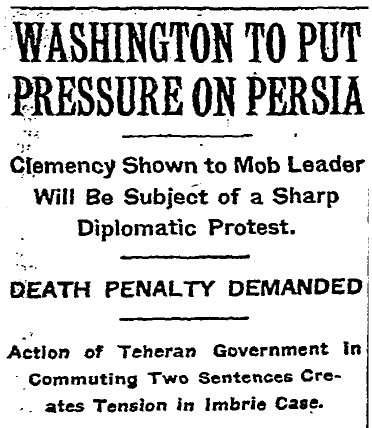
On this date in 1924, diplomatic maneuvering, oil patch politics, and a dead American consul put two Iranian teenagers in front of a firing squad.

Largely forgotten today, the affair which prompted their execution helped Cossack commander Reza Khan‘s ongoing consolidation of power, culminating in another year’s time with his conquest of the Persian throne itself.

By the summer of 1924, he was by title Prime Minister and his domestic opponents could read the writing on the wall: he had made a premature bid for formal executive authority in 1923 only to be rebuffed.* At the same time, he was engaged in the perilous oil game with an attempt to use American companies to break a British oil monopoly.

On July 18, 1924, American Vice Consul Maj. Robert Imbrie and his civilian countryman Melvin Seymour were attacked by a Tehran mob while photographing a well which had become a Moslem devotional site for purported miraculous healings. Imbrie was beaten to death; Seymour was lucky to survive … and it soon emerged that soldiers from the nearby barracks had not only failed to protect the Americans but actually taken part in the assault.

Iran’s emerging strongman lost no time in making the most of it.

The event gave [Reza Khan] … the excuse for declaring martial law and a censorship of the Press … Numerous arrests have been made, chiefly of political opponents of the Prime Minister. (British military attache Col. W.A.K. Fraser)

It’s like Lenin said, you look for the person who will benefit and, uh, you know, uh, you know, you’ll, uh, you know what I’m trying to say …

Assuming one discerns some measure of design in the Imbrie murder, and the convenient outburst of anti-Baha’i paranoia that sparked the fatal incident, one can go a couple of different directions at this point.

  1. That the Prime Minister’s foes, allied with British oil interests (the British angle was so widely believed in Iran at the time that press censorship forbade the incendiary charge), were firing up the rowdies in an attempt to shake his power. This 1924 American cable makes that case:

    “It had the earmarks from the beginning of an artificially inspired movement, of which the organized powers of evil were quick to take advantage in order to create disorder for the Government … Reza Khan found himself faced with a situation before which he was powerless. The fanaticism of the crowd was so incited by the continuous preaching of the Mullahs that any act on his part would have been interpreted as treason to Islam and prima facie evidence that he was a Bahai; hence his unfortunate orders to the military and the police not to intervene under any circumstances in religious demonstrations and under no circumstances to fire.”

  2. That Pahlavi’s own agents fomented the disorder. According to Michael Zirinsky‘s review of the case, another American official speculated that Reza Khan himself hoped a foreigner would die “so that he could declare martial law and check the power of the Mullahs.”

Which, in the event, is exactly what happened.

The U.S. made a great show of demanding exemplary justice, and it had the leverage to do so: Iran (how times change!) wanted American support and American oil exploitation.

Three were condemned to death for their parts in the riot, and after the first, a young soldier named Morteza said to have incited the mob, was shot on Oct. 2, the government announced leniency for the other two.

Not good enough.


“When you are dealing with a government like Persia … if you ask them to execute a Moslem for the death of a Christian … if they do it, you accomplish more for the prestige of your country than if they paid a million.” -a young Allen Dulles, in 1926 testimony to the U.S. House of Representatives.

At American insistence, those other two were recalled to death after all: 17-year-old mullah Sayyid Husain (various alternate transliterations – e.g., Seyid Hussein), who was supposed to have raised the riot-triggering “Baha’i well-poisoner” accusation in the first place, and 14-year-old camel driver Ali Reshti.

Zirinsky once again:

With the ending of the Iran-U.S. dispute by the execution of Ali and Husain on November 2, 1924, Reza was free to leave the capital city. He had support from the foreign legations, he had secured financing for the army, he had reestablished discipline in the Cossack Brigade, and by executing Sayyid Husain — a mullah — he had demonstrated his domination over the clergy … in the course of the next months’ campaign, he completed the unification of Iran and ensured that his government would get all the [Anglo-Persian Oil Company] royalties…

While the Imbrie affair was not the only critical event of Reza’s seizure of total power in Iran, it came at a critical moment in his rise … he used the murder to his best advantage.

And they all lived happily ever after.

* The future Shah’s future rival Mohammed Mossadegh was among the Iranian Majlis members who blocked Reza Khan’s attempt to rule Iran as a republic in 1923.

** “Blood, Power, and Hypocrisy: The Murder of Robert Imbrie and American Relations with Pahlavi Iran, 1924,” International Journal of Middle East Studies, vol. 18, no. 3 (Aug. 1986). Zirinsky quotes an American diplomat who believed Reza Khan was actually intentionally trying to create a situation where a foreigner would be killed, to give him a pretext for bringing his nation to heel with foreign support.

On this day..