On this date in 1948, Burma hanged six for a shocking assassination that haunts the country to this day.
The previous summer — specifically, at 10:37 a.m. on July 19th — independence hero/proto-head of state Aung San and six members of his cabinet had been massacred by gunmen
The trail quickly led back to rival pol U Saw, himself a former Prime Minister of under British colonial rule.
U Saw had once defended in court the hero of a peasant revolt that the British had quelled with some difficulty. His own maneuverings were heretofore of a more slippery character, having negotiated with the British government early in World War II for independent dominion status — and then turned around and negotiated with the Japanese for consideration in their occupation government.
(The British caught him at his act, and locked him up for the rest of the war. Aung San — “hands … dyed in British and loyal Burmese blood,” Winston Churchill charged* — had also collaborated with the Japanese, who were viewed as liberators by many who had struggled against British domination.)
U Saw was executed with three collaborators in this plot this day at Insein prison, while two others were hanged at Rangoon prison.
The damage done by the assassination, in any event, could not be undone with the noose. Aung San appeared to be the only person with sufficient stature to govern Burma effectively. After his death, the newly independent country suffered impotent governments, ethnic conflict, and eventually coups that have today brought to power one of the more repugnant military dictatorships in the world.
The current Burmese junta has for a generation held under house arrest the most recent person to democratically win (but not assume) the office of Prime Minister: Aung San’s daughter, Nobel laureate Aung San Suu Kyi.
* Churchill said this after Aung San’s assassination. See London Times, Nov. 6, 1947, p. 4.
On this date in 1795, the attorney who had engineered the Terror was guillotined for engineering the Terror.
Antoine Quentin Fouquier de Tinville (English Wikipedia page | French), or just plain Fouquier-Tinville, had emerged during the Revolution from penurious obscurity to wrangle a jury foreman’s position courtesy of his connection to Camille Desmoulins. When Desmoulins ally Georges Danton spearheaded creation of a Revolutionary Tribunal (French link), Fouquier-Tinville drew the choice gig of Public Prosecutor.
From that perch, he would supply the arbitrary exercises of the Committee of Public Safety their (increasingly scanty) scaffolding of formal legality in Paris’s greatest show trials.
Fouquier-Tinville’s own onetime benefactors, Danton and Desmoulins. (He struggled to contain Danton’s rhetorical fireworks, as depicted in the 1983 film Danton — we see him plying his trade from about 3:29 of this clip.)
Heck … when the Terror ended, our good state’s attorney even signed off on the execution of Robespierre, with what must have been a lump in his throat. He was himself denounced within days, and narrowly preserved from the summary justice of his fellow-prisoners upon incarceration.
Naturally, like every criminal barrister since, Fouquier-Tinville’s defense was, hey, don’t blame me: the law made me do it. “I had only acted in the spirit of the laws passed by a Convention invested with all powers. Through the absence of its members [on trial], I find myself the head of a conspiracy I have never been aware of.”
I have been told by a gentleman who was at school with Fouquier, and has had frequent occasions of observing him at different periods since, that he always appeared to him to be a man of mild manners, and by no means likely to become the instrument of these atrocities; but a strong addiction to gaming having involved him in embarrassments, he was induced to accept the office of Public Accuser to the Tribunal, and was progressively led on from administering to the iniquity of his employers, to find a gratification in it himself.
And, indeed, he was condemned by his own hand. His lawyerly letter to the Convention during Danton’s trial — “the accused are behaving like madmen and demand the summoning of their witnesses … our judicial powers do not furnish us with any means of refusing” — duly elicited those heretofore absent powers, which the prosecutor immediately deployed to gag the defense.
Antoine Quentin Fouquier de Tinville, the sinister mediocrity who gave villainy the cover of law, was guillotined this morning in 1795 to the delight of the Paris mob: the last head to roll in a batch of 16.
[Alarum. Fight at sea. Ordnance goes off. Enter a Captain, a Master, a Master’s Mate, WALTER WHITMORE, and others; with them SUFFOLK, and others, prisoners.]
SUFFOLK.
Obscure and lowly swain, King Henry‘s blood,
The honourable blood of Lancaster,1
Must not be shed by such a jaded groom.
Hast thou not kiss’d thy hand and held my stirrup?
Bare-headed plodded by my foot-cloth mule
And thought thee happy when I shook my head?
How often hast thou waited at my cup,
Fed from my trencher, kneel’d down at the board,
When I have feasted with Queen Margaret?2
Remember it and let it make thee crest-fallen,
Ay, and allay thus thy abortive pride,
How in our voiding lobby hast thou stood
And duly waited for my coming forth.
This hand of mine hath writ in thy behalf,
And therefore shall it charm thy riotous tongue.
WHITMORE.
Speak, captain, shall I stab the forlorn swain?
CAPTAIN.
First let my words stab him, as he hath me.
SUFFOLK.
Base slave, thy words are blunt and so art thou.
CAPTAIN.
Convey him hence, and on our long-boat’s side
Strike off his head.
SUFFOLK.
Thou dar’st not, for thy own.
CAPTAIN.
Yes, Pole!
SUFFOLK.
Pole!
CAPTAIN.
Pool! Sir Pool! lord!
Ay, kennel, puddle, sink, whose filth and dirt
Troubles the silver spring where England drinks.
Now will I dam up this thy yawning mouth
For swallowing the treasure of the realm;3
Thy lips that kiss’d the queen shall sweep the ground;
And thou that smil’dst at good Duke Humphrey‘s death4
Against the senseless winds shalt grin in vain,
Who in contempt shall hiss at thee again.
And wedded be thou to the hags of hell,
For daring to affy a mighty lord
Unto the daughter of a worthless king,
Having neither subject, wealth, nor diadem.
By devilish policy art thou grown great
And, like ambitious Sylla, overgorg’d
With gobbets of thy mother’s bleeding heart.
By thee Anjou and Maine were sold to France,
The false revolting Normans thorough thee
Disdain to call us lord, and Picardy
Hath slain their governors, surpris’d our forts,
And sent the ragged soldiers wounded home.5
The princely Warwick, and the Nevils all,
Whose dreadful swords were never drawn in vain,
As hating thee are rising up in arms;
And now the house of York, thrust from the crown
By shameful murther of a guiltless king6
And lofty proud encroaching tyranny,
Burns with revenging fire, whose hopeful colours
Advance our half-fac’d sun, striving to shine,
Under the which is writ ‘Invitis nubibus.’
The commons here in Kent are up in arms;7
And, to conclude, reproach and beggary
Is crept into the palace of our king,
And all by thee.–Away! convey him hence.
SUFFOLK.
O that I were a god, to shoot forth thunder
Upon these paltry, servile, abject drudges!
Small things make base men proud; this villain here,
Being captain of a pinnace, threatens more
Than Bargulus the strong Illyrian pirate.8—
Drones suck not eagles’ blood but rob bee-hives.
It is impossible that I should die
By such a lowly vassal as thyself.
Thy words move rage and not remorse in me.
I go of message from the queen to France;
I charge thee waft me safely cross the Channel.9
CAPTAIN.
Walter,–
WHITMORE.
Come, Suffolk, I must waft thee to thy death.
SUFFOLK.
Gelidus timor occupat artus; it is thee I fear.
WHITMORE.
Thou shalt have cause to fear before I leave thee.
What, are ye daunted now? now will ye stoop?
1 GENTLEMAN.
My gracious lord, entreat him, speak him fair.
SUFFOLK.
Suffolk’s imperial tongue is stern and rough,
Us’d to command, untaught to plead for favour.
Far be it we should honour such as these
With humble suit; no, rather let my head
Stoop to the block than these knees bow to any
Save to the God of heaven and to my king,
And sooner dance upon a bloody pole
Than stand uncover’d to the vulgar groom.
True nobility is exempt from fear;
More can I bear than you dare execute.
CAPTAIN.
Hale him away, and let him talk no more.
SUFFOLK.
Come, soldiers, show what cruelty ye can,
That this my death may never be forgot!
Great men oft die by vile bezonians:
A Roman sworder and banditto slave
Murther’d sweet Tully; Brutus’ bastard hand
Stabb’d Julius Caesar; savage islanders
Pompey the Great; and Suffolk dies by pirates.10
1 Shakespeare brackets Suffolk clearly into the political faction that would become the winning contestant in the War of the Roses and give rise to the Tudor dynasty that ruled England at the time of the play’s writing. Suffolk’s key ally, Somerset, was slain in 1455 at the first battle of the generation-long conflict.
2 Margaret of Anjou was wed to the feebleminded King Henry VI by William de la Pole’s offices. Shakespeare portrays Suffolk and Margaret as maybe a little too close. When Suffolk’s head is posthumously retrieved for her, she laments,
… who can cease to weep and look on this?
Here may his head lie on my throbbing breast;
But where’s the body that I should embrace?
3 William de la Pole had a serious popularity problem, on several scores (as we shall see). Endemic corruption that had dissipated the wealth of the crown during Henry VI’s reign was among the most explosive, and laid at his door because of his proximity to power (and because Suffolk had not failed to exploit the revenue opportunities afforded by his position).
4 Another grievance: Humphrey, Duke of Gloucester, the popular uncle to the king and onetime Lord Protector, had been arrested for treason at the Suffolk-Beaufort faction’s instigation in 1447. He died shortly thereafter, which naturally gave rise to suspicions of assassination.
5 Perhaps most damaging of all for Suffolk, England’s foothold in northern France from which it had maintained itself during the Hundred Years’ War preceding, had suddenly collapsed in the 1440s. Maine was handed directly over to Charles VII — the price, critics charged, of the king’s marriage to Anjou. Then an ill-advised offensive had invited a French counterattack that rousted the English from Normandy and brought furious domestic recriminations for the debacle.
Incidentally, as a younger man, this day’s victim had been one of the commanders besieging Orleans when Joan of Arc famously relieved the city. He was captured by the Maid shortly thereafter, and eventually ransomed.
6 Again, a clear identification of the the factions taking shape for the Wars of the Roses. Richard, Duke of York, the standard-bearer of (obviously) the Yorkist cause in the coming conflict, had been Suffolk’s main rival at court, and is a key suspect in engineering Suffolk’s death. The guiltless king referred to is Richard II, overthrown a half-century before by Henry Bolingbroke which gave rise to the competing claims of legitimacy that would color the York-Lancaster contest.
7 Weeks after Suffolk’s death, Jack Cade’s rebellion erupted in Kent, an infamous affair whose dubious connection to York was great fodder for Tudor propaganda like, well, Henry VI, Part 2. Be that as it may, the Bard placed one of his immortal lines in the mouth of one of Cade’s peasants:
The first thing we do, let’s kill all the lawyers.
8 This reference may be an anachronism. Pirates operating from Illyria — the uskoci (or uskoks) — plagued the Adriatic Sea in Shakespeare’s time.
9 As a royal minister, Suffolk was essentially immune from Parliament as long as the king backed him … unless he could be hit with a treason charge. Given his unpopularity, a great many mostly outlandish charges of treason were duly conjured early in 1450, and Suffolk had not the political support to repel them. Henry VI, still Suffolk’s supporter, exiled the noble to protect him from possible execution. He was intercepted as he left England for France, however, and what the House of Commons had wanted done by a bill of attainder was simply handled extrajudicially upon the seas instead.
10 The duke was beheaded (“within half a dozen strokes” of “a rusty sword”) upon one of the pirate vessel’s small boats.
On this date in 1820 — which was not yet a red-letter day on the leftist calendar — five radicals were hanged at Newgate Prison for a plot to overthrow the government.
This day’s conspirators plotted to overturn the authoritarian rule of Lord Liverpool by murdering his ministers at a dinner party. Next steps:
????
Revolution!
This excellent plot was hatched by none other than a government informant, who planted the idea among the circle and arranged their arrest when they took the bait. Already-notorious subversive Arthur Thistlewood was the jewel in the crown’s crown, particularly after having slain an arresting officer in the fray when the trap was sprung.
Ten were condemned to death, five of those sentences commuted to transportation — leaving Thistlewood to hang* along with John Brunt, James Ings, Richard Tidd and the Afro-Caribbean tradesman William Davidson. The crowd was reportedly vocally supportive of the condemned.
The Cato Street Conspirators hanged. As represented at the bottom of the scaffold: the dead men were cut down after their execution and posthumously beheaded.
It was in the aftermath of this shocking affair that Byron completed his work on a long-ago Venetian putsch, Marino Faliero, with such stirring reflections upon the blood sacrifice of liberty as
They never fail who die
In a great cause: the block may soak their gore:
Their heads may sodden in the sun; their limbs
Be strung to city gates and castle walls —
But still their Spirit walks abroad. Though years
Elapse, and others share as dark a doom,
They but augment the deep and sweeping thoughts
Which overpower all others, and conduct
The world at last to Freedom.
Still, even from the safety of Italy, the rakish rebel had a gentleman’s disdain for these lowborn butchers overpowering anything at all.
What a set of desperate fools these Utican conspirators seem to have been. As if in London, after the disarming acts, or indeed at any time, a secret could have been kept among thirty or forty. And if they had killed poor Harrowby — in whose house I have been five hundred times, at dinners and parties; his wife is one of ‘the Exquisites’ — and t’other fellows, what end would it have answered? ‘They understand these things better in France’, as Yorick says, but really, if these sort of awkward butchers are to get the upper hand, I for one will declare off. I have always been (before you were, as you well know) a well-wisher to, and voter for reform in parliament; but ‘such fellows as these, who will never go to the gallows with any credit’ … and make one doubt of the virtue of any principle or politics which can be embraced by similar ragamuffins. I know that revolutions are not to be made with rose water, but though some blood may, and must be shed on such occasions, there is no reason it should be clotted; in short, the Radicals seem to be no better than Jack Cade or Wat Tyler, and to be dealt with accordingly.
They were. Archive.org has the free text of An authentic history of the Cato-Street conspiracy; with the trials at large of the conspirators, for high treason and murder; a description of their weapons and combustible machines, and every particular connected with the rise, progress, discovery, and termination of the horrid plot. With portraits of the conspirators, taken during their trials, by permission, and other engravings.
* “The men died like heroes. Ings, perhaps, was too obstreperous in singing ‘Death or Liberty’, and Thistlewood said, ‘Be quiet, Ings; we can die without all this noise.'”
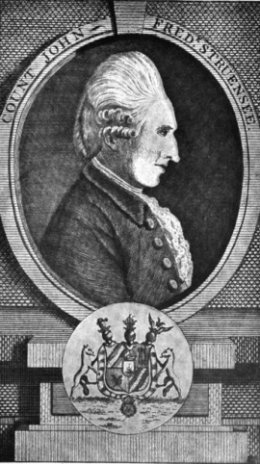
The 1700s were a time of radical reform, and as the Enlightenment reached the shores of Denmark, it suddenly became possible to be a professed atheist and not lose your head. That is, of course, as long as you didn’t also try to usurp the crown, undermine the aristocracy, and agitate the commoners while you were at it.
Such was the course that ended the rise of Johann Friedrich Struensee on this date in 1772. His friend and sometime cohort Enevold Brandt (Danish Wikipedia entry) was put on the block on the same day.
Struensee was born in 1738 in present day Germany and educated in Prussia, a doctor by trade and a budding Enlightenment political writer by practice. He seemed an unlikely character to involve himself in the court of King Christian VII of both Denmark and Norway, but Struensee was a vain and social man who managed to befriend the right people at the right time.
The first was Brandt. The second was Count Schack Karl Rantzau. A lawyer and Supreme Court justice, Brandt was a court favorite* and planted Struensee’s name as a capable doctor: young, kind, and competent, he would make a perfect personal physician for a king known for being a bit off: Christian was likely schizophrenic. Rantzau, meanwhile, was Count of the Holy Roman Empire, exiled from Copenhagen some 15 years before he met young Struensee, and eager to get back into politics.
In June 1768, Struensee took a post as the king’s traveling physician in England, and he immediately attached to Christian’s loneliness. The regent was interested in literature, philosophy, and music, and Struensee obliged him with patient regard for his charge, for which he was duly rewarded with access to a social life much more fulfilling than in Prussia. As a traveling physician, though, Struensee’s post had a finite span, and he lobbied hard to become a member of the Danish court.
With some help from others in the king’s court, Struensee managed to retain a permanent post, and his clamber up the nearest cliff to power began.
The young doctor, it seems, had a talent for playing two sides for personal gain. It started with the king, who had immense trust in Struensee and began to confide almost everything. Struensee was tactful with this information, adhering to an early form of patient-doctor privilege that endeared him to Christian. The other side was Queen Mathilde, Princess of Wales, by all accounts a beautiful woman who was not happy in Denmark and even less happy to be married to a mad and deteriorating king.
Mathilde initially disliked Struensee — or, at the very least, was indifferent to his actions. But near the end of 1769, the queen finally admitted Struensee into her chambers, and their relationship took off. He ably gamed Mathilde by convincing her that she was the kingdom’s future; Christian, meanwhile, remained ill, and Struensee remained a steady presence in his life. Come spring, Crown Prince Frederick VI also came under Struensee’s care, and as smallpox ravaged Copenhagen, the doctor pressed for inoculation. The king and queen assented, Frederick survived the epidemic, and Struensee garnered himself an official advisorship. It’s also suspected that, while Struensee and Mathilde watched over Frederick as he recovered from the inoculation,** their love affair began.
With a taste of power, Struensee pressed King Christian VII for cabinet changes — which he got — and was named Privy Councilor before 1770 was out. Now the principal advisor to the king, Struensee was able to advance his Enlightenment agenda, notably freedom of the press, the abolition of torture, limiting the death penalty, changing the rules of appointments, numbering the houses in Copenhagen, lighting the streets, and, perhaps in anticipation, removing penalties against those who produced illegitimate children. He was a bold visionary, but he also intoxicated by his growing power … and his programme obviously gored many an ox.
Struensee ascended still further early in 1771 when the king became practically unfit to rule. He was mentally faltering, and Struensee was all but running the show, and more.
In early July, the queen gave birth to a daughter who was widely assumed to be Struensee’s child. Days later, and just three years after being introduced to King Christian VII, Johann Friedrich Struensee effectively appointed himself Privy Cabinet Minister with dictatorial authority through one of King Christian’s edicts. Struensee’s orders would now have the force of law, and, as Christian’s proclamation noted, “They shall be immediately obeyed.”
Enevold Brandt (top), not to be confused with Brandt, the Big Lebowski lackey (bottom).
Struensee spent the next six months turning the European aristocracy inside-out and foisting an aggressive set of cabinet orders on the Danish people — over 1,000, by some counts. Having ridden on the coattails of a queen and king, he now pushed them aside. He moved the court to Schleswig-Holstein, in Prussia, and pleasingly enjoyed both the prerogatives of aristocracy and a middle class contempt for them.
Struensee was, to say the least, not a favorite abroad;† that he and his friends dominated the king and queen did not sit well with Danish commoners. Even Brandt was becoming disaffected, writing in a letter asking for either a larger salary or a resignation from the court:
No despot ever arrogated such power as yourself, or exercised it in such a way. The King’s pages and domestics tremble at the slightest occurrence: all are seized with terror. They talk, they eat, they drink, but they tremble as they do so. Fear has seized on all who surround the minister, even on the Queen…
But Brandt stayed on, and as 1771 drew to a close, Copenhagen became hostile territory for the royal family and their favorite doctor.
After the season’s first masquarade ball, on 16 January 1772, the Queen Dowager — Christian’s step-mother — Juliana Marie exposed Struensee’s affair and had Struensee, Brandt, the queen,‡ and many other Struensee accomplices arrested, ostensibly by order of the king.
Struensee was charged with lèse-majesté, a crime against the crown, for his affair with the queen; though he initially denied the charges — and though Mathilde did her best to shield him from harm — he was found guilty. Brandt was charged with the same crime for allegedly assaulting the king after being himself threatened with a flogging for impertinence (he even had a nip at Christian’s finger). Brandt’s punishment was the same. Each had his right hand chopped off, then was beheaded, drawn, and quatertered.
The queen, meanwhile, went into exile in France. Juliana Marie effectively ruled the kingdom through her son for over a decade, rolling back many of Struensee’s reforms and reverting power back to the aristocracy. This also turned out to be unpopular (the Danes and Norwegians are fickle people), and Mathilde’s son Frederick VI was able to regain power for his father in 1784, eventually moving to liberal reforms more in line with his erstwhile physician’s ideals.
Struensee’s epic rise and fall have spawned a variety of writings since his death. A memoir appeared just months after his execution which detailed his final months. He was also the subject of the Per Olov Enquist novel The Royal Physician’s Visit, which examines his life from multiple perspectives. Queen Mathilde’s life was put to ballet by Peter Maxwell Davies. And for a more contemporary cultural artifact, there’s the 2012 film A Royal Affair.
* Brandt was a court favorite, but after attempting to destroy the position of another minister, he was briefly expelled from Copenhagen, shortly after Struensee accepted his post.
** These inoculations predated “safe” inoculations by non-fatal, related disease strains such as cowpox. Frederick would have been made ill through the small pox strain Variola Minor, which had a mortality rate of about 1%. By contrast, Variola Major was fatal in about 30% of cases.
† While Struensee seems to have been book smart, his feel for international politics was limited, and his standing abroad would have unraveled had it ever raveled in the first place. He repeatedly upset the Russians, and Mathilde’s relatives were not pleased with him. Had he not been downed by public sentiment, it seems likely he would have fallen victim to one of his many royal detractors abroad.
‡ In a curious twist, Rantzau was the queen’s arrestor, and one of the principal conspirators in the dowager’s plot was a cabinet minister Struensee was responsible for ejecting very early in his career.
But the silly hats in Parliament wanted much of the potentially dangerous army to demobilize, and do so without settling the small matter of its back pay. Poyer refused to hand over his command and Pembroke Castle to a Parliamentary agent, and sought a better deal from monarchists.**
Only with a painstaking siege was the imposing medieval fortress of Pembroke reduced. Poyer, his superior Rowland Laugharne, and Rice Powell were hauled to London and condemned to death.†
In an interesting twist, it was decided that one example would prove the point as well as three, and to allot the clemencies by chance. When the three refused to draw their own lots, a child was given the job instead, and distributed three slips of paper. Laugharne and Powell read “Life given by God.” Poyer’s was deathly blank.
Mark Twain latched onto the singular role of a child in this deadly lottery, and wrung it for every drop of pathos in a short story, “The Death Disk”.
Unlike the proposed victim of that story, Poyer did not benefit from any last-second Cromwellian pity. His death is related in the zippily titled “The Declaration and Speech of Colonell John Poyer Immediately Before his Execution in Covent-Garden neer Westminster, on Wednesday, being the 25 of this instant April, 1649. With the manner of his deportment, and his Proposals to the people of England.”‡
Having ended his speech, he went to prayers, and immediately rising up again, called the men designed for his execution to him, which were six in number, and giving them the sign when they should give fire, which was by holding up both his hands, they observed his motion, who after some few expressions to his friends about him, prepared an embracement for death, and casting his eyes to Heaven, with both hands lifted up, the Executioners (with their fire locks) did their Office, who at one voley bereav’d him of his life, his corps being taken up, was carryed away in a Coach, and the Souldiery remanded back again to White-Hall.
* A few sources say April 21, but the overwhelming majority concur on the 25th — as do the primary citations available in 17th-century comments on his death (e.g., “he was upon the 25 of this instant Aprill being Wednesday, guarded from White-Hall in a Coach, to the place of execution” in “The Declaration and speech of Colonell John Poyer before his execution…”)
** D.E. Kennedy observes that the divide between Parliament and Royalist was not so bright as might be imagined — and that Cromwell himself was at this time negotiating with the future Charles II as an expedient to get around Charles I.
† The rank and file of Welsh insubordination basically skated, a display of clemency from the Lord Protector that Ireland would not enjoy.
‡ The title promises much more scaffold drama than two and a half forgettable pages deliver — basically, that Poyer died (a) penitent; (b) Anglican; and (c) wishing for peace.
On this date in 1521, the day after winning the decisive battle in the Castilian War of the Communities, royalist forces beheaded its three principal leaders in Villalar.
Even while the Spanish Empire was burgeoning in the New World, its home peninsula remained a house divided.
The Iberian Kingdoms of Aragon and Castile had joined in a personal union with the marriage of Ferdinand and Isabella in the late 15th century.
When the couple passed, it was not a given that their conjoined territory would become, as it did, the germ of a unified Spain.
Instead, the royal power couple’s crazy daughter was kept under lock and key while her infant son grew into the redoubtable Emperor Charles V. To exacerbate the local annoyance, Chas had continent-spanning territories, and ambitions; Spain was not his base, merely one of his provinces. (He’d grown up in Flanders. Ah, dynastic politics.)
The Emperor was only a teenager when his Castilian subjects rose against his levies, and against the paradoxical perception that the first true King of Spain was a foreign ruler.
A riot in Toledo mushroomed into a revolt, and everyone started drawing up sides. (Spanish link) Things went south when the commoner rebels started adopting an unwelcome radicalism (beyond rebelling against the king, that is), enabling the imperial rep (and future pope) Adrian of Utrecht to pull back into the royalist camp rebellious nobles increasingly fearful of expropriation at the hands of the firebrands.
The Execution of the Comuneros of Castile, by Antonio Gisbert. Segovian Juan Bravo allegedly asked to die first, so as not to witness the death of so good a knight as Padilla.
The demise of the “Caballeros Comuneros” pretty much squelched the revolt — although Padilla’s widow Maria Pacheco defended the rebel ground zero of Toledo for several months more.
The comuneros have lived on ever since as a symbol in literature and propaganda, among monarchists (for whom they are a symbol of perfidy), liberals (rather the reverse) and Castilian nationalists. Though “comuneros” was for a period an all-purpose smear against agitators in the Spanish dominions, April 23 (the date of the fateful battle) has been Castile and Leon Day, a public observance, since 1986.
This monolith in the Villalar town plaza commemorates the Comuneros. Image (c) Julio Alvarez, and used with permission.
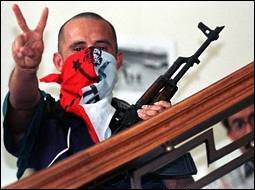
On this date in 1997, Peruvian paramilitaries stormed the Japanese ambassador’s residence held hostage for 126 days by leftist rebels.
Peace out.
All 14 of the Tupac Amaru Revolutionary Movement (MRTA) were slain in the raid,* along with two of the commandos and one hostage. Officially, there were no “executions” at all.
Unofficially?
It’s pretty well-documented that some — perhaps most — of the terrorists were taken alive, and thereafter summarily executed. (pdf of Defense Intelligence Agency cable hosted by the National Security Archive)
However untoward the outcome and however unimpressive the foe, the operation was a master stroke for then-President Alberto Fujimori. Peru’s neoliberal taskmaster had introduced the world to the auto-golpe, the “self-coup”, a Cromwellian maneuver of shuttering parliament in order to rule as dictator, and he thereafter made ruthless suppression of Peru’s ruinous internal conflict the calling card of his presidency.
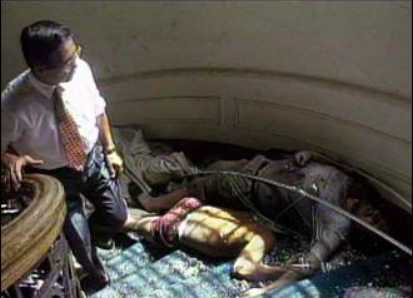
The DIA cable linked above claims Fujimori himself ordered the commandos to take no prisoners. He did not scruple to show himself in the middle of the bloodbath.
Alberto Fujimori made sure to get himself snapped standing over the bodies of the guerrillas, including MRTA leader Nestor Cerpa Cartolini.
El Presidente banked the political capital from having restored civic order, but it wasn’t the only capital he was banking. Three and a half years later, with a corruption scandal darkening his door, Fujimori absconded to Japan, faxed in his resignation, and became a fugitive.
Even there, he continued to justify his authoritarian governance.
Many Peruvians have always agreed with Fujimori’s self-assessment, even many who regret his well-publicized disregard for human rights.
But human rights researcher Michael Baney calls this day’s executions “pointless.”
“The MRTA was a spent force by the time of the embassy takeover,” said Baney. “The takeover was an act of total desperation, which is evidenced by the fact that the leader of the movement, Nestor Cerpa Cartolini, personally participated in it.”
After spending the best part of a decade in exile, Fujimori returned to the headlines by boldly returning to the hemisphere — to Chile, specifically, which arrested him and extradited him on a Peruvian warrant.
Just days ago as of this writing, Fujimori was convicted in his own former courts of authorizing death squads,** and sentenced to 25 years in prison. (Here’s some legal analysis.)
In the court of public opinion, it’s a different matter.
Fujimori’s daughter Keiko, a Peruvian congresswoman, figures to be a leading contender for the presidency in 2011, and has said she would pardon her father if given the opportunity.
“A majority of Peruvians think that Fujimori was guilty of serious human rights violations, but a majority also believe that he was a good president,” Baney observed. “And Fujimori really does believe that he single-handedly saved his country from economic and political collapse, and that Peru needs him around.”
* “Operation Chavin de Huantar”, profiled in several Spanish-language documentary videos available online. (Such as this one.)
** Not specifically related to this day’s MRTA killings, although these could be prosecuted in the future.
When the Rwandan genocide erupted following the April 6, 1994 assassination of President Juvenal Habyarimana, the southern province of Butare went initially unscathed. Its large and powerful Tutsi population had limited the foothold of violent Hutu paramilitaries.
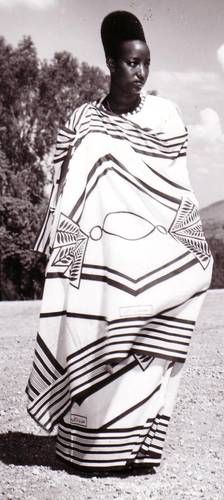
That calm lasted a mere fortnight, however, and was shattered this date in 1994 when the aged widow of Rwanda’s last monarch was hauled to Butare city’s national museum and shot along with several of her caregivers.
Taken in marriage in 1942 (French link) by King Mutara III, Rosalie Gicanda had stayed out of politics after he died mysteriously and Rwanda became a republic.
Being an emblematic Tutsi in April 1994, however, was all the political involvement needed to doom her. According to Human Rights Watch.
At 11 a.m. … a detachment of soldiers commanded by Lt. (jg) Pierre Bizimana, acting under the orders of Capt. Nizeyimana, invaded the modest home of Rosalie Gicanda … About eighty years old, she lived a quiet life as a devout Catholic, sharing her home with her bed-ridden mother and several women and girls who cared for them both. Because she eschewed any involvement in politics and behaved with discreet dignity, even the most anti-Tutsi politicians had left her largely undisturbed throughout the thirty years of Hutu rule…. The soldiers passed through the wooded enclosure that protected the house from the main street and entered the little house with its air of faded respectability. They seized the former queen and six others, leaving her bed-ridden mother and one girl to care for her. The soldiers passed by the ESO and then took Gicanda and the others to a place behind the national museum where they shot them. One teenaged girl, left for dead, survived to recount the murders. The soldiers returned to pillage Gicanda’s home in the afternoon and, two days later, they killed her mother. …
The news that this gracious lady and others from her household had been taken away by soldiers in the back of a pickup truck spread rapidly and alarmed Tutsi and all others who opposed the genocide. They concluded that if soldiers dared to seize even this revered person, then no one was safe.
That conclusion, of course, was well-founded. Over 200,000 Butare Tutsis are thought to have suffered Gicanda’s fate (or worse) in the ensuing months, making it the Rwandan genocide’s bloodiest province.
Pierre Bizimana was sentenced to death for Gicanda’s killing in 1998; I have been unable to document whether that sentence was ever carried out. His commanding officer, Idelphonse Nizeyimana, was arrested in October 2009.
Putatively in the service of a rebellious lord, Topi immediately established himself as the cause’s most capable commander. His forces bloodily seized Cawnpore (Kanpur) in a heady surprise victory during the conflict’s opening stages.
A British counterattack overturned that promising development. The Indian lord was captured, but “all the capacity for resistance that he ever displayed” had been supplied by Topi. Now, Topi found a more impressive liege in Rani Lakshmibai, and deployed his genius for soldiery in a fast-evolving war — harrying the occupiers in both conventional and (increasingly) guerrilla-style combat.
The rebels were outclassed; the time was not yet ripe — but Topi’s was the model of anticolonial guerrilla insurgency that would figure so prominently in the next century.
Topi’s exploits and elusiveness, maintaining his freedom in the field long after every other pillar of the uprising had collapsed, made him a domestic hero, and formed a continuing theme in the British press in 1858 and 1859. He was genuinely admired by his enemies as a soldier, however much his cause was abhorred. (The stiff-upper-lippers dinged him for inadequate personal courage, however.)
Topi was taken, at last, by betrayal, and dead at the order of a drumhead military court within days.
But the day after the London Times published its report of the popular hero’s hanging (“a great scramble was made by officers and others to get a lock of hair, &c”), it editorially eulogized* Topi with the gusto of victor catching, perhaps, the foreshadow of Indian resistance awaiting in generations still to come.
He raised armies as fast as we could disperse them, took up one position after another to our infinite annoyance, and led us a chace which, despite of unexampled efforts on the part of our soldiers, seemed to be really endless. Our troops pursued him without intermission, contrived more than once to surprise him, repeatedly captured his artillery and scattered his troops, but could never deprive him entirely of followers or guns. He seemed to summon forces from the earth as if by magic. As the pursuit grew hotter and hotter he mounted his men on ponies and camels, and marched, it is said, at the average rate of 60 miles a-day. Wherever we found him he had always cavalry and guns, and these he posted with remarkable skill.
…
Be it remembered that for half a century we had been training soldiers, and that in Bengal alone there were 150,000 natives under arms when this revolt broke out. Now, in all this enormous host there was not a single man who, when the bonds of allegiance and discipline were abruptly removed, displayed the intuitive capacities of a military commander. … The two years of the revolt, with all their opportunities, never produced one native General. … One man alone reproduced the old Indian character, and that man was TANTIA TOPEE — an obscure civilian, without place or power. He, by the light of nature alone, discerned the strong points of the rebels’ position and our own weak points. By the exercise of that faculty with which heroes are gifted he could always, even in his most desperate straits, draw followers to his standard. …
Nothing could more forcibly illustrate the reputation which this man had acquired than the fact that his fate has been attended with some regret … if he had not met his match in those opposed to him he might have founded a dynasty.
* May 21, 1859. Information moved a little slower.

 The trail quickly led back to rival pol U Saw, himself a former Prime Minister of under British colonial rule.
 Antoine Quentin Fouquier de Tinville (
 Such was the course that ended the rise of


 That calm lasted a mere fortnight, however, and was shattered this date in 1994 when the aged widow of Rwanda’s last monarch was hauled to Butare city’s national museum and shot along with several of her caregivers.
