1098: Yaghi-Siyan, commander of Antioch

On this date in 1098, the Turkish commander of Antioch put to flight by the invading Crusader army was seized and beheaded as a trophy of the victory.

Yaghi Siyan, the Seljuk governor known to European chroniclers as Acxianus, Gratianus or Cassianus, found himself in a bad way when Christian forces of the First Crusade laid siege to Antioch late in 1097.

Although the Europeans were famished, they maintained the siege for the best part of a year, finally surging into Antioch on the night of June 2-3, 1098, with the help (as so often the case in siege warfare) of an inside man who agreed to open a gate.

Arab historian Ali ibn al-Athir described the city’s fall.

Yaghi Siyan showed unparalleled courage and wisdom, strength and judgment. If all the Franks who died had survived they would have overrun all the lands of Islam. He protected the families of the Christians in Antioch and would not allow a hair of their head to be touched.

After the siege had been going on for a long time the Franks made a deal with one of the men who were responsible for the towers. He was a cuirass-maker called Ruzbih [or Firuz, or Firouz] whom they bribed with a fortune in money and lands. He worked in the tower that stood over the river-bed, where the river flowed out of the city into the valley. The Franks sealed their pact with the cuirass-maker, God damn him! and made their way to the water-gate. They opened it and entered the city. Another gang of them climbed the tower with ropes. At dawn, when more than 500 of them were in the city and the defenders were worn out after the night watch, they sounded their trumpets … Panic seized Yaghi Siyan and he opened the city gates and fled in terror, with an escort of thirty pages.

Yaghi-Siyan fell from his horse in flight; his

companions tried to lift him back into the saddle, but they could not get him to sit up, and so left him for dead while they escaped. He was at his last gasp when an Armenian* shepherd came past, killed him, cut off his head and took it to the Franks at Antioch.**

A borderline “execution” at best, but close enough for our purposes; the Turkish garrison Yaghi-Siyan left behind to face the music was receiving similar treatment from the Crusaders, as were civilians, Muslim and Christian alike.

The month following Yaghi-Siyan’s death was a strange and pivotal one in the strange and pivotal history of the Crusades.

The city of Antioch was almost immediately invested again — by a relief force of Turks who had arrived too late. Facing seemingly long odds on the other end of the siege, and still near to starvation, the Crusaders discovered the “Holy Lance”† and managed to repel the Turks, enabling the upstart Christian army to march on to Jerusalem.

* Having had their homelands overrun by the Seljuks during the preceding decades, there was no small tension in the Armenian relationship with their Turkish rulers; the man who betrayed the city was himself said to be an Armenian who had been forced to convert to Islam. The account of the city’s capture by Raymond d’Aguiliers reports that our day’s victim “was captured and beheaded by some Armenian peasants, and his head was brought to us. This, I believe, was done by the ineffable disposition of God, that he who had caused many men of this same race to be beheaded should be deprived of his head by them.”

** Different accounts give slightly different versions of how Yaghi-Siyan came to his end — whether thrown from his horse or caught attempting to take refuge — and the station in life of the Armenian (everyone seems to agree on the nationality of the executioner) who decapitated him.

† The spear supposed to have pierced Christ on the cross, whose discovery was directed by Peter the Hermit at the direction, he said, of St. Andrew. Ibn al-Athir had a more skeptical take:

a holy man who had great influence over them, a man of low cunning … proclaimed that the Messiah had a lance buried in the Qusyan, a great building in Antioch … Before saying this he had buried a lance in a certain spot and concealed all trace of it. He exhorted them to fast and repent for three days, and on the fourth day he led them all to the spot with their soldiers and workmen, who dug everywhere and found the lance as he had told them.

On this day..

1453: Çandarli Halil Pasha, after the fall of Constantinople

On this date in 1453, Ottoman Grand Vizier Çandarli Halil Pasha (or Chandarly) was put to death, the first time anyone holding that office had suffered such a fate.

In Istanbul, Halil Pasha tower — part of the siegeworks used to take Constantinople — overlooks Fatih Sultan Mehmet Bridge, named for the man who ordered Halil Pasha’s death.

It was a stunning fall for the man who had presented himself in the sultan’s council just six days before to argue for discontinuing the seven-week-old Ottoman siege of Byzantine Constantinople.

This siege would succeed, on May 29, in conquering the second Rome, and it may have been Halil Pasha‘s longstanding opposition to this project so glorious for the rising Ottomans that cost him his life.

Or, something else; we are obliged to speculate. Other possible factors include:

  • Halil Pasha’s enormous personal wealth, which made his family both a potential rival and a source of confiscated revenues badly needed by the state.
  • Personal rivalry with the sultan now known as Mehmed the Conqueror, whom Halil Pasha had deposed in the former’s childhood in favor of his retired father when exigencies of state required a more experienced hand.
  • A generation gap with the sultan’s younger advisors. Both Ottoman and Christian sources recorded charges that he was in league with Byzantium’s defenders; even if not true in a literally treasonous sense, the veteran statesman had relationships with Christians through Constantinople and (as evidenced by his opposition to the siege) likely had more to lose than to gain from Mehmed’s aggressive foreign policy.

Especially in the last respect, Chandarly Halil Pasha’s death turned over a leaf in Europe’s complex relationship with the rising Turks. And among those inclined to view a clash of civilizations between the Christian and Muslim worlds, the May 29, 1453 Ottoman conquest of Constantinople rates as a day just as weighty for the fate of the world as for that of Halil Pasha himself.

A highly recommended digression: Lars Brownworth’s coverage in the 12 Byzantine Rulers podcast of that empire’s last ruler, Constantine XI — who died with his boots on the day Constantinople fell, “the empire as his winding-cloth.”

[audio:http://download.12byzantinerulers.com/16-Constantine-XI.mp3]

On this day..

1076: Waltheof II, Earl of Northumbria

On this day in 1076, William the Conqueror had Northumbrian Earl Waltheof II beheaded for treachery — the only major noble executed by the Norman king.

Waltheof in the comics! (Or see him trade up to battle-axe here.) According to Reality Fiction, Waltheof had a colorful afterlife as a literary character whose reputed exploits grew more prolific with age; he was a popular saint in the next generations. Some also consider Waltheof a possible ancestor of Robin Hood.

When the Norman Conquest brought William the Conqueror to power, the nobles didn’t know the Normans would be able to keep what they’d won … and being nobles, they started plotting.

Multiple revolts shook the northern marches where Waltheof had his domain, and the burly Northumbrian, according to skald Thorkill Skallason, was a Norman-killing machine.

Waltheof burned a hundred
Of William’s Norman warriors
As the fiery flames raged;
What a burning there was that night!

Our day’s principal made nice with the Conqueror and even got dynastically wedded to William’s niece, Judith.

But his fame as a warrior and strategically positioned estates soon had conspirators wooing him for another run at rebellion — the Revolt of the Earls, which would turn out to be the last serious resistance to the last successful invasion of Britain.

Waltheof either (accounts are radically at odds) signed on and then got cold feet, or got entrapped into it, or didn’t join but also didn’t report it when he found out, or got shopped for political reasons by his Norman bride. (Judith, suspiciously, got to keep his huge tracts of land after Waltheof lost his head for the property-confiscating offense of treason.)

Whatever the case, he was soon obliged to throw himself on the mercy of the king. He got a royal wife as his first prize for a brush with treason. His second prize was, he was decapitated.

Waltheof is supposed to have made such a delay at the scaffold with the Lord’s Prayer that the headsman got impatient and lopped off his dome after the words “Lead us not into temptation.” Devotional legend says that the severed head completed the prayer.

Thorkill Skallason remembered the last English earl still keeping it real under William’s rule.

William crossed the cold channel
and reddened the bright swords,
and now he has betrayed
noble Earl Waltheof.
It is true that killing in England
will be a long time ending;
A braver lord than Waltheof
Will never be seen on earth.

Another quarter-millennium elapsed before another English earl — Thomas Plantagenet, Earl of Lancaster — was put to death in the realm.

Waltheof’s story is told in detail in the context of The history of the Norman conquest of England, available free from Google books, and directly from the relevant primary documents here.

On this day..

1962: Gheorghe Arsenescu, Romanian partisan

On this date in 1962, partisan Gheorghe Arsenescu was put to death at Bucharest’s Jilava Prison.

Arsenescu was a leader and co-founder of one of Romania’s several bands of anti-communist resistance units. Arsenescu’s Haiducii Muscelului — the Muscel Outlaws — were a band of 30 to 40 in the Carpathian fooothills who scarcely posed a serious threat to the Romanian state, but who nevertheless managed to elude capture for nine solid years in the 1950’s.

(More about the Haiducii in this Romanian pdf.)

Arsenescu was finally nabbed in 1960, a few months after his former comrades Toma and Petre Arnautoiu had themselves been executed. According to Revolution and Resistance in Eastern Europe, Arsenescu’s wife and father were also given long prison sentences for aiding him.

This band was perhaps most especially notable for one of its members who not only survived capture, but outlived the Communist regime: Elisabeta Rizea.

Crippled by torture, Rizea became a potent symbol in post-Communist Romania of the resistance of Arsenescu and others.

On this day..

1871: The Paris Commune falls

On this date in 1871, the last barricade of the Paris Commune fell to the onslaught of the army — and a legion of Parisians fell to the army’s firing squads.

On the evening of that bright Sunday when the insurrection finally collapsed, a Sunday when the streets of central Paris were crowded with returning bourgeois, all expressing their satisfaction that the struggle was at last over, the city’s walls were placarded with a proclamation emanating from MacMahon. “Inhabitants of Paris,” said he, “the Army of France has come to save you. Paris is delivered. At four o’clock our soldiers carried the last position occupied by the insurgents. Today the struggle is over, order, work and security will now revive.

I read that announcement in the Rue de Rivoli, not far from the Hotel-de-Ville. A moment later, however, I heard a discharge of musketry … Several insurgents who had been taken fighting were being shot. (My Adventures in the Commune, Paris, 1871, an anti-Commune source)

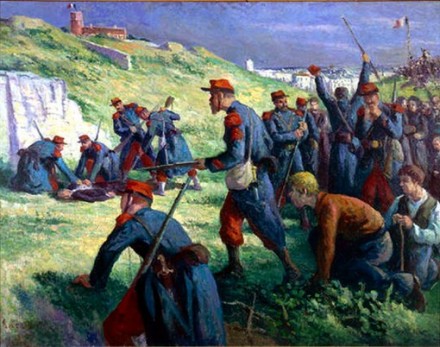
The day was climax and curtains for the first working-class seizure of power in industrial Europe, but in truth indiscriminate reprisal executions had been underway since troops of the conservative Versailles government first breached rebellious Paris on May 21.

What followed was semaine sanglante, the “bloody week” — each barricade’s surviving defenders executed summarily, and anyone in the city liable to a similar fate if the nearest French officer disliked the cut of his or her jib. Rumors swept the city that women of the Commune were torching buildings, for instance, and suddenly any woman in the street could be killed as an arsonist; some firefighters were shot as saboteurs when the “water” they threw on such flames failed to speedily quench them,* and was consequently adjudged to be kerosone.

And heaven help he who should chance to resemble one of the wanted Communard leaders!

Any passer-by calling a man by a revolutionary name caused him to be shot by soldiers eager to get the premium … Members and functionaries of the Commune were thus shot, and often several times over, in the persons of individuals who resembled them more or less.


Un rue de Paris en 1871, by Maximilien Luce.

The total body counts are guesswork: the killing ran far ahead of the record-keeping. Twenty thousand, or thirty, or more are thought to perished by summary execution. Even the press of the bourgeoisie, whose sword arm the Versailles men comprised, was aghast. London’s Times filled its broadsheets with calumnies upon the Commune, but noted on May 29:

“The Revolution is crushed;” but at what a cost, and amid what horrors! … the Communists seem not very much worse than their antagonists. It sounds like trifling for M. Thiers to be denouncing the Insurgents for having shot a captive officer “without respect for the laws of war.” The laws of war! They are mild and Christian compared with the inhuman laws of revenge under which the Versailles troops have been shooting, bayoneting, ripping up prisoners, women and children, during the last six days.

Whatever the true death toll, it massively surpassed that of the much more eagerly commemorated Revolutionary Terror.

Not for Executed Today to number what the butchers themselves could not. In a city turned charnel house in the midst of a Week of Blood, a few scenes of mortality from the day the Commune fell. (Heavily sourced to the very pro-Commune — hence potentially sensational — History of the Commune of 1871)

This people, heroes in the face of the foreigner, must therefore by called assassins, criminals, wretches, because they died for the Universal Republic, because in defense of their beliefs, their conscience, their idea, they preferred, in their fierce enthusiasm, to bury themselves in the ruins of Paris rather than abandon it to the coalition of despots a thousand times more cruel and more lasting than any foreigner.

-Lissagaray

The 147 Fédérés at Communards’ Wall

At a wall still consecrated to leftists in the Pere Lachaise cemetery of Belleville, 147 were summarily shot.

The 147 are acclaimed as the last defenders of the Commune.

the Commune is in its death throes. Like the dragon of fairy lore, it dies, vomiting flames … What must these men feel who are killing and being killed in the cemetery! To die among the dead seems horrible. But they never give it a thought; the bloody thirst for destruction which possesses them allows them only to think of one thing, of killing! Some of them are gay, they are brave, these men. That makes it only the more dreadful; these wretches are heroic! Behind the barricades there have been instances of the most splendid valour. A man at the Porte Saint-Martin, holding a red flag in his hand, was standing, heedless of danger, on a pile of stones. The balls showered around him, while he leant carelessly against an empty barrel which stood behind. — “Lazy fellow,” cried a comrade. ‘”No,” said he, “I am only leaning that I may not fall when I die.”

Paris Under the Commune, an anti-Commune source

Communard Eugene Varlin

Varlin, alas! was not to escape. On Sunday the 28th May he was recognized in the Rue Lafayette, and led, or rather dragged, to the foot of the Buttes Montmartre before the commanding general. The Versaillese sent him to be shot in the Rue des Rosiers. For an hour, a mortal hour, Varlin was dragged through the streets of Montmartre, his hands tied behind his back, under a shower of blows and insults. His young, thoughtful head, that had never harboured other thoughts than of fraternity, slashed open by the sabres, was soon but one mass of blood, of mangled flesh, the eye protruding from the orbit. On reaching the Rue des Rosiers, he no longer walked; he was carried. They set him down to shoot him. The wretches dismembered his corpse with blows of the butt-ends of their muskets.

Varlin was shot along with a nameless batch of others to whom the March 18 execution of Generals Lecomte and Thomas had been hastily imputed (they were held at the generals’ execution site, to contemplate their sin). A pro-government paper allowed that Varlin “died game.”

L’execution de Varlin, another Maximilien Luce scene.

Many at the stock exchange

According to the Paris Francais as quoted by this Marxist review of the events

It is at the Bourse that there was to-day the largest number of executions. The doomed men who attempted to resist were bound to the iron railing.

The stock exchange is “a fit place, to be sure, for this sort of business,” observes our interlocutor.

Eighty-plus defenders of Belleville, at the Arc de Triomphe

The London Times editorialized on May 31 upon this incident when the Marquis de Gallifet plucked from the mass of Belleville’s May 28 captives “eighty prisoners, principally soldiers of every arm, linesmen, artillerymen, and Zouaves, [who] were set apart and afterwards led to the right of the rampart to be shot.”

The French are filling up the darkest page in the book of their own or the world’s history. The charge of ruthless cruelty is no longer limited to one party or to one class of persons. The Versailles troops seem inclined to outdo the Communists in their lavishness of human blood. The Marquis de Gallifet is escorting a column of prisoners to Versailles or Satory. He “picks out eighty-two of them, and shoots them at the Arc de Triomphe.” Next came a lot of 20 firemen, then a dozen women, one aged 70. On another spot our Correspondent came upon “80 corpses, piled upon each other, a mass of arms and legs and distorted faces, while the roads and gutter literally flowed with blood.” About 1,000 are said to have thus suffered. By this wholesale and summary execution of prisoners in batches of 50 and 100, not only must the innocent perish with the guilty, but many must bear the penalty of imaginary guilt.

An utterly disconnected Englishman, according to the paper’s correspondent, was accidentally among the four score at the Arc, and only saved by the fortuitous intervention of a Belgian attache.

an English officer somehow got mixed up in the procession, and was forced to keep in it by the escort, who, out of 5,000 prisoners, could not, of course, be expected to recognize one innocent man … it so happened that some of the prisoners tried to escape, and to make an example the leader of the cavalry escort, the Marquis de Gallifet, a man who is not prone to err on the side of mercy, had then and there 81 shot, and the English officer was all but one of them, his explanations being at first refused the slightest attention. Human life has, in fact, become so cheap that a man is shot more readily than a dog.

Socialist physician Tony Moilin

One single fact was Tony Moilin reproached with: that of having on the 18th March taken possession of the mairie of his arrondissement, and having thus had a share in giving the signal for the insurrection …

The court-martial condescended to tell him that the fact of the mairie, the only one he could be reproached with, had in itself not much importance, and did not merit death, but that he was one of the chiefs of the Socialist party, dangerous through his talents, his character, and his influence over the masses; one of those men, in short, of whom a prudent and wise Government must rid itself when it finds a legitimate occasion to do so

[A] respite of twelve hours was granted him in order that he might make his testament, write a few words of farewell to his father, and finally [marry his pregnant lover] … on the 28th May, in the morning, Tony Moilin was led into the garden a few steps from the palace and shot. His body, which his widow claimed, the surrender of which had been at first promised, was refused her. (History of the Commune of 1871)

The unnumbered dead of Lobau Barracks

Since morning a strong cordon is being formed round the theatre (Châtelet); where a court-martial is permanently established. From time to time one sees a band of fifteen to twenty individuals coming out, composed of National Guards, civilians, women and children fifteen to sixteen years old.

These individuals are condemned to death. They march two by two, escorted by a platoon of chasseurs, who lead and bring up the rear. This cortege goes up the Quai de Gevres and enters the Republican Barracks in the Place Lobau. A minute after one hears from within the fire of platoons and successive musketry discharges; it is the sentence of the court-martial which has just been executed.

The detachment of chasseurs returns to the Chatelet to fetch other prisoners. The crowd seems deeply impressed on hearing the noise of the shootings.

This is another publication’s story cited in the History of the Commune of 1871, which itself also details the court-martial procedures of this drumhead tribunal:

Thousands of prisoners who were led there were first of all penned in upon the stage and in the auditorium, under the guns of the soldiers placed in the boxes; then, little by little, like sheep driven to the door of the slaughter-house, from wing to wing they were pushed to the saloon, where, round a large table, officers of the army and the honest National Guard were seated, their sabres between their legs, cigars in their mouths. The examination lasted a quarter of a minute. ‘Did you take arms? Did you serve the Commune? Show your hands.’ If the resolute attitude of a prisoner betrayed a combatant, if his face was unpleasant, without asking for his name, his profession, without entering any note upon any register, he was classed. ‘You?’ was said to the next one, and so on to the end of the file, without excepting the women, children, and old men. When by a caprice a prisoner was spared, he was said to be ordinary, and reserved for Versailles. No one was liberated.

The classed ones were at once delivered to the executioners, who led them into the nearest garden or court. From the Châtelet, for instance, they were taken to the Lebau Barracks. There the doors were no sooner closed than the gendarmes fired, without even grouping their victims before a platoon. Some, only wounded, ran along by the walls, the gendarmes chasing and shooting at them till they fell dead. … There were so many victims, that the soldiers, tired out, were obliged to rest their guns actually against the sufferers. The wall of the terrace was covered with brains; the executioners waded through pools of blood.


Summary executions — death squads — continued for days or weeks afterwards in Paris; martial law throttled left organizing in the city; and those “fortunate” enough to have been captured alive were processed in a steady stream of judicial executions over the months yet to come.

The Commune, a palpably subversive example even in the present day, was destroyed in every way possible for the Versailles government. But its example could hardly be forgotten.

Marx would write The Civil War in France of the only proletarian revolution he would actually witness in his lifetime.

The next generation’s subversives also took inspiration from the Parisian example … and lessons from its mistakes. Lenin — a fond student of the Commune, who was eventually buried wrapped in a Communard banner — said that

two mistakes destroyed the fruits of the splendid victory. The proletariat stopped half-way: instead of setting about “expropriating the expropriators”, it allowed itself to be led astray by dreams of establishing a higher justice in the country united by a common national task; such institutions as the banks, for example, were not taken over … The second mistake was excessive magnanimity on the part of the proletariat: instead of destroying its enemies it sought to exert moral influence on them; it underestimated the significance of direct military operations in civil war, and instead of launching a resolute offensive against Versailles that would have crowned its victory in Paris, it tarried and gave the Versailles government time to gather the dark forces and prepare for the blood-soaked week of May.

“The lesson learnt by the proletariat will not be forgotten,” Lenin vowed, and his own revolution gained a vital object lesson in the Bloody Week of Paris, and an anthem besides: Communard Eugene Pottier, fleeing the Versailles army’s slaughter, wrote the verses that have been sung ever since by millions dreaming of a better world — the Internationale.

* Water can accelerate a fire, under the right circumstances.

On this day..

1525: Thomas Müntzer, prophet of the Peasants’ War

On this date in 1525, radical religious reformer and Peasants’ War leader Thomas Müntzer lost his head in the town of Mühlhausen.

Müntzer, a university-educated theologian, caught the whiff of Lutheranism in the Zeitgeist; following Luther’s call to study the Biblical text directly without the intervention of the doctors of Rome, Müntzer swiftly discerned a heavenly admonition to set to rights the many wrongs of an unjust world.

Luther had not had in mind dispossessing the haves, particularly not when imperial electors defended him from the Pope’s inquisitors.

When in 1517 opposition against the dogmas and the organisation of the Catholic church was first raised by Luther, it still had no definite character. Not exceeding the demands of the earlier middle-class heresy, it did not exclude any trend of opinion which went further. It could not do so because the first moment of the struggle demanded that all opposing elements be united, … Luther’s sturdy peasant nature asserted itself in the stormiest fashion in the first period of his activities. “If the raging madness [of the Roman churchmen] were to continue, it seems to me no better counsel and remedy could be found against it than that kings and princes apply force, arm themselves, attack those evil people who have poisoned the entire world, and once and for all make an end to this game, with arms, not with words. If thieves are being punished with swords, murderers with ropes, and heretics with fire, why do we not seize, with arms in hand, all those evil teachers of perdition, those popes, bishops, cardinals, and the entire crew of Roman Sodom? Why do we not wash our hands in their blood?”

This revolutionary ardour did not last long. The lightning thrust by Luther caused a conflagration. A movement started among the entire German people. In his appeals against the clergy, in his preaching of Christian freedom, peasants and plebeians perceived the signal for insurrection. Likewise, the moderate middle-class and a large section of the lower nobility joined him, and even princes were drawn into the torrent. While the former believed the day had come in which to wreak vengeance upon all their oppressors, the latter only wished to break the power of the clergy, the dependence upon Rome, the Catholic hierarchy, and to enrich themselves through the confiscation of church property. The parties became separated from each other, and each found a different spokesman. Luther had to choose between the two. Luther, the protégé of the Elector of Saxony, the respected professor of Wittenberg who had become powerful and famous overnight, the great man who was surrounded by a coterie of servile creatures and flatterers, did not hesitate a moment. He dropped the popular elements of the movement, and joined the train of the middle-class, the nobility and the princes. Appeals to war of extermination against Rome were heard no more. Luther was now preaching peaceful progress and passive resistance.

Muntzer became adopted into the Marxist pantheon sufficiently to grace East Germany’s five-mark bill.

That’s Engels in The Peasant War in Germany, revisiting the theological conflicts at the birth of the Protestant Reformation from the perspective of 19th century Marxism.

Projecting backwards, Engels saw in Müntzer a distant forerunner of their own day’s class conflicts — the man whose language was Biblical and apocalyptic but whose subject matter was the peasantry’s demand for material justice.

[Luther] says in his booklet on commerce that the princes should make common cause with thieves and robbers. But in this same writing he is silent about the source of all theft … Behold, the basic source of usury, theft, and robbery is our lords and princes, who take all creatures for their private property. The fish in the water, the birds in the air, the animals of the arth must all be their property, Isaiah 5[:8]. And then they let God’s commandment go forth among the poor and they say, “God has commanded, ‘Thou shalt not steal’.” But this commandment does not apply to them since they oppress all men — the poor peasant, the artisan, and all who live are flayed and sheared, Micah 3[:2f]. But, as soon as anyone steals the smallest thing, he must hang. And to this Doctor Liar says, “Amen.” The lords themselves are responsible for making the poor people their enemy. They do not want to remove the cause of insurrection, so how, in the long run, can things improve? I say this openly, so Luther asserts I must be rebellious. So be it!*

In this detail view of East German artist Werner Tübke’s weird panorama of the Battle of Frankenhausen, a crestfallen Müntzer realizes divine aid is not forthcoming.

Müntzer embraced the cause of a massive peasant revolt in central Europe in 1524-25. Luther said God wanted them “knocked to pieces, strangled and stabbed, secretly and openly, by everybody who can do it, just as one must kill a mad dog!”

So it was with Müntzer, who was captured in the decisive Battle of Frankenhausen, tortured into recanting his heretical doctrines,** and beheaded.

Whether one thinks of politics leading Müntzer’s theology or theology leading his politics† or some sort of dialectic between them, we see Müntzer latterly through a glass darkly — the wasted root of a lost Reformation.

* From a 1524 pamphlet vituperatively entitled “Highly provoked defense and answer to the spiritless, soft-living flesh at Wittenberg, who has most lamentably befouled pitiable Christianity in a perverted way by his theft of holy Scripture,” reprinted in Revelation and Revolution.

** Müntzer’s theology included rejection of infant baptism, which ranks him as an early anabaptist.

† “I have done nothing but say that a Christian should not so wretchedly sacrifice someone else on the butcher’s table. And if the political bigwigs do not cease to do so, the government should be taken from them. Whenever I have seriously proclaimed this to Christendom, it either refused to act or was too scared to do so. What more shall I do? Should I perhaps be silent, like a dumb dog? Why should I then make a living off the altar?”

On this day..

1832: Samuel Sharpe, “I would rather die upon yonder gallows than live in slavery”

On this date in 1832, Jamaican national hero Samuel Sharpe died upon the gallows for instigating the slave revolt that would (help to) end slavery.

Samuel Sharpe, an educated slave who was also a Baptist deacon, was the moving spirit behind the attempted general strike that became the Christmas Rebellion.

That time of year was less than festive for Jamaica’s enormous slave population, for Saint Nick opened the short window for harvesting the island’s sugar cane.

Samuel Sharpe and collaborators had the wit to realize that being depended upon to bring in the cash crop that made life comfortable for their owners put the slaves’ hands upon a potent economic lever. In the last few days of 1831, they pressed it.

The “passive resistance” thing didn’t last long, however, and the “strike” transmuted into a rebellion — the cause swiftly taken up by thousands of slaves around the island who torched crops. Given the small (less than 20) white body count,* the “violence” appears to have been directed against the instruments, rather than the perpetrators, of their enslavement.

Not so the reprisals.

The rebellion was suppressed within days, and over 300 put to death for it (in addition to 200 slave casualties during the pacification itself). There’s an absorbing BBC Witness episode about this affair available as a podcast here.

Sharpe was the last of those executed.

But his revolt is widely thought to have given impetus to the British parliament’s deliberations over the ensuing months that ultimately led to the Slavery Abolition Act (1833).

What [abolitionist MP William] Wilberforce was endeavoring to win from the British senate by his magic eloquence the slaves themselves were endeavoring to gain by outbreaks and violence. The combined action of one and the other wrought out the final result. While one showed that slavery was wrong, the other showed that it was dangerous as well as wrong. Mr. Wilberforce, peace man though he was, and a model of piety, availed himself of this element to strengthen his case before the British Parliament, and warned the British government of the danger of continuing slavery in the West Indies. There is no doubt that the fear of the consequences, acting with a sense of the moral evil of slavery, led to its abolition. The spirit of freedom was abroad in the Islands. Insurrection for freedom kept the planters in a constant state of alarm and trepidation. A standing army was necessary to keep the slaves in their chains. This state of facts could not be without weight in deciding the question of freedom in these countries … I am aware that the insurrectionary movements of the slaves were held by many to be prejudicial to their cause. This is said now of such movements at the South. The answer is that abolition followed close on the heels of insurrection in the West Indies, and Virginia was never nearer emancipation than when General Turner kindled the fires of insurrection at Southampton.

Frederick Douglass

Sharpe, today, is an official national hero of Jamaica. The place in Montego Bay that he hanged is known as Sam Sharpe Square, and his face adorns the currency.

* Contrast with the much smaller, much bloodier rebellion of Nat Turner in the U.S., which preceded the Christmas Rebellion by a few months.

On this day..

1781: Tupac Amaru II, Incan insurgent

On this date in 1781, the last name in Incan rebellion met a horrible end in the ancient Incan capital of Cusco.

José Gabriel Condorcanqui — rechristened Tupac Amaru II, as he was a distant descendant of the last Incan king — was a member of the privileged indigenous population depended upon by the Spanish to administer the forced and extorted labor that made its New World empire worth having.

Condorcanqui evidently had an epiphany.

In November 1780, he launched a well-planned rebellion by engineering the public execution of a hated corregidor Antonio de Arriaga at the hands of his own servant.

“From this day, no longer shall the Spanish feast on your poverty!”

This attention-grabbing entry onto the political chessboard was followed with an exemplary victory over Spanish forces. His revolt rapidly metastasized into an ethno-religious crusade, with all the accumulated bitterness of the Indians’ two-plus centuries maltreatment ferociously visited upon the Spanish.

It was a heady moment — but only a moment; within a few months, the Spanish had rallied and Tupac Amaru was betrayed into their hands.

The rebel had seized Incan symbology for his own purposes — speaking at ancient shrines, for instance — and the Spanish sentence against him included not only the inevitably horrific execution (of both Tupac Amaru and his wife and family) but a comprehensive and explicit programme of cultural annihilation to consign the Incan identity to the past. This lengthy sentence is well worth the read. (Sourced here, a pdf file; the bolded sections are my highlights.)

I must and do condemn José G. Túpac Amaru to be taken out to the main public square of [Cuzco], dragged out to the place of execution, where he shall witness the execution of the sentences imposed on his wife, Micaela Bastidas [Spanish link]; his two sons, Hipólito and Fernando Túpac Amaru; his uncle, Francisco Túpac Amaru; and his brother-in-law, Antonio Bastidas, as well as some of the principal captains and aides in his iniquitous and perverse intent or project, all of whom must die on the same day.

And once these sentences have been carried out, the executioner will cut out his tongue, and he will then be tied or bound by strong cords on each one of his arms and feet in such a way that each rope can be easily tied or fastened to others hanging from t he saddle straps of four horses, so that, in this position, each one of these horses, facing opposite corners of the square, will pull toward his own direction; and let the horses be urged or jolted into motion at the same time so that his body be divided into as many parts and then, once it is done, the parts should be carried to the hill or high ground known as “Picchu,” which is where he came to intimidate, lay siege to, and demand the surrender of this city; and let there be lit a fire which shall be prepared in advance and then let ashes be thrown into the air and a stone tablet placed there detailing his main crimes and manner of his death as the only record and statement of his loathsome action.

His head will be sent to the town of Tinta where, after being three days on the gallows, it shall be placed on a stake at the most public entrance to the town, one of his arms will go to the town of Tungasuca, where he was chief, where it will be treated in like manner, and the other in the capital of the province of Carabaya; one of the legs shall likewise be sent for the same kind of demonstration to the town of Libitaca in the province of Chumbilcas, while the remaining one shall go to Santa Rosa in the province of Lampa along with the affidavit and order to the respective chief magistrates, or territorial judges that this sentence be proclaimed publicly with the greatest solemnity as soon as it arrives in their hands, and on the same day every year thereafter; and they will give notice in writing of this to their superiors in government who are familiar with the said territories.

Since this traitor managed to arm himself and form an army and forces against the royal arms by making use of or seducing and leading with his falsehood the chiefs who are the second in command in the villages, since these villages, being of Indians, are not governed by such chiefs but rather by mayors who are elected annually by the vote or nomination of the chiefs: let these same electoral communities and the chief magistrates that care to give preference to candidates who know Spanish, and who are of the best behavior, reputation, and customs so that they will treat their subjects well and lovingly, honoring only those who have demonstrated honestly their inclination and faithfulness, eagerness, respect, obedience, submission, and gratitude to the greater glory of our great Monarch through the sacrificed of their lives, properties, or ranches in deference of their country or religion, receiving with brave disdain the threats and offers of the aforesaid reel leader and his military chiefs, yet taking care that these elected leaders are the only ones with the right to the title of chief or governor of their ayllus [communities] or towns, and that they cannot transmit their position to their children or other family members.

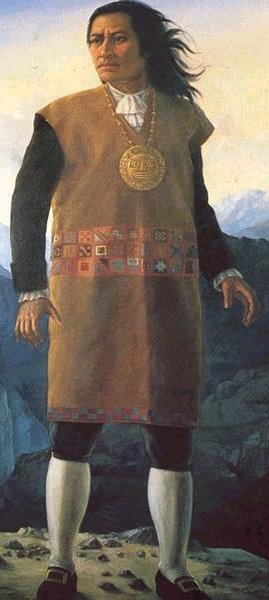
To this same end, it is prohibited that the Indians wear heathen clothes, especially those who belong to the nobility, since it only serves to symbolize those worn by their Inca ancestors, reminding them of memories which serve no other end than to increase their hatred toward the dominant nation; not to mention that their appear is ridiculous and very little in accordance with the purity of our relics, since they place in different parts images of the sun, which was their primary deity; and this prohibition is to be extended to all the provinces of this southern America, in order to completely eliminate such clothing, especially those items which represent the bestialities of their heathen kings through emblems such and the unco, which is a kind of vest; yacollas, which are very rich blankets or shawls of black velvet or taffeta; the macapaycha, which is a circle in the shape of a crown from which they hand a certain emblem of ancient nobility signified by a tuft or tassel of red-colored alpaca wool, as well as many other things of this kind and symbolism. All of this shall be proclaimed in writing in each province, that they dispose of or surrender to the magistrates whatever clothing of this kind exists in the province, as well as all the paintings or likenesses of their Incas which are extremely abundant in the houses of the Indians who consider themselves to be nobles and who use them to prove their claim or boast of their lineage.

These latter shall be erased without fail since they do not merit the dignity of being painted in such places, and with the same end in mind there shall also be erased, so that no sign remains, any portraits that might be found on walls or other solid objects; in churches, monasteries, hospitals, holy places or private homes, such duties fall under the jurisdiction of the reverend archbishops or bishops of both viceroyalties in those areas pertaining to the churches; and in their place it would be best to replace such adornments with images of the King and our other Catholic sovereigns should that be necessary. Also, the ministers and chief magistrates should ensure that in no town of their respective provinces be performed plays or other public functions of the kind that the Indians are accustomed to put on to commemorate their former Incas; and having carried out the order, these ministers shall give a certified account to the secretaries of the respective governments. In like manner shall be prohibited and confiscated the trumpets or bugles that the Indians use for their ceremonies and which they call pututos, being seashells with a strange and mournful sound that celebrate the mourning and pitiful memorial they make for their antiquity; and there shall also be prohibited the custom of using or wearing black clothing as a sign of mourning, a custom that drags on in some provinces in memory of their deceased monarchs and also of the day or time of the conquest which they consider disastrous and we consider fortunate since it brought them into the company of the Catholic Church and the very loving and gentle domination of our Kings.

With the same goal it is absolutely forbidden that the Indians sign themselves as “Incas,” since it is a title that anyone can assume but which makes a lasting impression on those of their class; and it is ordered, as is required of all those who have genealogical trees or documents that prove in some way their descent, that they produce them or send them certified and without cost by mail to the respective secretaries of both viceroyalties so that the formalities may be observed by those persons responsible to their excellencies the viceroys, consulting His Majesty where necessary according to each case; and the chief magistrates are charged to oversee the fulfillment of such requirements, to seek out and discover anyone who does not observe them correctly, in order to have it done to collect the documents with the aim of sending them to the proper authorities after giving their owners a receipt.

And so that these Indians renounce the hatred that they have conceived against the Spaniards, and that they adhere to the dress which the laws indicate, adopting our Spanish customs and speaking Castilian [Spanish], we shall introduce more vigorously than we have done up to now the use of schools, imposing the most rigorous and fair penalties on those who do not attend once enough time has passed for them to have learned the language; the duties and responsibilities involved in this plan going to the very reverend ecclesiastical prelates so that, in the opposition between parishes and doctrinas, they take care that those candidates bring affidavits from the provincial judges as to the numbers of people who speak the Said Castilian in those provinces … it being left up to the sovereign discretion of His Majesty to reward and honor those towns whose inhabitants have rendered, under the present circumstances, their due loyalty and faithfulness.

Finally, the manufacture of cannons of all kinds shall be prohibited under the penalty that any noble found manufacturing such items will be sentenced to ten years of prison in one of the presidios in Africa and any commoner will receive two hundred lashes as well as the same penalty for the same time period; reserving for a future time a similar resolution with regards to the manufacture of powder. And since there cannons of almost every caliber in the many ore-crushing mills and timber yards in these provinces, they will be gathered up by the magistrates once of the pacification of this uprising has been completely terminated in order to give account of them to the respective captaincy general so that he may determine whatever use he deems proper for them. Thus have I visualized, ordered, and signed: this is my final judgment.

José Antonio de Areche.

Tupac Lives.

The Spanish campaign to eradicate his name and identity didn’t exactly have legs.

The savagery of the crackdown helped generate Incan support for the rebellions that would shake off Spanish authority in the generations to come. He entered the official iconography of the post-colonial state, and can be found on Peruvian currency.

The very name Tupac Amaru became pregnant with the spirit of resistance — both in Peru, where it was adopted by a 1990’s revolutionary movement, and abroad, where a New York City Black Panther activist (pdf) gave the name to a son: Tupac Amaru Shakur.

On this day..

1381: Eppelein von Gailingen

On this day in 1381, probably the most infamous robber baron in Germany was flogged, done in on the breaking wheel, and beheaded in Postbauer, near Nürnberg.

Eppelein von Gailingen (or Egkelein Geyling, or some variation thereof) has been dramatized across the ages, but little is known of the man’s life. His death, certainly, but his life is clouded in myth and folklore. What’s clear is that von Gailingen met his grisly end for robbery and a subsequent escape from incarceration. The rest is a tad murky (German link).

Von Gailingen belonged to the class of original robber barons, who supplemented their income with unauthorized tolls and, sometimes, flat-out theft. While the term is more popularly known for its application to the so-called industrial robber barons, it derived from a literal description from centuries past — Raubritter, in German, “men of birth who elected to live, in a lawless age, by saddle and by sword; who sought gain by masterful spoliation, and strove for glory by despiteful deeds of arms.” (Source)

A combination of factors led to the slow and steady dissolution of the former feudal system in favor of a money-based economy during the Middle Ages, and after the Plague swept through Europe around 1350, the accumulated changes and decimated population left much of the continent short on labor and, as a result, short on production. This really was a spot of bother for barons who, unlike their monarchical brethren, had no way to draft extra manpower. With resources thinning and a social lifestyle to keep up, many of these former lords turned to theft and exploitation. Although Rome established the rules governing tolls and trade, many local lords, now charged with obeying distant regulations, opted for a more convenient route: they stopped ships at unauthorized points, shook down the merchants, and sometimes seized wares to stock their own shelves.

Eppelein von Gailingen (German link), a lord in the castle at Gunzenhausen, near Illesheim, was of this group, but apparently one of its more bold and populist members.

He was often felt to be a kind of Robin Hood, and the earliest celebrations of the man were largely in this vein: a knight’s knight, fighting against an out-of-control state disregarding its people. Eppelein got away with his skulduggery until 1369, when he was captured by a political rival and imprisoned in Nürnberg. Von Gailingen was sentenced to death, but shortly before his hanging, an accomplice managed to sneak him a horse, on which he rode out the tower gates and hurdled the enclosing wall and moat.

Now the leader of a loyal band of brigands flouting the Roman Catholic Church, Eppelein went on the run for six years, eventually making his way back near his home. It was there that, after six more years, his minimal forces finally yielded to the Count of Nürnberg, who carried out a much more unpleasant version of the death sentence.

Eppelein’s rise to prominence began in the 16th century, when he was immortalized by a folk song, a medium that continues to be kind to him. Locals still tell a variety of tales of his exploits, and a rendition of these classics is vaguely effected through the film Ekkelins Knecht.

Others have simply waxed poetic on the topic.

As if all that attention weren’t enough, von Gailingen’s run from the law lives on through the legend of Nürnberg: locals pushing the town on tourists claim that two hoofprints from his daring escape are imprinted in the stonework near the the castle’s five-pointed tower.* And perhaps most indicative of his endurance as a cultural icon, a neighboring town has devoted a festival to him, which is more than most robber barons of any day can claim.

* Not surprisingly, the tower was destroyed and rebuilt at least once — just five decades after Eppelein’s alleged leap. But the new sandstone structure does bear the marks of what could conceivably be a horse’s hooves.

On this day..

1297: Marion (Murron) Braidfute, bride of The Wallace

May of 1297 marks the first appearance in the historical record of Braveheart hero William Wallace … so we mark today the undated (and presumably fictional) execution/murder of his wife that, by the most cinematic account possible, set Wallace on his own path to the scaffold.

The face that lifted a thousand claymores: Catherine McCormack as Braveheart‘s version of Marion, Murron MacClannough. Murron’s “execution” inspires William Wallace.

Marion (or Marian) Braidfute, she’s called by the Scottish poet Blind Harry in the epic dating near two centuries after famed rebel’s rising. Not wanting audiences to confuse her with Robin Hood sweetie Maid Marian, the Braveheart script renamed her Murron MacClannough.

In Mel Gibson’s gory silver screen epic, Wallace is, at this point, a determinedly apolitical commoner — a stance contrasting markedly with a backstory of nationalistic identity-forming experiences, like having his father and brother killed by the English. He’s radicalized only after his attempt to protect Murron from rape results in her demonstrative summary execution.

And of course, Wallace then wreaks a bloody revenge (complete with summary execution of his own) that soon has the country in flames.

Hollywood’s avenging-his-woman angle exploits a folkloric embroidery of a female character perhaps created by Blind Harry, writing in the 15th century. In “The Wallace”, the titular hero is already well along his conflict with the English crown when he weds Marion — whose story arc differs greatly from that of the peasant eye candy Mel Gibson taps. In the poem, Marion is exposed to the vengeance of the Sheriff of Lanark, William Heselrig, when Wallace goes off to fight and refuses to take her along.

Now fierce with Rage the cruel Foe draws near,
Oh does not Heaven make Innocence its Care!
Where fled thy guardian Angel in that Hour
And left his Charge to the fell Tyrant’s Power,
Shall his fierce Steel be redned with thy Gore
And streaming Blood distain thy Beauties o’er?

But now awaken’d with the dreadfull Sound
The trembling Matron threw her Eyes around,
In vain alace were all the Tears she shed
When fierce he waves the Fauchion o’er her Head
All Tyes of Honour by the Rogue abjur’d
Relentless deep he plung’d the ruthless Sword;
Swift o’er her Limbs does creeping Coldness rise
And Death’s pale Hand seal’d up her fainting Eyes.

Wallace slays Heselrig the next day, according to the poem — the actual historical event of May, 1297,* that marks Wallace’s emergence from the dim fogs of history. (In the film Braveheart, the chronology is unstated, but Wallace is revenged before Murron’s burial.)

John of Fordun, writing in the 14th century, tells the tale.

The same year William Wallace lifted up his head from his den — as it were — and slew the English sheriff of Lanark, a doughty and powerful man, in the town of Lanark. From that time, therefore, there flocked to him all who were in bitterness of spirit, and weighed down beneath the burden of bondage under the unbearable domination of English despotism; and he became their leader. He was wondrously brave and bold, of goodly mien, and boundless liberality … So Wallace overthrew the English on all sides; and gaining strength daily, he, in a short time, by force, and by dint of his prowess, brought all the magnates of Scotland under his sway, whether they would or not.

* “In the month of May the perfidious race of Scots began to rebel.” (Walter of Hemingborough)

On this day..