1681: Isabel Alison and Marian Harvey, Covenanters

We turn today to William Crookshank’s (certainly partisan) narrative of the hanging of two Scottish Covenanters on this date in Edinburgh, as told in his The history of the state and sufferings of the Church of Scotland.


On the 25th of December some of the students in the College of Edinburgh brought to the head of the Cowgate the effigy of the pope in his robes, with his keys, mitre, and triple crown; and, when they had excommunicated him, they carried him about in a chair, like that wherein he is elected at Rome, to the foot of the Blackfriars’ Wynd. The students, knowing the thing had taken air, gave out that they were to carry his holiness in procession to the Grassmarket, the place of the execution of criminals; whereupon the guards marched thither. Meanwhile the boys marched in procession by the Black-friars’ Wynd to the High-street, three of them going before with lighted torches. Being come thither they condemned his holiness to be burnt: accordingly the torchmen blew up the effigy with gun-powder, notwithstanding their being attacked by some soldiers commanded by Linlithgow and his son; whom they warned to beware whom he struck, since he had relations among them.

The Duke of York’s [the future James II -ed.] being now in Scotland sharpened the edge of the persecution; so that no less than twenty were executed in the course of this year 1681.

The sufferers had, it is true, declared against the king’s authority, for which many of them were hanged, and otherwise persecuted by their enemies, and’censured by their friends. They branded them as madmen, enemies to government and civil society; but it is very plain that they never opposed government or monarchy as such, but only wicked, perjured, and persecuting governors. These they did oppose, and that for the very same reasons that brought about the Revolution and the protestant succession.

I cannot express this better than in the words of the author of the Memoirs of the Church of Scotland, when speaking of the Torwood excommunication. Says he,

I desire the impartial reader to compare it with the memorials above-mentioned, [to wit, the memorial to the Prince of Orange from the people of Great Britain, to invite him to come to their assistance] and see if it be posible for any British protestant, who owns the justice of the Revolution, to reflect upon the zeal of these people, without blushing for himself and the whole nation, that they did not see and abhor the tyranny of those reigns sooner; then they had joined with those people instead of censuring their zeal; the Revolution had then been brought about without sovereign help at all; the Prince of Orange had then been called over, as peaceably as King George, to take possession of the crown; and the blood of near 20,000 people, who were one way or other murdered and destroyed by that now abdicated race of tyrants, had been saved. What a shame is it, says he, to us, and how much to the honour of these persecuted people, that they could thus see the treachery and tyranny of those reigns, when we saw it not; or rather, that they had so much honesty of principle, and obeyed so strictly the dictates of conscience, as to bear their testimony early, nobly, and gloriously to the truth of God and the rights of their country, both civil and religious; while we all, though seeing the same things, yet betrayed the cause of liberty and religion, by a sinful silence and a dreadful cowardice.

But suppose, through the treatment, the unacountable treatment they met with, they had gone a little beyond due bounds, and though sometimes their expressions were not so well chosen, can that either condemn the principles of religion and liberty upon which they acted; nay, or their actual disowning those tyrants, who, for nothing but the matters of their God and Saviour, had declared them outlaws, rebels and traitors? Besides, the blood of many was shed, against whom they could prove nothing, but what they extorted from them by their ensnaring questions. Nay, even some of the weaker sex were hanged or drowned on this score. But I shall relate the matters of fact as they happened in the order of time.

It was a dreadful affront to the Duke of York to find his holiness treated in such a manner, on that grand festival the 25th of December; and therefore the sycophant managers must not overlook such an indignity.

Accordingly, on the 4th of January, the masters of the college declared their abhorrence of what their scholars had done; and on the 6th, the council commanded the magistrates to order the college gates to be shut, and the classes to be dissolved. About this time several of the students were imprisoned, besides Mr Ridpath, which so exasperated the rest, that it is said, they threatened to burn the provost’s house at Priestfield, because the magistrates, who were patrons of the college, instead of protecting them, had acted violently against them; and in a few days the house of Priestfield was burnt.

Whereupon the council, on the 17th, issued a proclamation, offering 2000 merks and a remission, to any who should discover the actors: but it does not appear that any discovery was made …

The order of time leads me to the case of Isobel Alison and Marion Harvey, two young women, who were executed this month, to the perpetual disgrace of the bloody managers, who could have no acts of what they called rebellion, in the least, to lay to their charge.

When they were taken, I know not. Isobel Alison was apprehended at Perth, where she lived, only for speaking against the severity used to sundry good people there; for they could accuse her of nothing else. Marion Harvey was seized while going one day from Edinburgh to hear sermon in the fields, and was last year before the council. But though they had nothing against these two young women, they were resolved to shed their blood: and therefore upon what they owned at their examination they founded their indictment, and took away their lives. That the reader may have a specimen of the injustice of this period, that afterwards became common, I shall here insert the substance of their examination first before the council, and next before the lords of justiciary.

When Isobel Alison was before the council, she was interrogated as follows:

Q. Can you read the Bible?

A. Yes.

Q. Do you know the duty we owe to the civil magistrate?

A. When the magistrate carrieth the sword for God, according to what the scripture calls for, we owe him all due reverence; but when they overturn the work of God, and set themselves in opposition to him, it is the duty of his servants to execute his laws and ordinances on them.

Q. Do you own the Sanquhar declaration? [a speech disavowing Presbyterian allegiance to the government]

A. I do own it.

Marion Harvey’s examination before the council was upon the same points with that of her fellow-sufferer … Only, among other tilings, they said, Will you cast away yourself so? To which shy replied, I love my life as well as any of you, but would not redeem it upon sinful terms. They said, the rock, the cod and bobbins, were as fit for her to meddle with as those things. They offered her the assistance of ministers, but she would have none of their pro. vidiug

On the 17th of January they were brought before the Lords of Justiciary; for it was the constant practice at this time, the one day to bring such as fell into their hands before the council, and there by ensnaring questions, to bring them into a confession of such things as they accounted treason, and next day to prosecute them before the criminal court. These two women were accused for hearing at field-conventicles, harbouring Messrs Cargill, Cameron, &c. owning the Rutherglen and Sanquhar declarations, &c.

When Isobel Alison was before them, she was examined as follows:

Q. Do you abide by what you said the last day?

A. I am not to deny any thing of it. She owned she had converged with David Hackstoun, and disowned their authority.

Q. Do you disown us and the king’s authority in us?

A. I disown you all because you carry the sword against God, and not for him, and have, these nineteen or twenty years, made it your work to dethrone him, by swearing, year after year, against him and his work, and assuming that power to a human creature which is due to him alone, and have rent the members from their Head, Christ.

… Then they said, Your blood be on your own head, we shall be free of it. She answered, So said Pilate, but it is a question if it was so; and ye have nothing to say against me, but for owning of Christ’s truths and his persecuted members. They made no reply, but desired her to subscribe what she had owned, and, upon her refusing, did it for her.

Marion Harvey, before the justiciary, owned the Sanquhar declaration, &c. and then protested that they had nothing to say against her as to matter of fact; but only that she owned Christ and his truth, his persecuted gospel and members; of which she said, Ye have hanged some, others you have beheaded and quartered quick. To this they said nothing; but called those who were to sit on the jury, who appeared with reluctance. One of them said, He did not desire to be engaged in this matter; but he was obliged: then he desired that the confessions of the two prisoners might be read, because he knew not what they had to say against them. When he was ordered to hold up his hand and swear, he fell a-trembling. The jury being fixed, the confessions were read, and the advocate in a speech, aggravated every particular, in order to prove them guilty of treason. Some of the jury urged that there was no fact proved against them. The advocate said, But treason is fact; and taking himself again, he said, It is true, it is only treason in their judgment, but go on according to our law; and if you will not do it, I will proceed. The jury brought them in guilty on their own confession; however, the passing of the sentence was deferred till the 21st, when they were both condemned to be hanged at the Grassmarket on the 26th.

Meanwhile, on the 20th, the council enlarged the powers of the laird of Meldrum for apprehending those who were in the rebellion. The many searches which were made in consequence of this were most oppresive. The same day the magistrates of Edinburgh were ordered to call all the masters of coffee-houses before them, and obliged them to come under a bond of 5000 merks, to suffer no news-paper to be read in their houses, but such as are approved of by the officers of state.

Next day all the students in the college of Edinburgh were ordered to retire fifteen miles from that place, within twenty four hours, and not to come within these bounds without leave from the council, under the pain of being treated as seditious persons. A fine protestant government, to make such a splutter about burning the pope! But it was decent to compliment his Royal Highness the Duke!

On the 26th, Isobel Alison and Marion Harvey were executed according to their sentence. The reader will find what passed between them and Mr Riddel in the Cloud of Witnesses, together with their respective testimonies. When they were brought from the prison to the council-house, in order to be carried from thence to the place of execution, Marion Harvey said, with a surprising chearfulness and heavenenly transport, Behold, I hear my Moved saying unto me, Arise, my love, my fair one, and come away. When in the council-house, Paterson bishop of Edinburgh (such was the spirit of the man!) said, Marion, you said you never would hear a curate, now you shall be forced to hear one; and immediately ordered one of his suffragans, whom he had prepared for the purpose, to pray. When he began, she said to her fellow-prisoner, Come, Isobel, let us sing the 23d Psalm; which they did, and thereby drowned the curate’s voice, and confounded their persecutors.

Their behaviour on the scaffold is not to be omitted. Isobel having sung the lxxxiv Psalm, and read Mark xvi, cried over the scaffold, and said, Rejoice in the Lord ye righteous; and again, I say, rejoice. She was not suffered to pray till she came to the foot of the ladder. As she went up, she cried out, ‘O be zealous, sirs, be zealous, be zealous! O love the Lord, all ye his servants! O love him; for in his favour is life!’ And added, ‘O ye his enemies, what will ye do? Whither will ye fly in that day? for now there is a dreadful day coming on all the enemies of Jesus Christ. Come out from among them, all ye that are the Lord’s people.’ Then she concluded, ‘Farewell all created comforts; farewell sweet Bible in which I delighted most, and which has been sweet to me since I came to prison; farewell Christian acquaintances. Now into thy hands I commit my spirit, Father, Son, and Holy Ghost.’ Then the executioner threw her over.

Marion Harvey likewise sung Psal. lxxxiv. and having read Mal. iii, she said, ‘I am come here to-day for avowing Christ to be Head of his church and King in Zion. O seek him, sirs, seek him and ye shall find him: I sought him and I found him; I held him, and would not let him go.’ Then she rehearsed briefly the heads of her written testimony. Going up the ladder she said, 0 my fair one, my lovely one, come away. And, sitting down on the ladder, she said, ‘I am not come here for murder; for they have no matter of fact to charge me with ; but only by judgment. I am about twenty years of age: at fourteen or fifteen I was a hearer of the curates and indulged; and while I was a hearer of these I was a blasphemer and Sabbath-breaker, and a chapter of the Bible was a burden to me; but since I heard this persecuted gospel, I durst not blaspheme nor break the Sabbath, and the Bible became my delight.’ Upon this the commanding officer called to the executioner to throw her over, which he did accordingly.

On this day..

1855: Emmanuel Barthelemy, duelist

The winner of England’s last fatal duel was hanged at Newgate on this date in 1855 … but not for the duel.

Both participants in that duel, Emmanuel Bart(h)elemy and Frederic Cournet, were French emigres* who had commanded Parisian barricades during the 1848 revolution.

On its surface the duel was one of those trivial affairs of honor: Barthelemy heard that Cournet (otherwise unknown to him) had repeated some defamatory rumors about Barthelemy already abroad in France, and challenged Cournet on that basis; Cournet at first dissociated himself from any such smears, but upon better consideration thought he considered Barthelemy’s notice a little on the ultimatum side and took exception to that.

The consequent set-to was delayed some time by negotiations over every element of its ceremony. When at last it was arranged, it unfolded thus:**

it should commence with pistols, the combatants, being 40 paces apart, advancing 10 paces before firing if they chose, and having two shots each, miss-fires not counting; that the choice of position, the choice of pistols, and the signal for firing should be determined by tossing up; that if the pistols proved ineffectual swords should be resorted to to terminate the affair.

Cournet won the toss and got to choose his position and take the first shot. Barthelemy had to stand stock-still as Cournet

advanced his 10 paces and fired, but though on 14 similar occasions he had never failed to hit his opponent this time he missed. Barthelemy then told him that he had his life in his hands, but would surrender his right to fire if Cournet would agree to terminate the duel with swords. [Barthelemy had wanted swords to be the dueling weapon in the first place -ed.] Cournet declined to do so, saying that he would stand his adversary’s fire and take his second shot. Barthelemy then levelled his pistol, but … it snapped. He put a fresh cap on and it snapped a second time,† and it was then agreed that he should use Cournet’s pistol, which was loaded and handed to him. Before discharging it, however, he again offered ineffectually to terminate the contest with swords. He then fired, and with fatal precision.

Barthelemy himself and all four of the seconds involved (both Barthelemy’s and Cournet’s) were arraigned in this case, but the jury returned only a manslaughter verdict. Barthelemy served a few months; he would have to exercise fatal precision once again to find a different route to the scaffold.

In his non-duelling life, Barthelemy was a mechanical engineer, and it was in this capacity that a soda-water manufacturer named George Moore employed him to repair his machinery at 73 Warren Street, just off Fitzroy Square.

Late the night of Friday, December 8, Barthelemy showed up with a veiled woman at the place and asked for Moore. Minutes later, the servant-girl saw all three emerge struggling violently together from their private meeting. As she raced to the door to scream for help she saw the Frenchman raise a pistol and fire …

“Murder!”

Her screams started attracting the neighbors as Barthelemy burst past her, but an iron gate in front of the house obstructed him. Before more people could assemble he fled back into the house and locked it shut behind him.

Moore’s neighbor, a former East India Company man named Charles Collard, thought quickly to his own grief. Collard raced around the back side of the house where a garden opened onto another street, and arrived just in time to catch Barthelemy vaulting over the garden wall. Collard pounced on him, and in the ensuing melee Barthelemy shot him, too.

This was all too late for Barthelemy, for the delay had brought an onrushing of neighbors and passersby who quickly subdued the gunman. Somehow — nobody quite knew how — his companion was nowhere to be found. She had vanished from the house leaving only her veil, and as she had surely not escaped by the front gate it was thought that she must have found some way to slip out the back casually amid the commotion and made a nonchalant escape. She was never seen again.

Moore was found quite dead in his home: he’d been shot through the head, and the marks on his body indicated that the fatal wound had been preceded by some whacks with a cane. Collard lingered on many hours in agony — long enough for his captured murderer to be brought before him and Collard to deliver a signed j’accuse identifying Barthelemy as the villain.

Barthelemy must have had a way with jurors because even in convicting him for murder on this occasion, the panel still recommended mercy. There seems to have been some thought that the mysterious dispute in the house might have been a spontaneous affair qualifying as manslaughter, while the murder of Collard might have passed (since Collard grabbed Barthelemy) as self-defense. The crown unsurprisingly did not share this exceptionally generous view of a man who had already been in the dock for homicide in the past and declined to extend mercy.

Barthelemy disdained the religious entreaties of his captors, scandalizing the right-thinking with bon mots like “it is no use to pray to God, as God will not break the rope.” Indeed, He did not.

* It was perhaps fitting that Frenchmen, a people with an abiding enthusiasm for the duel, who transacted this milestone encounter. En garde!

** Per the London Times of Oct. 28, 1852, summarizing evidence presented in court.

† Upon post-duel examination it emerged that Barthelemy’s pistol had failed to discharge because of a bit of linen rag stuck in the breach. This eyebrow-raising fact gave rise to the suspicion of foul play, though on whose part and to what end is less distinct. Both guys ended up with a shot at one another with the exact same pistol. Cournet just missed his.

On this day..

Feast Day of Saint Agnes

January 21 is the feast date and traditional martyrdom date (in the year 304) of Agnes of Rome, a 13-year-old put to death in the Diocletian persecutions who has the distinction of being among the seven women mentioned by name in the Catholic Canon of the Mass.

Agnes means “chaste” in Greek,* and this was precisely the problem.

As prosperous as she was pulchritudinous, she was pious even moreso and spurned the many suitors for her hand and bed. Eventually one or the other of them peevishly reported her as a Christian.

Upon arrest, the abstinent youth was allegedly subjected to an official program of sexual assault, including displaying her naked in public and forcing her into a brothel. It’s said that divine intervention prevented her violation in these ordeals. (The flowing locks in the Ribera portrait of her at right are part of that myth, supposed to have sprouted long enough to save her from her public shaming.)

Considering that her defining characteristic is her virginity, Agnes has quite the lurid legend — and that does not exclude her very martyrdom. Per the erotically-charged poetic account of the 4th-5th century Christian poet Prudentius,** Agnes rejoiced sensually in the executioner sent to to render her to her heavenly bridal-bed:

I rejoice that there comes a man like this,
A savage, cruel, and wild warrior,
Rather than a languid, soft,
Womanish youth fragrant with perfume,
Come to destroy my life with the death of my honor.

This lover, this one at last, I confess, pleases me.
I shall rush to his eager steps
And not demur from his hot ardor.
I shall welcome the entire length of
His blade into my bosom, drawing the sword-blow
To the depths of my breast.

Original Latin here from Prudentius’s Liber Peristephanon (Crowns of Martyrdom)†

Agnes, whose purported relics are interred in the Roman church Sant’Agnese in Agone, is the patron saint of an entire pantheon of feminine sexual incipience: chastity, virgins, young women, and betrothed couples.‡

Little surprise, then, that the legend arose in Christendom that a maid could invoke the vision of her future husband by performing certain suggestive rituals — like lying supine and naked on her bed — on the eve of St. Agnes (that is, the night of January 20).

It’s upon this occasion that Keats pins his narrative poem The Eve of St. Agnes§ (full text here or here), in which a young woman performing these rites is in her dreamlike state deflowered by the desired suitor her family forbids — and then the two slip away by night “o’er the southern moors.”

Beyond a mortal man impassion’d far
At these voluptuous accents, he arose,
Ethereal, flush’d, and like a throbbing star
Seen mid the sapphire heaven’s deep repose;
Into her dream he melted, as the rose
Blendeth its odour with the violet,–
Solution sweet: meantime the frost-wind blows
Like Love’s alarum pattering the sharp sleet
Against the window-panes; St. Agnes’ moon hath set.


The Eve of St. Agnes, by John Everett Millais (1863) shows Keats’s Madeleine about to disrobe before taking to bed on that occasion. The Keats poem was very popular with Millais’s pre-Raphaelite crowd.

* It’s also similar to the Latin word for lamb, agnus; consequently, the lamb is Agnes’s usual iconographic symbol.

** Prudentius, best-known for his seminal allegorical verse Psychomachia, composed a number of hymnal poems. Some are still in use today — such as “Of the Father’s Love Begotten”.

† Translation has a few tweaks of my own but is primarily that of Colbert I. Nepaulsingh in “The Afrenta de Corpes and the Martyrological Tradition,” Hispanic Review, Spring, 1983.

‡ She’s also the patron saint of rape victims.

§ Tennyson later wrote a short poem of his own touching the same theme, “St. Agnes’ Eve”.

On this day..

2013: Alireza Mafiha and Mohammad Ali Sorouri, viral video stars

A 37-second security camera clip of a Tehran being mugged by machete-wielding assailants went viral to great outrage in Iran in December 2012, and resulted in the very speedy execution on January 20, 2013, of the culprits.

Alireza Mafiha and Mohammad Ali Sorouri were publicly hanged at a still-dark 6:30 a.m. before a crowd of about 300 people for Moharebeh (waging war against God)

There’s a photo series of the execution here.

Two other accomplices (the video captures four assailants in all) received 10 years in prison and 74 lashes.

On this day..

1973: Lim Seng, under Philippines martial law

On this date in 1973,* under the then-new martial law regime of Philippines strongman Ferdinand Marcos, a 52-year-old Chinese businessman was shot at Fort Bonifacio.**

Lim Seng was a struggling restauranteur in the 1960s when he dove into the heroin business.

He wasn’t struggling much longer.

He quickly became the Walter White of Manila heroin production, exploiting ties to criminal syndicates in the Golden Triangle to churn out (by the early 1970s) 1.2 tons of smack. Ninety percent of it was exported to the United States. (.pdf source on Lim Seng’s criminal career)

The other 10% helped feed a burgeoning heroin addiction among Manila students, leading to a seminal 1972 anti-drug law under which Lim Seng was arrested days after martial law came down that September. He faced a military, rather than a civilian trial.

Naturally quite wealthy from his enterprise, he evidently believed up until the last moments that he could buy his way out of execution. Little did he understand that he had been ticketed to demonstrate the incipient dictatorship’s iron fist: thousands of civilian spectators crowded the ropeline of the rifle range to glimpse the garishly publicized ceremony, while others took in the radio broadcast or news footage.

Lim Seng was the first person executed by the Marcos regime for drug trafficking.

* Lim Seng was tried in December 1972, and some sources report this as his execution date. Contemporary newspaper accounts unambiguously confirm that the execution took place on January 15, 1973.

** Fort Andres Bonifacio, formerly a base of the U.S. occupation called Fort McKinley, was christened for an executed Filipino patriot.

On this day..

1730: Neither James Prouse nor James Mitchel, much to their surprise

January 14, 1730, was the date appointed for the public hanging in Philadelphia of James Prouse and James Mitchel for burglary.

Prouse, for his part, admitted the crime but insisted that James Mitchel had nothing to do with it — and Mitchel insisted the same. This ultimately generated considerable support for clemency which the authorities did not seem inclined to act upon.

Naturally the young newspaperman Benjamin Franklin — just turning 24 in January 1730 — was keen to publish this affecting story in his Philadelphia Gazette. Through the magic of public domain, he’s generously allowed us to republish his account from the January 20, 1730 Gazette as our guest post today.

Hyperlinks are, as one may surmise, Executed Today‘s own annotations.


We think our Readers will not be displeased to have the following remarkable Transaction related to them in this particular Manner.

Wednesday the 14th Instant, being the Day appointed for the Execution of James Prouse and James Mitchel for Burglary, suitable Preparations were accordingly made. The tender Youth of one of them (who was but about 19) and the supposed Innocence of the other as to the Fact for which they were condemned, had induced the Judges (upon the Application of some compassionate People) to recommend them to His Honour‘s known Clemency: But several Malefactors having been already pardoned, and every Body being sensible, that, considering the great Increase of Vagrants and idle Persons, by the late large Importation of such from several Parts of Europe, it was become necessary for the common Good to make some Examples, there was but little Reason to hope that either, and less that both of them might escape the Punishment justly due to Crimes of that enormous Nature. About 11 o’Clock the Bell began to Toll, and a numerous Croud of People was gathered near the Prison, to see these unhappy young Men brought forth to suffer. While their Irons were taken off, and their Arms were binding, Prouse cry’d immoderately; but Mitchel (who had himself all along behaved with unusual Fortitude) endeavoured in a friendly tender Manner to comfort him: Do not cry, Jemmy; (says he) In an Hour or two it will be over with us, and we shall both be easy. They were then placed in a Cart, together with a Coffin for each of them, and led thro’ the Town to the Place of Execution: Prouse appear’d extreamly dejected, but Mitchel seemed to support himself with a becoming manly Constancy: When they arriv’d at the fatal Tree, they were told that it was expected they should make some Confession of their Crimes, and say something by Way of Exhortation to the People. Prouse was at length with some Difficulty prevailed on to speak; he said, his Confession had been taken in Writing the Evening before; he acknowledged the Fact for which he was to die, but said, That Greyer who had sworn against him was the Person that persuaded him to it; and declared that he had never wronged any Man beside Mr. Sheed, and his Master. Mitchel being desired to speak, reply’d with a sober compos’d Countenance, What would you have me to say? I am innocent of the Fact. He was then told, that it did not appear well in him to persist in asserting his Innocence; that he had had a fair Trial, and was found guilty by twelve honest and good Men. He only answer’d, I am innocent; and it will appear so before God; and sat down. Then they were both bid to stand up, and the Ropes were order’d to be thrown over the Beam; when the Sheriff took a Paper out of his Pocket and began to read. The poor Wretches, whose Souls were at that Time fill’d with the immediate Terrors of approaching Death, having nothing else before their Eyes, and being without the least Apprehension or Hope of a Reprieve, took but little Notice of what was read; or it seems imagined it to be some previous Matter of Form, as a Warrant for their Execution or the like, ’till they heard the Words PITY and MERCY [And whereas the said James Prouse and James Mitchel have been recommended to me as proper Objects of Pity and Mercy.] Immediately Mitchel fell into the most violent Agony; and having only said, God bless the Governor, he swooned away in the Cart. Suitable Means were used to recover him; and when he came a little to himself, he added; I have been a great Sinner; I have been guilty of almost every Crime; Sabbath-breaking in particular, which led me into ill Company; but Theft I never was guilty of. God bless the Governor; and God Almighty’s Name be praised; and then swooned again. Prouse likewise seemed to be overwhelmed with Joy, but did not swoon. All the Way back to the Prison, Mitchel lean’d on his Coffin, being unable to support himself, and shed Tears in abundance. He who went out to die with a large Share of Resolution and Fortitude, returned in the most dispirited Manner imaginable; being utterly over-power’d by the Force of that sudden Turn of excessive Joy, for which he had been no Way prepared. The Concern that appeared in every Face while these Criminals were leading to Execution, and the Joy that diffused it self thro’ the whole Multitude, so visible in their Countenances upon the mention of a Reprieve, seems to be a pleasing Instance, and no small Argument of the general laudable Humanity even of our common People, who were unanimous in their loud Acclamations of God bless the Governor for his Mercy.

The following are Copies of the Papers delivered out by Prouse and Mitchel the Evening before, with little or no Alteration from their own Words.

I James Prouse was born in the Town of Brentford in Middlesex County in Old England, of honest Parents, who gave me but little Education. My Father was a Corporal in the late Lord Oxford’s Regiment of Horse, (then named the said Lord’s Blues) and I was for some Time in the Care of an Uncle who lived at Eling near Brentford aforesaid, and who would have given me good Learning; but I being young would not take his good Counsel, and in the 12th Year of my Age came into Philadelphia, where I was recommended to one of the best of Masters, who never let me want for any Thing: But I minding the evil Insinuations of wicked People, more than the good Dictates of my Master, and having not the Fear of God before my Eyes, am deservedly brought to this wretched and shameful End. I acknowledge I justly merit Death for the Fact which condemns me; but I never had the least Design or Thought of the like, until often press’d, and at length seduced to it by John Greyer, who was the only Person that ruined me. He often solicited me to be guilty of other Crimes of the like Nature, but I never was guilty of any such, neither with him or any one else; neither did I ever wrong any Man before, save my too indulgent Master; from whom I now and then pilfer’d a Yard or the like of Cloth, in order to make Money to spend with the said Greyer. As for James Mitchel who dies for the same Fact with me, as I hope to receive Mercy at the great Tribunal, he the said James Mitchel is intirely innocent, (*) and knew nothing of the Fact until apprehended and taken. I am about Nineteen Years of Age and die a Protestant.

JAMES PROUSE.

(*) N. B. He declared the same Thing at the Bar just before he received Sentence.

The Speech or Declaration of James Mitchel written with his own Hand.

I James Mitchel, was born, at Antrim in the Kingdom of Ireland, of good and honest Parents, and brought up with them until the Age of 13 Years, and had a suitable Education given me, such as being taught to read and write English, with some Latin; and might have been further instructed, but at my earnest Request was bound Apprentice to a Book-binder, and served 4 Years to that Trade; after which I left the Kingdom and went for England in order to be further improved in my Business; but there had the Misfortune to be press’d on board the Berwick Man of War, commanded by the Honorable George Gordon, and having been at several Parts abroad, returned to England in Octob. 1728. where I was by Sickness reduced to a very sad Condition, through which I came over to this Country a Servant; here I was it seems unfortunately led into bad Company, and one Evening by James Prouse was raised out of my Bed to go and drink with him and one Greyer, the which Greyer after parting gave to the said James Prouse Six-pence, which was all the Money I saw that Night and till next Morning, and then James Prouse took out of his Pocket a 15 Shilling Bill, and desired me to get it changed for him, in order to spend some of it; but coming unto Town I was apprehended for the robbing of Mr. George Sheed, and now am to die for the same. I die a Protestant.

JAMES MITCHEL.

On this day..

1869: William German, surprising Klan lynch victim

(Thanks to Meaghan Good of the Charley Project for the guest post. -ed.)

On this date in 1869, a man named William German was lynched by the newly formed Ku Klux Klan.

German, a white man, had been hanged for killing a black man, Bill Cullum.

Yes, you read that right.

Bill Cullum was a former slave; William German, a former soldier in the Confederate Army. German was living on a farm he’d rented from a white plantation owner, Alvin Cullum, who had been Bill’s owner.

German was ordered to clear off the land so the ex-slave could live there instead. Furious, German put on KKK robes and, with another man, tracked down Bill Cullum and shot him several times. The dying man was able to crawl to a nearby house and name his attacker before he expired.

The local KKK chapter was outraged. William German had committed his act wearing their garb, but without their authorization and against their rules.

What happened next was recounted in the Memphis Daily Appeal (now called The Commercial Appeal):

The Union and American of Saturday says: “By a private letter from a trustworthy gentleman residing at Cookville in Putnam County, we give some further information in regard to the recent execution near Livingston, in Overton County, by a body of supposed Ku-Klux, of the young man Wm. German, an account of which we published Thursday morning. “He says that a few days before the execution, German shot and badly wounded, and supposed he had killed, a Negro man living in his neighborhood. The shooting took place in a public road, and the Negro managed to crawl to the house of his employer, where he told who had shot him. The Negro had the character of being a quiet, peaceable man, and as there had been no previous trouble between him and German, it was supposed the crime was perpetrated in pure wantonness.

It is thought that the persons by whom German was killed were members of a secret organization, to which he belonged — but whether Ku-Klux or not, nobody in the neighborhood appears to know. The body of men concerned in the execution numbered about 200, and none of them were identified by citizens who witnessed their appearance and departure. Accounts reported Bill German was found hanged in a nearby barn; a sign posted there declared: Hung for shooting a Negro, Bill Cullum, and violating the laws of Ku Klux.”

These days, this story has been used by the KKK as evidence that they are a peaceable organization and not at all racist, honest, pinky-swear.

An aside: executions ran in the German family. William German’s brother, Columbus C. “Lum” German, had also served in the Confederate Army and also met his death at the end of a rope, in 1866.

On this day..

1864: Samuel Wright, by contrast

Samuel Wright and George Townley both murdered romantic partners late in 1863. Both were tried, convicted, and condemned to hang in very short order and both the subjects of intense pressure for a crown commutation of sentence.

Only one of those men hanged. It was 150 years ago today.

George Townley

Townley lived near Manchester and was courting a young woman named Bessie Goodwin from Derbyshire. Described as a man from a respectable upper middle class family with “refined manners,” and an intelligent linguist* to boot, Townley was nevertheless a rung or two below Miss Goodwin on the wealth and status ladder.

He was, accordingly, frustrated of his designs when the young lady accepted a clergyman’s proposal and broke off her previous engagement to Townley. Despite being disinvited by ex-fiancee, Townley took a train to her village and pressed his company on her. The two went for a walk that evening, and Townley stabbed her in the throat — a fact which he confessed on the scene to the first person who responded to the commotion and found Miss Goodwin staggering towards her home with a fatal gash in her neck.

In the great tradition of weird stalkers everywhere, Townley then helped the Good Samaritan carry the dying woman home, and kissed her tenderly, all the while bemoaning to arriving gawkers his guilt. “She has deceived me, and the woman who deceives me must die,” he responded chillingly to the inquiries of his would-be father-in-law. “I told her I would kill her. She knew my temper.”

This is all a very bad hand to deal a defense barrister.

Having little to work with, his superstar attorney — remember, the family had money — went with an insanity defense, aided by the lunacy diagnosis of prominent psychiatrist Forbes Winslow.** There was some history of insanity in his family, and everyone seemed agreed on the point that Townley didn’t set out with the intent to commit murder, but impulsively — madly? — took that course as he realized during his interview that he would surely not be putting a ring on that.

The legal standard of the time gave no purchase to this sort of thing. Townley’s judge instructed the jury to find insanity only if he “was under delusions … [and] supposed a state of things to exist which did not exist, and whose diseased mind was in such a condition that he acted upon an imaginary existence of things as if those things were real.” This is the M’Naghten rule, a historically pivotal and also highly restrictive insanity definition dating to 1843.

On December 12, 1863 Townley was sentenced to death for the murder, with the hanging scheduled for the approaching New Year’s Day. According to the London Times report the next week (Dec. 18), the sentence “has not made the slightest alteration in his demeanour. He partakes of his meals heartily, sleeps well, and repeatedly asserts that he was perfectly justified in taking away his victim’s life, and that he feels no remorse for the deed.”

Nevertheless, Townley’s well-off family and friends had enough pull to pry open a previously little-known legal escape hatch.

Upon the judge’s own request, the crown empaneled a committee to adjudicate Townley’s sanity for his mercy petition. But a sloppily written law actually allowed any two doctors plus any two magistrates to issue a formal certification of madness which would compel the prisoner’s removal to the asylum. Townley’s own solicitor simply assembled himself a quartet so minded and presented their finding to the Home Secretary, forcing his hand — to a great deal of public outrage once the obscure mechanism became known.

“Good friends and abundant means may give a convicted criminal unexpected advantages over an ordinary offender,” the Times complained in an editorial. (Jan. 27, 1864) Plus ça change.

Samuel Wright

Samuel Wright was not a man of means or linguistic gifts, but a bricklayer who lived in a Waterloo Road public house in Surrey, on London’s southern outskirts.

On December 13, 1863, he slashed the throat of his live-in lover Maria Green after they’d both been on a drinking bout. On December 16, mere three days later, Wright voluntarily pleaded guilty and received a death sentence.

A hue and cry for Wright’s sentence to be abated soon arose among London’s working classes, especially in the wake of Townley’s commutation. Wright had a good reputation, while Green was known for her violent temper. Wright intimated that she had menaced him with a knife during a quarrel.

Was this not a case like George Townley’s, only more so?

The contrast in the fates between the two murderers did not flatter. The crimes were analogous even to the mode of slaying.† If anything, the rich man’s suggested a more egregious context: Townley’s victim appeared more sympathetic, and Townley had gone out of his way to track her down in order to kill. Why was Townley’s heat of passion “insanity” but Wright’s was motive and deliberation?

The Home Secretary offered his sympathy but not his mercy. After all, Wright himself agreed that he intentionally killed Green. “To commute the sentence on the grounds on which it has been pressed would, in fact, be to lay down a rule of law as to the distinction between murder and manslaughter contrary to that which is well established,” wrote a Home Office spokesman on Jan. 7 in response to three separate petitions submitted on Wright’s behalf. Maybe they thought the same thing about Townley … but that decision was out of their hands.

In one of the period’s characteristic hanging broadsides, the balladeer has Wright lament,

Friends, for me have persevered,
To save me from the gallows high;
Alas! for me there is no mercy,
Every boon they did deny,
While others who was tried for murder,
And doomed to die upon a tree,
Through friends and money has been pardon’d
who deserved to die as well as me.

But, oh! my friends, you must acknowledge
what I say has oft been said before.
Some laws are made to suit two classes,
One for the rich, one for the poor;
So it is with me and Townley,
A reprieve they quickly granted he,
He was rich, and I was poor, —
And I must face the fatal tree.

The mood of the populace for the hanging at Horsemonger Lane Gaol this date in 1864‡ was decidedly ugly. On the night of the 11th, when it became clear that the many last-ditch bids for commutation — directed not only at the Home Secretary but even to Queen Victoria and even to the Prince of Wales appealing for a boon on the occasion of his first son‘s January 8 birth§ — a handbill circulated in the prison’s neighborhood entreating its denizens to protest the execution by shuttering all windows. “Let Calcraft and Co. do their work this time with none but the eye of Heaven to look upon their crime.”

Indeed this summons was widely obeyed.

A small crowd only turned out for the occasion, and shouted their disgust for the proceedings: “Shame!” and “Judicial murder!” and “Where’s Townley?” Even many months later, at the controversial August 10 hanging of Richard Thomas Parker, the crowd chanted Townley’s name, now the emblem of the unequal justice of the law.

One diarist’s entry for the day recalled that “[t]he blinds were down in all the neighbouring streets and the military were called out in case of an attempted rescue. When the unfortunate man appeared on the scaffold, loud cries of ‘Take him, take him down’ were heard in every direction, to which the unhappy man responded by repeated bows to the multitude, he still continued bowing and was actually bowing when the drop fell.”

Postscript

The language of the law that permitted Townley his backdoor commutation was revised by Parliament within weeks.

As to Townley himself, another panel appointed by the Home Office found him fully cogent, which meant that officially, he had become insane after his death sentence and the insanity abated thereafter. While this finding theoretically reinstated the death penalty, actually hanging him after these circumstances was thought to be inhumane, and he was reprieved. One supposes there must have been some thought for the potential disturbance Townley’s hanging would have occasioned.

On February 12, 1865 — a year and change after escaping the noose that claimed Samuel Wright — George Townley hurled himself headlong off a high staircase onto a stone floor in Pentonville Prison, where he had been transferred as an ordinary inmate. He died on the spot.

* Of course, he could never hope to match the linguistic’s fields most famous English murderer.

** You might recognize this distinctive name from our Winslow’s son, L. Forbes Winslow, a figure in the Jack the Ripper investigation.

† An additional unflatterering comparison point to Derbyshire contemporaries: a proletarian named Richard Thorley had been hanged in Derby in 1862 for a very similar crime: he slashed his girlfriend’s throat when she tried to break up with him.

‡ Among the very last public hangings at Horsemonger Lane Gaol. All UK hangings were conducted behind prison walls by 1868.

§ This infant, Prince Albert Victor, is the royal eventually identified with Jack the Ripper by a particularly inventive hypothesis.

On this day..

1909: The Pollet gang, breaking the French moratorium

Warning: Graphic severed head pictures await at the bottom of this post.

On this date in 1909, the guillotine returned France after an absence of more than three years.

The sitting president was a staunch death penalty opponent and had blocked all executions since his term began in 1906. That was about the same span of time that the Pollet gang had, in the words of a New York Times wire report,* “infested the Belgian-French frontier, robbing churches, houses, and inns, holding up stage coaches and belated travelers, and torturing and slaying their victims according to the old piratical adage that dead men tell no tales.”

Abel Pollet had been a smuggler who put his native gift for leadership to good use organizing his fellow traffickers into a more lucratively violent line of work. Thanks, presumably, to the syndicate’s pre-existing professional aptitude for evasion, it persisted for years and authored a quantity of robberies and murders that authorities could only guess at. (The official homicide estimation ran north of 50.) It was a spree so atrocious that it helped force the end of the whole death penalty moratorium since sentiment was so strong against the Hazebrouck gang .

Incited by the many depredations and perhaps starved from years without the bloody spectacle of public execution, a vast concourse of 30,000 mobbed the guillotine at Bethune.

“At midnight there were 2,000 watchers in the square,” one report ran. “The main street of the town was crowded as on the eve of a fete. Soon after midnight men brought ladders and benches to the square and mounted them to obtain an uninterrupted view. Others climbed into the branches of trees, where their presence was revealed by the glow of cigarettes and pipes in the dark among the branches.”

Undeterred by the steady winter’s drizzle, they would wait all the night through, their numbers continually augmented as road-trippers arrived by train.

At four in the morning the dread traveling executioner Anton Diebler, who had already plied this trade for a generation and more and would continue in the role for another 30 years, arrived with four assistants to set up the guillotine. It was only with difficulty that police restrained the pawing mob.

By half-past five the public prosecutor officially informed the condemned men what they surely already knew — that there would be no mercy. The crowd on the square would have its prey.

As the first robber, Theophile Deroo, emerged at 7:25 a.m., “there was a painful silence, and then an outbreak of hoots and curses from the crowd.” A wilting Deroo had to be hustled to the board amid the jeers. “A mort! A mort!” came the howls.

Three times in the next eight minutes the executioners furiously scrubbed the apparatus clean while guards (per the Times) “held the crowd back with main force.”

Canut Vromant followed coolly; Auguste Pollet was third, fighting and shouting. His brother, the leader Abel Pollet, went under a rain of curses that he answered with the words “Down with the priests! Long live the Republic!”

People are ghoulish. Far be it from us to deny them.


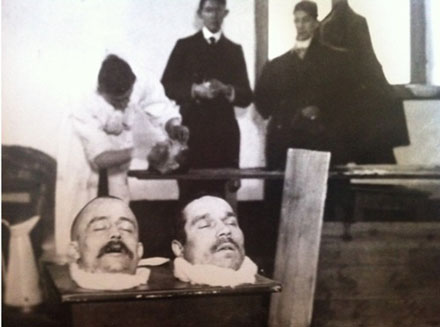
Top: the heads of the Pollet brothers. Middle: The heads of their two accomplices. Bottom: Canut Vromant’s headless trunk awaits autopsy. All images from the invaluable Bois de Justice, via this goregrish forum.


After the quadruple executions, the heads are cleaned up. (Source)

Perhaps, dear reader, you find the public exhibition of these severed heads objectionable. If so, you have an ally in the French state that did the severing.

For years, French elites had been fretting the indecorous behavior of the crowd at what was supposed to be a solemn occasion. The advent of photography only made matters worse, for now the discomfiting head-chopping exercise could be shared with those indisposed to sitting up all night smoking pipes in trees.

But as the moratorium gave way, the rising media form of cinema promised even more debased exhibitions. Enterprising cinematographers were already staging execution re-creations; now there was the prospect for film audiences to be incited to countless bloodlust frenzies by on-the-scene deathporn footage of hated criminals going under the blade. It was in response to just this fear that France a bit later in 1909 promulgated (French link) its first film censorship rules — forbidding in this case the public display of film liable to disturb the public tranquility.

* Jan. 16, 1909 … under the excited headline “THIRST FOR BLOOD AMONG THE FRENCH”,

On this day..

1690: Andrei Ilyich Bezobrazov, stolnik

On this date in 1690, the Russian stolnik (an administrative office in the Russian court) Andrei Ilyich Bezobrazov was put to death with the magicians he allegedly contracted to bewitch Tsar Peter the Great.

Whatever its other sins, Russia enjoys a reputation for having largely steered clear of the frightful witch-hunts that broke out elsewhere in Europe. Certainly tsars issued many decrees against witchcraft and even prescribed the death penalty in law. But unlike courts in western Europe, Russia does not seem ever to have folded the entire swath of extra-Christian folk beliefs and everyday peasant “magic” together into a juridical theory of omnipresent diabolical terrorism stretching from the neighborhood midwife to the Prince of Darkness himself. Perhaps for that reason, its historical record of witch persecutions presents fewer and more scattered data points.

Elites, write Valerie Kivelson and Jonathan Shaheen,* “demonstrated no interest in formulating a systematized or theorized framework for explaining the uncanny power of magic [and] they also made no effort in their courtrooms to unearth evidence of such a framework … Instead of pursuing connections to the devil, Muscovite judges exerted themselves to track the lineages and results of magic: Who taught you? Whom have you taught? Whom have you bewitched? The judges’ concerns were concrete and this-worldly: who were the victims and who were the victimizers?”

Unfortunately for Bezobrazov, his victim was the tsar himself.

Bezobrazov allegedly obtained the service of “sorcerers and witches” who worked magic “on bones, on money and on water” to enspell the new 17-year-old sovereign during the uncertain period after Peter threw off the regency of his older sister Sophia. Despite Peter’s ultimate reputation as Russia’s great westernizer, the immediate effect of this transition was an oppressive interregnum wherein conservative religious interests took advantage of the new sovereign’s distraction from internal Russian politics to reassert themselves violently.

For Bezobrazov, political turnover augured personal uncertainty. The innocent explanation for his “witchcraft” was invoking a little ritual in hopes of catching a favorable assignment in Peter the Great’s new Russia. It didn’t work.

Bezobrazov was beheaded on Red Square on this date at the same time two folk healers went to the stake with their magic talismans and healing herbs at a swamp across the Moskva from the Kremlin. An essay in this Festschrift describes what it’s like to be a peasant folk healer suddenly under investigation for regicide.

Dorofei Prokofiev … had treated animals belonging to the Bezobrazov household. But when arrested and interrogated, Dorofei did not identify himself as a “sorcerer,” but rather as a posadskii chelovek (artisan), specifically a horse-trainer (konoval) and a blood-letter (rudomet’). He admitted to practicing bean divination and palm reading in addition to treating the illnesses of children and adults with herbs and incantations. His bag contained beans, incense (for protecting brides and grooms from sorcerers, Dorofei said), and a variety of herbs. The herb bogoroditskaia (= royal fern) he gathered himself on St. John’s Day, while reciting the charm “whatever you, herb, are good for, be good for that.” But he denied ever casting a spell to harm the sovereign, and he claimed not to be acquainted with Andrei Bezobrazov — a lie that was quickly uncovered when Dorofei was subjected to torture. At that point Dorofei changed his story: Bezobrazov had asked him to cast a spell on the tsar, but only to make him feel favorably towards Bezobrazov, not to damage the sovereign’s health. Dorofei gave his interrogators examples of the incantations that he used in fortune-telling, all intertwined invocations of Christian figures with sympathetic magic. In short, Dorofei tried to rescue himself by claiming that his healing and fortune-telling activities were all well-intentioned. But the investigators, and Peter himself, were convinced of Bezobrazov’s guilt, which meant Dorofei was guilty as well. Bezobrazov was beheaded, and Dorofei was burned at the stake as a witch.

For everyday folks like Dorofei Prokovie, the author notes, “well-positioned patrons could be either a source of protection or of danger.”

According to Crime and Punishment in Early Modern Russia, which is also the source of the January 8 date, Bezobrazov’s wife was punitively tonsured for not reporting the “plot” and several other of Bezobrazov’s peasants were knouted and sent to Siberia.

* “Prosaic Witchcraft and Semiotic Totalitarianism: Muscovite Magic Reconsidered” in Slavic Review, vol. 70, no. 1 (Spring 2011)

On this day..