Robert Browning‘s long narrative poem The Ring and the Book concerns the murder trial of the nobleman Guido Franceschini — a real-life case that saw the defendant in question executed in Rome on this date in 1698 for murdering his wife Pompilia as a suspected adultress. (And her parents just because.)
The 21,000-line work was Browning’s greatest success in life, though many particulars of Browning’s spin on events have been challenged by the 2001 study Roman Murder Mystery.
We’ll be content this day to take Browning’s audience’s-eye view of the jealous husband’s scaffold comeuppance on execution-day.
To mount the scaffold-steps, Guido was last
Here also, as atriciousest in crime.
We hardly noticed how the peasants died,
They dangled somehow soon to right and left,
And we remained all ears and eyes, could give
Ourselves to Guido undividedly,
As he harangued the multitude beneath.
He begged forgiveness on the part of God,
And fair construction of his act from men,
Whose suffrage he entreated for his soul,
Suggesting that we should forthwith repeat
A Pater and an Ave with the hymn
Salve Regina Coeli, for his sake.
Which said, he turned to the confessor, crossed
And reconciled himself, with decency,
Oft glancing at Saint Mary’s opposite,
Where they possess, and showed in shrine to-day,
The blessed Umbilicus of our Lord,
(A relic ’tis believed no other church
In Rome can boast of) — then rose up, as brisk
Knelt down again, bent head, adapted neck,
And, with the name of Jesus on his lips,
Received the fatal blow.
The headsman showed
The head to the populace. Must I avouch
We strangers own to disappointment here?
Report pronounced him fully six feet high,
Youngish, considering his fifty years,
And, if not handsome, dignified at least.
Indeed, it was no face to please a wife!
The “old yellow book” of original case notes that Browning found at a Florentine market and subsequently served as his reference source is available here. The poem itself is, of course, in the public domain; read it in its entirety here, or get hours of free audio reading here.
The desertion rate for American soldiers in the War of 1812 was 12.7%, according to available service records. Desertion was especially common in 1814, when enlistment bonuses were increased from $16 to $124, inducing many men to desert one unit and enlist in another to get two bonuses.
We’re not sure how well these eight got paid off in life … only that they collected their last check in lead.
Nathaniel Chester, age unknown, a member of the Corp of Artillery.
Benjamin Harris, 38, a private in the 44th Regiment. Born in Virginia and raised in New Orleans, Louisiana, he enlisted on March 26, 1814 and deserted on July 1.
John Jones, 33, a private in the 2nd Rifle Regiment. He’d enlisted for a five-year stint on July 25, 1814 in Farquier, Virginia. The date he deserted has not been recorded.
Jacob King, 20, a private in the 1st U.S. Artillery. He was born in Pennsylvania and enlisted on March 28, 1814 for five years. He deserted on July 12.
James McBride, 21, a native of Virginia. Records about his military service are unclear: some reports are that he enlisted on April 20, 1813, and other accounts give the date as July 22, 1814. It’s possible he deserted twice; this was a common practice, as noted above.
William Myers, 19, a private from Georgia. He enlisted on March 27, 1814; it’s unknown when he deserted.
Drury Puckett, 36, a member of the 2nd Infantry. (Almost certainly the son and namesake of this Drury Puckett.) Like Harris and McBride, he was from Virginia and he had enlisted there for five years on September 24, 1814. The record says he deserted on December 31, but this is surely in error, because by then he had already been sentenced to die.
John Young, age unknown, from Winchester, Virginia. He enlisted on October 3, 1814 and deserted after a mere five days.
General (and future President) Andrew Jackson affirmed their sentences on January 28, pardoning five others at the same time. This was twenty days after Jackson fought the Battle of New Orleans, the final major conflict in the war. This day’s event was the largest mass execution in Tennessee history.
On this date in 1864, a bustling market Saturday in Port-au-Prince, Haiti was enlivened with the public executions of eight Haitians for cannibalistic murder.
It was perhaps the signal event in a long-running campaign against vodou (voodoo, vaudoux) in whose service the murder was supposedly committed. The charge sheet had it that a man intent on an occult rite to propitiate the spirit world had slaughtered his own young niece and with several friends and family devoured her remains.
It made for some great copy.
“The eye of the law has penetrated into the midst of the bloody mysteries of this religious cannibalism, against which all the teachings of Catholicism have remained powerless,” breathed the world press in salacious revelry.
Sketch of the Bizoton Affair accused from Harper’s Weekly.
Within Haiti and without, vodou itself stood in the dock alongside its adherents. This was quite likely the very point of the trial.
The popular syncretic religion, heavily derived from Haitian slaves’ African roots, represented to Haitian elites and European observers alike all that was most barbarous about the one place that had run white slavers off. Just a few years ago as I write this, the U.S. televagelist Pat Robertson claimed that Haiti had come by its liberty due to a long-ago pact with the devil. That “pact” was a secret vodou ceremony launching the rebellion that became the Haitian Revolution.
Vodou persisted throughout the 19th century — it still persists today — among Haiti’s underclasses. Though frequently persecuted, vodou enjoyed the support and personal devotion of Emperor Faustin Soulouque, a former slave who ruled Haiti in the 1850s. When Soulouque was overthrown by Fabre Geffrard in a coup backed by Haiti’s elites, dissociating from vodou was one of his principal tasks.
As the history blogger Mike Dash explains in a detailed exploration of the case’s background, the deeply Catholic Geffrard had come to an arrangement with the Vatican that
committed the president to making Catholicism Haiti’s state religion — and the executions of February 1864, which so clearly demonstrated Christian “orthodoxy,” took place just weeks before the priests of the first mission to the country arrived from Rome. The trial was followed up, moreover, by a redrafting of Haiti’s Code Pénal, which increased the fines levied for “sorcery” sevenfold and added that “all dances and other practices that … maintain the spirit of fetishism and superstition in the population will be considered spells and punished with the same penalties.”
The original records of the trial are long lost, meaning the surviving accounts are typically the very partisan ones already convinced that pagan vodou cannibalism was rampant in Haiti. The British charge d’affairesSpenser St. John* has one of the best-known and most influential from his 1887 memoir of Haiti. (St. John attended the trial personally with other European dignitaries.)
St. John considered the case self-evident, and dwelt on its lurid revelations of the cannibalism scene — the flaying of little Claircine’s body, the palm of the hand savored by one cannibal as the choicest morsel. Cannibal testimony was St. John’s own choice morsel; in his view, Haitians extremely “sensitive to foreign public opinion” obstinately threw up a collective wall of silence on a practice that “every foreigner in Hayti” just knew was everywhere around him. But even when St. John published, after another 20-odd years past the Bizoton trial to gather evidence of anthropophagism, all that he managed to produce were two highly dubious second-hand accounts of white men allegedly sneaking into vodou ceremonies under cover of blackface and reporting the sacrifice of children. In the hands of Victorian writers prone to still further embroidery these few sketchy dispatches — and the notorious Bizoton case — would help to cement vodou’s sinister reputation.
St. John’s American counterpart was less impressed with the show trial, its moral panic scenario, and the thrashings administered to the accused to force their confessions.
It was not a fair trial; the evidence was extracted by torture. There was a report in circulation. It caused great excitement. Government took it up, and was determined to convict, because it was a seeming stain on their race. The verdict was forced.
Per St. John, the execution itself was badly botched. “The prisoners, tied in pairs” were “fired [at] with such inaccuracy” by their respective shooting teams “that only six fell wounded on the first discharge.” It took half an hour and much reloading to complete the executions, “and the incidents were so painful, that the horror at the prisoners’ crimes was almost turned into pity at witnessing their unnecessary sufferings.”
* As a consular official in a previous post on the opposite side of the globe, St. John accompanied two of the earliest ascents of Mount Kinabalu in Borneo; as a consequence, one of that mountain’s peaks bears his name.
On this date in 1973, 12 actual or supposed Ugandan guerrillas opposing the Idi Amin dictatorship were shot in groups of one or two at various places around the country — having been condemned just days before in military trials for terrorism and assassination plots.
The Fronasa rebel movement was a new player on the Uganda political scene, and it drew a ferocious government response. Idi Amin’s regime was reluctant even to dignify its opposition by naming it, but it certainly made no secret about the punishments. “The public are to attend,” said the official announcement, ominously. (London Times, Feb. 8, 1973.)
“The execution by firing squad that has been carried out today is a real lesson to the people of Uganda to know that involvement in guerrilla activities means loss of life,” a military spokesman explained, unnecessarily. (Times, Feb. 12) Just to make sure the public turned up thoroughly for the lesson, the shootings were filmed and televised.
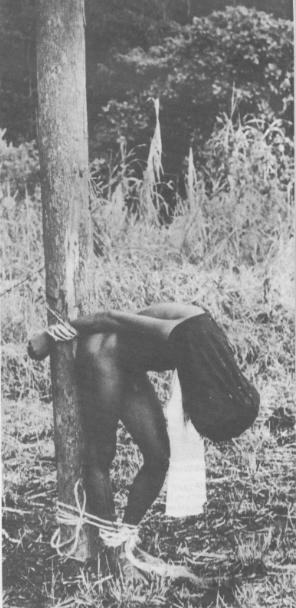
There’s an extensive photographic series of at least one set of executions — that of Tom Mabasa and Sebastino Namirundu in Mbale. It’s viewable here. Per the image captions,
Masaba and Namirundu were interrogated, stripped naked, fitted with short white aprons and tied to their execution posts. Masaba, who was accused of being a terrorist, was reported to have said, “Let those, like me, who are killing innocent people in the country, come out and report to the authorities.”
The book Battles of the Ugandan Resistance contains an account of Namirundu’s capture. According to the author, Namirundu was a mere bystander whe Ugandan troops arrived to his area trying to arrest rebel leader (and present-day Uganda president) Yoweri Museveni. Museveni gave them the slip, but as soldiers rudely searched houses, the teenaged Namirundu made a panicked run to get away from them, which act was taken as self-incrimination and led him to the stake.
On an uncertain date in the winter of 416-415 B.C.E., the island of Melos surrendered to an Athenian siege during the ruinous Peloponnesian War.
Athens put all of Melos’s adult men to death, selling its women and children into slavery.
This ghastly event is covered by Thucydides‘ History. Thucydides’ account of the diplomatic negotiation between the mighty Athenians and the hopelessly outmuscled Melians is the subject of the Melian dialogue — a timeless classic of philosophy and statecraft.
The Athenians’ coldly realistic position — and their ultimate disposition of their conquest — is summed up in the wonderful epigraph, “the strong do what they will, and the weak suffer what they must.” (And numerous variations of this translation.)
As the reigning naval power, Athens (at war with a league led by its rival, the land power Sparta) had decided that an independent and neutral Melos would no longer be in the offing. The Melian dialogue pits Athens’ ultimatum to Melos to submit and save itself, against the Melians’ vain attempt to assert the justice of their cause; likewise, it is the dialogue of an imperial order against a holdover independent city-state from a fading era.
Athenians: Well, then, we Athenians will use no flue words; we will not go out of our way to prove at length that we have a right to rule, because we overthrew the Persians; or that we attack you now because we are suffering any injury at your hands. We should not convince you if we did; nor must you expect to convince us by arguing that, although a colony of the Lacedaemonians, you have taken no part in their expeditions, or that you have never done us any wrong. But you and we should say what we really think, and aim only at what is possible, for we both alike know that into the discussion of human affairs the question of justice only enters where the pressure of necessity is equal, and that the powerful exact what they can, and the weak grant what they must.
Melians: Well, then, since you set aside justice and invite us to speak of expediency, in our judgment it is certainly expedient that you should respect a principle which is for the common good; and that to every man when in peril a reasonable claim should be accounted a claim of right, and any plea which he is disposed to urge, even if failing of the point a little, should help his cause. Your interest in this principle is quite as great as ours, inasmuch as you, if you fall, will incur the heaviest vengeance, and will be the most terrible example to mankind.
Athenians: The fall of our empire, if it should fall, is not an event to which we look forward with dismay; for ruling states such as Lacedaemon are not cruel to their vanquished enemies. And we are fighting not so much against the Lacedaemonians, as against our own subjects who may some day rise up and overcome their former masters. But this is a danger which you may leave to us. And we will now endeavour to show that we have come in the interests of our empire, and that in what we are about to say we are only seeking the preservation of your city. For we want to make you ours with the least trouble to ourselves, and it is for the interests of us both that you should not be destroyed.
Melians: It may be your interest to be our masters, but how can it be ours to be your slaves?
Athenians: To you the gain will be that by submission you will avert the worst; and we shall be all the richer for your preservation.
Melians: But must we be your enemies? Will you not receive us as friends if we are neutral and remain at peace with you?
Athenians: No, your enmity is not half so mischievous to us as your friendship; for the one is in the eyes of our subjects an argument of our power, the other of our weakness.
Over and over the Melian envoy is dismayed by his visitors’ indifference to the moral high ground. Frustrated of any concession, he resolves his embattled city to embark upon the remote hope of resistance in preference to voluntary servitude — leading the Athenians to part with this chilly sentiment:
You told us that the safety of your city would be your first care, but we remark that, in this long discussion, not a word has been uttered by you which would give a reasonable man expectation of deliverance. Your strongest grounds are hopes deferred, and what power you have is not to be compared with that which is already arrayed against you. Unless after we have withdrawn you mean to come, as even now you may, to a wiser conclusion, you are showing a great want of sense. For surely you cannot dream of flying to that false sense of honour which has been the ruin of so many when danger and dishonour were staring them in the face. Many men with their eyes still open to the consequences have found the word honour too much for them, and have suffered a mere name to lure them on, until it has drawn down upon them real and irretrievable calamities; through their own folly they have incurred a worse dishonour than fortune would have inflicted upon them. If you are wise you will not run this risk; you ought to see that there can be no disgrace in yielding to a great city which invites you to become her ally on reasonable terms, keeping your own land, and merely paying tribute; and that you will certainly gain no honour if, having to choose between two alternatives, safety and war, you obstinately prefer the worse. To maintain our rights against equals, to be politic with superiors, and to be moderate towards inferiors is the path of safety. Reflect once more when we have withdrawn, and say to yourselves over and over again that you are deliberating about your one and only country, which may be saved or may be destroyed by a single decision,
Athens wasn’t kidding.
Finding no traction with the Melian delegation, the greater power immediately besieged Melos. Thucydides recounts the Melians’ subsequent fate:
So the summer ended.
In the following winter the Lacedaemonians had intended to make an expedition into the Argive territory, but finding that the sacrifices which they offered at the frontier were unfavourable they returned home … About the same time the Melians took another part of the Athenian wall; for the fortifications were insufficiently guarded. Whereupon the Athenians sent fresh troops, under the command of Philocrates the son of Demeas. The place was now closely invested, and there was treachery among the citizens themselves. So the Melians were induced to surrender at discretion. The Athenians thereupon put to death all who were of military age, and made slaves of the women and children. They then colonised the island, sending thither 500 settlers of their own.
On top of everything else, the Athenian sack put an end to the production of Melian reliefs. (The island still had the glory of the Venus de Milo to look forward to, however.)
If there was a consolation for the scattered remains of the ruined Melian polis, it was that Athens’ cruel imperial hubris led it just months later to launch a catastrophic invasion of Sicily.
That defeat helped turn the Peloponnesian War decisively against Athens. Just eleven years after overrunning Melos, haughty Athens itself surrendered to a Spartan siege.
Thucydides, an exiled former Athenian general, deploys the classical dialogue form to great effect; his own perspective on the various arguments advanced in the Melian debate is difficult to discern with confidence. Clearly, however, it’s a topic of great interest to Thucydides, as his account dwells repeatedly on the conundrums touching justice and international relations: he’s one of the first intellectuals to explore what’s now thought of as the “realist” view of foreign policy. Compare the Melian Dialogue, for instance, to the Athenian demos‘s Mytilenian Debate; or, to the Plataean speech making a Melos-like appeal to the powerful Spartans.* And in one early passage, private Athenians appeal to Sparta and Corinth not to commence on war against the hegemony of Athens with words similar to those later used at Melos: “It has always been a rule that the weak should be subject to the strong; and besides, we consider that we are worthy of our power. Up till the present moment you, too, used to think that we were; but now, after calculating your own interest, you are beginning to talk in terms of right and wrong. Considerations of this kind have never yet turned people aside from the opportunities of aggrandizement offered by superior strength.”
At any rate, Thucydides’ proud city-empire would never recover from the inglorious fall inflicted by this war. The result was a fourth-century power vacuum which the Macedonia of Philip II and Alexander the Great eventually rose to fill.
* Thucydides also reports the Athenians hoisted by their own realpolitik when, in the Sicilian invasion, they attempt to appeal to Camarina for support. That city spurns the appeal, fearing subjugation should expansionist Athens prevail, and the revenge of their overwhelmingly powerful neighbor Syracuse otherwise.
These pageants of orthodox Catholic authority, with parades of heretics publicly confessing their error and being received back into the community on penitential terms, while others more contumacious were consigned to the flames, would soon become one of the signature features of Inquisition Spain. Some 700 people were executed at such events over the decade to come.
But here in the early 1480s, the terrifying powers of the Holy Office for the Propagation of Faith (the Inquisition’s business-card title) were, well … unexpected.
/Mandatory
Don Diego Suson, one of the six put to death this date, was the wealthy patriarch of a marrano family — Jews, who had converted a century prior. The Inquisition’s whole founding spirit was the sense of characters like Torquemada that as such conversions had generally been obtained under duress, the families in question were still secretly maintaining their Semitic rites. That would make them apostates (since they were baptized and supposedly Christian), and it would implicate them in God knows what other malignancy (since they were malignant Jews).
This made it especially dicey for Suson that he was also a rabbi to an underground community of still-practicing “converted” Jews. (Spanish source) Torquemada was on to a real thing here.
Unfortunately his daughter — so the legend says — didn’t quite grasp what the Inquisitors had coming and lightly betrayed the fact to her Christian lover. In no time at all, the guys with the racks and thumbscrews had the terrible family secret in hand.
It’s said that the beautiful (of course) daughter was so riven with grief and shame for the careless destruction of her father that she shut herself up in a convent … and arranged that when she died her guilt-stricken head should be hung up at her former home.
The location of this macabre monument is still marked in Seville today; once known as the Calle de la Muerte, it is now called the Calle Susona.
On this date in 1653, the German bandit Jasper Hanebuth was broken on the wheel in Hanover.
An illiterate farmer’s son from Groß-Buchholz, Hanebuth came of age during the calamitous Thirty Years’ War and thereby made his bread for a time as one of the numberless strong arms enlisted to let out one another’s blood.
Hanebuth is the titular villain in the German historical fiction novel The Murderer’s Concubine.
In a time of crisscrossing armies with conflicting loyalties and uncertain pay, it was a fine line between soldiers and thieves — sometimes just the hour of the day. What matter to a rural family or a vulnerable traveler if the gang of armed men who dispossessed him did so under the banner of God or that of opportunism? And given means and opportunity, what matter to the armed gang itself? Victims in such a chaotic environment, either actual or potential, were liable in their own turn to resort to brigandage as the only viable option, paying the devastation forward.
True to the template, Hanebuth parlayed wartime soldiery into an alarmingly bold career of opportunistic robbery in the still-extant Eilenriede. A purported “Hanebuth’s Block” in the vicinity of the present-day zoo there long preserved the association; there’s still a street in the forest known as Hanebuthwinkel.
He was reputed an especially vicious outlaw, who would raid singly as well as jointly with other farmers and decommissioned warriors, and would as readily for sport or pleasure shoot a convenient target dead before bothering to approach and find out if the business end of the felony was even worth the murder. He ultimately confessed to 19 homicides.
But it was still the pecuniary motive that drove things. Hanebuth approached crime-lord status with secret smuggling tunnels allegedly set up to move his ill-gotten gains and regular traffic with Hanover merchants. Hanebuth also set up as a horse-trader, exploiting his predilection for violence to obtain stock by force. One trader who refused a shakedown simply had his horses outright stolen the next night, and this man at last reported Hanebuth, resulting in his arrest, torture, and execution on the wheel.
He remains one of Hanover’s most iconic historical criminals.
Jacques Collot’s 1633 cycle “The Miseries of War” might have foretold Hanebuth’s fate: here, a soldier of the Thirty Years’ War who has turned to robbery is punished, as Hanebuth would be, on the wheel. The caption explains:
The ever-watching eye of the divine Astrée [Justice]
Banishes entirely the mourning from the country
When holding the sword and scales in her hands
She judges and punishes the inhuman thief
Who awaits passersby, hurts them, and plays with them
[And] then becomes himself the plaything of a wheel.
On Saturday, January 3, 1857, the Archbishop of Paris Marie-Dominique-Auguste Sibour had just reached the church of Saint-Etienne-du-Mont when Jean-Loiuis Verger stepped out of a crowd — out of obscurity — and plunged a long Catalan knife fatally into Sibour’s chest.
The assassin Verger (English Wikipedia entry | French) was a 30-year-old ordained priest who had accumulated a quarrelsome reputation among his ecclesiastical peers. The previous year, he had been laid under an official interdiction for preaching against the Catholic Church’s controversial new doctrine of the Virgin Mary’s Immaculate Conception.
Some reports had Verger crying out “No goddesses!” as he daggered the archbishop. “It is nowise the person of the Archbishop of Paris whom I wished to strike, but, in his person, the dogma of the Immaculate Conception,” Verger told the magistrates who judged him within days. There wasn’t a whole lot of doubt about the trial, so why wait around? But Verger’s vendetta wasn’t only theological; his suspension meant he wasn’t getting paid, and as his fury mounted over it he went so far as to post himself at the door of a church with a placard proclaiming that he was starving.
Archbishop of Paris was a surprisingly dangerous job in the mid-19th century. Sibour got the post because his predecessor was shot dead negotiating at a barricade during the 1848 revolution; in 1871, Archbishop Georges Darboy was taken hostage by the Paris Commune and executed by his captors when the national government invaded the city.
In reality no advocate could be of material service to the accused, save in the most exceptional cases. The men who organized the Holy Office knew too well what they wanted to leave open any possibilities of which even the shrewdest advocate could take advantage, and it was admitted on all hands as a recognized fact that there was no method of defence save disabling the witnesses for the prosecution. It has been seen that enmity was the only source of disability in a witness, and this had to be mortal — there must have been bloodshed between the parties, or other cause sufficient to induce one to seek the life of the other. If, therefore, the case rested on witnesses of this kind, their testimony had to be rejected and the prosecution fell. As this was the only possible mode of escape, the cruelty of withholding from the prisoner the names of the adverse witnesses becomes doubly conspicuous. He was forced to grope around in the dark and blindly name such persons as he imagined might have a hand in his misfortunes. If he failed to hit upon any who appeared in the case, the evidence against him was conclusive, as far as it went. If he chanced to name some of the witnesses, he was interrogated as to the causes of enmity; the inquisitor examined into the facts of the alleged quarrel, and decided as he saw fit as to the retention or the rejection of their testimony. Conscientious jurists like Gui Foucoix and inquisitors like Eymerich warned their brethren that as the accused had so slender a chance of guessing the sources of evidence, the judge ought to investigate for himself and discard any that seemed to be the product of malice; but there were others who sought rather to deprive the poor wretch of every straw that might postpone his sinking. One device was to ask him, as though casually, at the end of his examination, whether he had any enemies who would so disregard the fear of God as to accuse him falsely, and if, thus taken unawares, he replied in the negative, he debarred himself from any subsequent defence; or the most damaging witness would be selected and the prisoner be asked if he knew him, when a denial would estop him from claiming enmity. It is easy to imagine other tricks by which shrewd and experienced inquisitors could save themselves the trouble of admitting the accused to even the nugatory form of defence to which alone he was entitled. As to allowing him to call witnesses in his favor, except to prove enmity of the accusers, it was never thought of in ordinary cases. By a legal fiction, the inquisitor was supposed to look at both sides of the case, and to take care of the defence as well as of the prosecution. If the accused failed to guess the names of enemies among the witnesses and to disable their testimony, he was condemned.
In England, under the barbarous custom of the peine forte et dure, a prisoner who refused to plead either guilty or not guilty was pressed to death, because the trial could not go on without either confession or defence. Cruel as was this expedient, it was the outcome of a manly sense of justice, which based its procedure on the rule that the worst felon should have a fair opportunity to prove his innocence. Far worse was the system of the Inquisition, which was equally resolved that its culprits should have no such easy method of escape as a refusal to plead. It had no scruples as to proceeding in such cases, and the obstinacy of the accused only simplified matters. The refusal was an act of contumacy, equivalent to disobeying a summons to appear, or it was held to be tantamount to a confession, and the obdurate prisoner was forthwith handed over to the secular arm as an impenitent heretic, fit only for the stake. The use of torture, however, rendered such cases rare.
The enviable simplicity which the inquisitorial process thus assumed in the absence of counsel and of all practical opportunities for defence can perhaps best be illustrated by one or two cases. Thus in the Inquisition of Carcassonne, June 19, 1252, P. Morret is called up and asked if he wishes to defend himself against the matters found in the instructio or indictment against him. He has nothing to allege except that he has enemies, of whom he names five. Apparently he did not happen to guess any of the witnesses, for the case proceeded by reading the evidence to him, after which he is again asked thrice if he has anything further to say. To this he replies in the negative, and the case ends by assigning January 29 for the rendering of sentence. Two years later, in 1254, at Carcassonne, a certain Bernard Pons was more lucky, for he happened to guess aright in naming his wife as an inimical witness, and we have the proceedings of the inquest held to determine whether the enmity was mortal. Three witnesses are examined, all of whom swear that she is a woman of loose character; one deposes that she had been taken in adultery by her husband; another that he had beaten her for it, and the third that he had recently heard her say that she wished her husband dead that she might marry a certain Pug Oler, and that she would willingly become a leper if that would bring it about. This would certainly seem sufficient, but Pons appears nevertheless not to have escaped. So thoroughly hopeless, indeed, was the prospect of any effort at defence, that it frequently was not even attempted, and the accused, like Arnaud Fabri at Carcassonne, August 26, 1252, when asked if he wished a copy of the evidence against him, would despairingly decline it. It was a customary formula in a sentence to state that the convict had been offered opportunity for defence and had not availed himself of it, showing how frequently this was the case.
On this date in 1868, a trio of notorious Italian brigands went under the French guillotine in Marseilles.
Joseph Coda-Zabetta, the leader, had escaped a hard labor sentence in Italy and fled to France where he founded a large band of robbers who terrorized France’s Mediterranean countryside from Nice to Marseilles for some months in 1867.
From raiding unoccupied country homes the gang soon progressed to bold invasions of occupied houses and waylaying travelers. “In one instance,” a press report of their trial reported,* “six of the band attacked a convoy of carriers, one of whom received a pistol-shot in the breast and a stab with a knife, from which injuries he afterwards died.”
Twelve of the band faced trial, and four of their number received death sentences. (Seven others had long prison sentences; a man named Muletto was acquitted.)
Coda, Antoine Quaranta, and Felix Mardi (Italian pdf) were all guillotined on this date in 1868. (They died, it was said, repentant (French).) The fourth condemned prisoner, Jacques Mulatere, had his death sentenced commuted to life at hard labor.