1863: John P. Wood, of the Army of the Potomac

This dispatch to the New York Herald was published on June 16, 1863.

Mr. W. Young’s Letter.
Near Beallton Station, Va., June 14, 1863.

THE DESERTER J.P. WOOD.

John P. Wood, of Company F, Nineteenth Indiana, who had deserted once or twice before, again deserted on the 28th of May, and was subsequently arrsted at Aquia Creek, tried by court martial, and sentenced to be shot on Friday last.

Wood was about nineteen years old, quite intelligent, and when arrested was dressed in rebel uniform and represented himself as belonging to the Nineteenth Tennessee.

He alleged that he deserted because he had come to the conclusion that the war was not right, and he could not therefore go into action. He admitted that when he volunteered his views were somewhat different, and that he enlisted because he did not wish to see the Union dissolved.

He regarded his sentence as just, and expressed the belief that his execution for desertion would be of more service to the army than he could render it in any other manner.

THE EXECUTION, AND THE EFFECT UPON THE ARMY.

As this is the first instance of an execution for desertion in the Army of the Potomac, it created considerable sensation.

The sentence was executed upon the prisoner on Friday, near Berea church. About two P.M., near Berea church, the corps was halted. The First brigade was ordered out, with the balance of the division to which the prisoner belonged, the First brigade in advance.

Two ambulances, in the first of which was seated the prisoner, and the other containing his coffin, at the head of the division, advanced about half a mile, when the division was drawn up, occupying three sides of an oblong parallelogram. On the fourth side were placed the coffin, the criminal and the guard. The men were selected to do the firing, and received their muskets from the guard properly loaded.

HIS LAST MOMENTS.

A clergyman —- was with the prisoner, who displayed no emotion. General Wadsworth then went to the men who were to perform the duty of execution, and spoke to them in regard to the disagreeable nature of the duty to be performed — the shooting of a comrade — and urged them, as a matter of humanity, to take good aim.

The General then returned to the right, Colonel Morrow to the left. The guard was then withdrawn, and the Provost Marshall, Lieutenant Rogers, took the prisoner to the coffin, upon which he was seated, his eyes blindfolded, his hands tied behind him, his knees tied together and his breast bared.

All having retired, except the executions and the Provost Marshal, the order to take aim was given. Before the order to fire was given two pieces were discharged, but without effect.

At the order to fire, the remainder of the men — ten in number — fired. The prisoner fell backward, and the Provost Marshal went up to him. He struggled for an instant, and then all was over.

An additional detail from the Pioneer corps were called up and began to dig the grave, and the division marched off in perfect order, much impressed by the solemn scene which they had witnessed.

On this day..

1866: Anton Probst, “I only wanted the money”

(Thanks to Meaghan Good of the Charley Project for the guest post. -ed.)

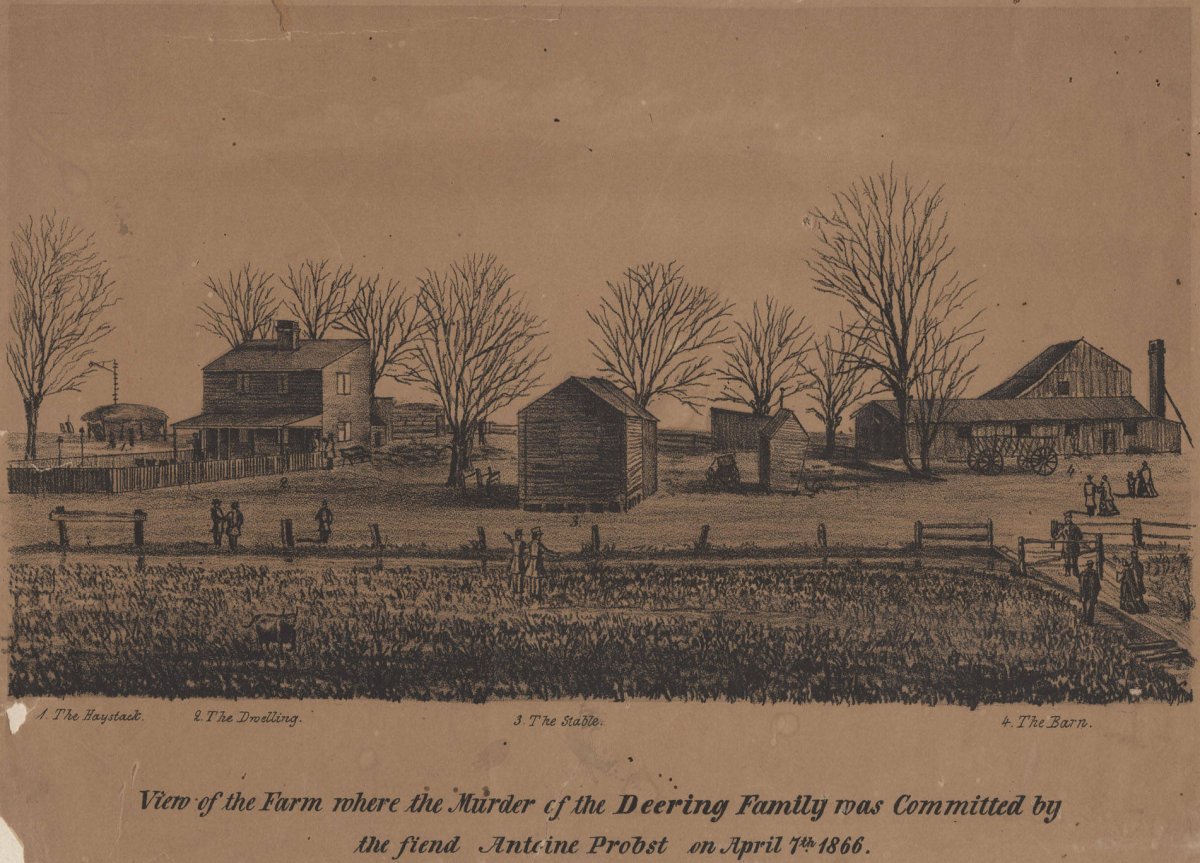
On this date in 1866, mass murderer Anton Probst (sometimes called “Antoine”) was hanged in Philadelphia, Pennsylvania. He made national headlines in its time, but today he is forgotten except among serious students of violent crime.

Probst was a native of Germany, the son of a carpenter. He later claimed he had a normal childhood and “never did anything wrong” until after he had left his home country.

He moved to the United States in 1863, in the middle of the Civil War, and became a professional “bounty jumper”: he would join up with a Union Army regiment, collect the $300 enlistment bonus, desert as soon as he could, then enlist with another regiment and start the cycle over again. He made a tidy living for himself this way until 1865, when he accidentally shot his thumb off and was discharged from the military for good.

Probst squandered his enlistment bounties on liquor and and rapidly fell into post-discharge penury. This was why, in the fall of 1865, he hired himself out as a farmhand to Christopher Deering, an Irish immigrant who lived in a rural part of Philadelphia with his wife and five children.

Deering offered Probst a salary of $15 a month plus room and board. Probst quit after only a few weeks, though, not being accustomed to honest labor.

He soon fell ill and, without a source of income, wound up in the workhouse. In dire straits, he returned to the Deering farm on February 2, 1866 and begged for his job back. And, although Probst’s behavior from before had given Christopher’s wife the creeps, the farmer took pity on him and re-hired old Thumbless.

Things went well for the next two months. But unbeknownst to his employer, Probst had thought of another way to get money.

Christopher’s nearest neighbor, Abraham Everett, lived a quarter of a mile away. Everett subscribed to several local weekly newspapers and, every weekend, Christopher would send his son to borrow the previous week’s editions.

One Saturday, the boy never showed up.

Nor did he arrive on Sunday.

Or for the next several days after.

By Wednesday, Everett was getting worried and decided to go to the Deering place and see if they were all right. He found the farm deserted and the horses inside the barn, nearly dead of thirst and starvation. After giving food and water to the distressed animals, he went and looked through the window into the Deering family’s house and saw it had been ransacked.

Seriously alarmed now, Everett forced the window open and climbed inside, and found every room in the house in a state of disarray. In the bedrooms, the beds had been torn and flipped upside down, dresser drawers had been rifled through and clothes were scattered everywhere. There was not a soul to be seen.

At this point, Abraham Everett went off to get help, summoning another neighbor and then the police. Inside the barn they found something Everett had missed while he was helping the horses: Christopher Deering’s body, partially covered in hay, alongside the body of a cousin visiting from New Jersey.

“His head,” crime historian Harold Schechter reports in his book Psycho USA: Famous American Killers You Never Heard Of, “was crushed to pieces, almost to powdered bone, and his throat was cut … from ear to ear.” Christopher’s cousin had similar injuries. A search of the barn turned up the bodies of Christopher’s wife, Julia, and four of the couple’s five children, stacked in the corncrib.

All of them had their throats cut and their skulls bashed in.

The only survivor in the family was the oldest child, ten-year-old William Deering, who had been staying with his grandparents at the time of the murders. And so the family line did not die out: according to this Philadelphia Inquirer article, William has 60 descendants.

The murder weapons were lying around bloodstained and in plain sight on the property: a hammer, a small hatchet and a full-sized ax. Hours later, the police found the last body hidden in a haystack a few hundred yards from the barn: seventeen-year-old Cornelius Carey, one of the Deerings’ farmhands.

The other farmhand was missing and, under the circumstances, had to be viewed as the prime suspect in this massacre. Nobody knew much about him, but the neighbors recalled that missing right thumb, spoke poor English with an accent, and was called something like “Anthony.”

Fortunately, he would not prove hard to find. “It might be supposed,” Harold Schechter says,

that a man who had methodically slaughtered eight people, including three prepubescent children and a fourteen-month-old infant, would lose no time in putting as much distance between himself and the crime scene as possible. For all his low cunning, however, Anton Probst was incapable of prudent calculation. Indeed, from all available evidence, he thought of nothing beyond the gratification of his immediate physical needs.

Hours after the murders, Probst was no further away than a house of ill repute on Front Street in Philadelphia, where he spent the night with a $3 prostitute. For the next few days he hung around his favorite bars drinking, making occasional excursions to pawn items he’d stolen from the Deering farm. He was in no hurry to leave.

Only the day after Probst’s grisly crimes were discovered, a police officer named James Dorsey spotted him strolling around near Market Street. Something about his bearing, and the way his hat was pulled low over his eyes, made the lawman suspicious. He walked up to him and noticed the stranger’s right thumb was missing.

Dorsey pulled Probst’s hat off to have a look at his face and said, “Good evening.” Probst mumbled a reply and Dorsey, noting the accent, said, “You’re a Dutchman?”

“No,” Probst answered. “Me a Frenchman.”

“You are, are you? Take a walk with me.” Dorsey grabbed the murderer’s arm and hauled him off to the nearest station house. There the police searched him and determined he was wearing Christopher Deering’s clothes, and carrying the farmer’s snuffbox and pistol. Probst had left Elizabeth Dolan’s carpetbag at a tavern earlier that day; it contained a number of small items, including cheap children’s toys, all of which were from the Deering farm.

The police had to transfer Probst from the Philadelphia City Jail to Moyamensing State Prison for his own safety, after a would-be lynch mob stormed the jail. Probst claimed he had only killed Cornelius Carey and tried to blame the other murders on an imaginary accomplice; at his trial (which began on April 25, less than three weeks after the murders) his lawyers argued that the case against him was strictly circumstantial and not proved beyond a reasonable doubt. But the trial’s outcome was clear from the beginning. The jury deliberated for only twenty minutes before convicting.

Death row agreed with Probst; he seemed at ease and actually gained twelve pounds in the five weeks between his trial and execution. On the morning of May 7, exactly one month after the murders, he finally confessed that his accomplice didn’t exist and he’d acted alone. He was “quiet, undemonstrative, cool and unembarrassed” as he told his story, “without the least trace of shame or remorse.”

You can read it all here in his very own words, or below, in mine. At first his intention had just been to rob the family of everything they had, then flee. But he found himself unable to accomplish this because there were always too many people around.

About a week before the murders, it occurred to Probst that perhaps murder might be necessary to facilitate the robbery. At first he thought he could just kill Christopher Deering, but as he mulled the matter over he decided the rest of the household would have to die as well.

First to go was Cornelius Carey as they were working together in the field. Then Probst went into the barn and lured the others in one by one, killing them as they each came inside: eight-year-old John Deering, then the mother, Julia, then the rest of the children: six-year-old Thomas, then four-year-old Annie, and finally the baby, Emma. Probst estimated that it all took about half an hour.

Christopher Deering was off picking up that visiting cousin from the ferry, and they didn’t arrive back at the farm until the afternoon. Probst was waiting for them. While the guest Elizabeth Dolan went into the house, Probst told Christopher one of the animals was sick and he had to go inside the barn. There he killed him like the others, then called Miss Dolan to the stable. She was the last one to die.

If we are to believe the killer’s account, the victims all died quickly and quietly, and did not suffer. None of them, he said, so much as cried out after the first blow.

Once finished, Probst tore the house upside down looking for things to steal, washed, shaved, changed out of his bloody clothes and put on some of Christopher’s, and had himself a snack of bread and butter. At sunset he headed off to town.

Schechter records:

When asked by Chief Franklin why on earth he had perpetrated such an atrocity, Probst gave a little shrug. “I only wanted the money,” he said. “I killed the boy Cornelius first so that he could not tell on me. I killed the two oldest children so they would not afterwards identify me. I killed the two youngest as I did not wish to leave them in the house alone without someone to care for them. I had no ill feeling to anyone in the family. They always treated me well.”

Probst submitted meekly to his execution, which went off without a hitch. The public understandably rejoiced at his death and the New York Times, in its report of how Probst “shuffled off his mortal and disreputable coil,” called him “the greatest criminal of the nineteenth century.”

Probst was permitted to write to his family in Germany. He told them of “the terrible fate which has befallen me,” admitted to the eight slayings, and blamed his bad behavior on his experiences in the Union Army, where he “heard nothing but cursing and swearing, and soon became a sharer in every wickedness.”

Whatever, Anton.

After his death, Probst’s body was handed over to the physicians at Jefferson Medical College, who subjected it to a series of bizarre experiments with electricity. When they finished with their fun they performed an autopsy. Probst’s brain turned out to be unusually small, almost a full pound lighter than average. What, if anything, this has to do with his apparent psychopathy is anyone’s guess. His head and arm were later displayed in the Jefferson Medical College museum.

On this day..

1573: Meister Frantz Schmidt’s first execution

On this date in 1573, 19-year-old Frantz Schmidt — heretofore only an apprentice to his father’s craft — conducted his first solo hanging. As the body of the thief hung there, his father or perhaps another established Scharfrichter stepped forward and ritually slapped the teenage hangman three times, announcing his successful passage into the ranks of Germany’s master executioners.

“Leinhardt Russ of Zeyern, a thief. Executed with the rope at the city of Steinach. Was my first execution.” Those words begin Meister Frantz’s remarkable diary* of 361 hangings, beheadings, breakings-on-the-wheel, drownings, and burnings — as well as many other sub-capital punishments, primarily as the executioner of Nuremberg from 1578 to 1617.

Nuremberg executioner Frantz Schmidt at work in 1584.

Executioners occupied a strange outcast social niche, with charge not only of death sentences but of other dishonorable public tasks. Either as cause or consequence of this, the profession carried its own stigma for underworld less-than-respectable behavior; it was not unheard-of for a shady executioner to wind up climbing the scaffold as patient rather than hangman.

But in his 45-year career, the sober Meister Frantz operated with ahead-of-his-time dignity and sobriety, so much so that Schmidt was granted citizenship in Nuremberg and eventually had his civic honor officially restored. He freed himself and his heirs from the social pollution inherent to his life’s work.

Joel Harrington of Vanderbilt has authored a new book titled The Faithful Executioner: Life and Death, Honor and Shame in the Turbulent Sixteenth Century, a fascinating account not only of Frantz Schmidt’s life but the world he inhabited. Dr. Harrington was good enough to chat with Executed Today.**


Book CoverET: Your book is built around a sort of life’s mission by Frantz Schmidt to return himself and his family to respectable-ness. Certainly he accomplished this marvelously in the end, but I’m curious how firm do you feel is the inference that this was his specific intent from the start?

JH: I have no doubts that as a child, Frantz Schmidt was repeatedly told the tale of his family’s fall from grace, especially since he can still remember so many details even as an old man. We also know from his own words in his appeal to the emperor to restore that lost honor that his grandfather, father, and his own children all felt the sting of this stigma. Finally, the late-in-life struggles to assert that regain honor — against the challenges of his bitter successor — further underscore the centrality of this mission in Frantz Schmidt’s life.

Executioners often had a family trade at this point, but the Schmidts — specifically the father, Heinrich Schmidt — had a bizarre path into this business via the German nobility’s old prerogatives. Could you explicate the “ancient custom” that allowed Albrecht Alcibiades to force Frantz’s father Heinrich, who was not an executioner, to become one? And for that matter, the social customs that then led Heinrich’s neighbors in Hof to treat him as a dishonored untouchable after he was forced to carry out these three executions — rather than viewing him, as we might today, as himself a victim who ought to be helped to get back to his real life?

Most European laws in the early sixteenth century were customary and highly localized. Legal codification throughout jurisdictions was just getting underway. This meant that two villages only a few miles apart might have very different traditions regarding something like execution. In the larger cities, such as Nuremberg, and well organized territorial states, such as the prince-bishopric of Bamberg, standing executioners on salary were the norm. But in many of the hundreds of tiny German states during this period, execution by the victim’s oldest male relative or by another local male was still practiced.

In the case of Hof, the margrave intentionally invoked an ancient and outdated tradition because he was in a hurry to get the job done. The stigma around the job of executioner in general was, by contrast, nearly universal. There seems to have been a little less hostility in southern German states but nobody would have openly socialized with an executioner or his family. As I describe in the book, the severity of this stigma — like all social prejudices — would depend on the individual or occasion in question. So, while some people clearly had sympathy for Meister Frantz, there were still stark boundaries of propriety as to how they might express that sympathy.

Executioners had charge of a variety of disreputable tasks and spheres of civil live: refuse, prostitutes, lepers, torture, and so forth. I’m struck by the importance of Schmidt’s Nuremberg assistant, “the Lion”, in allowing the faithful executioner to (somewhat) separate some of the most visibly dishonorable tasks from Schmdit’s direct purview. Just as a realistic matter, could Frantz Schmidt have reached respectability had he himself had to handle everything personally?

You’re right, the Lion played a key role in this respect. The broader evolution of the job was also significant, from a kind of catch-all for various unpleasant tasks to a civic professional focused on interrogation and punishment. You can also see this in the clothing that executioners start to wear in the sixteenth and seventeenth centuries, usually either colorful bourgeois outfits or military garb.

Frantz Schmidt’s later entries have a great deal of detail, and you use that to tease out the executioner’s psychology, and the way he thinks about crime, sin, choice, and misfortune in his mature adulthood. It’s quite intriguing. Why, however, did Schmidt begin his journal in the first place? Is there something his shorter, earlier entries tell us about the younger man and the evolution of his views of the “poor sinners” he handled?

After a long time — and especially after I found the oldest version of the journal — I figured out that he started the journal upon his 1578 appointment in Nuremberg. This means that he reconstructed the executions of the previous five years from memory (and without dates).

Why then? The timing strongly suggested to me that he was already thinking about using the journal as a supporting document in his eventual appeal to have his honor restored.

As for changes over time, the most obvious ones are that his passages become much longer, more detailed, and more concerned with motivations and explanations than the earlier, bare-bones accounts. The main evolution in his thinking about poor sinners shows both harsher judgments of those who squandered countless chances to reform and greater pity for those who simply make a bad decision in the heat of the moment.

You have a fascinating chapter devoted to Schmidt’s sidelight as a healer, and to the important ways this practice intersected with executioners’ expertise in [harming] the body. I was amazed that Frantz Schmidt himself also took part in the era’s dissection trend. If one were a regular Nuremberger at this time, would one have any compunctions about a medical consultation with the executioner, a man one might otherwise shun? If a non-executioner physician were available too, would there be any intrinsic preference for the physician as a more respectable figure?

Yes, it’s quite a paradox. You would think that most people would be squeamish or embarrassed about consulting an executioner on medical matters, but by his own estimate Frantz Schmidt saw 15,000 patients over the course of 45 years — fifty times the number of individuals he executed. So he must have been doing something right.

This journal was (re-)discovered at an interesting point, at the beginning of the 19th century when public executions are ending but romantic German nationalism is beginning. How has “Frantz Schmidt” the present-day cultural figure been used and misused by we moderns? What’s the most important misapprehension that reading his diary ought to dispel for us?

This is really the focus of my epilogue, which discusses how “medieval” executioners have been used for the purposes of “enlightened” penal reform, nineteenth-century gothic fantasies, and in modern tourism to elicit disgust, amusement, or even the glorification of pain and suffering. My chief goal in writing the book was to get closer to understanding one such man in his own terms and in the context of his own society. To the degree that the book succeeds, parts of his world will look bizarre and alien, while other aspects (especially how people treat each other) will be strikingly familiar.

* Print-on-demand editions of Schmidt’s original diary are on the market. Although these derive from what I believe to be public domain translations, I have not been able to locate a free English copy online; German speakers can read it here.

** Also recommended: this podcast interview with Dr. Harrington.

On this day..

1793: Ezra Mead, “in one of these fits of insanity”

The July 13, 1793 Wyndham (Conn.) Herald quotes the last dying words of Ezra Mead, hanged May 31 at Poughkeepsie, N.Y.

I, Ezra Mead, aged forty years, was born at Stamford in the State of Connecticut, of honest and credible parents, with whom I lived until I was about ten years of age; when I was bound as an apprentice to learn the Cooper’s trade. After having served the time of my apprenticeship, I went to Fish Kill and married my wife Catherine Rogers; since which time I have been in several parts of the World working at my trade, in order to get something in an honest way by my industry for the support of my wife and children, who resided in the town of Fish Kill. Having returned to my family, I resided with them, but being afflicted by a certain neighbor of mine, in words and actions, was driven by turns to drinking to excess; and in one of these fits of insanity, I committed the crime for which I suffer. But I declare to the world, that I was not willfully guilty of the crime aforesaid; at that present moment I might have suspected he had injured me, but not being master of my reason, have been guilty of what I never intended to have done, as appeared in the course of my trial. And I do further declare that I never have been guilty of any other crime deserving such punishment, as has been represented or reported by many evil minded persons since my imprisonment. And that I forgive all mankind, and hope the Lord and they will forgive me, and that they will take warning by my untimely end. Farewell. Ezra Mead.

On this day..

1868: Joseph Brown, for arson, murder, and money

On this date in 1868, Joseph Brown hanged in Hudson, N.Y..

He and his wife Josephine had recently moved to the hamlet of Canaan just this side of the Massachusetts border. With them was a twelve-year-old daughter.

On the night of December 5, 1867, they left little Angie in their basement rental and called on neighbors for the evening — and the house went up in flames. Neighbors rushing to the emergency had to force their way through the doors to extinguish the blaze, and discovered the Angie’s scorched remains amid several bushels of suspiciously flammable rubbish. Some neighbors thought the Browns had not hurried to the scene as they ought, and found their expressions of grief unconvincing.

These dubious circumstances could hardly help but lift an eyebrow, but in the end there was little for it and a coroner ruled the death accidental, perhaps caused by the unattended child attempting to fill a lighted kerosene lamp.

However, the fate of “poor little Angie” took on a decidedly more sinister cast when the Browns turned around and filed for a $5,000 life insurance benefit on Angie’s bones — a short-term, three-month policy due to expire in two weeks. A suspiciously dead child was one thing, but now there was money at stake. Travelers Insurance — the present-day corporate conglomerate then in its infancy, carving out its titular niche with innovative policies insuring against once-dangerous rail travel — put some real investigative muscle into the situation before it paid up.

The facts as developed by Travelers made a damning circumstantial case against the couple that was soon taken over by the criminal authorities: “a reflected glow of guilt,” in the summing-up of the state’s attorney who prosecuted Joseph.

Angie turned out not to be the couple’s own child at all, but a loaner from a woman in their hometown of Dayton, Ohio. She had given permission for her daughter to accompany the couple on a trip to Connecticut. (A weird arrangement in which the child was to call them “mother” and “father”, but one made innocently by the victim’s natural mother so far as anyone could determine.)

En route, Joe and Jo insured the life of this child who was not their own. And by the time they got to Canaan, Joseph had indiscreetly negotiated to purchase some property, intimating an ability in no way justified by his pre-fire resources to pay several thousand dollars cash on the nail.

To cinch Joseph’s conviction, physicians hired by Travelers testified that Angie had not inhaled smoke … meaning that she was dead before the fire started at all.

“I have told the insurance company that I would give them the policy if they would let me go,” a desperate Joseph at one point said in a police interview. He should have thought of that sooner.

But he was, as he said on the scaffold, “not an accomplished man” and he could only complain confusedly about minor points of the trial he considered prejudicial while maintaining a general insistence upon his innocence that persuaded nobody.

At the time of this hanging, Josephine Brown still lay in the Columbia County jail awaiting her turn at the bar in the same affair. But despite the sense among many participants in the case that it was she who instigated her cloddish husband to the lucrative homicide, the prosecution couldn’t assemble a satisfactory case and dropped charges later that year.

On this day..

1818: Abraham Casler, marital woes

On this date in 1818, Abraham Casler was hanged in Schoharie, N.Y. for escaping an ill-advised marriage by means of an illicit powder.

Casler had got young Catherine (Caty) Sprecker pregnant and was only induced to change her name in 1812 by threat of prosecution. Even at the wedding he told the bride’s own brother that he didn’t intend to live with the poor girl.

Casler immediately regretted committing himself to wedlock in any form whatsoever (his alternative would have been to pay a fine, much the bargain as compared to an unpromising marriage — particularly so in those benighted days before no-fault divorce). So he promptly enlisted in the army then fighting the War of 1812 so as “not to live with his wife that he wished … was out of the land of the living,” as he said to another recruit.

Well.

If wishes were fishes, they’d have arsenic inside. (n.b.: they do!)

When he finally had to return, Casler preferred to spend his time paying court to a widowed Albany innkeeper, and generally had a manifestly unhappy time of it with Caty. The latter’s epileptic fits probably only exacerbated the unwilling husband’s ire.

At last, while traveling, Caty Casler took ill with “a burning heat at her stomach & breast … cold chills by spells accompanied with sweat.” She “said her whole body was in pain; she was alernately [sic] cold and hot; would throw off the bed clothes, and then cover herself again.” After a couple of miserable bedridden days, all the while being personally treated by an attentive Abraham Casler who also shooed away attempts by other guests to assist or to summon medical aid,* Caty Casler succumbed, and “looked blue round the mouth and eyes” and “her hair came out.”

Doctors who conducted the post-mortem found what they were certain was arsenic and opium in Caty’s stomach. The trial record features a number of these medical men describing the exact tests they used to establish the presence of this deadly mineral; for instance, a Dr. James W. Miller described finding “particles … of a vitrious appearance” in the stomach.

Some of those particles were placed on a heated iron; a dense white fume arose from their combustion. Some of them were likewise placed between two plates of polished copper prepared for the purpose; those coppers were bound by an iron wire and placed into the fire until they were brought to red heat; they were then removed and after they were cold they were separated, the interior of the plates were whitened towards the edges of the plate in the form of a circle.

Last, taking two teaspoons of stomach fluid containing these suspicious particles,

He diluted it with a pint of water, then took the nitrate of silver and dissolved it and put into a separate glass; took pure ammonia into another glass; then took two glass rods, wet the end of one of them in the solution of the nitrate of silver, and dipped the end of the other in the pure ammonia, then brought the two ends of the rods in contact on the surface of the water in the vessel containing the contents of the stomach, and passed them down into the fluid; there was a precipitate from the point of contact, that precipitate was of an orange colour. He repeated that experiment several times, and also with arsenic dissolved in water. The results of the experiment were similar; the same precipitate in the one as in the other, tho’ it was more distinct in the solution made of arsenic, that being coulourless.

There was, in Dr. Miller’s opinion, “arsenic in the stomach; [he] has no doubt of it; considers the test made by him infallible; does not know that any thing except arsenic, will produce the same effect on copper, as was produced by those particles in the experiment.”

The court record merely summarizes the testimony witness by witness rather than providing a literal transcription, but one gets a sense of the thing merely leafing through it: it has 16 pages of prosecution testimony, from Casler’s Albany crush and family members catching him in suspicious circumstances, plus six different physicians, one of whom was a Professor of Chemistry at Fairfield Medical Academy.

The defense has one-half of one page, consisting of a flat denial by Casler and the observations of one former boarder with nothing useful to say.

The jury took two hours to convict.

After Casler hanged at the eponymous seat of Schoharie County (admitting his guilt on the scaffold), the gallows were left standing “as a solemn admonition of the penalty such crimes demand.”

That admonition had to be repeated: less than a year later, the crossbeam that had once supported Casler’s dying throes was tested again to dispatch a farmer from Sharon Springs who had bludgeoned a deputy sheriff to death.

* “It would only make a bill of expense,” Casler said of the prospect of summoning a physician for his wife. This was also the same disquieting answer he gave when asked if he would be taking the body to bury with her family; instead, he unsentimentally buried it at the nearest available spot, where it was soon exhumed by suspicious locals. The guy hung himself with skinflintedness.

On this day..

1829: George Chapman, besotted

On this date in 1829, George Chapman became the first person hanged in Waterloo, N.Y.

According to the July 29, 1829 New York Spectator, the tailor Chapman “had a quarrel with Daniel Wright, laborer (both excessively intemperate drinkers),” but the two sorted it out.

“According to a vulgar custom, however, they must ratify their treaty of amity over a bottle of whiskey”: in drinking their accord the drunks promptly fell back into dispute, leading Chapman to fatally clobber Wright across the head with a shovel.

This article refers soberingly to the perpetrator’s “inevitable doom”, and so it was.

The following spring (according to this pdf memoir which misstates the year of the event), thousands came by foot, by boat, by ox-cart, sleeping under the stars to witness the strange spectacle of Chapman’s public execution. “Trees around the spot were so filled with sight-seers that they looked as if they were covered with blackbirds.”

On this day..

1721: Joseph Hanno, “miserable African”

(Thanks to Meaghan Good of the Charley Project for the guest post. -ed.)

On this date in 1721, Joseph Hanno was hanged in Boston, Massachusetts for the murder of his wife, Nanny.

He’d killed her “in a very barbarous manner” on November 10 the previous year: while she was getting ready for bed, he struck her twice in the head with the blunt end of an ax and then slit her throat. He made a feeble attempt to pass the murder off as a suicide, but the coroner’s jury was not fooled.

“Could Hanno expect a fair trial in a Massachusetts court?” asks Mark S. Weiner in his book Black Trials: Citizenship from the Beginnings of Slavery to the End of Caste.

Perhaps surprisingly, Weiner believes the answer is yes:

In general, free black men received rather even treatment in the New England judicial system, at least at this period … They were entitled to the full range of legal rights, with the important exception of the ability to serve on juries. There also was no marked inequality between the punishments they received and those of white convicts. And though Hanno, in particular, certainly faced hostility and anger in the courtroom, in [Judge Samuel] Sewall, he was facing no irredeemably biased magistrate; in fact, years earlier, Sewall had written the first antislavery pamphlet published in the American Northeast.

Weiner notes that Hanno “had no defense counsel, for at the time the institution was almost unknown.” He may have hoped to beat the rap because there were no witnesses to the murder. But the jury convicted him and the judge pronounced the sentence of death.

Ultimately, Hanno himself admitted his guilt.

Other than her name, nothing is known about the victim in this case. But we know something about the perpetrator because of a sermon preached at the time of his execution and distributed in pamphlet form under the bombastic title of “TREMENDA: The DREADFUL SOUND with which the WICKED are to be THUNDERSTRUCK, Delivered upon the Execution of a MISERABLE AFRICAN for a most inhumane and uncommon MURDER.”

The sermon was promulgated by none other than Cotton Mather, the Puritan minister noted for his role in the Salem witchcraft trials. (Old Cotton really got around the gallows back in his day.)

Hanno had been brought over from Africa on a slave ship as a child and grew up in slavery. He was freed in 1707, when he was about forty years old, and then settled down in Boston with his wife.

He was literate and his masters brought him up as a Christian, and he enjoyed “vain gloriously Quoting of Sentences” from the Bible. Indeed, when Cotton Mather offered spiritual counsel to the condemned, Hanno boasted, “I have a great deal of knowledge. Nobody of my color, in old England or new, has so much.”

Replied the minister (without apparent irony), “I wish you were less puffed up with it.”

Hanno himself seems to have subscribed to the “slippery slope” theory of criminality. A newspaper account of his execution says he

hoped that all Mankind would take warning by him to keep themselves from committing such Sin & Wickedness as he was guilty of, particularly, Sabbath-breaking and willful Murder, the one being the Ringleader to the other, for which last he was justly Condemned, which had he not been guilty of the first he might probably have never committed the second.

An aside: although he may have been the only person executed that day, Joseph Hanno didn’t stand alone on the gallows.

At the same time a white woman did public penance on the same gallows. Her crime: giving birth to a child of mixed race. This being considered the lowest depth of self-degradation (especially if the father was a Negro), the woman was made to sit on the gallows with a noose around her neck — a sign of extreme disgrace. Then she was whipped through the streets until her back was raw. (Source)

On this day..

1872: John Presswood Jr., the last legal hanging in DeKalb County

On this date in 1872, a faltering John Presswood Jr., “nearly 18 years old,” was publicly hanged in Smithville, Tenn., for a still-infamous crime there. He’s the last person to suffer that fate in DeKalb County.


This image (click for a larger version) of the Presswood hanging — in which the gallows practically disappear into the scenery — comes from the Library of Congress.

It was all the way back in late 1870 that Presswood murdered 36-year-old Rachel Fowler Billings, a Civil War widow remarried to a man who unfortunately was away rafting the Caney Fork River. Presswood savagely axed the woman to death in her house, in the presence of her three children — and bashed 11-year-old Inez, the oldest of them, with the axe as well.

Inez survived, but hadn’t seen the attacker. Her three-year-old (!) half-sister provided the identification: “It was Bill Presswood.” While the assailant calmly cleaned himself up with the family water bucket, the traumatized kids comforted each other around the butchered corpse of their mother. (Later, other women of the community would shrink from the neighborly job of tidying up poor Rachel for burial — so horribly had she been mauled.) In the end, the badly injured Inez had to hoof it half a mile to the nearest neighbor to summon help.

An estimated 8,000 people crowded Smithville’s courthouse square for the execution. The sheriff charged with conducting it made sure to give them a pulse-pounding, excruciating (especially for Presswood!) show.

Immediately following the sermon and reading of the confession, Sheriff Henry Blackburn put a hood over Presswood’s head, attached the rope tightly and stood back.

With his hand on the trip bar, he intoned, “Presswood, you have five minutes to Live.”

The crowd surged forward, and then relaxed.

Again Sheriff Blackburn said, “Presswood, you have four minutes to live.”

Beside the lonely figure in the hood, Sheriff Blackburn stood out in sharp contrast. He was a handsome figure, tall, well proportioned and filled with the dignity of his office. He was “High Sheriff” of Dekalb County.

After seemingly hours Sheriff Blackburn announced, “Presswood, you have three minutes to live.”

Occasionally a sob as if a heart were being torn from a body was heard, but there was no outburst from the crowd. The stillness of the May morning was again broken by the commanding voice of Sheriff Blackburn, “Presswood, you have two minutes to live.”

By now several persons in the crowd, no doubt from a pang of conscience, were shifting from one foot to another. Neighbors look guilty at neighbors and the calmest man of all was Sheriff Blackburn as he announced, “Presswood, you have one minute to live.”

Brave members of the crowd gazed intently, wonderingly as the still form with the hood on his head stood torically on the scaffold just a few feet above their heads.

Suddenly Sheriff Blackburn shouted, “Presswood, you die” and sprung the trap. The body jerked at the end of the rope, quivered slightly, and was still.

On this day..

1942: Stjepan Filipovic, “death to fascism, freedom to the people!”

On this date in 1942, this happened:

The young man striking the dramatic pose is Stjepan Filipovic, an anti-fascist partisan hanged in the city of Valjevo by the Serbian State Guard, a collaborationist force working with the Axis occupation of Yugoslavia.

Filipovic is shouting “Death to fascism, freedom to the people!” — a pre-existing Communist slogan that Filipovic’s martyrdom would help to popularize. Smrt fašizmu, sloboda narodu! … or you can just abbreviate it SFSN!

In the city where Filipovic died, which is in present-day Serbia, there’s a monumental statue in his honor replicating that Y-shaped pose — an artistically classic look just like our favorite Goya painting, poised between death and victory.


(cc) image from Maduixa.

Filipovic was a Communist so we’re guessing that he would not have had a lot of truck with the ethnic particularism that’s latterly consumed the Balkans. Times being what they are, however, the national hero to Tito’s Yugoslavia has become a post-Communist nationalist football.

That Valjevo monument — it’s in Serbia, remember — calls him Stevan Filipovic, which is the Serbian variant of his given name. But as Serbia is the heir to Yugoslavia, he at least remains there a legitimate subject for a public memorial. Filipovic himself was Croatian, but his legacy in that present-day state is a bit more problematic: in his native town outside Dubrovnik, a statue that once commemorated Filipovic was torn down in 1991 by Croat nationalists; its vacant plinth still stands sadly in Opuzen. (Opuzen’s film festival, however, awards its honorees a statuette replicating the destroyed monument.)

On this day..