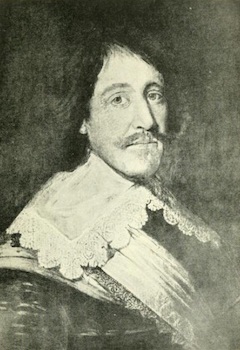
1503: A banderaio and an executioner

Courtesy of Emotions in the Heart of the City (14th-16th century), we travel to Florence during its between-Medicis republican interim* for a very emotional execution:

On the morning of 29 May 1503, outside the city’s great Gate of Justice,** a young flag-maker (banderaio) was put to death for having murdered another banderaio. In a scene that struck the throng of spectators as an outrage, the executioner had failed to cut off his head even after three blows of his sword. The sight must have been grisly, for the attending mounted captain was next forced to move in and club the flag-maker to death. The compassion of the crowd now pivoted into incandescent rage. A tumult broke out, as men and boys directed a cannonade of rocks at the executioner. There was, in addition, something oddly religious about the event, because rocks were also thrown at the men hooded in black, the members of the religious confraternity who were there to offer comfort to the unfortunate banderaio. They had to flee for their lives. The executioner was killed, and children then lugged his corpse around, worked their way back into the city, and dragged the body all the way up to the Franciscan Church of Santa Croce. Were they sending a message to Savonarola‘s great local enemies, the Franciscans? There was a possible religious subtext to this episode : some contemporaries claimed that the hangman had been punished — he was the very same man — for having first insulted and then hanged Savonarola five years previously. It goes without saying that he had died without last rites, and the dragging about of his body again touched on something religious in being subject to a ‘ceremony’ of desecration.

Although I cannot locate an online version of this document, it appears to me that a primary source for this incident is the chronicle of Simone Filipepi. This historian is a bit less famous than his little brother Alessandro Filipepi … who is inscribed in the annals of art’s history by his nickname (meaning “Little Barrel”) as Sandro Botticelli.

Tangentially, readers might also enjoy this 1625 instance of a clumsy executioner being lynched: in that case, his proposed prey actually survived the scaffold. A similar fate nearly befell notorious English hangman Jack Ketch, after his maladroit butchering of the Duke of Monmouth in 1685.

* This period prior to the restoration of the Medici was also Machiavelli’s political heyday. (He wrote his classics of statecraft after Giuliano de’ Medici subsequently recaptured Florence from the pie-eyed republicans and retired Machiavelli to countryside exile.)

** This public domain English translation of Guido Carocci‘s classic Firenze Scomparsa (Bygone Florence) illuminates some of the relevant topography.

A tower which now only consists of four stone walls, plain and undecorated, but which some day must have been much higher and surmounted by battlements, rises at the end of the Lungarno apposite the viale Carlo Alberto.

It is the sole remnant, the only souvenir of a number of ancient buildings which were situated in this position, and were known as the old mint (Zecca Vecchia).

Previous to the demolition of the walls the tower reared its massive proportions on the river bank in the midst of the ramparts of a dismantled fortress, near a mill race and buildings next the walls which at this point showed traces of a walled up gate.

The buildings next to the tower seemed a mixture of old and modern construction with large arched rooms, long corridors and balconies overhanging the canal from the Arno — which gave motive power to the wheels of various cloth mills.

These houses, which grouped en masse were of singular picturesqueness, completed the view of green banks and vine covered hills lining the river and were full of interesting historical associations.

A postern gate was situated here, flanked by a tower on the river bank to defend the city from a water attack; this was called the Gate of Justice, and its name calls up painful and melancholy memories. Outside the walls at the end of a meadow beyond the moat was a small low church whose facade was frescoed with sad subjects. In this meadow was placed the gallows and executionary scaffold. The Gate of Justice was generally closed for the better security of the city and was only thrown open for the passage of religious companies accompanying condemned criminals to the place of execution.

The street through which they passed to the gate was very appropriately known as Via Malcontenti, (Street of the Discontented).


Via dei Malcontenti, Florence (c. 1880) by Telemaco Signorini.

In 1346 criminals condemned to death were brought to a chapel, still in existence, next to the church of San Giuseppe in Via Malcontenti were tied to an iron ring which may still be seen in the pavement, but afterwards the little church outside the walls was built for this last grim service. [If this artifact still exists, I would be indebted to anyone who can supply a picture of it. -ed.]

The church was used as a resting place where the penitent might offer his short and final prayer before being handed over to the executioner.

The victims’ bodies remained suspended on the gallows for days in order to act as a wholesome warning to all evil disposed persons, but the Florentines, who must have their little joke even on the most solemn subjects, called these meadows which formerly belonged to the Nemi family, the paretaio of the Nemi (bird-catching place of the Nemi).

The gate of Justice was walled up during the great siege, and after that the lugubrious procession passed through the Porta alla Croce. In our times traces of this gate, partly buried in the raised soil, could still be seen previous to the destruction of the old walls and above it the hole through which every defensive missile might be hurled on attacking parties below.

On this day..

1753: George Robertson, prick

We are indebted to the redoubtable medical historian Dr. Lindsey Fitzharris for the substance of this post, which she brought to our attention on her blog, The Chirurgeon’s Apprentice. Fans of the macabre, and particularly of the recurring medicinal theme here at Executed Today, are sure to enjoy her book The Butchering Art: Joseph Lister’s Quest to Transform the Grisly World of Victorian Medicine — or her “Under the Knife” video series.

We (and Dr. Fitzharris) enter these sensitive parts via a bit of junk preserved at the Royal College of Surgeons: the severed penis which long ago inhabited, along with the bacterium Neisseria gonorrhoeae, the trousers of a highway robber named George Robertson.

Neither bacterium nor reader will be surprised to discover that when Robertson and a couple of other hard men knocked down James Holland in Mansfield Street to dispossess him of his hat and his wig, the pestilential thief resided at “a bawdy-house” (per the evidence of his perfunctory trial).

We don’t know the ins and outs of what this specimen got up to when Robertson had his liberty — only that its condition was so obvious that it interested the doctors. With nary a care for patient privacy, the Ordinary of Newgate emitted to the public that Robertson felt “so ill with the foul Disease, as not to be able to walk, and wished himself dead, because he had no Money or Friend to put him in the Hospital.”*

Agony though it might have been to our dissolute footpad, such cocks excited the physicians.

Dr. Fitzharris directs our attention to A Treatise on the Venereal Disease, by Robertson’s contemporary, the surgeon John Hunter. Hunter might well have fondled this very todger in his own day; as we learn from this turgid treatise, he and his colleagues found in the engorged members of the hung a penetrating scientific tool. The eightfold execution in the spring of 1753 that Hunter references below might be a previous Tyburn hanging date, of February 12, 1753. (That hanging included Robertson’s accomplice John Briant or Bryant: no word on the condition of John Briant’s John Thomas.)

Till about the year 1753 it was generally supposed, that the matter from the urethra in a gonorrhoea arose from an ulcer or ulcers in that passage; but from observation it was then proved that this was not the cafe. It may not be improper to give here a short history of the discovery of matter being formed by inflammation without ulceration.

In the winter 1749, a child was brought into the room used for dissection, in Covent Garden, on opening of whose thorax a large quantity of pus was found loose in the cavity, with the surface of the lungs and the pleura furred over with a more solid substance similar to coagulable lymph. On removing this from those surfaces they were found intire. This appearance being new to Dr. Hunter, he sent to Mr. Samuel Sharp, desiring his attendance, and to him it also appeared new. Mr. Sharp afterwards in the year 1750, published his Critical Enquiry, in which he introduced this fact, “That matter may be formed without a breach of substance;” not mentioning whence he had derived this notion. It was ever after taught by Dr. Hunter in his lectures ; we however find writers adopting it without quoting either Mr. Sharp or Dr. Hunter. So much being known, I was anxious to examine whether the matter in a gonorrhoea was formed in the same way. In the spring of 1753 there was an execution of eight men, two of whom I knew had at that time very severe gonorrhoeas. Their bodies being procured for this particular purpose, we were very accurate in our examination, but found no ulceration, the two urethras appeared merely a little blood-shot, especially near the glans. This being another new fact ascertained, it could not escape Mr. Gataker, ever attentive to his emolument, who was then attending Dr. Hunter’s lectures, and also practising dissection under me. He published, soon after in 1754, a treatise on this disease, and explained fully, that the matter in a gonorrhoea did not arise from an ulcer, without mentioning how he acquired this knowledge; and it has ever since been adopted in publications on this subject. Since the period mentioned above, I have constantly paid particular attention to this circumstance, and have opened the urethra of many who at the time of their death had a gonorrhoea, yet have never found a fore in any ; but always observed that the urethra near the glans was more blood-shot than usual, and that the lacunae were often filled with matter.

* As usual, the Ordinary plied the condemned while they languished in Newgate. However, he broke with his usual practice and did not make the trip to Tyburn for this triple execution, “because as they all three died Roman Catholicks, I did not choose to attend, to give them the Opportunity of turning their Backs upon me, as a Protestant Minister, which I knew they must do if I did.”

On this day..

1661: Archibald Campbell

On this date in 1661, Presbyterian lord Archibald Campbell, the first Marquess of Argyll, lost his head at Edinburgh.

Once a privy councilor to King Charles I, “Red Argyll” had been in the 1640s a great champion of Scottish national liberty and a leader of the Presbyterians in the many-sided wars that tore apart the British Isles.
Scotland’s Presbyterians — who favored bottom-up church governance as opposed to the crown-controlled selection of bishops that’s known as episcopacy — made an initial alliance with English Parliamentarians to support one another in their mutual hostilities with King Charles I. And in Scotland’s civil war in the mid-1640s, Argyll’s Presbyterians defeated the Earl of Montrose‘s royalists.

But the failure of Oliver Cromwell‘s similarly victorious Parliament to deliver on its covenant fractured the Presbyterian party and drove Argyll to the political sideline.

Argyll’s own opposition to other Presbyterians’ attempted engagement with the imprisoned Charles I became untenable when, to the horror of his countrymen, Charles was beheaded by Parliament. As his entry in the Dictionary of National Biography notes, Charles’s execution “completely upset his calculations, which had all along been founded on a close union between the parliaments of Scotland and of England … the results of his safe and prudent policy were ruthlessly annihilated … [and] Argyll lost his presence of mind, and therefore his control of events in this stupendous conjuncture, and became as much a puppet in the hands of contending factions as was Charles II.” His growing ranks of foes derisively nicknamed him the “Glaed-Eyed Marquis”, attributing an obvious metaphorical import to his imperfect eyesight.

“Myself encountered so many difficulties that all remedies that were applied had the quite contrary operation,” he later wrote of those years when his influence waned. “[I was] a distracted man of a distracted subject in a distracted time wherein I lived.” It did not wane all at once: Argyll had the honor of crowning King Charles II at Scone on the first of January, 1651, and even tested the king with dynastic marriage inquiries for his daughter. (No dice.)

But as events ran away from him he fell into debt, disgrace, and irrelevancy.

When Charles II resumed the throne in 1660, Argyll presented himself at the court of his would-be father-in-law, and was surprised to find himself immediately thrown in the Tower. Like the Presbyterian cause itself, he was permanently and tragically alienated from both factions of the English Civil War: Cromwell always suspected Argyll a royalist for that whole crowning-the-king thing, and Charles always resented Argyll for his part in the destruction of his father.

The Glaed-Eyed Marquis found himself shipped off to Edinburgh to stand trial for treason. Although records of the trial are lost, it’s said that he was on the verge of total acquittal when Cromwell’s former commander in Scotland, George Monck, delivered a packet of incriminating letters. This story might be apocryphal but Argyll lost his head all the same, on Edinburgh’s distinctive Maiden.

Peruse here Argyll’s tart and downright comical last will and testament, satirizing many of the surviving figures of the day and bidding his heirs to lay his body “so shallow, that at the next trump of sedition, it may by the same raise-devil directory [i.e., Parliament] be conjured up again, and meet my exalted head, that bound-mark of Presbytery, its ne plus ultra, ‘Hitherto shall you go and no further.'”


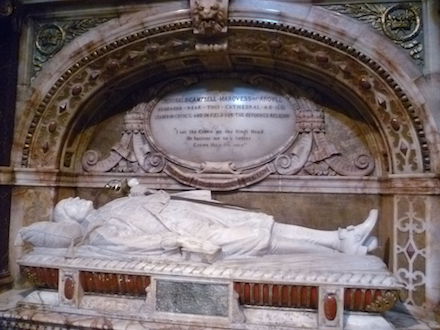
Memorial to Archibald Campbell in Edinburgh’s St Giles’ Cathedral with the epitaph “I set the Crown on the King’s Head. He hastens me to a better Crown than his own.” (cc) image from Kim Traynor.

Argyll’s son and heir, also named Archibald Campbell, was himself executed in 1685 for organizing a Scottish “Argyll’s Rising” against King James II in alliance with the Duke of Monmouth. Their descendants still maintain the rank of Duke of Argyll to this day.

On this day..

1584: Samuel Zborowski, dangerous precedent

On this date in 1584, Samuel Zborowski was beheaded at Krakow’s Wawel Hill for treason and murder committed ten years before.

A monument to the timeless abuse of the prosecutor’s discretion, Zborowski (English Wikipedia entry | Polish) was a powerful nobleman who got into a snit when nobody of equal stature would enter the lists with him at a tournament.

Instead, his challenge was answered by a common trooper in the retinue of the castellan of Wojnice,* one Jan Teczynski. Pissed at the affront, and doubly so when his own retainer was defeated by Teczynski’s, Zborowski went right after Teczynski right there in the presence of the newly elected Polish king, Henry de Valois.** The affront of lese-majeste was compounded when Zborowski’s flailing mace mortally wounded another castellan who attempted to intervene.

The outlawed Zborowski fled to the protection of Stephen Bathory,† Voivode of Transylvania.

That might have been that, and left Zborowski to join Europe’s forgettable ranks of exiles, adventurers, and pretenders playing out the string under the patronage of some foreign prince.

But when the elective throne of mighty Poland came open soon thereafter, Zborowski’s patron decided that he liked the look of it — and he obtained the result, with the help of a dynastic marriage into Poland’s Jagiellon dynasty of illustrious memory.

Since the Zborowskis had been big supporters of Stephen Bathory, Samuel returned as well, justifiably anticipating not merely pardon but elevation. To their dismay, they found themselves frozen out … and they responded with a series of insubordinations: plotting with the invading Russians, fomenting an unwanted diplomatic crisis with freelance attacks upon the Ottomans.

In the end, our man was undone by the same violent highhandedness that had forced his flight from Poland in the first place. Zborowski’s ill treatment of the young lute composer Wojciech Dlugoraj left the latter so desperate to escape Zborowski’s court that Dlugoraj stole some treasonable correspondence between Zborowski and his brothers and sent it to Zborowski’s enemy, Jan Zamoyski.‡ Those letters indicated that Samuel was contemplating assassinating the king.

Zamoyski found, and Bathory agreed, that the most expedient way to remove this troublemaker was simply to execute the 1574 sentence, from that bludgeoned castellan. The new regime had conveniently never bothered to lift it.

Although legal, Zborowski’s execution was obviously quite irregular and it outraged many in the nobility who perceived it a potential precedent for absolutism; recrimination over the action tore apart the 1585 meeting of the Polish Sejm. (In later years, this body formally endorsed Zamoyski’s actions but only after enacting a Lex Zborowski to better govern the handling of treason cases.)


Jan Matejko‘s 19th century rendering of Samuel Zborowski en route to beheading.

* At the time an important fortified city, Wojnice or Wojnicz was ravaged by a Swedish army in the 1650s and never recovered; today, it’s a town — having only re-promoted itself from “village” status in 2007 — of fewer than four thousand souls.

** This youngest son in the French royal house had seemed to the Valois safe to make available on the transfer market for foreign sovereigns. However, his brothers’ uncanny talent for dying young without issue very soon required his return to his homeland to take up the throne of France as Henri III during that country’s Wars of Religion. There Henri proved not to be exempt from the family curse: we have previously explored the circumstances of his own violent death — which was also the end of the House of Valois — during the War of the Three Henrys.

† A legendary surname in the annals of horror. This Stephen Bathory was the maternal uncle of the infamous “Countess of Blood”.

‡ The gambit did indeed get the scared lutenist free from Zborowski’s control, but he had to flee to Germany for fear of Zborowski kinsmen’s vengeance.

On this day..

1425: Murdoch Stewart, Duke of Albany

On or about this date in 1425, Murdoch Stewart, Duke of Albany, climbed the Heading Hill.

Murdoch’s dad Robert Stewart was the (second) son of King Robert II, the very first monarch of the Stewart line*

That made the Dukes of Albany pere et fils a pair of vipers in a pit full of them: violent, covetous lords scrabbling ruthlessly after power. Few scrabbled with less ruth than the Albanies.

Robert Stewart had seized effective control of the government in an intra-family coup in 1389, so even though his older brother succeeded as King James I, it was the kid brother who ruled and this made for some extremely awkward years.

And he did not exercise the office with a kinsman’s love. If anything, he had an idea to supplant his brother. In 1402, the Duke of Albany even seized his own nephew — and potential royal heir — the Duke of Rothesay** and murdered him in custody. The frightened king soon sent his youngest kid, the future King James I, out of the country to keep him away from the relatives. James was promptly kidnapped by the English, and Albany — succeeding to titular power as the Regent when his feeble brother died — gleefully refused to pay the ransom while he bossed Scotland from 1406 until his death in 1420. James spent 18 years refining his poetry at the English court.

In another timeline — the one intended by Albany, no doubt — this is all prologue to his own offspring gaining the crown. It didn’t quite work out that way.

Albany’s death in 1420 passed his title to his son, our man Murdoch Stewart — who was already at the ripe old age of 58.† But the Albany run as permanent Regent was nearing the end of the line and political pressure soon forced Murdoch to sign off on the ransom of the occluded King James. His return in effect put two rival sovereigns in the realm, where both could not long abide together.

An English rout of French and Scottish troops on the continent at the Battle of Verneuil would prove ruinous to Murdoch as well, for Murdoch’s brother the Earl of Buchan was slain in the process. With him died Murdoch’s own political security, and the king crushed his cousin with dispatch.

Although some sources place Murdoch Stewart’s execution on the 24th, we’ll follow the narrative of Patrick Fraser Tytler’s History of Scotland, Volume 3:

Murdoch, the late governor, with Lord Alexander Stewart, his youngest son, were suddenly arrested, and immediately afterwards twenty-six of the principal nobles and barons shared the same fate. Amongst these were Archibald Earl of Douglas, William Douglas Earl of Angus, George Dunbar Earl of March, William Hay of Errol, constable of Scotland, Scrimgeour, constable of Dundee, Alexander Lindesay, Adam Hepburn of Hailes, Thomas Hay of Yester Herbert Maxwell of Caerlaverock, Alexander Ramsay of Dalhousie, Alan Otterburn, secretary of the Duke of Albany, Sir John Montgomery, Sir John Stewart of Dundonald, commonly called the Red Stewart, and thirteen others. During the course of the same year, and a short time previous to this energetic measure, the king had imprisoned Walter, the eldest son of Albany, along with the Earl of Lennox, and Sir Robert Graham, a man of a dark, fierce, and vindictive disposition, who from that moment vowed the most determined revenge, which he lived to execute in the murder of his sovereign. The heir of Albany was shut up in the strong castle of the Bass, belonging to Sir Robert Lauder, a firm friend of the king, whilst Graham and Lennox were committed to Dunbar, and the Duke of Albany himself, confined in the first instance in the castle of St Andrews, and afterwards transferred to that of Caerlaverock. At the same moment the king took possession of the castles of Falkland, and of the fortified palace of Doune, the favourite residence of Albany. Here he found Isabella, the wife of Albany, a daughter of the Earl of Lennox, whom he immediately committed to the castle of Tantallan; and with a success and a rapidity which can only be accounted for by the supposition of the utmost vigour in the execution of his plans, and a strong military power to overawe all opposition, he possessed himself of the strongest fortresses in the country; and after adjourning the parliament, to meet within the space of two months at Stirling, upon the 18th of May, he proceeded to adopt measures for inflicting a speedy and dreadful revenge upon the most powerful of his opponents.

In the palace of Stirling, on the 24th of May, a court was held with great pomp and solemnity for the trial of Walter Stewart, the eldest son of the Duke of Albany. The king, sitting on his throne, clothed with the robes and insignia of majesty, with the sceptre in his hand, and wearing the royal crown, presided as supreme judge of his people. The loss of all record of this trial is peculiarly to be regretted, as the proceeding would have thrown important light upon a most interesting, but unfortunately, most obscure portion of our history. We know only from an ancient chronicle that the heir of Albany was tried for robbery, “de roboria.” The jury was composed of twenty-one of the principal nobles and barons, and it is a remarkable circumstance, that amongst their names which have been preserved, are to be found seven of the twenty-six barons whom the king had seized and imprisoned two months before at Perth, when he arrested Albany and his sons. Amongst these seven, were the three most powerful lords in the body of the Scottish aristocracy — the Earls of Douglas, March, and Angus; the rest were Sir John de Montgomery, Gilbert Hay of Errol the constable, Sir Herbert Herries of Terregles, and Sir Robert Cuningham of Kilmaurs. Others who sat upon this jury we know to have been the assured friends of the king, and members of his privy council. These were, Alexander Stewart, Earl of Mar, Sir John Forrester of Corstorfin, Sir Thomas Somerville of Carnwath, and Sir Alexander Levingston of Callendar. It is probably that the seven jurymen above mentioned were persons attached to the party of Albany, and that the intention of the king, in their imprisonment, was to compel them to renounce all idea of supporting him, and to abandon him to his fate. In this result, whatever were the means adopted for its accomplishment, the king succeeded. The trial of Walter Stewart occupied a single day. He was found guilty, and condemned to death. His fate excited a deep feeling of sympathy and compassion in the breasts of the people; for the noble figure and dignified manners of the eldest son of Albany were peculiarly calculated to make him friends amongst the lower classes of the community.

On the following day, Albany himself, with his second son, Alexander, and his father-in-law, the Earl of Lennox, were tried before the same jury. What were the crimes alleged against the Earl of Lennox and Alexander Stewart, it is now impossible to determine; but it may be conjectured, on strong grounds, that the usurpation of the government and the assumption of supreme authority, during the captivity of the king, offences amounting to high treason, constituted the principal charge against Duke Murdoch. His father undoubtedly succeeded to the regency by the determination of the three Estates assembled in parliament, but there is no evidence that any such solemn decision was passed which sanctioned the high station assumed by the son, and if so, every single act of his government was an act of treason, upon which the jury could have no difficulty in pronouncing their verdict. Albany was accordingly found guilty; the same sentence was pronounced upon his son, Alexander Stewart; the Earl of Lennox was next condemned; and these three noble persons were publicly executed on that fatal eminence, before the castle of Stirling, known by the name of the Heading Hill. As the condemnation of Walter Stewart had excited unwonted commiseration amongst the people, the spectacle now afforded was calculated to raise that feeling to a still higher pitch of distress and pity. Albany and his two sons were men of almost gigantic stature, and of so noble a presence, that it was impossible to look upon them without an involuntary feeling of admiration; whilst the venerable appearance and white hairs of Lennox, who had reached his eightieth year, inspired a sentiment of tenderness and pity, which, even if they admitted the justice of the sentence, was apt to raise in the bosom of the spectators a disposition to condemn the rapid and unrelenting severity with which it was carried into execution. Even in their days of pride and usurpation, the family of Albany had been the favourites of the people. Its founder, the regent, courted popularity, and although a usurper, and stained with murders, seems in a great measure to have gained his end. It is impossible, indeed, to reconcile the high eulogium of Fordun and Winton with the dark actions of his life; but it is evident, from the tone of these historians, that the severity of James did not carry along with it the feelings of the people. Yet, looking at the state of things in Scotland, it is easy to understand the object of the king. It was his intention to exhibit to a nation, long accustomed to regard the laws with contempt, and the royal authority as a name of empty menace, a memorable example of stern and inflexible justice, and to convince them that a great change had already taken place in the executive part of the government.

With this view, another dreadful exhibition followed the execution of the family of Albany. James Stewart, the youngest son of this unfortunate person, was the only member of the family who had avoided the arrest of the king, and escaped to the Highlands. Driven to despair, by the ruin which threatened his house, he collected a band of armed freebooters, and, assisted by Finlay, Bishop of Lismore, and Argyle, his father’s chaplain, attacked the burgh of Dumbarton, with a fury which nothing could resist. The king’s uncle, Sir John of Dundonald, called the Red Stewart, was slain, the town sacked and given to the flames, and thirty men murdered, after which the son of Albany returned to his fastnesses in the north. But so hot was the pursuit which was instituted by the royal vengeance, that he, and the ecclesiastical bandit who accompanied him, were dislodged from their retreats, and compelled to fly to Ireland. Five of his accomplices, however, were seized, and their execution, which immediately succeeded that of Albany, was unpardonably cruel and disgusting. They were torn to pieces by wild horses, after which their warm and quivering limbs were suspended upon gibbets; a terrible warning to the people of the punishment which awaited those, who imagined that the fidelity which impelled them to execute the commands of their feudal lord, was superior to the ties which bound them to obey the laws of the country.

* Destined in time to suffer one of the annals’ most illustrious beheading.

** Fun aristocratic title fact: “Duke of Rothesay” is a still-extant title held by the British heir apparent (so, as of writing, Prince Charles).

† He’d spent more than a decade in English custody himself, after being captured in battle; he’s referenced in the opening lines of Shakespeare’s Henry the Fourth, Part 1 using another title companion to that of the Duke of Albany, the Earl of Fife.

Ten thousand bold Scots, two and twenty knights,
Balk’d in their own blood did Sir Walter see
On Holmedon’s plains. Of prisoners, Hotspur took
Mordake the Earl of Fife, and eldest son
To beaten Douglas; and the Earl of Athol,
Of Murray, Angus, and Menteith:
And is not this an honourable spoil?
A gallant prize? ha, cousin, is it not?

On this day..

1525: Jäcklein Rohrbach, for the Weinsberg Blood Easter

On the 21st or perhaps the 20th of May in 1525, the peasant rebel Jakob Rohrbach — more commonly known as Jäcklein (“Little Jack”) Rohrbach — was chained to a stake and burned alive as the nobility celebrated its victory in the German Peasants’ War.

Rohrbach was by history’s acclamation the most bloody-minded of the peasant revolutionaries — for Jakob perhaps had learned the lesson of the Jacquerie that rebels against the lords must vanquish or perish. (Jakob Rohrbach was literate.)

When the peasantry rose to shake Germany, Rohrbach was elected a leader in the environs of Weinsberg, in Baden-Wuerttemberg. It was here that Rohrbach’s band would author the rebellion’s most spectacular outrage, the Weinsberg Massacre, or Weinsberg Blood Easter — for on April 16, Easter Day, they overwhelmed the city and put its garrison to slaughter, collectively executing Count Ludwig von Helfenstein by forcing him to run a gantlet while peasants screamed their grievances at him.

“You thrust my brother into a dungeon,” one cried, “because he did not bare his head as you passed by.” “You harnessed us like oxen to the yoke,” shouted others; “you caused the hands of my father to be cut off because he killed a hare on his own field … Your horses, dogs, and huntsmen have trodden down my crops … You have wrung the last penny out of us.” (Will Durant)

As word of the blood rage went abroad, it not only horrified the respectable (Martin Luther turned his considerable vituperation upon the insurrection after hearing about it*) but split the rebellion itself between moderate and radical factions. We lack access to the peasant councils of war, but perhaps that was even intentional on Rohrbach’s part, to force the revolution towards its most extreme ends, much as French Jacobins would decapitate the king to cut off any hope of their moderate brethren making an accommodation.

If so, it failed in that objective. It would be the fragmented German polities that by dint of the danger made common cause and defeated the rebellion. For a special villain like Rohrbach, special treatment was reserved, yet his was only most exemplary among innumerable long-forgotten cruelties meted out. The lords returned stroke for stroke ten times over for every injury that Rohrbach and his kind had dealt them.

The total number of the peasants and their allies who fell either in fighting or at the hands of the executioners is estimated by Anselm in his Berner Chronik at a hundred and thirty thousand. It was certainly not less than a hundred thousand. For months after, the executioner was active in many of the affected districts. Spalatin says: “Of hanging and beheading there is no end”. Another writer has it: “It was all so that even a stone had been moved to pity, for the chastisement and vengeance of the conquering lords was great”. The executions within the jurisdiction of the Swabian League alone are stated at ten thousand. Truchses’s provost boasted of having hanged or beheaded twelve hundred with his own hand. More than fifty thousand fugitives were recorded. These, according to a Swabian League order, were all outlawed in such wise that any one who found them might slay them without fear of consequences.

The sentences and executions were conducted with true mediaeval levity. It is narrated in a contemporary chronicle that in one village in the Henneberg territory all the inhabitants had fled on the approach of the count and his men-at-arms save two tilers. The two were being led to execution when one appeared to weep bitterly, and his reply to interrogatories was that he bewailed the dwellings of the aristocracy thereabouts, for henceforth there would be no one to supply them with durable tiles. Thereupon his companion burst out laughing, because, said he, it had just occurred to him that he would not know where to place his hat after his head had been taken off. These mildly humorous remarks obtained for both of them a free pardon.

… Many places were annihilated for having taken part with the peasants, even when they had been compelled by force to do so. Fields in these districts were everywhere laid waste or left uncultivated. Enormous sums were exacted as indemnity. In many of the villages peasants previously well-to-do were ruined. There seemed no limit to the bleeding of the “common man,” under the pretence of compensation for damage done by the insurrection.

The condition of the families of the dead and of the fugitives was appalling. Numbers perished from starvation. The wives and children of the insurgents were in some cases forcibly driven from their homesteads and even from their native territory. In one of the pamphlets published in 1525 anent the events of that year, we read: “Houses are burned; fields and vineyards lie fallow; clothes and household goods are robbed or burned; cattle and sheep are taken away; the same as to horses and trappings. The prince, the gentleman, or the nobleman will have his rent and due. Eternal God, whither shall the widows and poor children go forth to seek it?”

Ernest Belfrt Bax, The Peasants’ War in Germany

* Weinsberg is also famous for a different siege centuries previous, which ended in an altogether more humane fashion.

** Luther wrote a Blood Easter of his own in Against the Robbing and Murdering Hordes of Peasants.

they are starting a rebellion, and violently robbing and plundering monasteries and castles which are not theirs, by which they have a second time deserved death in body and soul, if only as highwaymen and murderers. Besides, any man against whom it can be proved that he is a maker of sedition is outside the law of God and Empire, so that the first who can slay him is doing right and well. For if a man is an open rebel every man is his judge and executioner, just as when a fire starts, the first to put it out is the best man. For rebellion is not simple murder, but is like a great fire, which attacks and lays waste a whole land. Thus rebellion brings with it a land full of murder and bloodshed, makes widows and orphans, and turns everything upside down, like the greatest disaster. Therefore let everyone who can, smite, slay and stab, secretly or openly, remembering that nothing can be more poisonous, hurtful or devilish than a rebel. It is just as when one must kill a mad dog; if you do not strike him, he will strike you, and a whole land with you

a prince and lord must remember in this case that he is God’s minister and the servant of his wrath (Romans XIII), to whom the sword is committed for use upon such fellows, and that he sins as greatly against God, if he does not punish and protect and does not fulfil the duties of his office, as does one to whom the sword has not been committed when he commits a murder. If he can punish and does not — even though the punishment consist in the taking of life and the shedding of blood — then he is guilty of all the murder and all the evil which these fellows commit, because, by willful neglect of the divine command, he permits them to practice their wickedness, though he can prevent it, and is in duty bound to do so. Here, then, there is no time for sleeping; no place for patience or mercy. It is the time of the sword, not the day of grace.

hey may die without worry and go to the scaffold with a good conscience, who are found exercising their office of the sword. They may leave to the devil the kingdom of the world, and take in exchange the everlasting kingdom. Strange times, these, when a prince can win heaven with bloodshed, better than other men with prayer!

On this day..

1618: Nicole Regnault and the brothers Bouleaux

On this date in 1618, Venice crushed a Spanish conspiracy with sudden violence.

The reality of this conspiracy has been argued for the four hundred years since it was exposed or “exposed” but there is no questioning the security panic experienced by Venice at this moment.

Spain’s viceroy to Naples, the Duke of Ossuna, was massing a fleet that the Serene Republic suspected was meant for her; meanwhile, contradictory rumors of possible conspiracies within the city dogged the Doge.

At last, a Frenchman named Juven informed on confederates and countrymen whom he claimed had taken him into their confidence with the intent to destroy Ven

The Government now determined to act. On the 12th May 1618 [Nicole] Regnault and the brothers Bouleaux were arrested, just when the former had been writing to his sister in Paris, to say that he had a piece of business in hand which would save him the trouble of earning his livelihood for the future, which was true enough. The two Bouleaux, it appeared at their examination, had been engaged at the Spanish embassy in the manufacture of petards and fireworks in connection with a general plan of incendiarism; and they were forced into the admission that the embassy was a perfect storehouse of arms and ammunition, and that the order of the arrangements had been drawn up by Regnault and Pierre … On the person of Charles Bouleaux were found several damning papers; two letters of Lorenzo Nolot, a Burgundian (Pierre’s messenger to Ossuna), directed to a Signor Pireu, and in his stocking two others written to the Duke of Ossuna … The capture of Regnault and the others produced a scare, and there was a sudden exodus from the city, unhindered by the Executive, and emptying the lodging-houses of their motley and disreputable occupants. All who fell into the hands of the Government confessed that everything on their side was ready, and that if Ossuna had been able to support them, Venice must have been overpowered … On the same day which witnessed the arrests of Regnault and the two Brouleaux, orders were transmitted to the proveditor-general at sea to dispatch [naval officers already detained under suspicion -ed.] Pierre, Langlad, and their secretary Rossetti, in such a manner as he might judge fit; in reporting their executions, Veniero stated that the fireworks fabricated by Langlad for the use of the fleet had been in reality destined to burn it. On the 18th Regnault and his confederates were strangled in prison, and their bodies afterward suspended head downward between the Columns. Other summary measures followed, and about 300 persons paid with their lives for their participation in the foolish and flagitious project; but no particulars have been preserved of the exact number or of the mode of disposing them … What sad shocks must have befallen households where a father, or a son, or a brother, whose guilt was unsuspected perhaps by the rest, was seized by the sbirro to be seen no more! What a spectacle the lower Dungeons must have offered during days and days!

On this day..

1693: Francis Winter, at the Whitefriars sanctuary

On this date in 1693, Francis Winter was executed for the murder of a London sheriff.

Winter’s hanging takes us back to the last days (in England) of a queer old institution: sanctuary. Dating to centuries before the Norman conquest, this privilege of holy places to confer legal immunity upon fugitives was well into its dotage. In principle and sometimes in practice, a fellow could once upon a time frustrate the pursuit of the law by reaching such a sanctuary. However, most legally recognized sanctuaries had been eliminated with the Reformation.

Among the last of their breed was a dubious district between Fleet Street and the Thames, known as Whitefriars after the Carmelite monastery that had also germinated its zone of sanctuary. Though the Carmelites had been expelled in the 16th century and the right of sanctuary for criminals abolished in general during the 1620s, still Whitefriars held onto this association through the 17th century, gradually accumulating civil refugees such as debtors and an accompanying red light district bustling with taverns, brothels, thieves, and other accoutrements of the urban underbelly.*

This interesting place would come to be nicknamed “Alsatia”, tribute to the continental frontierlands between France and Germany which was controlled at the time by neither and thus perceived as lawless, and its reputation earned a literary profile to match: playwright Thomas Shadwell had a 1688 hit with his cant-heavy** portrayal of Whitefriars rogues (with evocative names like Cheatley, Shamwell, and Scrapeall) in The Squire of Alsatia.


Whitefriars retained its shady reputation long after the end of sanctuary: In William Hogarth‘s 1747 Industry and Idleness prints, the gallows-bound “Idle ‘Prentice” is seized by the authorities at a dive in the district’s Hanging Sword Alley. (Meanwhile, a murdered body is dumped into the cellar in the background.)

By this late date, “sanctuary” was a fading custom and was for that reason defended all the more vigorously by its claimants — all of whom shared a desperate interest in the crown’s maintaining a hands-off policy in “Alsatia”.

“The libertines, the rogues, and the rascals, who frequented its purlieus and committed abuses and outrages on peaceable citizens, made it a notorious place of criminal resort,” one history observes. “Bailiffs and officers of the law were afraid to enter its precincts to serve warrants or make executions.”

Our man Francis Winter was one of these fugitives bold enough to strike fear into the officers of the law.

In 1691, the Temple attempted to seal a gate connecting to Whitefriars. The Alsatians resisted this impediment to their movement, and when sheriffs showed up to control the situation the resistance turned into an outright riot. A lawman named John Chandlor was fatally shot in the fray.

This near-insurrection was far too much disturbance for a state whose tolerance for an open thieves’ district was very near its end. After some months evading arrest, Francis Winter would hang on May 17, 1693 for leading the angry mob. (He may or may not have personally pulled the trigger that killed Chandlor; given the chaotic situation, even contemporaries weren’t sure about it.)

Winter was a Cornish former ship’s captain who had commanded a vessel in England’s war against the Dutch a generation earlier; according to the Newgate Ordinary, Winter had then “behaved himself with a great deal of Candor and Courage.” Financial ruin later in life had driven him to Whitefriars where evidently he still retained the knack for leadership. Despite his offense against the public peace, Winter earned the Ordinary’s regard for accepting his sentence with pious equanimity.

Perhaps in respect for this frame of mind — or more probably, the better to orchestrate the demonstrative spectacle of an execution at the very gates of Whitefriars — Winter was reprieved from a May 8 mass hanging at Tyburn by Queen Mary II. (King William III was away, warring on France.) Then, upon the 17th,

he was put into a Coach at Newgate Stairs, and from thence Conveyed down Old Baily, and over Fleet-Bridge, to the Fryars Gate, in the way to which place, there were several Thousands of Spectators, who thronged to see him, when the Cart was settled under the Gibbet, and he put into it, (which was Erected there on purpose) he stood up, and spake as follows: I have no Publick Declaration to make here, my Thoughts being wholly taken up in the Concerns of my Eternal Welfare, for that is the Work that I am come here to do: Therefore I desire that I may not be interrupted. Then the Minister Prayed with him, and for him, and Recommended him to the Mercy of God, Etc.

The right of sanctuary was fully abolished in 1697.

* One notable denizen was the writer Daniel Defoe, who sought relief from his debts in Whitefriars in 1692.

** Including such charmers as “ready, cole and rhino for money; putt for one who is easily cheated; clear for very drunk; meggs for guineas; smelts for half-guineas; tatts and the doctors for false dice.” (Jonathon Green, The Vulgar Tongue: Green’s History of Slang) One can read the play here.

On this day..

1863: Zygmunt Padlewski, January Uprising rebel

On this date in 1863, Zygmunt Padlewski was shot for rebelling against the Russian empire.

A young St. Petersburg-trained tsarist officer with a patriotic bent — his father had taken part in the November [1830] Uprising against Russian domination — Padlewski (English Wikipedia entry | German | the surprisingly least detailed Polish) spent the early 1860s organizing revolutionary exiles in Paris.

He then put his neck where his mouth was by returning to Warsaw to agitate and, eventually, to assume the leadership of Polish rebels in that area during his own generation’s doomed revolution, the January [1863] Uprising.

Padlewski’s carriage was detained at a checkpoint when he tried to sneak back to Warsaw after a defeat, and his too-liberal bribes excited the suspicion of the Cossack sentries — who searched the traveler and discovered they had a man well worth the capturing.

He was shot at Plock, where a street and a school today bear his names (numerous other cities around Poland also honor Padlewski).

On this day..

1835: Four slaves, for the Malê Rebellion

On this date in 1835, four African slave rebels were shot at Salvador.

The Malê Revolt acquired its name from the local designation for Muslims … which was the predominant religion of the slaves harvested from West Africa* who were pouring into Brazil. (It’s also known as the Muslim Revolt, or simply the Great Revolt.) Ethnically, these were mostly Yoruba peoples, known in Brazil as Nagôs; Nagôs constituted the bulk of the slave sector whom the Portuguese had nicknamed “Minas” — Gold Coast imports who had embarked their slave ships at the notorious Elmina Castle.

Under whichever designation, this population was particularly thick in the agrarian Atlantic province of Bahia; there, “slaves constituted the majority of Bahia’s population in the 1820s and 1830s, [and] the maority of slaves were African-born.” And African-born slaves proved over the years to share a vigorous spirit of resistance. Slave risings and plots had emerged in Bahia in 1807, 1809, 1814, 1816, 1822, 1824, 1826 1827, 1828, 1830, and 1831, spanning the periods of Portuguese colonialism and Brazilian independence. Scottish botanist George Gardner, recalling his travels in Brazil in the late 1830s, opined that

The slaves of Bahia are more difficult to manage than those of any other part of Brazil, and more frequent attempts at revolt have taken place there than elsewhere. The cause of this is obvious. Nearly the whole of the slave population of that place is from the Gold coast. Both the men and the women are not only taller and more handsomely formed than those from Mozambique, Benguela, and the other parts of Africa, but have a much greater share of mental energy, arising, perhaps, from their near relationship to the Moor and the Arab. Among them there are many who both read and write Arabic. They are more united among themselves than the other nations, and hence are less liable to have their secrets divulged when they aim at a revolt.

Here, in secret madrassas and an underground tongue, these people cultivated a shared religion that naturally fused with the religious to the political and eventually germinated a revolutionary conspiracy. Two elderly, enslaved Muslim teachers seems to have been particular nodes in this community of resistance.**

On the night of January 24-25 of 1835, some 300 of these African-born slaves (with a few African-born freedmen) rebelled and attacked the city of Salvador. The fighting spanned only a few midnight hours; rumors of a rising had reached white ears on the 24th and as a result the masters stood halfway prepared and rallied quickly enough to crush the revolt — killing around 80 rebels in the process.

Nevertheless, it was perhaps the largest and most frightening servile rebellion in Brazil’s history. And although not all participants were Muslim, they very distinctively were all African-born: second-generation, Brazil-born blacks (whether slave or free) as well as mulattoes, who occupied a higher caste rank more in simpatico with whites, were deeply distrusted by African natives as liable to betray the plot — and rightly so. This turned out to be the very channel by which advance warning of the imminent rebellion reached white ears on the night of January 24. It was a great, if last-minute, victory for white Brazilians’ intentional stratification of the servile labor force: “The division among Africans is the strongest guarantee of peace in Brazil’s large cities,” the governor of Bahia had written in 1814.

Surprisingly, only four juridical executions are known to have resulted from this rising, although flogging sentences inflicted on others were so brutal that at least one person also died under the lash. Records, however, are patchy, and as João José Reis notes in his essential text on the Malê revolt (Slave Rebellion in Brazil: The Muslim Uprising of 1835 in Bahia) it is scarcely apparent why these particular men came in line for the law’s final extremity:

The president of the province, under pressure from influential members of Bahian society, felt that it was important to put on a public spectacle and hang prisoners as soon as possible so as to intimidate would-be rebels. With this in mind, on 6 March 1835 Francisco de Souza Martins wrote to the minister of justice:

It seems fitting, as has been suggested to me by many Citizens of this Capital, that the Government of His Majesty the Emperor, so as not to diminish the healthy effect of an execution as soon as possible after the crime, should have the sentences carried out on the two or three main leaders, at the same time declaring that these individuals should not have any recourse or appeal; that is, such a measure is thought to be both efficacious and necessary to the present circumstances.

In a decree dated 18 March 1835 the central government accepted this suggestion and ordered that the death sentences be “immediately carried out without being allowed to go before a Court of Appeal, after the remaining legal steps had been taken.” A month later, on 14 May, one day after the publication of the law on deportations, and without having taken “the remaining legal steps,” the government put four Africans to death.

There was only one freedman among those executed: Jorge da Cruz Barbosa, a hod carrier (carregador de cal) whose African name was Ajahi. Ajahi had been arrested on the day after the uprising, in the house of some fellow Nagô acquaintances, Faustina and Tito. Tito was also involved in the rebellion and had left home some days before the twenty-fifth, never to return. On the morning of the twenty-fifth, Ajahi showed up wounded and hid under a bedframe (estrado). Faustina turned him in to inspectors Leonardo Joaquim dos Reis Velloso and Manoel Eustaquio de Figueiredo, who arrested him. Under questioning Ajahi declared that he lived on Rua de Oracao and was a neighbor of Belchior and Gaspar da Cunha, whom he used to visit regularly. Concerning the meetings they had there, he claimed: “Everybody prattled on and on or just stopped in to say hello.” He denied being a Malê and having participated in the revolt. He tried to convince the judge and jury that the bayonet wound in his right leg “had been inflicted by soldiers … while he was at the window, [and] not because he was outside fighting with anybody.” Ajahi was apparently just an ordinary rebel. Indeed none of the Africans questioned in 1835 suggested he had played an important part in the Malê organization. Even so, on 2 March 1835 he was sentenced to death, along with other important prisoners. His sentence had been set by Francisco Goncalves Martins, the chief of police, now presiding over the jury as a judge: “In light of the previous declaration … on behalf of the Sentencing Jury I sentence prisoners: Belchior da Silva Cunha, Gaspar da Silva Cunha, and Jorge da Cruz Barbosa (all freedmen), as well as Luis Sanim, a slave of Pedro Ricardo da Silva, to natural death on the gallows.” With the exception of Jorge Barbosa (Ajahi), all those listed by Martins had their sentences commuted. Ajahi appears to have escaped from prison, but he was quickly recaptured. Perhaps the maintenance of his sentence comes from his being considered an incorrigible rebel.

Little is known about the others sentences to death. They were all Nago slaves. One of them was Pedro, a slave of Joseph Mellors Russell, the English merchant. It seems that all of this man’s slavees took part either in the rebellion or, at least, in the Malê conspiracy. On his own Russell had turned over to the justice of the peace a crate containing a great number of Malê objects belonging to his slaves — Necio, Joao, Joaozinho “the urchin,” Tome, Miguel, and Pedro. Of all these men Joao was the most militant, and his final sentence is not known. No one knows why Pedro was singled out for the death penalty. I could not find the records for his particular trial.

The other two slaves executed were Goncalo, whose owner appears in the records as Lourenco so-and-so, and Joaquim, who belonged to Pedro Luis Mefre. About them all that is known is that they were among the thirteen rebels wounded and taken prisoner during the confrontation at Agua de Meninos. It may be that they were both abandoned by their masters, since nothing suggests that they might have been leaders and none of the other eleven taken prisoner in the same circumstances received similar punishment.

These were, then, the four Africans put to death in 1835. Rodrigues began a tradition claiming that five Africans were executed, but there is no evidence for it. He names a freedman by the name of Jose Francisco Goncalves as the fifth victim. This African actually existed. He was a Hausa and lived in the Maciel de Baixo neighborhood. According to his testimony, he earned his living “bringing out samples of sugar from the warehouses for Merchants.” His name appears on the Roll of the Guilty with this observation: “sentenced and acquitted on 4 June 1835.” On that same roll the names of Jorge da Cruz Barbosa, Joaquim, Pedro, and Goncalo appear, with the following observation after each one: “sentenced to death and executed on 14 May 1835.”

Like all public executions, this one had its share of pomp and ceremony. The victims were paraded through the streets of Salvador in handcuffs. At Campo da Polvora new gallows had been constructed to replace the old ones, which had rotted from lack of use. At the head of the cortege marched the council “doorman,” Jose joaquim de Mendonca, who cried the sentence out to the ringing of bells. After him came Joao Pinto Barreto, the execution scribe, and Caetano Vicente de Almeida, a municipal judge. On both sides of the prisoners marched a column of armed Municipal Guardsmen. The Santa Casa da Misericordia was also presente, since the bylaws of that important philanthropic institution obliged its members, who were recruited from the local elite, to march along with people condemned to death as an act of Christian piety. The execution itself was to be witnessed by the interim chief of police (Martins had already gone to Rio de Janeiro as a congressional deputy), Judge Antonio Simoes da Silva, and by the commandant of the Municipal Guard, Manoel Coelho de Almeida Tander.

Much to the authorities’ disappointment, the new gallows could not be used to hang the prisoners. No one would act as executioner. On 13 May, one day before the execution, the vice-president of the province, Manoel Antonio Galvao, in response to a request from the chief of police, offered 20-30 milreis to any ordinary prisoner in Bahia’s many jails to act as executioner. Even though that was four months’ earnings for the average urban slave, no one came forward. The chief warden, Antonio Pereira de Almeida, expressed his disappointment in a communique to the chief of police that afternoon: “I have offered the job to the inmates, and no one will take it. I did the same thing today at the Barbalho and Ribeira dos Gales jails, and no one will take it for any amount of money; not even the other blacks will take it — in spite of the measures and promises I have offered in addition to the money.” Either because of prisoners’ solidarity or out of fear of retaliation from the African Muslims, an executioner could not be found. For this reason, still on 13 May, the president of the province had a firing squad formed to carry out the sentences. Then, on the fourteenth at Campo da Polvora, the four men were executed by a squad of policemen and immediately buried in a common grave in a cemetery run by the Santa Casa, next to the gallows. Without the hangings, the didactic value Bahian leaders envisaged in the spectacle was lost.

Less pomp surrounded floggings, although they too were public. Here, as well, the chief of police insisted (20 March 1835) that the “punishment should immediately follow the crime.” He argued that haste was necessary “so that the prisoners would not overflow,” a practical more than a political reason. The scenes of torture oculd not have been more degrading. The victims were undressed, tied, and whipped on their backs and buttocks. Floggings were held at two different sites: the Campo da Polvora and the cavalry garrison at Agua de Meninos, where the last battle of the uprising had been fought. At times the authorities worried that these public spectacles would themselves disturb the peace. Alufa Licutan’s sentence to one thousand lashes would be carried out in public, “but not on the street of the city.”


Illustration of a slave being publicly flogged in Brazil, by Johann Moritz Rugendas.

Prisoners received fifty lashes per day, “for as many days as it took to undergo the entire sentence … provided there was no risk to a prisoner’s life.” The victims’ suffering was closely watched by armed guards and carefully supervised by officers of the law, as well as by a court scribe who on a daily basis recorded the date, names, and numbers of lashes. From time to time, doctors visited the victims to check on their health and to advise whether the whipping should be continued or suspended for a while. These doctors’ reports are shocking testimony to the physical state of the tortured individuals. On 2 May 1835 Dr. Jose Souza Brito Cotegipe told Caetano Vicente de Almeida, the municipal criminal judge: “I have only found two who are well enough to continue serving their sentences. The rest cannot because of the enormous open wounds on their buttocks.” In a report on 19 September he said: “Having proceeded in the examination … of the Africans being flogged, I can inform Your Grace that the blacks [named] Carlos, Belchior, Cornelio, Joaquim, Carlos, Thomas, Lino, and Luiz (at the Relacao Jail) are in such a state that if they continue to be flogged, they may die.”

On that very day Luiz was admitted to the Santa Casa da Misericordia Hospital, where he stayed for two months. On 3 November he went back to the stocks, and two weeks later he completed his sentence of eight hundred lashes. Narciso, another slave, was less fortunate. He was caught red-handed during the uprising and did not survive the twelve hundred lashes of his sentence. He is the only African known to have died from that terrible punishment, but there may have been more.

After the Malê Rebellion, the signs and practices of Islam came under harsher surveillance than ever before. Brazil did not abolish slavery until May 13, 1888 — the very last nation in the western hemisphere to do so.

* Prisoners taken by all sides during the wars accompanying the formation and growth of the Sokoto Caliphate were a key source for the early 19th century slave trade.

** Neither teacher was directly involved in the rebellion: one, Ahuna, had alredy been exiled to another locale and the other, Bilal, languished in prison for debts. We have particularly poignant word of the latter’s devastation upon hearing word of what had transpired.

After the rebellion, Bilal, still in jail, received news of the fate of the rebellion. One of his cell companions said in a gripping testimony that Bilal lowered his head to weep and that he never saw him raise it again. Bilal wept as many of his cherished students were brought into the jail. When one of the surviving rebels, who was being incarcerated, passed Bilal a piece of paper with a message written on it, he read it and swiftly began to weep. The devastating fate of his students had brought Bilal to a perpetual trail of tears. His fate, however, was to be amongst the most devastating. Although he could not be charged with participation in the physical uprising that took place, it was clear to authorities that he had participated in the spiritual cultivation of the uprising. Bilal “was sentenced to 1,200 lashes of the whip, to be carried out in public, though not in the streets where everyone could see. The sentence was divided up into 50 lashes a day until completed.” We can imagine that this is how Bilal died.

On this day..