1863: William Griffith, for the Marais des Cygnes massacre

One of the signal outrages of Bleeding Kansas was avenged with a hanging on this date in 1863.

“Bleeding Kansas” was the guerrilla war over slavery in the late 1850s that presaged the conflagration about to consume the Republic; here on the frontier, pro- and anti-slavery partisans traded atrocities in their respective campaigns to secure Kansas’s imminent entry to the Union as either a slave or a free state. The stakes, had America continued her antebellum course, were vital Congressional votes on which the continuance of the peculiar institution might one day hang.

The naked brutality of the conflict shocked its contemporaries; as one particularly notorious example, the sons of abolitionist crusader John Brown executed pro-slavery captives with broadswords.

The Marais des Cygnes massacre was one of the last major horrors of that conflict: a party of 30 or so pro-slavery men led by Charles Hamilton seized 11 Free-Staters. They were mostly people who knew Hamilton personally, and seem to have gone along without resistance not anticipating what he had in store for them.

But Hamilton had told his men that on this campaign, “we are coming up there to kill snakes, and will treat all we find there as snakes.” (Source)

Much to their chagrin, these “snakes” were driven into a narrow ravine and lined up before Hamilton’s men’s guns. The volleys they delivered before fleeing back over the porous border into equally restive Missouri “only” killed five of their hostages: the other six survived by playing dead.
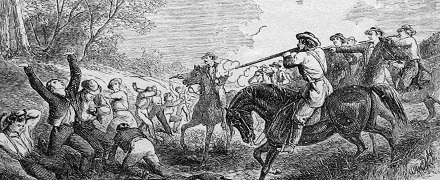

(Via)

Five years later, one of those survivors, William Hairgrove, supplied the identification that damned William Griffith — whose claim that he only helped capture the Marais des Cygnes victims, and didn’t help shoot them was an especially lame offering at the height of the Civil War.

According to Legal Executions in Nebraska, Kansas and Oklahoma Including the Indian Territory: A Comprehensive History, Griffith paid the forfeit for his role in the massacre “in a wood west of [Mound City, Mo.] on the opposite bank of Little Sugar Creek” before a crowd of thousands. There,

[a] little after noon Griffith was conveyed to the wood where he stepped onto the wooden platform a few inches above the ground. His wrists, knees and ankles were bound and the noose was adjusted. The black cap was pulled over his face at 1:07 p.m., and in but a moment William Hairgrove, one of the survivors of the massacre, cut the restraining rope with a hatchet; the four hundred pound weight dropped, jerking Griffith upward. The body rebounded and hung motionless while the attending physicians monitored his vital signs, and in twenty-five minutes they pronounced him dead.

Today, the site of the massacre is a U.S. National Historic Landmark. Quaker abolitionist poet John Greenleaf Whittier also memorialized the blood that was shed there in a poem titled “Le Marais du Cygne”:

A blush as of roses
Where rose never grew!
Great drops on the bunch-grass,
But not of the dew!
A taint in the sweet air
For wild bees to shun!
A stain that shall never
Bleach out in the sun!

Back, steed of the prairies!
Sweet song-bird, fly back!
Wheel hither, bald vulture!
Gray wolf, call thy pack!
The foul human vultures
Have feasted and fled;
The wolves of the Border
Have crept from the dead.

From the hearths of their cabins,
The fields of their corn,
Unwarned and unweaponed,
The victims were torn,—
By the whirlwind of murder
Swooped up and swept on
To the low, reedy fen-lands,
The Marsh of the Swan.

With a vain plea for mercy
No stout knee was crooked;
In the mouths of the rifles
Right manly they looked.
How paled the May sunshine,
O Marais du Cygne!
On death for the strong life,
On red grass for green!

In the homes of their rearing,
Yet warm with their lives,
Ye wait the dead only,
Poor children and wives!
Put out the red forge-fire,
The smith shall not come;
Unyoke the brown oxen,
The ploughman lies dumb.

Wind slow from the Swan’s Marsh,
O dreary death-train,
With pressed lips as bloodless
As lips of the slain!
Kiss down the young eyelids,
Smooth down the gray hairs;
Let tears quench the curses
That burn through your prayers.

Strong man of the prairies,
Mourn bitter and wild!
Wail, desolate woman!
Weep, fatherless child!
But the grain of God springs up
From ashes beneath,
And the crown of his harvest
Is life out of death.

Not in vain on the dial
The shade moves along,
To point the great contrasts
Of right and of wrong:
Free homes and free altars,
Free prairie and flood,—
The reeds of the Swan’s Marsh,
Whose bloom is of blood!

On the lintels of Kansas
That blood shall not dry;
Henceforth the Bad Angel
Shall harmless go by;
Henceforth to the sunset,
Unchecked on her way,
Shall Liberty follow
The march of the day.

On this day..

1859: Thomas Ferguson, but not on a Sunday

The first judicial execution of a white man* in the history of the Utah Territory took place on this date in 1859.

One Thomas Ferguson earned the distinction by getting roaring drunk and shooting dead the shopkeeper who employed and boarded him. Allegedly, Alexander Carpenter’s provocation had been to accuse Ferguson of being party to the unknown burglars who had lately raided his Salt Lake City shop, which obviously got way under Ferguson’s skin.

This was frontier America, being newly-settled by Brigham Young‘s upstart Latter-Day Saints sect, though not only by them. The capital’s population was perhaps 14,000 — the kind of place where dubious refugees could wash up from parts unknown, trusting their fortunes to their native wit and Colt’s Manufacturing Company.

“Crime has run riot in this city since the assassination of McNeill and Sergeant Pike” a hostile, non-Mormon correspondent wrote to the San Francisco Bulletin (letter dated Oct. 5, 1859, and published Oct. 27).

Till lately, no one has been arrested. Ferguson, a “Gentile,” murdered Carpenter, a Mormon, and for such an outrage “this people” will permit the sentence of death to be carried into effect; but the murderers of McNeill, of Pike, of Drown, of Arnold — the first two “Gentiles,” the last “apostates” — run at large to hold the community in terror and carry out other sentences.* An apostate committed suicide a few nights since by shooting himself twice in the back of the head!

Carpenter murdered his partner named Turner near Fort Laramie, Nebraska, brought their goods to this city, where, he said, (and convinced his associates,) he was tried and acquitted. Tried and acquitted in Utah for murder in Nebraska!

Both men were New Yorkers — and per a less strident observer writing to the New York Herald (datelined Oct. 7; published Nov. 7) neither of the two was Mormon. They had been allured to the West by the usual siren songs: wealth, fortune, fame. As young men do, these may have pictured themselves forever getting the drop on their enemies and never the other way around … and always with a dashing jailbreak at the ready if it came to that.

Unfortunately for Ferguson, he wasn’t the only Old West stock character in this tableau; a hanging-judge of dubious character named Charles Sinclair officiated the trial, so deep into his cups that he initially set Ferguson’s execution date for a Sunday. (It was changed to a Friday.) Ferguson himself gave the judge a right scorching from his scaffold rostrum on his way off this mortal coil:

I was tried by the statutes of Utah Territory, which give a man the privilege of being shot, beheaded or hanged. But was it given to me? No, it was not. All Judge Sinclair wanted was to sentence some one to be hanged, then he was willing to leave the Territory; and he had too much whiskey in his head to know the day he sentenced me to be executed on, and would not have known, if it had not been for the people of Utah laughing at him … A nice Judge to send to any country! (Source)

* The Espy file credits earlier executions of Native Americans, two Goshutes named Longhair and Antelope who hanged for slaying two whites during settler bush wars. (I would not venture to assert the judicial propriety, even by antebellum standards, of these proceedings.) And of course, Ferguson’s distinction excludes extrajudicial killings like the Mountain Meadows Massacre.

** The unpunished killings the correspondent names in this piece took place in the immediate aftermath of the 1857-1858 war between Mormon settlers in Utah and the federal government asserting its jurisdiction — a period when Brigham Young’s martial law had just been rescinded. Utah Gentiles inclined to read these incidents as emblematic of a lawless atmosphere in which reluctance to prosecute gave Mormons virtual impunity in their conduct towards the rest of the population.

On this day..

1821: Elizabeth Warriner, Lincoln poisoner

For this just-in-time-for-Halloween wicked stepmother, we are indebted to the highly browsable The Word On The Street, a collection of highlight broadsides held by the National Library of Scotland.

The Last Dying Words, Speech, & Confession of Elizabeth Warriner. Who was Convicted at the last Lincoln Assizes, for the Horrid Murder of her Step-Son, J. Warriner, by poison, and who was Executed at the City of Linclon [sic], on Saturday the 27th of Oct. 1821.

ELIZABETH WARRINER was indicted for the Murder of J. Warriner, her Step-Son, at Surfleet, by administering poison to him. The prisoner was the second wife of a Farmer. The deceased was his Son by a former marriage, about 12 years of age. From the period of her marriage, the prisoner treated the child with great cruelty. On various occasions she was heard to say she would be the death of him. At length on the morning stated in the indictment, the boy, immediately after breakfast, which consisted of bread and milk, was taken ill. Medical aid was called in, but he breathed his last in the course of the day. After she had poisoned the unfortunate boy, she dragged him out of the house, and put him in the stable, and hanged him up, with a rope round his neck, to make people believe he had hung himself, as there was no marks of violence round the neck. The body was opened by a surgeon, when the stomach and intestines were found to exhibit all the appearance of arsenic having been administered. It was afterwards ascertained that a quantity of arsenic was in the possession of the father, who used it for some husbandry purpose, [and to] which the prisoner had access. It further turned out, that a small quantity was found [in t]he basin from which he had eaten his breakfast: and that the prisoner had given him his breakfast in that basin. This circumstance, added to a variety of others, which in the [cou]rse of the examination of the witnesses, seven in numher, came out, led to to the conclu[sion], that the prisoner administered the poison.

Mr. Justice Holroyd summed up tne evidence, and the Jury found her gulity, The [judge] in passing sentence, obserted to the prisoner, that the crime of murder in all cases [was] an heinous one, and in all countries was punished with death; but there were gradations e[ven] in this crime, and her’s [sic] was of the worst nature. She had destroyed her Step-Son; and no other motive could be assigned than that arising from a cruel, hardened, and vicious disposition — her crime was that of muder, the most heinous and cruel. — He hoped she would sincerely repent of her crime, and take all possible care of her soul during the few hours she had to live, so to be reconciled to her offended Maker; he feared she was not so convinced of the necessity of this as she ought to be, but trusted she would seek for that advice which would satisfy her of that necessity, and enable her to meet her future Judge, with a well-rounded hope in his mercy from the sincerity of her contrition; all that remained for him to do was to pass sentence upon her which the law required, which was, that she should be taken from whence she came, and on Saturday the 27th October, 1821, to be taken from thence, to the place of execution, there to be hanged by the neck till she was dead, and that her body should be delivered to the surgeons for dissection — concluding with — “and may the Lord have mercy on your soul.”

The moment she heard that her life was to be forfeited for the barbarous murder, and her cruel treatment to her Step-Son, she jumped up from the floor in the greatest agony, wringing her hands, and other symptoms of distraction.

About ten o’clock on Saturday morning, she ascended the fatal scaffold with a greater degree of fortitude and resignation than could have been expected; and addressed the numerous spectators around her in nearly the following words: “Good people, you see now before you an unfortunate woman, cut off just in the prime of life, and for the most dreadful of al [sic] crimes, Murder! let my dreadful fate be a warning to you not to suffer your passion to work forcibly on your minds, which has been the cause of the melancholy situation in which I am now placed; let me beg your prayers — good people pray for me; O pray for me.”

On the morning of her awful execution, she was dressed all in white, with a child suckling at her breast, which was taken from her by the executioner and her melancholy cries was heard at a great distance. It was shocking to the surrounding multitude.

She then dropped a handkerchief she held in her hand, as a signal, crying, O my Child! my Child! and was immediately launched into a dreadful eternity.

Printed by John Muir, Glasgow.

On this day..

1761: Richard Parrott

(Thanks to Meaghan Good of the Charley Project for the guest post. -ed.)

On this date in 1761, Richard Parrott, a middle-aged man from Harmondsworth, was hanged for the murder of his wife.

According to witness accounts, it all started over “a trifling dispute first arose between the prisoner and the deceased, whether their son or daughter, should go to the field for a cow.”

Parrott later claimed his wife, Anne, had “told a great many lies of him.” The end result was that he beat her and then cut off a large chunk of her tongue. The policeman who responded to the scene later described what he saw in graphic terms:

She lay on the bed, leaning over one side, spitting blood, but could not speak. Her mouth was swelled, and battered in such a manner, there was no such thing as seeing her tongue, She was so swelled and black, she looked like a blackamoor; I should not have known her, though I had known her from a little girl, being born in the same parish.

The assault had knocked out several of Anne’s teeth and badly bruised her. The swelling in her mouth was such that she could eat only broth, and that with great difficulty.

She died a few weeks later.

Before the tragic incident Richard had claimed his wife put “brimstone” in his clothes in an attempt to kill him. To save himself from the supposed brimstone he’d torn off the garments, cut them into pieces and buried them. Witnesses reported he had been “barbarous cruel” to his wife. Anne had told their son he was paranoid and “out of his mind,” and said she was afraid of him.

Nothing was done about it, however, until it was too late.

As the Newgate Ordinary’s account opined,

Nothing but the defence made for the prisoner, viz. Insanity, (supposing it to have a real foundation) can extenuate this horrid and most inhuman fact: nothing but the supposed madness of the perpetrator, can rescue it from being ranked among the most cruel deeds, that ever was perpetrated …

But these circumstances put together don’t remove the probability of the prisoner’s being insane when the fact was done. Subtilty and craft are known to attend this unaccountable distemper, in carrying on any mischief or outrage. The affections are generally inverted; love is turned into hatred, suspicion, jealousy, and rage; and the dearest object of love, is doomed to be the first victim of the perverted passions. The excuse he made when apprehended for this outrage, shews something like this, viz. That she had told lies of him, and he would prevent her doing the like again. Probably he resented her representing and declaring him to be out of his mind, as it appears on the trial she did, when she sent one of her sons for another of them twelve miles, to come and take care of his father, as being in that case. Nothing can provoke a madman more than to be thought or called mad; they are the last, generally speaking, who are sensible of it; and it is the last thing they will acknowledge. Happy had it been for his family, his friends, his neighbours, and parishioners, had they secured and put him under care for this fatal malady; they might have prevented this sad event to the deceased, this reproach to the survivors, who are in any degree blameable for this gross and dangerous neglect.

Found competent to hang by his jury, Parrott “seemed calm, sensible, and resigned” at the Tyburn gallows, where he hanged with three other people: thief Edward Garnet; infanticide Esther Rowden; and a grossly incompetent forger named Donald Campbell who was detected in his craft “by misspelling the names, and the inconsistency of placing 200l. at the top, and writing one hundred pounds in the body of the bill.”

On this day..

1781: Gaspard de Besse, social bandit

The French robber Gaspard de Besse was broken on the wheel in Aix-en-Provence on this date in 1781.

From a cave in the Esterel Mountains looming over the French Riviera, Gaspard raided the ample traffic wealthy merchants sent to and from the Mediterranean and Italy. He established a Robin Hood-esque “social bandit” profile by dint of his targets and populist provocations like, “the two scourges of Provence are the mistral and the parliament!”

Legend holds that he was unfailingly courteous in his raids and never killed those he preyed upon.

No surprise, he did not enjoy a like deference once one of his gang betrayed him. Hopefully amid the limb-shattering blows of the executioner he could console himself with the prospect of posterity’s renown.

On this day..

1668: Two men and a woman, too early for Samuel Pepys

The L.P. Hartley saw about the past as a foreign country might roll a few eyes at the neighborhood history department, but one cannot dispute that the march of time has fundamentally altered many particulars of our everyday life.

Public executions are among the phenomena that ancestor generations once reckoned a routine fixture of the world, but for most of us are little but the stuff of fantastic nightmares. It requires an act of conscious imagination to project oneself into a world where expiring convicts propped up on breaking-wheels are just a part of the scenery — as in this absurd episode from Monty Python and the Holy Grail.

This date’s entry arrives courtesy of the pen of intrepid 17th century English diarist Samuel Pepys, whose faithful daily journals frequently record the public deaths occurring here and there like so many matinees.** Pepys at one level is a very accessible figure as he hustles through bourgeois banalities; that people are strung up and butchered around him and the fact rates nothing but a stray subordinate clause rudely injects that foreign past into his narrative.

On October 23, 1668, Pepys worked the day’s hanging right into an industrious calendar of business and social calls. (He attended Tyburn in the company of a surgeon, which made it a possible business trip for his companion.) Like the rest of us, Pepys wound up so pinched for time that he ran late and ended up missing the execution full stop, but he didn’t let the snafu perturb his day one bit.

Up, and plasterers at work and painters about my house. Commissioner Middleton and I to St. James’s, where with the rest of our company we attended on our usual business the Duke of York. Thence I to White Hall, to my Lord Sandwich’s, where I find my Lord within, but busy, private; and so I staid a little talking with the young gentlemen: and so away with Mr. Pierce, the surgeon, towards Tyburne, to see the people executed; but come too late, it being done; two men and a woman hanged, and so back again and to my coachmaker’s, and there did come a little nearer agreement for the coach, and so to Duck Lane, and there my bookseller’s, and saw his moher, but elle is so big-bellied that elle is not worth seeing. So home, and there all alone to dinner, my wife and W. Hewer being gone to Deptford to see her mother, and so I to the office all the afternoon.

After which Pepys turns as if to the our guilty-pleasure TMZ bookmark, and begins gossiping about the bawdy shenanigans of the royal court.

* Of course, the question depends on place as well as time; public executions are still routine in a few locales today — such as Saudi Arabia and Iran.

** Viz., the regicides as a successful sequel to the Charles I show:

I went out to Charing Cross, to see Major-General Harrison hanged, drawn, and quartered; which was done there, he looking as cheerful as any man could do in that condition … Thus it was my chance to see the King beheaded at White Hall, and to see the first blood shed in revenge for the blood of the King at Charing Cross.

On this day..

1773: Four convict labor escapees in Maryland

We owe this date’s post, as with a number of others on this site, to Anthony Vaver, proprietor of the superb (albeit recently dormant) Early American Crime blog.

Vaver wrote the book on pre-Revolutionary War convict transportation to the Americas, and we were directed to the men featured today in a post Vaver ran on one of the most common resistance strategies — running away.

Being shipped out of Britain to the American colonies where they faced years of involuntary labor and the prospect of being bought and sold like slaves, convicts could hardly fail to ponder the advantages of escape.

Many did more than ponder: colonial newspapers are rife with adverts for absconded convict laborers, whose descriptions of the fugitives also make for a rich source on the everyday accoutrements of the 18th century working class. Pictured here are a very few arbitrarily chosen samples of the genre:

Such self-liberation did not always entail slipping away in an unsupervised moment: more direct means were occasionally employed, a fantasy that many surely entertained counterpoised by the threat of violent state reprisal. The four men who hanged together at Frederick, Maryland, made bold to put the dream into bloody actuality.

These men had been purchased by a merchant specializing in the convict labor trade — part of “a parcel of convicts” as the New York Gazetteer matter-of-factly described it (Aug. 5, 1773) which Archibald Moffman obtained “in order to dispose of them again to advantage.”

Instead it was Moffman who was disposed of. As Moffman and his nonplussed workingman retinue traveled through Maryland,

about two or three miles on the other side of Frederick-Town, one of the servants told his master that he was too much fatigued to go any further; they therefore all rested themselves on an old tree by the side of the main road. After some time, Moffman told them they must proceed on their journey, but they refused and immediately threw him backwards over the tree, dragged him about five steps into the woods, and then cut his throat from ear to ear; took his pocket book and then went over the mountain, calling at every tavern on the road.

But while the proximity of wilderness and the mutability of identity in the 18th century potentially facilitated escape, the colonies’ sparse habitation also made it harder to disappear into the obscurity of plain sight. Maryland was one of the most populous of the New World jurisdictions with barely 200,000 souls in 1770. It wasn’t that everybody knew everybody, but at such scales one could only go so long without engaging by chance the recognition of some acquaintance or busybody.

Seen in this light, the decision of our murderous fellows to call at every tavern on the road looks a mightily ill-considered course of action for men who ought to have felt the scourge of desperation at their backs. At one of these watering-holes, someone who had noticed these convict laborers on the road recently as they accompanied the yet-unkilled Moffman now ran into them sans oversight, and made inquiries — justifiably skeptical of the “parcel’s” story that their owner was following a few leisurely clicks behind. Failing to find Moffman on his way down the road, he sent up an alarm and the cutthroat tipplers were soon detained. Confession, conviction, and execution all followed within a matter of weeks.

The newspaper stories about this quartet do not so much as mention their names.

On this day..

1939: Operation Tannenberg public mass executions begin

This photo (from the German Bundesarchiv) captures an SS execution of Poles in Kornik just weeks into the German occupation of Poland in 1939, fruit of a pre-planned Nazi project to secure the new territory as lebensraum.

Operation Tannenberg (English Wikipedia entry | German | Polish) could be seen as a vanguard for the mind-boggling exterminations to come in subsequent years, cementing the army’s commitment to a campaign that extended well beyond territorial conquest. Alexander Rossino examines this understudied segment of World War II in Hitler Strikes Poland: Blitzkrieg, Ideology, and Atrocity and contends that “the unlimited, almost nihilistic violence of the Wehrmacht” emerges first in these initial weeks of the Polish campaign, which proved a “transitional conflict” pivoting towards the more notorious atrocities to come. “The invasion of Poland thus occupies a crucial place in the history of Nazi Germany’s descent into mass murder and genocide.”

Drawn up by Hitler, Himmler, and Heydrich and officially authorized on August 25, a week before Germany invaded Poland, Tannenberg intended to destroy Poland’s elites — from intelligentsia and nobility down to community priests and teachers, and the politically active across the spectrum from Communist to monarchist. The hope was to leave the subject nation supine, incapable of challenging Berlin’s designs on her future. Estimates I have seen vary widely but tens of thousands of Poles (with a liberal portion of Polish Jews) were shot by SS Einsatzgruppen units under Tannenberg even by the end of 1939, and kilings continued apace thereafter. Though not the literal first Operation Tannenberg Killings, the October 20-23 period marked the first public mass executions; a Polish-language list of the incidents and victims involved is available here.

The very name Tannenberg is a nationalist allusion to Germany’s time-immemorial rivalry with Poland; the original Battle of Tannenberg saw the rising Polish-Lithuanian empire defeat the Teutonic Knights, essentially breaking the latter as a European power. This defeat resonated in 20th century German national mythology not unlike the Battle of Kosovo for Serbia; in 1914, Field Marshal Paul von Hindenburg made himself a household name by smashing the Russians in a battle vaguely in the vicinity, and cannily christened it, too, the Battle of Tannenberg. (The Germans put up a monument to it which they felt obliged to tear down later in the war as they were being driven out of Poland.)

On this day..

1862: Ten Confederate hostages in the Palmyra Massacre

On this date in 1862, Union Gen. John McNeil had ten Confederate soldiers shot in what history has recorded as the Palmyra Massacre.

The Slave Power’s northern salient, Missouri was surrounded to the east, north, and west by free soil — which made it an antebellum flashpoint since the days of the Missouri Compromise.*

In the 1850s, the Missouri conflict spilled into neighboring Kansas as the enemy sides of the slavery question fought to determine whether Kansas would enter the Union as slave state or free. The Missouri borderlands of Bleeding Kansas was where the radical abolitionist martyr John Brown made his name, commanding free state militia in a guerrilla war that presaged the coming clash of North and South.

By the time we lay our scene in 1862, John Brown has exited courtesy of Virginia’s gallows, and the dragon’s teeth sown in Missouri and Kansas and everywhere else had sprung to horrible life. Missouri’s own civil war pitted neighbor against neighbor throughout the state in a bushwhacking conflict that extended locally for many years after Appomattox.**

The nastiness of the years to come is aptly suggested by this date’s events.

Like neighboring Kentucky, Missouri was a border state with a Union government, albeit one contested by a rival Confederate government. From the standpoint of the North, all Confederate activity there was behind its lines and the perpetrators therefore potentially subject to treatment (up to and including execution) as spies, saboteurs, and the like.†

Joseph Chrisman Porter, a Confederate officer, was one such possible client of this here site, tapped as he was for recruiting and raiding operations in northeast Missouri. His Union adversary Gen. John McNeil saw Porter as basically a terrorist. In August of 1862, Porter’s aide Frisby McCullough fell into McNeil’s hands: the Union general had McCullough shot.

On September 12, Porter raided the town of Palmyra, where McNeil held a number of Confederate prisoners. In the course of the raid, he kidnapped Andrew Allsman, a 60-year-old Palmyra resident. “It was said of him that he was able to inform the military authorities of certain movements of the enemy, and that he gave definitive information as to the homes and whereabouts of many men of Confederate leanings,” in the words of this pro-Confederate 1902 pamphlet on the incident. “Naturally, this placed him in disfavor with the Southern sympathizers and those who were fighting in that cause.”

What happened next — though it was not known to the Union at the time — was that Allsman was shot. The pamphlet just cited attempts to obfuscate this event into the fog of war and not really Porter’s fault. The bare fact is that his raiders had gone out of their way to seize an aged non-combatant and then summarily executed him.

Not knowing Allsman’s fate, McNeil responded with an ultimatum to his opposite number.

Palmyra, Mo., Oct. 8, 1862.

To Joseph C. Porter.

Sir: — Andrew Allsman, an aged citizen of Palmyra and a non-combatant, having been carried away from his home by a band of persons unlawfully arraigned against the peace and good order of the State of Missouri, and which band was under your control, this is to notify you that, unless Andrew Allsman is returned unharmed to his family within ten days from date, ten men, who have belonged to your band, and unlawfully sworn by you to carry arms against the government of the United States, and who are now in custody, will be shot as a meet reward for their crimes, amongst which is the illegal restraining of said Allsman of his liberty, and if not returned, of presumptively aiding in his murder. Your prompt attention to this will save much suffering.

Yours, etc.,

W.R. Strachan
Provost Marshal General Northeast District of Missouri
By order of Brigadier General commanding McNeil’s column

The Confederates, of course, could not produce Allsman.

So, on the evening of Oct. 17, five rebel prisoners in the Palmyra stockade plus five more held in Hannibal were informed that they would be shot the next afternoon, in ruthless enforcement of the threat.

The men who died this date in 1862 by a volley of musketry at the Palmyra fairgrounds were:

  • Captain Thomas Sidenor
  • William T. Baker
  • Thomas Humston
  • Morgan Bixler
  • John McPheeters
  • Hiram Smith
  • Herbert Hudson
  • John Wade
  • Marion Lair
  • Eleazer Lake

Their names adorn the base of a monument erected in Palmyra in 1907 commemorating the so-called “Palmyra Massacre”. The state of Missouri as a digital archive of original documents relating to the affair available here.

* Missouri was where the slave Dred Scott lived; his owner taking him to the neighboring free state of Illinois and thence points north occasioned the notorious Supreme Court case that bears his name.

** Frank and Jesse James were Confederate partisans for William Quantrill in the Missouri war; they segued directly into their more celebrated career in outlawry right after the war ended — robbing banks whilst settling scores with pro-Union men for the rest of the 1860s, before branching out to other points on the frontier.

† The Union might obviously have chosen to treat the entire Confederacy as a treasonable enterprise rather than a legitimate enemy belligerent. As a historical matter, it did not take this perspective.

On this day..

1677: John S., William Fletcher, and Robert Perkins

The Confession and Execution of the Three Prisoners suffering at Tyburn on Wednesday the 17th of October, 1677

At the Sessions of Oyer and Terminer for London, and Gaole-delivery of Newgate begun at Justice-Hall in the Old Bayly, 10 Octob. and ending on the 12 of the same Month, there were in all (as by a Printed Narrative you may already have heard) Five persons, who being Convicted on fair Tryals (per Patriam) of several capital Crimes, received Sentence of Death: But Two of them, whose Crime was stealing of two horses, appearing to be objects of mercy, as having never been concern’d in any such offences before, and seeming now extremely penitent for the same, obtained a Gracious Reprieve. The other Three were this present Wednesday 17 Octob. carryed to the place of execution, and by a shameful death surrendered their unhappie lives as Victims duely forfeited to the Justice of the Law.

These were all three old notorious offenders; two of them (taken in Gardiners-lane, Westminster) had long followed the Padd, as they called it, that is, Robbed upon the Highway: The other had made it his trade to break open houses, and pilfer away peoples Goods, being burnt in the hand but two Sessions ago: So that if such Malefactors should have longer been endured, honest Subjects would not be able either to sleep securely in their Dwellings, or travel abroad with safety on their lawful occasions; but both within doors and without, been liable to the spoils and outrages of these barbarous Savages.

To assist these poor wretches for the good of their Souls after the time of their Condemnation, the Sheriffs not onely manifested their pious Charity in sending them able Divines to instruct them, and especially Mr. Ordinary, who very laboriously discharges his weighty office on such occasions, but likewise several godly Ministers of their own accord, in Christian-compassion to their perishing condition, were pleased to visit them. Who laid before them the miserable state they were in; That now their days we [sic] numbered, nay their very hours and minutes which they had to live in this world; and yet these few minutes were all the time and opportunity they had to provide for eternity. That they were doom’d by Justice to a certain death; and though ’twas vain for them to flatter themselves with hopes of longer life in this world, yet there was means left, by a speedy, thorow, sincere and hearty repentance of their sins, and fleeing to Christ for mercy and forgiveness, to secure themselves, by vertue of his merits and righteousness, of a most happy and everlasting life in the world to come. That to such vile and sinful wretches as they had been, it was unspeakable mercy that they had yet a little space left, wherein to make peace with their God: for they might have gone on still in riot and wickedness, and been suddenly snatcht away in the very acts of their impiety Etc. These and many other pressing exhortations, together with severe threatnings to affright them and sweet promises to allure them, taken from the Word of God, were made use of, to bring them to a due sense of their sins, and to cry mightily to God for salvation. But the deaf adder refuses the voice of the charmer, charm he never so wisely All this good seed could take no root, or produce very little visible fruit on the stony ground of two of these Prisoners obdurate hearts; they not seeming (to outward appearance at least) to take that due and sensible notice of this most important counsel, as might be expected from persons in their condition. But the Spirit bloweth where it listeth. The third seemed much affected with this pious advice, and was very earnest and frequent in bewailing his sins, and condemning himself bitterly for having so wickedly mis-spent his precious time heretoforr. He acknowledged to some, that he had several years been a Thief, but not till of late upon the High-way: that at fust his Conscience would after every fact severely check him; but since custom of sinning taking away the sense, he had run on from one degree of wickedness to a greater without controul. He was very frequent in Prayer, wherein he has been heard to express himself to this effect.

Most dreadful and glorious God, though then hatest all the workers of iniquity, yet through the Mediation of they blessed son, with pity behold me a miserable sinner. Had I lived according to thy Commandments, or submitted to the Gospel of thy son, I might approach thee with the confidence of a childe: but I have been a Rebel against thee from my youth up, forgetting the God that made me, and the saviour that redeemed me, quenching and grieving the holy spirit, and slighting the endless Glory which thou hast prepared for me. Oh the precious time which I have lost, which all the world cannot call back; the wonderful love which I unthankfully rejected! How have I lived in continual acts of all kinde of Profaneness, all kind of Debanchery, whoring, swearing, Drunkenness, and especially Theft, which now has brought me to this woful, forlorn, condemned case wherein I am a shame to my friends, and burden to my self; and thou, O God, art my Terrour, who shouldot be my onely Hope and Comfort. Lord, thou knowest my secret sins, which yet are unknown to men, and all their Aggravations. Mine iniquities, Lord, have found me out; my fears and sorrows overwhelm me: a shameful death expects me in this world, and endless torments are ready to receive me in the other. But, Lord! thy Goodness is equal to thy Greatness, thy Mercy over all thy works. Good God, be merciful therefore unto me, the vilest of sinners: save me for thy abundant mercy, for the merit of thy Son, and for the promise of forgiveness which thou hast made through him; for in these alone is all my trust. Thou who didst patiently endure me when I despised thee, Oh do not refuse me now I seek unto thee, and in the dust implore thy mercy. Lord, I ask not for longer life in this world, but for life eternal; not for liberty to sin again, but for deliverance from this sinning nature, and that body of death which overwhelms me. To this purpose Lord give me thy grace to improve these few minutes, and prepare me for death and Judgement; that when I leave this world with Shame, I may be received into glory, and yeeld my departing soul with joy into the faithful hands of my Redeemer. Amen.

He behaved himself very penitently in the Cart, Prayed a considerable time by himself privately at the place of Execution; desired all people to take warning by him to avoid Idleness and Ill Company, which brought him to this Ignominious End. The other joyned in the publick Prayers, but said very little that could be heard. But all of them together suffered very patiently, and with submissive acknowledgements of the Justice of the Sentence.

(Via the invaluable Old Bailey Online)

On this day..