Oliver Cromwell famously called his victory in the last battle of the English Civil War “a crowning mercy” … but it was anything but for royalist nobleman James Stanley, who was beheaded a few weeks afterwards, on this date in 1651.
He had fought the cavalier side in the 1640s and made his name notorious with the storming of Bolton that resulted in the Bolton Massacre. Weeks later, he was present when royalist fortunes went pear-shaped in the north at the Battle of Marston Moor.
Stanley holed up on the Isle of Man after King Charles I lost his head, refusing his enemies’ every blandishment until he could re-enter the field as a commander for Charles II‘s reboot of hostilities.
This also proved a catastrophic failure, and while Charles was able to slip back to continental exile the Lord Derby could not find such obliging oak trees as served his master.*
Though given terms by his captors, a court martial subsequently disallowed such liberality to the butcher of Bolton and condemned him as a traitor.
The parliamentarians would take him back to Bolton to face his punishment; the spot of the beheading is marked by a column in Bolton’s market cross.
Undependable local folklore holds that Lord Derby spent his last night in the ancient (and still-extant) Ye Olde Man and Scythe inn, whose environs exhibit some artifacts of Lord Derby, including a prop severed head.
It’s even said that Stanley’s ghost haunts the pub.
* Stanley was also the Lord of Mann (i.e., of the Isle of Man), and the efforts of Stanley’s wife to negotiate surrender of the royalist island in exchange for her husband’s safety triggered the rebellion of Illiam Dhone.
(Thanks to friend of the blog Sonechka for research, translation, and background information touching this post. -ed.)
October 14 (October 1 O.S.) is a liturgical feast celebrating the protective intercession of the Virgin Mary, a date of particular significance in Russia and Ukraine. Indeed, Red Square’s St. Basil’s Cathedral is actually the Cathedral of the Intercession of the Most Holy Theotokos [i.e., Mary] on the Moat, just one of many Orthodox churches so named.
Also known as Pokrov — a quaint Slavic term for covering, denoting safeguarding — the holiday celebrates an incident from 10th century Byzantium when a saint beheld Mary descend through the dome of the church, then spread her garment protectively over the entire congregation.
It is of special significance in Ukraine where the ecclesiastical celebration pulls double duty as the Day of the Ukrainian Cossacks. And it is in honor of Pokrov that we dedicate this post.
17th century icon of the Madonna’s broad cloak protecting Ukrainians.
On an unspecified date in 1638, a Cossack named Ostryanin was broken on the wheel in Warsaw … maybe.
The Ostryanin Uprising of 1638 was one of the ongoing cycle of Cossack disturbances in the southern reaches of the Polish-Lithuanian Empire — modern-day Ukraine. Like many of these, it was a short-lived affair considered on its own, but the pattern of disaffected Cossacks struggling against the Polish crown for some combination of recognition, largesse, and autonomy was an ongoing pattern in the 17th century — and by the 1650s it would begin tearing apart the formerly mighty Polish-Lithuanian realm and transferring Ukrainian territory from Polish to Russian domination.
Tradition held that after the rising was stamped out in the summer of 1638, Stepan Ostryanin himself was treacherously seized and taken to Warsaw for execution. A late 18th century chronicle* of a distinctly patriotic bent called Istoriya Russov embroiders upon that death by breaking-wheel with racist gusto:
in accord with their treachery, insidious and duplicitous, having learned through their Jew spies that hetman Ostryanin’s would travel unguarded … the Lyakhs [term for “Poles”; it’s derogatory in present-day Russian but may have been less so at the time -ed.] surrounded him in Kanev monastery with a host of men. They, having tied the hetman and his men, altogether thirty seven people, … prepared an execution for them in Warsaw unprecedented in its cruelty, which posterity will scarcely believe to be true, because it would not occur to even the most barbarous and ferocious Japanese (!) and the reality of which would terrify the very beasts and monsters.
On the other hand, a Cossack named Yakiv Ostryanin was to be found on Russian soil in the subsequent years, until he was murdered in 1641. Some historians think that he was the very same namesake Cossack rebel escaped from Polish vengeance, and the story about him being broken on the wheel in Poland is pure sentimental folklore; alternatively, Stepan and Yakiv might have just been two different Cossacks named Ostryanin who met two different fates.
Quite a difference for our supposed Stepan Ostryanin, but a minor mystery from this distance in time. Nevertheless, our man, whoever he was, had a posthumous contribution yet to make to the letters of his Slavic brethren.
Polish historian Szymon Okolski rode along with the Polish commander Mikolaj Potocki in Potocki’s successful campaign of the spring-summer 1638 to suppress this rebellion. Okolski’s field diaries of the campaign are a key historical source on the Cossacks and are thought to have been used extensively by the Cossack-descended writer Nikolai Gogol in composing his short story Taras Bulba.
A product of Gogol’s youth, Taras Bulba has a rough romanticism — and a romanticism for the Cossack (read: national Ukrainian) cause specifically that nonplussed Russian authorities at the time. (And probably now, too.)
Taras Bulba‘s title character is a mature Cossack patriot who with his two sons joins the Cossack risings against Poland. Its location in time is indeterminate, not unlike the unending cycle of risings themselves. Taras Bulba is a nearly eternal character, almost a fixture of nature, because his war seemed eternal too.
And of course it contains some cracking execution scenes. The execution by breaking-wheel of Taras Bulba’s son might havebeen inspired by the Istoriya Russov‘s outraged account of that full Japanese barbarism. The excerpt below hails from this public-domain English translation.
Ostap had been seized and bound before his very eyes, and that he was now in the hands of the Lyakhs. Grief overpowered him. He pulled off and tore in pieces the bandages from his wounds, and threw them far from him; he tried to say something, but only articulated some incoherent words. Fever and delirium seized upon him afresh, and he uttered wild and incoherent speeches. Meanwhile his faithful comrade stood beside him, scolding and showering harsh, reproachful words upon him without stint. Finally, he seized him by the arms and legs, wrapped him up like a child, arranged all his bandages, rolled him in an ox-hide, bound him with bast, and, fastening him with ropes to his saddle, rode with him again at full speed along the road.
“I’ll get you there, even if it be not alive! I will not abandon your body for the Lyakhs to make merry over you, and cut your body in twain and fling it into the water. Let the eagle tear out your eyes if it must be so; but let it be our eagle of the steppe and not a Polish eagle, not one which has flown hither from Polish soil. I will bring you, though it be a corpse, to the Ukraine!”
Thus spoke his faithful companion. He rode without drawing rein, day and night, and brought Taras still insensible into the Zaporozhian Setch itself. There he undertook to cure him, with unswerving care, by the aid of herbs and liniments. He sought out a skilled Jewess, who made Taras drink various potions for a whole month, and at length he improved. Whether it was owing to the medicine or to his iron constitution gaining the upper hand, at all events, in six weeks he was on his feet. His wounds had closed, and only the scars of the sabre-cuts showed how deeply injured the old Cossack had been. But he was markedly sad and morose. Three deep wrinkles engraved themselves upon his brow and never more departed thence. Then he looked around him. All was new in the Setch; all his old companions were dead. Not one was left of those who had stood up for the right, for faith and brotherhood. And those who had gone forth with the Koschevoi in pursuit of the Tatars, they also had long since disappeared. All had perished. One had lost his head in battle; another had died for lack of food, amid the salt marshes of the Crimea; another had fallen in captivity and been unable to survive the disgrace. Their former Koschevoi was no longer living, nor any of his old companions, and the grass was growing over those once alert with power. He felt as one who had given a feast, a great noisy feast. All the dishes had been smashed in pieces; not a drop of wine was left anywhere; the guests and servants had all stolen valuable cups and platters; and he, like the master of the house, stood sadly thinking that it would have been no feast. In vain did they try to cheer Taras and to divert his mind; in vain did the long-bearded, grey-haired guitar-players come by twos and threes to glorify his Cossack deeds. He gazed grimly and indifferently at everything, with inappeasable grief printed on his stolid face; and said softly, as he drooped his head, “My son, my Ostap!”
…
The square on which the execution was to take place was not hard to find: for the people were thronging thither from all quarters. In that savage age such a thing constituted one of the most noteworthy spectacles, not only for the common people, but among the higher classes. A number of the most pious old men, a throng of young girls, and the most cowardly women, who dreamed the whole night afterwards of their bloody corpses, and shrieked as loudly in their sleep as a drunken hussar, missed, nevertheless, no opportunity of gratifying their curiosity. “Ah, what tortures!” many of them would cry, hysterically, covering their eyes and turning away; but they stood their ground for a good while, all the same. Many a one, with gaping mouth and outstretched hands, would have liked to jump upon other folk’s heads, to get a better view. Above the crowd towered a bulky butcher, admiring the whole process with the air of a connoisseur, and exchanging brief remarks with a gunsmith, whom he addressed as “Gossip,” because he got drunk in the same alehouse with him on holidays. Some entered into warm discussions, others even laid wagers. But the majority were of the species who, all the world over, look on at the world and at everything that goes on in it and merely scratch their noses. In the front ranks, close to the bearded civic-guards, stood a young noble, in warlike array, who had certainly put his whole wardrobe on his back, leaving only his torn shirt and old shoes at his quarters. Two chains, one above the other, hung around his neck. He stood beside his mistress, Usisya, and glanced about incessantly to see that no one soiled her silk gown. He explained everything to her so perfectly that no one could have added a word. “All these people whom you see, my dear Usisya,” he said, “have come to see the criminals executed; and that man, my love, yonder, holding the axe and other instruments in his hands, is the executioner, who will despatch them. When he begins to break them on the wheel, and torture them in other ways, the criminals will still be alive; but when he cuts off their heads, then, my love, they will die at once. Before that, they will cry and move; but as soon as their heads are cut off, it will be impossible for them to cry, or to eat or drink, because, my dear, they will no longer have any head.” Usisya listened to all this with terror and curiosity.
The upper stories of the houses were filled with people. From the windows in the roof peered strange faces with beards and something resembling caps. Upon the balconies, beneath shady awnings, sat the aristocracy. The hands of smiling young ladies, brilliant as white sugar, rested on the railings. Portly nobles looked on with dignity. Servants in rich garb, with flowing sleeves, handed round various refreshments. Sometimes a black-eyed young rogue would take her cake or fruit and fling it among the crowd with her own noble little hand. The crowd of hungry gentles held up their caps to receive it; and some tall noble, whose head rose amid the throng, with his faded red jacket and discoloured gold braid, and who was the first to catch it with the aid of his long arms, would kiss his booty, press it to his heart, and finally put it in his mouth. The hawk, suspended beneath the balcony in a golden cage, was also a spectator; with beak inclined to one side, and with one foot raised, he, too, watched the people attentively. But suddenly a murmur ran through the crowd, and a rumour spread, “They are coming! they are coming! the Cossacks!”
They were bare-headed, with their long locks floating in the air. Their beards had grown, and their once handsome garments were worn out, and hung about them in tatters. They walked neither timidly nor surlily, but with a certain pride, neither looking at nor bowing to the people. At the head of all came Ostap.
What were old Taras’s feelings when thus he beheld his Ostap? What filled his heart then? He gazed at him from amid the crowd, and lost not a single movement of his. They reached the place of execution. Ostap stopped. He was to be the first to drink the bitter cup. He glanced at his comrades, raised his hand, and said in a loud voice: “God grant that none of the heretics who stand here may hear, the unclean dogs, how Christians suffer! Let none of us utter a single word.” After this he ascended the scaffold.
“Well done, son! well done!” said Bulba, softly, and bent his grey head.
The executioner tore off his old rags; they fastened his hands and feet in stocks prepared expressly, and—We will not pain the reader with a picture of the hellish tortures which would make his hair rise upright on his head. They were the outcome of that coarse, wild age, when men still led a life of warfare which hardened their souls until no sense of humanity was left in them. In vain did some, not many, in that age make a stand against such terrible measures. In vain did the king and many nobles, enlightened in mind and spirit, demonstrate that such severity of punishment could but fan the flame of vengeance in the Cossack nation. But the power of the king, and the opinion of the wise, was as nothing before the savage will of the magnates of the kingdom, who, by their thoughtlessness and unconquerable lack of all far-sighted policy, their childish self-love and miserable pride, converted the Diet into the mockery of a government. Ostap endured the torture like a giant. Not a cry, not a groan, was heard. Even when they began to break the bones in his hands and feet, when, amid the death-like stillness of the crowd, the horrible cracking was audible to the most distant spectators; when even his tormentors turned aside their eyes, nothing like a groan escaped his lips, nor did his face quiver. Taras stood in the crowd with bowed head; and, raising his eyes proudly at that moment, he said, approvingly, “Well done, boy! well done!”
But when they took him to the last deadly tortures, it seemed as though his strength were failing. He cast his eyes around.
O God! all strangers, all unknown faces! If only some of his relatives had been present at his death! He would not have cared to hear the sobs and anguish of his poor, weak mother, nor the unreasoning cries of a wife, tearing her hair and beating her white breast; but he would have liked to see a strong man who might refresh him with a word of wisdom, and cheer his end. And his strength failed him, and he cried in the weakness of his soul, “Father! where are you? do you hear?”
“I hear!” rang through the universal silence, and those thousands of people shuddered in concert. A detachment of cavalry hastened to search through the throng of people. Yankel turned pale as death, and when the horsemen had got within a short distance of him, turned round in terror to look for Taras; but Taras was no longer beside him; every trace of him was lost.
Despite his cunning escape on this occasion, Taras Bulba himself is also in the end put to death: the story ends with him going to the stake as his soul summons the brethren he can still see in the distance to resume the fight, again and again.
[A] band of Lyakhs suddenly rushed up, and seized him by the shoulders. He struggled with all might; but he could not scatter on the earth, as he had been wont to do, the heydukes who had seized him. “Oh, old age, old age!” he exclaimed: and the stout old Cossack wept. But his age was not to blame: nearly thirty men were clinging to his arms and legs.
“The raven is caught!” yelled the Lyakhs. “We must think how we can show him the most honour, the dog!” They decided, with the permission of the hetman, to burn him alive in the sight of all. There stood hard by a leafless tree, the summit of which had been struck by lightning. They fastened him with iron chains and nails driven through his hands high up on the trunk of the tree, so that he might be seen from all sides; and began at once to place fagots at its foot. But Taras did not look at the wood, nor did he think of the fire with which they were preparing to roast him: he gazed anxiously in the direction whence his Cossacks were firing. From his high point of observation he could see everything as in the palm of his hand.
…
“Farewell, comrades!” he shouted to them from above; “remember me, and come hither again next spring and make merry in the same fashion! What! cursed Lyakhs, have ye caught me? Think ye there is anything in the world that a Cossack fears? Wait; the time will come when ye shall learn what the orthodox Russian faith is! Already the people scent it far and near. A czar shall arise from Russian soil, and there shall not be a power in the world which shall not submit to him!” But fire had already risen from the fagots; it lapped his feet, and the flame spread to the tree…. But can any fire, flames, or power be found on earth which are capable of overpowering Russian strength?
Broad is the river Dniester, and in it are many deep pools, dense reed-beds, clear shallows and little bays; its watery mirror gleams, filled with the melodious plaint of the swan, the proud wild goose glides swiftly over it; and snipe, red-throated ruffs, and other birds are to be found among the reeds and along the banks. The Cossacks rowed swiftly on in the narrow double-ruddered boats—rowed stoutly, carefully shunning the sand bars, and cleaving the ranks of the birds, which took wing—rowed, and talked of their hetman.
* The Istoriya Russov had a great influence on young writers in the early 19th century. The text can be read as advancing a nationalism of all the Russias, or as speaking in a more specifically Ukrainian voice. See The Cossack Myth: History and Nationhood in the Age of Empires.
October 12, 1781 saw the hanging at Saint Michael’s Hill in Bristol of Benjamin Loveday and John Burke — “for the detestable Crime of Sodomy; they were both capitally convicted on the clearest Evidence, which is shocking to Human Nature to describe.”
The newspaper reporting, both slight and heartbreaking, can be perused at the website of gay history expert Rictor Norton, here. Between the lines, it suggests Loveday as the proprietor of a molly house or something very like it — an establishment catering to the underground market in same-sex desire, the like of which periodically surfaced in moral panic episodes in the 1700s and early 1800s. (See Norton’s topical Mother Claps Molly House: Gay Subculture in England 1700-1830.)
Loveday, “about 41 years of age … was formerly waiter at a principal inn in Bristol, but had lately kept a public-house in Tower Lane.” The younger Burke “had acted as a midshipman in the impress service, and he was the unlucky one. Three other men, Joseph Giles, James Lane, and William Ward, also faced potentially lethal charges of committing sodomy with Loveday at the same assizes; Giles and Lane got off with misdemeanor convictions and Ward was acquitted outright.
About Twelve o’Clock they were brought out of Newgate, and being placed in a Cart, moved in slow Procession to the fatal Tree, preceded by the Under-Sheriff on Horse-back, and other proper Offices; and attended in a Chariot by the Rev. Mr. Easterbrooke and two other Clergymen, who have frequently visited them since their Conviction, and earnestly laboured to bring them to a due Sense of their Crime, and a Confession of their Guilt. To and at the Place of Execution, their Behaviour was decent, and becoming their awful Situation; and though their Convicted was founded on clear and positive Evidence, yet with their last Breath, they both, in the most solemn Manner, protested their Innocence respecting the Crime for which they were doomed to suffer; but at the same Time acknowledged themselves to have been guilty of many heinous Offences. (Oxford Journal, Oct. 20, 1781)
On this date* in 1689, Fyodor Shaklovity was beheaded in Russia: a signal of the transfer of imperial power just days before to the young Peter the Great.
A commoner who rose to the apex of political power — or at least its orbit — Shaklovity (English Wikipedia entry | Russian) was the “second favorite”** of Sophia Alekseyevna during her run as the Russian regent in the 1680s.
She was able to occupy this position because the last tsar had died without issue in 1682. The result was a shaky power-share split between two male tsars who could not rule: Ivan, who was mentally disabled, and Peter, who was 10 years old.
But the problem with 10-year-olds is that, seven years later, they become 17-year-olds.
By 1689, Peter was chafing at his sister’s power. As the regent, how much longer could she expect to rule the tsar now that he was no longer a boy?
A disturbance on the night of August 7, 1689 brought the matter to a head. Moscow’s Streltsy, a body of soldiers who had murderously run amok in the Kremlin in 1682, paraded or demonstrated near the Kremlin.
Shaklovity would claim that this was nothing but a bodyguard for the routine procession of Sophia, but Peter — either actually alarmed or simulating it — bolted to the Trinity Monastery of St. Sergius north of Moscow and “immediately threw himself upon a bed and fell a weeping bitterly.”†
Peter accused Shaklovity of attempting to incite another Streltsy rising to win power for Sophia, and maybe that’s exactly what happened. But it might also have been the case that Peter’s party cynically engineered the crisis to force a confrontation.
In either event, the two rivals were now holed up in their respective compounds (Sophia’s was the Kremlin). The standoff never came to blows, for it soon demonstrated that Sophia’s support was distinctly inferior to Peter’s, to whom the legitimate government apparatus increasingly gravitated.‡ Muscovite soldiers, foreign diplomats, and even the Streltsy began abandoning Moscow for Peter’s monastery.
Sophia’s regency ended in September, and the proof of her capitulation was acceding to Peter’s demand that she hand over the “blatant criminal” Shaklovity for condign punishment as a failed regicide. Despite the late hour (10 p.m.), a vast concourse of commoners and elites alike saw Shaklovity’s head axed off by torchlight on the main road near the Trinity-St. Sergius monastery.
† Hughes, op. cit., quoting the diaries of the fascinating Scottish general Patrick Gordon, whose loyalty to Peter in 1689 helped to decide the conflict.
‡ The disastrous Russian performance in Crimean campaigns launched by Sophia did the regent no favors.
If the execution of the “Fourteen of Meaux” falls far short of the massacre of the Vaudois as regards the number of its victims, its strictly judicial character makes it more instructive as an example of the treatment of heretics.
In the year 1546 the Reformers of Meaux organised themselves into a Church after the pattern of that set up by the French refugees at Strassburg eight years before. They chose as their first pastor, a wool-carder, named Pierre Leclerc, a brother of the man who was burnt at Metz.
Their number increased under his ministry, and the matter soon came to the ear of the authorities. On September 8 a sudden descent was made on the congregation, and sixty persons were arrested and sent to Paris to be tried by the Parliament. Their greatest crime was that they had celebrated the Holy Communion.
On October 4 sentence was pronounced. Fourteen were sentenced to be tortured and burned, five to be flogged and banished; ten, all women, were set free, while the remainder were to undergo graduated forms of penance. The sentences were carried out at Meaux on October 7.*
Etienne Mangin, in whose house the services had always been held, and Leclerc, were carried to the stake on hurdles, the rest on tumbrils. They had all previously undergone what was known as “extraordinary” torture, and all had refused to reveal the names of other Reformers at Meaux. At the stake six yielded so far as to confess to a priest, thereby escaping the penalty of having their tongues cut out; the others who remained firm suffered this additional barbarity, which it was the custom to inflict on those who died impenitent. The congregation at Meaux was thus broken up, but the survivors carried the evangelical seeds to other towns in France.
The “Fourteen of Meaux” were not the only victims of the year 1546. Five others had already been burned at Paris, including the scholar and printer Etienne Dolet. Others were burned in the provinces. The next year, 1547, opened with fresh executions; and on January 14 the mutilation of a statue of the Virgin was expiated by a solemn procession at Paris.
Such was the policy which Francis I began definitely to adopt towards Protestantism after the affair of the placards, and which he put into active execution during the last seven years of his life. How far was it successful? As we have seen, it drove a large number of persons into exile; and these consisted chiefly of the better-born and better-educated among the Reformers.
It intimidated many into outward conformity with the Church. It prevented all public exercise of the Reformed religion, and all open propaganda. Religious meetings were held by night or in cellars; doctrines were spread by secret house-to-house teaching, or by treatises concealed amongst the wares of pretended pedlars.
On the other hand the frequent executions helped to spread the evil they were meant to repress. The firm courage with which the victims faced death did as much as the purity of their lives to convert others to their faith. Moreover, the influence of the exiles reacted on their old homes. From Geneva to the other Swiss centres of Protestantism missionaries came to evangelise France.
* There are some sources that aver Oct. 6, and it appears that the primary documents are not explicit on the exact date of execution. This Proceedings of the Huguenot Society collects a great deal of information about the Fourteen of Meaux and settles on Thursday, Oct. 7 (see fn 54, page 101 and fn 64, page 103) — in part because the Parlement also demanded that the heretical house be razed, with Catholic services to be held there every Thursday.
On this date in 1573, Antwerp burned a clutch of Anabaptists, including the martr Maeykens Wens.
Thereupon on the next day, which was the 6th of October, this pious and God-fearing heroine of Jesus Christ, as also her other fellow believers, who in like manner had been condemned, were with their tongues screwed fast, like innocent sheep brought forward, and after each was tied to a stake in the market place, were robbed of life and body by a dreadful and horrible fire, and in a short time were burned to ashes. The oldest son of this aforementioned martyr, called Adrian Wens, about fifteen yars old, upon the day on which his dear mother was sacrificed, could not stay away from the place of execution, so he took his youngest brother, called Hans Matthias Wens, about three years old, on his arm, and stood on a bench not far from the burning-stake to witness his mother’s death. But when she was brought to the stake he fainted, fell down, and lay unconscious until his mother and the others were burned. Afterward, when the people had gone away and he came to himself, he went to the place where his mother was burnt, and hunted in the ashes until he found the screw with which her tongue had been screwed fast, and he kept it for a memento. There are now, 1659, still many descendants of this pious martyr living well known to us, who, after her name, are called Maeyken Wens.
On this date in 1736, a Jewish gangster named Herry Moses was hanged as a highwayman at Vlaardingen, Netherlands.
Our source for Moses is Florike Egmond’s “Crime in Context: Jewish Involvement in Organized Crime in the Dutch Republic” from Jewish History, vol. 4, no. 1 (Spring 1989) — for whom Moses forms an window into the criminal life of Netherlands Jews. According to Egmond, Moses hailed from Frankfurt am Main, then an imperial Free City. He had no property or station, and spent the first decades of his life as a wandering beggar, a tinker, and one might guess a petty thief where the opportunity arose.
By 1723, when Moses was around 37 years old, he had washed up in the Dutch Republic — one of many Jews who had migrated to that more tolerant climate from Germany and points east.
In the Low Countries, these arrivistes filled many niches but one of the most noticeable was a burgeoning network of Jewish criminal gangs; per Egmond, in this period “between one-half and two-thirds of all Ashkenazim convicted of burglaries, theft, or robberies had been born outside the Dutch Republic.” The documentary record is far from thorough, but court cases suggest to Egmond the emergence of a small Jewish underground in the mid-17th century following the Thirty Years War, which was bolstered by subsequent immigration waves.
Jews filled plenty of more legitimate places too, of course — and we notice how diligently free of moral panic is the court that handles this minority outlaw. But the Dutch Republic endured in this period the decline of her former trading preeminence, and for the glut of new arrivals — who were sometimes legislated out of certain protected economic spheres — less legitimate occupations could not help but appeal.
Jewish gangs were accordingly quite prominent among the robbers and cutthroats prowling the roads; among other things, they were noteworthy for their willingness to raid churches, which Christian gangs tended to shy from attacking.
Similar “names, geographical background, occupation, travels, meeting places, and variable associations” populate the identifiable records of Jewish criminals, in Egmond’s words. They “were Ashkenazim, most of them poor, and a large majority were first-generation immigrants from Eastern and Central Europe.” Just as with Herry Moses.
So far as I have been able to tell, the annals do not supply us with the why in his strange story … which only deepens the intrigue of the what. Egmond:
In 1735 Herry Moses, alias Abraham Mordechai or Hessel Markus, confessed to a crime he did not commit. According to his version of the story, he murdered a Roman Catholic priest in his house in the Dutch town of Weesp and robbed him of aboug 3,000 guilders. The murder and theft were real enough, and a less scrupulous court than the schepenbank of Weesp (a high jurisdiction some twenty kilometers east of Amsterdam) might have sentenced Herry Moses to death on the strength of his confession alone. Adhering strictly to criminal procedure and confronted with some slight inconsistencies in Moses’ confession, the court tried to obtain more information. Could Moses have murdered the priest, as he declared, when standing behind the bedstead? (There was no room for a man to stand there.) Was he lying when he denounced several Jews and a Christian as his accomplices in both the murder and a burglary at The Hague? His descriptions proved accurate enough to track down some of these men and arrest them in different parts of the Netherlands, but they denied any involvement in the crimes and told the court that they did not even know their accuser. They were eventually released.
Herry Moses was interrogated a number of times during 1734 and most of 1735. Lengthy questioning yielded more detail and added more inconsistencies, but Moses continued to stand by his confession. The court, by now convinced of his innocence, saw no other solution than to torture him — not to obtain a confession but to have him retract it. Moses still did not oblige. The case was subsequently sent to a higher court (the Hof van Holland), which shared the doubts of the local court. Finally, at the end of 1735, Herry Moses was sentenced to whipping, branding, and banishment for life from the provinces of Holland and Zeeland, on account of his false accusations and his contempt for justice in general. Shortly before Herry’s sentencing — after he had been in prison for well over a year — the priest’s housekeeper and her husband confessed to having murdered the priest as well as the woman’s first husband. Both of them were sentenced to death.
As could be expected, Herry disappeared from sight after receiving his sentence, until September 1736, when he again stood trial in a Dutch criminal court. This time, there was no doubt about the indictment or the evidence. Passersby had caught him and his two accomplices in the act of attempting to strangle and rob a woman on a country road near Rotterdam. They arrived in time to save the woman’s life. Herry Moses was sentenced to death, and on 5 October 1736 was hanged at Vlaardingen.
Gentleman highwayman James MacLaine hanged at Tyburn on this date in 1750.
The debauched son of a Presbyterian minister, MacLaine wasted first an inheritance and later a dowry on expensive clothes, gambling, and ladies of easy virtue; want, however, was his ticket to the immortality of the gallows when he joined fellow penniless gentleman William Plunkett to seek his revenue on the roads. (Inspiring the 1999 film Plunkett & Macleane — which uses one of several alternate spellings available for our man’s surname.)
For several months in 1749-1750 they prowled the environs of a lawless London, and notably Hyde Park, with the exaggerated courtesy demanded by romance of their profession. They found noteworthy prey: once, they stole a blunderbuss from the Earl of Eglington, though Eglington survived to suffer a noteworthy murder years later; in November 1749, they robbed M.P. Horace Walpole, even skimming his face with a pistol-ball that was inches wide from depriving posterity of the gothic novel.*
When caught** by mischance, the mannered† Maclaine became the object of public celebration, much to the bemusement of Walpole — who professed no ill will for his assailant but wondered that “there are as many prints and pamphlets about him as about the earthquake.”
Three thousand people are reported to have turned up on a sweltering summer Sunday to pay their admiration to the rogue, not excluding the very cream of society. Walpole teased his friends, court beauty Lady Caroline Fitzroy (wife of the Earl of Harrington) and her sidekick Miss Elizabeth Ashe, for presenting themselves among these masses to starfuck this latter-day Duval. “I call them Polly and Lucy,” he wrote, alluding to female conquests of the outlaw Macheath in The Beggar’s Opera, “and asked them if he did not sing,”
Maclaine did not have to borrow Macheath’s ballads, for he was celebrated with verse dedicated all to him — like this “Jemmie Maclaine”, to the tune of Derry Down:
Ye Smarts and ye Jemmies, ye Ramillie Beaux,
With golden cocked hats, and with silver laced clothes,
Who by wit and invention your pockets maintain,
Come pity the fate of poor Jemmy Maclaine,
Derry down derry, etc.
He robb’d folks genteely, he robb’d with an air,
He robb’d them so well that he always took care
My lord was not hurt and my Lady not frighted,
And instead of being hanged he deserved to be knighted!
* Walpole once remarked of the ubiquity of violent crime in London that “one is forced to travel, even at noon, as if one was going to battle.”
** Plunkett was never apprehended; it’s alleged that he ultimately escaped to North America.
† Although our man “has been called the gentleman highwayman,” the player-hating Ordinary of Newgate wrote, “and his dress and equipage very much affected the fine gentleman, yet to a man acquainted with good breeding, that can distinguish it from impudence and affectation, there was little in his address or behaviour, that could entitle him to that character.”
On this date in 1850, Henry Leander Foote was hanged in Connecticut.
Foote was an educated man who used his time languishing in jail — there was nearly a full year between his conviction and his execution — to bestow upon the world an autobiographical narrative of his peregrinations, which the reader can peruse in its entirety at the bottom of this post. Affected with wanderlust, he struck out from home as a teenager and began a rambling career that would take him all over America.
One of his first stops was the bustling and burgeoning metropolis that will become the hub of his narrative and, as Foote conceived it, the source of his ruin — New York city. There he was introduced to the city’s vast sexual marketplace.
At the end of two or three weeks, I found myself in the city of New York. What a place for a stranger, a young man of seventeen or eighteen years of age to visit alone, without any guardian to conduct him or advise him, and warn him against evil company! I had no acquaintances except three or four young men, whom I met on board the boat, who were also from Connecticut. They were in company, all belonging to one town, and then invited me to stop at the same public house with them. I had been informed that one of them was the son of a minister of the gospel, consequently I concluded that the company was good and safe to be with. But I found, to my astonishment, that this young man was the ring leader, the rudest and wildest of the crowd. The first night I was led to the Theater, from there to the brothel, and from there to the gambling house and drinking saloon. Here we must be fashionable and have a game of cards and a bottle or two of champane. [sic] … We played and drank till sometime past midnight, when we concluded it was time to retire.
Foote is coy here and suggests that his virginal young self repelled the subsequent invitation to a brothel. Whether or not this is so, he soon became by furtive subsequent visits whose purpose he was careful to conceal from his family an intimate of the city’s many whores.
These youthsome frolics are only foreshadowing for the excuses that Foote would be obliged to make many years later in the pall of the gallows. He spent the 1830s and 1840s bouncing around the growing republic — upstate New York, westward to Cleveland and St. Louis, south to Charleston where he married but lost his wife within a year to childbirth. (The son died, too.) After that, he enlisted in the cavalry and fought in the Seminole Wars.
Foote does not give us much of his sexual adventures on these trips, but between the lines it appears that the concupiscient fornicator and the New England prude ever travel side by side with him. He ships to Rio de Janeiro and does not fail to notice that “the dress of most of the women was not much better than none, being merely a short gown, all open in the neck and breast, and reaching only half way to the knee, fastened round the waist with a belt. They would make any civilized man blush from head to foot, but they were not at all particular as to what position they happened to be in.” Nevertheless, he affects shock when “a mixed-blood, half Spanish and half Indian publican” offers him a girl for the night. (According to Foote, he did not take the girl.)
As for the army, well, it “is a most dangerous and destructive place to the morals of young men. It is a school of intemperance, profanity, licentiousness, obscene language, filthy communications, and all kinds of vile and lewd company” thanks to the degrading example of officers who “when at home, or where they are known, always assume the character of gentlemen, and presume to walk in respectable society, unite with the ‘upper ten,’ and [associate] with virtuous females, who, if they knew their true character, would turn from them with disgust.”
By 1849 we find the peripatetic Foote back in his native hamlet of Northford, Connecticut, 37 years old and again, or still, preoccupying himself with the diversions of the Tenderloin. To the best of my knowledge he is the subject of no biography save his own, and since we find that the diverse sojourns of the previous 20 years have ultimately changed neither his conduct nor even his locale, we might be excused for speculating how many adventures were contrived by the author’s hand.
Wherever it was that he had been, he was becoming a worldly denizen of the bagnio.
A few months before the murder, I spent one week in the city of crime and pollution, viz., New York. As usual on former occasions, I spent my evenings and nights in a theater, gambling house, or brothel. Also on a former visit I had attended an exhibition of nudes, or model artists, as they are termed. But at this time the company had gone to New Orleans; a few of them, however, remained in New York, with one of which I had the misfortune to become acquainted. She was an arrogant prostitute, residing in a house of the higher class. I found her at the Bowery Theater; she enticed me, and I consented to accompany her home. As we entered her room she locked the door, laid aside her upper garments, and invited me to take a glass of wine with her. She poured out two glasses, and took a phial from the drawer of her toilet, drew the cork, and pretended to drop some of the contents in her glass of wine, but not a drop did she let fall. She said it was Cream of the Valley, it would give the wine a delightful flavor, and then made a motion to drop some into my glass. But I was too wide awake for her. I knew it was some drug that might upset my ideas, so I told her to save her cream, I did not need any cream of that sort. She looked at me, and said, “you are not so green as you pretend. I gues syou understand a game or two.” I replied, “I understand enough to know the nature of your cream.” And said I, “what was your object in giving it to me?” “O,” she replied, “I was only going to give you a drop or two, to make you feel keen.” She was very proud of her perfect symmetry of form, and proceeded to make a model artist of herself again, that she might give me a clear view of her model, and also of the extra manoeuvres which she had learned in the model artist plays.
After passing the night with his model artist’s “extra manoeuvres,” Foote pinched the potion for himself thinking to deploy it for his own benefit. He first called on a prostitute who had previously robbed him, engaged her charms for the night, and administered the drug to her, thereby having leisure to rob back the lost funds (“with interest,” Foote admits) as well as to leave behind a taunting note. He also found that she, too, possessed a dose of this potent Cream of the Valley, and duly replenished his supply.
Our dissolute principal was much given to exploiting his moment of notoriety for moral grandstanding, and we again should treat his account with caution.* Another author who visited Foote and published his observations in a pamphlet titled Death Cell Scenes, Or, Notes, Sketches and Momorandums of the Last Sixteen Days and Last Night of Henry Leander Foote is by no means hostile to his subject but often notices his unbecoming worldly preoccupations when he ought to be attending his imminent death with due gravity: he “showed a singular disposition to make money even at the hazard of his soul” by cranking out paintings to sell to the gawkers come to gape at him through the prison-bars and on one occasion arrives only to be brushed off as Foote is “in the height of glory and ambition, vending pamphlets and pictures to persons surrounding his cell with as much gusto as though he had to live twenty years or more!”
He was a doomed man with a keen sense of his audience; Foote even took the trouble to pre-order his own inscribed marble tombstone. (The stone can still be seen at Northford Old Cemetery in New Haven.)
He had a gift for rationalizing and segmenting his hypocrisies, surely honed by his years alternating Puritan piety with opportunistic harlotry. At the end when it could no longer be denied, he surfaced the contradiction by way of attenuating his own guilt.
“By this and other means, the hags who keep brothels contrive to get many of their recruits,” Foote wrote of the drugs like Cream of the Valley — subtly conflating his own loss of self-control with white slavery. “And if an inexperienced young man allows himself to visit their houses once, perhaps for mere curiosity, when he is not aware of any danger, they will bewitch him in some way that will induce him to come again; and so he will continue to go until his ruin is completed. Beware, young man, and shun all such places! Once in, you insensibly lose self-command. It is not easy to resist such temptations when once poisoned. These female Satans use the very arts of old Satan himself, and some that he does not use. Once in their power, you are not your own keeper.”
Not your own keeper — even as he admits and bewails his own crime, Foote wants to convey to posterity the notion of a Jekyll-and-Hyde: that there is a Foote distinct from the murderer.
Back at Northford, “my thoughts were continually revolving upon the obscene views which I had witnessed in New York, particularly upon the model artist female … I seemed to have a bewitching anxiety to see the same again, or to see something of the same kind, and this base desire I could not overcome. A curiosity to see and examine some female in the same state of nudity was constantly haunting my mind.”
Although he’s taken the care to secret the prostitutes’ powerful draught in his trunk, it is not quite he who addresses himself to the “bewitching anxiety”: he gets drunk, and then “Satan himself was certainly busy with me, driving me on to ruin with all his power … [using] me as an instrument for the destruction of innocent life.” At length, “Satan” suggests him his young cousin Emily as the object to satisfy his base desire. Foote intercepted her on the way to school and, he said, lured her into the woods to snack on some tomatoes which he had dosed with the sleeping potion after which, you know, stuff happened. For a guy who carried out a premeditated plan to incapacitate and molest his underage kin, he sure expected to be given a lot of latitude.**
But with shame! shame! do I write it, I now proceeded to examine her person, which inflamed my baser passion to an unmanageable degree; and after my eyes were satisfied, I violated and robbed her of her virgin purity. She gave no signs of feeling except to draw one deep sigh. My brutish passion was now satisfied. I meditated upon what I had done, the criminal nature of the awfully wicked deed, the meanness of the act itself, and the base stratagem which I had employed to gratify my shameful curiosity. In the first place I had no intention of doing any thing more than to satisfy my eyes; but this created a passion so strong as to overrule all better feelings, honor, and decency. I stood over the wreck of beauty, innocence, and purity, and sincerely wished I had never seen the city of New York, or any of its bewitching female satans … my head was wild, and my heart felt as if it had turned into a great stone. I would have given half of the town had I possessed it, if I could have undone what I had done that morning. But that was impossible.
And having come this far, Foote realized if he should allow her to revive and be on her way, her story would send him to prison. “As if I almost heard an audible voice,” “something” suggested to him that he murder her. Foote floridly describes himself alternately resisting and impelled to the idea until “I acceeded [sic] to the horrible proposal, and Satan used me as an insensible instrument for his nefarious, bloody, and soul-destroying purpose.” Then Satan used him to slash Emily’s neck through the windpipe.
It’s a bit difficult to disentangle the actual or purported sequence of steps to the next murder; Foote writes of it as if he was hurled into despair by his crime and only paused from his intention of suicide to murder his mother when he reflected that the incestuous rape-murder imputed him might destroy her after he was gone. We get a somewhat different picture from the period’s newspaper accounts which suggest that he was no suspect at all when Emily first turned up missing and coolly played it as if shocked, before getting drunk and bashing mom’s head with a hammer. If you liked his story about how Satan made him rape Emily, you’ll love this.
I drank several times during the forepart of the afternoon, and about three o’clock I went to get another drunk, but the jug was missing — my mother had hid it, and it was not to be found by me. This enraged me … if she had let the liquor alone, it is possible, and not improbable, that I would have drank so much as to render me incapable of making any attempt upon her life; and thereby she might have escaped entirely. But she was often very unwise in provoking me, especially when I had liquor in my head. It was a wrong way to deal with me, to take liquor from me to prevent my drinking, for I was generally sure to go and get a larger quantity and drink so much the more. But she has many times done it, and thereby caused me to behave much worse than I should otherwise have done. Late years my mother has been very petulant towards me; whether I had been drinking or not, it seemed to be about the same. This I attributed to trouble, and the influence of opium, which induced her to pack the faults of others upon me, charge me with things of which I was entirely innocent, and find fault with me when I was not in the least to blame; and to complain of things which I knew were right.
Foote insists that he tells us all this not “for the purpose of defending or screening myself from any blame” from the matricide he committed for mom’s own benefit. Just wanted to contribute to the historical record. And then he has the chutzpah to accuse a neighbor who came running to the battered woman’s shrieks of being a big old pussy for backing away and yelling for help when threatened with the bloody hammer. This is a man who required a more forceful minister, a good psychiatrist, or a better P.R. team. Even to the last, the killer’s self-awareness only amounted to his own narcissism.
“The last act of Foote in his cell,” writes the hanged man’s companion in Death Cell Scenes, “was to make use of a quantity of mus on his hair, six cents worth of which he had ordered the night previous, besides ‘two pleasant Spanish cigars.'”
* As pertains the potion specifically, Foote cites (and perhaps may be suspected of borrowing from) the story of temperance moralizer John Bartholomew Gough, who disappeared in New York for a week in 1845 and was discovered in a whorehouse, floating in an opiate daze.
** There was a witness who heard a scream, presumably by Emily. Foote’s account essentially renders the attack “non-violent” (he says, as if to complete his travesty of Eden, that at one point she shrieked when she caught sight of a snake). It really is entirely possible that he simply perpetrated an uncomplicated wilderness rape and subsequently concocted every other convenient detail. (“No intention of doing any thing more than to satisfy my eyes” indeed.)
Come all my friends and near relations;
Come and listen unto me.
I will sing about two men,
About two men that’s to be hung.
‘Twas on the eighteenth night of December,
In eighteen hundred ninety-five,*
‘Twas the night they did the murder
For which they had to give their lives.
One says, “Father and dear mother,
Won’t you both remember me,
When I’m dead and gone forever,
And my face no more you’ll see?”
“We were held long in this prison —
No one came to go our bail** —
God will aid and assist us
Now to break the Gatesville jail.”
And when started from that prison
And the guards surrounded them —
“I must die and I’m not guilty,”†
‘Twas the answer Jim made then.
Ed was tall and fair complected;
Jim was low and very neat.
They were pale and very silent,
And their lips did seem to meet.
One says, “Lord, oh, do have mercy
On those who swore my life away.”
They tied their wrists and their ankles,
Placed black caps upon their heads.
The trapdoor fell and left them hanging,
Between the earth and the sky.
It was for a dreadful murder
These two men were made to die.
They’s cut down, placed in their coffins,
Delivered over to their friends,
Who were there for that purpose,
To receive them at their end.
Come all young men, now take warning;
Live, oh, live a sober life.
* The crime(s) for which Leeper and Powell hanged actually occurred on the evening of December 17, in 1889. Two armed outlaws waylaid some farmers returning to the country after they sold their cotton in Gatesville; a J.T. Mathis was mortally wounded in the resulting firefights, lingering until December 18 before he finally succumbed. (Another man named W.H.H. Harvey was wounded, but survived.)
** Actually, Ed Leeper’s mother was a prosperous Tennessee matron who spent liberally on her son’s defense; the men’s appeals, even challenging the legality of the entire Texas penal code, went all the way to the U.S. Supreme Court — quite unusual for the time. But it is correct that they did not have bail: the enormity of the crime, and the fear of inviting a lynch mob, saw them behind bars and under heavy guard from the time of their arrest hours after the robbery.
This is not to say that Mrs. Leeper’s efforts were wholly without effect:
From the Dallas Morning News, September 30, 1891.
† Since the attack took place under cover of darkness, nobody could positively identify the assailants. Leeper and Powell, well-known local ruffians, were suspected at once and the suspicion appeared circumstantially supported.
Both men did continue to assert their innocence on the scaffold: “I die innocent and I die game for the crime of some one else,” in Powell’s words. (Dallas Morning News, September 30, 1891)

 Packing the marvelous title of Earl of Derby and the Marvel Comics-esque one of Baron Strange, Stanley was the maternal grandson of playwright Edward de Vere.
 For several months in 1749-1750 they prowled the environs of a lawless London, and notably Hyde Park, with the exaggerated courtesy demanded by romance of their profession. They found noteworthy prey: once, they stole a blunderbuss from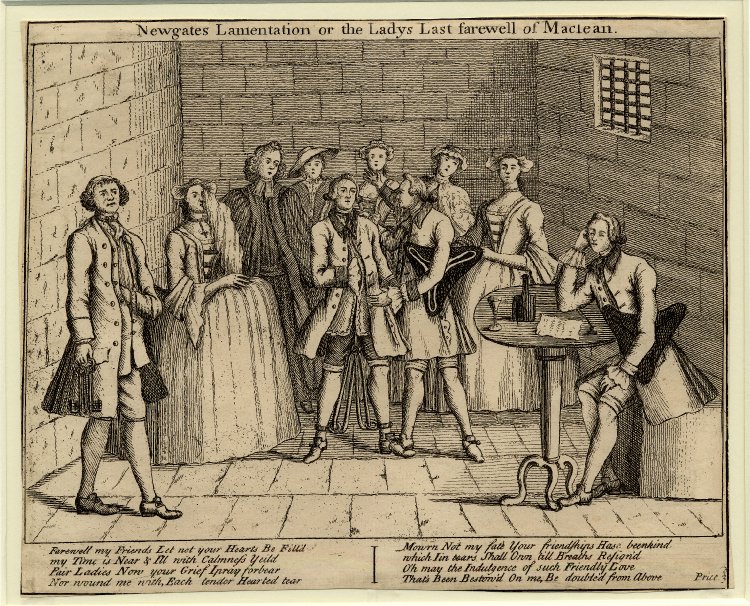

 Foote was an educated man who used his time languishing in jail — there was nearly a full year between his conviction and his execution — to bestow upon the world an autobiographical narrative of his peregrinations, which the reader can peruse in its entirety at the bottom of this post. Affected with wanderlust, he struck out from home as a teenager and began a rambling career that would take him all over America.

