Muscovy’s long march to supremacy among the early Russian polities reached a decisive turn on 14 July 1471 when it defeated longtime rival Novgorod at the Battle of Shelon.
Ten days after that defeat, Novgorod’s commander Dmitry Isakevich Boretsky was put to death by the will of Ivan III.
Novgorod the Great had been losing ground to its neighbor for generations. Matters came in the end to the “Mayoress” Marfa Boretskaya, the widow of Novgorod’s former mayor (posadnik) Isaac Boretsky; she emerged in the 1460s as the charismatic leader of the hardline anti-Muscovite types.
Struggling to find a political foothold upon which to resist burgeoning Moscow, Marfa Boretskaya intrigued with the friendly — and similarly Muscophobic — Polish-Lithuanian Commonwealth. This drew Ivan III into what would prove to be the decisive military showdown between these venerable cities.
Marfa’s son Dmitry, our date’s unfortunate executed, would have stood to garner the glory of it had he prevailed.
He didn’t.
Bummer: Klavdy Lebedev‘s 1889 panorama of Marfa Boretskaya surveying the destruction of Novgorod.
Marfa Boretskaya was not put to death herself, but taken prisoner to Moscow upon Novgorod’s formal annexation in 1478 and socked away in a convent.
This speech inaugurated some of the darkest days of the Cold War … but they were probably even worse for Oleg Penkovsky, who was arrested just hours before Kennedy delivered it. He might have been shopped by a U.S. intelligence mole working for Moscow.
Penkovsky and his British contact, businessman Greville Wynne, faced a public show trial in May 1963 — resulting in the spy’s prompt execution. (Wynne got a prison sentence, and was later exchanged back to the West for Portland Spy Ring principal Gordon Lonsdale.)
As befits the shadow world of espionage, Penkovsky’s activities and motivations are still disputed to this day. While some consider him among the most valuable/damaging spies in the Cold War, former MI5 officer Peter Wright claimed that Penkovsky was a loyal Moscow agent all along actually trafficking disinformation — and that he was not executed at all but cashiered to a comfortable secret retirement after his show trial “condemnation.”
We’ve touched in these pages — one of our earliest posts, in fact — on Soviet war heroine Zoya Kosmodemyanskaya, a teenager executed by the advancing German army in November 1941 for conducting partisan attacks behind enemy lines.
Zoya’s story became known after the Red Army recaptured village of Petrishchevo, where she was hanged. A January 27, 1942 Pravda article recounted the gallows defiance of the young guerrilla, whom villagers knew only by her nom de guerre, “Tanya”. She had withstood German torture, refused to give them any information, and at her hanging incited her countrymen and -women to resist the invaders. She’s still to this day a beloved national martyr in Russia, which is why she’s also an Ace in our execution playing cards.
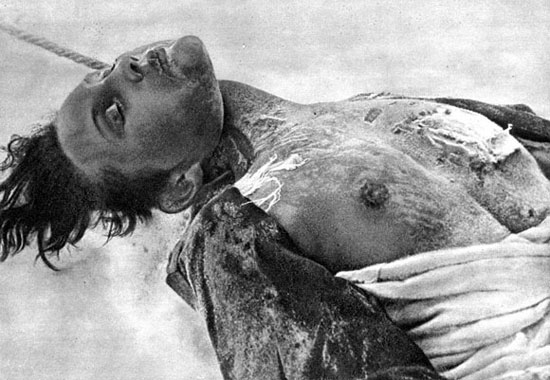
The young woman on the gallows, and in the ghastly post-mortem pictures with her left breast mutilated swiftly became propaganda grist for Moscow.
Zoya’s instant Joan of Arc-like legend invited investigation of the precise circumstances of her capture and death … and this in turn meant extremely dangerous scrutiny for any Soviet citizen in her environs whose behavior in those last days could be held to be in any way sub-heroic.
This brings us to today’s unfortunate entry, Vasily Klubkov, a humble mail-sorter before the war whose picture belongs in the dictionary next to “poor luckless sod.” Just him, Zoya, and everyone else on the terrible Eastern Front.
It was on this date* in 1942 that Klubkov paid the penalty for Zoya’s sacrifice.
Vasily Klubkov and Boris Krainov were other partisans who had been detailed along with Zoya Kosmodemyanskaya to torch some enemy assets on the same mission around Petrishchevo. Practically children all, they each acted independently from the others; long story short, Zoya and Vasily Klubkov were both captured.
Zoya fiercely endured every torture the Germans could throw at her, but Klubkov was made of softer stuff. When an officer pointed a gun at his head and demanded some answers, Klubkov started talking.
“I was a coward,” he later admitted. “I was scared I would be shot.”
Now, this admission very much against his own safety was made to the NKVD in March 1942, and since we already know that Vasily Klubkov was the sort to fold under torture, we can well imagine that the NKVD also got whatever it wanted out of the misfortunate young man. Considering the politicized quality of the trial and the circumstances of the “confession,” it has to be treated with caveats.
Under NKVD pressure, Klubkov signed off on a version of events that just so happened to mesh beautifully with the iconography already forming around the hanged “Tanya”: namely, that he was brought face-to-face with his fellow-prisoner and confirmed her identity, whereas she refused to breathe a word to her captors; that he saw her stripped naked and bashed with truncheons for hours and still summon the fortitude to refuse her interrogators the least satisfaction. Pavel Klubkov gave posterity firsthand evidence of Zoya Kosmodemyanskaya’s heroism in captivity.
“Klubkov may have been telling the truth, since it’s easy to imagine a terrified teenager on his first mission agreeing to his German captors’ demands,” notes Andrew Nagorski in The Greatest Battle: Stalin, Hitler, and the Desperate Struggle for Moscow That Changed the Course of World War II. “But there’s no way of knowing for sure how he really behaved, since he surely was just as terrified when he was interrogated by the NKVD. Or how much of what he said about Zoya was accurate, since the NKVD may already have been preparing the transcript with the idea of her elevation to mythic status.”
Heck, the reason the NKVD even had Klubkov to interrogate was that he escaped German custody, another big character red flag as far as the Soviets were concerned. That he escaped from the same custody that martyred Zoya Kosmodemyanskaya probably sealed his fate before he received his first pistol-whipping. NKVD records paint a kid who has already given up.
Well he might have. The verdict of the court was surely ordained from the start, but it was formally delivered on April 3: “Execution by shooting, without confiscation of property due to its absence.”
* Though there are some cites for April 3 out there, it appears that April 3 was the date of his conviction by a military tribunal and April 16 his execution date. This is a bit of a protracted delay by wartime Soviet tribunal standards, but then, Klubkov would have been a person of relevance to the state itself. The highest-ranking official who thought he could approve Klubkov’s execution without asking anyone else might have been a little further up the food chain than for your run-of-the-mill deserter.
Pavlik Morozov was one of the must well-known figures in the Soviet Union. Every Soviet schoolchild learned his name and the story of his heroic life and tragic death. On April 7, 1933, his alleged killers — his own grandparents, uncles and cousin — were executed by firing squad for his murder.
A postage stamp honoring the Moscow statue honoring little Pavlik Morozov. Many more Pavlik propaganda images are here.
While most Morozov monuments have long since been destroyed or removed from public view, apparently a few still persist.
The legendary Pavlik, a Russian boy who lived in the remote village of Gerasimovka in western Siberia, was a member of the Young Pioneers, a kind of Communist version of the Boy Scouts designed in indoctrinate youth into the Soviet way of thinking. When the superlatively loyal child found out his father, Trofim, was acting against the state, he denounced him to the secret police, the OGPU. (Accounts differ as to what Trofim’s misdeeds actually were; he may have hoarded grain, or sold forged documents, or both.) The result was that Trofim was sent to a labor camp, never to be heard from again.
The Morozov family, not being good Communists like he was, were furious with him for the denunciation. Soon after his father’s trial, in early September 1932, his grandparents, his uncle and his cousin murdered him while he and his eight-year-old brother Fyodor were picking berries in the woods. (Fyodor was taken out too, as he was a witness.) The boys’ bodies weren’t located for several days and it’s unclear when they actually died.
An OGPU officer, Ivan Potupchik, who was another of Pavlik’s cousins, found them. The murderers were arrested in due course, and Pavlik became a martyr and an example for every Soviet child to look up to — a Stalinist passion play, the horrid little saint of denunciation. As Soviet dissident writer Yuri Druzhnikov wrote in this article,
Indeed, it is virtually impossible for someone not born and raised in the USSR to appreciate how all-pervasive a figure Morozov was … [E]veryone in the Soviet Union, young and old alike, used to know about Pavlik Morozov. His portraits appeared in art museums, on postcards, on match-books and postage stamps. Books, films, and canvases praised his courage. In many cities, he still stands in bronze, granite, or plaster, holding high the red banner. Schools were named after him, where in special Pavlik Morozov Halls children were ceremoniously accepted into the Young Pioneers. Statuettes of the young hero were awarded to the winners of sports competitions. Ships, libraries, city streets, collective farms, and national parks were named after Pavlik Morozov.
A reconstruction of the suppressed Eisenstein film based on the Pavlik Morozov story, Bezhin Meadow. Aptly, its supposed ideological flaws got some of its own participants arrested.
The Cult of Pavlik declined significantly once World War II began and there were other youngheroes to exalt, and even more so after Stalin’s death. Still, even into the 1980s public figures praised the child as an “ideological martyr.”
The problem, as you might have guessed already, is that almost none of the accepted story about Pavlik is true. While not entirely made up, his Soviet-official biography was always thick with exaggerations, distortions and outright lies.
This Los Angeles Times article explains that Druzhnikov first got interested in Pavlik Morozov in the mid-1970s, when he attended a conference that included a discussion of “positive heroes of Soviet culture.” Pavlik was mentioned, and Druzhnikov asked just what was so positive about someone who had betrayed his own father. A few days later, he was summoned to KGB headquarters and two agents told him very firmly, “do not touch this subject.” It backfired: more curious than ever, Druzhnikov began secretly researching the case.
The book that resulted, Druzhnikov’s Informer 001: The Myth of Pavlik Morozov, was written in the early 1980s, but it was too politically sensitive for publication at the time. Instead it circulated privately among intellectuals and dissidents as Samizdat. It finally saw publication in Russian in 1988, and was then translated into English in 1993. (The full text of this book is available online for free here … in Russian.)
British historian Catriona Kelly published a second book on the subject in 2005, Comrade Pavlik: The Rise and Fall of a Soviet Boy Hero. By then, nearly all the surviving witnesses were dead. But unlike Druzhnikov, Kelly was able to obtain access to the official records of the Morozov murder trial and used them as a major resource.
These two authors got as close to the truth as one is able to get at this late date.
The Real Pavlik’s Life and Death
Pavlik Morozov’s story is sordid and mysterious as only a grand Soviet propaganda myth can be.
There really was a boy named Pavel Morozov (his name was the Russian equivalent of “Paul”) in Gerasimovka, but his nickname was Pasha or Pashka, not Pavlik. He was not ethnically Russian but of Belorussian descent on both sides of his family, as were most of the inhabitants of Gerasimovka. He could not have been member of the Pioneers, since there was no Pioneers troop where he lived.
When Yuri Druzhnikov began picking apart the Pavlik Morozov myth in the 1980s, he was able to talk to those still alive who had known the youth. In addition to the elderly villagers in Gerasimovka, he also interviewed Pavlik’s mother and his sole surviving brother, Alexei. (Another brother, Roman, was killed in World War II.)
Druzhnikov developed the following data points:
The exact date of Pavlik’s birth is unknown; his own mother didn’t remember it when asked in her old age. He was probably between twelve and fourteen at the time of his death.
The villagers of Gerasimovka who knew Pavlik and were interviewed by Druzhnikov did not remember him fondly: he was variously described as a “hoodlum,” a “rotten kid” and a “miserable wretch, a louse” who enjoyed smoking cigarettes and singing obscene songs.
Pavlik enjoyed denouncing his neighbors for breaking the rules; he “terrorized the whole village, spying on everybody.”
According to his former schoolteacher, he was almost illiterate; in fact, Druzhnikov believed he may have been slightly mentally retarded.
Pavlik’s whole family was the Russian equivalent of poor white trash. Tatiana was a mentally unstable and quarrelsome woman who was widely disliked in the village. After Trofim’s arrest, the state seized all his property and so the family went from mere penury to the brink of starvation.
Druzhnikov’s witnesses from Gerasimovka remembered Trofim Morozov’s denunciation, trial, and exile, which was central to the Pavlik-the-martyr myth. They remembered the boy testifying and said he didn’t seem to understand what was going on.
Kelly, however, examining the historical records twenty years after Druzhnikov, could find no documentary evidence of any trial — nor any proof that Pavlik had denounced his father to the OGPU or that Trofim had been convicted of political offenses and exiled.
Trofim had definitely disappeared from Gerasimovka by the time of his sons’ murders, but Kelly believes it’s entirely possible that he simply walked out of little Pavel’s life and wasn’t put in a labor camp at all. If Pavlik did in fact denounce his father, it was probably at the behest of his mother, Tatiana, and not for political reasons: Trofim had deserted the family and moved in with a mistress.
Tatiana was bitterly angry about her husband’s defection, and Pavlik, as the oldest male member of the household, was stuck with the exhausting household and farm chores his father had once performed. The family certainly did not want for points of friction … and Pavlik Morozov’s murder certainly had nothing to do with politics.
However, one of the four people put to death for the crime might actually have been involved after all.
After the Murders
The murdered boys were buried quickly, before the police even arrived to investigate. No photographs were taken, experts consulted or forensic tests performed. No doctor examined the bodies, and it isn’t even known how many wounds the victims suffered.
Within short order, however, investigators had rounded up five suspects: Pavlik’s uncles, Arseny Silin and Arseny Kulukanov; his grandparents, Sergei and Ksenia Morozov, both of whom were in their eighties; and his nineteen-year-old cousin, Danila, who lived with Sergei and Ksenia.
The accused.
The only physical evidence to implicate them was a bloodstained knife and some bloody clothes found in Pavlik’s grandparents’ house. As Druzhnikov records:
The prosecution had at its disposal two pieces of material evidence that were found in the home of Sergei Morozov: the knife, which was pulled out from behind the icons during the search, and the blood-spattered trousers and shirt — though whose clothes they were, Danila’s, the grandfather’s, or someone else’s, and whose blood was on them remained unknown. The court did not demand a laboratory examination of the blood stains.
It’s worth noting here that Danila had recently slaughtered a calf for Pavlik’s mother; this would provide an alternative, innocent explanation for the bloody clothes.
During their nationally publicized show trial in November 1932, the defendants presented incriminating yet often wildly conflicting statements abut the murders, and virtually no other evidence was presented. Druzhnikov details the farcical proceedings, which lasted four days:
Witnesses for the prosecution (about ten people) … did not introduce facts but demanded that the court employ “the highest measure of social defense” — execution. In fact, there were no defense witnesses at all. At the trial there was only one defense counsel, but during one of the court sessions he stepped forward and announced to the hall that he was revolted by the conduct of his clients and refused to defend them further. After this the lawyer withdrew with a flourish, and the trial concluded without him.
Four of the five were convicted and sentenced to death for “terrorism against representatives of the Soviet Government.” Sergei, Ksenia, and Danila Morozov, and Arseny Kulukanov, were all shot in April after the inevitable rejection of their appeals. (Arseny Silin was able to produce a credible alibi and was acquitted.)
Tatiana supported the convictions and testified against the defendants. Stalin later purchased her a resort home in the Crimea, where she lived until her death in 1983.
Were They Guilty?
Druzhnikov, researching the case fifty years later, concluded that Pavlik and his brother were deliberately set up to be murdered by agents of the OGPU, who treated the murders as political and the children as martyrs, bringing righteous proletarian wrath upon a fiercely independent village which had so far successfully resisted collectivization.
“The murder,” he wrote towards the end of his book, “could only have been committed, or at least provoked, by the hands of the OGPU.”
Stalin’s regime would become famous for its terrifyingshow trials. “A show trial in the Urals,” Druzhnikov suggests, “called for a show murder.” Because, in Gerasimovka, “there really was no crime. The peasants living there were peaceful; they didn’t want to kill one another. So they needed help.”
Kelly, on the other hand, suggested that the appearance of the crime scene, with no attempt to hide the bodies by burying them or dumping them in the nearby swamp, suggests an impulsive act of violence probably committed by a local teenager or teenagers. (One wonders, however, why it took so long for searchers to find bodies supposedly lying in plain sight.)
Kelly’s best guess was that Pavlik’s cousin Danila may have actually been guilty after all, possibly acting in concert with another villager his own age, Efrem Shatrakov: Danila and Pavlik had a very nasty argument over a horse harness only a few days before Pavlik and Fyodor disappeared, and Pavlik had allegedly denounced the Shatrakov family for possessing an unlicensed gun, which was confiscated.
In fact, Danila’s statements to the authorities made reference to his fight with Pavlik about the harness, and Shatrakov actually confessed to the murders, but later retracted his statements and was let go.
In any case, as Kelly wrote, if one or more of the defendants convicted at the trial happened to be guilty, either of committing the murders or as accessories after the fact, “they most certainly did not receive a fair trial, and the corpus delicti upon which the sentence was based was without question seriously flawed.”
No matter who killed Pavlik, as Druzhnikov says, the final result is this: “It is a historical commonplace that Stalin ruthlessly converted living people into corpses. In this instance, he effected the conversion of a corpse into a living symbol.”
The only known real-life photograph of Pavlik Morozov, at center under the arrow, taken as a school class portrait by a wandering photographer in 1930.
On this date in 1882* Stepan Khalturin** was hanged in Odessa, Ukraine … but not for his most (in)famous crime.
Khalturin (English Wikipedia entry | Russian) came from a well-off peasant family near the city of Vyatka (today, Kirov; it was renamed for an assassinated Bolshevik). As a young carpenter in 1870s St. Petersburg, he fell in with revolutionary circles and became a distinguished propagandist and organizer. Khalturin helped found the first political labor labor organization in Russia, the “Northern Russian Workers’ Union”.
He’s said by other leftist agitators who knew him to have “persuaded his student workers with tears in his eyes to continue propagandizing, but in no event go down the path of terror. From this, there is no return.”
If that used to be his sentiment, Khalturin’s thinking … evolved.
By February 1880, Khalturin was for all intents and purposes in on the terrorism strategy. He took advantage of a workman’s gig at the Winter Palace to pack the cellar full of dynamite,† two floors below the imperial dining room.
But Tsar Alexander II and party had not yet returned when it blew. Eleven people, mostly guardsmen in the intervening room below the dining hall, died in the blast; dozens of others were injured.
Khalturin watched in frustration from the iron gates of the Winter Palace, and slipped away — never detected. His co-conspirator Zhelyabov consoled him with the prospects of mass recruitment sure to be unleashed by this spectacular propaganda of the deed. “An explosion in the king’s lair — the first attack on the autocracy! Your deed will live forever.” (Russian source)
A year later, Narodnaya Volya finally succeeded in assassinating Alexander II in St. Petersburg. Zhelyabov and five others hanged for that.
Khalturin wasn’t involved in that plot: he had escaped to Odessa.
There, he shot a police officer named Strelnikov. He was captured and hanged under a bogus alias, nobody realizing that they were also executing the mysterious Winter Palace bomber.
Unusually considering Lenin’s distaste for terrorism and Narodnaya Volya, Khalturin was elevated in post-Soviet times into an officially-approved revolutionary exemplar. The street Millionnaya running to the Winter Palace in St. Petersburg was cheekily renamed for him (it’s subsequently been changed back). Public monuments went up for the bomber, especially in the environs of his native soil around Kirov.
* April 3 by the Gregorian calendar; March 22 by the Julian calendar still in use in 19th century Russia.
** Appropriately given Khalturin’s Winter Palace work, khaltura is Russian for an item of shoddy construction. The word has no etymological connection to our man, however. (Linguistic tip courtesy of Sonechka.)
Late the night of March 31-April 1, which was in 1923 the dark between Holy Saturday and Easter Sunday, the Catholic priest Konstanty Budkiewicz (Konstantin Budkevich) was shot in the cellars of Lubyanka.
Born to a Polish family in present-day Latvia, Budkiewicz (English Wikipedia link | Polish) went to seminary in St. Petersburg. He was in that same city, now a 50-year-old vicar-general, when the Bolshevik Revolution shook Petrograd.
Given the Bolsheviks’ anti-clericalism, this was bound to be a trying position: Catholic clergy, especially of relative prominence, faced intermittent harassment. The outlander Latin rite and any Pole’s hypothetical association with Russia’s ancient geopolitical foe only exacerbated the situation.
Matters came to a head with the March 13, 1923 arrest (Polish link) of a number of Catholic clergy. In the ensuing days, most would be convicted and sentenced to death at a show trial on the grounds of “inciting rebellion by superstition.” To be charged with “inciting rebellion by superstition” is pretty much to stand condemned for it, one would think.
New York Herald correspondent Francis McCullagh, who was present in the courtroom, would later publish his observations of the proceedings in The Bolshevik Persecution of Christianity. The proseutor, McCullagh wrote,
launched into an attack on religion in general and the Catholic Church in particular. “The Catholic Church,” he declared, “has always exploited the working classes.” When he demanded the Archbishop’s death, he said, “All the Jesuitical duplicity with which you have defended yourself will not save you from the death penalty. No Pope in the Vatican can save you now.” …As the long oration proceeded, the Red Procurator worked himself into a fury of anti-religious hatred. “Your religion”, he yelled, “I spit on it, as I do on all religions, — on Orthodox, Jewish, Mohammedan, and the rest.” “There is not law here but Soviet Law,” he yelled at another stage, “and by that law you must die.”
Although information about anti-Christian hostility in the USSR tended to reach the wider world in fragmentary form only, there was an outcry in the western world over this trial’s condemnation of Budkiewicz’s boss, Archbishop Jan Cieplak, as well as that of Monsgnor Budkiewicz. International pressure would ultimately save one of those men … but only one.
Cieplak’s death sentence was commuted, and in 1924 he was even released and allowed to leave for Poland. He died in the United States in 1926.
Budkiewicz made do with grace of the celestial kind. He was whisked from his cell late on the 31st, and shot sometime overnight in the notorious Lubyanka prison in Moscow. Soviet authorities were so tight-lipped and obfuscatory about his situation that the pope prayed publicly in St. Peter’s later that same day for Budkiewicz’s life to be spared. Only several days later was the accomplished fact of Budkiewicz’s execution openly confirmed.
The Polish poet Kazimiera lllakowiczówna dedicated a verse to Budkiewicz, titled The story of the Moscow martyrdom.
Budkiewicz is being investigated by the present-day Catholic church for possible beatification. (Archbishop Cieplak is, too.)
Set against the background of the Soviet moderisation process, the development of sport in the two decades from the early 1930s to the early 1950s not only established the world-recognised pattern of sport in the Soviet Union and, later, in many other communistcountries (like China, Cuba and the GDR), it also resulted in a phenomenon unprecedentedin world sports history: the arrest and execution of a host of sports personalities. No one knows the exact numberof victims; but the purges carried off five sports ministers, Olympic Committee members for the Baltic states, heads of the major physical education colleges, eminent sports scientists and medics4 and probably thousands of leading athletes.
-Jim Riordan*
Sports and the physical body emerged early in Soviet history as a major doctrinal focus. A 1925 party resolution (quoted in this pdf) declared it
“essential to consider physical culture not only from the standpoint of physical education and health, and as one aspect of our youth’s cultural-industrial and military training, but also as a method of educating the masses.”
Dziga Vertov’s Soviet silent masterpiece Man With A Movie Camera (1929). This clip should cue up at the sports bit (45:26), but the entire film is a must-watch.
In the Stalin years, Soviet athletics took on the institutional patterns that continue to structure Russian sport to this day.
Given his position during the time of purges, Alexander Kosarev might have been bound for a bad end regardless. At least he had the consolation of leaving his fingerprints on a sporting institution that still thrives to this day.
We get to Kosarev by way of another man, Nikolai Starostin, an elite athlete of the 1920s and 1930s.**
A hockey star as well as a footballer, Starostin supported his family with his athletic gifts in the 1920s, and in 1922 helped found the local sports club that eventually developed into one of Europe’s most storied champions.
After juggling sponsorships and team names for a decade, Starostin approached Kosarev about bringing the club under the patronage of the Communist Party’s youth organ Komsomol, which Kosarev headed. He also suggested the name by which the team is still known, Spartak Moscow — paying tribute to the ancient rebel Spartacus.†
Komsomol support was not Komsomol control, however: Spartak remained basically independent, and this set it starkly apart from the other top Soviet teams, each controlled by a state ministry and its associated industry. (e.g., Lokomotiv Moscow, or the Red Army team CSKA.‡)
The football bully on the block at the time was Dynamo Moscow, a club dating to the tsarist age that was in the ambit of the internal security services. Dynamo won the first Soviet championship in 1936.
But Spartak quickly stepped over the Lokomotivs and established itself as Dynamo’s top rival.
Football matches, like everything else in Stalinist Moscow, were about politics, bureaucratic infighting, and the characteristic through-the-looking-glass rules of the dictatorship. Spartak used a controversial goal to beat Dynamo Tblisi (there were six Dynamo teams in the top division) in a Soviet Cup semifinals in 1939, the last before World War II. After Spartak went on to win the final, the Dynamo teams’ scary patron, NKVD boss Lavrenty Beria, ordered the semifinal match replayed. Spartak, already the tournament champion, then proceeded to win its semifinal a second time, compounding Beria’s fury. The referee from the first match was later arrested.
Beria was a passionate fan of the beautiful game — the ultimate football hooligan, you might say. He frequently attended Dynamo matches.
The secret police chief had even played for a Georgian club in his youth; in fact, he had played against (and lost to) a Starostin team. (Starostin thought Beria was a dirty player. Truly the Georgian was a man who tackled life studs-up.)
In contrast to Dynamo’s establishment backing, independent Spartak didn’t even have a home stadium until 1956. Nevertheless, it soon began attracting a sizable popular following. Its tactics were less stodgy; its persona less institutionally leaden; its star, Starostin, was a legend. And Spartak won, a lot.
“The people’s team” became a pole for — not resistance, exactly. But something a little bit alienated. A little bit defiant. Sport might not be your thing, but you have to appreciate any team that can embarrass the national torturer-in-chief. You have to appreciate the opportunity to hiss the secret police under cover of innocent fandom.
Unfortunately, Spartak’s Komsomol patron Kosarev fell. There’s an apocryphal story that Kosarev’s fate was football-related; surely the rivalry did him no favors when his life was hanging in the balance.
But it was actually just the routine infighting that did Soviet bureaucrats in throughout the late 1930s. His power eroded; a Komsomol official whom Kosarev had previously booted went over his head to Stalin himself, and Uncle Joe’s apparatchiks brought him down at a November 1938 Komsomol plenum with accusations of favoritism and alcoholism. (Stalin popped in briefly to see if “maybe this is a system and not a mistake?”)
Kosarev spent November 19-22 desperately fending off accusations at the rostrum, was removed from his post by the end of the session, and resided in a Lubyanka dungeon before the month was out. And you thought your committee meetings were awful.§
Kosarev got the bullet. Spartak lived on.
So did Starostin, who was not executed but sent to the Gulag. In 1948, Stalin’s son Vasily extracted Starostin to use as a coach for the Soviet Air Force’s football team, leading to a bizarre saga as a, well, human football between Vasily and Beria. (Beria’s security services kept trying to arrest Starostin, leaving the coach shuttled from city to city as the political winds shifted — and sometimes even bunking with his young protector and the revolver Vasily kept under his pillow. All for football!)
Kosarev was rehabilitated shortly after Stalin died. Khrushchev mentioned him by name in his “secret speech” denouncing the previous years’ terror.
And since Stalin’s death precipitated Beria’s own execution, Starostin was rehabilitated as well. “It was like the sun rising in the Far North after the long Polar night,” Starostin remembered of 1953.
The exiled football legend returned to coach and manage Spartak Moscow — from 1955 until 1992, when he retired at age 90. Nikolai Starostin was associated with the club he helped create in 1922 almost as long as the Soviet Union was associated with Russia: 70 years … minus those lost to the Arctic labor camps.
“Camp bosses, arbiters of the life and death of thousands upon thousands of human beings, personifications of the GULAG brutalities and horrors, were so benevolent to anything concerning soccer,” said Starostin in his memoirs of the starstruck commandants who treated their special prisoner with kid gloves and invariably recruited Starostin to coach local clubs. (Dynamo clubs, ironically.) “Their unbridled power over human lives was nothing compared to the power of soccer over them.”
“The soccer ball was always out of Beria’s reach.”
* “The Strange Story of Nikolai Starostin, Football and Lavrentii Beria,” Europe-Asia Studies, Vol. 46, No. 4 (1994). Riordan, a Briton, played for Spartak in the 1960s. (He wote an autobiography about it.)
** Nikolai was the oldest of four Kosarev brothers, all four of whom played for Spartak. All four were also arrested and tortured in 1942. Nikolai was the only one of them to remain involved in football after his release.
‡ In the 1930s, the Red Army team was known as CDKA. The reason its name changed was because a CDKA-based national team lost to Tito’s Yugoslavia in the 1952 World Cup, and Stalin in a huff ordered the CDKA club dissolved.
§ Information on Kosarev’s fall and the November 1938 Komsomol plenum from Seth Bernstein’s 2011 University of Toronto graduate paper “‘Lifestyle Cannot Be Separate from Politics’: Degeneracy and Promotion in the Purge of the Soviet Komsomol Leadership, 1934-1938”. This paper no longer appears to be available online.
This date in 1985 spelled farewell for the KGB agent Vladimir Vetrov … code-named Farewell by the western handlers to whom he passed Soviet secrets.
Vladimir Vetrov was a career officer in Soviet intelligence who grew disgruntled* and in 1980 went to work for the West.
And he was no ordinary spy. Think Aldrich Ames, to the power of ten.
Vladimir Vetrov oversaw the entire KGB directorate charged with a critical program: Line X, which surveilled western R&D and passed its fruits back to Mother Russia. In the 1960s and 1970s, Line X stole jaw-dropping volumes of military, computer, and industrial advances.
And by 1980, all that information passed through Vetrov’s hands for distribution within the USSR. His betrayal blew the entire thing to smithereens.
When he turned, Vetrov gave 3,000 pages of top-secret documents to his French handlers, information which also made its way to the CIA. “The Soviet military and civil sectors were in large measure running their research on that of the West, particularly the United States,” recalls the gobsmacked American defense advisor who reviewed the file. “Our science was supporting their national defense.”
The Farewell dossier exposed the entirety of the Soviet technology-stealing infrastructure, with a couple of enormous consequences.
One, it influenced Cold War strategy in the West, supporting the Reagan administration’s view that the Soviet economy (absent its stolen technological advances) could be pushed into collapse.
And two, it facilitated Langley’s most spectacular counterespionage coup, brainchild of Gus Weiss. Rather than smashing up the Line X network, the CIA turned the enormous (and in Moscow, trusted) apparatus against its creators.
By feeding Soviet agents promising but subtly flawed technology, the Americans infiltrated sabotage points into the USSR — a Trojan Horse for the information age. In 1982, software running the Soviet Trans-Siberian Pipeline allegedly escalated gas pressure fatally on the Urengoy-Surgut-Chelyabinsk pipeline, triggering an explosion so large (three kilotons) that some foreign monitoring stations initially suspected a nuclear detonation. Weiss just told them not to worry.
Meanwhile, goes the story (and one must discount appropriately here for triumphalist spin), other crapware started failing elsewhere in the Soviet Union. “Pseudo-software disrupted factory output. Flawed but convincing ideas on stealth, attack aircraft and space defense made their way into Soviet ministries.” Suddenly, the Russians couldn’t know which Line X acquisitions were dependable and which were time bombs.
From Farewell, a 2009 film.
Vetrov’s candle burned bright, but brief: he stabbed his mistress (non-fatally) during a drunken argument in 1982, then stabbed to death the man who knocked on his window to intervene. Vetrov got a trip to Siberia, but while serving his time, he casually revealed that he’d authored maybe the most spectacular inside betrayal of Russian intelligence in the 20th century. He was duly recalled for a new trial and, eventually, a bullet in the head in Moscow’s Lefortovo Prison. Even in the post-communist state, he’s still considered a villain in his homeland.
* Vetrov didn’t betray the Kremlin for money. Sergei Kostin believes it was professional frustration — the revenge of the underappreciated nebbish whose merits couldn’t break through the nepotism ceiling at the clubby KGB. However — though the explanations are not necessarily inconsistent — Vetrov also wrote a pre-execution “Confession of a Traitor” savaging the Soviet system: “My only regret is that I was not able to cause more damage to the Soviet Union and render more service to France.”
ODESSA, Jan. 17. — The public gardens was the scene of a triple execution today. Three terrorists were hanged in a row after having been condemned to death for the armed robbery of a shop. Their trial took place before a drumhead court martial.
New York Times Jan 18, 1907
ODESSA, Jan. 17. — The public gardens here to-day were the scene of a triple execution. Three Terrorists condemned to death for the armed robbery of a shop were hanged in a row. They obtained only $3.50 from the store they robbed.
This atrocity (derogated as “Field Courts Martial which endeavor to confuse ordinary civil offenses with revolutionary acts leading to the almost daily execution of offenders, who in civilized lands would receive only the most trivial sentences.”) appeared in a petition for the U.S. Congress to condemn the Russian crackdown against agitators in the waning 1905 revolution.
We, the undersigned, believe that it is time for civilized nations to protest against the atrocities practiced by the Russian Government in its prolonged warfare against its own people.
The subject is one which interests all nations, as a matter of common humanity. On more than one occasion governments have taken action for the amelioration of termination of abhorrent conditions existing in foreign countries. Many instances might be cited, but we content ourselves, as sufficient for our present purposes in citing the case of the Bulgarian atrocities in 1877, when Russia, in taking advantage of the general horror excited by the inhumanities of the Turkish forces within the dominions of the Sultan, intervened in the name of humanity, to rescue the inhabitants of Bulgaria from their deplorable condition. Fifty years before, various European powers, of whom Russia was one, intervened to redeem the Greek inhabitants of the Sultan’s dominions from barbarities and oppression. In seeking now some entirely pacific means of inducing the Russian Government to ameliorate the condition of its subjects, we are asking for nothing which the Russian Government has not itself in times past afforded a good precedent.
This petition and protest rest solely and entirely upon the instances wherein the Russian Government is disregardful of the usual customs of civilized nations; and wherein it is guilty within its borders of flagrant violation of the terms of agreement of the Geneva Treaty of 1864 and 1868 between the Nations, and also the Second Convention of the Peace Conference at the Hague in 1902.
One notices that among the behaviors viewed by this petition’s congressional sponsors as “disregardful of the usual customs of civilized nations” when conducted by tsarist Russia were acts that in other times members of that august body would rise to defend: “Tortures are applied to prisoners within fortresses and prisons to elicit information.”
On this date in 1934, Leonid Nikolaev was convicted and (an hour later) shot for the murder of Leningrad communist leader Sergei Kirov.
Nikolaev was a disaffected young man who’d come of age during the Revolution and latterly been expelled from the Party for his bad attitude. He took his frustration out on December 1, 1934, when he stalked into the (suspiciously unguarded) office of Kirov and shot him dead.
The victim was much the more consequential figure in this transaction — both in life, and in death. Kirov’s murder would stand as a Reichstag fire moment unleashing the darkest years of Stalinist purges.
Kirov was an old Bolshevik agitator from way back. Widely respected, he’d been the party boss of Leningrad for nearly a decade, and a few months before his murder was overwhelmingly elected to the Communist Party’s Central Committee at the party Congress.
He was also, perhaps, seen by anti-Stalin factions within the party as a potential pole of resistance to Stalin* — though his weight as an “opposition” figure has also grown with the hindsight knowledge of what came next.
Kirov’s assassination was a double gift to the Kremlin, for not only did it remove the impediment himself, it licensed a furious security crackdown against the “terrorists” who orchestrated it. Said terrorists conveniently turned out to be dozens upon dozens (and indirectly, thousands upon thousands) of officials whom Stalin found convenient to destroy. “Kirov was killed in Leningrad,” Bukharin remarked upon hearing the news. “Now Koba [Stalin] will shoot us all.”
Within weeks of the murder, the exiled Trotsky was coming to the same conclusion, and charged that the Kirov investigation’s purposes was
to terrorize completely all critics and oppositionists, and this time not by expulsion from the party, nor by depriving them of their daily bread, nor even by imprisonment or exile, but by the firing squad. To the terrorist act of Nikolaev, Stalin replies by redoubling the terror against the party.
Stalin personally oversaw the investigation, even personally interrogated Nikolaev. And no surprise: the investigation’s casualties multiplied with alacrity.
The first commissar who made it to the murder scene “fell out of a truck” the very next day. Nikolaev’s mother, wife, siblings, and other associates were all disappeared and executed. 104 prisoners already under lock and key at the time of Kirov’s murder were judged guilty of conspiring with the assassin and shot out of hand. (Source)
In January 1935, Stalin had his long-neutered old rivals Zinoviev and Kamenev** preposterously convicted for “moral responsibility” for Kirov’s murder. Though they weren’t death-sentenced directly for this “responsibility” their condemnation set them up for their fatal show trial the following year. (Which included public confessions of involvement in the Kirov affair.) Guilt in Kirov’s death would be routinely bolted onto the show trials of political opponents for the remainder of the 1930s.
Stalin mined this terrorism panic so nakedly and purged so widely that the belief that Stalin himself ordered Kirov’s murder has long predominated. This theory of Stalin’s master orchestration also happened to be very convenient (pdf) for the post-Stalin party; Khrushchev directly hinted at his predecessor’s complicity in the secret speech.
That theory remains highly contestable. Matthew Lenoe in particular has vigorously disputed the idea that Stalin ordered everything in his acclaimed The Kirov Murder and Soviet History; there’s an informative Q&A with Lenoe on the invaluable Sean’s Russia Blog here, and a podcast interview on the New Books Network here. For a bit of background on Lenoe’s research, click here.
* Foreshadowing the unwelcome independence Leningraders enjoyed post-World War II … until Stalin smashed it.
** Nikolaev, the disaffected party member, was a Leningrader himself. That meant that when he was still in the party, it was in Zinoviev’s Leningrad party, since that city happened to be Zinoviev’s base and stomping-ground. And that meant that he must ipso facto have been part of the “Zinovievite Opposition”.


 This speech inaugurated some of the darkest days of the Cold War … but they were probably even worse for Oleg Penkovsky, who was arrested just hours before Kennedy delivered it. He might have been shopped by
  This brings us to today’s unfortunate entry, Vasily Klubkov, a humble mail-sorter before the war whose picture belongs in the dictionary next to “poor luckless sod.” Just him, Zoya, and everyone else on the terrible Eastern Front.


 Khalturin (
 Born to a Polish family in present-day Latvia, Budkiewicz (