1918: Boris Donskoy, Left SR assassin

One hundred years ago today, the Germans hanged Russian revolutionary Boris Donskoy.

Donskoy was not a Bolshevik but a Left Social Revolutionary — the party faction most closely aligned with Team Lenin. And his offense was a revolutionary crime, but one that events soon swept into irrelevancy.

In March of that same year, Russia’s revolutionary government had fulfilled its promise to exit the charnel house of World War I, ceding in exchange for peace the huge territorial gains that Germany had exacted in the bloodlands in-between empires.

These prospectively gigantic territorial gains were not long held by Berlin, whose wartime government would collapse suddenly before the year was out … but in the short interim where we lay our post, the Baltic States, Belarus, and Ukraine are under firm German control.

The last of these stood under the authority of Field Marshal Hermann von Eichhorn. Donskoy, a radical sailor who had served on the Executive Committee of Kronstadt when it demonstrated against the Revolution’s initial, too-moderate Provisional Government, on July 29 assassinated the field marshal — declaring to his captors that the old Prussian warhorse had been condemned by the Left SRs for suppressing the Ukrainian revolution.

On this day..

1938: Mikhail Viktorov, Soviet naval commander

Soviet admiral* Mikhail Viktorov fell in the purges on this date in 1938.

A young officer fresh from the Naval Academy when World War I broke out, Viktorov (English Wikipedia entry | Russian) made a timely switch to the Bolshevik side during the Civil War and scaled the heights of the Soviet navy.

He commanded the Baltic Fleet in the latter 1920s, and the Pacific Fleet in the 1930s, and finally — fleetingly — became chief of the Soviet navy in 1937, filling dead man’s boots when his predecessor was arrested and executed.**

The same fate awaited Viktorov, a perilous occupational hazard in those days.

He was rehabilitated posthumously in 1956.

* Viktorov’s rank was “Fleet’s Flag Officer, First Rank”; in 1938, this was the equivalent of admiral, and after a 1940 reorganization it was replaced full stop with admiral.

** It appears to me that fully seven consecutive heads of the Soviet Navy eventually ended up executed in the 1930s and 1940s (not all of them directly deposed from running the navy). Pantserzhanskiy, Zof, Muklevich, Orlov, our man Viktorov, and also his successors Smirnov and Frinovsky.

On this day..

1961: Rokotov and Faibishenko, black marketeers

On this date in 1961,* two 22-year-old Soviet men were — very much to their surprise — shot as black market currency speculators.

Ian Timofeyevich Rokotov and Vladik Petrovich Faibishenko were leaders of a small ring of illicit currency traders who made their bones swapping Soviet rubles with foreign visitors at a handsome markup, earning “wealth” on the scale of moderate personal ease that seems laughable compared to their homeland’s present-day oligarchy. Among this nine-person ring, authorities recovered 344,000 Russian rubles plus about $19,000 in gold coins and a few thousands each of various western European currencies.

These deeds augmented the inherently parasitic act of profiteering by the inherently subversive act of making unchaperoned contact with foreign visitors, at a moment when the Soviet state was particularly sensitive to both infractions. This was nearly the exact apex of the Cold War, in the tense months between the U-2 Crisis and the Cuban Missile Crisis.** “Peaceful coexistence,” Soviet premier Nikita Khrushchev said in a 1961 address, means “intense economic, political, and ideological struggle between the proletariat and the aggressive forces of imperialism in the world arena.”

In a 13-day trial concluding on June 15, Rokotov and Faibishenko were sentenced along with another of their circle, Nadia Edlis, to 15 years in prison. You might think that’s a stern message sent, but the excitable Khrushchev took an almost personal offense to their behavior and on viewing the intentionally nettlesome exhibition of the black marketeers’ banknote heaps, exclaimed, “They need to be shot for this!”

The minor matter of having no capital statute on the books for the occasion was resolved on July 1 by the Presidium of the Supreme Soviet, which introduced the death penalty for major economic crimes; the statute was then immediately deployed to retroactive effect in a new trial before the Russian Republic Supreme Court.

Many people more would face capital punishment for economic crimes under that 1961 law.

* The official execution date is elusive but press reports indicate that the Soviet news agency TASS announced it on July 26. Given that their final condemnation had occurred only five days previous, we fall at worst within a narrow margin of error.

** Also of note: the USSR had just revalued the ruble as of January 1, 1961.

On this day..

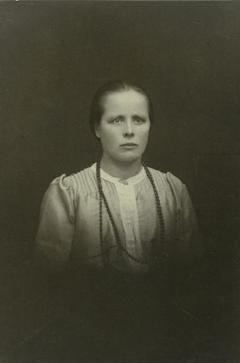
1918: Edla Sofia Hjulgrén, Finnish parliamentarian

One hundred years ago today, former Member of Parliament Edla Sofia Hjulgrén was shot during the Finnish Civil War.

A labor activist for many years, Hjulgrén (English Wikipedia entry | the vastly more detailed Finnish) won election to the Eduskunta in 1913 as a Social Democrat.*

At the time, Finland was still a Grand Duchy within tsarist Russia. When the Russian revolutionaries who conquered power in St. Petersburg in 1917 proved reluctant to agree to Finnish independence, the Finns just declared it, and a civil war ensued in the first months of 1918 — between Soviet-backed Red Guards and German-backed White Guards.

The Whites won a nasty war thick with atrocities on both sides. Although she was a pacifist, our Sofia Hjulgrén was among hundreds of Red supporters swept up after the decisive Battle of Vyborg clinched White victory. She was shot there — it’s Viipuri to the Finns, and Vyborg to the Russians — in the cemetery. The Soviets got Vyborg back in a subsequent war with Finland, and erected a monument there to the hundreds of victims of the Whites’ April-May 1918 Vyborg Massacre.


(cc) image by Olga.

* Finland boasts of being the first legislature in the world with full gender equality — meaning that, as of 1906, women enjoyed full equality both to vote and to stand for office. Women comprised above a tenth of its parliamentary delegates on the eve of Finland’s independence.

On this day..

1863: Zygmunt Padlewski, January Uprising rebel

On this date in 1863, Zygmunt Padlewski was shot for rebelling against the Russian empire.

A young St. Petersburg-trained tsarist officer with a patriotic bent — his father had taken part in the November [1830] Uprising against Russian domination — Padlewski (English Wikipedia entry | German | the surprisingly least detailed Polish) spent the early 1860s organizing revolutionary exiles in Paris.

He then put his neck where his mouth was by returning to Warsaw to agitate and, eventually, to assume the leadership of Polish rebels in that area during his own generation’s doomed revolution, the January [1863] Uprising.

Padlewski’s carriage was detained at a checkpoint when he tried to sneak back to Warsaw after a defeat, and his too-liberal bribes excited the suspicion of the Cossack sentries — who searched the traveler and discovered they had a man well worth the capturing.

He was shot at Plock, where a street and a school today bear his names (numerous other cities around Poland also honor Padlewski).

On this day..

1592: The Uglich Bell

On this date in 1592, the bell of Uglich had its “tongue” cut out, then was sent to Siberian exile — the crowning indignity of the collective punishment visited on that Volga River town for the murder of Tsarevich Dmitri.

Eight years on from the death of the ferocious and epoch-making Ivan the Terrible, Russia was under the rule of the boyar Boris Godunov, governing in the stead of his brother-in-law, etiolated Ivan heir Tsar Feodor.*

Although rival interpretations exist,** the conventional understanding of events we shall detail here is that Godunov turned assassin in order to maintain his hold on power and, eventually, achieve the tsardom for himself.


Boris Godunov’s 1598 coronation, from the Mussorgsky opera Boris Godunov.

Not yet the tsar himself at this point, Godunov’s problem was that he exercised power only through Feodor … and that heirless sovereign had a (much) younger brother, our victim Tsarevich Dmitri, who in the fullness of time might easily come to supplant both Feodor and Godunov. Boris Godunov had hidden this moppet and his mum away in Uglich, where the child had his own court as Russia’s last appanage prince. The English diplomat Gil(l)es Fletcher† never met Dmitry but his 1591 Of the Russe Commonwealth caught the peril of the situation, with a bit of foreshadowing.

Besides the emperor that now is who hath no child (neither is like ever to have for ought that may be conjectured of his body and the barenness of his wife after so many years’ marriage),‡ there is but one more, viz., a child of six or seven years old in whom resteth all the hope of the succession and the posterity of that house

[The child] is kept in a remote place from the Moscow under the tuition of his mother and her kindred of the house of the Nagois, yet not safe (as I have heard) from attempts of making away by practice of some that aspire to the succession if this emperor die without any issue. The nurse that tasted before him of certain meat (as I have heard) died presently. That he is natural son to Ivan Vasil’evich the Russe people warrant it by the father’s quality that beginneth to appear already in his tender years. He is delighted (they say) to see sheep and other cattle killed and to look on their throats while they are bleeding (which commonly children are afraid to behold), and to beat geese and hens with a staff till he see them lie dead.

The court rumors about Dmitry’s danger were onto something. On May 15, 1591, the eight-year-old princeling was found dead. He’d been stabbed in the neck.

Dmitry’s mother had the local prelates ring the cathedral bell summoning townsfolk to the commons to announce the murder and accuse Boris Godunov’s agents of perpetrating it. Outrage and panic soon whipped people into a mob that rampaged through Uglich, lynching 15 people — including one of Dmitry’s playmates as well as Moscow’s dyak, Mikhail Bityagovsky.
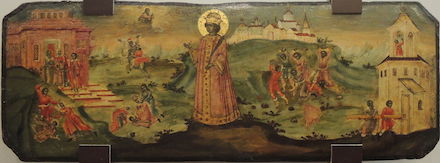

18th century icon of the Tsarevich Dmitry “Uglichsky” (click for larger image) shows his murder (left), and the cathedral bell being sounded to instigate summary justice (right). At the base of the cathedral, Mikhail Bityagovsky tries to batter down the door to silence the alarm.

Dangerous to bystanders, this mob was impotent against the Russian state. Boris Godunov dispatched a delegation that whitewashed Dmitry’s murder and ruthlessly punished Uglich; some 200 are reported to have been put to death for the disturbances.

The bell itself received the crowning punishment on the first of April in 1592, as the literal physical instigator of the riot: hurled from its tower, it was flogged on the public square and mutilated by having its “tongue” (the clapper) torn out. Then it was sent into exile in Tobolsk, where it remained until the 19th century. It hangs today at Uglich’s Church of St. Dmitry on Blood, although — as detailed in the bell’s Russian Wikipedia page — there is some debate about its authenticity.

As for “Saint Dmitry”, his story was just beginning and the canonization wasn’t the half of it.

When Tsar Feodor died in 1598 and Boris Godunov seized the throne outright, Russia entered her “Time of Troubles” — fifteen terrible years of civil war, invasion, and contested succession that ended with the seating of the Romanov dynasty. The Time of Troubles was characterized by, among other things, several imposters claiming to be this very murdered Prince Dmitry and therefore the rightful tsar. False Dmitrys were so ubiquitous during this interregnum that they have their own pretender regnal numbering, but all were failures in the contest for power: False Dmitri I, False Dmitri II, and False Dmitry III each came to violent and sordid ends.

* Ivan the Terrible had a perfectly cromulent heir being groomed for power in the form of one Tsarevich Ivan, but the volatile tsar had struck him during an argument in 1581 and accidentally killed him — which brought the unprepared Feodor into the succession and set up the catastrophic events of this post, as well as this incredible Ilya Repin painting:


Detail view (click for the full image) of Repin’s rendering of the horrified Ivan the Terrible clutching his mortally wounded son.

** The other principal version (Russian link) is that Dmitry suffered an epileptic fit while playing a game with knives, and accidentally stabbed himself. Many Uglichans gave this story to the official investigation (more Russian) that ensued the prince’s death, but their testimony is hard to depend upon since the Godunov-affiliated authorities conducting the investigation (like Patriarch Job, whom Godunov had made metropolitan of Moscow) preferred that version and presumably made sure that they received it. After Godunov’s death the official story reassigned responsibility to him — although this again was driven by the political imperatives of that moment. Some historians down the years have given credence to the “accident” hypothesis.

† That’s Giles Fletcher the elder, who is not to be confused with his son, the poet Giles Fletcher the Younger.

‡ Feodor had only a single daughter, Feodosia, born in 1592 (she died in 1594). As of the time of Dmitry’s murder, Feodor was 33 years old and completely childless.

On this day..

1943: Leen Kullman, Soviet hero

Soviet spy Helene (“Leen”) Kullman was shot by the Germans on this date in 1943 … or was she?

Kullman (English Wikipedia entry | the much more detailed Estonian) was just out of teaching school when the Germans occupied Estonia. She joined the Red Army and was eventually trained as an intelligence agent, infiltrated by parachute behind German lines in September 1942, and arrested by the Gestapo in January 1943.

This is where things get interesting.

According to the Soviet hagiography that resulted in her decoration as a Hero of the Soviet Union in 1965, Kullman defied her torturers and was shot by them on March 6, 1943: a standard Great Patriotic War martyr.

However, stories in post-Soviet, and heavily anti-Soviet, Estonia have circulated to the effect that Leen Kullman wasn’t killed in 1943 at all — that she cooperated with her captors and ended up dying peacefully in West Germany in 1978. One family member allegedly received a cryptic message in the 1960s, “Leen lives with the man who saved her life, and has two children. I’m not allowed to say more.”

Almost everything about her available online is in Estonian; readers with that particular proficiency might also enjoy this 1965 radio interview with her sister.

On this day..

1896: Ivan Kovalev, Russian meddler

On this date in 1896, Russian refugee Ivan Kovalev was hanged for a Sacramento double murder.

Kovalev and nine other Russian convicts had in 1893 fled from the most remote and dreaded of Russia’s Far East penal colonies, Sakhalin Island.

They might have met Anton Chekhov when he visited in Sakhalin in 1890 to compose the investigative articles that would become his book Sakhalin Island, one of the great pieces of journalism of his time. “Utter hell,” the great playwright mused of that brutal and befogged colony. “I feel that if I were a convict, I would escape immediately, whatever the consequences.”

Kovalev and nine mates felt exactly the same and they did it in the form of a downright suicidal flight from Sakhalin’s abyss in an open launch ventured into the Pacific in hopes of reaching Japan. They were on the brink of succumbing to their privations when they were miraculously picked up by a San Francisco-based whaler, the Charles W. Morgan.**

The convicts claimed that they were escaped political prisoners, a demographic that enjoyed western sympathy; there’s every chance that they were actually violent criminals but their tale of woe in the bowels of tsardom was persuasive and times being what they were a background check with the nearest consulate was not an option. The Sakhalin escapees were allowed to stay in California.

On December 30, 1894, about sixteen months after they drew their last moldy Sakhalin rations, Kovalev with two accomplices† bashed the brains out of the aged grocer F.H.L. Weber and his wife with an axe so that they could rob his store. Chekhov? Make that Dostoyevsky.

It took several months to zero in on the perpetrator but once the conviction was secured, indignant Sacramentans applied in record numbers for passes to attend the hanging, such “a spirit of enmity and hatred toward this son of far-away Russia” having been aroused by the horrid circumstances of the butchery that “it is evident that a spirit of satisfaction is abroad in the community at the thought that … Ivan Kovalev will expiate that crime with his life.”

* The New York Public Library hosts a digital collection of photos of the Sakhalin penal colony, here. Others can be browsed at the Sakhalin Regional Museum site.

** The Charles W. Morgan had an 80-year service history; it’s been restored and can be visited in Mystic, Connecticut.


1971 U.S. postage stamp commemorating the Charles W. Morgan‘s preservation.

† The accomplices don’t figure in the execution story: one was mortally wounded in an unrelated subsequent robbery, prior to Kovalev’s arrest; the other wound up serving time for burglary.

On this day..

1938: Vladimir Antonov-Ovseyenko, Winter Palace stormer

Communist revolutionary and Soviet military leader Vladimir Antonov-Ovseyenko (or -Ovseenko) was purged on this date in 1938.

Portrait of Antonov-Ovseyenko by Yuri Annenkov.

The Ukrainian was a radical agitator from youth; he was expelled from military college in 1901 at age 17 for refusing to swear loyalty to Nicholas II and proceeded thereafter upon a cursus honorum of revolutionary tribulations — albeit, until World War I, as a Menshevik.

He stood in some danger of achieving these pages by the hand of the tsarist government rather than the Soviet one, on account of helping orchestrate the Sebastopol mutiny during the 1905 revolution, but his death sentence was commuted to hard labor.

Nothing chastised, Antonov-Ovseyenko escaped and returned to that life of militancy suitable to his badass underground nickname “Bayonet”, organizing workers and publishing illegal newspapers while dodging Stolypin‘s police. After several arrests, he finally fled for exile abroad.

According to Harold Walter Nelson’s Leon Trotsky and the Art of Insurrection, 1905-1917, it was in Paris writing for the red paper Nashe Slove (aka Golos) that the former cadet drew close to Trotsky, finding a common “conviction that the relationship between military events and the development of the revolution was critical,” and thereafter “Antonov-Ovseenko’s enthusiasm for columns on military topics opened the pages of Nashe Slovo to Trotsky’s articles” ultimately amounting to “several hundred pages of commentary on the war [World War I].” Ere long both figures would have opportunity to implement their doctrines on the battlefield.

Nashe Slovo was suppressed in 1916 after mutinying Russian soldiers were found to have read it, an event that also led to Trotsky’s being expelled from France to New York City.*

But the time for revolutionists’ exile was drawing to a close. Barely a year after the indignity of having his subversive exile ‘zine shuttered by the Third Republic, Antonov-Ovseenko — as secretary of the Petrograd Military Revolutionary Committee — led a posse of soldiers and sailors into the Winter Palace and arrested the Provisional Government, consummating the October Revolution.


Despite Sergei Eisenstein‘s epic re-creation in October: Ten Days That Shook the World, and the 1920 live re-enactment staged by Nikolai Evreinov, the Winter Palace was barely defended and Antonov-Ovseenko entered and found the Provisional Government without meeting resistance. He offered amnesty for the surrender of the remaining Winter Palace holdouts, and the offer was accepted.

Now a key military figure in the infant Communist state, Antonov-Ovseyenko helped clinch Soviet victory in the ensuing civil war, routing White armies in the Ukraine in 1918-1919 and putting down the Tambov Rebellion of peasant anti-Bolsheviks in 1920-1921.


Antonov-Ovseyenko (center) chills with Red Army officers.

By the later 1920s his Trotsky affiliation had significantly dimmed his star,** though he was still entrusted in the 1930s as a Soviet consul to several countries — the last of them the Spanish Republic during the Spanish Civil War, before falling prey to the purges mere months after his return.

His son, the lately deceased Anton Antonov-Ovseyenko, survived 13 years in the Gulag to become a dissident historian; his The Time of Stalin, published abroad in 1981 after being smuggled out of the USSR by Russia scholar Stephen Cohen, was one of the milestones along the way toward the public reckoning with Stalinism. “An embattled personality and fearless” in Cohen’s estimation, Anton Antonov-Ovseyenko died in 2013, still directing a Gulag museum in Moscow even though he had long since gone blind.

* Via Spain.

** In The Time of Stalin, Anton Antonov-Ovseyenko alleges that his father considered betting on the loyalty of the army in a coup against the Stalin faction, back when control of the post-Lenin state was still uncertain. “This cannot go on for long,” runs one letter the young Antonov-Ovseyenko quotes. “There remains one alternative — to appeal to the peasant masses dressed in Red Army greatcoats and call to order the leaders who have gone too far.” Trotsky also wrote in his memoir that such a coup was mooted within their circle.

On this day..

1937: Georgy Pyatakov, Anti-Soviet Parallel Trotskyist

On this date in 1937, Georgy Pyatakov was condemned to death and shot in Moscow as a Trotskyist conspirator.

Pyatakov (English Wikipedia entry | the more detailed Russian) was a young Bolshevik activist not long out of his schooling — and his de rigueur Siberian sentence — when the Russian Revolutions of 1917 overturned tsarism. He played an important role in the Communist revolution in Ukraine but his political opinions come the 1920s essentially aligned with Trotsky’s and we know where that will land a Bolshevik once Koba has the state in hand.

Pyatakov would die in the second of the so-called “Moscow Trials”, which was the third of the signal deadly show trials that would herald the frightful acme of Stalinism: preceding it was the First Moscow Trial or the Trial of the Sixteen in August 1936, in which Old Bolsheviks Zinoviev and Kamenev were executed as supposed Trotskysts; it was followed in November 1936 by the Kemerovo Trial in Western Siberia, in which a mining disaster was pinned not on shoddy industrial management but on a Trotskyist “wrecking” conspiracy to sabotage the Soviet economy.

Gleefully did these trials compound upon the web that Trotsky was spinning from exile in Mexico. In principle, Stalin could have chosen simply to purge Zinoviev and Kamenev as rival aspirants and have done with it: in practice, these were merely early stones of an avalanche. The Kemerovo trial expanded the grasp of the Trotskyist conspiracy to compass orchestrating terrorist cells among the whole populace; and even as arrests in locales throughout the USSR vindicated this theory, the Second Moscow Trial — our focus — made the next round of doomed elites the “reserve center” backing up the Zinoviev-Kamenev guys “in case the main center was arrested and destroyed.” It was this junior varsity that had been coordinating for several years “the main work of wrecking, which ruined much in our economy” in coordination not only with Trotsky but with insidious capitalist rulers. (The comments are from the report that secret police chief Yezhov prepared for them, as quoted in 1937: Stalin’s Year of Terror) Hey, Trotsky in his day had put together the Red Army on the fly: the man knew how to organize.

The progress of these official lines put any real or alleged opposition to Stalin on the same plane as treason against the state, the people, Communism, and with links reaching from the humblest disgruntled kulak all the way to a distant demon figure the parallel to Europe’s witch hunts is difficult to resist. The Soviet Union’s burning times would ensue with seasons of wild purging in 1937 and 1938.

The Second Moscow Trial — or, as you might have guessed it is also called, the trial of the “Anti-Soviet Parallel Trotskyist Center” — unfolded from January 23 to 30 of 1937, and featured the entirely fictional tale that Pyatakov had secretly flown to Oslo to huddle with Trotsky on their wrecking strategy. Not everyone suffered Pyatakov’s summary fate at the end; the most famous defendant in this affair, Karl Radek, got a penal labor sentence and was later murdered in the camps.

The “Anti-Soviet Parallel Trotskyist Center” types were posthumously rehabilitated during the Mikhail Gorbachev era.

On this day..