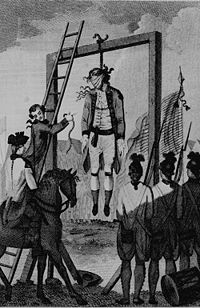
1887: Parsons, Spies, Fischer and Engel, the Haymarket Martyrs

On this date in 1887, the Chicago political machine hanged four at Cook County Jail to defend civilization from the eight-hour day.

The Haymarket martyrs, as they would be remembered ere the hysterical atmosphere of their sentencing had passed, were four from a group of eight anarchist agitators rounded up when a never-identified person threw a bomb at Chicago police breaking up a peaceful rally. The bomb killed one cop; the indiscriminate police shooting that followed killed several more in friendly fire, plus an uncertain number of civilians.

The incident occurred just days after nationwide strikes began on May 1, 1886, in support of the eight-hour day. Nowhere were the tensions greater than Chicago, an epicenter of militant organizing. When tens of thousands poured into the streets on May 1, the Chicago Mail darkly said of high-profile radicals Albert Parsons and August Spies,

Mark them for today. Hold them responsible for any trouble that occurs. Make an example of them if trouble does occur.

Sure enough …

Most of the eight hadn’t even been present at the time the bomb was thrown, but the state put anarchism itself on trial under the capacious umbrella of “conspiracy,” in a proceeding so absurdly rigged that a relative of a slain cop was on the jury. Quoth the prosecutor,

Law is upon trial. Anarchy is on trial. These men have been selected, picked out by the grand jury and indicted because they were leaders. They are no more guilty than the thousand who follow them. Gentlemen of the jury; convict these men, make examples of them, hang them and save our institutions, our society.

That was the argument for hanging them. And right-thinking burghers applauded it.

Seven of the eight were condemned to die; two had their sentences commuted, but the other five refused to ask for clemency on the grounds that, innocent, they would “demand either liberty or death.” One of those five, Louis Lingg, painfully cheated the hangman by setting off a blasting cap in his mouth the night before his execution. (Lingg might have made, though seemingly not thrown, the mysterious bomb.)

The others — Parsons and Spies, along with Adolph Fischer and George Engel — hanged together, with their epitaphs upon their lips — literally so for Parsons, whose parting remark is at the base of the Haymarket Martyrs Monument*

“The time will come when our silence will be more powerful than the voices you are throttling today.”

“Throttle” was right, as the Chicago Tribune reported the next day, taking up when the trap was sprung:

Then begins a scene of horror that freezes the blood. The loosely-adjusted nooses remain behind the left ear and do not slip to the back of the neck. Not a single neck is broken, and the horrors of a death by strangulation begin.

Six years later, Illinois Gov. John Altgeld granted the free pardon the hanged men had demanded to the three surviving Haymarket anarchists. There is no institutional mechanism to determine erroneous executions in American jurisprudence — a fact that occasionally leads to smugly circular avowals that nobody recently executed has ever been “proven” innocent — and death penalty researchers Michael Radelet and Hugo Bedau believed as of this 1998 paper (pdf) that Altgeld’s executive statement flatly asserting the injustice of the Haymarket convictions was the most recent official acknowledgment of a wrongful execution in U.S. history. If true, its uniqueness would be understandable: the gesture cost Altgeld his political career.

Long gone as all these principals are, the legacy of Haymarket remains very much with us, and not just as a magnet for digital archives like this, this and this (don’t miss the brass gallows pin).

May 1, now rich with the symbolism of the Haymarket Passion, was soon selected by the international labor movement as the date to resume the eight-hour-day push — thus becoming the global workers’ holiday it remains to this day.

* Opposing interpretations of the Haymarket affair — which can be the “Haymarket riot” or the “Haymarket massacre,” depending on where you line up — were marked by opposing memorials. The police memorial was itself eventually bombed by the Weather Underground, and subsequently squirreled away from easy public view. Paradoxically, the Haymarket Martyrs Monument has been federally dignified as a National Historic Landmark.

On this day..

1954: Hossein Fatemi, before the blowback

At dawn this date in 1954, the last Foreign Minister of democratic Iran was shot in Tehran.

It was a year since the dramatic events of 1953, when a CIA-backed coup d’etat overthrew Iranian Prime Minister Mohammed Mossadegh (or Mosaddegh, or Mossadeq, or Mosaddeq) for contemplating oil nationalization.

Over several chaotic days of “Operation Ajax” (or TPAJAX), the Mossadegh government repulsed a first coup attempt, then succumbed to another.

After Mossadegh initially appeared to have maintained his hold on power, the autocratic Shah Mohammad Reza Pahlavi fled for his life to Iraq and thence to Rome. Fatemi, Mossadegh’s forceful young foreign minister, excoriated the Shah in words that themselves raised the specter of execution.

A traitor is afraid. The day when you, O traitor, heard by the voice of Teheran that your foreign plot had been defeated you made your way to the nearest country where Britain has an embassy. (Quoted in the New York Times.)

Either way, it was high stakes for all concerned in oil country. There’s been contentious debate over the extent to which the affair was also a Cold War proxy conflict — or whether the involvement of the country’s Communist party was incidental, a smokescreen, or an outright stalking-horse for the west.

The coup against Mossadegh has emerged as a major historical turning point — and after the Shah was himself dramatically overthrown in the 1979 Iranian Revolution, not necessarily so successful for American foreign policy goals as it seemed at the time.

Appropriately — in fact, with eerie prescience given the events that then lay a generation in the future — a recently declassified 1954 CIA report on the coup made the first known use of a neologism that has since grown increasingly familiar: blowback.

Possibilities of blowback against the United States should always be in the back of the minds of all CIA officers involved in this type of operation. Few, if any, operations are as explosive as this type.

Maybe those possibilities should be in the front of the mind.

Today, there’s a street named for Fatemi in Tehran, and — strange to say — still some number of Americans who anticipate the greeting due liberators should they ever manage to roll a tank down it.

On this day..

2007: Not Earl Wesley Berry … for the time being

Minutes before he was to die this day last year, the lethal injection of Mississippi murderer Earl Wesley Berry was stayed by the Supreme Court — the signal that it had imposed a de facto moratorium on executions while it considered the constitutionality of lethal injection.

Condemned to die for kidnapping and beating to death Mary Bounds in 1987, Berry was your basic unappealing death row case with no particular issue either substantive or technical likely to help him out in the courts.

Luckily for Berry, the fundamental issue of whether whether the lethal injection regime used in Mississippi and in most of the United States was cruel and unusual punishment had reached the high court at just time time.

Also luckily, the phone lines were open: Berry got his reprieve with about 15 or 20 minutes to spare.

Berry’s stay finally clarified a few weeks of uncertainty that prevailed after the Court took last year’s lethal injection challenge, Baze v. Rees.

Could executions still go forward while lethal injection was under review? Would the holdup be limited to Kentucky, where the appeal originated? Was there any manner of case-by-case flexibility?

Berry was the bellwether. The execution-friendly Fifth Circuit Court let Berry’s scheduled date go ahead, making the hapless killer “the last best chance for prosecutors to restart executions this year [2007].”

But Earl Wesley Berry’s luck was only about seven months long: he was executed on May 21, 2008, the second prisoner put to death after the moratorium expired upon the Court’s rejection of Baze.

On this day..

1858: Marion Ira Stout, for loving his sister

It’s the sesquicentennial of a then-sensational, now-forgotten hanging in Rochester, N.Y.

At dawn on December 20, 1857, the city had awoken to the discovery of a mangled corpse by the Genesee River’s High Falls … and more than enough evidence to have the corpse’s killers in hand by tea time.

Marion Ira Stout — he just went by Ira — had made a dog’s breakfast of the job, according to History of Rochester and Monroe County New York from the Earliest Historic Times to the Beginning of 1907.

[W]hen they got near the edge of the bank, Ira struck his victim a sudden blow with an iron mallet, smashing the skull and producing death instantly. Stout then threw the body over the precipice, supposing that it would fall into the river and be swept into the lake before sunrise, but instead of that it landed on a projecting ledge thirty feet below the upper level. Perceiving that there had been some failure in the matter, Ira started to go down a narrow path that led sideways along the cliff, but in the darkness he missed his footing and fell headlong, breaking his left arm in the descent and landing beside the corpse. Summoning all his remaining strength he was just able to push the body over the bank, when he sank in a dead faint. On recovering from which in a few minutes, he called to his sister, who was still above, to come and help him. When she started to do so, the bushes to which she clung gave way; she stumbled, broke her left wrist, and fell beside her prostrate brother. But it would not do to remain there, wretched as was their plight. So, after searching in vain for Ira’s spectacles, which they had to leave behind them, but taking with them the fatal mallet, they scrambled slowly and painfully up the bank and made their way laboriously to their home on Monroe Street.

In lieu of a last statement, Stout referred his audience to this writing, which was published posthumously. Courtesy of the New York State Historical Association Library, Cooperstown, N.Y.

Sure enough, the glasses were waiting near the victim for the cops to find come daylight.

How did Ira, his sister, and the late Charles Littles — the sister’s husband — find themselves in this macabre dance?

That’s the murky bit, though it’s fair to say there was some negative energy in the family.

Littles was a violent, jealous, philandering drunk. His wife Sarah seems like the classic abused spouse. Ira was an ex-con who seemingly had his life back together. Oh, and Ira and Sarah were sleeping together — professedly true in the literal sense (they were observed to sleep in bed together in their underthings), and possibly true in the Biblical sense.

Now, where in this tangled knot of incestuous desire, domestic violence, protectiveness, jealousy and intrigue lies the motive is less than self-evident, but Ira and Sarah most definitely schemed to lure Charles to his demise. (Charles was found with a club which he’d brought to clobber a lover of Sarah that he’d been told would make a rendezvous.)

Still, the condemned charmer garnered sympathy for having saved his sister from an abusive marriage; Susan B. Anthony and Frederick Douglass rallied to his defense, and a female admirer smuggled him poison to cheat the hangman … which said admirer managed to end up ingesting herself, and barely survived.

Death got all ten-thumbed around Ira Stout, it seems. His hanging was no different.

The New York Times‘ archive has free access to the report of Stout’s execution, interestingly detailing the upward-jerking “sudden suspension” hanging apparatus in use for the job:

The gallows is the same which has always been in use in the jail — the rope, a hempen cord, alone being new. A weight of 186 pounds rests upon a swing door set in the garret floor of the jail. From this weight, the rope runs over two pulleys above, and the end of it drops through two doors, and nearly to the main floor of the jail. The weight falls about eight feet, jerking the slack end that distance. The halter attached to the main rope is a long distance below the main enginery of death, and the latter is not seen by the spectators or prisoner. The Sheriff stood at the foot of the stairs, some forty feet from the prisoner, and by a small cord pulled the latch which let the fatal weight fall.

But since this is Ira Stout, you know it didn’t come off without a hitch.

The death of the ill-fated man was not as sudden as could be desired. His struggles for eight or ten minutes were severe, and caused the spectators to turn away in disgust.

His neck was probably not dislocated, and he died by a slow process of strangulation. Doctors Hall, Avery, James and Miller stood near, and in eight minutes after the drop fell they said his pulse was as full as in life.

Sort of puts a grim twist on Stout’s own (fairly self-pitying) letters to the papers, in one of which he remarked, “I do not wish to show a cowardly tenacity for life, but I consider it my right and duty to live as long as I can.”

According to a feature story in the newsletter of Mount Hope Cemetery where Ira Stout takes his eternal rest, he might have tried to hang on quite a bit longer.

A rumor was current last night at a late hour that Stout was not dead, and that efforts were being made to resuscitate him by the use of galvanic batteries and other means sometimes employed for the restoration of persons supposed to be dead. How much truth there is in the rumors thus made we cannot say, as we have not taken pains to inquire at the house of Mrs. Stout.

No surprise, that didn’t work either.

On this day..

1865: Champ Ferguson, Confederate guerrilla

On this date in 1865, Champ Ferguson was controversially hanged at Nashville for the “murders” he committed as a Confederate guerrilla.

There seems to be some slight difference of opinion (and do click that link) over Champ‘s role in the War Between the States.

Had the Confederate cause prevailed, he probably would have been a hero. Since history is written by the winners … here he is instead.

For reasons that lie in the uncertain junction between personal enmity and sectional loyalty, the war’s start saw Ferguson terrorizing Union supporters in the Kentucky-Tennessee borderlands, operating primarily around Sparta, Tenn.

These were not only state borders, but borders between the rival federal and Confederate territories. Civil War borders, obviously, were hazy and violently contested affairs: Kentucky was northern-controlled but claimed by both sides (it had rival governments); Tennessee seceded only after Fort Sumter.

Loyalties within Kentucky and Tennessee were divided as well. Ferguson’s own brother died fighting for the Union, and his cousin was killed by Ferguson’s own men. But the main battles were fought far away, leaving the conflict to play out locally.

In many cases … guerrillas identifying with the Confederacy operated well outside Confederate lines and Confederate control, leading to a certain ambiguity in official attitudes, since they did have their uses.

Guerrilla activity was … a feature of those up-country or back-country areas of states like North Carolina, Georgia, Alabama, Tennessee and Kentucky, in which there were significant internal divisions in terms of sympathy for Confederacy or Union … guerrilla conflict was the only direct face of war experienced by many in Tennessee and Kentucky, since the movements of the main armies remained distant from them throughout. Unionist guerrillas, for example, controlled many of the counties of eastern Tennessee, while Confederate guerrillas disputed Union control of western Kentucky and middle Tennessee. One of the ironies of the situation in the Appalachians, the Cumberlands and the Ozarks was that, while these areas of rugged terrain were favoured by Confederate guerrillas, they were also the very areas within the Confederacy which most Union sympathisers inhabited

-Ian Beckett, Modern Insurgencies and Counter-Insurgencies

That was Ferguson — a “legendary Confederate partisan and guerrilla” or little better than a bandit, depending on your point of view. Either way, he was feared by area Unionists and renowned for killing prisoners. Stories of his savagery — severing heads and the like — made the rounds. Ferguson would argue (and did) that he did nothing his enemies weren’t also doing. (The New York Times printed a lengthy account (.pdf) of Ferguson’s versions of the many killings he was accused of — disputing some, frankly acknowledging many.)

That brings us back to winners and losers.

Ferguson, of course, got the losers’ treatment after the war; while vendettas against rank and file Confederate officers were not on the agenda, Ferguson’s irregular status and unbecoming reputation set him up for a war crimes trial. All attempts to claim wartime protections were rejected.

The Times account of his hanging this day — witnessed by his wife and 16-year-old daughter; their alleged rape is sometimes given as the reason for Ferguson’s campaign — is picturesque. (.pdf)

He stood composedly on the drop some twenty minutes, while the charges, specifications and sentence were read by Col. Shafter. He nodded recognition to several persons in the crowd, and shifted his position in an impatient manner while the sentence was being read. To some specifications he inclined his head in assent. To others he shook his head. That about Elam Huddleston caused him to say, “I can tell it better than that.” When the speaker read, “To all of which the prisoner pleads not guilty,” he said, “I don’t now.”


An 1865 Harper’s illustration of the hanging. See the way the troops surround the scaffold? There’s a bit of folklore that the military did that in order to fake the hanging and cut him down still alive.

Along with Henry Wirz, commandant of the notorious Confederate prison Andersonville, Ferguson was the only Confederate executed for Civil War “war crimes.”

Arguably somewhat neglected as a Civil War figure, Ferguson still has a few books detailing his life. An interview with the a author of the newly-published Cumberland Blood: Champ Ferguson’s Civil War is here.

A few books about Champ Ferguson

On this day..

1997: Ricky Lee Green

On this date in 1997, serial killer Ricky Lee Green died by lethal injection in Texas.

The radiator repairman was executed specifically for castrating and stabbing to death Steven Fefferman in 1986, but he killed at least three other people — two women and a 16-year-old boy — and investigators associated his m.o. with up to eight other unsolved murders. (Green also copped to another murder after his conviction, possibly to help another man, William Chappell, avoid execution. It didn’t work; Chappell was executed for that crime in 2002.)

“They all deserved it. They were kind of the dregs of society.”

“A Jekyll and Hyde thing” is how Green’s true-crime biographer characterized him — a lifetime of physical and sexual abuse and a drug habit dating to childhood had seriously warped the dude.

And the most famous serial killer from tiny Boyd, Texas might’ve kept getting away with it if wasn’t for his darn estranged wife.

Someone sure was grateful for Sharon Dollar Green’s help: even though she’d participated in some of the murders, she shopped hubby and skated with ten years’ probation as more Green’s victim than his accomplice.

Green went the popular “death row conversion” route while awaiting the inevitable, or so — atheists in foxholes and all — maintained his last statement.

I want to thank the Lord for giving me this opportunity to get to know Him. He has shown me a lot and He has changed me in the past two months.

I have been in prison 8 1/2 years and on death row for 7, and I have not gotten into any trouble. I feel like I am not a threat to society anymore. I feel like my punishment is over, but my friends are now being punished.

I thank the Lord for all He has done for me.

I do want to tell the …

But the lethal cocktail had begun, and the sentiment went to the grave with Ricky Lee Green.

On this day..

1943: 98 American civilian contractors on Wake Island

On this date in 1943, after Japanese-occupied Wake Island was subjected to a withering bombardment from the United States Navy, garrison commander Shigematsu Sakaibara ordered the summary execution of 98 American prisoners of war.

Wake Island came under Japanese attack immediately after the bombing of Pearl Harbor raised the curtain on the Pacific theater — and was overrun in two weeks.

It was strategically situated halfway between Hawaii and the Philippines. That’s why the Japanese wanted it — and that’s why the Americans wanted it back.

Caught in the middle were 1,600-plus Americans captured when Wake fell in December 1941, 1,100 of them civilian contractors of construction conglomerate Morrison Knudsen there to build a naval base. Most of these, and all military personnel, were shipped to POW camps in China early in 1941; only 700 contractors would survive their four-year sojourn in Japanese captivity.

By September 1942, only 98 Americans remained* on Wake Island — all contractors, the last remnants of the prison labor force who had been forced to lattice the island with defensive fortifications against the expected American invasion.

U.S. forces bombed Wake Island repeatedly during World War II — rare respites from the monotony of forced labor — but the most intense attack was an orchestrated naval bombardment and aerial attack beginning Oct. 5. Shigematsu Sakaibara feared it was the prelude to a long-anticipated landing attempt. And he wasn’t the only one: reporting the attack, the New York Times tried to read the tea leaves of the official pronouncements:

The fact that Wake was attacked yesterday by surface bombardment as well as aeriel bombing probably indicates that a major reduction of Wake is now intended. The atoll, which is the closest Japanese base to Pearl Harbor with the exception of a few islands in the Marshalls group, is a key stepping stone on Japan’s fastest aeriel route to her other central Pacific possessions in the Marshalls and Gilberts southwest of Hawaii.

Still,

[o]ccupation by United States forces of Wake Island, which is 1,033 miles from Midway, has been predicted for some time, but there is no indication that such an operation is probable immediately.

Sakaibara, unfortunately, didn’t have a Times subscription.

Expecting a landing, and fearing the prisoners would rise up as a “fifth column” against their captors when it came, Sakaibara had the 98 prisoners machine-gunned en masse on the beach. One of them managed to survive and escape the slaughter, but was recaptured shortly after, and is supposed to have been personally beheaded by the admiral. It’s said that unidentified man carved a (misdated) testimony to the crime on a nearby coral rock known as “98 Rock”: “98 US PW 5-10-43”.

As it turned out, the landing never did come. The U.S. Navy bypassed Wake Island, allowing it to languish under a blockade as it advanced elsewhere in the Pacific, and received Sakaibara’s peaceful surrender after the bombings of Hiroshima and Nagasaki.

Although the Japanese had hastily exhumed the murdered POWs and reburied them in a cemetery as the end of the war approached, the cover story on the “Wake Island Massacre” soon cracked. For this day’s affair, Sakaibara was convicted of war crimes by an American tribunal, and hanged in Guam on June 18, 1947.

* The identities of the 98 are known, and are listed online here as well as on a plaque at the site.

On this day..

1780: Major John Andre, Benedict Arnold’s handler

On this date in 1780, the honorable British Major John Andre got what Benedict Arnold had coming to him.

Piqued that his (quite considerable) brilliance in the field did not earn honors he thought his due, General Benedict Arnold contrived to betray West Point to the British during the American Revolution — the plot that made his name a synonym for treachery.

As the scheme ripened, the turncoat asked Sir Henry Clinton for “a personal interview with an officer that you can confide in.”

Enter Clinton’s adjutant John Andre, head of British Special Intelligence.

The dashing officer, well-liked in society on either side of the permeable divide between Tories and Patriots on the continent, slipped into Haverstraw, N.Y. to make the arrangements. On his way back — when he already thought himself safely clear of American-held territory — he was nabbed with the incriminating documents.

The narrowly-averted betrayal was mirrored by the narrowest of escapes: luckily for Benedict Arnold, Andre was received in custody by a subordinate officer of his, whose initial report to Arnold alerted the general to his danger and enabled him to escape to the British a whisker ahead of the law.

Treason, of the blackest dye, was yesterday discovered. General Arnold, who commanded at West Point, lost to every sentiment of honor, of private and public obligation, was about to deliver up that important post into the hands of the enemy. Such an event must have given the American cause a dangerous, if not a fatal wound; happily the treason has been timely discovered, to prevent the fatal misfortune. The providential train of circumstances which led to it, afford the most convincing proofs that the liberties of America are the object of Divine protection.

It was a gentlemanly war, and Andre didn’t seem like the guy to hang in the whole exchange. But his argument before a court-martial that he was merely availing “an advantage taken in war” by agreeing to talk to an enemy general who wanted to hand them the keys to a fort didn’t fly: he’d been behind enemy lines, out of uniform, sneaking around. That made him a spy.

And the British refused to obtain Andre’s liberty by trading the man the Americans really wanted to execute.

Instead, by year’s end, the hero of Saratoga was commanding redcoats in the field — perhaps a little nervously; when he asked a captured American what might happen to him should he be taken, the reply was “Cut off your right leg, bury it with full military honors, and then hang the rest of you on a gibbet.”

John Andre was left holding the bag, to the dismay of just about everyone American and British alike. This extended account of the luckless major’s last moments* is from the pen of Continental Army surgeon James Thacher.

Major Andre is no more among the living. I have just witnessed his exit. It was a tragical scene of the deepest interest. During his confinement and trial, he exhibited those proud and elevated sensibilities which designate greatness and dignity of mind. Not a murmur or a sigh ever escaped him, and the civilities and attentions bestowed on him were politely acknowledged…

The fatal hour having arrived, a large detachment of troops was paraded, and an immense concourse of people assembled; almost all our general and field officers, excepting his excellency [George Washington] and his staff, were present on horseback; melancholy and gloom pervaded all ranks, and the scene was affectingly awful … Major Andre walked from the stone house, in which he had been confined, between two of our subaltern officers, arm in arm; the eyes of the immense multitude were fixed on him, who, rising superior to the fears of death, appeared as if conscious of the dignified deportment which he displayed. He betrayed no want of fortitude, but retained a complacent smile on his countenance, and politely bowed to several gentlemen whom he knew, which was respectfully returned. It was his earnest desire to be shot, as being the mode of death most comformable to the feelings of a military man, and he had indulged the hope that his request would be granted. At the moment, therefore, when suddenly he came in view of the gallows, he involuntarily started backward, and made a pause. “Why this emotion, sir?” said an officer by his side. Instantly recovering his composure, he said, “I am reconciled to my death, but I detest the mode.” While waiting and standing near the gallows, I observed some degree of trepidation; placing his foot on a stone, and rolling it over and choking in his throat, as if attempting to swallow. So soon, however, as he perceived that things were in readiness, he stepped quickly into the wagon, and at this moment he appeared to shrink, but instantly elevating his head with firmness, he said, “It will be but a momentary pang,” and taking from his pocket two white handkerchiefs, the provost-marshal, with one, loosely pinioned his arms, and with the other, the victim, after taking off his had and stock, bandaged his own eyes with perfect firmness, which melted the hearts and moistened the cheeks, not only of his servant, but of the throng of spectators. The rope being appended to the gallows, he slipped the noose over his head and adjusted it to his neck, without the assistance of the awkward executioner. Colonel Scammel now informed him that he had an opportunity to speak, if he desired it; he raised the handkerchief from his eyes, and said, “I pray you to bear me witness that I meet my fate like a brave man.” The wagon being now removed from under him, he was suspended, and instantly expired; it proved indeed “but a momentary pang.” He was dressed in his royal regimentals and boots, and his remains, in the same dress, were placed in an ordinary coffin, and interred at the foot of the gallows; and the spot was consecrated by the tears of thousands.

Thus died, in the bloom of life, the accomplished Major Andre, the pride of the royal army, and the valued friend of Sir Henry Clinton. He was about twenty-nine years of age, in his person well proportioned, tall, genteel and graceful. His mien respectable and dignified. His countenance mild, expressive and prepossessing, indicative of an intelligent and amiable mind. … considered as a skilful, brave and enterprising officer, and he is reported to have been benevolent and humane to our people who have been prisoners in New York. … The heart of sensibility mourns when a life of so much worth is sacrified on a gibbet. General Washington was called to discharge a duty from which his soul revolted; and it is asserted that his hand could scarcely command his pen, when signing the warrant for the execution of Major Andre. … Could Arnold have been suspended on the gibbet erected for Andre, not a tear or a sigh would have been produced, but exultation and joy would have been visible on every countenance.

Andre makes a sort of loyalist counterpart to Nathan Hale. Interestingly, Thacher’s account — in which he uses his old diaries for a book that was published in 1823 — footnotes an extended narration of Nathan Hale in a comparative vein, complaining that “whilst almost every historian of the American Revolution has celebrated the virtues and lamented the fate of Andre, Hale has remained unnoticed, and it is scarcely known that such a character ever existed.” Today, in terms of their public recognizability, the two are rather reversed.

* Andre was to have been hanged October 1, but the matter was stayed when a British deputation arrived under flag of truce to make one last parley for their man’s life.

On this day..

1776: Nathan Hale, with regrets

On this date in 1776, Revolutionary spy Nathan Hale was hanged by the British in Manhattan — allegedly uttering the immortal last words, “I only regret that I have but one life to lose for my country.”

Nathan Hale statuary (with bound feet and hands) ironically stationed at Washington D.C.’s Department of Justice. Like statues are at the Chicago Tribune building and the Yale University campus; dueling plaques in New York contend to mark the execution spot.

Two years out of Yale when the Revolution broke out in 1775, the Connecticut-born Hale hitched onto the Continental Army and was directly promoted to captain.

When British Gen. William Howe landed at New York in the summer of 1776, Nathan Hale volunteered to slip behind enemy lines and reconnoiter enemy strength for George Washington. It turned out to be his mission into eternity.

As one might suspect, there’s a great deal more to Nathan Hale than his last words — and a fair bit of uncertainty about what his last words really were. Hale’s Wikipedia page retails many versions of the line from many sources.

The sentiment commonly attributed him (formulated in slight variations, e.g., “I only regret that I have but one life to give to my country”) was supposed to have been reported by a British officer attending him; it’s certainly a punchier version than, e.g., a Revolutionary War era report of “I am so satisfied with the cause in which I have engaged, that my only regret is, that I have not more lives than one to offer in its service.” Gah.

If all these presumably paraphrased reports have the gist right, it’s possible the 21-year-old recited an identical sentiment in the tragic play Cato:*

How beautiful is death, when earn’d by virtue!
Who would not be that youth? What pity is it
That we can die but once to serve our country.

There’s much more about this short-lived character and his larger-than-life transfiguration in mythologia Americana. The Library of Congress has a collection of links, and William Phelps recently penned this new (and surprisingly, first) biography of the revolutionary legend.

* The play was all the rage among patriots; Patrick Henry might have plucked his immortal “give me liberty or give me death” line from it, too. (“It is not now time to talk of aught/But chains or conquest, liberty or death.”)

Part of the Themed Set: Counterrevolution.

On this day..

1860: (William) Walker, Nicaragua Ranger

On this date in 1860, a kid from Tennessee who had made himself President of Nicaragua got his grateful subjects’ comeuppance in the form of a fusillade.

It was westward the wagons that first bestirred the pioneering blood of William Walker, a scion of privilege with an Ivy League medical degree, who uprooted for San Francisco in 1849.

But the “grey-eyed man of destiny” had an altogether grander gold rush in mind, as he stared pensively into the middle distance.

The air was fervid with Manifest Destiny, and most Americans reckoned that the entire hemisphere was its rightful Manifestation. In a time when private settlers effected the statecraft of conquering the Great Plains, was it really any crazier for Walker to fancy privately conquering some distracted European power’s American colonies?

Walker was one of — soon to be the most famous of — a whole class of such characters: filibusters, a word etymologically rooted in piracy but now claimed by the bustling ranks of soldiers of fortune with private militias bent on detaching some parcel of land from south of the border, for money or glory or what have you.*

Oh, and “what have you”? That means slavery.

Nicely dovetailing the individual spur to derring-do, the South’s structural impulsion to expand slaveholding territories to maintain political parity encouraged — and often bankrolled — filibuster adventuring.

It is to these unwholesome fellows that the United States likely owes its sovereignty over Texas, which was pelted with Anglo filibustering expeditions in the early 19th century, helping set the table for the revolution that severed the Lone Star state from Mexico; arguably, the Texas Revolution itself was a (fantastically successful) filibuster.

So Walker had the glittering destinies manifest before his grey eyes when he put off the white collar career to play soldier. After an abortive 1853 attempt to set up his own country in Mexico’s Baja California — a jury instantly acquitted him of waging war on a neutral power; filibustering, and damn near anything that promised America more Manifestly Destined land, was as popular as it was illegal — Walker moved on war-torn Nicaragua under the guise of a “colony”. With a few hundred men, he was able to conquer the capital and set himself up as head of state.

Who knows whether he could have had a future if he’d done it differently. In the actual fact, he wasn’t as hot an administrator as his ego might then have been telling him. He revoked Nicaragua’s anti-slavery edicts, of course; though this sparked resistance, more damaging may have been revoking a Vanderbilt trade concession and bringing a tycoon into the private warfare game on the opposite team.

Cornelius Vanderbilt-backed opponents drove Walker out of Nicaragua in 1857. Not knowing when he was beat, the ex-Presidente kept knocking around stateside piecing together several expeditions, each sadder than the last … until in 1860, when a landing at Honduras collapsed, and he surrendered himself to a British (rather than American) officer. Europeans with colonies to exploit didn’t have much use for filibustering, and Walker had made everyone nervous by openly aspiring to conquer Nicaragua’s neighbors — including British assets. Rather than return him home where he could continue scheming to meddle in the future canal zone, the Brits handed him over to the Hondurans, who stood him in a court-martial, then stood him up against a wall.

Alex Cox (Repo Man) turned this bizarre biography into a film, back when Ronald Reagan’s filibusters narco-terrorists “moral equals of our founding fathers” were having their own unofficial way with the country Walker once governed:

And for a corner of Americana little-known to most in the U.S. — well, the colorful, nigh-unbelievable quality of the action has overridden its obscurity when it comes to the written word.

Various books about William Walker and Filibustering

* More familiar for most Americans is “filibuster” as a legislative maneuver — refusing to yield the floor during debate to forestall the passage of a bill. Not surprisingly, this usage came online at the same time mercenary filibusters were active, and proceeds from the word’s original sense of “piracy”.

On this day..