On this date in 1860, William Fee became the only person ever executed in Wayne County, New York.
Fee’s alleged victim is not distinguished by a name, at least not one known to Fee’s prosecutors. The anonymous woman turned up dead September 26, 1859 on Wayne County’s old Montezuma Turnpike. She had been strangled, the coroner said — and ravished.
Though she was a stranger, the victim had been seen in the area inquiring about employment. Fee and another man named Muldoon had been observed following her the day previous, and that “following” was cast in a sinister light by their now-unknown whereabouts. Both men were laborers working on an enlargement of the Erie Canal around Lyons, N.Y.
Fee was eventually arrested in New York City; Muldoon, in Scranton, Pa. We’ll return to Muldoon later.
Fee and his ill-favored “Hibernian countenance” stood trial from January 30 to February 3, 1860. “Seats were at a premium in the court room and in the gallery behind the curtains there was a crowd of ladies, listening breathlessly to the testimony,” ran a retrospective from 1913. “During the noon hour, seats were bargained for and sold at 10 cents to 50 cents apiece.”
And though he maintained a superficial calm when the jury returned a guilty verdict against him — “Damn tough, but I’m not going to lie awake thinking about it” — William Fee broke down sobbing when the judge finally sentenced him.
The kid came from a working-class family and had a scrappy reputation. It wasn’t clear as he approached execution that he was handling it with the gravity expected for the occasion by right-thinking gentlemen. Then there was the worry for his eternal salvation: born of mixed Protestant/Catholic parents, he was essentially irreligious and indifferent to a parade of ministers who called upon his cell. (Fee accepted the ministrations of a couple of Catholic priests in his very last hours.)
While clerics kneaded the hard clay of Fee’s soul, municipal officials took a chisel to logistics. Since this was the first (and last) hanging in these parts, the equipment had to be obtained on loan: they borrowed the upward-jerking gallows recently used to execute Ira Stout in upstate New York.*
The gallows was erected in one of the small halls of the jail … four upright posts twelve feet high and five feet apart. Across the top was an oak timber projecting two feet or more beyond the frame. At the front end, above where the prisoner was to stand was a grooved wheel or pully; and another was inserted in the timber over the centre of the frame. The main rope ran over these rollers, one end falling in front, to which the halter was attached, the other dropping to the centre of the gallows frame, where heavy weights were attached. These weights, in all 254 pounds, were suspended by a small cord passing through the main timber above and over it to a pin. The weights had a fall of perhaps eight feet. When the cord was severed by a blow of the axe, the weights fell and jerked the main rope running over the grooved wheels. In order that there should be no failure, Sheriff Snedaker had the gallows put up in the court house and fully tested before removing it to the jail. (New York Herald, April 3, 1860)
Fee came to this device still asserting his innocence, but also asserting that Muldoon wasn’t involved. Don’t worry if those seem a bit at odds; the execution party was confused enough to require clarification, too. Cut him some slack: those 254 pounds of weights weren’t going to cut him any.
The hanging went off without difficulty and, whether influenced by Fee’s parting attempt at exoneration or otherwise, Muldoon was never ultimately brought to trial. The evidence against him being unsatisfactory, he was released some months later.
William Fee’s afterlife — apart from this blog post — is allegedly spent haunting his old Lyons Jail (today, the Wayne County Museum).
* From reports, Wayne County didn’t return the gallows: it was eventually scrapped (someone made a chair out of part of it), and the Lyons Republican nicked the hanging-weight to use as a doorstop.
On this date in 1881, George Parrott, a cattle rustler popularly known as Big Nose George, was lynched in Rawlins, Wyoming.
His story doesn’t end with his death, however: as his Wikipedia entry notes, Parrott was notable for “Banditry, Murder, being made into a pair of shoes.” Oh, and being pickled.
The series of events that lead to Parrott’s death began on August 19, 1878, when he and his gang tried to wreck a train near Medicine Bow, Wyoming so they could rob it. They loosened a rail and waited patiently, but an alert section foreman spotted the loose rail and notified railroad authorities, who came and fixed it before the train arrived.
Realizing the law would be after them, Parrott’s gang fled toward Elk Mountain and hid in Rattlesnake Canyon, waiting to ambush the posse they knew would be coming.
As soon as the lawmen were within their rifle sights, the bandits opened fire. Parrott killed Tip Vincent, a Union Pacific Railroad agent; one of the other fugitives, “Dutch” Charley Bates, killed Deputy Sheriff Robert Widdowfield. The gang then fled and hid out in Montana for a span, eventually reaching Canada — and all the while continuing their criminal ways.
Parrott couldn’t keep his mouth shut about his outlaw exploits and bragged everywhere he went. Inevitably, someone who’d heard one of his stories went to Rawlins and happened to mention the hook-nosed man who’d tried to derail a train, then killed two people when their plan failed.
“Dutch” Charley Bates was arrested in Green River, Wyoming in December 1878 and put on a train bound for Rawlins to face trial. Ironically, it was the same train he’d tried to derail earlier that year.
But Bates never made it to Rawlins: when the train made a stop at Carbon City, a group of masked vigilantes overpowered Bates’s guards, hauled him off the train, forced him to confess to his crimes and then hoisted him up on a rope to slowly strangle to death.
Parrott remained at large and the reward for his capture grew to $2,000 before his big mouth got him into trouble again. He and his gang had held up several stagecoaches and pulled off a particularly lucrative job in July 1880. He bragged about it to a lady friend, who told other people, and eventually word reached the ears of the Rawlins sheriff. Within hours he was under arrest.
In a repeat of the Bates lynching, a posse forced Parrott from his Rawlins-bound train in Carbon City. R. Michael Wilson, in his book Frontier Justice in the Wild West, writes what happened next:
They escorted him onto the station platform, put a noose around his neck, yanked him up, then lowered him and asked for a full confession. When he hesitated the men pulled him up several times and then promised that if he confessed, he would be given a fair trial — but if he did not confess, he would be hung. Parrott talked, and once he began, he gave every detail of his various criminal ventures, some of which were quite a surprise to the vigilantes. The mob, true to their word, then returned the prisoner to the custody of Sheriff Rankin.
That’s touching behavior for a vigilante mob, but it sure feels like Carbon City could stand to tighten up its railroad security.
At any rate, Parrott was tried for Tip Vincent’s murder in the fall of 1880, convicted, and sentenced to death.
However, on March 20, 1881, thirteen days before he was scheduled to hang, he made a desperate escape attempt. Though Parrott managed to knock Sheriff Rankin unconscious, Mrs. Rankin foiled the breakout by locking up the cells before Parrott could get out. Extra guards were assigned to watch him after that.
As Wilson records,
Sheriff Rankin asked the townsmen to wait the short time remaining before the prisoner was to be legally hanged, but the general opinion was that the sheriff had taken enough abuse from the prisoner and that Parrott might yet escape if left to await his fate on April 2. On March 22 at 10:55 p.m., a party of thirty masked men went to the jail and removed Parrott. They marched him to the telegraph pole … A rope was placed over the crossbeam of a telegraph pole, the noose was secured around the prisoner’s neck, and Parrott was forced to stand upon a barrel. Parrott begged piteously to be shot and cried out that it was cruel to hang him, but his pleas were ignored.
They kicked the barrel out from under him, but it was too short: the rope and Parrott’s neck stretched enough so that his toes touched the ground.
The mob cut him down and went and got a ladder. Parrott climbed it and said he would jump off and break his neck, but as far as the vigilantes were concerned, that was too good for him: they pulled the ladder away instead, and he slowly strangled to death, tearing off one of his ears in the process.
Drs. Thomas Maghee and John Eugene Osborne conducted the autopsy, examined Parrott’s brain, and could find no apparent abnormalities. Osborne then removed a large piece of skin from the dead man’s chest, kept the skullcap, and put the rest of the body in a whiskey barrel full of saline solution, effectively pickling it. The barrel was buried without ceremony, and Dr. Osborne had the skin tanned. He sent the leather to a shoemaker, who made him a pair of shoes with it.
Dr. Osborne was disappointed that Parrott’s nipples weren’t on the tips of the toes like he’d requested (!!!), but you can’t have everything you want in life.
He wore the human leather shoes on special occasions, including at his inaugural ball when he was elected governor of Wyoming in 1890. The skullcap he gave to his fifteen-year-old female assistant, Lillian Heath, who used it variously as a doorstop and an ashtray. (She would grow up to become the first female doctor in Wyoming.)
Parrott’s pickled remains were dug up at a construction site in 1950, and identified after some confusion. His skull, as well as the shoes, are now on display at the Carbon County Museum.
Pushing 70, the Kurd was a longtime pillar of the Iraqi Ba’ath party and had served in a variety of posts since it took power in 1968. For instance, he brought his management expertise to the Ministry of Industry: “I don’t know anything about industry. All I know is that anyone who doesn’t work hard will be executed.”
He was noted for his role in orchestrating Saddam Hussein’s terrifying 1979 internal purge.
While the first operations of America’s 2003 invasion took place on March 19, it was March 20, 2003 local time that the land invasion proper commenced. That made Ramadan’s execution a fourth-anniversary gift to the occupier’s preposterous foreign policy blunder.
Which was all too bad, since Ramadan had also floated a 2002 plan to avert conflict: have Saddam Hussein fight a duel with George W. Bush. Of course, the offer was declined. “An irresponsible statement,” replied the spokesman of a government that was at that moment engaged in a mendacious campaign to justify its coming aggressive war with creative fables about Iraq’s nuclear capacity.
On this date in 1825, a woman named Peggy Facto was hung on Plattsburgh, N.Y.‘s Broad Street Arsenal Lot.
Facto — or “Facteau,” which variant recalls the French influence here on the shores of Lake Champlain — started her way to the gallows the previous autumn when some neighborhood dogs unearthed the remains of a human infant. It had been partially burned in a fireplace, and when found it still had fast about its throat the cord used to choke it to death. (Plus, of course, the dogs had done their own damage.)
This hideous discovery led back to our day’s principal character, the local mother of two [living] children whose husband had abandoned her due to her affair with a guy named Francis LaBare. Both Peggy and Francis were indicted for “being moved and seduced by the instigation of the devil” to murder their inconvenient bastard immediately after birth.
They faced separate trials for the crime, just hours apart on January 19, 1825, on very similar evidence. Witnesses established the discovery of the body, and an acquaintance named Mary Chandreau testified that she had seen Peggy Facto in an obvious late stage of pregnancy that August. This woman also visited Peggy Facto in jail before trial, and testified that Peggy admitted to having taken a string from one of her gowns to furnish the strangulation-cord.
While this evidence was sufficient to condemn Peggy Facto upon mere minutes of juror deliberation, the same case against Francis LaBare resulted in an acquittal. The mother, who did not testify at her own trial, did take the stand at LaBare’s trial, claiming (according to the notes of the judge), that immediately after she delivered the child, Facto
asked [LaBare] to go find her mother & he refused. She then asked him to go find Mrs. Chandreau & he refused, and next asked him if he meant to let her die there & he said the damned old bitch, I can do better than she can. She then requested him to help her & he did & then the child was born & he took it out and went off & was gone an hour, and when he returned … he came towards her with a knife & threatened her life if she said anything about it.
This quote, and much of what is known about Peggy Facto generally, comes via the research of Plattsburgh judge Penelope Clute. See here and here for HTML versions of the article, or here for a pdf.
It’s difficult to account, on the face of it, for the wildly differential outcomes of these trials; the all-male juries might have something to do with it.
At any rate, while LaBare walked, judge Reuben Walworth* pronounced Facto’s fate with enough fury for two … and a distinct disbelief in Facto’s attempt to blame LaBare:
there are very strong reasons for the belief that your own wicked hands have perpetrated the horrid deed. And if there was any other guilty participator in the murder, that your own wickedness and depravity instigated and persuaded him to participate in your crime. To the crime of murder, you have added the crime of perjury, and that in the face of Heaven, and even on the very threshhold of eternity. I am also constrained to say, it is much to be feared, that you will meet more than one murdered child, as an accusing spirit at the bar of Heaven.
Wretched and deluded woman! In vain was the foul and unnatural murder committed under the protecting shade of night, in your lone and sequestered dwelling, where no human eye was near to witness your guilt.
Facto’s only “appeal” after her half-day trial was the clemency consideration of Gov. DeWitt Clinton, a petition that ended up garnering a great deal of popular support, on three stated grounds:
As to the policy of executing any person for the crime of murder when the public opinion is much divided on this subject
Even Judge Walworth ultimately supported this appeal, despite his confidence “that the woman was perfectly abandoned and depraved and that she had destroyed this child and probably the one the year previous, not for the purpose of hiding her shame which was open and apparent to everybody that saw her but for the purpose of ridding herself of the trouble of taking care of them and providing for their support.”
The governor disagreed, arguing that the sort of enlightened people who signed on to death penalty appeals were out of touch with the rank terror necessary to keep the criminal orders cowed.**
So on March 18, 1825, an enormous crowd (fretfully many of them women) summoned from all the nearby towns slogged through spring-muddied roads to be duly cowed by the execution of the infanticide. The condemned, visibly terrified, barely made it through her death-ritual without fainting away, but she managed to re-assert her innocence from the gallows. (Some of the firsthand newspapering is here.)
After execution, Peggy Facto’s remains were turned over to the Medical Society for dissection. “A great many went to see her body, although it had been agreed that it should not be seen,” one woman later recollected in her memoirs. “Many young men went. So much talk was made of this that they said that no other body should ever be given to the doctors.”
** “Their excellent character elevates them above those feelings which govern the conduct of the depraved … if terror loses its influence with them then indeed the life of no man will be secure.” For more on the evolution of the idea of “exemplary deterrence” as the death penalty’s raison d’etre, see Paul Friedland.
This date marks half a century since the hanging of Victor Feguer — the last man executed by the federal government in the 20th century. (And the last executed in the state of Iowa, period.)
A drifter holing up at a Dubuque, Iowa, boarding house, Feguer phoned up a random doctor claiming a woman needed medical attention.
Think about that the next time someone gets nostalgic for house calls.
Dr. Edward Bartels showed up only to be kidnapped by Feguer, and eventually murdered in Illinois. Feguer was picked up in Alabama, trying to sell the doctor’s stolen car; his motive for the whole affair was just to get whatever drugs the luckless physician had with him.
The cross-state crime spree put Feguer’s case in the hands of the feds. (It was not, however, a “Lindbergh Law” case, since Feguer was on the hook for capital murder independent of the kidnapping.)
Iowa still had a death penalty on the books at this time, but it had a death penalty abolitionist for a chief executive; just two years hence, that Gov. Harold Hughes set his pen to the Hawkeye State’s death penalty abolition bill. Iowa hasn’t hanged, shot, electrocuted, poisoned, or otherwise judicially executed anyone since.
Feguer’s last meal, oddly, was a single olive. He tucked the olive’s pit into the new suit he wore to his dawn hanging.
As the death penalty waned into a formal abeyance in the 1970s in the U.S., the federal government stopped executing people for a long, long time. (And stopped hanging people altogether.) The next time a human being was put to death under federal auspices was 38 years later: Oklahoma City bomber Tim McVeigh.
This date in 1777 saw the public execution of “John the Painter” — a Scotsman who had been christened “James Aitken” at his birth less than 25 years before, but who had run through countless aliases in his adult life as a (mostly) petty thief.
But this man was not a hapless victim of England’s Bloody Code, although he often enough offended the capital statutes against petty property crime.
Rather, the scraggly redhead with the thick Scottish brogue was the author of a stunning act of domestic terrorism, in England, in freelance support of the rebellious American colonies an ocean away.
“So dangerous an individual to the kingdom as this man perhaps never existed,” in the judgment of the Newgate Calendar, who knew him as “John Hill” — just one of Aitken’s many aliases. “and whose confession and repentence can hardly soften the abhorrence felt on the contemplation of the extent of his crimes.”
James Aitken, aka John Hill, aka John the Painter — for this last was, unfortunately, the unprofitable occupation of his apprenticeship training — fired the Portsmouth dockyards on December 7, 1776, then followed that up with an attack on the Bristol dock and city shortly after the New Year, as well as an unsuccessful attempt to ignite the Plymouth quay.
Although he was well-read for his class, he was not ideological, not a zealot of any creed religious or secular.
He was not American himself even in the loose sense that term could hold for the immigrant proto-nation. His only brush with that land was brief and unedifying: fearing his many thefts had made London a bit too hot for him, he signed on as an indentured servant and shipped out to the colonies in 1773 and slave-like labor in the fields. He escaped his master in 1775 and immediately shipped back to Europe, leaving no evidence of any revolutionary contacts.
And he wasn’t a madman. Just lonely, as evidenced, Warner says, by the “sad and always desperate invitations” to drink with which he plied the newest of acquaintances, to their discomfort. “He asked complete strangers to drink with him because he was lonely, and loneliness overrode his reason. His invitations always came too quickly, and his conversation and his manner always just a little off.” He even invited this indiscreet attention when on the incendiary job.
James Aitken reads like an Enlightenment version of the disaffected loser “going postal” on a world that could barely see him to tread upon him. His fondest desire from childhood was that classic Scots aspiration, the army commission. The closest he came was a series of short-term army enlistments to pocket the enrollment bonus, each of which he deserted as soon as practicable. (He did dream that his terrorism spree would earn him an appointment in the Americans’ Continental Army.)
Back in Britain after his unsuccessful foray in the colonies, Aitken conceived a disordered affinity for the burgeoning patriotic cause of the colonies he had recently fled. (Warner thinks he read Thomas Paine‘s Common Sense.) Only accidentally, when he overheard boozers at an Oxford pub chatting about the importance of the dockyards to the British Navy, did the heretofore aimless Aitken animate his wanderings with a new revolutionary purpose: he, scorned nobody, could win the War of Independence by crippling these facilities.
I spent two days in the contemplation of this malicious design, and promised myself immortal honour in the accomplishment of it. I beheld it in the light of a truly heroic enterprise, such as never would have been equalled to the end of time. I was persuaded it would entitle me to the first rank in America, and flattered myself with the ambition of becoming the admiration of the world! (Source)
Aitken was not a criminal mastermind, but there was a plausibility to the plot that fluttered the Admiralty’s heart once the details emerged. The dockyards were critical. They were also — Aitken readily perceived this as he began to case them — scarcely guarded; at Portsmouth, Aitken came and went as he pleased, freely schlepping his materiel in and out. (His attempt at Portsmouth set the subsequent facilities more on guard; the man’s initial plan to hit five different dockyards in sequence would ultimately have been as self-defeating as the 9/11 hijackers planning to commandeer a different plane on five consecutive days … but this was the way Aitken had to conceive it since he lacked the charisma or leadership aptitude to form a cell of fellow-travelers for a coordinated attack.)
Before launching himself into history, Aitken made an autumn 1776 visit to Paris to call upon the American representative there, Silas Deane.
Deane’s own recounting says he was struck by the wildness of Aitken’s scheme. But he was sufficiently taken with the prospective payoff to lend it his blessing, and “sponsor” it to the extent of giving the Scotsman a little pocket money to make his way back to England. He would later defend himself against “respectable persons,” presumably British ones, who “[regard] me equally criminal with the actor.”
[S]upposing me to be the liege subject, not of Great Brittain, but of a foreign independant Nation, at the Time at War with Great Brittain, and that imagining that I had found a favorable opportunity, & met with a proper Agent to destroy, at one blow, the Fleet & armaments preparing to carry, and to spread devastation, and bloodshed in my Country, and that I improved the favorable moment, and attempted through this agency, to effect this great object; on this view of the case I am confident that every one of common sense & impartiality must acquit me, nay more though they rejoice at the defeat of the enterprize they must approve of the motives, which influenced me to engage in it, motives no less than a desire to weaken a declared Enemy, and to preserve my Country, by every means in my power, from the horrors, and distress of Fire and desolation.
… if it was a noble, and most honorable Action in Lord Rodney to defeat the Count de Grasse, would not the Man who at equal hazard of his Life, had set fire to the Count’s Squadron in Brest, & thereby have equally defeated his expedition, been entitled (at least in the Court of Common sense) to the same Honors?
This was certainly good enough to convince Aitken that he torched in the name of Liberty, and he made his way back to set his plan in motion.
After botching his first attempt at Portsmouth and getting locked in the rope house — he pounded on the door until he got someone to open up, then bluffed his way out of the situation — Aitken got the least mileage possible from a superficially successful attack.
At about 3:30 p.m. on Saturday, December 7, Aitken fired three homemade incendiaries in the rope house and slipped away in what witnesses would later reconstruct as an evident state of agitation. The flames soon gutted the brick building (the damage would eventually reckon to £20,000) but he was this close to an exponentially more impressive bit of sabotage.
To begin with, many of his matches failed to start up Aitken’s jerry-built fuses. (This is also what caused his initial arson attempt to abort.) Having been once bitten by finding himself locked into the rope house at night, Aitken made his next trip earlier in the afternoon: that ensured that plenty of dockhands would still be in the vicinity to contain the fire to the one building. It also meant that the tide was in, and the nearby brig swollen with two thousand pounds of gunpowder could be easily put out to sea and away from danger as soon as the alarm went up.*
Admiralty investigators weren’t even sure at first that it was arson. Yards in the era of wood ships and wood buildings had a lot of flammable materials lying around. Fires happened.
Aitken soon dispelled any possible confusion.
Finding the Royal Navy dockyards at Plymouth too vigilant for his machinations, Aitken settled on an ambitious, and again somewhat plausible, scheme to engulf the densely-populated port of Bristol — dockyard and city alike. Repeatedly his blazes petered out or were suppressed. They did little consequential damage, but raised a rapidly-escalating panic at revolutionary incendiaries abroad, and it did not take long to link them to Portsmouth. (Copycat attempts and crackpot anonymous letters threatening same also started popping up elsewhere in the realm.)
“I have not the least doubt that the late fires have been the effects of premeditated malice,” wrote Bristol’s M.P. — the political philosopher Edmund Burke. Naturally this only had the effect of silencing potentially considerable pro-American sentiment in Bristol and throughout the realm. Lord Germain exploited the terrorist panic to push through a February 1777 Treason Act aimed at the American colonies. It authorized detention of suspected rebels without habeas corpus protection at His Majesty’s pleasure.
Aitken himself, though, was at the end of his own fuse. At Sir John Fielding‘s urging, the Admiralty posted an eye-popping £1,000 reward for the terrorists’ (multiple attackers were presumed, owing to the quantity of fires) capture. The arsonist was in irons with a week; a gaoler had noticed him and recognized Aitken’s fit to the description of the unknown Scotsman who had been seen in the vicinity of some of these blazes which Fielding had published in his crime clearinghouse periodical, Hue and Cry.** That man rode off after the suspect and overtook him in the village of Odiham,† where an exhausted and by now fatalistic Aitken surrendered without a fight.
The mizzenmast of the docked HMS Arethusa was removed and set up on land to hang this enemy of the navy outside the walls of the damaged Portsmouth dockyard.
Upon it, they would hang their man as high as Haman: after being turned off, a team of workmen hoisted Aitken’s still-strangling body 60 feet into the air. It’s reportedly the highest gallows ever known to be erected in England, and for the benefit of anyone who didn’t get a good enough look at the spectacle, his body remained conspicuously suspended in chains for years thereafter at Fort Blockhouse, overlooking the Portsmouth harbor as it rotted away.
One might expect that a man who had turned his face against king and country to such an extent would make his end defiantly. James Aitken, once again, defies expectations here, sounding submissive and contrite in the officially reported last words.
I asked John the Painter author Jessica Warner what it was that the state hoped a prisoner like Aitken would say from the scaffold. How did condemned prisoners typically come to shape their last words in (usual) conformity to the expected models? Was it usually necessary for somebody to convince them to do so?
JW: I can only speak for eighteenth-century England. The so-called “dying speeches” of the condemned follow a pretty predictable pattern: the condemned man expresses contrition for his crime, warns others against following his example, and says, in so many words, that he is reconciled with his Creator. That’s the official version, and really two things are going on here: the prisoner is in effect upholding the state’s right to take his life while also upholding the moral order of the Ancien Regime, its laws as much as its religious teachings. I say “official” because just about all dying speeches were penned by other people, the most notorious being the succession of chaplains (ordinaries) who presided over the condemned prisoners at Newgate. It was a bit of a standing joke that dying speeches were printed before they were delivered. The irony is that shorthand was used in the eighteenth century, and so theoretically it was possible to take down exactly what prisoners said.
Popular expectations, to the extent that they can be penetrated, also expected the condemned to make a good end, a good end being measured in terms of bravery bordering on contemptuous indifference to one’s fate. It’s hard to reconcile this indifference with the regret the prisoner was supposed to express.
ET: Did the fact that Aitken was a hated state criminal, rather than an everyday felon, alter anything about the role he was expected to play in the execution ritual?
JW: I don’t think so. The various accounts of his last moments read suspiciously like those you find in other dying speeches. Given the fact that he was a Scot who had poor social skills and who was also more than a little off his head, it beggars belief that he would have performed his part so well and in so conventional a fashion. I don’t doubt, though, that he made a brave end of it.
* The original Portsmouth plan was to start with a diversionary fire in the city itself, and then burn the dockyard while fire engines were occupied with the previous blaze. Again, his imagination outstripped his reach as a lone wolf: the attempt to kindle this preliminary fire just got him run out of his boarding-house and made the landlady a later witness against him.
** For more on Fielding’s criminal investigation reforms, see this post.
(Thanks to Robert Elder of Last Words of the Executed — the blog, and the book — for the guest post on the anniversary of what was then the first execution in Indiana for nearly 20 years. Fans of this here site are highly likely to enjoy following Elder’s own pithy, almanac-style collection of last words on the scaffold. -ed.)
“I don’t hold no grudges. I’m sorry it happened. I know what I’m doing.”
— Steven T. Judy, convicted of rape and murder, electric chair, Indiana.
Executed March 9, 1981
A serial rapist, Judy openly courted capital punishment. At his trial for killing a woman and her three children (ages five, four, and two), Judy told a jury to condemn him or else he might kill them, their children, and the judge. He showed no remorse for the murders, telling reporters, “I don’t lose sleep over it.” Judy asked for death. “I’ve lived my hell,” he said. “So [what waits for me] has to be better.”
According to some newspaper accounts deemed credible enough by almanacs and registers of the time, a British officer named Hamilton Ballendine was hanged by the Americans during the Siege of Charleston. The good colonel had thought he was approaching his own British sentries after a reconnoiter of Charleston’s defenses, and when hailed he provided this name.
His name, or his alias, or his password — whatever it was, it was not recognized by the sentries, who turned out in fact to be the colonial pickets. At that point, he was a spy caught red-handed, and these folks tended to get short shrift during the American Revolution.
This event has struck some observers as conspicuous by its absence from any of the numerous firsthand diarists’ accounts within the besieged city. The account in this footnote, recopied in its entirety below, appears to be the sum of the information on the matter. Judge accordingly, gentle reader.
In the Siege of Charlestown (Munsell), 68, we find the following: —
EXECUTION OF COLONEL HAMILTON BALLENDINE.
(From Dunlop’s Packet of April, 1780.)
WILLIAMSBURG IN VIRGINIA, APRIL 18.
On the 5th Ult. was hanged at Charlestown, South Carolina, Colonel Hamilton Ballendine, for drawing Draughts of the town and Fortifications. He was taken by a Picquet Guard, which General Lincoln sent out that Night to Stono, as he was making his Way to the enemy; and when he was hailed by the Guard his Answer was, ‘Colonel Hamilton Ballendine.’ The Guard told him that would not do, and carried him to the commander of the Picquet, upon which he pulled out of his pocket the Draughts. The Officer told him he was mistaken, and carried him to General Lincoln, who ordered him for Execution.” —New York Royal Gazette, April 16.
See, also, Moore’s Diary of the Revolution, vol. II, 260. The story is also incorporated in the text of the Annual Register for 1780 (London), vol. XXIII, 222, in which it is said that Ballendine suffered “the unpitied death of a traitor.” Both Simms (So. Ca. in the Revolutionary War, 177) and Draper (King’s Mountain and its Heroes, 22, note) call attention to the fact that the story is mentioned by none of the South Carolina historians, nor any of the Charlestown diarists or letter writers. Draper seems to doubt if there was any such person. In the So. Ca. and Am. Gen. Gazette, June 9, 1775, Hamilton Ballentine advertises a power of attorney to receive a legacy due and collect the assets of an estate. There was therefore doubtless such a person, but what became of him is not further known. His name is not on the list of those whose estates were confiscated (Statutes of So. Ca., vol. VI), where it probably would be found had the story been true. It is scarcely possible that such an event would have been overlooked by all the writers and diarists of the time, and not have been preserved by local tradition; and yet the particularity of the statement, and its acceptance by the Annual Register at the time, would suggest that there must have been some foundation for the statement.
Minutes after midnight on this date in 1909, an Oregon plasterer named C.Y. Timmons was hanged at the state prison in Salem, Oregon for the murder of Estella, his wife of two years.
On October 21 the previous year, he had put an ax in the back of her head, slit her throat from ear to ear with a straight razor and then attempted to take his own life with the same razor. The two were discovered by the neighbors at 7:30 the next morning when a partially unclothed C.Y. came knocking on their door, “covered in blood from head to foot.”
Timmons quickly regained his ability to speak and told authorities Estella had cut his throat while he was sleeping. He grabbed the razor from her hand, slit her throat in self-defense, and then finished her off with an ax. Then he lay down and waited until dawn before he went and asked for help.
The truth came out, however, and at his trial in mid-January 1909, C.Y. admitted that he’d gone round the bend with jealousy over his younger wife’s* affair with one Robert Hornbuckle. C.Y. and Estella had been quarreling for a long time about her relationship with Hornbuckle. Only the day before the murder, the couple had met with an attorney to procure a divorce — a drastic measure in that day and age.
During the meeting, Estella told the lawyer that her husband had a violent temper, especially when he had been drinking, and that he had threatened her life on numerous occasions.
C.Y. apparently believed his victim’s alleged infidelity would outrage the jury into acquitting him. Not so; they deliberated a whopping 35 minutes before finding him guilty. C.Y. broke down in tears when the verdict was read. And, for what it’s worth, all evidence indicates that Estella’s “affair” with Hornbuckle existed only in her husband’s imagination.
C.Y.’s hanging was as gruesome as his crime, as Wilson records:
[A]t 12:31 p.m., the trap was sprung and Timmons dropped six feet, one inch. The force of the drop caused the neck wound to open and for some time the hanging figure breathed through the gaping wound beneath the rope, and the body was drenched with blood. The attending physicians differed on whether Timmons’ neck was broken in the fall, but later examination proved that the vertebrae had been dislocated. This complication, breathing through the open wound, prevented pronouncement of death until 12:54 p.m., and the body was allowed to hang another seven minutes to ensure he was dead.
The murderer was buried separately from his victim, at the Lee Mission Cemetery in an unmarked grave.
* Her age was given in different accounts as either 19 or 21; C.Y. Was 37. Another pathetic detail to her tragic life: Estella was an orphan, raised in an orphanage after her parents both died of tuberculosis.
Late this night in 1969, a platoon of seven Navy SEALs slipped into the Mekong Delta village of Thanh Phong.*
At their head was a 25-year-old lieutenant, the future United States Senator Bob Kerrey.
Thanh Phong was reportedly an official U.S. Army free fire zone. That meant that any Vietnamese civilians within it were presumptively enemies and could be slain at will — according to the U.S. Army, if not to any recognizable law of war.
In Thanh Phong, they were slain. Nearly every single person in the town.
Gregory Vistica’s disturbing investigation brought this story to wide public attention in 2001; he subsequently expanded his investigation into a book.
Kerrey’s Raiders — the commando team’s comradely self-designation — were hunting a local National Liberation Front “general secretary” purported to be in Thanh Phong. By “hunting,” we mean they intended to murder him; given the nature and timing of the operation, it was presumably part of the brute-force assassination program Operation Speedy Express and/or its equally sinister CIA-run cousin, the Phoenix Program.
On this particular mission, Lt. Kerrey’s team first encountered an unexpected hut, not on their map. Fearing the people inhabiting it would blow their cover, they entered and killed the five inhabitants: quietly, intimately, at close quarters with their knives. It was an old man, a woman, and three young children. It’s a nasty business but it’s not what qualifies Thanh Phong as a potential execution … though it may explain the execution that followed.
After these unfortunate villagers were disposed of, the SEALs moved on towards the doomed hamlet. This same platoon had been to Thanh Phong two weeks before, and reported then that it held nothing but a few women. On February 25, they found much the same scene: no “general secretary.” Just 16 women and children.
Klann: We gathered everybody up, searched the place, searched everything.
Rather: What was the make-up of this group?
Klann: Probably a majority of em were kids. And women. And some younger women.
Rather: So you got all the people out of there.
Klann: We herded them together and in a group.
Rather: Were any of these people armed?
Klann: I don’t believe so.
Rather: Fair to say you didn’t see any weapons?
Klann: I didn’t see any.
Rather: Did you decide pretty quickly or not that the target of your mission, the Viet Cong leader, was not among them?
Klann: Yeah, we got together and we were, hey the guy ain’t here. Now we got these people, what do we do now?
Rather: What did you do then?
Klann: We killed them.
Rather: What do you mean, you killed em?
Klann: We shot them all.
Rather: Was an order given for that or was it more or less spontaneous?
Klann: I don’t think we would have acted spontaneously on something like that. There was an order given.
Rather: What was the order?
Klann: To kill them.
Rather: Why?
Klann: Cause we’d already compromised ourselves by killing the other group.
Rather: Whose responsibility, whose obligation as it to say that?
Klann: The ultimate responsibility fell on Bob Kerrey.
Rather: Do you remember him saying that?
Klann: I don’t remember his exact words, but he was the officer in charge. The call was his.
Rather: And then what happened?
Klann: We lined up, and we opened fire.
Rather: Individually or raked them with automatic weapons fire?
Klann: No. We, we just slaughtered them. It was automatic weapons fire. Rifle fire.
Rather: At roughly what range?
Klann: Six feet, ten feet, very close.
Rather: Then did the shooting stop?
Klann: Yeah, for a little bit.
Rather: Was it quiet?
Klann: It was dead quiet. It was dead quiet. Then you could just hear certain people, hear their moaning. So we would just fire into that area until it was silent there. And that was it. And, and until, we were sure that everybody was dead.
Rather: You said certain people were moaning or making noises. Were all those adults?
Klann: A few. I remember one baby still crying. That baby was probably the last one alive.
Rather: What happened to that baby?
Klann: Shot like the rest of em.
Klann’s testimony of a summary execution comports with that of a Vietnamese woman who says she hid on the outskirts of the tiny village and witnessed the slaughter.
Bob Kerrey has a different version of these events. The reader is invited to peruse the evidence available and conclude as desired; for me, Kerrey’s version is not very persuasive especially given the witness testimony to the contrary and the known normalization of atrocities in Indochina.
Kerrey agrees with Klann that the entire village ended up slaughtered together in a heap; a complaint against this atrocity was officially filed with the Army by Vietnamese locals within days of the incident, so there’s not much scope to deny the outcome. But Kerrey claims this happened when the SEAL team received incoming fire as they approached the village, then started shooting back wildly in the dark. Only after the bullets stopped flying did they find the civilians 50 to 100 yards further on.
Improbably — but much more consistent with an intentional, close-range massacre — all these women and children chanced to be huddled together, and all of them were stone dead from the crossfire. Not a one of these people accidentally winged in the night was wounded but alive, says Kerrey.
Kerrey’s commentary in Vistica’s initial story and its follow-ups suggests the judicious politician he had by that time become. In 2001 he had just retired from the Senate and was an elder statesman in government; he was said to be weighing a 2004 presidential bid. (His actual next gig, not anticipated at the time the story broke, was the 9/11 Commission.)
In interviews with Vistica and subsequently, Kerrey waffled and qualified cagily — shifting from a flat denial, to a weird acknowledgment that “it’s possible a slight version of that happened.” He wouldn’t commit to asserting that there really was incoming fire. He moved the conversation wherever possible to the abiding torments of conscience and the slipperiness of memory and perspective, as if this could span the distance from “summary execution” to “accidentally killed in the crossfire.” He maintained that there were only men in the first hut — that hut, alone among the village — but that this was only an indirect recollection since he didn’t enter it or participate in the killings.
“Please understand,” Kerrey emailed to Vistica in 2000, “that my memory of this event is clouded by the fog of the evening, age and desire.” Desire is a striking word to select.
For all their plausible deniability, Kerrey’s remarks on this matter markedly lacked indignation at bearing such a monstrous charge. Kerrey’s great and unfeigned sense of personal guilt was oddly mirrored by his inability to own a specifically culpable act. The Senator expressly declined to deny Gerhard Klann’s “memory.” (Klann said Kerrey urged him not to talk about Thanh Phong.)
Kerrey won a Bronze Star for Thanh Phong. “The net result of his patrol,” according to a citation Kerrey has acknowledged is fanciful, “was 21 Viet Cong killed, two hooches destroyed and two enemy weapons captured.”
Seventeen days after Thanh Phong, Kerrey’s service career came to an end when a grenade exploded at his feet during another assassination mission. Kerrey earned the Congressional Medal of Honor for continuing to direct fire while crippled by wounds on that day; by accounts, he spent the several years following mired deep in depression.
“I went out on a mission and after it was over I was so ashamed I wanted to die,” he said of Thanh Phong in 2001. “This is killing me. I’m tired of people describing me as a hero and holding this inside.”
It goes without saying that war crimes in Vietnam remain much too sensitive for the U.S. to grapple with formally. The story is out there now, but it’s been effectively reburied as far as the American public memory goes — another everyday horror in a horrible conflict. More information might oneday surface, but the matter will only be adjudicated between Gerhard Klann, Bob Kerrey, their comrades that night, and their Maker.
Not so in Vietnam where — with all due respect to the pangs that conscience can exact — the real victims lie.
February 25, 1969 has a dedicated exhibit in Ho Chi Minh City’s War Remnants Museum.
A display of the sewer pipe where the three children killed at the first hut tried to hide, along with photographs and an explanatory placard describing the Thanh Phong massacre, at the War Remnants Museum in Ho Chi Minh City. (cc) images by Schwede66.
* The only other member of the team who has spoken publicly, Mike Ambrose, backs Klann’s version of the hut narrative, and (mostly) Kerrey’s version of the (non-)execution. As Vistica’s initial investigation was going public, Kerrey convened a meeting of the other Raiders, their first since Vietnam; the group issued a statement denying that they had committed an execution of prisoners.

 The series of events that lead to Parrott’s death began on August 19, 1878, when he and his gang tried to wreck a train near Medicine Bow, Wyoming so they could rob it. They loosened a rail and waited patiently, but an alert section foreman spotted the loose rail and notified railroad authorities, who came and fixed it before the train arrived.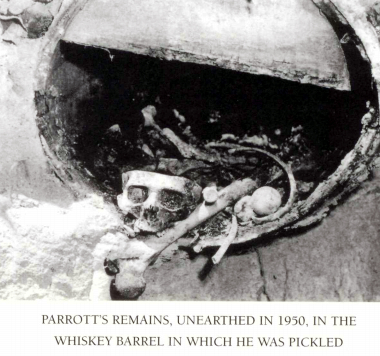


 But this man was not a hapless victim of England’s Bloody Code, although he often enough offended the capital statutes against petty property crime.
