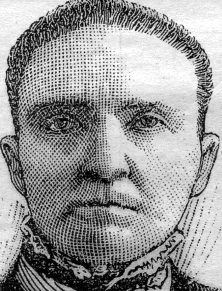
1886: Joseph Jackson and James Wasson, at Fort Smith


St. Louis Globe-Democrat, January 31, 1886

America’s most notorious “hanging judge” Isaac Parker issued the sentences resulting in this date’s double hanging at Fort Smith, Ark.

A much more prodigious body count had been ordered initially by the court, but clemencies straight from the hand of U.S. President (and former hangman) Grover Cleveland averted five of seven death sentences on their eve of execution. All the killers under sentence, spared or no, committed their murders in Indian Country.

In February, 1886, seven men were sentenced to be hung on April 23, 1886, but before that day arrived the sentences of all but two had been commuted. The two unfortunates were Joseph Jackson, a negro, convicted of killing his wife at Oak Lodge, Choctaw Nation, on March 9, 1885, and James Wasson, a white man, who participated in the murder of Henry Martin in 1872, but was not apprehended until he took a hand in the killing of a man named Watkins in 1884.* (Source)

Jackson slashed his own throat with the shard of a vase in an unsuccessful bid to cheat the hangman, and sported a terrible gash on his neck when he hanged.

* According to the Atchison (Ks.) Daily Globe of April 30, 1885, Watkins was a cattle baron, whose widow wife then put a $1,000 price on Wasson’s head. The killer’s arrest ensued promptly. Although Wasson hanged for the earlier murder and not for that of Watkins, the aggrieved Texan woman “was here [at Fort Smith] every term of court after Wasson was brought in, and employed counsel to assist the District Attorney in prosecuting him, having, it is said, spent over $7,000 in bringing him to justice.” (St. Louis Globe-Democrat, April 24, 1886.)

On this day..

1928: Charles Birger, bootlegger

On this date in 1928, colorful gangster Charles Birger was hanged in Benton, Illinois.

A sort of social bandit for the Prohibition era, Birger was born Shachna Itzik Birger to a Russian Jewish family that immigrated to the U.S.

Birger was a young saloon-keeper on the make when the U.S. decided to make a go of its first foolish drug war, Prohibition. And in the immortal tradition of drug wars, it made the enterprising purveyor a whole lot richer, and a whole lot violent-er.

While Al Capone‘s Tommy Guns were tearing up Chicago, Birger set up shop in southern Illinois. A literal shop: from his famous speakeasy Shady Rest, he did three-way battle with the (pro-Prohibition) Ku Klux Klan and the rival Shelton Brothers Gang.

This cinematic affair of armored car shootouts, aerial bombings, and gangland assassinations comes off with verve in A Knight of Another Sort: Prohibition Days and Charlie Birger. The bon vivant Birger, bursting with charisma, entertains at his gin joint, aids the misfortunate, corrupts the police, and merrily mobs up Williamson County.

That story reached its conclusion when Birger was arrested for ordering the murder of Joe Adams, mayor of a nearby town who had taken the Shelton Gang’s armored “tank” car in for repairs.

Birger said he hadn’t actually done that, but he went to the gallows grinning, and humorously chatted up reporters before the big show — cementing his myth with that legend-quality indifference to death.

“I’ve played the game and lost, but I’ll lose like a man,” Birger philosophized. “I’m convicted of a crime I didn’t commit, but I’ve committed a lot of crimes. So I guess things are even. We got too strong against the law, and the law broke it all up.” (From the Chicago Tribune, April 20, 1928.)


Birger shakes hands with so-called “humanitarian hangman”
Phil Hanna.


Birger insisted on hanging in a black, not a white, hood — owing to his hatred of the Ku Klux Klan.

Birger is still a legend in southern Illinois, and a live one at that: he’s been in the news lately due to a weird custody fight over the rope used to hang him.

This macabre historical memento also happens to be the last rope ever used for any public execution in Illinois.

On this day..

1921: Mailo Segura, a Montenegrin in Alaska

(Thanks to Meaghan Good of the Charley Project for the guest post. -ed.)

At noon on this day in 1921, Mailo Segura was hanged in Fairbanks, Alaska.

In 1918 he had murdered a miner, J.E. “George” Riley, near the gold rush town of Flat, in a dispute over money. His was the second execution in Fairbanks history.

George Riley was in charge of the mining operations along Orter Creek near Flat. Segura was a lumberjack and, together with some other men, had sold $300 worth of cordwood to Riley on credit.

In early 1918, Segura confronted Riley with the bill and demanded to be paid. By then, the bill had been outstanding for two years. Riley, however, refused to pay. He said he wasn’t going to hand over any money until Segura either brought his wood-chopping partners along with him to collect the sum in person, or brought a statement from his partners authorizing Segura to take the full amount.

As witnesses at his trial later testified, Segura was furious with Riley and said he would kill him if Riley didn’t give him the $300. On March 2, he withdrew his life savings of $1,800 from his bank account and later that day went looking for the deadbeat.

Segura found his quarry at the mining claim and waited patiently, assisting with the mining work so he wouldn’t look suspicious.

When all the other miners had gone inside the boiler house, Segura shot Riley in the back without warning. The miners heard the shots — there were three, any one of which would have been fatal — and ran outside to find their employer lying stone dead on the ground and Segura running away.

It didn’t take much effort to catch him. Once he was surrounded, Segura raised his hands in surrender and shouted, “Me no kill no more.”

Seeing as how Mailo Segura had repeatedly threatened Riley’s life and then shot the unarmed man from behind, his claim of self-defense didn’t go very far at his trial. He was convicted of first-degree murder on July 18 and was supposed to be hanged on October 8, but Segura put his $1,800 life savings to use filing appeals, and thereby prolonged his life by three years.

When his time came, he was terrified and unable to walk to his death. The authorities had to strap him to a board to keep him upright while they fastened the noose around his neck.

A matter of minor interest: Mailo Segura hailed from halfway around the world in the tiny Balkan kingdom of Montenegro; he might be the only Montenegrin ever executed in North America. (Montenegrins were then and still are today a sizable minority in Alaska.) In spite of his European descent, in trial documents he was referred to as “black,” and possible racial prejudice on the part of the jury was an issue in his appeals.

On this day..

1950: Eugene LaMoore, the last hanged in Alaska

Thanks to Melissa S. Green for giving Executed Today permission to reprint this summary of Alaska’s last execution. It appeared as a section of Green’s longer history of the death penalty in the state, first published here.

For the first (proper, juridical) execution in Alaska, see here. -ed.


Austin Nelson and Eugene LaMoore, both black, were separately convicted and executed for the same crime, the December 1946 murder of a 52-year-old (white) Juneau storekeeper named Jim Ellen. Ellen’s store had also been robbed. Ellen had immigrated to the U.S. from Greece as a boy in 1909. He was a World War I veteran who held memberships in the American Legion and the Juneau Elks Lodge.

Austin Nelson, a 24-year-old who did odd jobs around Juneau, was arrested for the murder after a check written by him to Jim Ellen was found on the store counter following the robbery/murder. He was represented at trial by Henry Roden and Joseph A. McLean. Nelson was convicted on circumstantial evidence, including that of a witness who reported seeing him in the victim’s store on the night of the murder. No one witnessed the actual murder, nor was a murder weapon found, not even the straight-edged razor witnesses testified that Nelson had once owned. Nelson lacked money to pay for an appeal and there was no provision for a public attorney in post-conviction proceedings, His execution was set for July 1, 1947.

Eugene LaMoore, a 42-year-old fisherman with a Tlingit wife and two children, was originally an alibi witness at Nelson’s trial. He testified that he had spent much of the evening with Nelson on the night of the murder, including along the avenue where the victim’s store was located. LaMoore’s credibility with the jury was apparently eroded when he initially denied a felony robbery conviction of twenty years before. Although LaMoore returned to the stand the following day to correct his testimony, he was arrested by U.S. Marshal William Mahoney on a charge of perjury and held on a bond of $10,000 — a high bond in 1947 — which LaMoore could not pay. He was held in a cell in the federal jail, shackled in leg irons and, later, in a ball and chain. He was repeatedly questioned by the local FBI agent and other local law enforcement authorities about the murder of Jim Ellen. Shortly before Nelson’s scheduled execution, Nelson was brought to visit LaMoore in his cell. According to later testimony by LaMoore, Nelson pled with LaMoore to help save his life.

On July 1, 1947, the date of Nelson’s scheduled execution, LaMoore signed a typed confession stating that he had participated in a robbery of Jim Ellen’s store with Austin Nelson and that Nelson had killed Ellen during the robbery.

LaMoore was charged with first degree murder. Nelson’s execution was delayed because he was now considered a material witness against LaMoore.

LaMoore was represented at trial by Henry Roden and Joseph A. McLean, the same court-appointed attorneys who had represented Nelson. The only significant evidence offered at trial to suggest LaMoore’s involvement in the murder was the typed confession he had signed while in jail. At trial, LaMoore retracted the confession, stating it had been made on the advice of a prominent Juneau attorney, Herbert W. Faulkner, who had been persuaded by Deputy Marshal Walter Hellan to come and talk with him (LaMoore had had no lawyer at the time).

LaMoore testified that Faulkner agreed to advise him, though Faulkner denied having done anything except typing up what LaMoore wanted to say in the confession. LaMoore also stated that the confession had been prompted by a desire — especially after Nelson’s visit to his cell — to delay Nelson’s execution. Despite his retraction and the lack of other significant evidence, LaMoore was convicted by the jury and sentenced to death.

Nelson, who had been kept alive during LaMoore’s trial but was never called to testify, was executed on March 1, 1948, a month after LaMoore’s trial ended. LaMoore was executed on April 14, 1950 after an unsuccessful appeal. He reportedly took 13 minutes to die.

His was the last execution to be held in Alaska.

Sources:

Lerman, Averil. (1994). “Death’s double standard: Territorial Alaska’s experience with capital punishment showed race and money mattered.” We Alaskans [Sunday magazine of the Anchorage Daily News], May 1, 1994.

Lerman, Averill. (1998). “Capital Punishment in Territorial Alaska: The Last Three Executions.” Frame of Reference [Alaska Humanities Forum] 9(1): 6-9, 16-19, April 1998.

On this day..

1912: Tom Miles lynched

From the Montgomery Advertiser (April 10, 1912)

Lynched After Acquittal

SHREVEPORT, La., Apr. 9 — Tom Miles, a negro, aged 29, was hanged to a tree here and his body filled with bullets early today. He had been tried in police court yesterday on a charge of writing insulting notes to a white girl, employed in a department store, but was acquitted for lack of proof.

On this day..

2005: Glen James Ocha, poorly endowed

On this date in 2005, Glen James Ocha took a lethal injection on account of his tiny penis.

It’s true. Ocha on Ocober 5, 1999 picked up a Kissimmee, Fla., barmaid named Carol Skjerva and got her (consensually) into bed.

But Skjerva sent his manhood meter to half mast by busting on Ocha’s unimpressive junk and threatening to tell her boyfriend, who was probably the kind of guy who wouldn’t stand for another man rogering his girl with a mere gherkin.

It’s sad but true that we can’t all wear magnums, and probably most on the hung-like-a-mouse side of the spectrum would prefer not to broadcast the fact to the wide world. But here’s a tip it might have done Glen Ocha well to reflect upon: one good way of keeping strangers in the dark about the paltry dimensions of your John Thomas is not to get yourself arrested for strangling and beheading a woman who makes fun of the paltry dimensions of your John Thomas.

Adolescent chortling aside, this was obviously quite a horrible tragedy for Carol Skjerva, as well as the boyfriend (actually her fiance). Nor was genitalia the only compromised characteristic of the murderer, who was high on ecstasy at the time this all happened and had a history of psychiatric problems and suicidal ideation, all circumstances that comport well with Ocha’s decision to sit his victim’s decapitated head in his lap for a little post-mortem conversation.

This gentleman went right onto suicide watch in the prison, but they needn’t have worried: Ocha was more than ready to work within the system. He confessed to the murder, pled guilty at trial, and dropped all appeals past the minimum required by law, hastening his trip to Florida’s gurney. (Along the way he legally changed his name to Raven Raven.)

His final statement:

I would like to say I apologize to Carol Skjerva, the girl that I murdered, her family and her friends. This is the punishment that I deserve. I’m taking responsibility for my actions. I want everybody to know I’m not a volunteer but this is my responsibility I have to take.

(Meanwhile, he released a last written statement, reading “I unjustly took the life of Carol Skjerva. I have made my peace with my God and go now to face His judgment.”)

Florida Gov. Jeb Bush, a Catholic just as Ocha was, said he was actually prepared to delay the execution out of respect to the April 2 passing of Pope John Paul II. Ocha, the determined volunteer, had no interest in any delay.

On this day..

1897: Ernest and Alexis Blanc, brothers in blood

On this date in 1897, some 4,000 residents of Lafayette turned up to watch the hanging of two Parisian-born young men.

It had been nearly a full year since Martin Begnaud was discovered bound, gagged, and stabbed over 50 times in his general store at Scott, Louisiana, just outside Lafayette. That was on April 22, 1896.

The motive was self-evident: the prosperous late burgher had been plundered of several thousand dollars. But who did it?

The matter remained a mystery for many months, although two men were indicted for the deed — and blessedly never brought to trial.

But a few days after the murders, brothers Ernest and Alexis Blanc, teenage French orphans who were sharecropping on a plantation in April 1896 also abruptly disappeared without even bothering to sell their crop shares. This naturally raised suspicion as well, but their whereabouts were totally unknown and as months passed any hope of finding them had practically vanished.

Just after New Year’s 1897, the Blancs made a slight miscalculation: they turned up again in Scott and applied to work at their old plantation.

They were swiftly arrested and questioned separately. It did not take long for them to crack; indeed, full of guilt as they were, one might speculate whether these young Catholics didn’t return with the subconscious desire to purge themselves.

The older sibling Ernest explained that they had

secured the loan of a book treating of the daring deeds of Jesse James. From reading this book originated the idea and our plans for the murder. Seeing how poor we were, and how difficult to otherwise better our situation, we made up our minds to emulate the examples inculcated by the book.

(In those days, television was called ‘books’.)

The boys executed this plan with something less than the steel-hearted aplomb of a seasoned outlaw, however. Having gained access after hours to Begnaud and his store on the pretext of making a purchase, the brothers nervously bought tobacco … and then sardines … and then made small talk about mouse traps … all the while trying to screw up the nerve to do the deed, and get Begnaud to turn his back on them so they could have the advantage. When Ernest (as he claimed) finally murdered the shopkeep, “my hand trembled. The triangular instrument burned my hand. I shut my eyes.”

(Both of the previous two quotes are as per the January 9, 1897 Lafayette Advertiser.)

After that, they took off on a travel spree which ought to have carried them safely away from the scene of their crime for good. Instead they returned, like a dog to vomit, and gave up their lives to unburden their hearts. “We have talked too much,” Alexis said matter-of-factly to a reporter before their sentencing. “That is all. Had we kept the secret and not confessed, we would not be here.”

The fact that there was a sentencing at all was a bit of an achievement, and the Blancs have generally been considered the first legal hangings in Lafayette Parish. Actual or suspected malefactors were typically handled with more dispatch and fewer legal niceties previously (also making it something of a miracle that the original, wrongly-accused pair was still around to draw breath). Both Ernest and Alexis spent a good deal of their time jailed in New Orleans for their own protection.

But that protection ran out today.

The boys went to their death in good humor, never adding a failure of nerve to their account of sins. Ernest even joked on the platform at the sight of so many people scrambling up trees to catch a glimpse of the hanging that “There are some who will surely have their necks broken in advance of ours.”

The Lafayette Gazette scored a coup by securing a lengthy confessional from the hands of the doomed lads themselves, which ran on April 3 and reiterated the role of leisure reading in the crime spree.*

It was a life of tranquility, sweet and honest, which we regret having discarded to follow the evil promptings of ambition; the love of fortune, and the desire for gold which the devil suggested to us through the leaves of a book entitled the “James Boys.”** It was by reading this book we were lead to steal. Why work in the field? Why walk behind a plow? And at the end of the year receive not enough to buy clothes to put on our backs?

To rob one of his gold in a single night appeared to us much easier. The birds had eaten the crops and we were discouraged.

The murder itself, they said, had not been premeditated. But

[w]e were discussing the manner in which we would tie [Begnaud] so that he could not give the alarm before morning, when he said:

“Do not destroy my account books nor my private papers, without which I cannot make a living.”

In the silence of the night this sonorous voice appeared probably stronger than it really was and impressed us with a feeling impossible to express, and we rushed to his room and I (Ernest) stabbed Martin who was sitting on his bed. How many times I stabbed him I know not, nor did I ever know.

The Blancs logged some serious mileage in their months living on the Begnaud score. But Catholic guilt aside, it sounds as if their capture might really be attributed more to the country’s miserable economic situation.

After visiting Belgium and England we boarded a steamer for New York City arriving there on the 12th of July. We had already spent the greater portion of the $3,000 [stolen from Begnaud]. Then we commenced our journey across the United States, visiting Chicago, St. Paul, Helena, Portland, Sacramento, San Francisco, Los Angeles, El Paso, Salt Lake City, Ogden, Omaha, Council Bluffs and St. Louis. In the latter city we spent the remainder of our money. Each one having ten dollars, we took the Frisco line on foot, passing through Missouri, Arkansas, Indiana Territory and Texas, and followed the Texas Pacific as far as Mexico, where we rested a few days. All along the route we tried to get work, but failed. There was nothing for strangers to do. It is in this manner that we reached Lafayette on January 2, 1897. Knowing so many people there we thought it would be easy to find employment. We knew that we were risking our necks, but being so miserable, did not care very much.

And this decision to risk returning in preference to starvation is, after all, nothing but the same calculation of risk and reward that people at the economic margins have always made: to descend a lethal mine to feed one’s family; to seek one’s fortune on the treacherous seas; or if it should come to that, not to walk behind the plow but to follow the lead of the James boys and make one’s bread by banditry.

* According to No Spark of Malice: The Murder of Martin Begnaud, the Gazette cleverly obtained the full rights to all the Blancs’ prison writings, and were able to turn them into a 23-page French pamphlet La Vie, le Crime et les Confessions d’Ernest et Alexis Blanc; ou, L’Histoire d’un Crime Horrible. This sold like hotcakes after the hangings and would now be in the public domain; sadly, it does not appear to be available online as of present writing.

** There were probably several books of this title then, just as there have been several since. This volume has a 1911 copyright, but if it is not a version of the same book the Blancs read, it’s surely not too far distant.

On this day..

1883: Emeline Meaker, child abuser, first woman hanged in Vermont

(Thanks to Meaghan Good of the Charley Project for the guest post. -ed.)

On this day in 1883, Emeline Lucy Meaker was hanged for the murder of her nine-year-old sister-in-law and ward, Alice. She was the first woman executed in Vermont and almost the last; the only other one was in 1905, when Mary Mabel Rogers was hanged after killing her husband for his insurance.

Alice’s father died in 1873 and her impoverished mother sent her and her brother Henry to live in an overcrowded poorhouse. There, the little girl was reportedly sexually abused. Others noted that she was “a timid, shrinking child—of just that disposition that seems to invite, and is unable to resist—persecution.”

In 1879, Alice and Henry got a chance for a better life when their much older half-brother* Horace (described by crime historian Harold Schechter as a “perpetually down-at-heels farmer”) agreed to take them in for a lump sum of $400. However, Horace’s wife, Emeline, was unhappy at this extra burden. She referred to Alice as “little bitch” and “that thing.”

Schechter writes of the killer in his book Psycho USA: Famous American Killers You Never Heard Of:

Married to Horace when she was eighteen, forty-five-year-old Emeline was (according to newspapers at the time) a “coarse, brutal, domineering woman,” a “perfect virago,” a “sullen, morose, repulsive-looking creature.” To be sure, these characterizations were deeply colored by the horror provoked by her crime. Still, there is little doubt that … Emeline’s grim, hardscrabble life had left her deeply embittered and seething with suppressed rage — “malignant passions” (in the words of one contemporary) that would vent themselves against her helpless [sister-in-law].

Young Alice’s life, however difficult it may have been before, became hell after she went to live with her half-brother and his family.

She was forced to do more and heavier chores than she was capable of, and for the slightest reason, Emeline would beat her horribly with a broom, a stick or whatever else was at hand.

Soon Alice’s sister-in-law dropped the pretense of punishment and simply hit Alice whenever she felt like it. Emeline was quite literally deaf to the little girl’s screams, as she had a severe hearing impairment. So did Horace.

Some of the neighbors later said they could hear the child’s cries from half a mile away, and Emeline had no compunctions about abusing Alice in front of visitors. Everyone in in their small community of Duxbury was aware of what was going on, but no one bothered to do anything about it until it was too late.

Less than a year after Alice’s arrival, Emeline decided to do away with her. The crime is reported in detail in Volume 16 of the Duxbury Historical Society’s newsletter.

Emeline convinced her twenty-year-old “weak minded” and “not over bright” son, Lewis Almon Meaker, to help. He later said his mother had persuaded him that Alice would be “better off dead” and that “she wasn’t a very good girl; no one liked her.”

Emeline’s first suggestion was to take Alice out into the mountain wilderness and leave her there to die, but Almon thought this was too risky. Instead, on the night of April 23, 1880, Almon and Emeline woke up Alice, shoved a sack over her head and carried her to the carriage Almon had hired in advance. They drove to a remote hill and forced Alice to drink strychnine from her own favorite mug, which her mother had given her.

Twenty minutes later, the child’s death agonies ceased and Almon buried her in a thicket outside the town of Stowe.

Emeline and Almon, people who had been concerned about the riskiness of a previous murder plot, didn’t bother to get their stories straight about the unannounced disappearance of their charge, so when the neighbors asked where Alice had gone their contradictory explanations for her disappearance raised suspicions.

On April 26, a police officer subjected both mother and son to questioning. Almon didn’t last long before he broke down and confessed. He led the deputy sheriff to the burial site and they disinterred Alice’s remains, still visibly bruised from her last thrashing. Because the deputy’s buggy was small, Almon had to hold Alice’s corpse upright to keep it from falling out during the three-hour journey back to Roxbury.

That must have been some ride.

Emeline and Almon were both charged with murder. Each defendant tried to put as much blame as possible on the other, but both were ultimately convicted and sentenced to death. Almon’s sentence was commuted to life in prison, but Emeline’s was upheld in spite of years of appeals and a try at feigning madness.

Her violent tantrums, attempts at arson, and attacks on the prison staff didn’t convince anyone she was crazy — they merely alienated her family and others who might have otherwise supported her. Once she realized she wasn’t fooling anybody, she calmed down and passed her remaining days quietly knitting in her cell.

She was hanged at 1:30 p.m., 35 months after the murder.

On the day of her execution she asked to see the gallows. The sheriff explained to her how it worked and she declared, “Why, it’s not half as bad as I thought.” For the occasion — she had a crowd of 125 witnesses to impress — she wore a black cambric with white ruffles.

The not-half-bad gallows snapped Emeline Meaker’s neck, but it still took her twelve minutes to die. Emeline wanted her body returned to her husband, but Horace refused to accept it and it was buried in the prison cemetery.

Ten years after his mother’s execution, Almon died in prison of tuberculosis.

* Some reports say Alice was Horace’s niece rather than his half-sister.

On this day..

1913: Floyd and Claude Allen, for the Carroll County courthouse massacre

Today is the centennial of the electrocution of Floyd Allen, the wealthy patriarch of a Virginia clan, and his son Claude — for an astounding shootout right in the Carroll County (Va.) courthouse.

Before the unpleasantness, Allen was for Carroll County gentleman farmer, prosperous shopkeep, moonshine-distiller, and political operator. He was also a guy with a violent reputation.

That’s him on the right, but maybe you want to picture an Old Dominion Don Corleone instead.

“The worst man of the clan,” said a local judge who suspected that Allen had dodged other brushes with the law by intimidating witnesses. “Overbearing, vindictive, high tempered, brutal, with no respect for law and little or no regard for human life.”

Mix a guy like that with an innocent rustic harvest-produce ritual and bloodshed is bound to follow.

Matters began for the 50-something Allen with teenage hormones at a local cornshucking. Custom dictated that finding a lucky red ear of corn would entitle the corn-shucker who drew it to a kiss from any girl of his choice. A youth named Wesley Edwards, nephew to Floyd Allen, drew a red ear.

The girl he kissed happened to have a boyfriend. So here we go.

The next day, the jealous beau got his by jumping Wesley Edwards, which drew Wesley’s brother into the brawl, which led to assault and weapons charges against the Edwards boys. They were arrested over the border in North Carolina, but en route to returning them to the Hillsville, Va., lockup, Floyd Allen stopped the cart and liberated his kin. Allen would say later that he didn’t intend this to go full-outlaw; rather, his lordly sense of prerogatives was offended to see the boys tied up instead of treated with dignity, and a political foe of a sheriff rushing to get them in manacles when Allen full intended to post bail for them.

And that led to the March 1912 trial of Floyd Allen for interfering with an officer of the law. Allen was convicted on this count and sentenced to one year in prison.

“Gentlemen,” replied our put-upon paterfamilias to this sentence. “I ain’t a-goin’.”*

Literally, this is what Floyd Allen got up and said in court in direct response to the judge’s delivery of sentence moments before.

And with this, the Carroll County courthouse turned into a shooting gallery.

There’s a great deal of after-the-fact argument and finger-pointing about who started this mess. It must have been mayhem: the sheriff plunked Allen, who collapsed on his attorney; Allen fired back with the revolver that he was naturally carrying to his own criminal sentencing.

Fears and rumors had circulated that exactly this sort of thing might go down if the surly Floyd Allen drew jail time, so quite a lot of attendees in the crowded courtroom were jittery and packing heat. Now they all started crouching and firing. At least fifty spent rounds were later retrieved from the hall of justice.

When the smoke cleared, the Allen clan had absconded as a gang with the now-fugitive Floyd. Five other people left the room for their coffins: the judge, the prosecutor, the sheriff, the jury foreman, and a 19-year-old girl who had testified against Allen.

Considering the distribution of bodies, that’s less a shootout than a massacre. (pdf)

A massive manhunt brought the Allens in within weeks. This time, jurors nervous of retaliation handed Floyd Allen the death penalty, and a like sentence to his son Claude.** The eventual clemency appeals for the latter would focus on his honorable adherence to the family, complaining that Claude was condemned for doing “no more than any boy would do for an old gray haired Father without a moments [sic] time to consider.” The appeals for the former blamed the sheriff for starting the shootout and the entire affair from the nephews’ arrest on down on political rivalries among Carroll County’s elites. Between these and clemency opponents decrying the “maudlin sentimentality” that proposed to spare these murderers, the standard of Virginia manhood was thoroughly litigated on editorial pages throughout the Commonwealth — indeed, throughout the country, for the astonishing case drained newsprint ink from coast to coast.

And why not? From corn-shucking to the twisted family honor to the electric chair, every pore oozed Americana. Even a young woman who was described as “a mountain girl” descended from her haunts to appeal for the life of her betrothed, Claude.


From the Trenton (N.J.) Evening Times, September 13, 1912.
“They were men of the mountains; they were out of the beaten parts of civilization; they were untaught in the ways of the world outside. Their habits and training had led them to adhere to a code of almost primal instincts in many ways; to them the right to do as they pleased regardless of what custom or other people demanded was ingrown. And yet they had never been criminal at heart.” -From a profile of the family in the March 28, 1913 Miami Herald

Gov. William Hodges Mann‘s verdict on all this inclined against the maudlin.

Though the Allens managed a few short delays as their appeals percolated, Mann was steadfast in his refusal to mitigate the crime. The two went to Virginia’s electric chair eleven minutes apart on this date.

All that from a red ear of corn. Incidentally, somewhere in this whole timeline, Floyd’s nephews were themselves sentenced for the original brawl with the boyfriend (long before the shootout, and the resulting serious prison sentences they got for that). Their punishment was 30 and 60 days working the sheriff’s orchard. That, plus the destruction of their family.

A book and a DVD under the title Carroll County Courthouse Tragedy can be had from the Carroll County Historical Society. There’s also an out-of-print 1962 volume, The Courthouse Tragedy, Hillsville, Va.

* Allen had successfully refused to serve a one-hour jail sentence for a 1903 scrape. One measly hour.

** Several other Allens got long prison sentences eventually truncated by executive pardons in the 1920s. Most of their estate was seized and the family generally scattered across the country, far from Carroll County. (Floyd Allen’s brother Jack got into a barroom argument in North Carolina in 1918 about the notorious Hillsville events, and Jack wound up shot dead himself in the dispute.)

On this day..

1936: George W. Barrett, the first to hang for killing an FBI man

(Thanks to Meaghan Good of the Charley Project for the guest post. -ed.)

On this date in 1936, Kentucky native George W. Barrett was hanged in Lockport, Indiana.

A rather nasty but ordinary enough career criminal specializing in car theft, Barrett also dabbled in murder. According to Keven McQueen’s book Offbeat Kentuckians: Legends to Lunatics, in 1930 he shot to death his elderly mother and his sister (who lingered for an extended time before dying of pneumonia, the consequence of her wounds), but pleaded “self-defense.”

Two juries were unable to reach a verdict.

Minor detail: Barrett’s cousin, Frank Baker, was the prosecutor in that case, and observers noted he appeared rather less than zealous about convicting his relative; the judge even remarked that Baker sounded more like Barrett’s defense attorney.

After his 1931 murder trial, a decidedly ungrateful Barrett allegedly murdered Frank Baker.

At his 1933 trial in that case he got a hung jury again, in spite of the fact that the only relative of his involved in the trial was the victim.

FBI agent Nelson Klein: shot dead in Ohio, but his killer hanged in Indiana.

Third time’s the charm: Barrett finally got his just deserts on December 7, 1935, when he was convicted of murdering FBI Agent Nelson B. Klein. The jurors stayed out for two days, but supposedly they decided on his guilt long before then and only wanted a few more free meals.

Barrett had killed Agent Klein in a shootout on August 14, 1935; before dying, Klein shot back, hitting Barrett in the legs and crippling him. The other agent involved in the gunfight, Donald McGovern, was unscathed and arrested Barrett.

There was an interesting dispute as to which state had jurisdiction over the crime; the agents had been standing in College Corner, Ohio, but the killer fired his shots from a position 22 feet over the Indiana state line. In the end, Indiana got the honors.

A recent federal law had mandated the death sentence for anyone convicted of killing an FBI agent. Barrett was the first to die under the new law; another man who’d murdered two agents in 1934 got a life sentence in Alcatraz.

The leg wounds Barrett suffered in his last shootout never healed. He attended his trial in a wheelchair and ultimately had to be carried to the gallows.

On this day..