Birkes was unquestionably part of the three-man team that had knocked over the Ketchum Bank the summer prior, laying poor Frank Pitts, Sr. in his grave. The robber’s potential “innocence” turned on the question of which miscreant actually put him there.
This “non-triggerman” stuff is not necessarily legally or morally compelling in the best of circumstances, but right or wrong it was dispositive in this case: his accomplices both drew life terms.
This generic Prohibition-era bandit was so perfectly a creature of his time that his dear mum Eliza trekked over from Siloam Springs, Ark. to make a tearful eleventh-hour clemency plea, maternally (and mistakenly) certain that “the governor will surely spare my boy’s life.”
That executive’s thoughts ran to different plans.
Alarmed at the rash of bank jobs by brazen outlaws like Birkes who could strike and then escape over county lines in their period Studebakers, twirling their villainous mustaches, said unmerciful Gov. Martin E. Trapp the next year created a statewide law enforcement agency, the Oklahoma State Bureau of Invesigation.
This bureau’s effective intervention in the Sooner gangland scene (bank robberies fell … ) heralded a long and fruitful life that still continues to this day. They’re the people you’re gonna call when some local police pathologist gets caught systematically cooking forensic results to order for the state’s prosecutors.
Puking her guts out, little Shirley was raced to the hospital where Earle Dennison had her day job as a nurse. But while the child lay dying, the aunt slipped away so that she could make a payment on a $5,500 life insurance policy she had taken out on the kid — a policy that would have expired the very next day.
This whole affair could hardly fail to cast an incriminating light on the death two years prior of Shirley’s older sister … whose body, upon exhumation, also showed traces of arsenic.
Dennison was indicted but never tried for that previous possible murder; Shirley Weldon’s case would more than suffice to secure the landmark visit to Yellow Mama. The main question was really whether Dennison had been, juridically speaking, plum off her rocker.
Not far enough off it to help her.
Shirley’s parents subsequently won a $75,000 judgment against the insurance company for issuing the policy to an in-law with no insurable interest in the young victim, thereby “plac[ing] the insured child in a zone of danger, with unreasonable harm to her and … the defendants in issuing the alleged illegal contracts.”
But that was a different era. As of today, vast tranches of collateralized policies among suspicious parties with no insurable interest, issued by bankers as rich as Croesus and implicitly guaranteed too big to fail, might well constitute a forward-thinking investment opportunity for troubled economic times.
* There had been only one woman of any racial category electrocuted in Alabama full stop, according to the Espy file of historical U.S. executions: African-American Silena Gilmore in 1930. Prior to that, Alabama had not executed a woman at all since the Civil War.
I have ever had the single aim of justice in view … ‘Do equal and exact justice,’ is my motto, and I have often said to the grand jury, ‘Permit no innocent man to be punished, but let no guilty man escape.’
On this date in 1875, the most famous — or infamous, depending on your perspective — “hanging judge” of the American West dropped the trap on his noosing career with his first six hangings at Fort Smith, Arkansas.
Isaac Parker, around the time he arrived at Fort Smith
No problem: his co-partisan president, Ulysses S. Grant, appointed Parker to a federal judgeship in neighboring Arkansas. It’s upon that renowned tenure that the man’s reputation, uh, hangs.
This expanse of land, the final destination of the Trail of Tears, had once been preserved for tribes forcibly “removed” from eastern North America.
But by the post-Civil War years, the frontier was sweeping past on iron wheels … and as long as Indian Territory remained (mostly) protected from white settlement, it remained a sparsely-populated refuge for outlaws.
Pandemonium in the Territory was only exacerbated by the Fort Smith court’s reputation for corruption and inefficiency; the office was open for Parker’s appointment because his predecessor had resigned to avoid impeachment.
Judge Isaac Parker came to clean up the place.
Fort Smith was an unusual portfolio for a federal judge. While most of Parker’s colleagues were confined to the tedium of interstate civil litigation, Parker was the court of first call for many regular criminal cases in the Indian Territory which in other jurisdictions would have been a state matter. He estimated in 1885 Congressional testimony that seven-eighths of his caseload came from Indian Territory.*
And in those cases he quickly established himself a reputation for severity.
“I never hanged a man,” Parker said of himself later in life. “The law hanged him. I was only its instrument.”
But make yourself the law’s instrument to the tune of 79 hangings, and folks are bound to sit up and take notice.
“they nearly hung me for stealin’ a horse
in Fort Smith Arkansas.
Judge Parker said guilty and the gavel came down
just like a cannon shot …”
At his court’s very first sitting in May 1875, Parker death-sentenced a murderer — Daniel Evans, who came straight from frontier central casting and had murdered a man for his boots.
As that year unfolded, he added enough condemned men to the bowels of the miserable jail nicknamed “Hell on the Border” — for an eight-strong hanging date to christen September.
One of the eight had his sentence commuted due to youth.
One was shot trying to escape.
And the other six were the debut crop for the mass-occupancy gallows that Parker ordered constructed at Fort Smith. (Its capacity was a full dozen.)
The clientele was six unconnected murderers, committing various atrocities for various motives and aptly embodying the region’s ethnic diversity.
Evans, white
James Moore, white
Samuel Fooy, quarter Cherokee
Smoker Mankiller, Cherokee
Edmond Campbell, black
John Whittington, white
And the audience? Five thousand or so reportedly on hand in Fort Smith this date, plus a national media audience … and posterity deep into the second century since this sturdy magistrate donned his first black cap and set about putting chaos into order with a rope in his hand.
New York Tmes, September 4, 1875.
Whatever one might have to say about his methods, Parker presents a magnetic personality, a figure so truly of his own time and place that he obligingly died just weeks after his court was finally relieved of its Oklahoman jurisdiction in 1896. He’d never hang around to jolt our anachronism meter by weighing in on trench warfare or cubism.
Parker is undoubtedly a more layered figure than his “hanging judge” reputation would suggest, and even his life’s project to bring his unruly jurisdiction to heel was more complicated than just being a hardass. (He had a significant administrative challenge to manage his chronically underfunded court, and he needed to foster the sense of communal reciprocity and legal integrity that would encourage fellow-citizens to turn up for jury duty and witness testimony that make the law’s everyday business possible.) The judge was famous for the long hours he kept, and capital cases were never more than a tiny fraction of his work.
Parker was notorious (slash-beloved, again depending on perspective) for his prosecution-friendly courtrooms, but even the tough sentences he handed down came in his mind from a place of tough love. He wrote late in life that
not one of [those he suffered to long prison terms for violent crimes], no matter how depraved, had entirely lost that better part of human nature …
The object of punishment is to revive, that in some cases, almost extinct spark, to lift the man up, to stamp out his bad nature and wicked disposition, that his better and God given traits may assert themselves.*
Still, whether you prefer him as the stern avatar of law on an outlaw plain or bloodthirsty yahoo, Parker’s ready amenability to latter-day Hollywood tropes will surely maintain his popularity in the cultural rookery of wild west cutouts.
Among numerous other reference points, the novel True Grit, and the 1969 and 2010 films based on it, use Judge Parker’s Fort Smith as the heroine’s embarkation point — with her dangerous journey carrying her into the untamed Indian Territory on his doorstep.
Pat Hingle’s “Judge Fenton” (from “Fort Grant”) in the Clint Eastwood western Hang ‘Em High also shows an unmistakable debt to the Judge Parker persona.
A few books about Judge Parker
Spare a thought, too, for the man operating the ropes and levers this date.
George Maledon, named Fort Smith’s official hangman just a couple of years before Isaac Parker’s appointment, would enforce the Hanging Judge’s hanging sentences into the 1890s: 60-plus executions in all, plus five other escaping prisoners he gunned down, all in a day’s work for an Arkansas lawman.
Maledon has a sad coda to this story, which wasn’t so upbeat to begin with.
The year after the veteran hangman hung up his hood and opened a grocery store, Maledon’s daughter was murdered. The bereaved father’s friend Judge Parker, still on the bench at that time, condemned the killer to die in a case we’ll suggest might have warranted a recusal by present-day standards. Nevertheless, a successful appeal balked Maledon’s successor of the malefactor, and the disgusted ex-executioner got his species of payback by taking the accoutrement of his late profession on the road as a traveling act.
There, under the billing of “the Prince of Hangmen,” Maledon lectured and exhibited old hanging ropes and pictures of the outlaws they had choked.
People of all classes flocked to the show grounds, crowded about the lecturer and filled the tent, viewing the gruesome relics and listening to the old hangman’s recital of soul-stirring events as he pointed out the…instruments of his vocation. (Source)
* See Mary Stolerg, “Politician, Populist, Reformer: A Reesamination of ‘Hanging Judge’ Isaac C. Parker”, The Arkansas Historical Quarterly, Spring 1988
On this date in 1772, the town of New Haven, Connecticut hanged a Mohegan Indian named Moses Paul for a drunken homicide. He’d been kicked out of a tavern as an unruly sot, and vengefully beat to death outside it a (white) fellow-customer with whom he had quarreled.
Notable to the reported “concourse” of attendees as the first execution in those parts for more than twenty years, it comes to posterity as the occasion for an interesting milestone: the first known Native American publication in America was Samson Occom‘s “A Sermon Preached at the Execution of Moses Paul, an Indian”. (pdf)
Occom, himself a Mohegan, was a Presbyterian divine whom the condemned solicited to deliver the hanging sermon. So the multitudes assembled were also treated to the edification of seeing an Indian preach from the scaffold, which may have been yet another first.
Occom’s sermon went predictably long on the hark-ye-to-this-warning Christian boilerplate (as a convert from heathenism, Occom did not want for zeal). But the speaker was also plainly self-conscious of his racial position,and took pains to invoke the egalitarianism of the afterlife:* the same death and judgment awaiting “Negroes, Indians, English, or … what nations soever.”
Given the liquor-induced crime that was even then a stereotype of Indian susceptibilities, Occom concluded “address[ing] myself to the Indians, my bretheren and kindred according to the flesh” with a call to temperance in view of the waste he saw laid to his own communities:
My Poor Kindred,
You see the woeful consequences of sin, by seeing this our poor miserable countryman now before us, who is to die this day for his sins and great wickedness. And it was the sin of drunkenness that has brought this destruction and untimely death upon him … this abominable, this beastly and accursed sin of drunkenness, that has stript us of every desirable comfort in this life; by this we are poor miserable and wretched; by this sin we have no name nor credit in the world among polite nations, for this sin we are despised in the world … when we are intoxicated with strong drink we drown our rational powers, by which we are distinguished from the brutal creation we unman ourselves, and bring ourselves not only level with the beasts of the field, but seven degrees beneath them.
…
Drunkenness is so common amongst us, that even our young men, (and what is still more shocking) young women are not ashamed to get drunk.
…
break off from your drunkenness … O let us reform our lives, and live as becomes dying creatures, in time to come. Let us be persuaded that we are accountable creatures to God, and we must be called to an account in a few days … Fight against all sins, and especially the sin that easily besets you, and behave in time to come as becomes rational creatures.
Ava Chamberlain’s “The Execution of Moses Paul: A Story of Crime and Contact in Eighteenth-Century Connecticut”, published in The New England Quarterly (September 2004) has a detailed summary of this case, Paul’s unsuccessful efforts to appeal around the question of premeditation, and the historiographical riddle left by Occom’s voluble commentary vis-a-vis his subject’s near-total silence.
* Our colonial Calvinist anticipated Marxist aphorists with the remark, “whether we concern ourselves with death or not, it will concern itself with us.” The colonists present probably would have appreciated the occasion more had they known they were participating in an Internet meme.
This “greatest American short story … a flawless example of American genius” (according to Kurt Vonnegut) was 1890 product of puissant wordsmith Ambrose Bierce.
In this non-chronological story, Peyton Farquhar, “a well to do planter, of an old and highly respected Alabama family,” is entrapped by a Union spy purporting to be a Confederate agent to attempt an act of sabotage in the face of a hanging warning issued by the Union army.
It can be ballparked in late August or early September based on its location in northern Alabama, which essentially didn’t see Civil War activity until the very end of the war. Except, that is, for the maneuvering building up to the Battle of Chickamauga fought just over the border in southeastern Tennessee September 19-20, 1863.* That also squares with seasonal indicators in the text pointing to summer, e.g.: “the flood of last winter had lodged a great quantity of driftwood against the wooden pier at this end of the bridge. It is now dry and would burn like tinder.”
At any rate, the story begins with Farquhar stationed on Owl Creek Bridge awaiting execution … but the rope snaps as he falls, giving him a bid for freedom. As for what happens next: read the story, or take in this economical screen adaptation by French director Robert Enrico aired for American audiences on The Twilight Zone.
“Not only the citizens of Aberdeen,” began the Feb. 23, 1900 Baltimore Sun, “but practically those of the whole of Harford county are wrought up to a high degree by the assault which was committed here upon Miss Jessie Bradford, the 15-year-old daughter of Mr. Edward Bradford, a well-to-do and respected farmer.”
A posse of mounted men was even then abroad hunting the suspect, a black shantytown dweller said to have assaulted the “prepossessing, well developed” girl with the “clear, wax-like complexion” as the latter returned on the train tracks to her uncle’s home. A conductor on a passing train had seen them struggling in the ditch and left a note (“Negro raping a white woman”) at the next stop; Miss Bradford, too, survived the trauma and gave an eyewitness description of her assailant that pointed at William Black.*
“The inhabitants of the county will spare no pains nor sacrifices to run down the miscreant,” the Sun concluded.
And we think we have a pretty good idea just what this running down would be liable to entail, since it was only days after Black’s capture that residents of a Harford county town went and lynched another African-American accused of attacking a white woman.
Black had managed to keep on the run for a week and get himself out of Harford County to Baltimore before he was arrested. He certainly owed his lease on the last few months of his life to eluding the outraged citizens.
Indeed, three months after the rape, the state’s attorney filed to handle the case in Baltimore rather than in Harford county on account of the continuing “probability of the negro being lynched had he been brought [to Harford county] for trial … it would only be the work of a few short minutes if he landed here.” (Sun, May 24, 1900) Passions had not cooled: to the contrary, it had since become known that Black had already been released from a previous prison term for a similar crime in neighboring Cecil County, and the law-and-order set was up in arms with the hempen fin de siecle version of a three strikes law.
Baltimore Sun, March 6, 1900
Black’s professed relief at evading the rigors of lynch law was to be short-lived.
A steady drumbeat of coverage for the “Aberdeen Outrage,” the “Miss Bradford Assault”, or whatever other salacious description could be conjured, kept him in papers as public enemy number one; Jessie Bradford, so very young and so very white, tearfully testified against Black in a scene that cannot have failed to stir the three-judge tribunal. (Black sensibly opted against a jury trial.)
He would remain lodged in Baltimore right up until his hanging in Bel Air back in Harford county, as a precaution against the mob. He was there long enough to see another of his race precede him: one Amos Smith, who hanged in Baltimore City Jail on August 3, fraternally comforting his fellow-sufferer that “I am only going ahead of you a few days and will be in the other world to meet you when you come.”** (Sun, Aug. 3, 1900)
Actually getting Black across that Styx in the legally prescribed fashion would require some craft on the part of the lawmen.
Even though the sentence was sure, the good folk of Harford County were feared violently inclined to prefer personally administering the judgment. Harford Sheriff Andrew Kinhart, said the Sun (Sep. 1, 1900), “stole a march on the watchful public” anticipating its potential victim arriving on a 9:30 train by racing his “exceedingly nervous” prisoner from Baltimore to Bel Air under cover of darkness, arriving at 5:40 a.m. in time for Black’s hearty if secretive last breakfast in the company of his wife, and then proceeding swiftly to the scaffold before the rabble could get wind of what was going on. It was a high-risk ploy as it entailed leaving behind in Baltimore Black’s armed escort in the interests of stealth — but it did work, our scribe judging the unhappy business to have been conducted “creditably”.
* Black persisted in his innocence at trial, and up to his execution. Though condemned prisoners’ assertions of virtue are hardly the most reliable gauge, neither are eyewitness statements … although in this case, Black reportedly admitted to the crime in the last hours before his death.
** Both Smith and Black also shared (Sun, July 11, 1900) the same spiritual advisor whilst awaiting execution: Methodist Episcopal preacher Ernest Lyon, later the U.S. ambassador to Liberia.
On this date in 1867, Irish immigrant maid Bridget Durgan (or Durgin, or Dergan) was hanged in New Brunswick, New Jersey for murdering the mistress of the house.
In this instantly sensational case, Durgan at first represented herself the party raising the hue and cry with the neighbors as her mistress was slaughtered by two unknown visitors. (Since it was a doctor’s house, the “unknown visitors” part wasn’t an unusual circumstance.)
Unfortunately our maidservant conducted this office without recognizing that her own dress was bloodstained and would implicate her in the crime — as would the suspicious circumstance that the homicide took place on the very eve of Durgan’s involuntary termination date, the victim having judged her contribution to the household inadequate.
If Durgan’s published confession is to be believed — and many didn’t believe it, since the condemned woman’s stories varied wildly before settling on the rather pat version that none of the other suspected participants were involved — she had come down in the world from a less abject birth in Ireland, transferred upon her victim a hatred conceived for a previous mistress in a previous household, and done the deed in some confused attempt to supplant Mrs. Coriell.
(This confession offers a florid narration — and illustration (pdf) — of the dying woman staying Bridget’s coup de grace long enough to give her infant child one last kiss.)
So, from the standpoint of criminal heinousness and public outrage over same, this was definitely the sort of thing to hang a body.
Difficult questions of weighing the proper level of culpability for offenses committed by those with a seemingly diminished mental capacity were at this time becoming a hot topic in criminology; in a few years, a madman who assassinated a president would make them national news.
Poet and women’s rights activist Elizabeth Oakes Smith, then entering her seventh decade, went to see Bridget Durgan. It was, she said, a habit of hers to “visit the prisons … that I may the better understand my own sex in every aspect.”*
Smith published a study (pdf; the same analysis was also printed in the New York Times) of our unhappy subject for the edification of the popular press. It’s quite an interesting read for a window on the social outlook in the post-Civil War North, doubly so when recalling as one reads that Smith is attempting to argue a case for clemency for her subject, and against the death penalty in general.
In the scale of human intelligence I find Bridget Durgin on the very lowest level. She has cunning and ability to conceal her real actions; and so have the fox, the panther, and many inferior animals, whose instincts are not more clearly defined than those of Bridget Durgin …
her hair combed close to her head … give the observer an opportunity to notice her strong animal organization. She is large in the base of the brain, and swells out over the ears, where destructiveness and secretiveness are located by phrenologists, while the whole region of intellect, ideality and moral sentiment is small …
Her texture, temperature, all are coarse; hair coarse and scanty, forehead naturally corrugated and low, nose concave and square at the nostrils, leaving a very long upper lip … her eyes wavering constantly. They open across, not below, the ball, and the pupil is uncommonly small; I should say she would be naturally dim-sighted. It is purely the eye of a reptile in shape and expression. The jaws are large and heavy, but the mouth is small … narrow gums, catlike in shape, with pointed teeth.
There is not one character of beauty, even in the lowest degree, about the girl — not one ray of sentiment, nothing genuine, hardly human …
I looked upon Bridget Durgin without prejudice, and I describe her without exageration. She was born without moral responsibility, just as much as the tiger or the wolf is so born;
Tiger ((cc) image from Chris Ruggles); wolf ((cc) image from C. Young Photography).
and the question naturally arises, what is the duty of a wise, humane and just legislator in her case … whether it is right to take an irresponsible, morally idiotic creature, and she a woman, whose sex has had no voice in making the laws under which she will suffer, and hang her by the neck till she is dead, is a question for our advanced civilization to consider.
Durgan, who bore all the public opprobrium of a Casey Anthony — plus points for being unattractive,** and for class-based moral panic, and for actually being convicted — had little chance to avoid her sentence, as Smith herself admitted.
When the time came, she met her fate steadily (in some quarters, this was also held against her insofar as it could support the “dumb animal” narrative) and yanked aloft on an upward-jerking gallows, ushered to the afterlife by a couple thousand people who crowded adjoining buildings for a view into the jailhouse yard. (A spectators’ platform collapsed.) This bit of technological wizardry was poorly engineered and, rather than efficiently snapping Durgan’s neck as was its intent, strangled the murderess to death instead.
“More abominable curiosity, more mawkish sentimentality, more religious affectation, has been expended on this bloodthirsty animal than we remember in the case of almost any other modern criminal,” complained The New York Times.
* Smith had another reason for familiarity with prisons: her son Appleton Oaksmith, late a filibuster in William Walker‘s party, did time during the Civil War for pro-Confederate gun-running and slave trading. His mother helped secure him a pardon.
** The New York Times (May 21, 1867) had simply called our hated Irishwoman “ordinary-looking.” We’ve seen with, for instance, Charlotte Corday that observers are wont to shape perceived feminine beauty according to perceived criminal monstrousness, and vice versa.
On this date in 1851, three men were publicly hanged from a scaffold at Fourth and O Street in Sacramento, California: John Thompson* and James Gibson legally, and William Robinson under color of lynch law.
According to Ken Gonzales-Day’s Lynching in the West: 1850-1935, all three had been condemned to death under the brand-new state‘s brand-new Criminal Practices Act, making theft a capital offense.
They had assaulted and robbed a guy on the streets of Sacramento a few weeks previous, and the local vigilance committee had already made plain its impatience with the matter: upon the granting of a legal motion to stay the trial three days in order to allow the defense to actually prepare, an orderly posse had firmly forced the court back into session to proceed with the speediest of trials. Any outcome other than death could scarcely have come to pass.
Nonetheless, California governor John McDougall made bold to stay one of the hangings, that of William Robinson.**
The San Francisco-based Alta California — which had previously (August 1, 1851) editorialized in strong support of the forced trial: “If our courts would in all cases act, the people would have no occasion for assuming the responsibility of ferretting out criminals, and awarding them their proper punishment” — narrated (September 1, 1851) a, er, popular veto of that gubernatorial mercy.
The Executions in Sacramento City
The Sacramento papers of Saturday are filled with accounts of the exciting scenes that have transpired in that city within a few days past.
We condense from the Sacramento Union, a decription [sic] of the occurrences of Friday last.
THE SCENES OF YESTERDAY. — By daylight yesterdat morning, teams, horsemen and pedestrians, were seen pouring into the city from every direction, and at an early hour the city was crowded with miners and strangers from the country, who had come in to witness the execution of the three culprits, Thompson, Gibson and Robinson.
Soon after nine o’clock, a rumor ran through the city, that a respite of Robinson’s sentence had been received from the Governor, and that the day of his execution was to be postponed until the 19th day of September. …
As the hour for the execution drew nigh, the crowd around the Station House became immense, and there was evidently a fixed determination in the minds of the populace that the prisoner, Robinson, should suffer the same penalty as the other two culprits, and that, too, in spite of the Governor’s proclamation …
The Sheriff, after reading the reprieve, ordered the two prisoners, Gibson and Thompson, to be taken to the place of execution, and likewise commanded the “Guards” to convey the prisoner, Robinson, to the Prison brig. The former two were then placed in a wagon, with their arms securely pinioned, and driven rapidly off, in company with the officers, to the scaffold.
The “Guards” then brought out Robinson, and attempted to convey him to the prison brig, but were compelled, on the corner of 2d street, to deliver their prisoner to the people, who placed him in a cart, and thus, surrounded by the “Guards,” were escorted to a grove near the place where the scaffold was erected.
A committee was appointed who were to take charge of the execution of Robinson after the legal authorities had performed their duty.
While these proceedings were going on at the grove, the final peparations for the execution of the unfortunate men, Gibson and Thompson, were progressing. …
The prisoners bore themselves with the greatest fortitude throughout the whole of this tragical scene, and not the slightest agitation was perceptible. At the moment the cord was cut, a cry was heard — “Now for Robinson.” The shout went up from the dense throng, “Hang the scoundrel!” — “Bring him here!” — “Let him hang too!”
The scene which followed was the most terrific we ever witnessed. The thronging crowds rushed for the station house in the greatest excitement, and on all sides was heard the thrilling cry, “Hang the rascal!” In the mean time the Sheriff, having performed his duty efficiently and faithfully, retired from the scene, as did also the officers with whom he was connected.
The muffled drum of the Guards announced that the culprit Robinson was approaching. The crowd gave way, the Committee with their prisoner slowly and solemnly ascended the scaffold, and the Guards formed a hollow square around it below.
Robinson appeared perfectly cool and collected, and on being requested to address the crowd, came forward, and in a clear voice made another confession. He evidently appeared desirous of creating a sensation, and accordingly commenced by alleging the grossest and most unfounded charges against men who stand high in this community … we do not feel ourselves justified on such evidence as this, in proclaiming to the world that officers who have heretofore been deemed perfectly upright and honourable, are no better than felons.
…
After the events of Friday, a portion of the excited populace assembled during the evening, and hung John McDougal in effigy. This proceeding, perhaps, was more the result of a hasty and excited spirit on the part of the few, than the calm reflection of the public mind, although the Union apologizes for the act by observing that persons engaged in it did not desire to cast obloquy on the office, but to exhibit their contempt for its incumbent.
* Thompson’s real name was evidently McDermott. The Espy file of historical American executions calls him “Thornton,” though it’s not clear whether this was yet another alias or simply an erroneous entry in the database.
** According to a different article in the same September 1, 1851 Alta California, the governor’s grounds for clemency were “the conviction of about thirty men … that Robinson was quite guiltless of the offence with which he stood charged. That false testimony had been trumped up to convict him, that he was not a hardened man, had fought the battles of his country, and finally, (as stated in a letter from a clergyman) he was quite a promising youth, of pious education, and possessing a ‘good understanding of the Christian doctrines.'”
This date in 1692 was the third of four execution dates during the notorious Salem witch trials.
Five souls were dispatched at Gallows Hill this date. With the executioner’s due respect to John Willard, George Burroughs, George Jacobs, Sr. and The Crucible main character John Proctor, we’re elated this date to focus on the only woman among them — Martha Carrier.
Carrier is the subject of the recent historical novel The Heretic’s Daughter by her tenth-generation descendant Kathleen Kent, whom we’re delighted to welcome for an interview on this anniversary.
How did you first learn of your connection to Martha Carrier, and how does your family feel about this link?
I was very fortunate to have heard stories of the colonial Carriers from the time I was a young child. My first memory of hearing about the Salem witch trials was when I was eight years old, visiting my maternal grandmother. She was the first one to tell me that my grandmother back nine generations, Martha Carrier, had been hanged as a witch in 1692. When I asked her if Martha was in fact a witch, my grandmother said, “Sweetheart, there are no such things as witches, just ferocious women.”
She, along with the rest of my family, had a great sense of pride over Martha’s courage in standing up to her accusers. She was one of the few people, out of the 150 New Englanders accused of practicing witchcraft, who not only refused to admit to being guilty, but also never accused anyone else of being a witch, which most people did to save themselves.
Your book tells the story of Martha Carrier from the perspective of her 10-year-old daughter. As an author, how did you approach the research, especially when it comes to Martha as an individual? Is that something you were able to source pretty strongly or did it require a lot of filling in the blanks?
The Heretic’s Daughter was my first novel, and it took five years of research and writing to complete it.
Fortunately, there is a wealth of historical information about the colonies during that time. The courts where the witch trials were conducted kept very meticulous records so I was able to gather a lot of facts regarding the magistrates and deponents, as well as the accused. There are so many wonderful fiction and non-fiction books alike that have been written about the Salem witch trials, but I wanted to write a very personal story about the Carrier family; how they lived day to day, how they survived disease, Indian raids, hostility from their neighbors, and ultimately the witch trials. I was able to weave in a lot of my family’s stories — the cow that gave golden milk, Andrew’s near death experience in the prison — that have been passed down through 10 generations.
When I first began working on the book, it was written from Martha’s point of view, but I decided it would make more compelling reading if the narrator was one of the Carrier children, Sarah, and it is through her eyes that we see the growing hysteria over witchcraft, and her struggle with Martha’s strong, unyielding character. This theme of mother-daughter conflict is central to the book’s development.
So, who was Martha Carrier and why did she become one of the people caught up in the Salem witch trials?
Martha Carrier had evidently long been resented by the community in Andover, where the Carrier family lived during the Salem witch trials, because of her forceful nature. She argued over boundary lines with several neighbors (which was a common occurrence amongst the settlers), telling one neighbor, “I will stick as close to you as bark on a tree.” (source: Salem witch trial deposition; see this document) She was also married to a man who had fought in the English Civil War, and was widely rumored to be one of the executioners of King Charles I of England. Martha fell outside of the Puritan ideal of what a woman was supposed to be and was so vocal in her own defense during the trials that when she was asked by her judges if she had ever seen the Devil, she responded by telling them that the only devils she had ever seen were the men sitting in judgment before her.
Her own children accused her of witchcraft. Are you descended through those kids as well? And do we know anything about how they later dealt with or rationalized that act?
My family is descended from Tom, Jr., and I learned the full genealogy at an early age from my grandparents. Four of Martha’s five children were arrested to compel her to admit to being guilty. Her two oldest sons were arrested first, and they were tortured until they agreed to testify against their mother. Tom and Sarah were then arrested — the real Sarah being only 7 years old at the time, and the second youngest child to be imprisoned during the trials — and they quickly admitted that they, too, were complicit in witchcraft.
During the research, I discovered how truly awful the conditions were in the Salem jail. Nearly half of the 150 people arrested from towns all over New England were under the age of 18. The surprising thing was not that people died, but that anyone survived at all. The four children were kept imprisoned for months after their mother was hanged and they were finally released in the fall of 1692. Within a few years, their father, Thomas, collected his children and grandchildren and moved to the wilds of Connecticut to start a new life.
How did she try to defend herself?
Martha Carrier was so vocal in her own defense during the trials that Cotton Mather, one of the most famous theologians of his day, named her the “Queen of Hell.”
This Rampant Hag, Martha Carrier, was the Person, of whom the Confessions of the Witches, and of her own Children among the rest, agreed, That the Devil had promised her, she should be Queen of Hell.
When she was confronted by the accusing girls, she turned to her judges and said, “It is a shameful thing that you should listen to these folks who are out of their wits.”
By the time of her arrest, several women had already been sentenced to be hanged, and she knew that her refusal to confess would mean death. She never wavered in her testimony and never accused another person to save herself, even when her four children were arrested and two of her sons were tortured.
Do you feel like she’s an overlooked figure in this affair? She’s not, for instance, even a character in The Crucible.
Arthur Miller did extensive research for The Crucible, but he did make changes to the historical facts for fictional purposes: for example John Proctor was in his seventies during the trials; hardly the strapping figure played by Daniel Day Lewis in the film adaptation.
There were so many remarkable people and events during the trials that he had to choose selectively in order to illustrate his primary motivation in writing the play which was to shed light on the McCarthy era communist “witch” trials.
Nathaniel Hawthorne wrote about Martha Carrier, as did Cotton Mather, but her forceful character made her a difficult subject, especially when there were more motherly figures like Rebecca Nurse, or titillating young characters like Abigail Williams to explore.
At this distance of time, Martha Carrier must have a great many descendants. Are you in touch with other branches of the family?
Soon after publishing The Heretic’s Daughter, I started getting emails and letters from fellow descendents of Thomas and Martha Carrier telling me that they, too, had heard many of the stories that I had grown up with.
For the release of my second novel, The Wolves of Andover, about Thomas Carrier’s life, I decided it would be fun to invite some of these extended family members to Salem for a book launch. On November 5th, 2010, nearly 250 Carrier descendents, some of them flying in from as far away as Washington State, California and Arizona, came to Salem for a weekend of author talks, receptions and story swapping. A video on my web site captured some of the highlights from that remarkable weekend.
We came as strangers and left Salem as family.
Ultimately, what’s changed about you yourself from your literary encounter with this famous ancestor?
The Salem witch trials were a dark period in American history, but from researching those events I discovered that positive changes occurred over time in the judicial system, the penal system, and for religious tolerance. I am awe-struck by the courage and fortitude of the settlers who sacrificed so much for their children and grandchildren.
And I am especially proud of my heritage: that my 9x great-grandmother defended her principles and conscience, even in the face of death. An interviewer once asked if, having written the novel, I felt I was speaking for Martha Carrier, and I said that I felt she had been speaking for me. A ferocious woman indeed!
With your second book, The Wolves of Andover, you’ve written two about the Carrier family. What’s your next project?
Wolves is a prequel to Heretic, as it explores the life of Thomas Carrier during the English Civil War and his journey to the new world from London.
I am about halfway through my third novel, but this one is quite different from the first two. It takes place during reconstruction era Texas in 1870, and chronicles a particularly chaotic, violent time in Texas history.
There’s another fine interview with Kathleen Kent here. -ed.
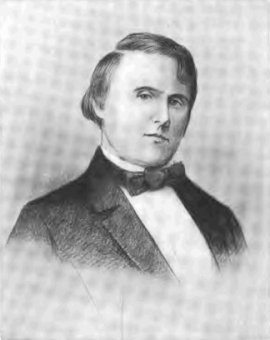
“An American kneels only to his God, and always faces his enemy,”* declared William Logan Crittenden, refusing to kneel before his executioners in Havana this date in 1851.
This well-bred** Kentuckian veteran of the Mexican-American War ditched a New Orleans customs-house gig when Narciso Lopez formed a private filibustering expedition to try to steal Cuba from the Spanish.
Placed at the head of one of Lopez’s three battalions, Crittenden’s force was cut off and overwhelmed by the Spanish. (The detailed progress of the campaign is described here.)
He and 50 of his command captured with him were all ordered for immediate execution, six at a time, as pirates, with just a few hours’ allowance to take down official statements and scribble their hasty goodbyes. With “not the heart to write to any of my family,” Crittenden sent one to a friend giving his farewells … then, just before the end, dashed off another addressed to the Attorney General of the United States — his uncle, John J. Crittenden.†
Dear Uncle: In a few moments some fifty of us will be shot. We came with Lopez. You will do me the justice to believe that my motive was a good one. I was deceived by Lopez — he, as well as the public press,‡ assured me tat the island was in a state of prosperous revolution.
I am commanded to finish writing at once.
Your nephew,
W.L. Crittenden
I will die like a man
(Some other affecting last letters from Crittenden’s party can be perused here.)
All this scene, including a post-mortem mutilation by the enraged mob of onlookers, became a bloody banner for U.S. Southerners — since expanding the slave power was core to the entire filibustering project.
When word of the shootings reached New Orleans, a crowd sacked the Spanish consulate.
But in the international relations game, the U.S. had disavowed filibustering and its raiders enjoyed no special diplomatic protection. When a number of the later prisoners were returned in chains to Spain, the Millard Fillmore administration asked their release, but had no grounds to demand it. It was a touchy diplomatic situation … one that our late Crittenden’s uncle, as a member of cabinet, was right in the middle of.
Fillmore eventually secured the captives’ release, atoning the insult to the European power’s agents by causing the Spanish colors to be saluted in New Orleans in honor of the birth of the Infanta Isabella.
All this mincing instead of brawling struck a certain variety of hothead as distinctly unmanful.
Our flag has been wantonly insulted in the Caribbean sea … captured citizens of our country [were] sent in a slave ship to the coast of Spain, fettered, according to the custom of that inhuman traffic, and released, not as an acknowledgement of wrong on demand of our government, but as a gracious boon accorded to a friendly suit … Whilst the dying words of Crittenden yet rung in the American ear, and the heart turned sickening away from the mutilated remains of his liberty-loving followers; whilst public indignation yet swelled at the torture which had been inflicted on our captive countrymen, even then we were called upon to witness a further manifestation of the truckling spirit of the administration …
William Crittenden’s brother Thomas Theodore Crittenden fought on the Union side of the Civil War, and became Governor of Missouri in 1881. He’s noteworthy for having issued the bounty on outlaw Jesse James that led to the latter’s assassination by Robert Ford.
† Family in the president’s cabinet was just no guarantee of preferential treatment, abroad or at home; just a few years before, a son of the sitting Secretary of War had been hanged at sea for mutiny.
‡ The Spanish press likewise excoriated American yellow journalism in terms that no few present-day scribes would also deserve.
New Orleans papers, there is your work! There is the result of your diragations, of your iniquitous falsehoods, of your placards with large black letters, and your detestable extras … This blood must flow, drop by drop, upon your heads — this blood will torment you in your sleep, for they have lost their lives when you were in security in your houses.

 On this date in 1924, “chewing the frayed stump of a cigar,” holdup man Richard Birkes sauntered to the electric chair at the McAlester, Oklahoma state prison and rode the lightning for gunning down a teller in the course of a heist.


 This “greatest American short story … a flawless example of American genius” (


 This well-bred** Kentuckian veteran of the Mexican-American War ditched a New Orleans customs-house gig when