No, not Netflix. Just a small-time hood who robbed a Dallas Blockbuster (back when there was such a thing) of $392, and in the process wasted the two employees minding the till.* Something about it — the familiar ubiquity of video rental joints in the 1990s, maybe — really resonated. The Blockbuster murders were immediately notorious.
Though Dorsey was a suspect in this crime — because he told his girlfriend, and she ratted him out — police concluded that the man in the surveillance tapes was too tall. He wasn’t charged.
Dorsey actually got convicted (non-capitally) of a different murder and the Blockbuster homicides went unsolved — until a cold cases unit dug into the surveillance tapes, decided the telemetry fit Dorsey after all, and went knocking on his cell door. The guy was still foolishly willing to gab about it.
“They’re dead,” he would say dismissively of his victims in a pre-trial interview. “That’s over and done with. I could have came in here and been, ‘Oh, I’m sorry, I’m so bad.’ But I don’t feel like that. That’s not being honest with myself.”
One doesn’t doubt that sentiment is shared by many malefactors great and small, but blithe narcissism is not quite the pose calculated to win a lot of sympathy from a jury when you’re on trial for your life.
Dorsey stayed “honest with himself” on death row to the tune of 95 disciplinary violations, including a stabbing attack on a guard, and he vowed to fight the team that came to take him to the gurney. (Texas officials reported that he didn’t actually fight.)
And two years after the Blockbuster killer got his … so did Blockbuster.
* The Blockbuster Corporation’s outreach to the families of its slain employees was considered a model stroke of public relations (Dallas Morning News, Nov. 2, 1994).
Entomb your mate in a trunk and the Show-Me State will hoist your neck on a rope: Hugh Mottram Brooks found that out on this date in 1888.
This story had made worldwide headlines within hours of the time an employee at St. Louis’s Southern Hotel had opened the door to a guest bedroom emitting a horrible stench and discovered a corpse stuffed in a trunk.
Headline of the St. Louis Daily Globe-Democrat, April 15, 1885. The story occupied the entire front page.
The remains, in life, had belonged to Charles Arthur Preller, an English traveling salesman who had been hanging about the hotel with his impecunious countryman, Brooks.
Those two had been understood on the premises to have been involved, in the Oscar Wilde sense. But the spark for homicide was mere avarice.
The dramatic note left pinned to the late Preller — “so perish all traitors to the great cause” — was almost immediately deemed a red herring, and suspicion descended on Preller’s recent companion, who had absconded with our dead salesman’s money.
A global manhunt pursued the fugitive, who was found to have fled to San Francisco and thence overseas; he was soon arrested in Auckland and extradited back to face a sensational trial — which, by the by, entailed disinterring the corpse to search it for evidence that it had been catheterized. (It hadn’t, and this rubbished the defendant’s alibi that he’d accidentally killed the guy while consensually chloroforming him in the course of a bit of home medicine.)
The wonderful 19th century crime site Murder by Gaslight covers this case and Brooks’s futile defense in meticulous detail. Aptly enough, the Trunk Murderer didn’t have a leg to stand on.
Brooks hanged along with another murderer, Henry Landgraff. The British government did make diplomatic representations on its citizen’s behalf, but they were ignored — prosecutors retorting that London had recently given short shrift to American citizen Patrick O’Donnell.
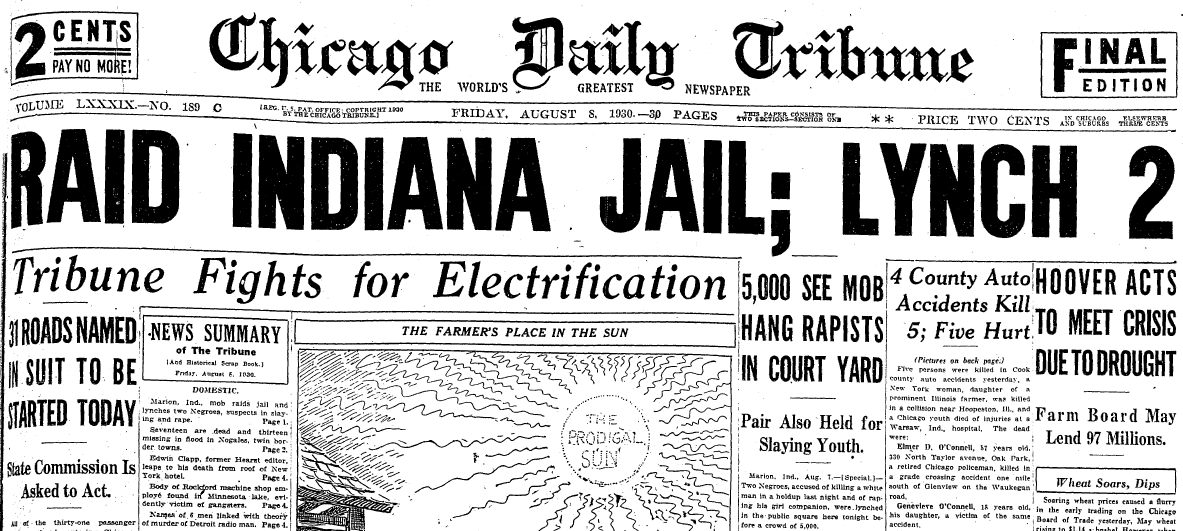
On this date in 1930, two black youths were lynched in Marion, Indiana for murdering a white man and raping his girlfriend.
(The rape allegation — although it, and not the homicide, seems to have been the thing that triggered the lynching — was subsequently withdrawn, and there were even rumors that the white girlfriend was a lover and confederate of one of the lynched men. It’s just one strand in the very human tapestry around the “last classic lynching north of the Mason-Dixon line” explored by Cynthia Carr in Our Town: A Heartland Lynching, a Haunted Town, and the Hidden History of White America.)
Shipp, who is said to have confessed killing the white man, Claude Deeter, 23, of Fairmount, Ind., was hanged from an elm tree in the courthouse yard. Smith, whom the girl identified as her assailant, was thrown from a third floor window of the jail with a noose around his neck and strangled.
…
Reports of the crimes and confessions, published in Marion newspapers this afternoon, stirred this quiet community of 23,000 to intense excitement. There was no hint of the impending violence, however, until 8:30 p.m., when a motorcade of Deeter’s fellow townsmen arrived from Fairmount.
The Fairmount delegation, numbering about 100, gathered in the public square, openly displaying their guns and shouting for a lynching … The sheriff led his deputies to the front door, argued a moment with the leaders of the mob and then ordered the tear bombs thrown. Blinded, the lynchers fell back for a few minutes, but returned and began the sledge hammer siege which forced the jail doors within ten minutes. No shots were fired on either side.
Following the lynching the mob gathered in the square for an hour, some proposing to drive the 2,000 members of the Negro colony from the city and burn their dwellings. Peace officers from Indianapolis, Kokomo, Fort Wayne, and other towns were arriving however, and gradually the mob broke up.
The corpses hung in the square for hours, attracting throngs of gawkers — including a photographer able to snap this picture:
Teacher/poet Abel Meeropol ran across this photo of the Shipp-Smith lynching a few years later in a magazine, and it so “haunted” him — his word — that he penned the anti-lynching poem “Strange Fruit”. You know it from Billie Holiday‘s arresting vocal rendition.
Southern trees bear strange fruit
Blood on the leaves
Blood at the root
Black bodies swinging in the southern breeze
Strange fruit hanging from the poplar trees
Pastoral scene of the gallant south
The bulging eyes and the twisted mouth
The scent of magnolia sweet and fresh
Then the sudden smell of burning flesh
Here is a fruit for the crows to pluck
for the rain to gather
for the wind to suck
for the sun to rot
for the tree to drop
Here is a strange and bitter crop
Abel Meeropol was no passing sentimentalist himself, but a prolific left-wing activist. During the McCarthy years, he adopted the children of the Rosenbergs when the latter were electrocuted as Soviet spies. As faithfully as those two orphaned boys have carried the torch for their lost birth parents, they also still carry an adoptive surname: Michael Meeropol and Robert Meeropol.
A third person was almost lynched in the same Marion, Ind., incident, but 16-year-old James Cameron (sometimes called “Herbert” or “Robert” in the 1930 news reports) managed to convince the mob that he wasn’t involved. Just how he managed this feat and what he’d really been up to is another strand of Carr’s tapestry: many of the Marion blacks as well as whites she interviewed overtly mistrusted Cameron.
At any rate, the crowd let him off with a beating, and Cameron served time as an accessory to the crime.
After release, he became an anti-lynching activist in Indiana and, later, Wisconsin — where he founded a (since-shuttered) Black Holocaust Museum. He started several NAACP chapters.
In the more immediate aftermath, it was far from a given that this date’s effusion of summary justice wouldn’t cascade into a generalized racial pogrom.
As the Tribune article notes, the lynch mob mulled attacking the black community, ultimately dissuaded by the gradual arrival of lawmen. By the next day, the Indiana national guard had occupied Marion. The Tribune on Aug. 10 reported the town “peaceful to all outward appearances but acutely aware of an undercurrent of racial antagonism that it feared might flame into open warfare at any moment.”
Lest this seem a bit over-the-top, recall that all this went down just a few years since a lynch mob in Tulsa had metastasized into one of America’s most notorious race riots. The prospect of wholesale bloodletting was very real.
When the local attorney general and grand jury waved away the small matter of punishing mob leaders, several of whom were publicly known by name, Indianapolis attorney general (and Marion native) James M. Ogden drove up to town and personally filed indictments, to the fury of white residents.
“It was astonishing to see and feel the mob atmosphere that still prevailed nearly seven months after the murder,” wrote a correspondent for The Nation. Ogden’s deputies were “looked upon as enemies of the community, not only by the mob, but also by most of the court officials.” After all-white juries acquitted the first two people tried, the state dropped its remaining indictments.
The maelstrom of race and politics and history that emerged from that first fatal transaction — a brutal but banal Lover’s Lane heist — grew so far beyond the original cast of criminal and victim that they practically became secondary to the story.
On August 8, 1930, a wire story datelined Fairmount, Ind., ran in the Indianapolis Star (but not the Marion papers):
Deep regret that the negro slayers of their son Claude, were lynched in Marion last night by a mob, was expressed today by Mr. and Mrs. William Deeter, members of the Apostolic faith, a sect similar to the Quakers.
“God should have been the judge,” said the elderly Deeter. “They had no right to do it,” his wife assented.
Both are opposed to capital punishment and did not want to see the negroes put to death for their crime.
On this date in 1882, William Hamilton “Ham” Yeatts was hanged in Chatham, Va., for the murder of his friend Pressley Adkerson.
When a fellow lures you to a deserted stretch of rural train-track and pops a cap in your head, it’s a given that he’s nursing some manner of grievance.
In the case of Ham Yeatts, that grievance is said to have been a rivalry with Pressley Adkerson — really, we couldn’t make these names up — over the affections of the local knockout, Fanny Rorer. This here page claims that Yeatts, having just wed the girl, was aghast to discover that his friend had deflowered her premaritally.
But we take note of this report of the hanging in the Richmond Daily Dispatch to the effect that the provocation was merely the victim’s nasty prophecy that Yeatts was liable to end up in a penitentiary, the stronger cuckolding allegation arising as the doomed youth made a desperate play for clemency.
Yeatts’s hanging was delayed by a week when he raised these claims of offended manhood — resulting in a bid on his life by a lynch mob, “defeated of their laudable ambition by the alertness of the guards”* — but it was all to no avail.
He requested that he be executed in a blue flannel suit, and that his body be encased in a metallic coffin with a glass face and be placed in an upright position in a cemented grave with steps leading down into it so that those who wished to see him “lying in state” could do so.
So … add vanity to wrath, envy, and lust on Ham’s cardinal sins register.
After the execution the crowd turned their attention to the circus, which had just entered the town, and Yeatts and his crime were for the time forgotten.
Oh.
Though sometimes described as the last hanging in Pittsylvania County, it apparently wasn’t.
Yeatts was only one of four men hanged in various places around the U.S. that August 4, as the Augusta (Ga.) Chronicle described in its next day’s edition …
FERNANDINA, Fla., August 4. — Merrick Jackson, colored, was hanged here to-day, at 1 o’clock, p.m. He murdered a colored boy, named John Thomas, near King’s Ferry, on November 19, 1881. On the scaffold he offered up a prayer, and thanked the Sisters of Charity for their kindness to him. He met his fate with composure. He died by strangulation.
JACKSONVILLE, Fla., August 4. — Harrison Carter, colored, who murdered Lewis Adams, colored, at Baldwin, in this county, on January 6, 1882, was executed in the ail hard here to-day.
MOBILE [Ala.], August 4. — Armand Coleman, colored, was hanged, to-day, at West Point, Miss., for the murder of Georgia Bright, on May 13, 1880. He was sentenced to be hanged on May 4, 1881, and the case was carried to the Supreme Court, where he was resentenced, but respited by the Governor till to-day. Three thousand persons were present, a large number of whom were negro women. The prisoner ascended the scaffold with a firm step, smiling pleasantly. He said he was willing to go and trusted in God. He denied his guilt to the last.
It was not all the hangman’s day, however. Louisiana Gov. John McEnery respited the scheduled August 4 execution of Jack Chapman in Bossier parish. (Chapman still hanged, on September 22.)
* The Daily Inter Ocean (Chicago, Ill.), July 31, 1882.
On this date in 1915, New York City cop and New York City mafioso Charles Becker was electrocuted at Sing Sing for engineering a hit on bookie Herman Rosenthal.
This case of police corruption and gangland gunplay owned the Big Apple’s headlines in the early nineteen-teens — it even gets a callout in The Great Gatsby. Whether it was rightly decided has been hotly contested ever since.
Sing Sing had already prepared for Becker’s death.
Invitations had been despatched in the middle of July to those chosen to witness the execution. There were three dozen in total, and they went to doctors and to a sanitary engineer, to representatives of the press, and to the operators of several wire services. One, scarcely surprisingly, was sent to Swope of the World, but the reporter — to his undoubted chagrin — was recuperating from a bout of rheumatic fever and his doctor had forbidden him to attend. Swope despatched another World reporter in his stead; the man arrived at Ossining bearing a large sheaf of handwritten instructions setting out in considerable detail exactly how the story should be covered. Preparations were also made to cater for the needs of the large body of newsmen expected to descend on Sing Sing without the benefit of invitations. Linemen spent several days installing additional telegraph wires and Morse code senders in a shack opposite the death–house.
Inside the condemned cells, white curtains were fitted across the bars of all the cells that Becker would have to pass on his way to the execution chamber, so that the other inmates would not be able to see him as he walked by. In the execution chamber, guards tested each piece of equipment. The lieutenant’s electrocution was scheduled to be the first at which a new system of signals would be used, as the New York Times reported:
Instead of the old method, by which the executioner signalled with his arm to the man in charge at the power plant, there is a little electric button behind the chair, and above it is tacked a placard bearing the following gruesomely suggestive instructions: “Five bells, get ready; one bell, turn on the current; two bells, turn on more current; three bells, turn on less current; one bell, shut off current; six bells, all through.”
New York’s newspapers remained predominantly hostile to the condemned man. The Times spoke for most of the Manhattan press when it observed that Becker’s death sentence was a punishment not just for Herman’ s death, but for the arrogance Rosenthal’s killer had displayed during his strong–arm days: ‘He paid for the times when “Big Tim” called him “Charlie”. He paid for his one–time power, that almost of a dictator, over the underworld of New York. And he paid for his pride in all this.’ Several dailies had issued their reporters with instructions to study Becker carefully for signs of weakness or incipient collapse; in the end, opinion seemed evenly divided between those who thought that the policeman continued to display an ‘iron nerve in the face of doom’ and those who discerned the onset of a nervous breakdown.
The lawyers were more generous. [Williiam] Bourke Cockran paid tribute to his client’s astounding self–control: ‘His hand is just as cool and his voice as steady as can be.’ John McIntyre said that he had never previously doubted the verdict of a jury in a murder trial. ‘But in this case I say that if Becker is executed tomorrow I will carry to my grave the conviction that at least one innocent man has suffered the death penalty.’ And Joseph Shay, another of the lieutenant’s old attorneys, released a statement of his own: ‘I believe that Becker is dying a martyr, and that his innocence will be established in time, perhaps by the deathbed confession of Vallon or Webber. Rose is too low to confess even on his deathbed.’
Becker himself was woken early on his last morning. At 8am his prison clothes were exchanged for special black cotton shirt and trousers, made without metal buttons or wire stitching; he was given black felt slippers instead of shoes. A guard shaved a spot on his temple, ready for the electrode. Another appeared carrying a pair of shears and neatly slit Becker’s trouser leg almost to the knee. When the time came this would allow the death–house guards to affix a second wire to the condemned man’s calf.
The next portion of the day was passed in writing: a love letter for his wife, a final statement for the press. At two in the afternoon the policeman saw his relatives for the last time. His brothers John, the detective, and Jackson, now a Wall Street broker, found him sitting in his cell, gazing at a small photograph of Helen that he kept on the wall. The meeting was so difficult that the two men were relieved when one of the other prisoners along death row broke the awkward silence by singing ‘Rock of Ages’. Becker joined in with the chorus.
Helen Becker reached Sing Sing, pale and breathless from her journey, soon after 11pm. Her husband had been waiting for her with increasing anxiety for most of the evening. Becker was so popular in the death–house that he had received special permission to spend more than an hour and a half with his wife in the warden’s room. The guards, who had been given strict instructions to keep their eyes on the prisoner at all times, turned their backs as the couple embraced for the final time. ‘No condemned man at the prison had ever had such sympathetic treatment,’ observed the World.
Helen left the prison at 1.30 in the morning, and Becker was returned to his cell. ‘I am tired of the world and its injustice to me,’ he told Father Curry, the New York priest. ‘My happy life has been ruined; I have not been given a chance a mere dog would get.’ Warden Osborne, coming to say good-bye at 2.30am, found his prisoner awake and sitting on the edge of his cot, ‘his chin sunk in his hands’. At four, Father Cashin heard Becker’ s last confession, which contained no admission of guilt and ended with the firm assertion: ‘I am sacrificed for my friends.’
The execution was set for 5.45am. Outside the walls, a double line of guards poked long sticks through the fence that marked the limit of the prison grounds to keep back the crowds assembling there. Inside, the executioner – a small, sharp-faced, balding electrician dressed in a baggy grey sack suit, a striped shirt, polka–dot tie and pointed patent leather shoes – checked his equipment for the final time.
Becker was the one hundred and sixteenth prisoner to die at Sing Sing since electrocution was first used to execute a man in August 1890. The victim on that occasion had been an axe-murderer named William Kemmler, who was accidentally subjected to ‘a far more powerful current than was necessary’ and died ‘in convulsive agony’, flames jetting from the base of his spine and purplish foam spewing from his lips. The technique for electrocuting a man had been refined somewhat since then, but it was still common for the death-house to fill with the odour of burning flesh and scorched hair as the moistened electrical conductors placed against the condemned man’s skin dried out. A lengthy electric shock could ‘turn blood into charcoal and boil a brain’. When a prisoner was ready to enter the chamber, he was issued with thick muslin underwear, and little wads of cotton would be forced into his ears and nostrils to prevent scalding brain fluids spurting forth uncontrollably when the current was applied.
Thomas Mott Osborne, who had vowed never to be present when a man in his charge was being executed, walked away from the death–house at 5am, leaving Deputy Warden Johnson to bring the policeman from his cell. Becker, who was still awake when Johnson came for him, went quietly to his death. A dozen steps took him from his cot to the door leading to the execution chamber. At 5.42 the witnesses clustering inside saw a narrow red door swing open, and the condemned man entered the room. He walked with a strange, hobbled gait, his knees locking involuntarily. His face was a mask. The chair, surprisingly insubstantial, stood on a thick rubber mat almost in the centre of the room. There was no glass and no partition to separate Becker from the witnesses who had come to watch him die, the nearest of whom sat only 10 feet away. The electric chair itself, the man from the American observed, ‘had had a double coat of varnish and its metal fixtures had been burnished for the occasion.’ Straps dangled loosely from its arms and legs, and a heavily–insulated wire hung from a goose-necked fixture above it. The policeman’s guards, anxious to spare the condemned man the agony of a lengthy wait, hurried so much with the buckles that they neglected to secure one of the restraints that stretched over his chest. Becker’s last words, uttered as another leather strap was fastened across his mouth, were a recitation of the Catholic litany: ‘Into Thy hands, O Lord, I commend my spirit.’
Five bells rang, then one. The executioner took his hands out of his pockets and threw a long wooden lever on the wall. The raucous drone of electricity filled the room, a green flash shot from the equipment and Becker’s muscular body lurched forward against the straps, his head twisting sideways and upwards as though attempting to escape the shock.
Charley Becker was the largest man ever brought into the execution chamber at Sing Sing, and it may be for this reason that his electrocution was horribly botched. Too little current was applied at first, so that the death agonies became protracted. The temperature within the dying man’ s body rose to 140 F, the loose strap across his chest burst open, flames were seen to spurt from his temple, and despite the administration of 1,850 volts for a full 60 seconds, Charles Farr, the death–house doctor, found Becker’s heart ‘not only still beating, but pounding strongly.’ In the end it took nine minutes and three separate jolts to kill the prisoner, though the representative of the World observed that ‘to those who sat in the grey-walled room and listened to the rasping sound of the wooden switch lever being thrown backward and forward, and watched the greenish-blue blaze at the victim’s head and feet and the grayish smoke curling away from the scorched flesh, it seemed an hour.’ The whole affair was described in later years as ‘the clumsiest execution in the history of Sing Sing.’
As the reporters gathered to witness the execution filed out of the chamber, they were handed copies of Becker’s final letters. The first was addressed to Governor Whitman:
You have proved yourself able to destroy my life. But mark well, Sir, these words of mine. When your power passes, the truth about Rosenthal’s murder will become known. Not all the judges in this State, nor in this country, can destroy permanently the character of an innocent man.
The second letter was a final testament. Becker had spent much of the night memorising it, in the hope of being allowed to deliver it himself, but the guards had not permitted this.
‘I stand before you,’ this statement began,
in my full senses knowing that no power on earth can save me from the grave that is to receive me, and in the presence of my God and your God I proclaim my absolute innocence of the crime for which I must die. You are now about to witness my destruction by the State … And on the brink of my grave, I declare to the world that I am proud to have been the husband of the purest, noblest woman that ever lived, Helen Becker. This acknowledgement is the only legacy I can leave her. I bid you all goodbye. Father, I am ready to go.
CHARLES BECKER
When most of the reporters had left, Becker’s corpse was removed to the autopsy room for the usual examination, arms dangling, head hanging back, legs swinging. Dr Farr stripped the black cotton shirt from the lieutenant’s hulking body, and was startled to discover that it concealed the little photo of Helen that Becker had kept on the wall of his cell. The dead man had pinned it to his undershirt, with the face turned inward, over his heart.
On this day in 2010, at 10:38 a.m., at the Southern Ohio Correctional Facility in Lucasville, convicted arsonist and quintuple murderer William L. Garner got the needle for the crimes he had committed eighteen years earlier.
Garner had burglarized the Cincinnati, Ohio apartment of Addie F. Mack on January 26, 1992, after he stole her purse and keys while she was being treated in a hospital emergency room.
After taking some electronics, Garner set three fires within the residence, although he knew there were children asleep inside it. Markeca Mason and Richard Gaines, both 11, Denitra Satterwhite, 12, Deondra Freeman, 10, and Mykkila Mason, 8, all died of smoke inhalation. Addie Mack’s oldest child, 13-year-old Rodriczus Mack, escaped through a window; he was the only survivor.
Rodriczus, Denitra, Deondra and Mykkila were siblings, and Markeca was their cousin. Richard was a friend of Rodriczus who happened to be spending the night.
Thanks to a tip from an observant taxi driver, Garner was arrested the next day and quickly confessed. He considered the children’s deaths to be “accidental” because he only set the fires to obliterate his fingerprints and he believed the children would smell the smoke and be able to get out in time.
Unfortunately, the apartment’s smoke detector was inoperable.
Garner was nineteen years old at the time of the murders. He had a criminal record dating back to age eleven, and following his January 1992 arrest he racked up thirteen behavior infractions in prison … including a fire-setting incident.
A psychologist who interviewed him said he functioned at the level of a 14-year-old, and his IQ tested at 76, barely above the juridical cutoff mark for mental retardation. When asking for clemency, Garner’s attorneys cited these factors as well as his “extremely violent and dysfunctional” upbringing, and also argued that he was brain-damaged due to lead poisoning.
In June 2010, the parole board voted unanimously to reject Garner’s clemency request, stating in its report, (pdf)
Considerable weight was afforded the considerable mitigation presented. It is clear that Mr. Garner suffered developmentally and was raised in an exceptionally and horrendously abusive environment. However, we cannot conclude that the mitigating factors are significant enough to outweigh the aggravating circumstances of an offense resulting in the death of five innocent children.
Garner was executed a month later, using Ohio’s recently-adopted “one-drug” lethal injection protocol (most states use, as Ohio had previously, a cocktail of three). It didn’t go smoothly.
A Toledo Blade article provides a detailed account of his last moments. The prison had to open a second viewing room to fit all the people who came to watch him die.
On this date in 2006, Ohio murderer Rocky Barton died by lethal injection for murdering his wife.
Say this for Barton: the experience of failed marriages had not jaded him on the institution. When his fourth wife, Kimbirli Jo, proposed to leave him, he was distraught enough to shoot her dead in a fit of passion, and then turn the gun on himself, too. “I couldn’t stand the thought of living without her,” he explained.
And say this, too: he wasn’t one for any special pleading.
“”It was an act of anger. Evidently it was not too thought out or I wouldn’t be where I am today,” he told a reporter just days before his execution. “I strongly believe in the death penalty. And for the ruthless, cold-blooded act that I committed, if I was sitting over there [in the jury box], I’d hold out for the death penalty.”
Voluntarily dropping his appeals, he spent less than three years on the “greased lightning” track to the Ohio gurney, only some 42 months overall from murder to execution. Kimbirli’s daughter, and Rocky’s stepdaughter, got a special release from a county jail where she was serving a drug sentence to witness the execution.
His suicide attempt, though unsuccessful, required “four surgeries to insert pins, wires and screws to hold his eyes in their sockets and the cadaver’s jaw to replace his shattered one,” and hundreds of thousands in public expenses to post special guard details for said reconstructive surgeries.
Jensen’s counterattack [during the Battle of Chochiwon in the opening days of the Korean War] in the afternoon [of July 10] uncovered the first known North Korean mass atrocity perpetrated on captured American soldiers. The bodies of six Americans, jeep drivers and mortar-men of the Heavy Mortar Company, were found with hands tied in back and shot through the back of the head. Infiltrating enemy soldiers had captured them in the morning when they were on their way to the mortar position with a resupply of ammunition. An American officer farther back witnessed the capture. One of the jeep drivers managed to escape when the others surrendered. (Source, specifically)
This post was contributed by Andrew Gustafson, a writer and cartographer based in Brooklyn, NY. Andrew’s work can be found on his website, and he regularly blogs about New York City history and culture for Urban Oyster Tours.
On this date in 1938, Anthony Chebatoris was hanged at the federal prison in Milan, Michigan, becoming the only person executed in Michigan since it gained statehood in 1837.
Chebatoris and an accomplice, Jack Gracy, rolled into Midland, Michigan on September 29, 1937, with the intention to rob the Chemical State Bank. They never did get their hands on the cash, and only one of them would leave the town alive, though with a proverbial noose dangling from his neck. The two men, armed with a pistol and a sawed-off shotgun, entered the bank and approached the bank manager, Clarence Macomber, with guns drawn. In the ensuing scuffle, Chebatoris shot Macomber and another bank employee, Paul Bywater. Upon hearing the shots, Frank Hardy, a dentist whose office was next to the bank, grabbed the loaded deer rifle he kept handy and went to the window to see what the commotion was about. As Chebatoris and Gacy abandoned the botched robbery empty-handed, Hardy began firing at the fleeing robbers, hitting Chebatoris in the arm and causing him to crash the getaway car he was driving. As the wounded men looked for another escape route, Chebatoris spotted a uniformed truck driver named Henry Porter, whom he mistook for a police officer, and shot him. The men then tried to hijack a truck to make their escape, but as Gacy attempted to climb into the cab, the sharpshooter Hardy shot him in the head from 150 yards away, killing him instantly.* Chebatoris took off on foot and was apprehended a short distance away, exhausted and bleeding.
Chebatoris would survive his injuries, as would the bank employees Macomber and Bywater. But the innocent bystander Henry Porter put our convict on the road to the gallows: after two weeks in the hospital, Porter would succumb to his injuries, and murder would be added to the charges against the surviving bank robber. Michigan had outlawed the death penalty for murder in 1846, becoming the first U.S. state to do so. But Chebatoris found himself subject to a legal system that had been changed by New Deal politics and the public’s panic over escalating violence and criminality. Federal prosecutors took on the case, under the authority of the National Bank Robbery Act of 1934, which was passed in response to the rash of bank holdups across the country. The law gave the federal government the authority to prosecute anyone involved in the robbery of a bank that was a member of the Federal Reserve System or the newly created Federal Deposit Insurance Corporation. Unluckily for Chebatoris, Chemical State Bank was a member of both.
With a mountain of evidence against him, Chebatoris was easily convicted, and on November 30, 1937, he was sentenced to death by federal judge Arthur Tuttle. The case set off a political controversy in Michigan, one that would pit an anti-death-penalty governor against federal judges and prosecutors who wanted the sentence passed down and carried out in the state. Under the federal statute, federal death sentences could only be carried out in states that had their own death penalty. While Michigan had long abolished capital punishment for murder and other crimes, it still kept an obscure law on the books allowing execution for treason (which has never been exercised, as it is unclear how one would commit treason against the state of Michigan). This loophole allowed the federal capital prosecution and execution to proceed within the confines of the staunchly abolitionist state.
In response to the decision, Michigan Governor Frank Murphy said, “There hasn’t been a hanging in Michigan for 108 years. If this one is carried out in Michigan, it will be like turning back the clock on civilization.” Illinois, which had its own electric chair, offered to finish off Chebatoris, but Judge Tuttle ordered that the execution should proceed in Michigan, noting, “The just verdict having been returned, the law was mandatory in the three respects, namely that the penalty should be death, that it should be hanging, and that it should be within the state of Michigan. These last two requirements resulted from the fact that Michigan has one statute providing for the death penalty by hanging. If the sentence had been different in any one of these respects, it would have been unlawful. I have neither the power nor the inclination to change the sentence.”
Chebatoris was transferred from the Saginaw County Jail, where he had been held throughout his trial, to the federal prison in Milan. At 5 a.m. on July 8, 1938, he was brought to the gallows, and before 23 witnesses, including an inebriated hangman named Phil Hanna, he was hanged. In the middle of the night before the execution, Hanna had arrived at the prison demanding that his three drunken friends be admitted to the hanging. After an argument with the warden and a call to the director of the Federal Bureau of Prisons, Hanna was allowed to proceed with execution, and the warden acceded to his demands (though at the time of the execution, the warden barred the three friends from the proceedings, knowing that the room was too dark, and Hanna too drunk, for him to notice their absence).**
Chebatoris’ execution was both a unique event and a bellwether for things to come in the federal death penalty system. Since 1927, he is the only person to be executed for a murder committed in a state that does not have its own death penalty statute. After World War II, executions, both federal and state, went into a steep decline across the United States, culminating in the 1972 Supreme Court decision Furman v. Georgia, which struck down every capital punishment statute in the land. Four years later, the death penalty was revived in Gregg v. Georgia, and it took barely six months for states to resume executions. The federal government was slower, however, and the first post-Furman federal death penalty statute did not appear until 1988. Since that date, however, we have seen the steady expansion of the federal death penalty, building on the precedents set by the National Bank Robbery Act. Rather than targeting bank robberies, the federal government has used the death penalty to take aim at other perceived scourges, employing it is a weapon in the various domestic “wars” on crime, drugs, and terrorism.
In the past twenty years, the federal death penalty has been transformed from a seldom-used punishment for pirates and crimes committed in the territories to an expansive weapon that can be imposed in a wide range of jurisdictions, leading the Criminal Defense Network to conclude that “virtually every homicide occurring within federal jurisdiction is now death-eligible.”† The greatest expansion of the federal death penalty came with the 1994 Violent Crime Control and Law Enforcement Act, which greatly expanded federal jurisdiction and authorized the death penalty for nearly 60 different crimes. And the reach of the federal death penalty has continued to expand, even into states like Michigan that have rejected capital punishment.
There are currently 58 people sitting on the federal death row, nine of whom committed their crimes in states that either do not have a constitutionally valid state death penalty statute or have active moratoriums on the death penalty.‡ Interestingly, all of those nine were sentenced to death during the tenures of Attorneys General John Ashcroft and Alberto Gonzalez, and their decisions to pursue capital prosecutions marked a departure from the actions of their predecessors. Early in his term, John Ashcroft revised the U.S. Attorneys Manual and removed language about the Department of Justice’s policy towards seeking the death penalty in states that did not have their own capital punishment statutes. Previously the manual stated that in these states, “penalty-driven decisions to file federal charges are inappropriate.” That language was removed, and presumably this opened the door for the increase in prosecutions, convictions, and death sentences handed out in federal districts located within abolitionist states. Since Chebatoris’ execution, no one who falls into this category has been executed, and current Attorney General Eric Holder has signaled a return to the earlier practices, meaning the federal government will be less inclined to pursue these kinds of cases. Nevertheless, it is likely that at least one of these nine will eventually be executed.
When that happens, Anthony Chebatoris will no longer be a solitary historical footnote.
* Hardy was a hero, but he is not nearly as celebrated as another bank robbery foiler, Northfield, Minnesota’s Joseph Lee Hayward, who is remembered annually at the town’s “Defeat of Jesse James Days.” Perhaps Midland could build its own tourist attraction around Hardy?
** For a detailed account of the case of Anthony Chebatoris, read Aaron Veselenak’s article in the May/June 1998 issue of Michigan History Magazine, “The Execution of Anthony Chebatoris.”
† From Burr, Dick, David Bruck and Kevin McNally (2009). “An Overview of the Federal Death Penalty Process.” Capital Defense Network.
‡ These death row inmates are: Carlos Caro (WV), Donald Fell (VT), Marvin Gabrion (MI), Dustin Honken and Angela Johnson (IA), Ronald Mikos (IL), Alfonso Rodriguez (ND), Gary Sampson (MA), and Kenneth Lighty (MD). For a description of their cases, visit the Death Penalty Information Center. All are held in the Federal Correctional Complex in Terre Haute, IN, with the exception of Gary Sampson, who is being held in New Hampshire. For more information on these cases, visit the Death Penalty Information Center.
After its famously inauspicious debut the previous summer, this date in 1891 marked the second, third, fourth and fifth uses of New York’s pioneering electric chair.
Having grotesquely botched its maiden execution of William Kemmler, there was a considerable sentiment to retire the electric chair immediately.
The second round of “electrocutions” — 19th century papers still put this then-neologism in quotes — were closely watched as an acidelectric test of the chair’s staying-power. If these men burned to death, slowly and horribly, as Kemmler had, that might have been it. And had New York reverted to hanging or moved on to lethal injection,* the chair’s subsequent adoption by other states and its journey into the iconic popular culture would likely have been aborted.
But, they fixed up the chair, tested it on some more large animals, and moved the electrode combination from head+spine to head+leg … and voila!
There was nothing about the executions of the horrible nature that shocked the country when Kemmler was made the first victim of the law. If the testimony of a score of witnesses is to be believed, the executions demonstrated the use of electricity for public executions to be practical whether or not it is humane. While the Kemmler butchery, with all its terrible details cannot be forgotten, against that one awful failure the advocates of the law now point with unconcealed pride to four “successes.”
“Unconcealed” pride would be an interesting choice for these advocates, since these prophets of brave new death technology had themselves feared a calamitous failure of their apparatus as much as anybody — well, as much as anybody except the condemned.
Consequently,
every witness of the execution was made to pledge himself in writing never to reveal any detail of it unless requested to do so by the authorities. No newspaper representative was admitted. As THE TIMES has repeatedly stated, it was the intention of the advocates of the law to keep the public from knowing anything about these executions … Therefore, Gov. Hill** and his henchman, Warden Brown, made up their minds that these experiments with the law should not go before the public as anything else than successes, and they packed the jury accordingly with picked men.
The Times dilates considerably in this vein; ever the helpful courtier, it is concerned principally that the state’s orchestrated public relations campaign would have had more credibility had the successful executions been witnessed by third parties who have newspapers to sell. You know?
But … if only the state’s handpicked friendly witnesses were allowed to see what went down, do we actually know that it wasn’t another dog’s breakfast? The July 8, 1891 London Times — for the executions had a global audience — cobbled together a less reassuring wire report.
There are, however, many conflicting statements current as to what actually occurred, and it is extremely difficult to discriminate as to which are true and which are false … Dr. Daniels, one of the witnesses of the executions this morning, said, in an interview this afternoon, that he might tell a great deal about the affair if he were not bound to silence. He added that the Kemmler scene was practically repeated in each case, there having been two shocks given to each of the condemned men. The truth, Dr. Daniels said, would make a thrilling story.
Wait, what!?
If Dr. Daniels actually said anything like that, someone got this electric chair proponent rewrite (pdf) pretty quickly.
I was misquoted. I simply said that if I were at liberty to give a detailed account of the scenes in the death chamber the public would no doubt be interested in knowing that the executions had been a pronounced success.
You could totally see how the guy would say “pronounced success”, and this British rag would hear, “the Kemmler scene was practically repeated in each case.” Separated by a common language and all that.
For the record, the chair salvaged itself upon these unfortunates:
James Slocum (a former minor league baseball player†), for murdering his wife
Levy Smiler, for murdering his mistress
Joseph Wood, for murdering a fellow-laborer
Shibuya Jugiro, a Japanese seaman, for murdering one of his comrades
History has all but forgotten them … save that their deaths were officially ruled a great technological triumph, sufficient to rescue “the chair” from abortive 19th century penal cul-de-sac and set it on its way to becoming a pop culture icon.
* The modern-seeming method of lethal injection was actually one of the options vetted to replace the rope in the 1880s.
** Hill at this time was flirting with a presidential run, which ultimately didn’t happen: he won a Senate seat instead.

 Dorsey was the “Blockbuster Killer.”


 This case of police corruption and gangland gunplay owned the Big Apple’s headlines in the early nineteen-teens — it even gets a callout in The Great Gatsby. Whether it was rightly decided has been hotly contested ever since.
 Garner had burglarized the Cincinnati, Ohio apartment of Addie F. Mack on January 26, 1992, after he stole her purse and keys while she was being treated in a hospital emergency room.
 Say this for Barton: the experience of failed marriages had not jaded him on the institution. When his fourth wife, Kimbirli Jo, proposed to leave him, he was distraught enough to shoot her dead in a fit of passion, and then turn the gun on himself, too. “I couldn’t stand the thought of living without her,” he