1938: Albert Dyer, sex killer (presumably)

On this date in 1938, Albert Dyer hanged at California’s San Quentin prison for a triple rape-murder.

Dyer is a very modern bugbear, a monster right out of cable news and amber alerts and stranger danger.

As often with those, his path to infamy began with disappeared white girls — Jeanette Stephens, Melba Everett, and Madeline Everett, all ages 7 to 9 — who went to picnic at an Inglewood park one summer afternoon and never came home.

The police set about hunting for any known sex offenders in the area, but the offense would ultimately be attributed to a neighbor who was active with the concerned search parties that scoured the area.

Induced by a police threat to deliver him into the hands of a lynch mob, Dyer admitted to having lured the girls off on the pretext of catching rabbits, then strangling them to death and raping their corpses.

(Here’s a disturbing set of photos of the girls’ bodies.)

Dyer attempted to repudiate these confessions, which you’d have to say were obtained under a bit of duress. The case against him apart from self-incrimination was a tissue of meager circumstantial evidence; Dyer’s persona smacks of mental deficiency that might have left him easy prey for manipulation by his captors.

Newspapers described Dyer as “dull” and “stupid”, and in fact the defense attempted to cast doubt on the prisoner’s mental competence and the reliability of his confessions. The jury took agonizing days to reach a consensus, and the last man holding out against conviction would later say that he finally gave in after being led to believe that the judge considered Dyer guilty. (This revelation was among the defense’s last arguments for executive clemency, at the end of the process.)

In short, for all the horror of the crime, the case was not cut and dried in 1938. The passage of time — with our latter-day awareness of false confessions and developmental disability — will hardly make it more so, unless some forgotten crime locker still preserves a testable genetic sample. But no surprise, the popular press had a different take. The Los Angeles Times editorialized (Aug. 27, 1937) anticipating that

[t]he verdict of a jury that Albert Dyer must die for the murder of three Inglewood children is a long step toward the eradication of sex crime in California. It is the only outcome of the case that public opinion could afford to sanction.

The evidence against Dyer was overwhelming; and there could be no mitigating circumstance which could justify this State in letting such a miscreant go on living.

Even if Dyer is mentally defective, there is no reason for his continued existence. He could never be safe to have at large. Legally, his condition is not insanity; he knew what he was doing and that it was wrong. Eradication of such types is necessary for public safety.

And the death penalty is the best deterrent. If others have this criminal tendency, his fate may cause them to repress it. Dyer, hanged, may save the lives of countless California innocents. In any scale, the safety of children must weigh more heavily than his forfeited right to live.

Dyer was the second-last person hanged by the Golden State before the gas chamber came online to replace the gallows. His legacy was California’s 1939 passage of a law governing (pdf) the handling of “Sexual Psychopaths”. (This site suggests he was also posthumously exploited for the cause of marijuana criminalization.)

Part of the Themed Set: Americana.

On this day..

1922: Eugene Weeks, by Sheriff Robb

“Minister-Sheriff Hangs Iowa Murderer, Resigning Des Moines Pastorate to Do So” read the New York Times headline for the execution this date of Eugene Weeks.

Our interest here is not drawn by Weeks, who hanged for the forgettable murder of a grocer, but by his executioner, a truly American character running a truly American grift.

Winfred E. Robb parlayed decorated service as a World War I chaplain into a postwar book paying sentimental martial tribute to “young men … [and] their glorious death” the better to inspire “a greater patriotism and the dedication of himself to the common good of his fellows.”

Robb had returned from the European theater to his prewar gig as pastor of Des Moines independent evangelical congregation, the First Federated Church. (It still exists, nearing its centennial in the guise of a megachurch preaching “triumphalist, Americanized Christianity”.)

Our pastor proved amenable to exchanging this ministry of God for that of a more temporal power, and was elected Sheriff of Polk County in 1920 on an anti-corruption platform. The New York Times reported that his “campaign pledges of ‘cleaning up’ Des Moines have been followed by vigorous efforts against bootleggers and disorderly places.”

Among these edifying duties was another that some of his congregation found less tasteful: while Iowa had centralized its hangings at the penitentiary in Fort Madison, each execution remained the responsibility of the local sheriff in the county which sent the man to death row. That meant Pastor Robb.

Evidently some members of Robb’s congregation objected to this office, but where theology (potentially) clashed with politics, our man was prepared to render unto Caesar.

After all, in America, who knows how high a hangman might rise?

A co-conspirator of Weeks was executed on the same scaffold a few weeks later, and by the same Sheriff Robb. Robb’s self-satisfied justification for conducting these hangings could come straight from Rick Perry campaign literature.

Brainless people who have no ability to think … will condemn and rave and shout as usual. Unthinking religious fanatics will plead and pray and forget that God is a God of justice and mercy, and that judgment is as much a duty of love as mercy is the delight of love.

America is cursed today with a lot of spineless reformers. They think of a minister as a sissy, sexless, spineless creature with lily white hands who spends his time attending ladies’ societies and pink teas.

Tough love, baby. This was an apostle of muscular Christianity.

So Weeks resigned his ministerial commission, and on this date he skipped the ladies’ societies and put Eugene Weeks to death for murder.

By the end of the year, our hammer of the Lord had found himself on the anvil side of the law, and maybe rethinking those duties of love. Prohibition was Sheriff Robb’s milieu and the cause of his fall, as told by this Associated Press wire story printed in the New Year’s Eve Miami Herald:

IOWA PARSON-SHERIFF HELD FOR BOOTLEGGING

Jailer, Whose Sons He Arrested, Accuses Preacher Who Presided at Hanging.

DES MOINES, Ia., Dec. 30. — Sheriff Robb, Polk county’s preacher-sheriff, who gained nation-wide prominence last fall through officiating at the hanging of two murderers at Fort Madison penitentiary, was arrested here today charged with unlawfully disposing of liquors as the sensational backfire action on the part of his jailer, William McMurray, whose own sons had been arrested by the sheriff for alleged complicity in the theft of $30,000 worth of bonded whiskey from the county jail Wednesday night. The sheriff’s bond was fixed at $1,000 which he furnished and the hearing set for January 3.

John Robb, brother of the sheriff, and himself a minister, who has been acting as a deputy for his brother, also was arrested charged with larceny, on information sworn out by Jailer McMurray and released on $500 bond. Neither charge was made in connection with the theft of the 47 cases from the jail Wednesday night.

Later additional charges were filed against Sheriff Robb by McMurray which alleged the sheriff had illegally sold cider presses and other paraphernalia used in making liquors, which had been seized in raids.

Charges that Sheriff Robb personally sold 35 quarts and 75 pints of whiskey to L.S. Hill, president of the American Lithographing company, a month ago, and has given away and sold seized liquors to other persons, furnished the basis for the charges which McMurray filed. Mr. Hill denied he bought liquor from the sheriff.

Greater patriotism hath no man than this, than to peddle seized drug contraband to local oligarchs under guise of law enforcement. At least you could never accuse the guy of keeping those hands lily-white.

Part of the Themed Set: Americana.

On this day..

1894: Enoch Davis, like a cur

On this date in 1894, Enoch Davis — condemned for the fatally pistol-whipping his wife, who was planning to leave him (you’ll see why in a moment) — was shot to death at Lehi Junction, Utah.

We have some affection in these pages for men or women who do not “play the man” (or woman) at the end but die in piteously naked humanity.

Given that we bear no brief for the man’s eternal soul, it seems in these parts as if bursting with rage is no less legitimate a way than any other to shuffle off this mortal coil: surely, it is better spectacle than many. “The most despicable mangy canine whelp that ever met an ignominious fate,” reported Salt Lake’s Daily Tribune, “could not have whined itself out of existence in a more deplorable, decency-sickening state than was Enoch Davis’ last hour.”

Davis got started well before the last hour; according to this review of Utah’s notable executions, he kicked off execution day by asking his jailers if he could enjoy one last … prostitute.

Maybe that would have chilled him out a little.

Instead, the Salt Lake Herald reporter recounted (under a scandalized headline) that “for vileness, filth, obscenity, indecency, billingsgate and profanity, no man, standing on the threshold of eternity’s ante-room, ever equaled Davis, barring Ruloff who was hung in Binghampton [sic], New York, in 1872 [sic].”

By turns cursing, resisting, demanding (he had better luck with his demand for whisky), and cursing some more — the Herald report is full of blushing bowdlerizations of Davis’s dirty stories and blasphemous digressions. Solicited of his last remarks, “[t]he subsequent dialogue was of such a disconnected character that reproduction is impossible. First, because it was too filthy; second, the same. And so on ad infinitum.”

Now those are last words we can all enjoy.

Beyond the newsmen, and about 500 residents of Provo, Lehi, and environs who assembled for the show, the audience included the six anonymous members of the firing squad. In order to secret their identity, they had been carried to the site in the dead of night and situated in a tent: they would not emerge until the following nightfall.

Holes cut in the canvas provided their firing positions on Davis, staked out in a bar seat that was (for obvious reasons, but also because Davis was by that point too drunk to sit straight) as securely nailed down as the officiants could manage.

Davis objected to everything else, and of course he objected to this too. “Let me see ’em! Let me see them men who are going to kill me!” the doomed man carped, not wanting to “die like an Indian.” Odd phrase, but he was a little stressed out.

The sharpshooters demurred.

The demurrers shot sharp.

That part, at least, went off without a hitch. Like an Indian, like a cur, or merely like a weak and wicked villain, Davis succumbed instantly to the volley.

His own cowardly tears fell through the foulest of breaths during his last hour, his complete lack of nerve … might have won him a little human sympathy if it were not for his vile and lying tongue.

-Salt Lake Tribune, quoted in Frontier Justice in the Wild West: Bungled, Bizarre, and Fascinating Executions


This illustration (and the sketch of Davis above) both from the September 15, 1894 Salt Lake Herald.

Part of the Themed Set: Americana.

On this day..

1916: Mary the Elephant

On this date in 1916 — true story — this happened.

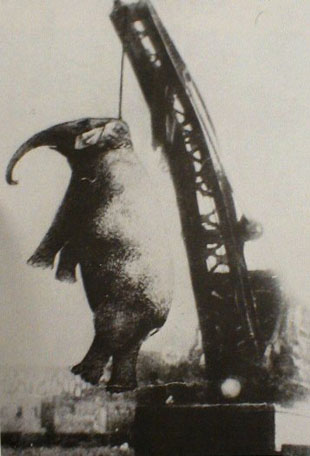
The circus elephant Mary hanged Sep. 13, 1913 in Erwin, Tennessee

Five-ton circus elephant Mary (yes, she has her own Wikipedia page) was in Kingsport, Tennessee on the chintzy fairgrounds touring circuit with Sparks World Famous Circus.

Billed as as “The Largest Living Land Animal on Earth,”* this exotic creature was a prime draw for the circus — and also a beloved pet of the Sparks family.

Unfortunately, this valuable asset was placed in the temporary stewardship of an inexperienced “under keeper” whom the circus had had to scoop up at a recent stop to cover staff turnover. Between shows on September 12, that fellow somehow (accounts conflict) enraged Mary, and (again according to one version among several) she

“collided its trunk vice-like [sic] about [the under keeper’s] body, lifted him 10 feet in the air, then dashed him with fury to the ground … and with the full force of her biestly [sic] fury is said to have sunk her giant tusks entirely through his body. The animal then trampled the dying form of Eldridge as if seeking a murderous triumph, then with a sudden … swing of her massive foot hurled his body into the crowd.”

It’s apparent in this report that the facts of an already-sensational event almost instantly began disappearing into its spectacle. See the largest land animal on earth! See it maul its handler to death! But what happened next lifted Mary all the way to legend.

The owners knew they had to euthanize the “mankiller,” or if they didn’t know they were soon persuaded by mushrooming press attention and towns threatening to ban the Sparks circus.

But how? They couldn’t shoot Mary to death — she apparently survived gunshots from the vengeful crowd in the immediate aftermath of the trampling; firearms just didn’t pack the wallop to put down a pachyderm in 1916. The area didn’t have the sort of electrical juice available that Thomas Edison had once used to drop a circus elephant during his weird campaign for the electric chair.

The choice for the baleful logistical task of killing a 10,000-pound evildoer was hanging, selected over “crushing it between railroad cars.”

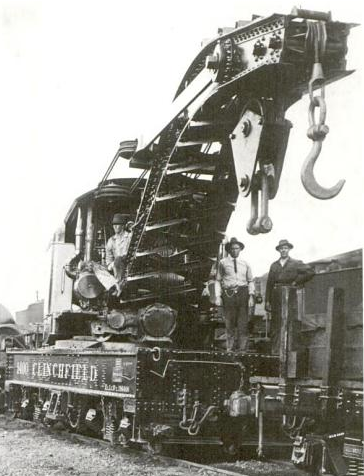
And for stringing up “Murderous Mary”, you need no ordinary gallows. No, for this job, you’re using the hoist on a train derrick and an industrial-strength chain for a noose.


The actual train derrick that hanged Mary the elephant. The leftmost man, seated on the machine, is the “executioner” who worked the controls, according toThe Day They Hung the Elephant.

The railroad was game for the operation, provided the circus would come to it. So on this date, the circus train cars loaded up for the nearest usable train derrickscaffold at Erwin, Tennessee.

There, a procession of all five Sparks elephants — the routine was supposed to keep Mary compliant, and it did the trick even though some observers later remembered the condemned creature behaving unusually skittishly — marched to the railyard.

There Mary was noosed with a 7/8″ chain and hoisted up. The chain broke, and the animal shattered its hip crashing to the ground; another, still larger, chain, did the trick on the second try.

Talk about a spectacle. Talk about scary clowns.

There’s something about this event abidingly piteous, even shameful. It may be for that reason that it’s also abidingly mysterious. The particulars about what happened on the day they hanged the elephant and what became of the body (a steamshovel dug a grave, but the exact location was never marked and there’s a wild story that it was dug up later for ivory) are the topics of conflicting, nth-hand rumors. Some in Erwin don’t to this day want to discuss the matter. Others, just the opposite.


Image (c) John Pugh of SourceToSea.net and used with permission.

* Sparks evidently kept the “largest living land animal” marquee in use for Mary’s successor, as indicated by this 1919 poster (pdf) for the show.

Part of the Themed Set: Americana.

On this day..

1941: Eugene Johnson, the first electrocuted in Louisiana

On this date in 1941, the U.S. state of Louisiana joined the 20th century (or at least the late 19th) with its first electrocution.

Louisiana’s electric chair did debut very late in the game. The great surge of adoption for this uniquely American way of death was the 1910s and 1920s. Louisiana was the last state to begin electrocuting prisoners save one — West Virginia.

But in 1940, the state legislature had finally joined the trend sweeping the South and voted for voltage.

So on March 7, 1941, Louisiana hanged its last hangings.

Eugene Johnson, the next to die, has no purchase on death penalty annals but his accidental milestone as the first to die seated: a black man condemned for killing a white farmer is just about your standard-issue condemned man in the interwar South. (The more things change …)

Johnson’s death this date would inaugurate the nickel-and-dime execution solution that Baton Rouge came up with to keep its various parishes right in the thick of the retribution business: the portable electric chair soon christened Gruesome Gertie, which trucked around to the local jails and courthouses meting out motorized justice.

This particular chair, though a latecomer and a modest overall contributor by the standards of Louisiana’s neighbors, would make itself the subject of highest jurisprudence a few years later by not merely botching but failing the execution of one Willie Francis — and then again in the 1980s as the subject of another man’s near-miss legal challenge to the constitutionality of electrocution.

Having always found five friends on the high court, the illustrious furniture retired in 1991 with 87 souls to its electrodes (including that of Willie Francis the second time around: he lost his appeal). Gertie lives on adorning the set of the Angola Prison Museum — and the Academy Award-winning film Monster’s Ball.

Part of the Themed Set: Americana.

On this day..

1951: Eliseo Mares, “silently and horribly”

On this date in 1951, Eliseo (sometimes rendered “Elisio”) Mares was shot in Utah for murder.

He was condemned for the 1946 murder of an Ohio sailor en route to California for his marriage. (Mares claimed self-defense.) The wait for his execution — “five long years,” Mares told a reporter* after he lost his last appeal — was unusually protracted for the time.

By the time his case had wended its way through the courts, county-managed executions had been consolidated at the state prison at Point of the Mountain. Mares was the first put to death there.

Not until 25 years later, in a reminiscence by one of the witnesses, Salt Lake Tribune reporter Clark Lobb, was it disclosed that Mares “died silently and horribly.” Two of the four bullets fired from 15 feet away struck Mares in the hip and abdomen. It was several minutes before the prisoner was declared dead.

This source speculates that the poor marksmanship was intentional, but whether intentional or not, it must have been an appalling spectacle.

The sheriff directing the proceedings immediately began pushing for a switch to away from the error-prone firing squad to the gas chamber. (No dice, although the 1955 legislature did approve a switch to electrocution that fell through for want of funding.)

* UP wire report quoted in the New York Times, Sept. 9, 1951.

Part of the Themed Set: Americana.

On this day..

1861: Not William Scott, the Sleeping Sentinel

On this date in 1861, Vermont private William Scott of the new-formed Army of the Potomac, then fortifying Washington D.C. for the unfolding Civil War in the aftermath of Bull Run, was led out for execution for having fallen asleep at his post.

The so-called Sleeping Sentinel took a sick comrade’s watch even though he himself was bushed, and … well, you know the rest.

Condemned for a dereliction of duty which “may endanger the safety of a command, or even of the whole army” (the words of the army’s commander Gen. McClellan), Scott still attracted widespread sympathy due to the obviously sympathetic nature of his situation. He was a youth new to war, with an exemplary military record outside of his forty winks.

“The American people,” reckoned the New York Times, “are quite unprepared to hear of a measure of such fearful and unwarned rigor as that which was awarded private SCOTT.”

Appeals went straight to the White House, which was conveniently located in the Army of the Potomac’s back yard, and freshman president Abraham Lincoln magnanimously spared the lad.

Still, wanting to use the case to impress military discipline upon the rabble of corn-fed conscripts, that clemency was delivered with a terrifyingly dramatic flourish. Scott was left to contemplate his last hours on the earth, and, Dostoyevsky-like, marched out to the stake ostensibly to face the firing squad. Only then did he and his fellow-soldiers hear the commutation order.*

This exhilarating climax did not long stay the hand of the Reaper, as it transpired.

Scott died in battle the following spring. In death he lives on, as befits the habitues of these pages: fellow Vermonter Lucius E. Chittenden, who was serving in the U.S. Treasury when all this sleeping sentinel stuff went down, commemorated William Scott for posterity in a subsequent entry to the merciful-Lincoln mythology, a postwar volume titled Lincoln and the Sleeping Sentinel.

The story was also made into a 1914 silent film, which sadly doesn’t seem to be available online: but never fear, this syrupy poem will amply represent our Sentinel’s contribution to the canon.

But God is love – and finite minds can faintly comprehend
How gentle Mercy, in His rule, may with stern Justice blend;
And this poor soldier, seized and bound, found none to justify,
While war’s inexorable law decreed that he must die.

‘Twas night. In a secluded room, with measured tread and slow,
A statesman of commanding mien paced gravely to and fro.
Oppressed, he pondered on a land by civil discord rent;
On brothers armed in deadly strife: it was the President!

The woes of thirty millions filled his burdened heart with grief;
Embattled hosts, on land and sea, acknowledged him their chief;
And yet, amid the din of war, he heard the plaintive cry
Of that poor soldier, as he lay in prison, doomed to die!

‘Twas morning. On a tented field, and through the heated haze,
Flashed back, from lines of burnished arms, the sun’s effulgent blaze;
While, from a somber prison house, seen slowly to emerge,
A sad procession, o’er the sward, moved to a muffled dirge.

And in the midst, with faltering step, and pale and anxious face,
In manacles, between two guards, a soldier had his place.
A youth, led out to die; and yet it was not death, but shame,
That smote his gallant heart with dread, and shook his manly frame!

Still on, before the marshalled ranks, the train pursued its way,
Up to the designated spot, whereon a coffin lay-
His coffin! And, with reeling brain, despairing, desolate-
He took his station by its side, abandoned to his fate!

Then came across his wavering sight strange pictures in the air:
He saw his distant mountain home; he saw his parents there;
He saw them bowed with hopeless grief, through fast declining years;
He saw a nameless grave; and then, the vision closed-in tears!

Yet once again. In double file, advancing, then, he saw
Twelve comrades, sternly set apart to execute the law-
But saw no more; his senses swam-deep darkness settled round-
And, shuddering, he awaited now the fatal volley’s sound!

Then suddenly was heard the sounds of steeds and wheels approach,
And, rolling through a cloud of dust, appeared a stately coach.
On, past the guards, and through the field, its rapid course was bent,
Till, halting, ‘mid the lines was seen the nation’s President!**

He came to save that stricken soul, now waking from despair;
And from a thousand voices rose a shout which rent the air!
The pardoned soldier understood the tones of jubilee,
And, bounding from his fetters, blessed the hand that made him free!

A few letters from Scott’s own hand are preserved here. A (defunct) mini-blog exploring the case in detail can be perused here.

* There was actually American precedent for this sort of stagey non-execution in a case from the War of 1812.

** Obviously, Lincoln did not actually bring his presidential person to the execution grounds to issue this pardon in the flesh: in fact, the presiding officer on-site simply read out the pardon: “the President of the United States has expressed a wish that as this is the first condemnation to death in this army for this crime, mercy may be extended to the criminal.”

Part of the Themed Set: Americana.

On this day..

1999: Double execution in Arkansas

On this date in 1999, Arkansas went retro with the double execution of Mark Gardner and Alan Willett.

Time was that the multiple-execution format was one of the standard guises of capital punishment in America as elsewhere in the Anglo world back to the Tyburn tree and well before.

Not uncommonly a party of malefactors — like the Lincoln assassination conspirators, the Rosenbergs, or Sacco and Vanzetti — would all get their deserts together, symbolically tying up the crime. So too the convenience of the state, or its interest in an impressive show of force, could put together a group hanging just for the whole effect.

The scaffold scaled up easily, of course, but even some more modern devices — like the two-seater California gas chamber — were constructed with committee sessions in mind.

For whatever reason, Arkansas really cottoned to this format in the Nineties. It carried out a double execution on May 11, 1994, and two separate triple executions on August 3, 1994 and January 8, 1997. Volume packages account for nearly half of the 21 Arkansan executions in that decade.*

But the operational efficiency of killing people in multiples inevitably bowed in the more deliberate modern era to the overriding inefficiency of its supporting judicial process. Rare would be the day — especially for a smaller state like Arkansas — when more than one prisoner exhausted remedies at the same time, even if they’d begun their legal journey as parties to the same crime.

In this late degenerate age, whatever rationales may once have existed for group executions have faded well away. The double execution this date in 1999 was at best a minor public relations flourish, and there wasn’t any symbolic import at all. The two culprits were completely unconnected:

  • Mark Gardner, a career criminal out on parole who had slaughtered a family in order to rape their daughter and steal their valuables (last meal: fried shrimp, grilled salmon, garden salad, and chocolate cake with a Coke);**
  • Alan Willett, a guy who killed his own son and mentally impaired brother, then dropped appeals to volunteer for execution (last meal: beef jerky, barbecue-flavored potato chips, onion dip, garlic dip, buttered popcorn, and Pepsi)

The volunteer aspect helped make the twofer scheduling happen, but to what end? A “double execution” here really means two individual executions back-to-back, each one with its own witness room, its own set of last-minute appeals, its own dose of poison. So why bother coordinating execution dates when there are already so many other moving pieces in the machinery of death? It’s just bad engineering

So this date’s exercise was the last multiple execution in the United States save one. In 2000, the absolute high-water mark for execution pace in the country’s busiest death chamber, Texas injected Oliver Cruz and Brian Robertson on the same day, Aug. 9. That’s the last multiple-execution to date in the U.S.

Arkansas actually made a bid to conduct another one in 2004. Condemned prisoner Karl Roberts, like Willett a volunteer, picked up his appeals at the last moment and remains on death row to this day; the state had to settle for one out of two.

* All these dates and figures per the Death Penalty Information Center’s handy searchable executions database.

** Gardner piously anticipated “a never-ending feast” at “the Lord’s supper” in his last statement, but his worldly appetites were less transcendental. He was accused of rape by his neighbor on death row: Damien Echols.

Echols was one of the West Memphis Three convicted for a supposedly occult triple homicide during the late gasps of America’s infantile Satanism panic. This case became a cause celebre (literally so: Eddie Vedder, Johnny Depp, and other glitterati were among his vocal supporters), and the convictions were debunked to such an extent that Echols and his two friends (both serving prison terms) were all released earlier this year.

Echols is not offically “exonerated” since ass-covering prosecutors negotiated an Alford plea as the price of his liberty. He remains a convicted killer in the eyes of the state and among some holdout defenders of the original verdict. This polarizing case is the subject of the HBO documentary Paradise Lost: The Child Murders at Robin Hood Hills and its sequel Paradise Lost 2. A third installment of the series is in post-production as of this writing.

Part of the Themed Set: Americana.

On this day..

1768: Isaac Frasier, three strikes offender

On this date in 1768, Isaac Frasier hanged at Fairfield, Connecticut for his career of (as the pamphlet told it) “Abominable Thefts”.

Frasier took to his larcenous ways from a very young age, and committed a host of thefts from the time of his minority apprenticed to a tightfisted shoemaker. For the volume and audacity of his thefts, Frasier was a sort of Charlie Peace of colonial New England with the significant difference that he was also extraordinarily bad about conducting his career in serial burglary without (repeated) detection.

And so Frasier was caught, over and over and over again: really, he might have thought about a different vocation. Eventually he ran afoul of an 18th-century three strikes law allowing the execution of repeat offenders. (And drawing in its case some lively public debate over the justice of hanging a man for a mere property crime under any circumstances whatsoever.

Anyway, thanks to his want of both restraint and wile, Frasier was clapped in irons, whipped, branded, sold to a privateer, had an ear cropped, whipped some more. He lost his wife after one arrest (that wasn’t juridical penalty, just a modicum of shame.)

He had a gift for escape which jibed well with his gift for arrest, but every time he busted out of stir he returned instantly to burglary with a positively alcoholic compulsion.

Even when he effected his last jailbreak while already under sentence of death for recidivism, he exercised not an iota of discretion but invited his swift recapture by frantically plundering every shopkeep he laid eyes on in a whirlwind tour of Connecticut and environs. Just one last fix for the road.

Last Wednesday evening the notorious FRASIER, who was under sentence of death for burglary, as has been mentioned, was brought from Worcester, (where he was taken up for theft, and whipt) and re-committed to the goal [sic] in this town, from whence he escaped about a month since, — in which time he has committed five or six burglaries and thefts, and traveled near 500 miles. The next night but one after his escape, he broke open no less than three shops in Middletown, from one of which he stole 70l. value in goods and cash. The Superior Court now sitting in Fairfield, have given strict orders, that he should be loaded with chains, and the goal guarded every night till the time of his execution …

Connecticut Gazette (aka New-London Gazette), Sep. 2, 1768

“Excessive Wickedness, the Way to an untimely Death.” That was the title of the gallows sermon they gave for him. At least they couldn’t knock him for idleness.

Frasier’s career is narrated in considerable detail at the excellent site Early American Crime, and this also affords enough excuse to note that this prolific blogger has published a book on his topic, Bound with an Iron Chain: The Untold Story of How the British Transported 50,000 Convicts to Colonial America. It’s a captivating read we recommend enthusiastically.

(Said blogger-author, Anthony Vaver, has also guest-posted on this site: see here and here.)

Part of the Themed Set: Americana.

On this day..

1811: John Andrews, whisky man

This date is the bicentennial of the first public execution in Seneca County, New York. (There would only be one other.)

Future New York Gov. Joseph C. Yates — for whom the adjacent Yates County is named — was already a state Supreme Court justice when he repaired to the newly-built county courthouse in tiny Ovid to judge the case of the cottonmouthed contract clodhopper.

Yates duly condemned John Andrews to hang on account of murdering (pdf) a local distillery worker for the rather disproportionate offense of not ladling Andrews a drink of whisky after Andrews had completed some odd job or other for the place.

Sometimes a man takes a drink. Sometimes a drink takes a man.

Surrounded by the usual contingent of Militia and the surging crowd that had assembled from the town and surrounding contryside through the earlier circulation of handbills that had declared the unusual event as a sort of holiday, the noose was adjusted and Andrews quickly jerked into eternity. Some of the spectators had taken to the roof-tops, others were perched in nearby trees, and parents held their children high on their shoulders for a better view. No other event, save the General Trainings of Militia, called together so many people as did a hanging in those early times. Years afterwards, the stumps of the gallows were pointed out, as a spectator recalled the details of that momentous day. Some three years later, Reuben Tingley, who lived in close proximity to the Court-House in this village, killed his wife by a blow on the head with an axe, and then cut his own throat. The murder and suicide on October 28, 1814, saved the county the expense of an execution, but deprived the curious of an opportunity to witness a second public hanging, a fact that might have well been foremost in the mind of the murderer after having dispatched his wife. (Source)

Part of the Themed Set: Americana.

On this day..