1659: The first two Boston Martyrs

October 27 is International Religious Freedom Day, dating to the execution this date in 1659 of Quakers Marmaduke Stephenson and William Robinson on Boston Commons. They were two of the four Boston Martyrs, Quakers whose necks were stretched in Massachusetts for failing to either keep quiet or stay out of town.

(Fellow Quaker Mary Dyer, perhaps the more famous martyr, was led out to execution with Stephenson and Robinson but reprieved at the last moment. Her time was still some months away.)

As Puritans had fled C-of-E persecution earlier in the 17th century, Quakers migrated to the New World with Cromwell‘s Puritan ascendancy.

And in the Massachusetts Bay Colony, the old dissidence had become the new orthodoxy — as described by the (obviously partisan) Horatio Rogers. (Via)

In June, 1659, William Robinson, a merchant of London, and Marmaduke Stephenson, a countryman of the east pan of Yorkshire, “were moved by the Lord,” in Quaker phrase, to go from Rhode Island to Massachusetts to bear witness against the persecuting spirit existing there; and with them went Nicholas Davis of Plymouth Colony, and Patience Scott of Providence, Rhode Island, a girl of about eleven years of age … During their incarceration Mary Dyer was moved of the Lord to go from Rhode Island to visit the prisoners, and she too was arrested and imprisoned. On September 12, 1659, the Court banished the four adults from Massachusetts upon pain of death

… On October 8, within thirty days of her banishment, Mary Dyer with other Rhode Island Quakers went to Boston, …where she was again arrested and held for the action of the authorities. Five days later William Robinson and Marmaduke Stephenson, who had been travelling about spreading their doctrines through Massachusetts and Rhode Island since their release from prison, also went to Boston to look the bloody laws in the face, in the words of the Quaker chronicler; and they too were arrested and cast into prison. …

The issue was now clearly made between Quaker and Puritan. The Quaker defied the unjust Puritan laws, and dared martyrdom. Dare the Puritan authorities inflict it?

On October 19 the three prisoners were brought before Governor Endicott and the Assistants, and demand having been made of them — Why they came again into that jurisdiction after having been banished from it upon pain of death if they returned? — they severally declared that the cause of their coming was of the Lord and in obedience to him. The next day they were again brought before the magistrates, when the Governor called to the keeper of the prison to pull off their hats, which having been done, he addressed them substantially as follows: “We have made many laws and endeavored in several ways to keep you from among us, but neither whipping nor imprisonment, nor cutting off ears, nor banishment upon pain of death, will keep you from among us. We desire not your death.” Notwithstanding which, he immediately added: “Hearken now to your sentence of death.” … When the Governor ceased speaking, however, Stephenson lifted up his voice in this wise: “Give ear, ye magistrates, and all who are guilty, for this the Lord hath said concerning you, who will perform this promise upon you, that the same day that you put his servants to death shall the day of your visitation pass over your heads, and you shall be cursed forevermore, the Lord of Hosts hath spoken it; therefore in love to you all take warning before it be too late, that so the curse might be removed; for assuredly if you put us to death, you will bring innocent blood upon your own heads, and swift destruction will come upon you.” …

Great influence was brought to bear to prevent the execution of the sentences. Governor Winthrop of Connecticut appeared before the Massachusetts authorities, urging that the condemned be not put to death. He said that he would beg it of them on his bare knees that they would not do it. … Governor Endicott, the Rev. John Wilson, and the whole pack of persecutors, however, seemed to thirst for blood; and it was determined that somebody must die.

The 27th of October, 1659, was fixed for the triple execution and elaborate preparations, for those days, were made for it. Popular excitement ran high, and the people resorted to the prison windows to hold communication with the condemned, so male prisoners were put in irons, and a force was detailed, in words of the order, “to watch with great care the towne, especially the prison.”…

The eventful day having arrived, Captain Oliver and his military guard attended to receive the prisoners. The marshal and the jailer brought them forth, the men from the jail, and Mary Dyer from the House of Correction. They parted from their friends at the prison full of joy, thanking the Lord that he accounted them worthy to suffer for his name and had kept them faithful to the end. The condemned came forth hand in hand, Mary Dyer between the other two, and when the marshal asked, “Whether she was not ashamed to walk hand in hand between two young men,” for her companions were much younger than she, she replied, “It is an hour of the greatest joy I can enjoy in this world. No eye can see, no ear can hear, no tongue can speak, no heart can understand, the sweet incomes and refreshings of the spirit of the Lord which now I enjoy.” The concourse of people was immense, the guard was strong and strict, and when the prisoners sought to speak the drums were caused to be beaten.

The method of execution was extremely simple in those days. A great elm upon Boston Common constituted the gallows. The halter having been adjusted round the prisoner’s neck, he was forced to ascend a ladder affording an approach to the limb to be used for the fatal purpose, to which limb the other end of the halter was attached. Then the ladder was pulled away, and the execution, though rude, was complete.

The prisoners took a tender leave of one another, and William Robinson, who was the first to suffer, said, as he was about to be turned off by the executioner, ‘I suffer for Christ, in whom I lived, and for whom I will die.” Marmaduke Stephenson came next, and, being on the ladder, he said to the people, “Be it known unto all this day, that we suffer not as evil-doers, but for conscience sake.”

Next came Mary Dyer’s turn. Expecting immediate death, she had been forced to wait at the foot of the fatal tree, with a rope about her neck, and witness the violent taking off of her friends. With their lifeless bodies hanging before her, she was made ready to be suspended beside them. Her arms and legs were bound, and her skirts secured about her feet; her face was covered with a handkerchief which the Rev. Mr. Wilson, who had been her pastor when she lived in Boston, had loaned the hangman. And there, made ready for death, with the halter round her neck, she stood upon the fatal ladder in calm serenity, expecting to die….

Just then an order for a reprieve, upon the petition of her son all unknown to her, arrives. The halter is loosed from her neck and she is unbound and told to come down the ladder. She neither answered nor moved. In the words of the Quaker chronicler, “she was waiting on the Lord to know his pleasure in so sudden a change, having given herself up to dye.” The people cried, “Pull her down.” So earnest were they that she tried to prevail upon them to wait a little whilst she might consider and know of the Lord what to do. The people were pulling her and the ladder down together, when they were stopped, and the marshal took her down in his arms, and she was carried back to prison. . .

It was a mere prearranged scheme, for before she set forth from the prison it had been determined that she was not to be executed, as shown by the reprieve itself, which reads as follows: “Whereas Mary Dyer is condemned by the Generall Court to be executed for hir offences, on the petition of William Dier, hir sonne, it is ordered that the sajd Mary Dyer shall have liberty for forty-eight howers after this day to depart out of this jurisdiction, after which time, being found therein, she is forthwith to be executed, and in the meane time that she be kept a close prisoner till hir sonne or some other be ready to carry hir away within the aforesajd tyme; and it is further ordered, that she shall he carrjed to the place of execution, and there to stand upon the gallowes, with a rope about her necke, till the rest be executed, and then to returne to the prison and remajne as aforesaid.

Mary Dyer once again returned from exile the following year, and was hanged in June 1660.

The hours were numbered, however, for New England Puritans in their most cartoonishly obnoxious form. Upon the restoration of the monarchy in the mother country, an edict forbidding the death penalty for Quakerism closed the doors to the Boston Martyrs club.

An Account of the Sufferings of Marmaduke Stephenson is available free on Google books.

On this day..

1769: Nicolas de Lafreniere and four others for the Louisiana Rebellion

On this date in 1769, five French Creoles were shot in New Orleans for a revolt the previous year against a Spanish takeover.

This date’s story begins with the French King Louis XV getting his French clock cleaned in the French and Indian War. This conflict blew an ill wind all over Francophone North America, much of which was taken by the British. Result: a quarter-millennium later, this blog is in English.

Even what France kept, she did not keep. In a secret pact, France ceded to wartime ally Spain “the country known as Louisiana, as well as New Orleans and the island in which the city is situated.”

This projection onto New World colonists of Old World diplomatic horse-trading was rife with potential hostility among the traded horses. In this instance, Louisianans were widely dismayed when they were finally informed that they’d become Spaniards.

When they did get the memo — and Louis XV declined to reconsider — they launched the Louisiana Rebellion of 1768, expelling the new Spanish govenror Antonio de Ulloa.*

These weren’t mere rabble who showed Ulloa “insubordination … a sense of liberty and independence,” but elites of French New Orleans. Nicolas de Lafreniere was the attorney general.

“The name of Lafreniere deserves rank with those of foremost American patriots,” Americans later reckoned. O’Reilly’s reputation did not fare as well in the patriotic literature, but he perhaps had the best of the law.

Between a rock and a hard place, the leftover French adjutant Charles-Philippe Aubry refused to support the rebels, but also refused to fire on fellow Frenchmen. Meanwhile, Ulloa refused to provide his credentials to the uppity colonists. Louis XV refused to receive the delegations sent to implore him to keep Louisiana.

All these refuseniks found the matter adjudicated by immigrant Irish officer Alejandro O’Reilly, plucked out of Cuba to replace Ulloa and lay down the law. He spoke softly when he landed, but the amnesty he offered was followed a few months later by the surprise arrest of the chief rebels.

Lafreniere, Joseph Milhet, Jean-Baptiste Noyan, Pierre Caresse, and Pierre Marquis were ordered hanged on this date. Noyan, nephew of the city’s founder and a young man just married, was offered his pardon, but melodramatically refused.

It was found that there was no hangman in the colony, so the condemned prisoners were ordered to be shot. When the day of execution came, hundreds of people left the city. Those who could not leave went into their houses, closed the doors and windows and waited in an agony of sickening dread to hear the fatal shots. Only the tramping of soldiers broke the deathlike stillness which brooded over the crushed and helpless city. At three o’clock on a perfect October afternoon in 1769, the condemned men were led to the Spanish barracks. Lafreniere, it is said, gave the order to fire. A volley of muskets broke out on the still air, and five patriots went to their death, — the first Louisianians to give their blood for the cause of freedom.

A History of Louisiana

The details and historiography of this event are the subject of this 146-page master’s thesis. (pdf)

Whether or not all that stuff about Louisiana planters as freedom-loving patriots trod down by the barbarous Spanish has any real merit to it, that’s the way they’ve been memorialized.

Lafreniere Park in Metairie, La. — home of anti-death penalty VIP Sister Helen Prejean — is named for Nick Lafreniere.

When next visiting the Louisiana State House, keep an eye out for this day’s victims on the frieze to the right of the main entrance. And when next visiting New Orleans, keep an ear out for the ghost of the priest that buried them.

* Ulloa was also a scientist and gave his name to the Ulloa Halo, a “physical illusion consisting of a white luminous ring or arch that can sometimes be seen in mountainous regions, typically in foggy weather, while facing an area opposite the Sun.”

On this day..

1942: Three Doolittle raiders

On this date in 1942, three captured American airmen who had bombed Japan in the Doolittle Raid were shot in Tokyo.

The Doolittle Raid — named for its commander, Jimmy Doolittle — was America’s April 1942 retaliation for the Japanese attack on Pearl Harbor a few months before.

The mission: bomb the Japanese homeland.

Later in the war, American advances in the Pacific would enable the Yankee to do this regularly. In 1942, it was all but a suicide mission.

The plan involved launching 16 B-25s from an aircraft carrier — an unprecedented feat in itself — to fly light with arms and heavy with fuel to just make it 400 miles to Honshu, and with any luck on to China before the tanks ran dry.

Considering that the bombers had to launch in a panic when the carrier group was spotted a couple hundred miles too early, the raid’s success was downright miraculous: all 16 bombers made it on to (or near enough) the mainland without being shot down, where the crews bailed out and, for the most part, escaped to allied forces. Jimmy Doolittle would title his autobiography I Could Never Be So Lucky Again.

But not all were quite as lucky as Lt. Col. (later, General) Doolittle.

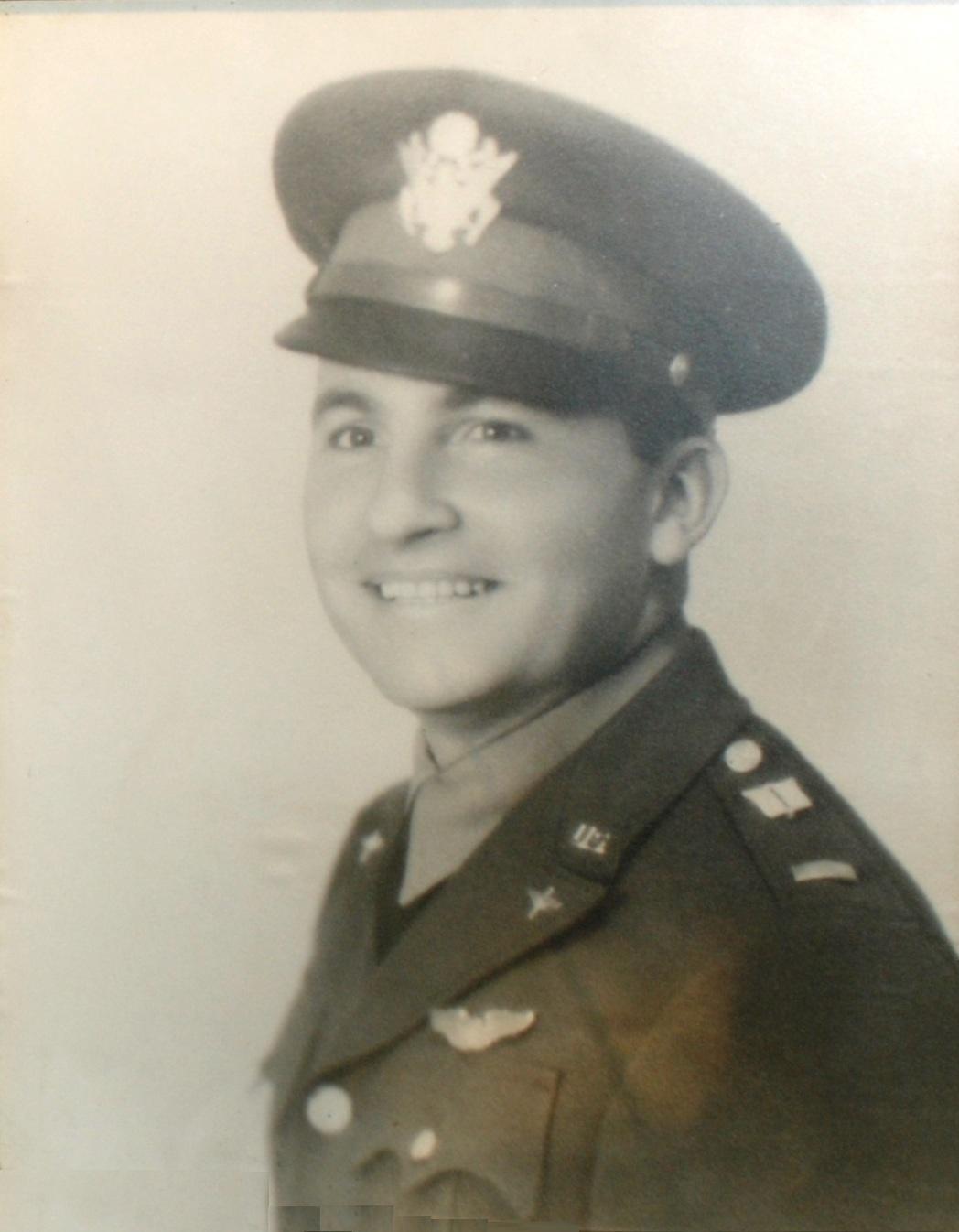
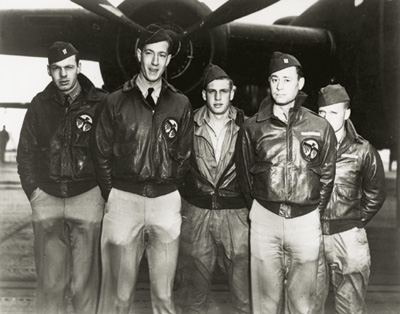
Farrow (left) and Hallmark. Spatz was a member of Farrow’s crew, and is pictured center in that plane’s crew shot here.

Two (out of eighty) drowned when their ride was ditched in the drink. Eight others were captured by the Japanese.

Four of those eight captives would survive the war to tell the tale. A fifth died in captivity. And the other three — pilots William Farrow and Dean Edward Hallmark, and (for somewhat unclear reasons) gunner Harold Spatz — were shot this day in a Shanghai cemetery following a sketchy military trial which condemned them for hitting civilian targets.

Designed largely for its psychological effect, the morale-boosting Doolittle raid has attracted interest from countless other sources who treat it in greater depth. DoolittleRaid.com and DoolittleRaider.com both provide detailed online information about the raid.

For more traditional media, one could do worse than bomber pilot Ted Lawson’s book, and its subsequent propaganda film adaptation, Thirty Seconds Over Tokyo.

On this day..

1920: Frank Campione, “are they really going to hang me?”

(Thanks to Robert Elder of Last Words of the Executed — the blog, and the book — for the guest post. This post originally appeared on the Last Words blog here. Fans of this here site are highly likely to enjoy following Elder’s own pithy, almanac-style collection of last words on the scaffold. -ed.)

“Are—they—really—going—to—hang—me? Don’t— let—them. Save me. Jesus—Mary—Joseph. My little baby! My wife! . . . I’m—going—my—rest. Take— care—me. Where are you, Mr. Meisterheim [his jailer]? Talk to me.”

Meisterheim: “Be brave, Frank. It’ll be over in a minute.”

“Shake hands once more then. Are they—really going—to hang me?”

— Frank Campione, convicted of robbery and murder, hanging, Illinois.
Executed October 14, 1920

Part of the Cardinella Gang, Campione and company were responsible for more than four murders and 250 holdups and burglaries, according to authorities. The gang killed Albert Kubalanzo for $6.30.

During the months he was in jail and on trial, Campione sang lullabies to his pillow night and day. Even when admitting that he had been feigning madness, Campione held the pillow. “I’ll die happy if you let me keep this pillow with me,” he said. “It reminds me of my baby son.”

On this day..

1800: Prosser’s Gabriel, slave rebel

On this date* in 1800,** the Virginia slave Gabriel — sometimes remembered as Gabriel Prosser after his owner’s surname, although that wasn’t what his contemporaries called him — was hanged in Richmond, along with a number of his confederates in a planned slave rising.

Decades before Virginia’s more famed Nat Turner rebellion, Gabriel was plenty frightening for the growing little burg of Richmond in 1800. (The incident would result in a clampdown on education and mobility for slave and free blacks alike.)

Gabriel and company conceived a daring revolution to seize the city of Richmond, take hostage Governor (and future U.S. President) James Monroe, and rearrange the state’s power structure.

This scheme, in which the rebels actually stay in Virginia, depended on an optimistic assessment for the prospects of a multiracial alliance — with Richmond’s own poor whites, and also, according to testimony given by conspirators, with Indians and with the French in opposition to a pro-British American policy tilt.

But if ever the time might have been right for such a plot, it was in 1800. A bitter presidential contest adjudicating the Republic’s most fundamental issues was unfolding; there were rumors that the governing Federalists would not voluntarily relinquish power, and the matter might fall to civil war between by the factions.

Gabriel unabashedly attempted to leverage this division between whites; working as he and many other urban blacks did side-by-side with white Republican laborers — whose own interests vis-a-vis Federalist merchants were being so bitterly contested — he must have had a good vibe about the situation on the ground to gamble his life on it. Though the hope was that the white working class would join the revolt after it broke out, there were at least a few whites already initiated into the conspiracy beforehand.

Alas, what broke out was not rebellion but a storm: a downpour that rained out the first planned rising, washing out bridges and roads that the conspirators were counting on to assemble. Before the makeup date could be scheduled, some slaves taking a care for their own necks had betrayed it.

The public mind has been much involved in dangerous apprehensions, concerning an insurrection of the negroes in several of the adjacent counties. Such a thing has been in agitation among the blacks, principally instigated by an ambitious and insidious fellow, a slave, by the name of GABRIEL, the property of Mr. Thomas Prosser, of the county of Henrico. This villain, assuming to himself the appellation of General, through his artfulness, has caused some disturbance, having induced many poor, ignorant, and unfortunate creatures to share in his nefarious and horrid design.

The plot has been entirely exploded, which was shallow; and had the attempt even been made to carry it into execution, but little resistance would have been required, to render their scheme entirely abortive. Thirty or forty of the party have been arrested and confined in jail for trial. Yesterday a called court was held for that purpose, at the court house in this city when six of them were convicted and condemned to suffer death this day at 12 o’clock. It is said that the evidence which has been procured, will go to prove nearly this whole of them guilty. To-day the court will proceed to go thro’ with the rest of the trials.

[The Governor has issued his Proclamation, offering a reward of THREE HUNDRED DOLLARS† for the apprehension of the above “GENERAL,” who has thought proper to take himself off. Exclusive of this sum, he likewise promises “to any number not exceeding five of the said accomplices, who shall apprehend the said GABRIEL, and deliver him up so that he be brought to justice, a FULL PARDON for their offences.” ]

Columbian Mirror, Tuesday, Sep. 16, 1800, quoting “a Richmond paper”

It would be interesting counterfactual history to know the world in which the insurrection was actually launched — whether “but little resistance” would have sufficed to put it down. Gabriel might have reckoned naively on the prospective balance of forces,‡ but his read of the fractious alliance against him was spot-on. Maybe with a modern communications infrastructure, the affair could have become a full-blown October Surprise.

The Jeffersonian party, desperate not to give its plantation supporters cause to rethink its partisan alignment, took pains to downplay what was really quite a bold conspiracy. Not for the last time, wealthy merchants (here backing the Federalists) sought their own advantage pressing the racial wedge issue — for the slaves’ prospective lower-class white allies were also part of Jefferson’s coalition.

“If any thing will correct & bring to repentance old hardened sinners in Jacobinism, it must be an insurrection of their slaves,” editorialized the Boston Gazetteex cathedra, as it were, from 18th century America’s very temple of Mammon. (The quote comes from this tome.)

One thing all right-thinking whites could agree on was a heaping serving of scorn for “General” Gabriel.


Columbian Mirror, Saturday, October 4, 1800.

But then, that personal interview with Monroe also gives a lie to Gabriel’s insignificance. (Gabriel told Monroe nothing of any use to the latter; Monroe sent him away with orders to keep him nearly incommunicado from the sort of working stiffs who would figure to be his jailers.)

A few years later, an English visitor captured at second hand this indefatigable portrait of the doomed slave in his masters’ courts.

I passed by a field in which several poor slaves had lately been executed, on the charge of having an intention to rise against their masters. A lawyer who was present at their trials at Richmond, informed me that on one of them being asked, what he had to say to the court in his defence, he replied, in a manly tone of voice: “I have nothing more to offer than what General Washington would have had to offer, had he been taken by the British and put to trial by them. I have adventured my life in endeavouring to obtain the liberty of my countrymen, and am a willing sacrifice to their cause: and I beg, as a favour, that I may be immediately led to execution. I know that you have pre-determined to shed my blood, why then all this mockery of a trial?”

In 2007, James Monroe’s (distant) successor as governor of the Old Dominion (informally) posthumously pardoned Prosser’s Gabriel. Gov. Tim Kaine’s statement on the occasion validated Gabriel’s own defense of himself.

“Gabriel and his colleagues were freedom fighters and deserve their rightful place in history as women and men of integrity who fought for freedom.”

And the site of his martyrdom? Well, it’s … a good place to park.

* Some sources give Oct. 7 as the date of execution; this apparently was the initial sentence of the court but delayed a few days to hang the ringleader along with others in a variety of spots around town.


Virginia Argus, Tuesday, Oct. 14, 1800.

** A pregnant year in the history of slave rebellion: Denmark Vesey bought his freedom in 1800; Nat Turner and John Brown were both born in 1800. (Noted here.)

† It was a slave who eventually turned in Prosser’s Gabriel … but Virginia stiffed him on the reward, handing over only $50 instead of the promised $300.

‡ Or maybe that’s just hindsight talking. In 1800, the Haitian Revolution was underway — so who could blame slaves for thinking big?

On this day..

1924: Frank Johnson, the first electrocuted in Florida

On this date in 1924, “colored male” Frank Johnson was electrocuted in Florida.

He was, in fact, the very first to die in the Sunshine State’s electric chair.


The original Florida electric chair.

“Old Sparky” (numerous electric chairs shared this nickname) was brand new here in the Roaring Twenties, a jerry-built contraption outfitted with “homemade accessories” to replace the icky old gallows with a brave new world’s brave new mankiller.


Top: a scantily-detailed penitentiary “personnel card” for Frank Johnson. Middle: details of the execution. Bottom: Florida’s official typed list of its early executions.

All images are from this Florida Department of Corrections page.

This same furniture that killed Johnson would ultimately take the lives of 265 men and one woman — notables from Giuseppe Zangara to Ted Bundy, milestones like John Spenkelink, and scores of strange and forgotten perps among them.

Notoriously error-prone by the end of its run, the device was finally replaced in 1999.

On this day..

1913: Joe Richardson lynched

Shortly after midnight on this date in 1913, Joe Richardson was hauled out of jail in Leitchfield, Kentucky, and lynched on the town square for attempting to assault an 11-year-old girl (white, of course).

“The little girl was on her way to school about 8 o’clock in the morning,” reported the Crittenden Record-Press (Oct. 9, 1913) “when, it is said, she was attacked by the negro who was frightened away by approach of the neighbors.”

According to Lynching and Spectacle: Witnessing Racial Violence in America, 1890-1940,

photographs rendered the violence of a lynching visible and accessible to a wider audience. Although, as will be shown, the public for these images was imagined as relatively narrow or contained, they nevertheless seemed to punctuate the lynching as a public spectacle. Small posses that quickly lynched their victims outside town but paused long enough to take pictures intended their actions to be witnessed … ‘the [Richardson] mob worked quietly and most of the citizens of Leitchfield knew nothing of it until the body was found hanging from a tree early this morning … A large crowd congregated … after the hanging was reported.’ A photograph of Richardson’s hanging body was mounted on a card and peddled door-to-door by an unknown photographer.

This lynching site claims that it was only after the work was done that townspeople realized the hanged man was the local drunk, and had “merely stumbled into the child, and not even torn her dress.”

On this day..

1858: Qualchan

“Qualchan came to see me at 9 o’clock, and at 9:15 he was hung.”

George Wright

It was this morning in 1858 that the gaily dressed Yakama Indian guerrilla Qualchan turned himself in to his Anglo hunter, and was promptly put to death.

Wright was prosecuting the Yakima War in the Pacific Northwest — another characteristic Indian conflict featuring a formerly remote tribe suddenly cursed with valuable land by the discovery of gold.

Qualchan (sometimes “Qualchen”, “Qual-Chen”, or “Qualchien”) was among the Yakima chieftains resisting “encouragement” to give up that part of their territory most desirable to white settlers, and eventually, Qualchan killed encroaching white miners and made himself an outlaw.

For more than two years, the army hunted Qualchan in vain as he harried white settlers around Washington — or, as Wright put it,

Qual-Chen … has been actively engaged in all the murders, robberies, and attacks upon the white people since 1855, both east and west of the Cascade Mountains … committing assaults on our people whenever the opportunity offered.

Late in the game, the American military had been reduced to a Bushian with-us-or-against-us posture:

Kamiakin and Qualchan, cannot longer be permitted to remain at large or in the country, they must be surrendered or driven away, and no accommodation should be made with any who will harbor them; let all know that asylum given to either of these troublesome Indians, will be considered in future as evidence of a hostile intention on the part of the tribe.

The expedient that induced this potent commando to throw his own life away was the capture of Qualchan’s father, Owhi, rather dishonorably effected on an invitation to parley, then parlayed into a threat to execute the hostage lest the wanted Yakima produce himself.

“I thought then the worst that could happen would be a few months’ imprisonment,” remembered Qualchan’s wife (who was also present). “You may imagine my terror and consternation when I saw that they were making preparations to hang my husband. I first thought it was a huge joke, but when I saw the deliberateness of their preparations, the fullness of their treachery and cowardice became apparent.”

And since the U.S. was maintaining that draconian view of Qualchan’s collaborators, Wright followed up his triumph with summary hangings over the next several days of several more Palouse. By the month’s end, he was prepared to declare the Indians “entirely subdued.”

Wright’s rough peace caused the nearby creek in eastern Washington to be christened “Hangman’s Creek”, though there’s been a tendency to steer away from that frightful name in recent times. But what better way to honor an indigenous foe of colonial land conquest than by naming a golf course for him?

The unfolding fate of the Yakimas is further explored in the public-domain book Ka-mi-akin, the last hero of the Yakimas, whose title character was Qualchan’s uncle.

On this day..

1902: Ernest Loveswar, the last hanging in Meade County

From the public-domain (1924) The Black Hills trails : a history of the struggles of the pioneers in the winning of the Black Hills by Jesse Brown and A.M. Willard:

BRUTAL DOUBLE MURDER

In the year of 1902, a couple of young men from Sioux City, Iowa, located on a homestead in eastern Meade county, South Dakota, and there they had built a cabin, fenced their claims and were making great efforts to establish for themselves a home out on the broad prairie. They were fine, industrious and honorable young fellows and at odd times worked among the ranchmen in the neighborhood in order to make the money for their several needed improvements.

In the early days of the west the latch string was hung out and everybody that came to the home of the man on the prairie was welcome whether the hour of coming be day or night.

On the 4th day of June, 1902, William Horlocker came riding into Sturgis upon a foaming horse and reported to the sheriff, John Smith, that the day before upon going to the cabin occupied by the men, George Puck and Henry Ostrander, he noticed that the door was ajar and in walking in he found before his startled eves the evidence of a foul murder and in going to the bed in the room he found it occupied by two forms who were strangely still beneath the covers. He turned the covering down and beheld their faces smeared with blood and crushed in a horrible manner. As investigation by the authorities failed to disclose any immediate clue but on the 6th day of June, 1902, a young half breed Indian had attended a picnic at Whitewood and had passed to one of the merchants in that little town a check for 125.00 drawn upon a Rapid City bank, made payable to Ernest Loveswar and purporting to have been signed by George Puck. The next day the check was returned to Whitewood by the Rapid City bank on the grounds that it was an absolute forgery. The cashier of the Whitewood bank thereupon called up Henry Perkins, cashier of the Meade County Bank at Sturgis, who immediately reported this information to Jesse Brown, acting deputy sheriff. Brown at the time was alone in town as both the sheriff and deputy were absent on other duties and he immediately proceeded to ascertain the whereabouts of the Indian, Loveswar, as he realized the check was an important clue pointing to the Indian as being implicated in the murder. Before he had proceeded very far he was met by Mr. Smith, the sheriff, who was returning from the inquest and who upon learning of the news from Brown decided to rest his horses and proceed out into the country in search of the Indian.

Accordingly Smith and Brown, after a change of teams went to the Smith ranch on the Belle Fourche river, made another change of teams, and then after a night of travelling arrived at the place where they expected to find the man, Loveswar. Here, hiding their team behind some bushes just about sunup they quietly proceeded to the house, each one to take a separate door to prevent the escape of the Indian if any attempt should be made. There happened to be but, one door leading into the kitchen and as they came quietly without warning they greatly frightened the lady who was preparing breakfast. Paying no attention to her screams. Brown quickly moved to an adjoining room where he soon had Mr. Loveswar under arrest as he had left his guns in the kitchen. A close search of the Indian failed to reveal anything that would connect him with the crime. However, the Indian was taken along Avith the two men and a stop was made for a time at the Jewett’s road house where Sheriff Smith, who had not been asleep for two days and nights rested for awhile. While he was resting Mr. Brown did not ask the Indian any direct questions as to his knowledge of the crime but volunteered the information that the party, whoever it was, that had committed the deed made a mistake. The Indian thereupon became interested and asked in what way and Brown replied, “In not burning the cabin.” This had the effect of causing the Indian to appear to be very much occupied in deep study and convinced Brown that he had the right man.

The next day the prisoner was taken to the sheriff’s office in Sturgis and very closely examined and questioned but he denied any knowledge of the crime whatever. He was finally asked where he was on the night of the murder and he replied, “At the Pete Culbertson ranch and that no one had seen him because it was late and he had slept in the barn.” The officers told him that two cowboys slept in the barn that same night and that no one else slept there, and in this way several other excuses volunteered by the Indian were rebutted until finally he weakened, broke down and cried and admitted killing the two men.

In his confession he told that he went to the home of the boys and asked them to permit him to stay all night. They told him to come in and gave him a cot to sleep on and he waited until they were in a deep sleep then he quietly took Puck’s gun from the wall, placed it to Puck’s head and his own gun to Ostrander’s head and then pulled the triggers of both guns at the same time. Then he procured an axe and crushed the skull of Ostrander but spared the head of Puck. After covering the faces of the dead men with the blankets he carried Puck’s gun away, but on the road near a Cottonwood tree he threw it away.

The gun was later picked up by Frank Smith and Doctor McSloy. In due course of time a charge of murder was placed against the Indian to which he entered a plea of guilty but Judge Rice refused to accept the plea and ordered that a regular trial be held. States Attorney McClung introduced the evidence on the part of the State and Michael McMahon appeared for the defendant. The evidence on the part of the State of course was mostly circumstantial and the defendant on the other hand had no witnesses except himself. He took the witness stand and denied everything and claimed that the confession had been obtaind by duress and that he had been annoyed and bothered so that he did not remember what he had confessed to but the fact that he had told where the gun he had taken from Puck might be found and that the gun later was found just where he said it would be, and despite the fact that he explained the possession of the check as being the difference paid to him in a horse trade made with Puck whom he claimed wrote it out in the field, explaining the difference of the check signature and the original signature on file at the bank, the jury after retiring brought in a verdict of ”Guilty” and placed the penalty at death.

Also see this auction lot of Loveswar hanging photos.

Thereafter on the 6th day of August he was sentenced to be hanged on the 19th day of September, 1902.

The sentence was duly carried out on that day before a number of invited officials and within an enclosure erected at the side of the court house. This was the last legal hanging in Meade county.

The Indian made out and delivered to Jesse Brown the following written confession : “I am going to write just what I have done in this matter, just the truth so that you all may know. Well, I had a quarrel with Ostrander. I come pretty near having a fight with him. It was about a girl but I will not tell who the girl was but he said he would take her away from me. I waited to get him alone but they were always together so I had to kill both of them. I had nothing against Puck. Well, I went to that house about dark. They said, ‘Stake out your horse and come in.’ I did just that and went to bed. When they were asleep I get up and take Puck’s gun off the wall, held guns in each hand, placed one to Puck’s head and one to Ostrander’s head and pulled both triggers. The thing was done. I ain’t got time to look things around the house. I looked for money but found none, I get blank checks and gun. Now this is all.”

(Signed) “Ernest Loveswar.”

On this day..

1773: David Reynolds, colonial counterfeiter

On Friday the 17th Instant at Morris Town in East New Jersey, was executed, David Reynolds, a Native of Ireland, about 32 years of age, for counterfeiting the money Bills of Credit of that Colony. He arrived there about ten Years ago, and chiefly followed the farming business, till getting acquainted with one Rosecrans (executed some time ago for the like Crime, but without declaring his Accomplices) he was by him led into the Scheme of making and passing counterfeit Money; after the Execution of Rosecrans, Reynolds accidentally met with Capt. Richardson (of Philadelphia, who is fled) and getting acquainted with each other’s Characters, was by him introduced to Ford, Haynes, Cooper, Budd, King, and the rest of the Gang. Ford the Principal, termed by the Rest, the Treasurer of the three Provinces, had counterfeited the Money Bills of New York, New-Jersey, and Pennsylvania, in so Masterly a manner as not to be distinguished from the true Bills without the nicest Inspection, and also several of the Gold and Silver Coins current in the British Colonies: and in passing these, Reynolds and the Rest of the Accomplices continued, till Ford and King were apprehended and imprisoned in Morris County Gaol, from whence they soon made their escape, as mentioned in the Papers.


Paper currency of colonial New Jersey.

One of the Gang being convicted of aiding them in their Escape and other high Misdemeanors, to mitigate the Punishment, made some Confessions tending to the Discovery of the Rest, which alarmed another, who made an ample confession of the whole, in Consequence of which Reynolds, Haynes, Cooper, and Budd, were tried, confessed their Guilt, and were condemned to be hanged. Their Execution was ordered to be on the 17th Instant; before that Time, Budd and Haynes were respited for a Month, but Reynolds and Cooper were ordered to prepare for Execution at the Time appointed. A few Minutes before the Time, Cooper confessed himself privy to the Robbery of the Treasury at Amboy, and that he received Three Hundred Pounds of the Money; on which he was also respited till he should make further Discoveries. Reynolds was therefore ordered for Execution alone, at which he seemed much affected and burst into Tears, but thro’ the Assistance of a Minister who attended him, he grew Calm, and resigned to his Fate. His Behaviour during his Confinement and after his Sentence, was penitent and submissive; he shewed a proper Sensibility of his unhappy Situation, and earnestly exhorted his Companions in Guilt, to a sincere Repentance. On the fatal Day, he took an affecting Leave of them; and they all discovered the most lively Expressions of that Distress to which their Crimes and Follies had reduced them, which drew Tears from the Eyes of the Spectators. At the Place of Execution, Reynolds sung and prayed very earnestly, and in a short but pathetic Speech, warned the People to avoid the Vices that had undone him, and earnestly requested them not to reflect on his innocent Wife and helpless Infants.

The New-York Gazette; and The Weekly Mercury, September 27, 1773

All the other three reprieved ultimately escaped hanging, owing to influential connections.

On this day..