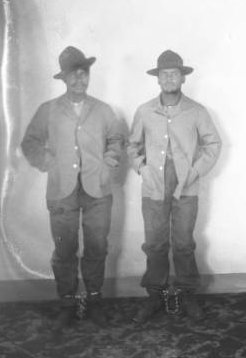
1870: Jacob Wallace, Henry Coston, and Moses and Peter Newby

The Daily Cleveland Herald, September 22 1870

THE VIRGINIA GALLOWS HORROR.

Tortured by a Bungling Hangman — Half Executed with a Rotten Rope — A Monster under the Gibbet.

The four negroes who were hanged on Friday last at the Court House of Isle of Wight county, Virginia, were convicted of the murder, under most brutal circumstances, of Josiah P. Grey, a citizen of that country, in December last. Six negroes were implicated in the crime, named respectively, Guyanetta Mears, Alfred Bunckley, Moses and Peter Newby, alias Lawrence, Jacob Wallace, and Henry Coston, alias East. The last five were immediately arrested, Mears having either effected his escape in a somewhat miraculous manner, or, as it is rumored, having been lynched by his captors. The five taken were tried at the August term of Isle of Wight county. Bunckley having turned State’s evidence, escaped, but by their own confession of complicity in the killing, four of them were condemned to be hanged. The Norfolk Virginian gives this account of the execution:

About 12 1/2 o’clock the officers entered the cell in which the prisoners were confined, and striking off their iron shackles, tied their hands behind their backs, at the same time telling them they could make any communication which they wished. To this no satisfactory answer was returned, and the condemned continued chanting their prayers for mercy from on high. As soon as the pinioning was performed, the condemned were marched out of the jail on the steps and upon the scaffold.

They walked firmly and undoubtedly, with one exception, Moses Newby, who shook as if in an ague fit, and were ranged in the following order: Peter Newby, Henry Coston, Moses Newby, and Jacob Wallace. The fatal nooses were then adjusted, when the Sheriff read the death warrant and sentence of death. The prisoners were informed that they could have an opportunity of saying a few words each.

The feet of the condemned having been pinioned upon their first taking their stand upon the scaffold, as each one ceased to speak the black cap was drawn over his head, and when all had finished, the scaffold was cleared of all but the condemned and at exactly 1 o’clock, at a signal from Deputy Sheriff Ely, the prop was pulled violently away, and the drop fell.

Then ensued a scene the recital of which we would willingly spare our readers, and a repetition of which we earnestly hope it may never be our lot to witness. As the bodies fell in the drop, the two end men, Peter Newby and Jacob Wallace, both large, athletic men, snapped the rope like pack-thread, and fell heavily to the earth, apparently insensible.

The other two remained suspended; but one was hanging by only one strand of the rope, the other two having been broken by the fall. Moses Newby died instantly, his neck being broken, but Henry Coston lived for nearly ten minutes, gasping for breath, and his limbs working convulsively.

The two men on the ground lay still for a few minutes, when Jacob Wallace rose to a sitting posture and broke into prayers and supplications. Peter Newby lay a while longer, when he also sat up, but kept silent, except groans extorted by pain. Their feet were then untied, when both stood up, Newby leaning heavily against the steps of the gallows, while Wallace walked back and forth, praying intently. New ropes were procured and adjusted to the beam, the two men hanging preventing the drop being raised. At the expiration of seventeen minutes the physicians in attendance, Drs. Jordan and Chapman, examined the bodies and pronounced them both dead, when another horror was enacted which made strong men shudder and turn pale.

Instead of lowering the bodies as is always customary, the ropes were cut, allowing the ghastly corpses to fall with a horrible thud at the very feet of the two half-hanged men standing below. Not content with this, the brutal monster who officiated as hangman, an occupation which he dishonored, and who rejoices in the name of the name of [sic] John J. Murphy, descended from the scaffold, and taking hold of the rope attached to the neck of one of the dead men, drew the body by it across the yard, and tumbled it into the coffin, as if it had been a dead dog. He repeated the operation on the next one, and seemed to think that by his disgusting brutality he had done some meritorious action.

During the whole of the time this disgusting scene was transpiring, Wallace and Peter Newby, although suffering horribly from the effects of the rope around their necks, in their fall, betrayed no emotion, save that Wallace used the time in praying loud and fast. Newby looked on apparently as unconcerned as if he was not an actor in the dreadful drama.

The new ropes, which were of stout cotton cord, having been fixed, the drop was replaced and the miserable men mounted the scaffold the second time, this time never to return alive.

The condemned both spoke to the crowd around in the same strain as before, at the conclusion of which the black caps were again drawn over their heads, and at half past one o’clock the drop again fell, and the ropes proving strong enough, they were left struggling in the air. Neither of their necks were broken, and for several minutes they gave painful evidence of life by their forced breathing and the convulsive jerking of their arms and legs. They were allowed to hang for half an hour, when they too were cut down, placed in their coffins, and taken to the court-house graveyard for interment.

[editor’s note: here’s the perfunctory and much less colorful New York Times report of the incident.]

On this day..

1962: Mack Merrill Rivenburgh cheats the executioner

On this date in 1962, just hours before he was to face a firing squad for the murder of a fellow inmate, Mack Merrill Rivenburgh cheated the executioner with a fatal drug overdose.

It was the final escape for a prisoner who had had a lot of them: five previous stays had scotched scheduled executions, sometimes with just hours to spare, back when such stays were anything but routine. The state’s Pardons Board was a long time mulling the case.

Rivenburgh’s own suicide note complained that he was “tired of waiting, tired of the excessive delays,” which is an interesting reason to take one’s own life just before the executioner was going to do it anyway. (Rivenburgh also asserted his innocence.)

Actually, Utah had built wooden execution chairs for two men set for death a September 14 death by musketry, but didn’t manage to seat either inmate.

The other, Jesse Garcia — condemned for helping Rivenburgh slay LeRoy Varner — was granted a commutation on the evening of September 13.

As it turned out, Utah would not put another criminal to death until Gary Gilmore in 1977.

On this day..

1983: Jimmy Lee Gray, drunk-gassed

Just after midnight on this date in 1983, Jimmy Lee Gray gruesomely paid with his life in the Mississippi gas chamber for raping and murdering a three-year-old.

Mississippi’s gas chamber had had a checkered history since its first usage in 1955, and with America just emerging from a long lull in executions, Jimmy Lee Gray was its first client in 19 years.

“Sumbitch took a little three-year-old girl out into the bush and he raped her,” executioner T. Barry Bruce would later explain of the man’s crime. “Then he tried to shove her panties down her throat with a stick, then he pushed her head into a little crick full of running shit and then he broke her neck. So yeah, I feel real sorry for Jimmy Lee.”

Gray was on parole at the time for the 1968 murder of his teenage sweetheart, so no — nobody felt all that sorry for Jimmy Lee, not even his mom.

But the reason that questions about the affair were being directed at the executioner (usually a party as silent in these matters as he is implacable) was that Jimmy Lee Gray’s had been drunk on the job — and the execution was a notorious horrorshow.

“Gasping” or “moaning” a recorded eleven times, Gray convulsed wildly in the Parchman death chair, slamming his unrestrained head “with enough force to shake the chamber” against a metal pole that some user interface genius had positioned right behind the death chair. The witness room was cleared eight minutes into the affair, with Gray still thrashing about.

Though the Magnolia State contended that Gray was clinically dead within two minutes, that head-smashing act disturbed everyone.

As a result, for the third time in a half-century, Mississippi switched to a newer and supposedly more humane method for killing people — adopting lethal injection for anyone sentenced to death after July 1, 1984. (Three more prisoners already condemned under the old sentencing guidelines would die in the gas chamber in the late eighties, however.)

Actual executions in the U.S. were still novel enough in the early 1980s that Gray’s made national news — albeit distinctly second fiddle to the tense Cold War escalation occasioned by the September 1 Soviet downing of Korean Air Lines flight 007.

On this day..

1923: Nathan Lee, the last public hanging in Texas

This date in 1923 was the passing of an era: the last legal public hanging in Texas.

The Texas of legend — the rough and vast frontier — fits the public hanging tableau (and its dark cousin, the lynching) like a hemp necktie.

And up until 1922-23, Texas executions had indeed been hangings administered by county sheriffs. But that newfangled killing technology, the electric chair, beguiled the legislature here as elsewhere. Oil wells popping up all over the state were rewriting its economic future … so why not a futuristic way of killing wrongdoers, too?

A 1923 bill centralized future executions in Huntsville, where they still remain today.

Denouncing countyseat [sic] executions as a barbaric relic of the frontier past, L.K. Irwin launched a one-man campaign to bring Texas in tune with the times. The state legislator converted many to his cause with the argument that public hangings harmed society almost as much as the condemned.

Irwin insisted executions usually degenerated into bloodthirsty carnivals that did nothing to instill in spectators a respect for the law. All too often untrained local officials made the spectacle even more gruesome, when the drop failed to snap the victim’s neck. On those occasions, he slowly strangled in full view of females and impressionable children.

In the 1923 session of the Lone Star legislature, Irwin introduced the Electric Chair Bill. In addition to doing away with the gallows, the proposal relieved county sheriffs of the responsibility of the carrying out death sentences. Future executions would be held behind closed-doors inside the Texas Department of Corrections.

That law took effect on Aug. 14, even though the electric chair hadn’t even been built yet. The hanging of one Roy Mitchell in Waco on July 30 figured to be the last, and thousands packed the public square to witness it. It’s still sometimes cited as the Lone Star State’s last hanging.

Grandfather Clause

But on that very same date in the Gulf town of Angleton, Nathan Lee, an illiterate middle-aged black sharecropper, was condemned to die for shooting his white employer dead in a dispute over money. (The Ku Klux Klan sent flowers to the funeral.)

A month later, he did so — albeit in an area whose public access had intentionally been curtailed, to chill out any potential carnival scene.

“I did it,” Lee said on the scaffold. “I am to blame, and no one else.”

On this day..

1927: Sacco and Vanzetti (and Celestino Madeiros)

America Sacco & Vanzetti must not die

-Allen Ginsberg, “America” (mp3)

We have now reached a stage of the case the details of which shake one’s confidence in the whole course of the proceedings and reveal a situation which undermines the respect usually to be accorded to a jury’s verdict.

-Felix Frankfurter in The Atlantic

America our nation has been beaten by strangers who have turned our language inside out who have taken the clean words our fathers spoke and made them slimy and foul

their hired men sit on the judge`s bench they sit back with their feet on the tables under the dome of the State House they are ignorant of our beliefs they have the dollars the guns the armed forces the powerplants

they have built the electricchair and hired the executioner to throw the switch

all right we are two nations

. . .

but do they know the old words of the immigrants are being renewed in blood and agony tonight do they know the old American speech of the haters of oppression is new tonight in the mouth of an old woman from Pittsburgh of a husky boilermaker from Frisco who hopped freights clear from the Coast to come here …

the men in the deathhouse made the old words new before they died.

John Dos Passos, The Big Money (part of the U.S.A. trilogy)

Let us abandon then our gardens and go home
And sit in the sitting room.
Shall the larkspur blossom or the corn grow under this cloud?
Sour to the fruitful seed
Is the cold earth under this cloud,
Fostering quack and weed, we have marched upon but cannot conquer;
We have bent the blades of our hoes against the stalks of them.

Let us go home, and sit in the sitting room.
Not in our day
Shall the cloud go over and the sun rise as before,
Beneficent upon us
Out of the glittering bay,
And the warm winds be blown inward from the sea
Moving the blades of corn
With a peaceful sound.
Forlorn, forlorn,
Stands the blue hay-rack by the empty mow.
And the petals drop to the ground,
Leaving the tree unfruited.
The sun that warmed our stooping backs and withered the weed uprooted
We shall not feel it again.
We shall die in darkness, and be buried in the rain.

What from the splendid dead
We have inherited —
Furrows sweet to the grain, and the weed subdued —
See now the slug and the mildew plunder.
Evil does overwhelm
The larkspur and the corn;
We have seen them go under.

Let us sit here, sit still,
Here is the sitting-room until we die;
At the step of Death on the walk, rise and go;
Leaving to our children`s children this beautiful doorway,
And this elm,
And a blighted earth to till
With a broken hoe.

-Edna St. Vincent Millay, “Justice Denied in Massachusetts”

If it had not been for these things, I might have lived out my life talking at street corners to scorning men. I might have died, unmarked, unknown, a failure. Now we are not a failure. This is our career and our triumph. Never in our full life could we hope to do such work for tolerance, for justice, for man’s understanding of man as now we do by accident. Our words — our lives — our pains — nothing! The taking of our lives — lives of a good shoemaker and a poor fish-peddler — all! That last moment belongs to us — that agony is our triumph.

-Bartolomeo Vanzetti


Ben Shahn, The Passion of Sacco and Vanzetti

A recently discovered letter indicates that Upton Sinclair was convinced of his subjects’ guilt.

“Alone in a hotel room with Fred [Moore], I begged him to tell me the full truth … He then told me that the men were guilty, and he told me in every detail how he had framed a set of alibis for them … I faced the most difficult ethical problem of my life at that point … I had come to Boston with the announcement that I was going to write the truth about the case.”

But Sinclair had reasons beyond the “ethical” to tell what he saw as the larger truth. From a different letter:

“My wife is absolutely certain that if I tell what I believe, I will be called a traitor to the movement and may not live to finish the book … Of course, the next big case may be a frame-up, and my telling the truth about the Sacco-Vanzetti case will make things harder for the victims … It is much better copy as a naïve defense of Sacco and Vanzetti because this is what all my foreign readers expect, and they are 90% of my public.”

Well, the dying time came, the legal midnight hour,
The moment set by law for the Chair to be at work,
To substantiate the majesty of the State of Massachusetts
That hour was at hand, had arrived, was struck by the clocks,
The time for two men to be carried cool on a cooling board
Beyond the immeasurably thin walls between day and night,
Beyond the reach of airmail, telegrams, radiophones,
Beyond the brotherhoods of blood into the fraternities
Of mist and foggy dew, of stars and ice.
 The time was on for two men
 To march beyond blood into dust —
 A time that comes to all men,
 Some with a few loved ones at a bedside,
 Some alone in the wilderness or the wide sea,
 Some before a vast audience of all manking.

 Now Sacco saw the witnesses
 As the straps were fitted on
 Tying him down in the Chair —
 And seeing the witnesses were
Respectable men and responsible citizens
And even though there had been no introductions,
 Sacco said, “Good-evening, gentlemen.”
And before the last of the straps was fastened so to hold
Sacco murmured, “Farewell, mother.”

Then came Vanzetti.
He wished the vast audience of all mankind
To know something he carried in his breast.
This was the time to tell it.
He had to speak now or hold his peace forever.
The headgear was being clamped on.
The straps muffling his mouth were going on.
He shouted, “I wish to forgive some people
  for what they are now doing.”
 And so now
 the dead are dead????

-Carl Sandburg, “Legal Midnight Hour”


(The executions took place just after midnight Aug. 22-23)

THE names of the “good shoe-maker and poor fish-peddler” have ceased to represent merely two Italian workingmen. Throughout the civilised world Sacco and Vanzetti have become a symbol, the shibboleth of Justice crushed by Might. That is the great historic significance of this twentieth century crucifixion, and truly prophetic, were the words of Vanzetti when he declared, “The last moment belongs to us–that agony is our triumph.”

Vanzetti was right when he declared that his execution was his greatest triumph, for all through history it has been the martyrs of progress that have ultimately triumphed. Where are the Caesars and Torquemadas of yesterday? Who remembers the names of the judges who condemned Giordano Bruno and John Brown? The Parsons and the Ferrers, the Saccos and Vanzettis live eternal and their spirits still march on.

-Alexander Berkman and Emma Goldman, “Sacco and Vanzetti”

Starting points for the many Sacco and Vanzetti resources online: Famous American Trials | Wikipedia | Massachusetts Supreme Court virtual tour | American Writers and the Sacco-Vanzetti Case

On this day..

1799: Thomas Nash, after rendition to the British

On this date in 1799, Thomas Nash was hanged in Jamaica for the bloody mutiny on the HMS Hermione.


Before there was Hermione Granger, there was the HMS Hermione. Painting by Thomas Whitcombe.

The Admiralty’s most notorious mutiny this side of the Bounty was actually a far bloodier affair. Dig the description from one of the conspirators who later turned state’s evidence.

“The captain,” said he, “was very severe with the men, who were all good seamen, and they were determined to either run the ship on shore and desert, or else take her by force. This had been in their minds for months before it happened. At last,” said he, “on a dark night, when the young lieutenant had the watch, our minds were made up. A party went to the cabin-door, knocked down the sentry, and entered it. The captain was in his cot, and he was soon overpowered. We threw him out of the cabin-window. Another party threw the officer of the watch over the larboard quarter, but he, being young and active, caught hold of the hammock-stanchion, when one of the men cut his hands off, and he soon dropped astern. The first lieutenant had been ill and keeping his cot, but on hearing the noise, he came up the hatchway in his shirt, when one of the carpenter’s crew cut him down with an axe, and he was sent overboard with several others.”

(There’s a fine audio lecture about this mutiny in the context of maritime class violence at the Bristol Radical History Group, which reminds that in a context where most of a ship’s manpower was marshaled with the violence of involuntary conscription, mutiny bids were a regular feature of Old Blighty’s maritime empire. London Times archives are available from 1785, and searches on the word “mutiny” in those early years reveal dozens of episodes — and those were just the reported ones.)

After making sharkmeat of that tyrannical captain, 27-year-old Hugh Pigot, the Hermione mutineers got drunk, and then delivered the frigate to the Spanish.

A Royal Navy vessel aptly named the Surprise* was able to surprise the wayward warship and cut her out of the Venezuelan harbor Puerto Cabello. The Hermione was then aptly renamed the Retaliation (and later, Retribution). Then, the British put the ominous word into action with a global manhunt for the mutineers.

Nearly thirty men ultimately hanged for the affair, though that meant that most of those involved escaped the noose.

And Executed Today never** deals with the lucky ones.

Mind if I do a Jay?

And so we come at last to our day’s protagonist, one of the Hermione mutineers who was at length recognized in the breakaway former British colonies now constituting themselves the United States of America.

Upon catching this intelligence, British envoys demanded the extradition of this character — who now claimed to be an American citizen by the name of “Jonathan Robbins” — under the terms of the recent and controversial Jay Treaty. After several months under lock and key without any American charge against him, Robbins/Nash eventually had a habeas corpus hearing before Judge Thomas Bee, who decided† that this “American citizen” was no such thing. With an okay from the Adams administration, Bee had the man delivered to the crown.

Nash was immediately shipped down to the British colony of Jamaica, put on trial on Aug. 15 (he had no defense), and hanged on Aug. 19.

Little could the Waterford-born seaman imagine the legacy he bequeathed his fake-adopted country.

I know my rights, man

The Nash extradition became a political firestorm in the U.S., with anti-British Jeffersonian Democratic-Republicans decrying the Federalist administration’s handling of the case. For the infant republic, formulating juridical precedent on the fly, this played as a separation-of-powers issue: was it within the president’s power to fulfill the treaty unilaterally, absent executing legislation passed by Congress? Was it within a judge’s purview to approve an extradition request without the constitutionally assured right to trial by jury?

Sounding eerily contemporary, New York Rep. Robert Livingston denounced a system whereby “a citizen of the United States might be dragged from his country, his connections and his friends, and subjected to the judgment of an unrelenting military tribunal.” Less measured, a Philadelphia Aurora headline announced: “BRITISH INFLUENCE threatens destruction of these United States!” (Source of both quotes)

Though it was surely not decisive, this issue provided great fodder in the 1800 elections swept by the Democratic-Republicans and standard-bearer Thomas Jefferson. Jefferson’s home state of

Virginia, the stronghold of inimical feeling to Great Britain … passed a law forbidding under heavy punishment a magistrate to be instrumental in extraditing any person out of the state. Thus desertions from British ships in a Virginian port became a regular event. Captains of British vessels sailing to United States ports in no long time would meet their men strolling in the streets, furnished with naturalization papers, who set them at defiance, for their arrest was impossible.

“This passage of history,” the otherwise hostile-to-Nash source is obliged to concede, “tells unfavourably on the character of the treatment of British seamen … the Discipline was harsh and oppressive, one of pure repression. The consideration of others, enforced by benevolence and duty, was often regarded as weakness.”

Hard to imagine why anyone would want to mutiny! It calls to mind, at the end of this passion play as at its start, the words supposed to have been hurled at the Hermione‘s doomed Captain Pigot as he pled with his assailants for mercy: “You’ve shown no mercy yourself and therefore deserve none.”

A real reactionary

Despite the electoral slam dunk, the real last word on the case ultimately belonged to the administration’s defenders.

Among these rose in Congress a first-term — for he would only serve a single such term — member of the House of Representatives also from the Old Dominion, John Marshall.

Just months later, Marshall would be one of outgoing President Adams’s “midnight judges” appointed to the federal courts: in Marshall’s case, to the U.S. Supreme Court, where his epochal 34-year term as Chief Justice would shape the future evolution of American jurisprudence.

Rising on March 7, 1800, in defense of President Adams’s conduct in the Nash case, Representative Marshall gave a preview of the strong federalist perspective that would define his time on the bench. (Read it in full here.)

The President is the sole organ of the nation in its external relations, and its sole representative with foreign nations … He possesses the whole Executive power. He holds and directs the force of the nation. Of consequence, any act to be performed by the force of the nation is to be performed through him.

This passage was exhumed from Congressional archives for citation in a 1936 Supreme Court case on federal supremacy, and has proceeded thence into a go-to bullet point for every latter-day defender of any arbitrary executive authority.

Of consequence (as Marshall might put it), Marshall’s speech about Nash gets an approving reference in Bush administration lawyer — and possible future extradition subject?John Yoo‘s September 25, 2001 memorandum on “The President’s Constitutional Authority to Conduct Military Operations Against Terrorists and Nations Supporting Them”.

Supreme Court Justice Clarence Thomas, too, quotes this phrase in his Hamdi v. Rumsfeld dissent, further to the doctrine that a man consigned to a presidential oubliette has no recourse to the courts; Justice John Harlan used it (with the rather grandiosely exaggerated qualifier that “from that time, shortly after the founding of the Nation, to this, there has been no substantial challenge to this description”) in his dissent in the Pentagon Papers case to claim that Richard Nixon could prevent the New York Times and Washington Post from publishing the embarrassing classified history of the Vietnam War.‡

So in this imperial age, Thomas Nash is more with us than ever he was. Who knows but what noxious monarchical theories are even now being buttressed with footnotes resolving to the vindictive execution of that obscure mariner two centuries past?

* The Surprise features prominently in novelist Patrick O’Brian‘s beloved Aubrey-Maturin series of nautical adventure novels, the most widely recognized of which is Master and Commander.

Given the vessel’s centrality in this popular series, there’s a book all about the colorful history of the Surprise. In reality, the Surprise — actually a captured French ship herself — was sold out of the service in 1802, prior to the notional 1805 setting of both the cinematic Master and Commander: The Far Side of the World and the book in the series when Jack Aubrey first commands her.

** … hardly ever.

† Rightly, it’s generally presumed; “Robbins” is alleged (albeit by his self-interested executioners) to have confessed to being Nash before his execution. This entry garners the Wrongful Execution tag on the basis of its contested American jurisprudence.

‡ The limited aim of Marshall’s speech in context, and its subsequent (mis)appropriation, is the subject of an interesting and accessible-to-laypersons law review article here. (pdf) This tome gets a bit more into the weeds on the way the separation of powers operated practically as the Nash case unfolded in Judge Bee’s court.

On this day..

1775: Thomas Jeremiah, Charleston’s wealthiest free black

(Thanks to Meaghan Good of the Charley Project for the guest post. -ed.)

On this day in 1775, Thomas Jeremiah, a free black man in the then-colony of South Carolina, was hung after being convicted of attempting to a slave insurrection.

The case against him was extremely weak, but he was tried/framed under the Negro Act of 1740 (in a slave court, although he was not a slave), wherein the defendant was considered guilty until proven innocent. South Carolina’s own royal governor, William Campbell, called it a case of “judicial murder.”

Very little is known about Jeremiah. He left no diary or letters behind, and most of his trial records have been lost. We know he was married but we know nothing about his wife, whether she was a slave or a free black like himself, or whether they had any children. We don’t know how he became free or how he learned his trade. He is, in fact, so obscure that he doesn’t even have his own Wikipedia entry.

What little we do know, however, suggests that he was a most extraordinary man: a fisherman and ship’s pilot, one of less than 500 free blacks in the city of Charles Town (now called Charleston), Jeremiah had somehow managed to claw his way up and amassed a net worth of £1,000, or about $200,000 in today’s money. He was one of the wealthiest free black men in North America, and certainly the wealthiest self-made one.

Himself a slaveowner, he had no reason to start a slave rebellion, but this didn’t matter to those who convicted him. Jeremiah’s life, trial and death are discussed in detail in J. William Harris’s 2009 book, The Hanging of Thomas Jeremiah: A Free Black Man’s Encounter with Liberty. (This book review provides a good summary.)

2010 saw the publication of a second book, The World of Thomas Jeremiah: Charles Town on the Eve of the American Revolution.

Jeremiah was basically a victim of his own success. He had risen too high; he made the local white elites uncomfortable. As Harris noted, Jeremiah “did not need to gather arms or preach revolution to undermine slavery, because his whole life was a refutation of whites’ basic justification for slavery.”

Henry Laurens, a wealthy businessman, future Continental Congressman, slaveowner, and contemporary of Jeremiah’s, stated he was “a forward fellow, puffed up by prosperity, ruined by Luxury & debauchery & grown to amazing pitch of vanity & ambition.” He needed to be smacked down and he was, most severely.

In the spring and summer of 1775, revolution was fomenting everywhere. White “Patriots” wanted an opportunity to get out from under England, but they feared their slaves would use the conflict to try and get out from under them.

Nat Turner and Charleston’s own Denmark Vesey — these immortal rebels lay years into the future, but their very prospect made slave rebellions an omnipresent fear among the white populace. It was jumpy. And when two slaves accused Jeremiah of trying to persuade them to rebel, it jumped.

Only a few months passed between Jeremiah’s arrest and his execution. By that time he was a broken man, welcoming death. After he was hung, his body was cut down and burned to ashes.

Books about Thomas Jeremiah

On this day..

1795: Pomp, a Negro

On this date in 1795, an African-American near-slave (slavery’s official 1783 abolition in the state seems not to have constituted a completely bright line) was hanged in Ipswich, Mass. for murdering his master-slash-employer.

Thanks to Laura James at CLEWS, we are drawn to this story reproduced here at the University of North Carolina-Chapel Hill’s Documenting the American South site. Pomp was perhaps mentally “touched”; he was certainly physically “touched” for any perceived inadequacy at his labors, and eventually chopped off his master’s head while the latter slept beside his wife. (The wife summoned the police, without molestation from Pomp.)

The victim, Captain Charles Furbush, was a minuteman who fought at Lexington, one of the opening skirmishes of the Revolutionary War.

Reprinted in full below (complete with breaks in the text where the original document is damaged) is the “Dying Confession of Pomp,” a broadsheet produced by a local merchant — who does not scruple to append some classified ads to the end of the text.*


I POMP now under sentence of death in Ipswich Jail, was born in [illegible], and brought from that place, so soon after I began my existence, that together with my Parents, I arrived at Boston when I was about three months old. My Father died soon after and my Mother has since had two husbands, and is now a widow. I have three sisters and three brothers now living in Boston, for whom a well as for my Mother I have a great regard.

My Mother soon after our arrival in this Country gave me away to Mr. Abbot of Andover. With this Gentleman I lived till I was sixteen years of age, but he being then on the point of moving back into the country some distance, told me if I chose it that I might then live with one of his sons, who was still to reside in Andover. I took up with his offer: choosing rather to continue in Andover, than to accompany my old master, to his new abode.

With young Mr. Abbot I lived not long, before I grew uneasy with the place. I told him that I meant to leave him soon, but he informed me that I was not free. About this time I was seized with convulsion fits which continued to oppress me at times ever after, to the fatal night that I murdered Capt. Furbush. Continuing still unreconciled to the new place, I went to the Select men of Andover to know whether I had not a right to leave it, and by their advice continued there a considerable time longer. But after a while it came to pass that Capt. Furbush took a notion to have a black man; and applying to the Select men, obtained their consent that I should be his servant. In compliance with the wishes [illegible] him; but soon found that I did not like him any better than the man with whom I had last lived. Furbush had a considerable farm and when I first began to live with him did some work himself, but I did not like the way he carried on his business, and after a while he left off work entirely, and by my desire left the whole management of the farm to me. I performed nearly all the work that was done on the place, cut all the hay, and with a trifle of help from the boy, whom my master desired to asist me a few days in a season, raised an hundred and seventy bushels of corn in a year. But my master still continued unkind to me, never letting me go to meeting on Sundays, and forcing me to clear out the cattle on those sacred days. When I asked him for money, he commonly gave me no more than four pence half peny, at a time: and even on Election day he gave me no more, nor would he suffer me on those days to go to frolicing till after one o’clock in the afternoon.

Though I did the best that I was able to do on the farm, my master was so far from seconding my endeavors, that he often brought whole droves of horses home with him in the night, and turned them in among the standing corn, that I had taken so much pains to plant, and hoe, and on the succeeding mornings he would charge me with the guilt of turning these horses into the corn field. In this way he often caused corn enough to be broken down in one night to fat a hog, and keep him fat a whole winter. I thought I found that he was a bad man, and a cheating horse jockey, and finally being unable to like him, I ran away from him, but was pursued, found, brought back, and severely flogged, by him for my pains. I afterwards ran off again but again met with the same fate. In this manner I went on ten or a dozen years, not liking my place, and not able to get away from it. I was frequently troubled with convulsion fits and sometimes crazy in such a degree, that I was generally bolted in to a chamber every night, in order to hinder me from getting into the chamber where my masters daughters slept. I worked very hard all the time. My master had one weakle son who was unable to work, and who often shed tears while he saw me labor and told me that he wished he was able to help me. I told him that perhaps I should contrive something after a while but did not explain myself. Continuing still uneasy I thought I would try once more the benefit of my legs. I accordingly ran off, but after a weeks absence, I was again brought back by my master, stripped naked, tied up by both hands, and unmercifully flogged. This was in the evening, and though it was late in the fall, and cold, frosty, icy weather, my master left me thus naked, and tied up, till the morning. My sufferings during the tedious hours of this lengthy night, by reason of cold and nakedness, a sore back and wounded spirits, were extremely great, and while under this torture, I thought it likely that my master would sometime or other feell the effect of his cruelty. My conjectures were so far right that it was the last time, that Furbush ever struck me.

My master used to tell me I might stay as long as I pleased at his house, adding that he should not stay in the world forever. From this I entertained an idea that Mrs. Furbush and the farm would be mine, after the death of my master. The hopes of being master, husband and owner, on one hand, and the cruel treatment I had received from Furbush on the other, prompted me to wish for his death and produced an idea of hastening [illegible] by [illegible] him myself.

In this state of mind the morning of the fatal day arrived. I arose considerably disordered having a great singing noise in the ears, and something whispering strange things to me I however went about my work as usual, cut up bushes all the day, near where there was another man to work but revealed nothing concerning my designs to him, at night went home, eat a beef steak for supper, and went to bed. Soon after I was seized with a fit, bit my tongue almost through, and after coming out of the fit, was delirious. I continued not long after this in bed, being impressed with an idea that I must get up and kill Capt. Furbush. The Lord a massy! said I to myself what is a going to take place now! The door of my chamber not being bolted as usual, I left my apartment and went down to the fire place. I was struck with horror by my reflections; but something still kept whispering in my ear, that now is your time! kill him now! now or never! now! now! I took an axe and went softly into the bed room of my master, and the moon shining bright, distinguished him from my mistress, I raised the ax before he awaked and at two blows, I so effectually did the job for him, that he never after even stretched himself.

My mistress being roused from sleep by the sound of the blows, said are you dead you? But receiving no answer she immediately left the bed, and called in a near neighbor. I did not try to escape not knowing that there was any necessity of it. I was told that I had but to go up to my chamber, I went there and perceived that somebody had bolted the door after me. Company soon began to croud into the house, and I was soon told that I should certainly be hanged. I was now very much frighted, nnd expected to be hung immediately, but my grief wore off considerably w [illegible] found that I was not to be hung there. I [illegible] soon brought to this Jail, and here enjoy mys [illegible] considerable well, though at Court time I [illegible] ry unhappy, and now some times, the idea [illegible] I have no friends, makes me dull.

The Ministers have been kind to me here, and I believe they are clever people: Mr. Stanniford too the Ja [illegible] keeper is kind and humane, and his wife and daughters clever people and pretty women. ([illegible] ndantly amiable ladies he ought to have said [illegible] whole family are clever folks.) The Ministers have told me to pray to God, and to the blood of Christ, for a new heart. I approve of [illegible] advice, and spend great part of my time in prayer, even ten or twenty times in a day I pray though I find it hard work, I do not however find fault with the hardness of the task, for [illegible] ieve it has been attended with great success. I have good hopes that I have got a new hear [illegible] the one that I used to have, used to ache [illegible] d, but the one I now have feels easy. I never [illegible] so well and hearty in my life as I now am, [illegible] fits and lunacy have left me entirely [illegible] hope to behave cleverly and graciously in this world.

I have prayed so much, that I have got all the minister’s [illegible] of praying and am not afraid to pray with [illegible] black coated man on the Continent. I [illegible] d make a very extraordinary priest, and inde [illegible] am turning very fast into one. When I [illegible] here, I was as black as any negro in the country, but now I have scarcely a drop of negro blood left in me, my blood having so far [illegible] ed into the blood of a Minister, that I am a [illegible] y nearly as white as a Mulatto. Minist [illegible] people and they can turn [illegible]

Some acc [illegible] the hapless POMP with some reflections [illegible] fate by J. PLUMMER, Jun.

Illustration of Pomp's hanging from the broadsheet

POOR POMP was a well made, considerable large, likely looking Negro. [illegible] e was very capable of contriving business on a farm, and such was his strength and industry, that besides the [illegible] which he received for his labour, Capt. Furbush could very well have afforded him 50 dollars per year–With such wages, or even with half that salary he might soon have acquired money enough to purchase 50 acres of excellent [illegible] land, and to have enabled him to clear and improve the same–In that situation some unfortunate white woman might possibly have sought [illegible] assylum in his arms, or at least the likelie [illegible] to girl that fell within the line of his ac [illegible] nce would have sprung like nimble doe [illegible] his marriage bed–The animating sweets of freedom, and of domestic life, had then been all his own–He would neither have sullied his hands with innocent blood, nor have been forced with unutterable woe, to breathe his last in a h [illegible] . But alas! instead of running this happy course, for want of understanding, and skill [illegible] him, to wife and laudable pursuits, we have seen him experience the sad reverse.

I ha [illegible] endeavored to preserve the ideas of poor Pomp, in the above speech, though I have taken the liberty to arrange the matter in my own way, [illegible] to word his thoughts more elegantly and [illegible] than he was able to express them. As to [illegible] said of something telling him to kill his [illegible] er, I believe it to be a falsehood of his ow [illegible] hing contrived by him to excuse his conduct, but as to the rest of his speech, I fancy that he believed it himself; though in several particulars he was pretty much mistaken. His [illegible] capacity was below the common pitch, and his understanding was undoubtedly considerably injured by convulsion fits, though his parts were vastly superior to those of an ideot. But for a rational being his mental improvements were extremely small; though when we consider the situation that he has lived in, this is not so very strange as we at first should think it. He lived either alone in the field, in bed, or in the kitchen of some people, who were too much above him to be his associates: and probably was never learned to read–There were few Negroes in Andover or any where near him, and all there was were unlearned people. From whom then or in what manner was it in his power to gain knowledge? ‘Tis true that he had some intercourse with his white neighbours, but very little that was profitable for instruction;– the discourse generally turning on domestic business, the raising country produce, the age, and strength, of oxen, and horses, the bulling of cows, or the lambing of sheep.– Of knowledge like this Pomp had a large stock. He knew all his master’s cattle, sheep, and hogs, and pretty exactly the age of each creature: and likewise the horses and oxen of many of his neighbours: could tell when such a particular cow of a certain neighbour had been bulled, and when his sow had pigged; but no man thought it worth his while to talk much upon other matters with him, nor would he have been much pleased with the discourse had it been otherwise. He knew not the names of the Seven Sciences, nor even that there were such things or names–knew nothing of ancient or modern history, nor even the late revolution in France, or the consequences of it so often rung through the universe–So little [illegible] ears–Of philosophy [illegible] , geography, good breeding, honor, politics, [illegible] he never heard, or heard with little attention, and less improvement– To crown his ignorance he lost his life by not knowing that murder was a sin: he expecting that he should immediately rise to a good estate and great felicity whenever he should be fortunate enough to kill his master. He knew nothing of the Laws of the United States or of this Commonwealth; and after the murder when he was told that he would be hung, he dreamed nothing of any previous imprisonment or trial: when he heard the sentence of death in Court, he expected to be hung the same hour but finding he was not to be executed that day, he conceived hopes that he never should be. He had seen others and been himself corrected in anger. He had observed that whenever his master was angry with him he either flogged immediately, or he for that time escaped correction, and that after the wrath of his master had subsided there was no danger. He thought the People of Andover and the Court at Ipswich would hang him in the same angry frame of mind, that his master used to flog him in, or that they would not hang him at all: he having no idea of the calm, but irrefutable ire, the deliberate, but vindictive, vengeance of the offended Justice, and of Heaven.

N. B. The reader will take notice that I do not attest to the truth of Pomp’s dying speech, but I affirm that he related to me as matters of fact the particulars [illegible] ted in this speech– Unfortunately for me [illegible] Jail keeper was absent when I visited the prisoner, [illegible] on his name does not appear a [illegible] tness: his lady was present, but perceiving that she was rather timorous, I did not trouble her with a request to be a witness; though I believe she will readly, orally attest to the truth of it.

Printed for and sold by JONATHAN PLUMMER, JUN. price 6d, who still continues to [illegible] various branches of trifling business–Underbeds filled with straw and wheeled to the ladies doors — Any person wanting a few dollars at any time may be supplied by leaving a proper adequate in pawn–Wanted 1000 junk bottles.

A certain secret disorder cured privately and expeditiously– Love-letters in prose and verse furnished on the shortest notice–The art of gaining the object beloved reasonably taught–

Nymphs and swains bow’d down with care
By cupid wounded to the heart,
Quick, O quick to me repair
For soon I ease the dreadful smart.


To Tell a Free Story: The First Century of Afro-American Autobiography, 1760-1865 characterizes the dueling interpretations of Pomp and his white interlocutor as “[pitting] two explanations of black criminal behavior against each other for the first time in Afro-American autobiography. Plummer’s argument is based on the notion of the Negro as absence. His lack of remorse for murder shows that he has no moral sense, and in justifying his crime with the “whispering” voices, he proves that he lacks truthfulness. Pomp’s narrative, on the other hand, insists that there was something at work in the black man’s psyche, a dynamic whose manifestations in the actions and language of Pomp resisted Furbush’s methods of control and Plummer’s system of reference.”

* By the way, click on my sidebar ads, why don’t you?

On this day..

1781: Isaac Hayne, paroled prisoner of war

On this date in 1781, South Carolina patriot Isaac Hayne was hanged for breaking his conditional British parole and re-enlisting in the American Revolution.

Though Hayne is not, to us, the most famous revolutionary executed by the British, he might have been considered by his contemporaries as the most prominent individual to go to the scaffold for the cause.

A wealthy planter (lots of slaves!) whose home and grave can still be toured in Jacksonboro, Hayne was among 5,000 to surrender to the British when the latter captured Charleston in 1780.

These prisoners were required to swear an oath of allegiance to the crown in exchange for their parole, which Hayne reluctantly agreed to do because his family had been hit with smallpox.

He declared to a friend that,

as they [the British] allow no other alternative than submission, or confinement in the capital, at a distance from my wife and family, at a time when they are in the most pressing need of my presence and support, I must, for the present, yield to the demands of the conquerors. I request you to bear in mind, that previous to my taking this step, I declare that it is contrary to my inclination, and forced on me by hard necessity. I will never bear arms against my country … I do not mean to desert the cause of America.

But as the British southern campaign foundered over the year ahead, the mother country eventually attempted to call him up to do just that: bear arms against his country.

Hayne thought his parole terms protected him from ever having to serve against the colonies, so he simply got back into the fight on the revolutionary side instead. He was captured in that capacity.

The British commander Francis Rawdon handled his relapsed prisoner with uncommon severity, putting him to a drumhead military tribunal with a preordained outcome and refusing the many public pleas for leniency.

The irregular and vengeful nature of these proceedings, and Hayne’s seemingly honorable conduct, raised hackles on both sides of the Atlantic; shortly after hanging Hayne, Rawdon returned to the British Isles to find a good deal of pointed criticism of his behavior. (Parliament quashed any damaging official inquiry, and Lord Rawdon actually extracted an apology from the peer who had the temerity to motion the investigation — an intolerable impeachment on Rawdon’s honor.)

The Hayne incident was widely understood to have been conditioned by British frustration at its failing fortunes in the war. By the time of the execution, the redcoats held nothing of South Carolina save Charleston itself. General Cornwallis had recently marched north from the Palmetto State; in a few weeks’ time, he would surrender his sword and the British cause alike after the decisive British defeat at Yorktown, Virginia.

And though the commandants at Charleston scarcely anticipated that stunning reversal, they had only a few months before suffered the upsetting (but more legally tenable) hanging of the honorable British Major John Andre as a result of the Benedict Arnold affair. British forces were reputedly on the lookout for any opportunity to trade tit for tat.

Continental Gen. Nathaniel Greene alleged that the British officer who received the petition for Hayne’s life simply wrote on it John Andre — and sent it back.


Isaac Hayne was the great-uncle of South Carolina pol Robert Y. Hayne, best remembered for a hot sectional debate with Massachusetts Sen. Daniel Webster. (Read it all here, if you must.)

It was during this exchange of Senatorial disquisitions that Webster delivered one of the noted orations of the antebellum era, the aptly-named Second Reply to Hayne:

I have not allowed myself, Sir, to look beyond the Union, to see what might lie hidden in the dark recess behind. I have not coolly weighed the chances of preserving liberty when the bonds that unite us together shall be broken asunder. I have not accustomed myself to hang over the precipice of disunion, to see whether, with my short sight, I can fathom the depth of the abyss below; nor could I regard him as a safe counselor in the affairs of this government, whose thoughts should be mainly bent on considering, not how the Union may be best preserved, but how tolerable might be the condition of the people when it should be broken up and destroyed. While the Union lasts, we have high, exciting, gratifying prospects spread out before us and our children. Beyond that I seek not to penetrate the veil. God grant that in my day, at least, that curtain may not rise! God grant that on my vision never may be opened what lies behind! When my eyes shall be turned to behold for the last time the sun in heaven, may I not see him shine on the broken and dishonored fragments of a once glorious Union; on States dissevered, discordant, belligerent; on a land rent with civil feuds, or drenched, it may be, in fraternal blood! Let their last feeble and lingering glance rather behold the gorgeous ensign of the republic, now known and honored throughout the earth, still full high advanced, its arms and trophies streaming in their original lustre, not a stripe erased or polluted, not a single star obscured, bearing for its motto, no such miserable interrogatory as “What is all this worth?” nor those other words of delusion and folly, “Liberty first and Union afterwards”; but everywhere, spread all over in characters of living light, blazing on all it sample folds, as they float over the sea and over the land, and in every wind under the whole heavens, that other sentiment, dear to every true American heart, – Liberty and Union, now and for ever, one and inseperable!

When not being rhetorically posterized by New England gasbags, Robert Hayne made time to pen a justification for his famous forebear’s conduct for the Southern Review in 1828 — comparing the British behavior of executing rather than detaining a prisoner who broke parole to the massacre at Jaffa Napoleon notoriously ordered in 1799.

(Actually, Isaac Hayne’s old nemesis Francis Rawdon had only died in 1826; Robert Hayne wrote his piece to confute a vindication of himself that Lord Rawdon — also recognized by his subsequent titles, Earl of Moira and Marquess of Hastings — had authored, decades after the fact, of his conduct in the Hayne matter.)

Though this 37-page slog of Robert Hayne’s is obviously in the public domain by now, it appears it is not yet freely available online. However, it’s the source of the otherwise unattributed quotes in this article.

Part of the Themed Set: The Empire Strikes Back.

On this day..

1903: Hilario Hidalgo and Francisco Renteria

Border-related violence and crime due to illegal immigration are critically important issues to the people of our state, to my Administration and to me, as your Governor and as a citizen.

Statement (pdf) by Arizona Gov. Jan Brewer on signing the anti-immigration law, which went into effect July 29, 2010

Some stories are just plain classics.

In February 1903, two Mexicans shot up Goddard Station stagecoach stop, for motivations that were never plain. (There was no robbery, but it might have been revenge.)

The shooters got away, but law enforcement soon enough decided that a couple of railroad workers on the Mexican side of the border matched their description, and contrived to lure them into Arizona where they could be arrested.

Hilario Hidalgo and Francisco Renteria, were put on trial for their lives in Prescott, Ariz., in June 1903, where they were doomed to hang on the strength of eyewitness testimony and thirty minutes of the jurymen’s time. Appeals forbidden, the sentence was executed on this date — not six months after the crime.

With feelings of profound regret and sorrow, I hereby invite you to attend and witness the private and decent and humane execution of two human beings, namely: Richard Roe and John Doe. Crime — Murder.

Said men will be executed on July 31, 1903 at 12 noon. You are expected to deport yourself in a respectful manner and any flippant or unseemly language or conduct on your part will not be allowed. Conduct on anyone’s part bordering on ribaldry and tending to mar the solemnity of the occasion will not be tolerated.

-Sheriff’s invitation to the hanging, quoted in Frontier Justice in the Wild West: Bungled, Bizarre, and Fascinating Executions

The men cracked wise at the reading of their death warrant — “I have heard that repeated so often that if it was a song I would sing it to you,” reported the Los Angeles Times (Aug. 1, 1903) — and with “perfect nerve” checked out, calling only “Adios! Adios!” from the scaffold.

It was the last hanging in Prescott, Ariz.

On this day..