1892: Ruggles brothers lynched

On this date in 1892, highway robbers John and Charles Ruggles were shanghaied from a Redding, Calif. jail and lynched.


John and Charles Ruggles, lynched in Redding, Calif.

These two charmers knocked over the Redding & Weaverville stage on May 14, 1892, killing the coach’s guard when he fired back.

Charles Ruggles was wounded in the exchange and soon captured, but John Ruggles got away with the lockbox.

With a price on his head, John secreted the stolen loot somewhere and was not arrested until June 19.

Reunited in jail, the handsome outlaws were evidently a big hit with the ladies. As the Los Angeles Times reported on July 25, 1892,

The recent sentimental attitude of a number of women toward the prisoners as well as the line of defense adopted by their counsel, who has been evidently endeavoring to implicate Messenger [Amos “Buck”] Montgomery [the dead victim] as a party to the crime, had been denounced by a number of persons in the county and it is believed the lynching was due to those causes.

When the vigilantes came for him, John tried to buy the boys’ way out of trouble — or at least, buy Charley’s way out — by offering to reveal the location of his treasure.

The mob wasn’t interested, and the cache has never been found since. On the other hand …

The lynching of a brace of stage-robbers at Redding a few nights ago was not at all in accordance with law and order; but that it will have a discouraging effect on the “hold-up” industry, there is little question. It will be perfectly safe to indulge in stage rides in Shasta county, no doubt, for some time to come.

Los Angeles Times, July 27, 1892

On this day..

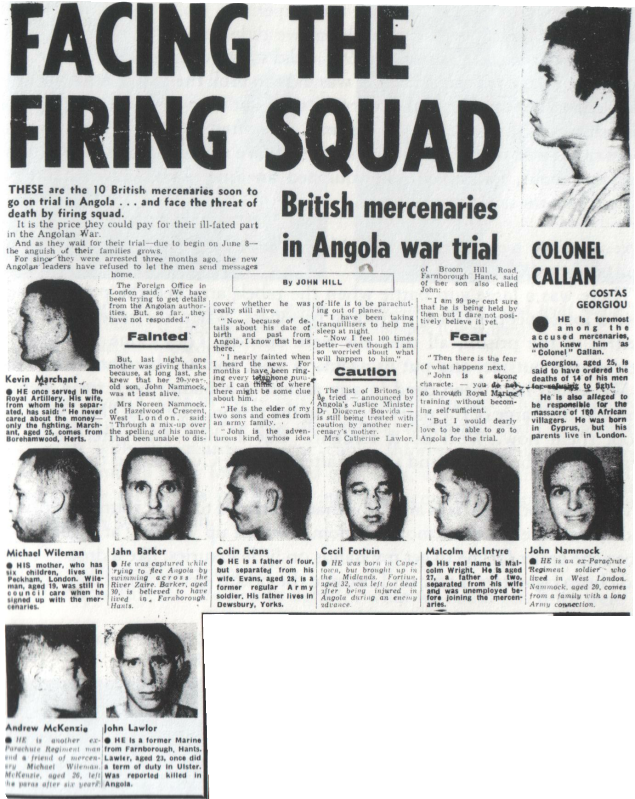
1976: Costas Georgiou and three other mercenaries in Angola

On this date in 1976, three Britons and one American were shot in Angola by a military police squad for murders committed as mercenaries earlier during the year.

Costas Georgiou.

They were among 13 foreigners sentenced at the Luanda Trial, which occurred on the pivot of Angola’s transition from generation-long anti-colonial insurrection on towards generation(s)-long civil war. Between them, more than half a million Angolans died, but this date belonged to a couple of unrepresentative Anglos.

Long story short, the immediate aftermath of Angolan independence in late 1975 was a scramble for control among the several factions who had been fighting the Portuguese … along with a scramble among interested outside states to line up their allies in this resource-rich Cold War prize.

Small wonder that foreign soldiers of fortune soon found their way into the chaotic scene.

Over the course of the first few months of independence, the Popular Movement for the Liberation of Angola (MPLA) more or less consolidated state power, and it proceeded to prosecute supporters of a rival guerrilla movement for their part in the conflict immediately after independence.

Thirteen foreign mercenaries who were captured by MPLA-supporting Cuban troops — the other nine drew long prison sentences — were charged in a show trial with war crimes for their conduct in the field in a case that made the western gun-for-hire an emblem of colonial depravity.

The most notorious of the bunch was Costas Georgiou. A Greek Cypriot emigre to Britain, he had gone to Angola as “Colonel Callan” and was wanted by Scotland Yard for there ordering a mass execution of other British mercenaries — an act he admitted at trial. Even the inevitable London Times editorial against the trial (June 29, 1976) agreed “the proceedings against Callan, if not the rigours of the sentence may be conceded.”

The others looked much less culpable, almost arbitrarily selected for death from among the ranks of unprepossessing, sometimes barely-there mercs. American Daniel Gearhart, a Vietnam veteran drowning in debt, had apparently been in the field for a mere three days and never so much as fired a shot; that he had advertised in Soldier of Fortune magazine was held to aggravate the charges against him, and in vain did the father of four insist that being tried for his life was enough to scare him straight out of the business.

Angolan defense attorneys, while also appealing against the legality of the trial on grounds of both international and domestic law, spoke that revolutionary language of decolonization in defending their charges. Georgiou, according to Maria Teresinha Lopes, was

“a colonized man … [treated in England as] a sub-human, just a Greek, just a ‘boy’.”

Another Angolan defense attorney argued against the death penalty because

“To condemn them to death while ignoring their social origin in terms of revolutionary justice would deny the theory which guided our revolution. My clients are an integral part of the exploited class.” (Both comments from London Times, June 19, 1976)

The era of decolonization was a time for idealism, but not the sort that would shrink from bloodshed.

In denying the doomed men clemency, Angola’s first independent president Agostinho Neto denounced

Mercenarism, instrument of the aggressive designs of imperialism … a scourge of the African continent and a grave threat to the peace, freedom and independence of the peoples …

It is imperative that the practice of mercenarism be banished once and for all from our planet. It is urgent that all states and peace-loving forces fight it most energetically.

We are applying justice in Angola not only in the name of our martyred people but also for the good of the brother peoples of Namibia, Zimbabwe and all the peoples of the world against whom imperialism is already getting ready to prepare new mercenary aggressions.

(Text dated July 9, and reprinted in the July 10 London Times)

You could just about substitute the word “terrorism” for “mercenarism” and read it on today’s campaign trail.

Juridically, Angola pursued these warriors as peoples who had fought unlawfully and could therefore be placed outside the protections conferred on soldiers by the Geneva Conventions — and subjected to the liberating power of revolutionary violence.

That this ad hoc concept of “mercenarism” could be exploited to license an outrage upon humanity was a notion relentlessly denounced by British and American officials,* who had not yet fully explored the utility of the “unlawful combatant” construct in extending the reach of their own security states.

As for all that peace-loving, brother-peoples stuff in the execution order?

What actually happened after the mercenaries were shot was that the two biggest former anti-colonial guerrilla movements in Angola morphed into Cold War proxies — the MPLA of the Warsaw Pact, supported by its control of the country’s oil; UNITA of NATO, supported by its control of the country’s diamonds — and bled the country dry in a horrific civil war.

* Henry Kissinger, then President Gerald Ford’s Secretary of State, complained that Angola’s decision

to ignore both the law and the facts … cannot help but affect adversely the development of relations between the United States and Angola.

On this day..

1704: John Quelch, pirate

On this date in 1704, John Quelch was hanged on a Boston wharf for piracy.

Quelch had re-appeared in New England less than a year after hastily absconding with a new privateering vessel while the owners tried to sort out the captain’s sickness.

(The captain suspected his crew were up to no good, but the mutineers locked him in his cabin and set sail before the investors could act on the information. The ill captain died at sea and was pitched overboard — in what order, no one can say.)

The privateer Charles had been tricked out and licensed to raid French shipping off Newfoundland, but the avaricious mutineers saw much better buccaneering prospects preying on the gold-laden Portuguese possessions in South America.

One small problem: Portugal had formed an alliance with England.

So when the Charles re-appeared, heavy with the sort of mineral wealth not to be found in North America, authorities could not fail to notice that its crew

Have lately Imported a considerable Quantity of Gold dust, and some Bar and coin’d Gold, which they are Violently Suspected to have gotten & obtained by Felony and Piracy, from some of Her Majesties Friends and Allies …*

This all looks very neat on the legal docket (and it certainly did to the jury-less Admiralty court, the first time this instrument had been used outside of England), except that pirates and piracy were far more integrated into the fabric of the colonial frontiers than their desperado reputation might suggest. Pirates shifted in and out of their outlaw careers; even the strictly law-abiding colonists traded knowingly with these freebooters. Certainly some momentary mutual convenience between London and Lisbon for reasons of continental politics was very far from most colonists’ scope of care.

John Quelch seems to be among those operating in the grey economy, and in this case bringing “gold and silver to specie-starved colonial economies.”**

Hunger for hard currency in an environment of wartime depreciation of various sketchy paper notes helps explain why Quelch’s trial raised hackles in New England. Here were men who had by dint of enterprise and adventure plucked nearly 1,000 pounds of gold from faraway Brazil and hauled it back home to New England, honestly paid out the shares to the crew and gone to settle up with the privateering syndicate’s financiers.

And the high-handed English governor Joseph Dudley responded by clapping them in irons and trying them for their lives, using a dubiously legal and heretofore unprecedent drumhead military tribunal at which Dudley himself presided while his son† prosecuted.

It’s a nice setup for winning convictions, which is exactly what happened.

In the process, Dudley blew through a good portion of the pirates’ confiscated booty, making it rain for “Stephen North, who kept the Star Tavern in which the trial was held, for entertainment of the Commissioners during the sitting of the Court of Admiralty” and that sort of thing. If a later denunciation circulated by Cotton Mather is to be believed, the Dudleys did not scruple to wet their own beaks, either.

There have been odd Collusions with the Pyrates of Quelch’s Company, of which one instance is, That there was extorted the sum of about Thirty Pounds from some of the crew for liberty to walk at certain times in the prison yard. And this liberty having been allowed for two or three days unto them, they, were again confined to their former wretched circumstances.

(The rest of the cash went neither to the privateer’s investors nor back to the aggrieved Portuguese, but was shipped to English mints under the capable administration of Isaac Newton.)

Little wonder at the unrepentant Quelch’s parting shot on this date.

Sarcastically interrupting one of his five fellow-sufferers’ bog-standard scaffold injunction against running with a bad crowd, Quelch urged the throng of onlookers to better “take care how they brought Money into New-England, to be Hanged for it!”

Their bodies remained gibbeted in the harbor.

In Quelch’s Gold: Piracy, Greed, and Betrayal in Colonial New England, Clifford Beal argues that Quelch’s trial marked the onset of an official crackdown on pirates that would drive these formerly semi-legitimate operators further underground and therefore into greater violence. He even suggests, at a bit more of a stretch, that Quelch’s case presaged the colonial resistance to the mother country’s political and economic dictates that would later blossom into the American Revolution.

As for the gold, much of it was not recovered in 1704. Legends to the effect that it remains stashed on New Hampshire’s Star Island continue to attract treasure hunters.

* From the proclamation of Quelch and his crew‘s arrest, quoted in Pirates of the New England Coast, 1630-1730.

** Villains of All Nations: Atlantic Pirates in the Golden Age, by Marcus Rediker.

† That son, Paul Dudley, later endowed a still-extant lecture series at Harvard University — the oldest endowed lectureship, even though (or rather because) the donor’s intention that it be directed “for the purpose of detecting and convicting and exposing the Idolatry of the Romish church” was eventually neglected.

On this day..

1885: James Arcene, the youngest juvenile offender hanged in the US?

(Thanks to Caitlin at Vast Public Indifference for the guest post -ed.)

On June 26, 1885, two Cherokee men — James Arcene and William Parchmeal — were hanged at Fort Smith, Arkansas. Moments before their deaths, both men made statements, though it is unlikely that their last words were intelligible to many witnesses at the military outpost, owing to the heavy rain and the fact that Parchmeal spoke little English.* Under the eye of Federal Judge Isaac Parker, the notorious “Hanging Judge” of the old Southwest, Arcene and Parchmeal had their limbs bound and their faces covered before being “launched into eternity.”**

In February, Arcene and Parchmeal had been convicted of a murder committed 13 years previously. On November 25, 1872, someone had killed a Swedish immigrant named Henry Feigel on the road near Fort Gibson in Indian Territory (now Oklahoma). The case remained unsolved for over a decade.

In 1884, 12 years after Feigel’s death, a U.S. Deputy Marshall named Andrews arrested Arcene and Parchmeal in connection with the murder. Though documents describing the evidence used to obtain the arrest warrant are not readily available, Andrews was able to convince a judge (probably the same Judge Parker who presided over the trial) that the trail had not gone cold after so many years. Arcene “denied having knowledge of the killing,” but Parchmeal made a statement through an interpreter “admitting being present, but said that he was there under duress and that Arcine did the killing.”†

After both men were convicted, Arcene made a confession stating that he had “shot [Feigel] six times, then both took rocks and mashed the man’s head” before dragging him off the road and robbing him of his boots and 25 cents. Judge Parker sentenced both men to hang.

At first glance, there is little to distinguish this case from the 77 other executions presided over by Judge Parker during his tenure at Fort Smith.‡ Parker had been appointed to the bench in the hope that he would make Indian Territory feel the full might of the federal government, and he did not disappoint. According to one chronicler of the Fort Smith court under Judge Parker,

“Tried, found guilty as charged, sentenced,” was the tale repeated until the mere fact of arrest meant almost certain conviction. The sentence “To die on the gallows” was passed upon more men here than anywhere in history. So numerous were the executions [Parker] ordered and so commonplace the thunderous crash of the gallows trap that street urchins playing outside the old walls would gleefully shout: “There goes another man to hell with his boots on!”

Glenn Shirley, Law West of Fort Smith: A History of Frontier Justice In The Indian Territory, 1834-1896 (1957), 79.

But this execution was peculiar in one significant detail: James Arcene claimed to have been “only a boy [about] 10 or 12 years old” at the time of the murder.† If true, he was one of the youngest criminals in American history to have his crime punished by a federally-sanctioned execution.

It is difficult to verify James Arcene’s age with any degree of certainty. Census records for Indian Territory in the 1870s and 1880s are spotty at best, and few other vital records survive. It is possible that Arcene may have hoped to obtain a pardon by falsely pleading youth, but he did not revise his statement, even when it became apparent that it would do him no good. We may never know how old James Arcene really was — all we can know is that he claimed to have been a child in 1872 and that Judge Parker ignored this information and sentenced the adult who stood before him.§

If James Arcene was a juvenile offender, he looked very much like the other children and adolescents executed in the United States since the era of the American Revolution. Those offenders executed for crimes committed before the age of 18 have disproportionately been African American, Native American, or Hispanic teenagers who have committed crimes against white victims. This is true of the 20th century as well as the 19th: of the 22 juvenile offenders executed for murder in the US between 1976 and 2004, 77% had killed a white victim, though only 50% of homicides perpetrated by juvenile offenders involved a white victim. As of 2004, 9 of the last 10 juvenile offenders executed in Texas, the state responsible for 59% of all juvenile executions, were black or Hispanic. (Figures from the Death Penalty Information Center.)

In March of 2005, the Supreme Court handed down a 5-4 ruling in Roper v. Simmons declaring that states could no longer execute criminals who had committed their crimes while under the age of 18.

* See “Murder for Money,” Daily Arkansas Gazette, 27 June 1885 on rain, and “Hanged on the Gallows,” New York Times, 27 June 1885 on Parchmeal’s need for an interpreter.

** “Murder for Money,” Daily Arkansas Gazette, 27 June 1885.

† “Hanged on the Gallows,” New York Times, 27 June 1885.

‡ Judge Parker sentenced 156 men and 4 women to death. Of these, 79 were actually executed, the rest having died in prison, had their sentences commuted, or were pardoned.

§ It should be noted that many books make the erroneous claim that Arcene was 10 at the time of his execution. This is not the case — all available primary documents agree that he was an adult in 1885. I made this same mistake in my earlier guest post on the case of Hannah Ocuish, having relied on Dean J. Champion’s The American Dictionary of Criminal Justice: Key Terms and Major Court Cases (2005).

On this day..

1989: Sean Patrick Flanagan, self-hating gay man

On this date in 1989, Sean Patrick Flanagan was executed for murdering two gay men in Nevada.

The ex-Marine been picked up for jaywalking in California, when he went and confessed to the slightly more problematic offense of murder. This is why you should never say anything to police when arrested.

But Flanagan had a whole confessional, expiation thing going on. Besides admitting to strangling two older men with “the thought that I would be doing some good for our society,” he dropped his appeals and volunteered for execution.

I’m just as wicked and nasty as Ted Bundy. I believe if I had not been arrested, I would have ended up being another Ted Bundy against homosexuals.

Flanagan

As is so often the case, the hatred that drove Flanagan to murder was actually directed inward — since the killer himself was also gay. Characterizing his own execution as “proper and just” and staying nose-deep in the Bible until injection time was all part of his uncertain journey of redeeming or defining or accepting himself.

The subsequent headlines were all about how Flanagan checked out of this world telling prosecutor and execution witness Dan Seaton, “I love you.”

“‘He means it in terms of Christian love and forgiveness,” Seaton explained later. No gay stuff.

On this day..

2010: Ronnie Lee Gardner, by musketry

A few hours ago as of this writing, the U.S. state of Utah put Ronnie Lee Gardner to death by firing squad, a method so vintage that its constitutionality was challenged in the 19th century.

He’d spent a lifetime in the clutches of various state institutions, and shot a lawyer dead in an audacious attempt to break out of a Salt Lake City courthouse while shackled.

That happened way back in 1985.

A quarter-century later — full half a lifetime, for Ronnie Lee Gardner — the clock finally ran out on the resulting legal process.

Gardner fought the execution to the very end, his plea for executive clemency (backed by some of the jurors who doomed him, and by some relatives of the murder victim himself who claim that Michael Burdell opposed the death penalty) falling on predictably deaf ears just a few days ago.

But Gardner did volunteer, if he had to die, to die that headline-grabbing, reminiscent-of-Gary-Gilmore death at the business end of an anonymous five-man team of marksmen.

With the execution of that procedure minutes after midnight today, Gardner became the first U.S. prisoner executed by firing squad since John Albert Taylor in 1996. He might ultimately be the last ever … though a few inmates still residing on Utah’s death row might yet supplant him.

On this day..

1692: Bridget Bishop, the first Salem witch hanging

On this date in 1692, the pious folk of Salem, Mass., hanged their first witch.

Local bawd Bridget Bishop, pushing 60 and onto her third husband, was a natural target for the emergent civic insanity.

She liked living it up down at the tavern with a red bodice and the occasional game of shuffleboard. When she entered the courtroom, all the little brats with the sorcery stories (strangers to the accused before all this started) fell down and howled. When the Salem goodwives were tasked with groping her for bodily disfigurements that might be a witches’ mark, they

discovered a preternathurall Excresence of flesh between the pudendum and Anus much like to Tetts & not usuall in women

Bishop was obstinate in repelling the charges against her, even uppity enough to question her persecutors’ categorical assumptions.

I am innocent I know nothing of it I am no witch I know not what a witch is.

(Both the above excerpts can be found in the proceedings against Bishop — and other witchcraft defendants — lodged here.)

The local respectable citizens certainly weren’t about to entertain any wisecracking about the whole “witch” construct from the likes of Bishop. (She’d already been accused once before, in 1680.) In Puritan Bible-basher Cotton Mather’s embarrassing 1693 defense of the proceedings, he’s got Bishop’s WMDsdaemonic influences confidently sussed out.

There was little Occasion to prove the Witchcraft, it being Evident and Notorious to all Beholders. Now to fix the Witchcraft on the Prisoner at the Bar, the first thing used, was the Testimony of the Bewitched; whereof several Testify’d, That the Shape of the Prisoner did oftentimes very grievously pinch them, choak them, Bite them, and Afflict them; urging them to write their Names in a Book, which the said Spectre called, Ours. One of them did further Testify, that it was the Shape of this Prisoner, with another, which one Day took her from her Wheel, and carrying her to the River side, threatned there to Drown her, if she did not Sign to the Book mentioned: which yet she refused. Others of them did also Testify, that the said Shape did in her Threats brag to them that she had been the Death of sundry persons, then by her Named; that she had Ridden a man then likewise Named. Another Testify’d the Apparition of Ghosts unto the Spectre of Bishop, crying out, You Murdered us! About the Truth whereof, there was in the matter of Fact but too much Suspicion.

With this kind of slam-dunk evidence, Puritan New England wasn’t the sort of place to suffer a condemned enchantress a lot of dilatory appeals. Victims demanded closure, and two days after Bridget Bishop heard her sentence, she was strung up at Salem’s aptly named Gallows Hill.

There is at this point in the timeline of the Salem hysteria a slight pause in the proceedings as, having crossed the Rubicon and actually begun stretching necks, colonial elites consulted one another as regards the unfolding tragedy (and in the case of one of the judges, resigned).

The remainder finding themselves still committed to the crazy, Salem fired up its witch trials in earnest at the end of the month and greased the hanging rope for 18 more noosings, plus the nasty pressing to death of Giles Corey, over the months ahead.

On this day..

1896: Bill Gay, prospector

This date in 1896 saw the Helena, Mont., hanging of frontiersman Bill Gay.


A ticket to Bill Gay’s hanging in December 1895 — which was, obviously, postponed.

As a prospector a generation earlier, Bill Gay had actually struck gold in the Black Hills, not far from Deadwood, S.D. The settlement that grew up around his claim, Gayville, was briefly in contention to be a key entrepot in the covered-wagon trade stripping Sioux land of precious metals.

Alas, Gayville burned down and became a ghost town, just like its founder became a ghost.

Maybe it was Bill Gay’s candle burning at both ends that caused the conflagration. The temporarily wealthy Gay (sporting furniture imported from the east coast!) had the pull to marry a dance-hall hottie … just, not so much pull that he had total impunity to ice a younger rival for his wife’s affections. After serving a turn in the clink for that murder — an abbreviated turn; the guy was rich, after all — Gay was back to square one as a prospecting plainsman, and moved on to Montana.

In Castle, Mont., where he settled (another mining camp later turned ghost town; see Ghost Towns of Montana), Gay fell into a mighty feud with local newspaperman John Benson.

When Benson’s establishment “mysteriously” burned down, a posse was detailed to bring in Gay, along with Gay’s brother-in-law. They killed a couple of deputies in the process of (successfully) blowing town; the in-law, Harry Gross, was never caught, but Gay was apprehended in California and returned to face the music.

Despite the Herculean efforts of his daughter, Maud — the wire report of the hanging (this one printed in the next day’s Omaha Morning World-Herald) complained that “never in the history of Montana have more efforts been made to save a criminal a neck” — he hanged this morning, still protesting that old Harry Gross had been the dead-eyed triggerman.

There’s a nice exposition of Bill Gay’s life from Wild West magazine reprinted at HistoryNet.com.

Bill Gay has no known connection to New York City piano lounge Bill’s Gay Nineties, which is an obvious oversight on someone’s part.

On this day..

1948: The condemned from the Doctors’ Trial

On this date in 1948, seven SS men were hanged at Germany’s Landsberg Prison, condemned for war crimes and crimes against humanity in the so-called Doctors Trial.

Four of the hanged were doctors; three were non-physicians who assisted them. Their trial (which included 16 others, variously acquitted or sentenced to prison terms) by an American military tribunal was a conscious attempt to establish criminal responsibility among the medical profession.

As prosecutor Telford Taylor* said in his opening statement.

To kill, to maim, and to torture is criminal under all modern systems of law. These defendants did not kill in hot blood, nor for personal enrichment. Some of them may be sadists who killed and tortured for sport, but they are not all perverts. They are not ignorant men. Most of them are trained physicians and some of them are distinguished scientists. Yet these defendants, all of whom were fully able to comprehend the nature of their acts, and most of whom were exceptionally qualified to form a moral and professional judgment in this respect, are responsible for wholesale murder and unspeakably cruel tortures.

It is our deep obligation to all peoples of the world to show why and how these things happened. It is incumbent upon us to set forth with conspicuous clarity the ideas and motives which moved these defendants to treat their fellow men as less than beasts.

One of several war crimes trials after the big Nuremberg Tribunal (and held in the same courtroom), the Doctors Trial dealt with the Third Reich’s Frankenstein lab of medical experimentation.

Some of this was combat-related. How long can a downed pilot survive in the North Sea? Throw a POW into freezing water and find out.

Some was more conventional medical advancement, shorn of any ethical sense. How can we treat malaria? Inject some untermenschen and start testing.

And some of it was straight from the Nazis’ racial purification theology: euthanizing the disabled, castrating and murdering Jews and Gypsies, that sort of thing. It’s all a rich tapestry.

The doctors hanged this date included

  • Karl Brandt, Hitler’s personal physician and the co-director of the Aktion T4 euthanasia program**
  • SS hygienist Joachim Mrugowsky, for experiments with concentration camp prisoners
  • SS surgeon and German Red Cross head Karl Gebhart, who enjoyed experimenting with operations on unanaesthetized prisoners
  • Waldemar Hoven, chief doctor at Buchenwald

They kept company with three others who didn’t see the “patients” but pushed around the paper for those who did.

Many of this day’s scaffold clientele died unrepentant; Karl Brandt harangued at such length that the hood was put over his head mid-sentence to move proceedings along.

Landsberg Prison was a fitting site for their expiation. As the New York Times reported (June 3, 1948)

The men died on two black gallows erected in the courtyard of the prison where Hitler wrote “Mein Kampf” while confined after his 1923 Munich putsch.

* In 1970, Telford wrote Nuremberg and Vietnam: An American Tragedy, arguing that American officials had committed war crimes in Vietnam because “we failed ourselves to learn the lessons we undertook to teach at Nuremberg.”

Telford died in 1998, so his commentary on the accountability-free torture of the modern war machine is unavailable.

** Karl Brandt was actually condemned to death by a Nazi court in the closing days of the war and only narrowly avoided execution. His crime? Moving his family out of Berlin so that they could surrender to the Americans instead of the Russians.

On this day..

1622: Not quite Squanto (Tisquantum), Pilgrim befriender

On this date in 1622, or very close to it, the Patuxet Native American Tisquantum (better known as Squanto) was about to be yielded by Plymouth Colony Governor William Bradford to Wampanoag chief Massasoit for immediate execution … when the unannounced appearance of a strange ship fortuitously saved him.

Squanto is most famous as the Indian godsend who saved the Mayflower Pilgrims at the Plymouth Bay colony from starvation by teaching those pious wayfarers how to live off the land in the New World.

In that capacity, he made possible (and participated in) the “First Thanksgiving” harvest gorger in 1621 that figures as the antecedent of the modern American holiday. Our day’s principal has therefore been portrayed on the stage by generations of schoolchildren from Cape Cod Bay to California.

But this was only the tail end of one of the most remarkable lives in history.


Photo of Tisquantum bust by N. Ayad of Cupids Cove Chatter. Photo was taken courtesy of the Pilgrim Hall Museum, Plymouth, MA, United States.

As a youth, Squanto was kidnapped from his native soil by English explorer George Weymouth, who sold him into slavery in Europe. Squanto wound up in London in some sort of forced-labor capacity, before hitching a ride back to the Americas with Captain John Smith — the Pocahontas guy.

It was thanks to this improbable abduction and return trip that Squanto was available to materialize out of the woods, speaking the Queen’s English on this alien continent, in the nick of time to save the Plymouth immigrants from disaster.**

However, because Squanto was a real person and not a Disney character, he began exploiting his privileged intermediary position for his own advantage.

According to Plymouth Gov. William Bradford’s chronicle Of Plymouth Plantation,

Squanto sought his own ends and played his own game, by putting the Indians in fear and drawing gifts from them to enrich himself, making them believe he could stir up war against whom he would, and make peace for whom he would. Yea, he made them believe they kept the plague buried in the ground, and could send it amongst whom they would, which did much terrify the Indians and made them depend more on him, and seek more to him, than to Massasoit. Which procured him envy and had like to have cost him his life; for after the discovery of his practices, Massasoit sought it both privately and openly, which caused him to stick close to the English, and never durst go from them till he died.

Seeking Squanto’s life both privately and openly, Massasoit sent messengers to the Plymouth colony requesting the Machiavellian diplomat’s return in accordance with the colony’s treaty arrangements with the Wampanoag.

Bradford ducked and dilated, not wanting to give up this valuable asset, but the precarious colony also needed the amity of its Indian neighbors.

Massasoit remained insistent, according to the account of Edward Winslow,

entreating [Bradford] to give way to the death of Tisquantum who had so much abused him … [Massasoit] sent his own knife and [two messengers] therewith to cut off his head and hands and bring them to him

Bradford was on the point of yielding to this demand when a strange boat appeared unannounced — and the guv hit the “pause” button on everything.

he would first know what boat that was ere he would deliver him into their custody (not knowing whether there was a combination of French and Indians). Mad with rage and impatient at delay the messengers departed in great heat.

The delay turned out to be permanent … which for Squanto was only a few more months before he caught ill† and died later in 1622.

The ship that quite unknowingly bought Squanto this extra purchase on life had nothing at all to do with the drama unfolding between Bradford and Massasoit: it was the Sparrow, the advance party of the coming Wessagusset (or Weymouth) colony which would plant itself adjacent to the Plymouth settlers and completely crash and burn.

And the Pilgrims and the Indians lived happily ever after.

* This site asserts May 31 was the date that the Sparrow came ashore at Plymouth. Most sites are slightly less specific, noting only that the ship arrived in very late May.

** Among Squanto’s good deeds for the fledgling colony was tracking down a boy who got lost in the wilderness. The boy was John Billington, the eponymous son of the first man hanged in the Plymouth Colony.

† Some suspect that Squanto’s “illness” wasn’t so accidental, and the frustrated Wampanoag chief simply dispensed with the diplomatic rigmarole and poisoned him off.

On this day..