1571: Anneken Hendriks, cursed Mennonist

On this date in 1571, Anneken Hendriks was martyred in Amsterdam as an Anabaptist.

She was about 53 years old and illiterate, and had come to Amsterdam from Frisia. Considering her outlaw faith could have done better than to move in next to the underbailiff. He soon apprehended his neighbor for “having forsaken the mother, the holy church, now about six years ago and having adopted the cursed doctrine of the Mennonists, by whom she had been baptized on her faith.”

That’s per the Martyrs’ Mirror catalog of Protestant martyrdoms. For the 1685 edition of this volume, Dutch illustrator Jan Luyken favored poor Anneken Hendriks with one of his grisly illustrations.

Anabaptists — practitioners of adult baptism — were heavily persecuted in the Low Countries and throughout Europe, particularly after right-thinking folk were shocked by the short-lived Anabaptist commune at Muenster. Anneken Hendriks, sure enough, had by the words of the sentence against her “not been for six or seven years at confession, or at the holy, reverend sacrament, but went to the meetings of the cursed sect of Mennonists or anabaptists, so that they have even held secret meetings or assemblies at her house.” She also threatened traditional marriage by “marrying” her husband “by night, at a country seat, after the manner of the Mennonists.”

Our source here notes that Anneken Hendriks was tortured by rack and strappado for the names of other Anabaptists. She refused to divulge any, but she was chatty enough on the way to her burning — warning her former neighbor that God would punish him if he kept up the Judas act, and spurning her Catholic would-be confessors — until they stuffed her mouth with gunpowder to still her heretical tongue.

On this day..

1752: James of the Glen

On this date in 1752, the Scotsman Seamus a’ Ghlinne mounted a gallows above the narrows at Ballaculish with the reproach of Psalm 35 for his persecutors:

False witnesses rose; to my charge things I not knew they laid.
They, to the spoiling of my soul, me ill for good repaid.

Seamus a’Ghlinne — James of the Glen, or just James Stewart — had come there that day to die for the ambush murder of Colin Roy Campbell.

The victim was stock of Clan Campbell, one of the largest Highland clans and one whose loyalties to England’s Hanoverian kings were being richly rewarded.

The Stewarts, who had backed the recent ill-fated Jacobite rebellion in favor of the exiled pretender Bonnie Prince Charlie, were in the opposite predicament.

Colin Campbell was said on that fatal May 14 to be en route to expel the Stewarts from the village of Duror so that Campbells could move in. But even Campbell’s everyday job of extracting resentful rents from estates repossessed from Jacobite sympathizers would have turned many a murderous eye his way.

Someone that day shot Colin Campbell in the back from wooded cover, then vanished, murderous eye and trigger finger and all, never to be never apprehended. So they got James Stewart to answer for it instead.

This wasn’t a tragic case of well-intentioned police developing tunnel vision on the wrong suspect so much as repaying tit for tat in a family feud. The trial was held at the Campbells’ Inverary Castle. Its presiding judge was the Campbell alpha male, the Duke of Argyll. Eleven more Campbells sat on Stewart’s jury. But then, from the Campbells’ side, or London’s for that matter, what was to say that this one murder might not be the germ of a new rebellion if not ruthlessly answered?

Still, there was “not a shred of evidence,” says present-day Glasgow barrister John Macauley, who is pushing for an official reversal of the verdict. “The whole thing from start to finish was a farce.” (Judge for yourself here.)

James Stewart was, however, the foster father of a man who actually was suspected of firing the shot, Allan Breck Stewart, a former Jacobite fighter who had returned from exile in France to collect rents for the Stewarts. Known to have threatened the Campbells previously, Allan was also tried and condemned to death — but only in absentia, since he suspiciously fled to France immediately after the so-called Appin Murder.

Many years later, Robert Louis Stevenson would use this dramatic crime, and Al(l)an Breck’s flight to safety, in Kidnapped. “I swear upon the Holy Iron I had neither art nor part, act nor thought in it,” Stevenson’s Alan says to the fictional protagonist in the novel, just after both have witnessed the murder.

And in reality, Alan too is thought by those who know the case to be clear of guilt in the matter. The Stewart family reputedly knew all along which of their number was Campbell’s real killer, but refused to give him up and kept the family secret for generations. It’s even said that that man had to be forcibly held down on execution day to prevent him giving himself up.

To judge by the most recent research, that man was likely Donald Stewart, the son of Stewart of Ballachulish and the best shot among a group of several young hotheads who resolved together to slay the Campbells’ hated Factor. The conspiracy also goes as the reason — or at least excuse — for keeping Donald silent, since in giving himself up he might see all four of them to the gallows. The late Lee Holcombe makes a comprehensive case for Donald Stewart as the gunman in the 2004 book Ancient Animosity: The Appin Murder and the End of Scottish Rebellion; Donald Stewart was also fingered publicly in 2001 by a matriarch of the Stewarts of Appin, though others of her family have not publicly confirmed that that’s the secret name.

James Stewart’s decaying corpse remained gibbeted on the spot of his execution for 18 months after, a rotting warning to the Stewarts or any late Jacobites. In 1754, a local halfwit called “Daft Macphee” finally tore down the gallows and threw it into Loch Linnhe … but its former position overlooking the modern Ballachulish Bridge is still marked by a mossy stone monument to James of the Glen, “executed on this spot Nov. 8th 1752 for a crime of which he was not guilty.”

A Few Books About the Appin Murder

On this day..

1698: Old Believer popes and Princess Sophia’s petitioners

This entry in our Corpses Strewn series on the October 1698 extirpation of the Streltsy is courtesy of the diaries of Austrian diplomat Johann Georg Korb, an eyewitness to the events.

Today was assigned for the punishment of the popes — that is to say, of those who by carrying images to induce the serfs to side with the Strelitz, had invoked the aid of God with the holy rites of his altars for the happy success of this impious plot. The place selected by the judge for the execution was the open space in front of the church of the most Holy Trinity, which is the high church of Moscow. The ignominious gibbet cross awaited the popes, by way of reward in suit with the thousands of signs of the cross they had made, and as their fee for all the benedictions they had given to the refractory troops. The court jester, in the mimic attire of a pope, made the halter ready, and adjusted it, as it was held to be wrong to subject a pope to the hands of the common hangman. A certain Dumnoi struck off the head of another pope, and set his corpse upon the ignominious wheel. Close to the church, too, the halter and wheel proclaimed the enormity of the crime of their guilty burden to the passers by.

The Czar’s Majesty looked on from his carriage while the popes were hurried to execution. To the populace, who flood around in great numbers, he spoke a few words touching the perfidy of the popes, adding the threat, “Henceforward let no one dare to ask any pope to pray for such an intention.” A little while before the execution of the popes, two rebels, brothers, having had their thighs and other members broken in front of the Castle of the Kremlin, were set alive upon the wheel: twenty others on whom the axe had done its office lay lifeless around these wheels. The two that were bound upon the wheel beheld their third brother among the dead. Nobody will easily believe how lamentable were their cries and howls, unless he has well weighed their excruciations and the greatness of their tortures. I saw their broken thighs tied to the wheel with ropes strained as tightly as possible, so that in all that deluge of torture I do believe none can have exceeded that of the utter impossibility of the least movement. Their miserable cries had struck the Czar as he was being driven past. He went up to the wheels, and first promised speedy death, and afterwards proffered them a free pardon, if they would confess sincerely. But when upon the very wheel he found them more obstinate than ever, and that they would give no other answer than that they would confess nothing, and that their penalty was nearly paid in full, the Czar left them to the agonies of death, and hastened on to the Monastery of the Nuns, in front of which monastery there were thirty gibbets erected in a quadrangular shape, from which there hung two hundred and thirty Strelitz. The three principal ringleaders, who presented a petition to [Peter’s half-sister and rival] Sophia, touching the administration of the realm, were hanged close to the windows of that princess, presenting, as it were, the petitions that were placed in their hands, so near that Sophia might with ease touch them. Perhaps this was in order to load Sophia with that remorse in every way, which I believe drove her to take the religious habit, in order to pass to a better life.

On this day..

Feast Day of Saints Crispin and Crispinian

This day is called the feast of Crispian.
He that outlives this day and comes safe home,
Will stand o’ tiptoe when the day is named
And rouse him at the name of Crispian.
He that shall see this day, and live old age,
Will yearly on the vigil feast his neighbors
And say, “Tomorrow is Saint Crispian.”
Then will he strip his sleeve and show his scars,
And say, “These wounds I had on Crispin’s day.”

…And Crispin Crispian shall ne’er go by,
From this day to the ending of the world,
But we in it shall be remembered-
We few, we happy few, we band of brothers.

–Henry V, Act 4, Scene 3

Though the band of brothers is much better-known than Crispin and Crispinian themselves, Shakespeare’s immortal verse alludes to a pair of questionable third-century martyrs whose feast date this is.

They were supposedly Christian missionaries proselytizing in Gaul, or possibly Britain,* and there made to suffer for the faith under Diocletian‘s persecutions: Crispin Crispian’s version of the period’s characteristic “execution survived” story has them being pitched into the drink with millstones, but failing to drown. As usual, the Romans had more methods in reserve than God had escapes.

Somewhat derogated latterly since their historicity is so shaky, C+C are the patrons of leather workers and related professions including tanners, saddlers and cobblers.

And in the great spirit of reappropriating ancient martyrs, fellows this handy with thongs and harnesses were claimed by one Toronto church as patrons of leather fetishists.

“These wounds I had on Crispin’s Day” indeed.

Oh, and speaking of St. Crispin’s Day and war and literature, October 25 is the anniversary not only of Agincourt but also of the Crimean War battle that inspired Alfred Lord Tennyson’s poem “The Charge of the Light Brigade”.

Theirs not to make reply,
Theirs not to reason why,
Theirs but to do and die.
Into the valley of Death
Rode the six hundred.

Cannon to right of them,
Cannon to left of them,
Cannon in front of them
Volley’d and thunder’d;
Storm’d at with shot and shell,
Boldly they rode and well,
Into the jaws of Death,
Into the mouth of hell
Rode the six hundred.

* There’s a Crispin and Crispianus pub in England dating all the way to Templar times and later frequented by novelist and public hanging scold Charles Dickens.

On this day..

1571: Hans Haslibacher, Bern Anabaptist

On this date in 1571, Anabaptist Hans Haslibacher was martyred in Bern, Switzerland.

Haslibacher (German link) joined the oft-suppressed movement in 1532 and quickly established himself as one of the most energetic proselytizers in the Emmental in Bern canton.

Condemned at last in 1571 after a lifetime of arrests, he was honored in a 32-stanza anonymous poem “Das Haslibacherlied” (German) alleging that Haslibacher prophesied that his death would be marked with three signs:

  1. His head when struck off would spring into a hat and laugh aloud;
  2. The sun would turn blood-red;
  3. The town fountain would spew blood.

According to the poem, all three prophesies came to pass … and “the hangman too was heard to say: / ‘Tis guiltless blood I’ve shed today.”

The Swiss Anabaptists are noteworthy as the confessional ancestors of the present-day Amish: the latter sect is named for 17th century Bern canton Anabaptist Jakob Ammann, who was the leader of one faction in a 1693 schism within the Swiss Anabaptist community.

Fortunately (though not for this here site) that schism emerged too late in the day for a classic religious martyrdom. Hans Haslibacher, in fact, was the last Anabaptist put to death for his faith in Bern.

On this day..

1435: Agnes Bernauer

On this date in 1435, the Duke of Bavaria-Munich had his son’s commoner mistress drowned.

Agnes Bernauer (English Wikipedia link | German) was supposed to have been the daughter of an Augsburg barber, though hard details about her life are hard to come by owing to her social class.

By 1432, she’s demonstrably a part of the Munich court; it’s thought that the prince Albert (the future Duke Albert III) must have met her at an Augsburg tournament in 1428.

The nature of her relationship to the Bavarian heir, too, must largely be guessed at. It’s been widely hypothesized that they might have married secretly.

Such a marriage might explain the shocking end to the Agnes-Albert relationship by situating it as a threat to dynastic succession: Albert was Ernst’s only legitimate son, and the Bavarian patrimony had been subdivided and fought over among Wittelsbach kin over the preceding decades.

Whatever the reason, Ernst took the disapproving (maybe) in-law act quite a lot farther than most. While Albert was out on a hunt, Ernst had Agnes seized, condemned for witchcraft, and executed by drowning in the Danube River on Oct. 12, 1435.

Upon hearing of the death of his beloved, Albert bitterly deserted his father for Ernst’s cousin and rival Louis VII, Duke of Bavaria-Ingolstadt. The prospect of capping domestic homicide with civil war loomed for several months until father and son were reconciled — and one must guess, once again, at how that conversation went. Albert endowed a perpetual mass for Agnes which is still said annually. A Bernauer chapel containing a tomb relief of Agnes, erected as an apology by Duke Ernst, remains a tourist draw in Straubing.

The star-crossed love of Agnes and Albert has proven irresistible to the arts over the centuries, with a special boom in the Romantic era.

King Ludwig I of Bavaria composed a poem in her honor; several 19th century stage tragedies (most notably that of Friedrich Hebbel) explore the story; and Carl Orff made it into an opera, Die Bernauerin.

On this day..

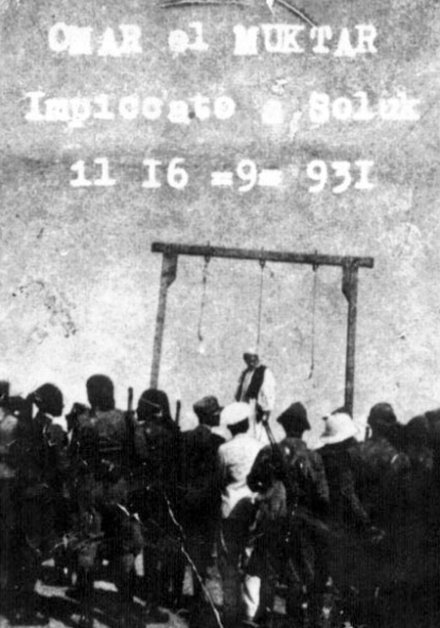
1931: Omar Mukhtar, Libyan revolutionary

On this date in 1931, Libyan independence martyr Omar [al-]Mukhtar was publicly hanged by the Italians at their concentration camp in Suluq.

Mukhtar (English Wikipedia entry | Italian) was born an Ottoman subject back in 1858 and had lived long enough to see his native Libya seized in the 1911-12 Italo-Turkish War.

Mukhtar, a religious teacher and follower of the Senussi movement, became the leader of the Libyan resistance that dogged the Italian occupation. Mukhtar proved an energetic and successful desert guerrilla fighter, and he had to be given the Italians’ mechanized military.

The Italians executed an estimated 4,000 Libyans in the 1920s, and drove hundreds of thousands into concentration camps, and gradually, only gradually, gained the upper hand on their adversaries.

Captured in battle after he abandoned a 1929 truce, Mukhtar was denied prisoner-of-war status and subjected to a snap military tribunal in one of the small coastal enclaves actually controlled by Italy — “a regular trial and consequent sentence, which will surely be death,” as the Italian general directed. It surely was.

He’s played by Anthony Quinn in the 1981 film Lion of the Desert — a better movie than you might think given that it was bankrolled by Muammar Gaddafi.

A national hero for contemporary Libyans across any social divide you’d care to name, Omar Mukhtar was valorized by the rebels who recently overthrew the aforementioned Gaddafi (here’s Mukhtar on a billboard in rebel-held Benghazi). “The whole world knows what Omar al-Mukhtar did,” Mukhtar’s 90-year-old son told media during the civil war. “That’s where they get their energy from. Ask the youth, they’ll tell you they are all the grandsons of Omar al-Mukhtar.”

His steely profile can be seen on Libya’s 10 10 dinar note.

On this day..

2007: John Joe “Ash” Amador

On this date in 2007, John Joe “Ash” Amador died of lethal injection in Texas.

Amador, age 18, and a 16-year-old cousin, hailed a taxi in San Antonio in the dark predawn hours of January 4, 1994, directed it on a long drive to a dark street in Poteet, Texas, and abruptly shot the cabbie in the head with a .25 caliber handgun. Amador’s cousin shot the cab driver’s ride-along companion.

It’s possible to get unusually up close and personal with Amador — both the man himself, and the gears of the death penalty process at the anticlimax of 13 long years.

To begin with, journalist Dave Maass interviewed Ash Amador a month before the latter’s execution, and posted 52 minutes of audio on Archive.org.

And in a more outre vein, a team of British filmmakers crafted a surreal and digressive but frequently touching documentary of Amador’s end, most especially through the eyes of the condemned man’s wife and family. As Maass put it, they’ve “given the man one wicked afterlife.”

If that teaser intrigues, the entire documentary is freely available online here — complete with an amazing scene of a death mask being cast from the freshly-executed, just-body-bagged Ash.

On this day..

509 B.C.E.: The Sons of Brutus

August 21 is the harvest-time feast of Consualia, honoring the Roman god of grain storage, Consus.

We mark on this occasion the legendary capital punishment inflicted by Lucius Junius Brutus when he was consul of the ancient Roman Republic upon two rebels — his own sons, Titus and Tiberius.

The great Brutus had been one of the leaders of the revolt that expelled Rome’s last king, Lucius Tarquinius — reputedly after the king’s son raped Lucius’s kinswoman Lucretia. (Brutus was also Tarquin’s nephew.)

Upon completing his coup, Brutus immediately summoned the populace to swear an oath that no king would ever rule Rome again. So potent was the civic memory of this event that even centuries later when the Republic was well gone, Rome’s emperors dared not appropriate such an incendiary title as “King”.

But that was for a later time, after the winners wrote the history.

The exiled Etruscan king, subsequent Romans’ eternal watchword for tyranny, got the boot about 510 B.C.E., and in 509 was still hanging about looking for an opportunity to re-seat his dynasty. The plot he hatched is known as the Tarquinian conspiracy, and Brutus, to his grief, would discover that his own children had adhered to it. The statesman’s willingness to put his own flesh and blood to death for the security of Rome would long stand as a parable of manful patriotism.

Our account here is from Livy (line breaks have been added for readability), and the excuse to approximate this undated execution to summer’s harvest-time is bolded therein.

liberty was well nigh lost by treachery and fraud, a thing they had never apprehended. There were, among the Roman youth, several young men of no mean families, who, during the regal government, had pursued their pleasures without any restraint; being of the same age with, and companions of, the young Tarquins, and accustomed to live in princely style.

Longing for that licentiousness, now that the privileges of all were equalized, they complained that the liberty of others has been converted to their slavery: “that a king was a human being, from whom you can obtain, where right, or where wrong may be necessary; that there was room for favour and for kindness; that he could be angry, and could forgive; that he knew the difference between a friend and an enemy; that laws were a deaf, inexorable thing, more beneficial and advantageous for the poor than the rich; that they allowed of no relaxation or indulgence, if you transgress bounds; that it was a perilous state, amid so so many human errors, to live solely by one’s integrity.”

Whilst their minds were already thus discontented of their own accord, ambassadors from the royal family come unexpectedly, demanding restitution of their effects merely, without any mention of return. After their application was heard in the senate, the deliberation on it lasted for several days, (fearing) lest the non-restitution might be a pretext for war, and the restitution a fund and assistance for war. In the mean time the ambassadors were planning different schemes; openly demanding the property, they secretly concerted measures for recovering the throne, and soliciting them as if for the object which appeared to be under consideration, they sound their feelings; to those by whom their proposals were favourably received they give letters from the Tarquins, and confer with them about admitting the royal family into the city secretly by night.

The matter was first intrusted to brothers of the name of Vitellii and those of the name of Aquilii. A sister of the Vitellii had been married to Brutus the consul, and the issue of that marriage were young men, Titus and Tiberius; these also their uncles admit into a participation of the plot: several young noblemen also were taken in as associates, the memory of whose names has been lost from distance of time. In the mean time, when that opinion had prevailed in the senate, which recommended the giving back of the property, and the ambassadors made use of this as a pretext for delay in the city, because they had obtained from the consuls time to procure modes of conveyance, by which they might convey away the effects of the royal family; all this time they spend in consulting with the conspirators, and by pressing they succeed in having letters given to them for the Tarquins. For otherwise how were they to believe that the accounts brought by the ambassadors on matters of such importance were not idle?

The letters, given to be a pledge of their sincerity, discovered the plot; for when, the day before the ambassadors set out to the Tarquins, they had supped by chance at the house of the Vitellii, and the conspirators there in private discoursed much together concerning their new design, as is natural, one of the slaves, who had already perceived what was going on, overheard their conversation; but waited for the occasion when the letters should be given to the ambassadors, the detection of which would prove the transaction; when he perceived that they were given, he laid the whole affair before the consuls. The consuls, having left their home to seize the ambassadors and conspirators, crushed the whole affair without any tumult; particular care being taken of the letters, lest they should escape them.

The traitors being immediately thrown into chains, a little doubt was entertained respecting the ambassadors, and though they deserved to be considered as enemies, the law of nations however prevailed.

The question concerning the restitution of the tyrants’ effects, which the senate had formerly voted, came again under consideration. The fathers, fired with indignation, expressly forbad them either to be restored or confiscated. They were given to be rifled by the people, that after being made participators in the royal plunder, they might lose for ever all hopes of a reconciliation with the Tarquins. A field belonging to them, which lay between the city and the Tiber, having been consecrated to Mars, has been called the Campus Martius. It happened that there was a crop of corn* upon it ready to be cut down, which produce of the field, as they thought it unlawful to use, after it was reaped, a great number of men carried the corn and straw in baskets, and threw them into the Tiber, which then flowed with shallow water, as is usual in the heat of summer; that thus the heaps of corn as it stuck in the shallows became settled when covered over with mud: by these and the afflux of other things, which the river happened to bring thither, an island was formed by degrees. Afterwards I believe that mounds were added, and that aid was afforded by art, that a surface so well raised might be firm enough for sustaining temples and porticoes.

After plundering the tyrants’ effects, the traitors were condemned and capital punishment inflicted. Their punishment was the more remarkable, because the consulship imposed on the father the office of punishing his own children, and him who should have been removed as a spectator, fortune assigned as the person to exact the punishment.

Young men of the highest quality stood tied to a stake; but the consul’s sons attracted the eyes of all the spectators from the rest of the criminals, as from persons unknown; nor did the people pity them more on account of the severity of the punishment, than the horrid crime by which they had deserved it.

“That they, in that year particularly, should have brought themselves to betray into the hands of Tarquin, formerly a proud tyrant, and now an exasperated exile, their country just delivered, their father its deliverer, the consulate which took its rise from the family of the Junii, the fathers, the people, and whatever belonged either to the gods or the citizens of Rome.”

The consuls seated themselves in their tribunal, and the lictors, being despatched to inflict punishment, strip them naked, beat them with rods, and strike off their heads. Whilst during all this time, the father, his looks and his countenance, presented a touching spectacle, the feelings of the father bursting forth occasionally during the office of superintending the public execution.


Bummer: Jacques-Louis David‘s 1784 painting, Lictors Bring Home the Sons of Brutus.

This Brutus was an ancestor of the Brutus who helped assassinate Julius Caesar, and that later et tu, Brutus is commonly represented as having been convinced to turn against his friend and patron by, in part, the example of his legendary namesake.

O, you and I have heard our fathers say,
There was a Brutus once that would have brooked
The eternal devil to keep his state in Rome
As easily as a king.

-Cassius to Brutus in Shakespeare’s Julius Caesar (Act 1, Scene 2)

* “Corn” meaning not American maize, of course — which was not available before the Columbian exchange — but the word’s earlier meaning of whatever was the local grain: wheat, barley, and millet in Rome’s case. (The word corn derives from the Latin granum.)

On this day..

1480: The Martyrs of Otranto

On this date in 1480, Ottomans invading Otranto, Italy conducted a mass execution of prisoners.

Landing at the southern Italian city on July 28, the Ottoman force quickly overwhelmed Otranto. (Otranto rashly slew the messenger come to offer a merciful capitulation, only to find that its garrison began deserting within days.) On August 11, the Turks took the city by storm. Thousands died on that day’s bloodbath, including the Archbishop of Otranto.

Surviving women and children were sold into slavery. Men over age 15 had the choice of conversion — or death.

“Now it is time for us to fight to save our souls for the Lord!” a Christian shoemaker is said to have exhorted his 800 fellow prisoners. “And since he died on the cross for us, it is fitting that we should die for him.”

The acclaim greeting this call signaled inflammation ahead for the Turkish headsmen’s rotator cuffs. They had 800 faithful souls to dispatch to their eternal reward this date at the place still known as the Hill of Martyrs. (When in Otranto, visit it by taking the via Ottocento Martiri, just off via Antonio Primaldo — that’s the name of the militant shoemaker.)


The remains of the Otranto martyrs, arrayed as relics in the Otranto cathedral. (cc) image from Laurent Massoptier.

Historical novel set during these vents.

This, at least, is the most pious version of the story. The mass execution certainly did occur, but some latter-day historians like Francesco Tateo have argued that martyrdom is not attested by any of the contemporaneous sources, and the specifically religious understanding of events was only read in after the fact.

On whatever grounds one likes, Italy’s fractious city-states were deeply alarmed by the appearance on their shores of the all-conquering Turks. “It will always seem as if the funeral cross is borne before me while these barbarians remain in the boundaries of Italy,” wrote the Florentine humanist Poliziano.* (Source, a nonfiction book which covers Otranto in some detail.)

In the ensuing months, they rallied together vowing to expel the invaders.

Fortunately for this coalition, the Ottoman sultan Mehmed the Conqueror died in May 1481, and a brief period of internal conflict within the Ottoman empire over the succession perhaps led it to allow its Otranto outpost to wither on the vine. The Turks made peace and withdrew from their potential beachhead not long after, having held the city for just over a year. The bodies of the martyrs were said to have been found uncorrupted by decay.

The Catholic church beatified the 800 martyrs in 1771, but their final elevation to sainthood occurred only in 2013, just three months ago as I write this. They were in the very first group canonized by the new Pope Francis — although the canonization was approved by his predecessor Benedict XVI on the same day that Benedict resigned his pontificate. Considering current relations between the respective faiths, it was seen as a potentially impolitic move.

“By venerating the martyrs of Otranto, we ask God to protect the many Christians who in these times, and in many parts of the world, are still victims of violence,” Pope Francis said at the canonization Mass, diplomatically not naming any of those parts of the world.

* At the same time, Florence (in common with other Italian polities) had trade and diplomatic relations with the Ottomans.

On this day..