On this date in 1703,* Thomas Cook was hanged at Tyburn.
Cook — or the Gloucester Butcher, to use the sobriquet that advertised his prize fights — was convicted of giving a constable a fatal rapier thrust during a mob affray.
As he faced execution in prison, Cook continued to insist that he didn’t do it. But he still gratified the ministrations of the Newgate Ordinary Paul Lorrain by admitting to a life of sinfulness:
that he had frequently stoln [sic] Sheep, and done many ill things … He acknowledg’d he had been a grievous Sinner, a great Swearer and Drinker, an Adulterer, a Prophane and Lewd Wretch, and a sworn Enemy of those who were employ’d in the Reformation of Manners; and that for some years past he had made it his great Business to Fight for Prizes; an Exercise which the Pride of his Heart carry’d him to, which he now looks upon as most Heathenish and Barbarous, and which, with all other the wicked Practices of his Life, especially his slight of Religion, he does detest and abhor … and in the Words of a Dying-Man (who by the just Providence of God, came to suffer a shameful and untimely Death, in the primer of his years) he exhorts all those of his Acquaintance, and others that live loosely and particularly that follow this Wicked Sport of Prize playing, to reform betimes, and apply themselves to that which is virtuous and laudable, lest if they cdo continue any longer in their ill way, the Wrath of God fall upon them, and they come to the same, or worse Punishment thatn himself.
But still, he didn’t kill the cop, he said. (This, actually, was a common enough dodge among the Ordinary’s patients: it enabled them to satisfy the confessor, and the weight of social conventions he pressed on them, while also persisting with a denial of this crime one might be invested in maintaining. Whether true or no, Cook must have been unusually persuasive to pass off a story that would ordinarily be held to characterize an “obstinate” prisoner.)
Paul Lorrain, who held the Ordinary of Newgate office from 1700 to 1719, absolutely adored a good conversion story; his profession after all was ministering to prisoners. Lorrain ate all this reform-themselves-betimes stuff right up.
Two days after Cook’s execution, Lorrain compared the hanged pugilist to the Biblical patriarch Enoch at an overwrought funeral sermon (titled “Walking With God”): proof positive that even the most wretched sinner could taste God’s redemption. Cook’s “Soul is now enjoying an honourable and happy Life in God’s Glorious Kingdom,” Lorrain averred.
This was mainstream theology, but not a universal opinion.
Cook’s fellow convicts in Newgate regarded the repentant condemned as an unctuous hypocrite and didn’t share the Ordinary’s susceptibility to the actual-innocence claim Cook smuggled into his big confession of general lifelong sin.**
One of those fellow convicts in 1703 was Daniel Defoe, who met Lorrain while incarcerated and took a violent personal dislike to the prelate.
Defoe (who would later put a dismissal of the Ordinary in the mouth of his great heroine Moll Flanders) retorted to Lorrain’s published sermon with a scathing pamphlet titled “A Hymn to the Funeral Sermon”. In it, he mocks Lorrain’s racket peddling the public† broadsheets which almost invariably celebrate the gallow’s-foot conversions of his innumerable malefactors. After all, when
Men of Infamy should rise,
By Ladders to Ascend the Skys …
What need we Mortifie and Pray If Gibbets are the Shortest Way?
In what disguise Religion may be drest,
The crooked Paths of Priest-craft Paint?
Where lies the Secret, let us know,
To make a Sheep-stealer a Saint?
Or bid me tell them that ’tis all a Jest;
What need they point out other ways,
Since Earthly Rogues can Merrit Holy Praise?
If this Wise Precedent the World receives,
Newgate shall ne’re be call’d a Den of Thieves.
Not related to Cook or to Defoe, this 1882 Puck cartoon (via the Library of Congress) makes Defoe’s same discomfiting point graphically: the soul of the hanged murderer ascends into angelic choirs, his crimes literally wiped away by his confessor — while that of his victim, slain unawares while unpurged sin weighs his conscience, wallows in hell. “The Murderer’s Straight Route to Heaven — Bringing Religion into Disrepute,” runs the caption.
* Cook had had a last-minute reprieve from joining a July 21 hanging date; in his account for that date, Paul Lorrain called out Cook by name to take “a happy Warning” from the right conduct of those gallows-birds.
** In 1706, two other men coming up for hanging made a point of insisting to Lorrain that the fighter who “with such an Air of seeming Repentance to his last breath deny’d his crime” did commit the murder.
† According to Lincoln Faller (“In Contrast to Defoe: The Rev. Paul Lorrain, Historian of Crime”, Huntington Library Quarterly, Nov. 1976), Lorrain left an estate of £5,000 at his death in 1719. His salary as Ordinary was something in the neighborhood of £35 per annum. Defoe overtly accuses Lorrain in “Hymn” not merely of profiteering but of taking payola to frame a gratifying obituary for a hanged criminal: “Pulpit praises may be had / According as the Man of God is paid.”
On this date in history, the French spy Francois Henri de la Motte was hanged at Tyburn — and, only after hanging, his head was cut off and his heart carved out. Old Blighty was going a bit soft: it didn’t do actual drawings and quarterings at this late enlightened date. (Well, just one.)
Those old enemies Britain and France had renewed hostilities over the American Revolution, which France backed to twist the neighboring lion’s tail.
De la Motte was a French expat living in England, in which capacity he supported the statecraft of his native realm by coyly picking up British army and naval dispositions and sending word home of who was going where, when. His intelligence allegedly enabled the French navy to turn an unusually aggressive gambit against the British in an engagement in the East Indies, with the loss of 207 souls.
“In the whole history of mankind, an instance was not to be produced of a more ingenious, able, and industrious spy than Mr. De La Motte,” his prosecutors charged. (There’s an account of the trial here.)
Perhaps this was flattery, since the operation was not defeated by counterintelligence except de la Motte’s own counter-intelligence. The guy dropped a bunch of incriminating notes he had taken on naval movements in a staircase, and they were there snatched up by King George’s true subjects and forthwith sent their owner to Newgate. His English accomplice quickly turned Crown’s evidence
Days after the spy’s ignominious end, General Cornwallis’s army in the American south arrived from Charleston at Yorktown, Va., a deep-water port from which he meant to command the Chesapeake. There, Cornwallis was surrounded by an overwhelming force of both American rebels and their French armies. The British defeat at Yorktown that October clinched independence for the colonies.
De la Motte’s trial — accused perfidious Frenchman in danger of barbaric old-timey punishment — appears to be the model for the London trial against Charles Darnay depicted at the start of A Tale of Two Cities. See if this sketch by noted death penalty skeptic (but also death penalty obsessive) Charles Dickens doesn’t essentially depict Francois de la Motte’s situation:
“What’s coming on?”
“The Treason case.”
“The quartering one, eh?”
“Ah!” returned the man, with a relish; “he’ll be drawn on a hurdle to be half hanged, and then he’ll be taken down and sliced before his own face, and then his inside will be taken out and burnt while he looks on, and then his head will be chopped off, and he’ll be cut into quarters. That’s the sentence.”
“If he’s found Guilty, you mean to say?” Jerry added, by way of proviso.
“Oh! they’ll find him guilty,” said the other.
…
Charles Darnay had yesterday pleaded Not Guilty to an indictment denouncing him (with infinite jingle and jangle) for that he was a false traitor to our serene, illustrious, excellent, and so forth, prince, our Lord the King, by reason of his having, on divers occasions, and by divers means and ways, assisted Lewis, the French King, in his wars against our said serene, illustrious, excellent, and so forth; that was to say, by coming and going, between the dominions of our said serene, illustrious, excellent, and so forth, and those of the said French Lewis, and wickedly, falsely, traitorously, and otherwise evil-adverbiously, revealing to the said French Lewis what forces our said serene, illustrious, excellent, and so forth, had in preparation to send to Canada and North America.
Darnay is acquitted, obviously, as Dickens was only three chapters in and being paid for a novel-length serial.
One of the original Apostles (literally, he and his brother John are the first two whom Jesus calls in the Gospels), James also had the distinction of apparently being the first Apostle to die for Christ.** His execution at the hands of Herod Agrippa† is reported in Acts 12:2;‡ it’s the only apostolic execution in the New Testament.
This, of course, occurred on the southeastern fringe of the Mediterranean, so it’s a wonder that James’s bones came to repose at a Spanish city literally situated on Finisterre, the far western edge of the world as far as Europeans saw it. The Lord works in mysterious ways.
It’s certainly plausible — though impossible to substantiate — that James evangelized in Spain prior to his execution. The whole Mediterranean was a Roman lake. More towards the outlandish is the patriotic story (pdf) that James’s relics were miraculously discovered there in 813 at the moment when Muslim expansion into Iberia gave the hard-pressed Christian kingdoms the greatest possible need for a morale boost.§
“A knight of Christ’s squadrons,” Cervantes wrote. “St. James the moorslayer, one of the most valiant saints and knights the world ever had, and that now the heavens have … this great knight with the vermilion cross has been given by God to Spain for its patron and protection.”
James’s martial prowess is entirely posthumous: when the Son of God recruits him, he’s a humble piscator at labor mending his nets (there are some less-bellicose present-day churches going under the name “Saint James the Fisherman”). Gibbon could not but marvel at the “stupendous metamorphosis [that] was performed in the ninth century, when from a peaceful fisherman of the Lake of Gennesareth, the apostle James was transformed into a valorous knight, who charged at the head of Spanish chivalry in battles against the Moors. The gravest historians have celebrated his exploits; the miraculous shrine of Compostella displayed his power; and the sword of a military order, assisted by the terrors of the inquisition, was sufficient to remove every objection of profane criticism.”
But mythmaking exercises a historicity all its own, and the James legends offered a rallying-point for Spain’s Christians. He stands to this day the patron of Spain as well as a number of places colonized by Spain.
Pilgrims have ever since that stupendous metamorphosis of the 9th century made the journey to the apostle’s purported resting-place; this Way of St. James, actually comprising several different possible routes covering hundreds of kilometers on foot, has in recent years emerged as a major tourist draw. The Way terminates, of course, at Santiago de Compostela and the enormous cathedral there where repose James’s relics.
Saint James’s Day, 25 July, is its celebratory culmination.
James so overawes July 25 on the liturgical calendar that it’s a mere footnote to add that this same day also pays homage to Saint Christopher, a historically dubious Christian martyr from the third or early fourth century Roman Empire.
Christopher is rather nifty, because he’s sometimes depicted in iconography as cynocephalic — that is, having the head of a dog. At least the rest of him is human, unlike Saint Guinefort the Greyhound. (No lie. It’s a doggie saint, albeit of the distinctly unofficial variety. To stamp out folk veneration, an incensed preacher “had the dead dog disinterred, and the sacred wood [where it received offerings] cut down and burnt, along with the remains of the dog.”)
* The name “Santiago” derives from our saint’s name in Latin, Sanctu Iacobu. This is also the source, and James the intended honorary, for other places on the map named Santiago, such as Santiago, Chile.
† Herod Agrippa is not to be confused with his grandfather Herod the Great — the Biblical Massacre of the Innocents guy — nor with his uncle Herod Antipas — the guy who punted Jesus’s prosecution back to Pontius Pilate. Three different Herods; three different New Testament heavies.
‡ James’s death in Acts 12 is followed immediately by Saint Peter staging a supernatural jailbreak out of the same prison. The latter goes on to evangelize for another 20-odd years.
§ The holy remains reached that resting point, goes the legend, only by perilously navigating a path of dragons, pagans, and wagons.
Muscovy’s long march to supremacy among the early Russian polities reached a decisive turn on 14 July 1471 when it defeated longtime rival Novgorod at the Battle of Shelon.
Ten days after that defeat, Novgorod’s commander Dmitry Isakevich Boretsky was put to death by the will of Ivan III.
Novgorod the Great had been losing ground to its neighbor for generations. Matters came in the end to the “Mayoress” Marfa Boretskaya, the widow of Novgorod’s former mayor (posadnik) Isaac Boretsky; she emerged in the 1460s as the charismatic leader of the hardline anti-Muscovite types.
Struggling to find a political foothold upon which to resist burgeoning Moscow, Marfa Boretskaya intrigued with the friendly — and similarly Muscophobic — Polish-Lithuanian Commonwealth. This drew Ivan III into what would prove to be the decisive military showdown between these venerable cities.
Marfa’s son Dmitry, our date’s unfortunate executed, would have stood to garner the glory of it had he prevailed.
He didn’t.
Bummer: Klavdy Lebedev‘s 1889 panorama of Marfa Boretskaya surveying the destruction of Novgorod.
Marfa Boretskaya was not put to death herself, but taken prisoner to Moscow upon Novgorod’s formal annexation in 1478 and socked away in a convent.
By the ancient world’s tradition, it was on July 21, 356 — the night of Alexander the Great‘s birth* — that a theretofore forgettable man set fire to the wooden rafters of the Temple of Artemis in Ephesus.
Situated on the Hellenized coast of Asia Minor, near present-day Selcuk, Turkey, Ephesus was one of the great cities of the Mediterranean. It counted Artemis (Diana) its patron deity, and gloried in a jaw-dropping marble temple, bankrolled two centuries before by the Lydian king Croesus, that would have nearly covered a modern football pitch. Ephesians took their Artemis seriously: 400-plus years later, St. Paul would barely escape lynching at the hands of enraged Artemis devotees when he proselytized there.
What a horror it must have been for 4th century BCE Ephesians to awake this day to the destruction of their city’s own sacred pride.
Even more shockingly, the temple’s destroyer made no effort to conceal himself. He openly boasted of his act, and of the horrifying reason for it: merely to exalt his obscure name with the luster of infamy.
Ephesus not only put this man to death, but passed a damnatio memoriae upon him, forbidding any mention of his name, in order to deny him his victory.
But the the historian Theopompus, who was not Ephesian, cheated the city of its sentence by recording it: Herostratus. It’s a word that has become a metonym in many languages and an allegory in many books for any villain impelled to his wickedness by the allure of celebrity.
We have no specific date for Herostratus’s execution. But we do have his last tortured victory. We do have his name.
The Ephesians in time rebuilt the magnificent temple, bigger and more awe-inspiring than before. It stood some 600 years more until the Goths sacked it in 268 AD, long enough to secure its place among the Seven Wonders of the Ancient World.
“I have set eyes on the wall of lofty Babylon on which is a road for chariots, and the statue of Zeus by the Alpheus, and the hanging gardens, and the colossus of the Sun, and the huge labour of the high pyramids, and the vast tomb of Mausolus,” wrote Antipater of Sidon of the reconstructed, post-Herostratus temple. “But when I saw the house of Artemis that mounted to the clouds, those other marvels lost their brilliancy, and I said, ‘Lo, apart from Olympus, the Sun never looked on aught so grand.'”
The Temple of Artemis today: a weedy rubble. (cc) image from LWY.
* Plutarch remarked that Artemis was too distracted delivering the conqueror into the world to protect her shrine.
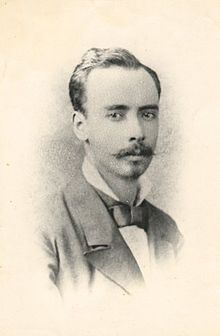
Prado’s father, Manuel Ignacio Prado, was twice the president of Peru (1865-1868,* 1876-1879).
As a military man (Prado’s first presidency was as outright dictator), the old man naturally had his son on a soldierly track as well. Leoncio was all of 12 years old when he took part in the Battle of Callao in 1866, defending that city against a Spanish bombardment during the Chincha Islands War.
That war saw Peru and Chile cooperating against Spain, after the latter seized a lucrative cluster of guano islands.
But different resource rivalries put the two former allies at loggerheads in 1879. When Peru nationalized saltpeter mining in the border province of Tarapaca — dispossessing Chilean interests — and Bolivia took similar measures, the countries fought the three-way War of the Pacific, also known as the Saltpeter War.
Chile would win the war decisively, dramatically reshaping Latin America in the process. Peru lost most of Tarapaca to Chile, devastating Peru’s saltpeter industry and provoking a generation of instability and social crisis. Bolivia fared even worse, losing its only littoral province to Chile: Bolivia remains landlocked to this day.
So it’s safe to say that there was something at stake worth fighting for as hostilities commenced.
As the Saltpeter War got underway, Prado returned from the United States where he was preparing an expedition to help Philippines separatists, and formed a guerrilla force. Though this corps had its highlight moments, it was overwhelmed in a scrap with Chilean regulars in July 1880 and Prado taken prisoner.
Considering his lineage and his exploits, he was an honored captive for the Chileans who repeatedly offered to release him on his honor not to take up arms again.
Prado refused these offers for some time, but he finally accepted his parole at the start of 1882 — a low ebb for Peruvian fortunes, for his father had been deposed by a coup and 1881-82 saw leadership of the country violently contested. Prado’s only thought, notwithstanding his pledge to Chile, was for the defense of his country and he rallied another party of guerrillas to his banner. “The enemy’s bullets do not kill,” he cried. “For to die for the fatherland is to live in immortal glory!”
That has proved to be the case for Prado, who certainly stood out from the politicians of his time for his patriotic heroism.
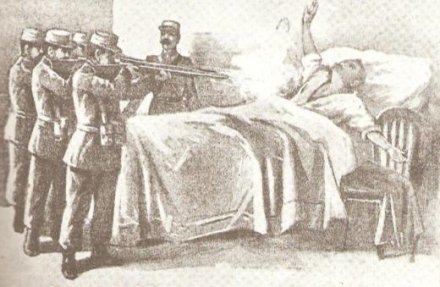
Captured during the decisive Chilean victory at the Battle of Huamachuco where a grenade shattered his thigh, the crippled Prado was regretfully executed in his bed for having broken his previous parole by resuming arms in the fight.
“We were all crying — all but Pradito,” recalled the Chilean captain tasked with overseeing the nasty business.
On this date in 1955, Albert Pierrepoint escorted the alluringly tragic Ruth Ellis to the gallows at Holloway Prison — the last woman ever hanged in Great Britain.
The former hostess had tracked her inconstant and abusive lover David Blakely to a Hampstead pub a few months before — getting the ride, and the murder weapon, from her unrequited hanger-on Desmond Cussen — and shot Blakely dead on the street. Five bullets: the last, a coup de grace. (Another missed entirely and winged a passerby.)
A bitterly controversial case from the moment it entered the public eye, Ellis’s hanging bolstered the movement to abolish Britain’s death penalty. Juridically, however, it was resolved in the blink of an eye when a crown’s attorney cross-examined the murderess:
Christmas Humphreys: Mrs. Ellis, when you fired that revolver at close range into the body of David Blakely what did you intend to do?
Ellis: It was obvious that when I shot him I intended to kill him.
The jury, which never heard that Blakely regularly beat his killer (including once to induce a miscarriage), needed 14 minutes to convict her.
ET: I think at a certain point in time, everyone in Great Britain would have known who Ruth Ellis was, and quite a few abroad, too. How true is that still, nearing 60 years after her execution?
I think her name is still quite familiar, to be honest.
When I began researching the book, everyone I discussed it with either already knew the very basic facts of Ruth’s story, and at the very least that she was the last woman to be hanged in England. The 1985 biopic Dance with a Stranger left a big impression too, even though it wasn’t entirely faithful to Ruth’s character, making her seem much more hysterical a personality than she actually was, although I thought Miranda Richardson was brilliant in the role — as she always is!
What led you to the Ruth Ellis story?
I’ve always been interested in Ruth and that period in history — and I vividly remember going to see ‘Dance with a Stranger’ when it came out in the cinemas here. But it always struck me that her full story had never been told, particularly the last few months of her life after she shot David Blakely. And a couple of years ago there was quite an intense debate about bringing back capital punishment; Ruth’s name was always mentioned in relation to that particular argument, and I really felt it was time to explore her whole story.
What are the greatest misconceptions people have of her? Have her previous biographies and screen portrayals fed those misconceptions?
Without doubt, many people see Ruth as she was shown in ‘Dance with a Stranger’ — very screechy, out of control and violently jealous.
I think it’s true to say that she and David were both deeply jealous of each other (both giving the other reason to be so), but Ruth was not as hysterical as she was portrayed in the film. In fact, it was quite the opposite — the men were hysterical and it was Ruth who usually vented a sort of quiet fury. There is one scene in the film which shows her smashing the windows of David’s car and screaming in the street. Reading the original police statement about that night reveals a very different story; she was described as very calm and rational. There was no screaming, and although she did damage the vehicle, it was not remotely as it was shown in the film.
I think other adaptations have also done her a disservice. Ironically, probably the most accurate portrayal is in the film ‘Pierrepoint,’ where the character of Ruth appears for no more than a minute or two on screen.
I get the sense that Ruth was always running uphill against her class position, trying to climb a little higher than she could reach — right up to the end where her lover is a well-off cad and the rivals for the lover’s affection are his middle-class friends. What role did England’s class relations have in Ruth Ellis’s life and death, and in the way that others perceived her? Do they still shape the way we talk about her all these years later?
Class and politics played a huge role in Ruth’s life generally.
England was distinctly class-led at the time and when the case hit the headlines, she was described as a working-class floozie who attached herself to the upper-class David Blakely purely in order to hoist herself up the class ladder.
That couldn’t have been further from the truth; if she was only interested in using men to better herself socially, she would surely have married her sometime-lover Desmond Cussen, who was a much steadier prospect with money and property and who wanted very much to marry her. Ruth worked hard to better herself but she didn’t use the men she loved to do so.
And when it came to her trial, the class values of the time were heavy in the courtroom with the male barristers and judge and so on all very much men of the upper classes — and who viewed her accordingly. I hope we have got beyond all that nonsense now — but it does add a very distinct dimension to discussions of her case.
She was working as a hostess when she met David Blakely. What would a hostess do, who worked in this trade, and who were the clientele? Was it usual for “real” relationships to evolve? Do people still have this job in the same form as Ruth had it?
Hostessing in the clubs in which Ruth worked was quite straightforward — or it should have been, but there was Morris Conley to contend with, and he was quite a character.
Ruth’s basic job description was to look good and to chat to customers (mostly men) in the clubs, laugh at their jokes and keep them buying food and drink for as long as possible. Most hostesses were in their late teens and early twenties, working-class girls who thought the lifestyle was more glamorous than toiling in a factory or in a shop.
They were usually paid badly and relied on tips to make ends meet, but were given a dress allowance so that they could look as alluring as possible. The clientele mainly consisted of demobbed servicemen who suddenly seemed to have lost their attractiveness to women after the war — where once they had been heroes, by the late 1940s many of them were down on their luck and working as door-to-door salesmen, very lonely and eager to talk to pretty young girls about their war exploits.
The girls who worked for Morris Conley, like Ruth, were expected to sleep with the clients if that was asked of them, and often had to sleep with ‘Morrie’ and his less than respectable friends too. Many of them were very poor young women who lived in flats owned by Conley and his wife — and if they didn’t toe the line, they lost their jobs and their homes in one fell swoop.
Did real relationships evolve? Yes, they did, but very rarely. There are girls all over the world doing very similar jobs today — from London to Japan and everywhere in between too, no doubt.
You have this quote from Ruth about David Blakely: ‘I thought the world of him; I put him on the highest of pedestals. He could do nothing wrong and I trusted him implicitly.’ Ruth had an alcoholic, abusive father, and then she had two children from marriages with two different men that both fell apart — one from bigamy and abandonment, the second from alcoholism and domestic violence. Blakely himself cheated on her. Why wasn’t she more cynical about Blakely? If you take away the tragic ending to this particular relationship, was something like this a pattern she was doomed to keep repeating ad infinitum?
She loved him — it’s really as simple as that.
Although she obviously had a good degree of self-awareness and knew what David was and always would be, she truly loved him and for a time believed they had a future together. As for a pattern — I don’t know. Perhaps if she had met one good, steady man to whom she was attracted as much as she was to David, her life — and David’s too of course — might have been very different.
I’m going to phrase this inelegantly: what is the DEAL with Desmond Cussen?
Good question! I really think that he was as confused and tormented by everything that was happening as a result of Ruth’s and David’s relationship as Ruth herself.
I think he did love Ruth, and he tried hard to make things work with her, but he knew her heart was with David. His apparent lack of self-respect and backbone is baffling — quite why he kept ferrying her across London and out to Buckinghamshire in pursuit of David is a bit mystifying. I did question in the book why no one seemed to query his state of mind as much as Ruth’s — and as to whether he gave her the gun or not, knowing what she intended to do … I am sure he did, even though he must have known where it would end for Ruth herself.
Perhaps he hoped that with David out of the way, she would be reprieved and they could then have a life together. But I really don’t know!
Ruth’s legal defence was legendarily feeble. That said, I’m very interested in the barrister’s attempt to frame its insanity defense around feminine hysteria — “the effect of jealousy upon a female mind can so work as to unseat the reason and can operate to a degree in which a male mind is quite incapable of operating.” This was bound to be undermined by Ruth’s own calm and the statements about her intent to kill that she gave to police and in court. Was it the case that the law at the time didn’t have the instruments to situate Ruth’s context and state of mind, other than hysterical/not? Or could an abler barrister have presented a different story?
I think part of the difficulty is obviously that the defence of diminished responsibility was not introduced in the courts here until 1957 — largely as a direct result of this particular case.
Ruth’s lawyers tried to argue this as a defence for her to some extent, but it just wasn’t possible legally. That said, I think they served her quite badly and didn’t bring out so much that might have enabled the jury to see her crime in context. There was no mention of the abuse in her childhood, no mention of the violence she had suffered at the hands of her ex-husband and very little said about David’s own brutal treatment of her.
But Ruth herself did not seem to care much what happened in the courtroom, once it became evident that the story as she saw it — David’s friends having, in her view, deliberately destroyed the relationship between them — was not going to come to light. She gave up, and volunteered nothing that could have helped her, minimizing the violence to which she had been subjected and dismissing most of the questions put to her in a short sentence or two.
She also infamously replied to the prosecution’s question of what she intended to do when she set out to find David with the gun, “It is obvious when I shot him I intended to kill him.” That one line completely sealed her fate.
Despite all this, the public did seem to be shocked by Ruth Ellis’s hanging, and it’s supposed to have boosted the anti-death penalty campaign. If one may phrase it this way, were people shocked for the right reasons? How much did the symbolic “Ruth Ellis” that even her supporters among the general public had in view have to do with the real person as you understand her?
I think any case is always immeasurably more complex than it is presented in newspaper columns and headlines.
I think, again, the outcry at her execution has to be seen in context — people were becoming more and more opposed to the death penalty and there had been some very high-profile, contentious cases that really did cause a great deal of debate, anger, and distress: the hanging of Timothy Evans in 1950 and of Derek Bentley in 1953 for instance (both of whom were posthumously pardoned).
The fact that Ruth was a young, attractive, lively woman with two small children caused many people to question the validity of capital punishment. It was her death on the scaffold that gave the abolition movement its emotional spur.
What became of Ruth Ellis’s body after her hanging? And what became of her family and the others who were part of the story?
Ruth was buried in the confines of Holloway Prison after her execution, sharing her unmarked grave with four other women who had been hanged there. In 1971, when the prison was demolished and rebuilt, her body was released to her son for burial.
He had hoped to lay his mother to rest alongside David Blakely at the Holy Trinity churchyard in Penn but the vicar there would not allow it. Ruth was instead buried in the churchyard of St Mary’s in Amersham, a few miles away.
As to what became of her family: her son Andre (who was ten when Ruth was executed) was diagnosed with schizophrenia as a very young man and never came to terms with the loss of his mother. He committed suicide in 1982. Ruth’s daughter, Georgina, had quite a colourful life, becoming a successful model who was in the newspapers fairly often as part of the George Best ‘set.’ She married and had children and worked hard to win a posthumous pardon for her mother, of whom she spoke often. She died of cancer at the age of only 50.
As for Desmond Cussen: he emigrated to Australia and opened a flower shop there. He never married and became an alcoholic, dying in Perth on 8 May 1991 of pneumonia and organ failure following a fracture dislocation of the neck in a fall at his home.
On this date in 1762, the Korean king Yeongjo had his son and heir Crown Prince Sado immured in a rice chest — where he would die after eight excrutiating days.
In Lady Hyegyeong’s telling, the tyrannical father warped the sensitive son, sending the latter into a destructive spiral of madness. As the 1750s unfolded, Sado’s behavior grew erratic, violent, and delusional. He was prone to sudden fits of rage, stalked and raped court ladies, and wandered Seoul streets in disguise. He eventually murdered numerous servants, eunuchs, and miscellaneous commoners — even his own concubine. The court lived in terror of the mad prince’s impunity; the ruling dynasty itself stood in peril.
Many years later, the prince’s desperate wife in her autobiography remembered Sado’s own mother finally appealing to the king to do the necessary, unthinkable thing:
“Since the prince’s illness has become quite critical and his case is hopeless, it is only proper that you should protect yourself and the royal grandson, in order to keep the kingdom at peace. I request that you eliminate the prince, even though such a suggestion is outrageous and a sin against humanity.
“It would be terrible for a father to do this in view of the bond of affection between father and son; but it is his illness which is to be blamed for this disaster, and not the prince himself. Though you eliminate him, please exert your benevolence to save the royal grandson, and allow him and his mother to live in peace.
Perhaps to avoid spilling the prince’s blood, the royal lunatic was that very day forced into a sturdy chest in a palace courtyard. The ferocious prince entered it placidly, and his living eyes never again beheld the outside of that box: it was nailed shut and buried. (A recently discovered inscription, however, perhaps implies that the king didn’t actually mean for eight days locked in a box to be fatal. If so, it certainly lends credence to the idea that Sado’s mistreatment in childhood lies behind the later psychotic breaks.)
The royal grandson was indeed spared. When that child, Jeongjo of Joseon, finally succeeded to the throne upon his grandfather’s death in 1776, he wasted little time restoring the honor of his dead father.
He cut his teeth — and a holy beard — as a surgeon and barber in the court of Saint Louis. When Louis died on crusade in 1270, Philip the Bold succeeded to the throne. Philip was tight with Pierre, so this seemed like great news for the chamberlain — and indeed, de La Brosse advanced rapidly with the new king’s patronage in wealth and influence.
The power of this Touraine arriviste did not fail to attract the enmity of the realm’s hereditary lords. As their grandchildren would do in Enguerrand de Marigny‘s time, they nursed their resentments and awaited only their chance.
King Philip’s marriage in 1274 to Marie of Brabant* gave them that chance.
His influence eclipsed by the new bride, de La Brosse developed a dangerous rivalry with the royal consort. When Philip’s firstborn son by his previous marriage and the heir to the French throne died suspiciously in 1276, Pierre de La Brosse allegedly made bold to suggest that the new queen herself might have poisoned the youth off.**
Philip “investigated” this by sending emissaries to consult a clairvoyant who, knowing she was speaking to representatives of the royal family, gave a judiciously positive appraisal of the queen, leaving de La Brosse on very tenuous footing indeed. The barons cut that footing out from under their foe a few months later when they produced documents, likely forged, implicating de La Brosse in a treasonable arrangement with the Spanish crown. De La Brosse was imprisoned for six months and condemned without a regular judicial proceeding: he has the unenviable distinction of being the first victim of an extraordinary royal commission in France. That commission destroyed the evidence (or “evidence”) in the case, but to judge from the positive appraisal de La Brosse enjoyed from chroniclers the popular sentiment for his innocence was widespread.
Pierre de La Brosse is among the several French royal counselors who are sometimes apocryphally said to have built the Montfaucon gallows only to hang upon them. The last word on him (and the more interesting trivia) belongs to Dante, who stationed the man in Purgatory as one who was unjustly slain but without opportunity to cleanse his soul with a last repentance.
I saw the soul
cleft from its body out of spite and envy —
not, so it said, because it had been guilty —
I mean Pier de la Brosse,
and may the Lady of Brabant
while she’s still in this world, watch
her ways—or end among a sadder flock
On this date in 1475, four members of Trent, Italy’s small Jewish community were burned at the stake outside St. Martin’s Gate for the ritual murder of a Christian child.
One of early modern Europe’s most outstanding “blood libel” instances, the Trent case proceeded from the widespread (among Christians) suspicion that Jews used Christian blood in their blasphemous rituals.
Latent under normal circumstances, belief in the blood libel was, er, liable to actuate a violent anti-Semitic outbreak if a Christian child disappeared in a spot where elites didn’t protect Jews. And in the 15th century, this was an increasingly likely situation.
As R. Po-Chia Hia puts it in Trent 1475: Stories of a Ritual Murder Trial, “Overnight the Jews, familiar and somewhat intimate neighbors, were transformed into strange murderers.”
This transformation began at the Good Friday service in 1475, when Master Andreas Unferdorben approached the celebrant, Trent’s Prince-Bishop Johannes Hinderbach. Master Unferdorben hadn’t seen his two-year-old son since last night and searches had turned up nothing. He must have been frantic.
Hinderbach ordered the news, and a description of the lost child, promulgated throughout the city. But when that didn’t turn up any new leads, Unferdorben appealed to the podesta to “send his servants to search the houses of the Jews, and see whether it [the lost child] could be found because he had heard in many places in the city that during these holy feast days the Jews want to kidnap Christian children secretly and kill them.” In fact, it was not such a general suspicion as that. Andreas Unferdorben had been specifically advised to look in the Jews’ houses by a shady character named der Schweizer, the Swiss.*
Trent was a mixed city of Italians and German immigrants, and both languages could be heard in the streets. (Both were used by various different parties in the Simon of Trent investigation.) Its Jewish population, however, consisted of a mere three households — the extended families of Samuel, Tobias, and Engel. Samuel, an emigrant moneylender from Nuremberg, had the largest Jewish household with nine family members ranging in age from toddlerhood to 80, plus two family servants.
On the request of the lost boy’s father, these three homes were searched by the municipal authorities. There was no trace of Simon.
But on Easter night, Samuel’s family cook ducked into the cellar to draw some water for dinner and made a horrifying discovery: the body of the missing little boy, in the water of a bath.
After what must have been a fearful consultation, Samuel and the other two heads-of-households Tobias and Engel reported the find — strictly forbidding anyone to succumb to the entirely reasonable temptation to blow town, lest one flight incriminate all. Nevertheless, every one of Trent’s Jews realized that Simon’s appearance among them could easily trigger pogroms, expulsion, forced conversions … or worse. Much, much worse.
Now, it should be said that a ditch communicating with the outside fed Samuel’s cellar cistern. In the absence of indoor plumbing, it was possible for someone to literally throw a body into a home from the outside; the Trent Jews, in fact, reported discussing this possibility when news of Simon started making the rounds on Good Friday, and made sure to lock up their cellar windows to prevent someone dumping the body from the streets. But the remains of a very small child could also, perhaps, be entrusted to the flow of the public ditch to wash into a house.
This sort of thing might also explain why the child’s penis was gashed. Maybe, maybe not.
Of course, since the hypothesis of freaky Semitic blood rite was already “out there” and then the body went and turned up in a Jewish house, the presence of a gash on the sex organ was always going to be interpreted in a different vein …
During the evening of Easter, the arrest of Trent’s Jews began. A pitiless judicial process which almost immediately became committed to the notion of a blood sacrifice soon began grinding these now-powerless people into dust.
The only other actual evidence touching Simon himself here — besides the admittedly powerful appearance of the body in the basement — was a Christian woman’s recollection that she had been near Samuel’s house on Good Friday and happened to hear an unseen child sobbing … somewhere. She thought it might have sounded like the lost boy.
But they’d soon be pointing fingers at one another.
Subjected one by one — the men, at least — to drops on the excrutiating strappado (“letting the prisoner jump,” in the words of the manuscript that forms the principal primary source about this event), they started to break down.
Tobias provided the critical (though not the first) crack. Looking “senseless or ruined” (in his interrogators’ records) after his strappado session, Tobias
spun this tale of murder, duly recorded and perhaps elaborated by the scribe: on the eve of Passover, Samuel suggested they should get a child; the task fell upon Tobias. He enticed Simon with sweet words to come with him and handed the sacrificial victim over to Samuel. On the day of Passover, Old Moses covered the boy’s mouth while the others stuck the child with pins and tore out his flesh; his blood was collected and distributed. Later, the dead child was thrown into the water by Samuel and Isaac. Tobias was not present at the killing, only rabbis possessed the knowledge of the rituals. In the minds of the prosecuting magistrates, Tobias’s confession established the scenario of the “real crime.” … With details embellished by the moral indignation of the Christians, this fantastic tale would become in time the history of the Trent ritual murder.
For the investigators, they were unraveling an obstinate criminal conspiracy while also attempting to document an arcane ritual. The present-day reader is likelier to see what amounts to a collaborative storytelling process in which torturers and prisoners reciprocally cued one another to the evolving needs of the script. “Tell me what I should say and I will say it,” one household servant at his wits’ end told his judges. This stuff still happens today.
they persisted in asking details of the Seder, trying to reconstruct every shade of meaning of blood symbolism, and recording with great care every Hebrew word associated with the imagined killing rite …
Some of the Jews held out, repeating their innocence over the screams of torment and stern questions; others broke down, blaming themselves and others in this grotesque elaboration of the fictive murder ritual. Still others retracted their confessions during moments of lucidity and respite from the rope, only to be tortured more severely into retracting their retractions. A few wanted to confess but could not anticipate the murder script written in the minds of the magistrates and, thus, continued to suffer; a handful, who desperately held onto reality, tried to incriminate themselves while excusing their loved one and subordinates from the charge, willing victims in a coercive sacrifice that demanded live offerings.
All these quotes, again, are R. Po-Chia Hsia, whose book handles all the horrible details of who copped to which story on what particular day, for the two-plus months of investigation, eventually coalescing into an official version that became the myth of the boy-martyr “Simonino”.**
In the end, nine of Trent’s male Jews were condemned to the stake for June 21-22 in Simon’s blasphemous murder: the three heads of households, plus all the male Jews in Samuel’s own house. The 80-year-old guy we mentioned before had also been tortured in the interrogation and was also among the condemned … but he blessedly committed suicide in prison before they could execute the sentence.
This first date was the turn of the household heads plus Israel, Samuel’s 25-year-old son — and like his father, one of the longest holdouts against the torture. They only broke at the end.
The remaining four were all to die on June 22. Two requested baptism, however, which bought them an extra day of life, plus the easier end of beheading on June 23.
* Der Schweizer, a known personal enemy of Samuel, was suspected by a follow-up apostolic investigation of himself murdering Simon and dumping the body to bring suspicion upon the Jews.
** Rome had long been nonplussed by the blood libel story, and the contemporary-to-Simon curia shut down Bishop Hinderbach’s Trent proceedings. But a century later, Pope Sixtus V promoted Simon of Trent to the official Catholic martyrology. Simon was only stripped of his official martyrs’ laurels, and his cult suppressed, in 1965.


 Those old enemies Britain and France had renewed hostilities over the American Revolution, which France backed to twist the neighboring lion’s tail.


 Prado’s father,


 This bizarre incident,
 De La Brosse (

