1772: Johann Friedrich Struensee, the doctor who ran Denmark

The 1700s were a time of radical reform, and as the Enlightenment reached the shores of Denmark, it suddenly became possible to be a professed atheist and not lose your head. That is, of course, as long as you didn’t also try to usurp the crown, undermine the aristocracy, and agitate the commoners while you were at it.
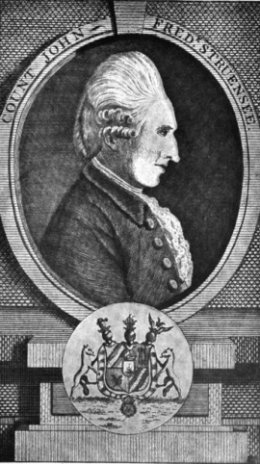
Such was the course that ended the rise of Johann Friedrich Struensee on this date in 1772. His friend and sometime cohort Enevold Brandt (Danish Wikipedia entry) was put on the block on the same day.

Struensee was born in 1738 in present day Germany and educated in Prussia, a doctor by trade and a budding Enlightenment political writer by practice. He seemed an unlikely character to involve himself in the court of King Christian VII of both Denmark and Norway, but Struensee was a vain and social man who managed to befriend the right people at the right time.

The first was Brandt. The second was Count Schack Karl Rantzau. A lawyer and Supreme Court justice, Brandt was a court favorite* and planted Struensee’s name as a capable doctor: young, kind, and competent, he would make a perfect personal physician for a king known for being a bit off: Christian was likely schizophrenic. Rantzau, meanwhile, was Count of the Holy Roman Empire, exiled from Copenhagen some 15 years before he met young Struensee, and eager to get back into politics.

In June 1768, Struensee took a post as the king’s traveling physician in England, and he immediately attached to Christian’s loneliness. The regent was interested in literature, philosophy, and music, and Struensee obliged him with patient regard for his charge, for which he was duly rewarded with access to a social life much more fulfilling than in Prussia. As a traveling physician, though, Struensee’s post had a finite span, and he lobbied hard to become a member of the Danish court.

With some help from others in the king’s court, Struensee managed to retain a permanent post, and his clamber up the nearest cliff to power began.

The young doctor, it seems, had a talent for playing two sides for personal gain. It started with the king, who had immense trust in Struensee and began to confide almost everything. Struensee was tactful with this information, adhering to an early form of patient-doctor privilege that endeared him to Christian. The other side was Queen Mathilde, Princess of Wales, by all accounts a beautiful woman who was not happy in Denmark and even less happy to be married to a mad and deteriorating king.

Mathilde initially disliked Struensee — or, at the very least, was indifferent to his actions. But near the end of 1769, the queen finally admitted Struensee into her chambers, and their relationship took off. He ably gamed Mathilde by convincing her that she was the kingdom’s future; Christian, meanwhile, remained ill, and Struensee remained a steady presence in his life. Come spring, Crown Prince Frederick VI also came under Struensee’s care, and as smallpox ravaged Copenhagen, the doctor pressed for inoculation. The king and queen assented, Frederick survived the epidemic, and Struensee garnered himself an official advisorship. It’s also suspected that, while Struensee and Mathilde watched over Frederick as he recovered from the inoculation,** their love affair began.

With a taste of power, Struensee pressed King Christian VII for cabinet changes — which he got — and was named Privy Councilor before 1770 was out. Now the principal advisor to the king, Struensee was able to advance his Enlightenment agenda, notably freedom of the press, the abolition of torture, limiting the death penalty, changing the rules of appointments, numbering the houses in Copenhagen, lighting the streets, and, perhaps in anticipation, removing penalties against those who produced illegitimate children. He was a bold visionary, but he also intoxicated by his growing power … and his programme obviously gored many an ox.

Struensee ascended still further early in 1771 when the king became practically unfit to rule. He was mentally faltering, and Struensee was all but running the show, and more.

In early July, the queen gave birth to a daughter who was widely assumed to be Struensee’s child. Days later, and just three years after being introduced to King Christian VII, Johann Friedrich Struensee effectively appointed himself Privy Cabinet Minister with dictatorial authority through one of King Christian’s edicts. Struensee’s orders would now have the force of law, and, as Christian’s proclamation noted, “They shall be immediately obeyed.”


Enevold Brandt (top), not to be confused with Brandt, the Big Lebowski lackey (bottom).

Struensee spent the next six months turning the European aristocracy inside-out and foisting an aggressive set of cabinet orders on the Danish people — over 1,000, by some counts. Having ridden on the coattails of a queen and king, he now pushed them aside. He moved the court to Schleswig-Holstein, in Prussia, and pleasingly enjoyed both the prerogatives of aristocracy and a middle class contempt for them.

Struensee was, to say the least, not a favorite abroad;† that he and his friends dominated the king and queen did not sit well with Danish commoners. Even Brandt was becoming disaffected, writing in a letter asking for either a larger salary or a resignation from the court:

No despot ever arrogated such power as yourself, or exercised it in such a way. The King’s pages and domestics tremble at the slightest occurrence: all are seized with terror. They talk, they eat, they drink, but they tremble as they do so. Fear has seized on all who surround the minister, even on the Queen…

But Brandt stayed on, and as 1771 drew to a close, Copenhagen became hostile territory for the royal family and their favorite doctor.

After the season’s first masquarade ball, on 16 January 1772, the Queen Dowager — Christian’s step-mother — Juliana Marie exposed Struensee’s affair and had Struensee, Brandt, the queen,‡ and many other Struensee accomplices arrested, ostensibly by order of the king.

Struensee was charged with lèse-majesté, a crime against the crown, for his affair with the queen; though he initially denied the charges — and though Mathilde did her best to shield him from harm — he was found guilty. Brandt was charged with the same crime for allegedly assaulting the king after being himself threatened with a flogging for impertinence (he even had a nip at Christian’s finger). Brandt’s punishment was the same. Each had his right hand chopped off, then was beheaded, drawn, and quatertered.

The queen, meanwhile, went into exile in France. Juliana Marie effectively ruled the kingdom through her son for over a decade, rolling back many of Struensee’s reforms and reverting power back to the aristocracy. This also turned out to be unpopular (the Danes and Norwegians are fickle people), and Mathilde’s son Frederick VI was able to regain power for his father in 1784, eventually moving to liberal reforms more in line with his erstwhile physician’s ideals.

Struensee’s epic rise and fall have spawned a variety of writings since his death. A memoir appeared just months after his execution which detailed his final months. He was also the subject of the Per Olov Enquist novel The Royal Physician’s Visit, which examines his life from multiple perspectives. Queen Mathilde’s life was put to ballet by Peter Maxwell Davies. And for a more contemporary cultural artifact, there’s the 2012 film A Royal Affair.

* Brandt was a court favorite, but after attempting to destroy the position of another minister, he was briefly expelled from Copenhagen, shortly after Struensee accepted his post.

** These inoculations predated “safe” inoculations by non-fatal, related disease strains such as cowpox. Frederick would have been made ill through the small pox strain Variola Minor, which had a mortality rate of about 1%. By contrast, Variola Major was fatal in about 30% of cases.

† While Struensee seems to have been book smart, his feel for international politics was limited, and his standing abroad would have unraveled had it ever raveled in the first place. He repeatedly upset the Russians, and Mathilde’s relatives were not pleased with him. Had he not been downed by public sentiment, it seems likely he would have fallen victim to one of his many royal detractors abroad.

‡ In a curious twist, Rantzau was the queen’s arrestor, and one of the principal conspirators in the dowager’s plot was a cabinet minister Struensee was responsible for ejecting very early in his career.

On this day..

1649: John Poyer, the lucky winner

On this date* in 1649, John Poyer, late the mayor of Pembroke, was shot at London’s Covent Gardens for switching sides in the English Civil War.

John Pembroke had earned his Round head by taking Carew Castle from King Charles‘ forces in the First English Civil War.

But the silly hats in Parliament wanted much of the potentially dangerous army to demobilize, and do so without settling the small matter of its back pay. Poyer refused to hand over his command and Pembroke Castle to a Parliamentary agent, and sought a better deal from monarchists.**

Only with a painstaking siege was the imposing medieval fortress of Pembroke reduced. Poyer, his superior Rowland Laugharne, and Rice Powell were hauled to London and condemned to death.†

In an interesting twist, it was decided that one example would prove the point as well as three, and to allot the clemencies by chance. When the three refused to draw their own lots, a child was given the job instead, and distributed three slips of paper. Laugharne and Powell read “Life given by God.” Poyer’s was deathly blank.

Mark Twain latched onto the singular role of a child in this deadly lottery, and wrung it for every drop of pathos in a short story, “The Death Disk”.

Unlike the proposed victim of that story, Poyer did not benefit from any last-second Cromwellian pity. His death is related in the zippily titled “The Declaration and Speech of Colonell John Poyer Immediately Before his Execution in Covent-Garden neer Westminster, on Wednesday, being the 25 of this instant April, 1649. With the manner of his deportment, and his Proposals to the people of England.”‡

Having ended his speech, he went to prayers, and immediately rising up again, called the men designed for his execution to him, which were six in number, and giving them the sign when they should give fire, which was by holding up both his hands, they observed his motion, who after some few expressions to his friends about him, prepared an embracement for death, and casting his eyes to Heaven, with both hands lifted up, the Executioners (with their fire locks) did their Office, who at one voley bereav’d him of his life, his corps being taken up, was carryed away in a Coach, and the Souldiery remanded back again to White-Hall.

* A few sources say April 21, but the overwhelming majority concur on the 25th — as do the primary citations available in 17th-century comments on his death (e.g., “he was upon the 25 of this instant Aprill being Wednesday, guarded from White-Hall in a Coach, to the place of execution” in “The Declaration and speech of Colonell John Poyer before his execution…”)

** D.E. Kennedy observes that the divide between Parliament and Royalist was not so bright as might be imagined — and that Cromwell himself was at this time negotiating with the future Charles II as an expedient to get around Charles I.

† The rank and file of Welsh insubordination basically skated, a display of clemency from the Lord Protector that Ireland would not enjoy.

‡ The title promises much more scaffold drama than two and a half forgettable pages deliver — basically, that Poyer died (a) penitent; (b) Anglican; and (c) wishing for peace.

On this day..

1521: The Comuneros of Castile

On this date in 1521, the day after winning the decisive battle in the Castilian War of the Communities, royalist forces beheaded its three principal leaders in Villalar.

Even while the Spanish Empire was burgeoning in the New World, its home peninsula remained a house divided.

The Iberian Kingdoms of Aragon and Castile had joined in a personal union with the marriage of Ferdinand and Isabella in the late 15th century.

When the couple passed, it was not a given that their conjoined territory would become, as it did, the germ of a unified Spain.

Instead, the royal power couple’s crazy daughter was kept under lock and key while her infant son grew into the redoubtable Emperor Charles V. To exacerbate the local annoyance, Chas had continent-spanning territories, and ambitions; Spain was not his base, merely one of his provinces. (He’d grown up in Flanders. Ah, dynastic politics.)

The Emperor was only a teenager when his Castilian subjects rose against his levies, and against the paradoxical perception that the first true King of Spain was a foreign ruler.

A riot in Toledo mushroomed into a revolt, and everyone started drawing up sides. (Spanish link) Things went south when the commoner rebels started adopting an unwelcome radicalism (beyond rebelling against the king, that is), enabling the imperial rep (and future pope) Adrian of Utrecht to pull back into the royalist camp rebellious nobles increasingly fearful of expropriation at the hands of the firebrands.

After the balance of forces decided in Charles V’s favor, all that remained was to give the chop to the primary troublemakers. Juan Lopez de Padilla, Juan Bravo and Francisco Maldonado were obligingly captured after the Battle of Villalar.


The Execution of the Comuneros of Castile, by Antonio Gisbert. Segovian Juan Bravo allegedly asked to die first, so as not to witness the death of so good a knight as Padilla.

The demise of the “Caballeros Comuneros” pretty much squelched the revolt — although Padilla’s widow Maria Pacheco defended the rebel ground zero of Toledo for several months more.

The comuneros have lived on ever since as a symbol in literature and propaganda, among monarchists (for whom they are a symbol of perfidy), liberals (rather the reverse) and Castilian nationalists. Though “comuneros” was for a period an all-purpose smear against agitators in the Spanish dominions, April 23 (the date of the fateful battle) has been Castile and Leon Day, a public observance, since 1986.


This monolith in the Villalar town plaza commemorates the Comuneros. Image (c) Julio Alvarez, and used with permission.

On this day..

1355: Marino Faliero, Doge of Venice

On this date in 1355, Marino Faliero* was escorted to the spot where he had been crowned Doge of Venice scant months before. There, he was ceremoniously relieved of his robes of state … and then his head.


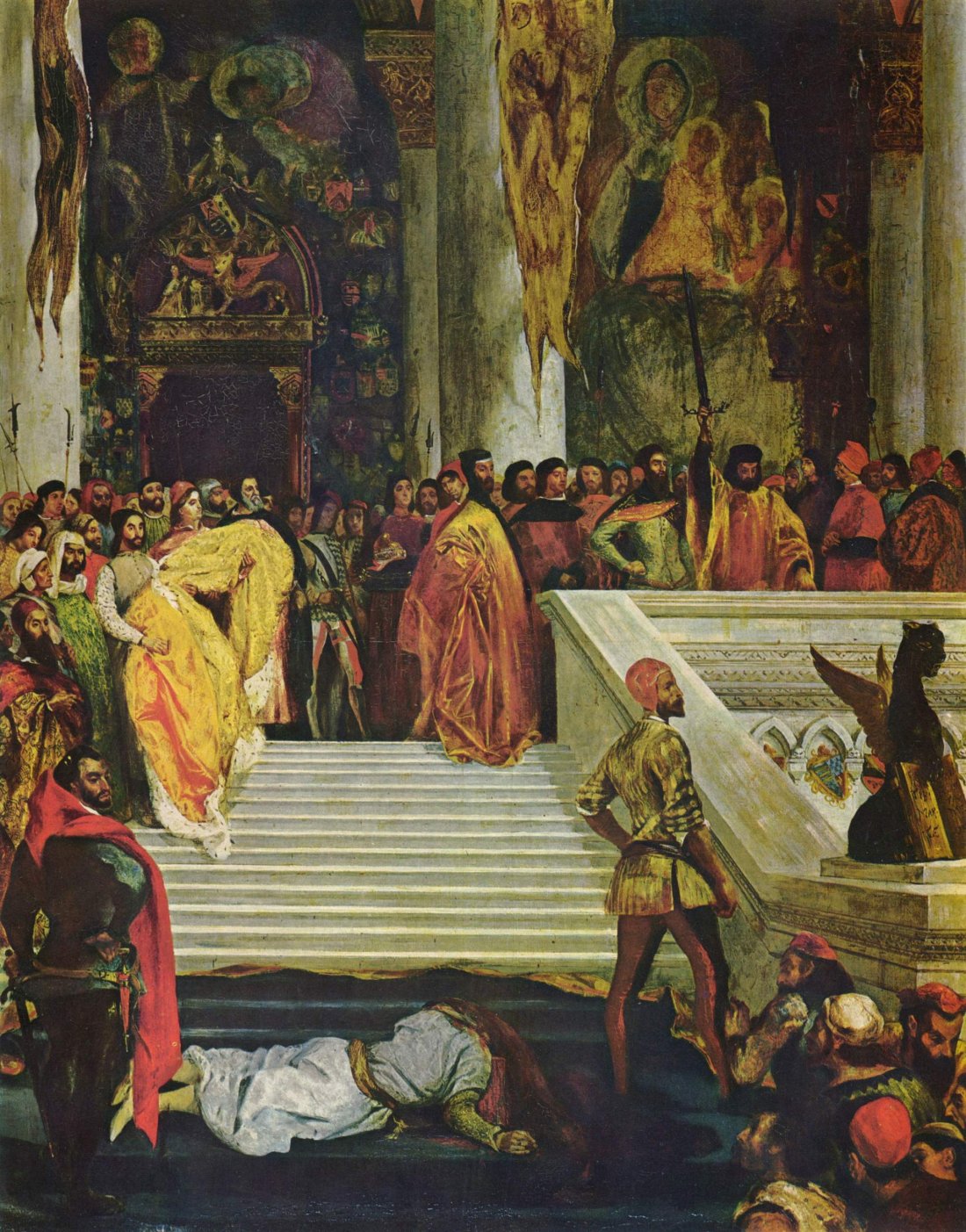
The Execution of Marino Faliero, by Eugene Delacroix (1827).

Some fog surrounds the day’s proceedings, product not only of time but of the Doge’s executioners’ damnatio memoriae upon their victim. What was written was circumspect; even Faliero‘s portrait in the great hall of the Doge’s Palace was veiled.

What is known — or at any rate, was admitted by the elderly first citizen — is that the ruler attempted a coup against the overweening power of Venice’s great families.

The putsch was supposed to occur on April 15, with the bell of St. Mark’s Cathedral tolling on a fabricated hue and cry. In the tumult, the Doge’s supporters meant to cut down the nobles who flexed the real political muscle in the maritime republic and consolidate ducal power.

Why?

The salacious version has the old goat in a tiff with a noble, who made fun of his May-December marriage —

Marino Faliero of the beautiful wife,
Others enjoy her while he maintains her

A tribunal of fellow-nobles let the rascal off with a slap on the wrist.

Power being what it is, and princes and nobilities being born for conflict with one another across the centuries in Europe, one may as well discern a straightforward political intent — heightened, perhaps, by the then-dire state of Venice’s naval contest with Genoa.

Downright Byronic under either scenario … and Byron wrote a play about Faliero. The doomed ruler gives throat to quite a magnificent curse upon his city, with all the foresight of Byron’s half-millennium of hindsight:

I perish, but not unavenged; far ages
Float up from the abyss of time to be,
And show these eyes, before they close, the doom
Of this proud city, and I leave my curse
On her and hers for ever! —

…

          — She shall be bought
And sold, and be an appanage to those
Who shall despise her! — She shall stoop to be
A province for an empire, petty town
In lieu of capital, with slaves for senates,
Beggars for nobles, panders for a people!

…

Amidst thy many murders, think of mine!
Thou den of drunkards with the blood of princes!
Gehenna of the waters! thou sea Sodom!
Thus I devote thee to the infernal gods!
Thee and thy serpent seed!
[Here the Doge turns, and addresses the executioner.]
          Slave, do thine office!
Strike as I struck the foe! Strike as I would
Have struck those tyrants! Strike deep as my curse!
Strike — and but once!

This sort of thing knocking about among litterateurs in the 19th century practically guarantees an opera.

* Or simply “Marin Falier”, in the Venetian dialect.

On this day..

1178 B.C.E.: Penelope’s suitors, by Odysseus

On this date in 1178 B.C.E., according to some enterprising astronomers, the Greek hero Odysseus returned home to Ithaca from a 20-year absence and slaughtered the suitors who had taken up lodgings in his palace.

The date was asserted in 2008 based on astronomical clues in the text of Homer’s Odyssey.

This sort of putative historical specificity extracted from what could as well be read as literary devices — e.g., an eclipse — for a literary episode might gratify an advocate of “the higher naivete”, but the reader is well entitled to doubt.

Similarly, and more specifically for this venue, is the problem of whether the summary justice exacted by a Bronze Age chieftain meets the definition of an “execution”. This dubious case is resolved here by the unique subject matter.

Crafty quasi- (or altogether) mythical hero Odysseus (aka Ulysses), having left a generation before for the decade-long Trojan War which he finally resolved with the famous Trojan Horse strategem, then spent the next decade wandering about the sea en route to his home island.

When he gets there, he finds that 108 ill-mannered suitors have moved in, dissipated his fortune in merrymaking, and have ceaselessly dogged his faithful wife (and presumed widow) Penelope to remarry one of them.*

Together with his now-grown son Telemachus, Odysseus punishes them terribly .

“Dogs, did you think that I should not come back from Troy? You have wasted my substance, have forced my women servants to lie with you, and have wooed my wife while I was still living. You have feared neither God nor man, and now you shall die.”

They turned pale with fear as he spoke, and every man looked round about to see whither he might fly for safety, but Eurymachus alone spoke.

“If you are Ulysses,” said he, “then what you have said is just. We have done much wrong on your lands and in your house. But Antinous who was the head and front of the offending lies low already. It was all his doing. It was not that he wanted to marry Penelope; he did not so much care about that; what he wanted was something quite different, and Jove has not vouchsafed it to him; he wanted to kill your son and to be chief man in Ithaca. Now, therefore, that he has met the death which was his due, spare the lives of your people. We will make everything good among ourselves, and pay you in full for all that we have eaten and drunk. Each one of us shall pay you a fine worth twenty oxen, and we will keep on giving you gold and bronze till your heart is softened. Until we have done this no one can complain of your being enraged against us.”

Ulysses again glared at him and said, “Though you should give me all that you have in the world both now and all that you ever shall have, I will not stay my hand till I have paid all of you in full. You must fight, or fly for your lives; and fly, not a man of you shall.”

The suitors fight back, and most of the resulting deaths occur in the fray. But it’s about as one-sided as the contest on any proper scaffold.

As eagle-beaked, crook-taloned vultures from the mountains swoop down on the smaller birds that cower in flocks upon the ground, and kill them, for they cannot either fight or fly, and lookers on enjoy the sport — even so did Ulysses and his men fall upon the suitors and smite them on every side. They made a horrible groaning as their brains were being battered in, and the ground seethed with their blood.

And if many of the doomed die with their boots on, there are at least a couple of specific instances that clearly have a summary-execution character.

Leiodes then caught the knees of Ulysses and said, “Ulysses I beseech you have mercy upon me and spare me. I never wronged any of the women in your house either in word or deed, and I tried to stop the others. I saw them, but they would not listen, and now they are paying for their folly. I was their sacrificing priest; if you kill me, I shall die without having done anything to deserve it, and shall have got no thanks for all the good that I did.”

Ulysses looked sternly at him and answered, “If you were their sacrificing priest, you must have prayed many a time that it might be long before I got home again, and that you might marry my wife and have children by her. Therefore you shall die.”

With these words he picked up the sword that Agelaus had dropped when he was being killed, and which was lying upon the ground. Then he struck Leiodes on the back of his neck, so that his head fell rolling in the dust while he was yet speaking.

The minstrel Phemius, whose services had been procured by force, has better luck pleading for clemency when Telemachus intervenes before Odysseus can give him the chop. But the explorer’s son has no use at all for twelve corrupt handmaids who have abetted the suitors’ predations. I like this version in the chilling verse form quoted by Dr. Samuel Haughton in an 1866 paper on hanging that weirdly goes on to produce the physics necessary to demonstrate the intuitively obvious point that this must have required the main rope to anchor to pillars between each suspended noose, rather than all twelve on a single line.

…leading forth
The women next, they shut them close between
The lofty wall and scullery, narrow, straight,
And dreadful, whence no prisoner might escape.
Then, prudent, thus Telemachus advised:
 The death of honour would I never grant
To criminals like these, who poured contempt
On mine and on my mother’s head, and lay
By night enfolded in the suitors’ arms.
 He said, and noosing a strong galley rope
To a huge column, led the cord around
The spacious dome, suspended so aloft,
That none with quivering feet might reach the floor.
As when a flight of doves entering the copse,
Or broad-winged thrushes, strike against the net
Within; ill rest, entangled, there they find;
So they, suspended by the neck, expired
All in one line together. Death abhorred!
With restless feet awhile they beat the air,
Then ceased.

On whatever date imagined, or strictly as fiction, this whole bloodbath fixes the climax of one of seminal works of the western literary canon.

The excerpts quoted here are from the Internet Classics Archive; multiple versions of both The Odyssey and The Iliad are available on Gutenberg.org … they’ve even done The Odyssey as a TV miniseries.

* This site claims that there’s at least one alternate tradition in which the famously virtuous Penelope — wasn’t.

On this day..

1739: Dick Turpin, outlaw legend

On this date in 1739, famed desperado Richard “Dick” Turpin rode through York on an open cart, saluting his admirers, then sat upon his gallows at the York raceway for half an hour, chatting with spectators and executioners, until he “with undaunted courage looked about him, and after speaking a few words to the topsman, he threw himself off the ladder and expired in about five minutes.”

Turpin was the ultimus Romanorum, the last of a race, which (we were almost about to say, we regret) is now altogether extinct. Several successors he had, it is true, but no name worthy to be recorded after his own. With him expired the chivalrous spirit which animated successively the bosoms of so many knights of the road; with him died away that passionate love of enterprise, that high spirit of devotion to the fair sex, which was first breathed upon the highway by the gay, gallant Claude Du-Val, the Bayard of the road — le filou sans peur et sans reproche — but which was extinguished at last by the cord that tied the heroic Turpin to the remorseless tree…

Turpin, like the setting sun, threw up some parting rays of glory, and tinged the far highways with a lustre that may yet be traced like a cloud of dust raised by his horse’s retreating heels.

The cloud hasn’t settled since William Harrison Ainsworth wrote those words.*

The “knight of the road”, one understands, is an artifice — a romantic construct. One name to bear its lustre to the present may be as good as another. Even so, in Dick Turpin, it has an exponent who bore very scant resemblance to the archetype … save for celebrity.

Turpin washed out of his apprenticed career as a butcher and took to the road, where he joined the “Essex Gang”. Far from dashing post-road stickups, this troupe specialized in invading domiciles where they would torture women into revealing the household stashes of valuables.


The Newgate Calendar captions this image, “Dick Turpin placing an old woman on the fire, to compel the discovry [sic] of her treasure”

Turpin’s highwayman career commenced when the gang was busted — our principal leaping out a window to evade capture — and he had a profitable couple of years plundering the traffic around Epping Forest.

Many are the colorful tales of Turpin’s career; the one of most moment for his legacy may be this chance encounter with a fellow outlaw, as related in the Newgate Calendar.

On a journey towards Cambridge, he met a man genteelly dressed, and well mounted: and expecting a good booty, he presented a pistol to the supposed gentleman, and demanded his money. The party thus stopped happened to be one King, a famous highwayman, who knew Turpin; and when the latter threatened destruction if he did not deliver his money, King burst into a fit of laughter, and said, “What, dog eat dog? — Come, come, brother Turpin; if you don’t know me, I know you, and shall be glad of your company.”

The well-mannered Tom King — “the gentleman highwayman” — seems to have had his courteous mien conjoined in legend with his much more villainous partner’s prolific career.

Nor is King the only fellow-outlaw whose exploits Turpin has absorbed.

Our anti-hero’s days pillaging the environs of London came to an end in an escapade that saw Turpin shoot his accomplice while trying to rescue him — a klutzy critical miss not usually associated with the swashbuckling rogue character kit. The dying King is supposed to have repaid this bit of friendly fire by revealing to the authorities the pair’s Epping Forest hideouts.

Escaping capture once again, Turpin changed his address, and it is said that the highwayman shed his pursuers with a marvelous 200-mile ride north to Yorkshire in 15 hours.

This feat was not Turpin’s originally, but ascribed to the 17th-century robber John “Swift Nick” Nevison, although even that might be folklore.

Ainsworth, bless his heart, fabricated (pdf) the Turpin ride in the interest of his yarn — “they were distancing Time’s swift chariot in its whirling passage o’er the earth … [Turpin] rode like one insane, and his courser partook of his frenzy. She bounded; she leaped; she tore up the ground beneath her; while Dick gave vent to his exultation in one wild prolonged halloo.” (Picturesquely, he rides his famous steed Black Bess to death on the trip.)

The story has been fixed ever since in the firmament, and licenses every pub along the route to claim Turpin’s patronage.

His end, if not heroic, was certainly attention-grabbing. Turpin settled in Yorkshire under the alias “John Palmer” and passed as a gentleman farmer … with a larcenous side business rustling stock.

His career, in a sense, had come full circle: ’twas a youthful cost-cutting practice of abducting animals that had put the kibosh on his legitimate butcher’s business.

His cover was blown most ingloriously, when he was detained as a possible horse thief and sent a pseudonymous letter to his brother in London asking for help. The brother was too cheap to pay the postage due, so the letter returned to the post office where Turpin’s schoolmaster chanced to see writing in a hand he recognized, and journeyed to York to identify the wanted man and pocket the reward.

So it was not housebreaking, highway heists, or his homicide that hung Turpin, but horse-rustling … although Turpin’s celebrity career attracted curiosity-seekers from far and wide when word of his capture got out. Whatever Ainsworth may have made of Turpin, he did not fabricate the man’s fame; Dick Turpin earned his own ballad sheets and made his own legend possible playing the man at his death.

This man lived in the most gay and thoughtless manner after conviction, regardless of all considerations of futurity, and affecting to make a jest of the dreadful fate that awaited him.

Not many days before his execution, he purchased a new fustian frock and a pair of pumps, in order to wear them at the time of his death: and, on the day before, he hired five poor men, at ten shillings each, to follow the cart as mourners: and he gave hatbands and gloves to several other persons: and he also left a ring, and some other articles, to a married woman in Lincolnshire, with whom he had been acquainted.

On the morning of his death he was put into a cart, and being followed by his mourners, as above-mentioned, he was drawn to the place of execution, in his way to which he bowed to the spectators with an air of the most astonishing indifference and intrepidity.

When he came to the fatal tree, he ascended the ladder; when his right leg trembling, he stamped it down with an air of assumed courage, as if he was ashamed of discovering any signs of fear, Having conversed with the executioner about half an hour, he threw himself off the ladder, and expired in a few minutes.

The spectators of the execution were affected at his fate, as he was distinguished by the comeliness of his appearance … The grave was dug remarkably deep, but notwithstanding the people who acted as mourners took such measures as they thought would secure the body: it was carried off about three o’clock on the following morning; the populace, however, got intimation whither it was conveyed, and found it in a garden belonging to one of the surgeons of the city.

Having got possession of it they laid it on a board, and carried it through the streets in a kind of triumphal manner, they then filled the coffin with unslacked lime, and buried it in the grave where it had been before deposited.

* LibriVox has a well-done free reading of Rookwood.

[audio:http://ia360943.us.archive.org/0/items/rookwood_pc_librivox/rookwood_26_ainsworth.mp3]

Part of the Themed Set: Selections from the Newgate Calendar.

On this day..

1952: Nikos Beloyannis, the man with the carnation

Before dawn on this date in 1952, four Greek Communists were shot outside Athens for treason.

Nikos (Nicholas) Beloyannis (or Mpeloyannis), the most prominent among them, spent a goodly portion of his adult life in prison for his subversive opinions — first at the hands of the interwar Greek nationalist government, then the Nazi occupation, then the British.

His many years’ service to communism was, unbeknownst to him, even then being horse-traded away as Stalin and Churchill carved up post-World War II spheres of influence.

Uncle Joe ceded Greece to the West — so the reds were left dangling during the Greek Civil War, and guys like Nikos got fitted for left martyrology.


The Execution of Beloyannis, by Peter de Francia.

“The man with the carnation” — it was his signature prop at the mass show trial where he drew a death sentence for “conspiring to overthrow by force the present regime in Greece.”

The trial, and the outcry that greeted its swift and questionable resolution, helped establish an enduring international reputation among fellow-travelers.

(From The Man With The Carnation, released after the fall of the Papadapoulos dictatorship.)

On this day..

1877: John D. Lee, for the Mountain Meadows Massacre

On this date in 1877, Mormon leader John D. Lee was shot at the site of (and for the crime of instigating) the Mountain Meadows Massacre 20 years before.

As the only person ever prosecuted for this dreadful affair, which saw 120 California-bound settlers slaughtered by a Mormon militia, Lee “was allowed … to carry to his grave Mormondom’s guilt for this horrible and barbaric act.” (Jan Shipps)

On this anniversary of Lee’s death, Executed Today interviews author Judith Freeman, whose historical novel Red Water tells Lee’s story through the eyes of three of his 19 wives.

You grew up Mormon — what brought you to this story? I gather that it wasn’t exactly daily discourse in your youth.

I found a copy of Juanita Brooks‘ book The Mountain Meadows Massacre in a used bookstore in Port Townsend, Washington, read it and was captivated by this story.

Growing up in northern Utah, I’d only heard vague, shadowy references to the massacre. It was the dirty little secret buried in the Mormon past — except for those people in Southern Utah who lived with that story as part of every generation’s experience and shame. I felt I had to write a novel about it, in part to try and understand this question: How do you get basically good people, like those Mormon settlers, to commit such evil?

You paint a picture of John Lee through the eyes of three of his wives. What kind of man was he — and how representative of the Mormon hierarchy would that be?

I think Lee was first and foremost a brilliant pioneer and survivalist and also a big blowhard, the kind of guy who would talk your head off — affable and a bit boring when it came to promoting his own virtues and experiences. He was self-aggrandizing, he’d do anything to make a buck, he had problems with the truth. He was a suck-up to Brigham Young who became his substitute father and then betrayed him.

He wasn’t entirely trustworthy because he put his own interests before all else. He could also be incredibly generous and kind, helpful to others. He wanted people to like him though they often didn’t, and he had an ingratiating quality. He was an orphan, with an orphan’s life-long neediness. In many ways I think he was good to his wives and cared deeply about his family — all sixty something kids and 19 wives. He was an amazingly talented man, skilled at many trades and businesses.

Was he representative of the Mormon Hierarchy? I don’t know. In some ways yes but I sense he was more sycophantic than some, and had a more amusing character than others, but what they all had in common was an absolute deference to church authority. I think I might have enjoyed meeting John D. Lee, he might have been more lively and fun than Brigham Young who strikes me as a misogynist and a brittle, cold man.

What about the women — three very different characters. What’s the sense you got of life for these women as pioneers, living in a polygamous family? How did they relate to one another, and how did the massacre and the execution of John Lee change their situation?

The women were also amazingly inventive as pioneers, strong, tough, formidable women though how can you generalize about 19 different personalities? Some liked each other and some couldn’t stand each other and the good thing was that Lee was a small industry and many of his wives had their own farms so they weren’t required to live on top of each other. He understood the “kitchen thing” when it comes to women, and said he wanted every one of his wives to have her own stove. The Lee family/families were devastated by his execution. His families were left penniless and destroyed, treated very cruelly, the women dispersed and shunned, the children shamed, and this shame was carried for generations.

To what extent is polygamy in the back story of the Mountain Meadows Massacre? What, for that matter, was the massacre really “about” in your judgment?

Polygamy had a small role to play in the massacre. The practice of polygamy, outlawed by the United States, was a part of what disturbed Washington and caused the federal government to send troops to Utah, which scared the Mormon populace into committing violent acts. One must remember that they had been the victims of violence and massacre, and fear turned in their minds.

What the massacre was really about, in my judgment, was the struggle for power in Utah. Would Brigham Young and the Mormon hierarchy control the territory and be masters of their own destiny, or would the federal government impose control of the “fiefdom”? The massacre came out of the idea the Indians could be made to carry out an attack and then the government would be forced to realize that if the Mormons were not allowed to control the territory and “their” natives, terrible things could happen. But the whole thing got out of control and took on a terrible life of its own.

A large party of Mormons, painted and tricked out as Indians, overtook the train of emigrant wagons some three hundred miles south of Salt Lake City, and made an attack. But the emigrants threw up earthworks, made fortresses of their wagons and defended themselves gallantly and successfully for five days! Your Missouri or Arkansas gentleman is not much afraid of the sort of scurvy apologies for “Indians” which the southern part of Utah affords. He would stand up and fight five hundred of them.

At the end of the five days the Mormons tried military strategy. They retired to the upper end of the “Meadows,” resumed civilized apparel, washed off their paint, and then, heavily armed, drove down in wagons to the beleaguered emigrants, bearing a flag of truce! When the emigrants saw white men coming they threw down their guns and welcomed them with cheer after cheer! And, all unconscious of the poetry of it, no doubt, they lifted a little child aloft, dressed in white, in answer to the flag of truce!

The leaders of the timely white “deliverers” were President Haight and Bishop John D. Lee, of the Mormon Church. Mr. Cradlebaugh, who served a term as a Federal Judge in Utah and afterward was sent to Congress from Nevada, tells in a speech delivered in Congress how these leaders next proceeded:

They professed to be on good terms with the Indians, and represented them as being very mad. They also proposed to intercede and settle the matter with the Indians. After several hours parley they, having (apparently) visited the Indians, gave the ultimatum of the savages; which was, that the emigrants should march out of their camp, leaving everything behind them, even their guns. It was promised by the Mormon bishops that they would bring a force and guard the emigrants back to the settlements. The terms were agreed to, the emigrants being desirous of saving the lives of their families. The Mormons retired, and subsequently appeared with thirty or forty armed men. The emigrants were marched out, the women and children in front and the men behind, the Mormon guard being in the rear. When they had marched in this way about a mile, at a given signal the slaughter commenced. The men were almost all shot down at the first fire from the guard. Two only escaped, who fled to the desert, and were followed one hundred and fifty miles before they were overtaken and slaughtered. The women and children ran on, two or three hundred yards further, when they were overtaken and with the aid of the Indians they were slaughtered. Seventeen individuals only, of all the emigrant party, were spared, and they were little children, the eldest of them being only seven years old. Thus, on the 10th day of September, 1857, was consummated one of the most cruel, cowardly and bloody murders known in our history.

–Mark Twain, Roughing It

John Lee: murderer, scapegoat, or both? How did he come to be prosecuted at all, and how to be the only one prosecuted?

John D. Lee was both murderer and scapegoat. He was bold and careless enough to hang around the area after the massacre, and to prosper from his various businesses and appear almost indifferent to what had happened — perhaps he thought he had the protection of the church authorities who continued to insist the Indians had committed this atrocity. A lot of others who’d participated in the massacre left the area, driven out by fear and shame. But Lee hung on.

John D. Lee, seated beside his coffin just before his execution.

How he was thrown to the wolves by the church authorities is a long story, as is the story of his two trials. He was the easiest person to scapegoat. He took the bullet for his church, and I think the authorities felt that they could put the affair behind them once he was dead, and they did for a very long time, until brave little Juanita Brooks wrote her book in the 1950s and was the first to tell the truth: the Mormons did it.

Does the Mormon church have some unfinished reckoning here? If so — why, after all these years?

Who cares what I think? But in my opinion, of course they do. They need to stop saying it was a “local” affair, carried out by some “local” renegade fanatics in southern Utah. The whole situation that led to the massacre was put into motion by people high up in the church, but I doubt very much they’ll ever go there and admit that. Too many lawyers, too much money, too impossible to admit culpability of prophets, seers, revelators.

Finally, I just want to say that after writing Red Water and thinking about this massacre for the five years it took to research and write the book, this is what I came to believe about how you get good people to do bad things.

You need to get three things going: First, you have to make people afraid and use that fear to manipulate them (think of 9/11). Second, you need get people to obey some greater force or consciousness other than their own — the Mormons had a principle of Perfect Obedience where you were required to subject yourself to the authority of the priesthood and church elders, but this idea could as well be inculcated in the concept of patriotism, or military duty. The point is, you subdue your own conscience in favor of deferment to an outside force. Third, you make people think their system is better than the other guy’s, that you’re doing God’s will, that your sense of right is greater than theirs. If you can make people think they are doing God’s will, you can get them to do anything. Get these three things going, and you can get good people to commit great evil.

On this day..

1804: Louis-Antoine-Henri de Bourbon-Condé, duc d’Enghien

It was worse than a crime, it was a blunder on this date in 1804.

Napoleon shocked, just shocked, his admirers and more especially his foes by having a royal relative ventilated at Vincennes for the trifling offense of plotting against his life.

The particular allegations against him may have been formulated with greater haste than precision, but the duc d’Enghien actually had been taking English coin to overthrow Republican France for the past decade, and nonchalantly avowed as much at his drumhead tribunal.


The Duke awaiting execution in the predawn gloom in the moat of the Chateau de Vincennes. The pathos of the accompanying dog is mandatory for this scene, as in this Harold Piffard illustration. This spot is now marked with a monument.

After surviving one too many assassination attempts, Napoleon was in the market for someone to make an example of, and the Bourbon scion, hanging about the French frontiers conniving with the English, certainly qualified.

The dispatch of his military commission, which rammed through a conviction the night of the 20th and arranged the fusillade immediately thereafter, raised self-righteous hackles among rival monarchs who had little enough compunction of their own about politically expeditious regicide.

Conventional disdain for the shooting (as with this (pdf) from the Fourth Estate), reached far and wide, and appears in Tolstoy’s War and Peace as a subject for (spurious) gossip in the Russian salons.

The group about Mortemart immediately began discussing the murder of the Duc d’Enghien. The vicomte said that the Duc d’Enghien had perished by his own magnanimity, and that there were particular reasons for Bonaparte’s hatred of him.

…

The vicomte told his tale very neatly. It was an anecdote, then current, to the effect that the Duc d’Enghien had gone secretly to Paris to visit Mademoiselle George; that at her house he came upon Bonaparte, who also enjoyed the famous actress’ favors, and that in his presence Napoleon happened to fall into one of the fainting fits to which he was subject, and was thus at the duc’s mercy. The latter spared him, and this magnanimity Bonaparte subsequently repaid by death.

Pierre Bezukhov, the novel’s spirit-questing Russian noble then in the thrall of the Little Corporal, has the rashness to defend d’Enghien’s execution.

“The execution of the Duc d’Enghien,” declared Monsieur Pierre, “was a political necessity, and it seems to me that Napoleon showed greatness of soul by not fearing to take on himself the whole responsibility of that deed.”

Though that defense went over like a lead balloon with the partygoers (and with Tolstoy), others have ventured to stand in the breach for the Corsican, who assuredly attracts far more opprobrium as a commoner shooting a royal traitor than he would have had their bloodlines been reversed. Bonaparte enthusiasts, like those of the Napoleon podcast, are particularly susceptible to such impolitic sentiment.

[audio:http://napoleon.thepodcastnetwork.com/audio/tpn_napoleon_20060920_011.mp3]

But Louis-Antoine-Henri normally gets better sympathy than that, as he did with the like of Chateaubriand, who resigned his Napoleonic commission in outrage.

And his death — far more notable than anything he did in life — is supposed to have occasioned the quip, “C’est pire qu’un crime, c’est une faute”: “it is worse than a crime, it is a blunder.” (Or, “it is worse than a crime, it is a mistake.”) Often attributed to Talleyrand, it was more likely uttered by his machiavellian mirror image, Joseph Fouche.

(See here for more on the phrase’s lineage. Talleyrand was so strongly in support of d’Enghien’s death that he is sometimes accused of steamrolling Napoleon on the subject. The wily minister destroyed some evidence and effected a timely volte-face when Bonaparte fell.)

The First Consul — he would crown himself Emperor later in 1804 — never had use for any such soft-pedaling, and unapologetically avowed the Duke’s execution literally to the end of his life.

Dying in exile on St. Helena years later, it is said, Napoleon read a calumny upon the d’Enghien shooting in the English press and promptly hauled out his already-completed will to insert in his own hand his lasting justification for the affair.

I caused the Duc d’Enghien to be arrested and tried, because that step was essential to the safety, interest, and honour of the French people, when the Count d’Artois* was maintaining, by his own confession, sixty assassins at Paris. Under similar circumstances, I should act in the same way.

* The Comte d’Artois was, at the time of Napoleon’s writing, the heir presumptive to the restored Bourbon monarchy — and he did indeed succeed in 1824 as Charles X. In 1804, the future king was in exile in Britain funding hits on Bonaparte and kindred counterrevolutionary stuff. For adherents of the much-disputed theory that Napoleon was poisoned in his island captivity, d’Artois figures as a possible instigator of the murder.

On this day..

1957: Burton Abbott, reprieved too late

On this date in 1957, the phone outside San Quentin’s gas chamber rang with a governor’s reprieve for Burton Abbott … but the execution was already underway.

Abbott was convicted of abducting and murdering 12-year-old Stephanie Bryan — a notorious crime that poet Sharon Olds, then a San Francisco teenager about the same age as the victim, memorialized in verse.

Then dirt scared me, because of the dirt
he had put on her face. And her training bra
scared me—the newspapers, morning and evening,
kept saying it, training bra,
as if the cups of it had been calling
the breasts up—he buried her in it,
perhaps he had never bothered to take it
off. They found her underpants
in a garbage can. And I feared the word
eczema, like my acne and like
the X in the paper which marked her body,
as if he had killed her for not being flawless.

Strong though ultimately circumstantial evidence connected Abbott to the crime, and the accused coolly maintained his own innocence at trial and thereafter. (The Oakland Museum has an extensive collection of photographic negatives from the trial.)

Abbott convinced his mom, but not many others — see this comment thread, for instance.

His last hours on March 15 were a rush of activity for a defense team that had fought for any possible angle to avert his death. A flurry of communications to Gov. Goodwin Knight delayed the execution once, and then secured a second stay just as the Abbott was being prepared for his fate.

By the time the phone rang, Abbott was already shrouded in cyanide fumes.

Goodwin’s Secretary Joseph Babich: Has the execution started?
Warden Harley O. Teets: Yes, sir, it has.
Babich: Can you stop it?
Teets: No, sir, it’s too late.

On this day..