1835: Dean and Donovan, white abolitionists

The planters comprising Livingston’s extralegal public safety committee had Albe Dean and Angus L. Donovan lynched on this date in 1835, during the ongoing panic at the prospect of slave rebellion.

Dean was a New England itinerant doctor, denounced by the “steam doctors” executed in Livingston on the 6th, in a desperate attempt to preserve their own lives; Donovan was a poor man from Kentucky whose name had been served up by similarly desperate slaves under torture at Beatties Bluff. Both were white, and in both cases the evidence marshaled against them largely resolved to a failure on the part of the accused to honor the color line.

The Livingston lynch committee was good enough to publish its own Proceedings by way of self-vindication, and we draw this post from its perspective on these marginal characters.

Trial of Albe Dean.

This man was a native of Ashford, Connecticut, whence he emigrated to Mississippi two years since. His general character before the disclosure of the conspiracy was not good; he was considered a lazy, indolent man, having very few pretensions to honesty. He had previously resided in the neighbourhood of Livingston, where he pretended to make a living by constructing washing-machines, until he became acquainted with Cotton, when he abandoned his business and turned steam-doctor, and went into partnership with Cotton, Saunders, & Co., and settled in Hinds county.

He was known to associate with negroes, and would often come to the owners of runaways and intercede with their masters to save them from a whipping. It was in evidence before the committee that he was seen prowling about the plantations in the neighbourhoods of Vernon, Beatie’s Bluff, and Livingston, ostensibly for the purpose of inquiring for runaway horses, which he did with great particularity — sometimes inquiring for a black, bay, gray, or other colour that suggested itself at the time. It was evident that horse-hunting was not his business, but that he was reconnoitring [sic] the country, and seeking opportunities to converse with the negroes …

Dean was arrested at the instigation of Saunders, who said he was a great rascal, and one of the conspirators. He was brought to Livingston with Saunders, on the 2d of July. On Monday, the 6th of July, he was placed on trial before the committee; but was in presence of the committee during the trial of Saunders and Cotton, and heard the whole of the testimony which went to implicate him.

It was in evidence before the committee, that, when on his way to Livingston, he had asked a witness, among other things, if some of Mr. W.P. Perkin’s negroes were not engaged in the conspiracy; and particularly if Hudnold’s Ned (a noted villain, whom he, Dean, had often endeavoured to screen from a whipping) was not concerned. He also inquired if Mr. Wm. Johnson’s Ruel Blake’s, and some other gentlemen’s negroes were not accused. He was not aware, at the time, that the very negroes about whom his inquiries were made had not only been suspected, but some of them actually hung; and, when informed Blake’s negro had been hung, he asked if he had made any disclosures about him. He was identified as one of their white accomplices by negroes accused.

And, lastly, he was accused by Dr. Cotton, who said, “Dean was one of his accomplices, and deeply engaged in the conspiracy, as a member of the Murrell clan.” After a cool and deliberate investigation of his case, he was, by a unanimous vote of the committee, found guilty of aiding and exciting the negroes to insurrection, and sentenced to be hanged.

In pursuance of the sentence, he was executed on the 8th of July, with Donovan, and died in dogged silence, neither acknowledging his guilt nor asserting his innocence.

This man requested that his name should not be given to the public, as his father was a public man, and it might lacerate the feelings of a venerated mother, who still survived. This request the committee and the writer would have scrupulously regarded, but that the name of the unfortunate man had already been made public by the officious and gratuitous information of some of the letter-writers [letters from Madison County to newspapers that were published widely in July and August -ed.], who have already given his name to the public.

Trial of A.L. Donovan, of Maysville, Ken.

After the trial of Dean, this young man was brought before the committee for examination, having been arrested on the evening of the 2d July, at Beatie’s Bluff.

His deportment, some weeks previous to his arrest, was very suspicious, from his intimacy with the negroes in the neighbourhood, being suspected at the time of trading with them, &c. His behaviour was so reprehensible as to compel the gentleman with whom he boarded to tell him, if he did not change his course he must leave his house, which he did a few days after, and went to the house of a man by the name of Moss, reputed a great scoundrel, whose name is mentioned in the report of the proceedings at Beatie’s Bluff: there Donovan remained until his arrest.

Donovan’s conduct was so very extraordinary and suspicious after he commenced boarding with Moss, as to induce the citizens of the neighbourhood to watch his movements. He was repeatedly found in the negro cabins, enjoying himself in negro society. Some persons requested him to leave the place, but he refused, alleging as a reason that he had to take care of some old keel-boats (which were entirely useless), half sunk, in Big Black river.

After the plot of the conspirators was discovered, instead of using his exertions to ferret out the ringleaders, and to assist the citizens in their efforts of detection, he would be found sneaking about the negro quarters, seeking opportunities to converse with them; and was caught at the house where the discovery of the conspiracy was made, engaged in earnest conversation with the girls who divulged the plot.

After arrests were made and examinations were going on, his conduct was such as no honest man would pursue; he would introduce himself into any company of gentlemen he would see conversing; this in itself at the time, was not noticed, as every one was desirous of finding out something to direct him in his investigations; but he would then go off and engage in conversations with Moss and his sons-in-law, who he knew, from their character, were suspected of being engaged in promoting the insurrection.

Even after several negroes were taken on suspicion, he still persisted in his attempts to converse with them, and at one time actually undertook (while the citizens were examining one) to release a negro who was tied, which negro afterward implicated him.

He was requested by the gentlemen who were examining the negroes not to come about them; they were compelled to take this step, from the fact that, when he was present, the negroes would say nothing, for the experiment was frequently tried; but when they were apprized that Donovan was not present, their disclosures were full, complete, and corresponding; the experiment was tried several times with the same success.

When he found he could not be permitted to be present at the examination of the negroes, he evinced considerable uneasiness, and kept walking to and fro, in view of the negroes under examination. The cause of his anxiety and alarm was soon explained; after his removal the negroes commenced a full detail and expose of the whole conspiracy (being at the time one or two hundred yards apart, and examined one at a time).

Among other white associates implicated by them, Donovan was said to be one of their leaders, and deeply concerned with them in the conspiracy.

After being implicated by a number of negroes at Beatie’s Bluff, the citizens thought proper to arrest him and bring him to Livingston, where the committee then organized was in session.

He was put on trial before the committee on the 7th July, and, in addition to the testimony before adduced, the following evidence was brought forward, which proved his participation in the conspiracy: —

A negro man from Beatie’s Bluff stated that Donovan was one of the white men engaged in persuading him to rebel with the rest, on the 4th of July, and that he had often solicited him to join them; Donovan said nothing was easier than for them to get their freedom; that the negroes could kill all the white people; and, if they should be pushed, that he would take them to a free state.

The confession of another negro man was in evidence before the committee, who pointed Donovan out at the time of the negro’s examination, and said, “He was to be one of their captains at Beatie’s Bluff.” It was also in evidence before the committee, that another boy, just before his execution, pointed Donovan out, when in a crowd, and said he was one of the men who persuaded him to enter into the conspiracy, and had encouraged him to go on, and get as many negroes to join as possible: other negroes implicated him.

A young man of unimpeachable character testified to the committee, in the presence of Donovan, that he and Donovan were walking through the field of his employer about the 25th or 26th May, when Donovan remarked to him that he should hate to be an overseer very much. Witness asked him why? He answered, it was such cruel work to be whipping the poor negroes, as he was obliged to do. Witness told him he never whipped only when they deserved it, and that was not often. Donovan exclaimed — “My friend, you will not have use for this long,” at the same time putting his hand on witness’s whip. Witness was a little astonished, and asked him to explain himself. Donovan, by way of explanation, remarked, the reason why he would not have use for it long was, that the negroes would soon be all free in this state. Witness replied, he knew the owners were not going to set them free, and that he (Donovan) ought to know that they could not effect their liberty by force, as they had tried it two or three times, and always failed; and that he thought they were now contented to remain in slavery.

Donovan replied warmly, in answer to his remarks, “that they could obtain their liberty by force, and that they would do it, not by themselves, but with the aid of thousands of rich, smart white men, who were ready to head them, with money, arms, and ammunition for their use.” And, before leaving the plantation, requested permission of witness to converse with the negroes, and to inform them of their rights, &c.

Of course, after the expression of such sentiments as above set forth, his request was denied, and at the same time he received a little good advice, and a threat from witness that, if he was seen on the plantation again, he might expect a “benefit” from his negro whip; and, using witness’s remark, Donovan cut out, and he had not seen him since until before the committee on his trial.

The committee were satisfied, from the evidence before them, that Donovan was an emissary of those deluded fanatics at the north — the ABOLITIONISTS. And, that while disseminating his incendiary doctrines among the negroes to create rebellion, he had found out that he was anticipated by a band of cut-throats and robbers, who were engaged in the same work, not wishing to liberate negroes, but to use them as instruments to assist them in plunder.

Being of a dissolute and abandoned character … and ripe for every rash enterprise, he joined the conspirators with the hope of receiving part of the spoils. If there had been any doubt on the minds of the committee as to his connexion with the conspirators, he would at least have been sentenced to be hanged for his attempts at diffusing among the negroes rebellious notions. On the 7th he was condemned to be hanged.

Accordingly, at twelve o’clock on the 8th of July he offered up his life on the gallows, as an expiation for his crimes. He said, from the gallows, that the committee did their duty in condemning him; that from the evidence they were compelled to do so.

Thus died an ABOLITIONIST, and let his blood be on the heads of those who sent him here.

On this day..

1835: The unknown lynched of the Murrell Excitement

We’ve done several posts in these pages devoted to Mississippi’s July 1835 slave insurrection panic and there are several more yet to come.

But today’s post is dedicated to the dead that we can’t date, and mostly can’t even name: the unknown slaves killed beyond the reach of law and documentation in forgotten lynchings or private murders around Madison County and environs. There’s no way to know how many these were; it’s guessed that they ranged into the dozens.

Well might one outrage to the well-documented extralegal lynch committee stretching necks in the county seat of Livingston — but as this was a committee of local oligarchs it had an orientation towards order, even if not law, and it brooked cross-examination and extenuating evidence, issued sub-lethal sentences and even acquittals. According to Joshua Rothman in Flush Times and Fever Dreams: A Story of Capitalism and Slavery in the Age of Jackson, many claimed — right or wrong — that Livingston was an island of relative calm in a panic compassing “a territorial belt along the Mississippi River stretching northward from Mississippi’s boundary with Louisiana nearly 250 miles toward Tennessee and inland roughly 75 miels toward the center of the state.”

Numerous public reports in Mississippi tried to suggest that a very different atmosphere prevailed in and around Madison County during the insurrection scare that continued on past the hangings of the gamblers in Vicksburg, and that the Livingston Committee of Safety had successfully introduced order to a situation that might otherwise have escalated into an uncontrolled orgy of violence.

Yet even in Livingston, the narrative is absorbed with the white purported masterminds; slaves’ executions appear as a part of the scenery, never exhaustively categorized. The white artisan Ruel Blake would be impeached on evidence given by a slave whose capture and hanging by a mob dignifying itself an ad hoc lynching subcommittee is entirely recounted — sans date — in a single footnote to the Livingston proceedings.

He was run by track-dogs some two hours without being taken, making his escape by taking to water. He remained in the woods until the excitement had partially subsided. By the laudable exertions of his master, he was decoyed into Livingston, where he was taken … the committee of safety had adjourned when he was taken. The citizens seemed determined he should be hanged, and consequently organized a committee, composed of some of the members of the first committee and other freeholders, who condemned him to be hanged; and, in pursuance of the sentence, he was executed in Livingston. Under the gallows he acknowledged his guilt, and said that R. Blake told him of the insurrection … Blake told him he must kill his master first, which he promised to do. Blake told him he was to be one of the captains of the negroes, &c.

And this is a wealth of information compared to some. Elsewhere we are left with passing allusions, shocking and frustratingly sparse, fragments deposited by a whirlwind.

In Warren County, the slave Israel Campbell remembered in his autobiography how he “saw the place where the slaughter took place. Two large wooden forks, with a pole laid from one to the other, served for the gallows, and they told me men hung there two days and nights.” But he never quite tells us how many or just when.

A July 8 letter from a white man in Clinton, Mississippi,* remarks that “a general excitement prevails, and every one is vigilant in the detecting and hanging of all villains, and it requires but little proof. I cannot say how many have been hung and shot among the white and blacks.”

From Mississippi Springs* on the same date: “Many white persons have been suspected of giving encouragement to it — some taken up, others pursued — those taken up have invariably been hung after a hasty examination by those who apprehended them; no more ceremony than is usually used upon hanging a dog for killing sheep is extended to them … A great number of negroes have been hung, and they are hanging them daily.”

Rothman again:

From near Natchez, about forty miles south of Claiborne, a plantation governess wrote in her diary about “insurrections, hangings, patrolling, and all sorts of frights” in the area, and one man wrote from Natchez itself that everyone in the city was “under arms all the time” and “hourly expect[ed] an insurrection, as the celebrated negro stealers Murrel and his band, are at the head of all the negroes.” All the towns upriver from Natchez, the man reported, were similarly guarded, and people in those places were “catching from 5 to 20 every day … and they hang them without judge or jury …

Future U.S. Senator and Mississippi Governor Henry Stuart Foote lived then in Clinton and his memoir heaped scorn on the ur-text of this statewide paroxysm, Virgil Stewart’s pamphlet claiming that small-time outlaw John Murrell was really a master criminal orchestrating a slave revolution. Foote remembered how in a timeless phenomenon “those who dared even to question the actual existence of the dangers which he depictured [sic] were suspected by their more excited fellow-citizens of a criminal insensibility to the supposed perils of the hour.”

[In Clinton] after the first organization of the vigilance committee, which sat afterward every day, the excitement, as was natural, increased perceptibly every hour. Suspected persons, both white and black, were apprehended everywhere; some of whom were brought before the committee for examination, while others, whose guilt seemed to be fully established, were hung without ceremony along the roadsides or in front of their own dwellings by those who had apprehended them …

Madison county was still the main focus of excitement, and every day we heard in the peaceful village where I dwelt of some new case of supposed guilt which had been there developed, and some new application of punishment not known to the law of the land, but which was supposed to be justified by the terrible necessity then dominating over all things beside.

Circumstances being what they are, we cannot but assume that such episodes each stand in for added multiples of lives taken by fire or noose or musketry, on plantation fastnesses or remote byways or hamlets too small for their own scrivener … nameless lives whose loss never spilled a drop of ink.

* Published in the Ohio State Journal, July 24, 1835.

* Published in the Baltimore Gazette and Daily Advertiser, July 30, 1835.

On this day..

1835: Five professional gamblers lynched at Vicksburg

On this date in 1835, five professional gamblers were strung up in Vicksburg.

It was an event more adjacent to than constituent of the slave rebellion panic shaking Mississippi, for the men were neither slaves nor their confederates and they were not struck down for threatening the Slave Power; at best, the uneasiness of possible insurrectionary stirrings abroad informed the tense background, or offered the post hoc justification — but these lynchings were a different thing that inhabited by chance the same time and place.

A Mississippi River boomtown “created by the easy credit of the Jacksonian ‘flush times’ and the scramble for wealth coincidental to Indian removal,” wrote Joshua Rothman,* Vicksburg had become a haven for faro players and other imps. The reports of this date’s events run thick with moralizing but as Rothman observes,

The merchants, doctors, lawyers, and planters who constituted Vicksburg’s budding elite may have believed professional gamblers threatened their moral integrity, but most people in Vicksburg were essentially speculators who had risked migration to the Southwest for the allure of fast profits almost unimaginable everywhere else in the country. In a very real sense, nearly everyone in Vicksburg was a gambler.

Then as now the high rollers at the tables of casino capitalism make free to snort at their louche progenitors and their marked cards and cathouse molls; gambling was a top-shelf moral hazard throughout 19th century America.

Whatever uneasy accommodation Vicksburg’s respectable had made with their cardsharps came to an abrupt end at an Independence Day barbecue that Fourth of July, when a player got into an altercation with a civilian and, ejected from the festivities, boldly returned to the scene armed, looking for trouble. Incensed townspeople overpowered him and drug him out of town to tar and feather him and order him out of town.

The summary executions that will follow two days hence would be widely condemned as news of the event echoed to the corners of the Republic, but that condemnation would always be attenuated by the nigh-universal public disapproval attached to gambling. A dispatch from Vicksburg that reached many other newspapers — we’re quoting it from the July 31, 1835 Richmond (Va.) Whig; one may find the piece in its entirety here — trowels on thick paragraphs of sermonizing before we come to the narrative: “shameless vices and daring outrages … destitute of all sense of moral obligations … intent only on the gratification of their avarice … vile and lawless machinations … every species of transgression … drunken and obscene mirth …” Et cetera, et cetera.

Now that we’ve forded this mighty river of invective, we find the townspeople of Vicksburg post-tar-and-feathering, “having thus aggravated the whole band of these desperadoes,

and feeling no security against their vengeance — the citizens met at night in the Court house, in a large number, and there passed the following resolutions:

Resolved, That a notice be given to all Professional Gamblers, that the citizens of Vicksburg are resolved, to exclude them from this place and its vicinity; and that twenty-four hours notice be given them to leave the place.

Resolved, That all persons permitting faro-dealing in their houses, be also notified that they will be prosecuted therefor.

Resolved, That one hundred copies of the foregoing resolutions be printed and stuck up at the corners of the streets — and that this publication be deemed notice.

Most of Vicksburg’s wagering fanciers took the ultimatum seriously and blew town. They were wise to do so.

On the 6th, as promised, Vicksburg’s soldiery marched door to door through a roster of homes suspected of hosting illicit gambling and there “dragged out every faro table, and other gambling apparatus that could be found” … until,

At length they approached a house which was occupied by one of the most profligate of the gang, whose name was North, and in which, it was understood that a garrison of armed men had been stationed. All hoped that these wretches would be intimidated by the superior numbers of their assailants, and surrender themselves at discretion, rather than attempt a desperate defence.

The House being surrounded, the back door was burst open, when four or five shots were fired from the interior, one of which instantly killed Doctor Hugh S. Bodley, a citizen universally beloved and respected.

The interior was so dark that the villains could not be seen, but several of the citizens, guided by the flash of their guns, returned their fire. A yell from one of the party announced that one of the shots had been effectual, and by this time a crowd of citizens, their indignation overcoming all other feelings — burst open every door of the building and dragged into the light, those who had not been wounded.

North, the ringleader, who had contrived this desperate plot, could not be found in the building, but was apprehended by a citizen, while attempting in company with another, to make his escape at a place not far distant. Himself, with the rest of the prisoners, were then conducted in silence to the scaffold.

One of them not having been in the building before it was attacked, nor appearing to be concerned with the rest, except that he was the brother of one of them, was liberated. The remaining number of five, among whom was the individual who had been shot, but who still lived, were immediately executed in presence of the assembled multitude. All sympathy for the wretches was completely merged in detestation and horror of their crime.

The whole procession then returned to the city, collected all the Faro Tables into a pile and burnt them.

The names of the individuals who perished, were as follows: North, Hullams, Dutch Bill, Smith and McCall.

Their bodies were cut down on the morning after their execution and buried in a ditch.

It is not expected that this act will pass without censure from those who had not an opportunity of knowing and feeling the dire necessity out of which it originated. The laws, however severe in their provision, have never been sufficient to correct a vice which must be established by positive proof, and cannot, like others, be shown from circumstantial testimony.

It is practised too, by individuals whose whole study is to violate the law in such a manner as to evade its punishment, and who never are in want of secret confederates to swear them out of their difficulties, whose oaths cannot be impeached for any specific cause.

We have borne with these enormities, until to have suffered them any longer would not only have proved us to be destitute of every manly sentiment, but would also have implicated us in the guilt of accessories to their crimes. Society may be compared to the elements which although “order is their first law,” can sometimes be purified only by a storm. Whatever therefore sickly sensibility or mawkish philanthropy may say against the course pursued by us, we hope that our citizens will not relax the code of punishment which they have enacted against this infamous and baleful class of society — and we invite Natchez, Jackson, Columbus, Warrenton, and all our sister towns throughout the State, in the name of our insulted laws — of offended virtue and of slaughtered innocence, to aid us in exterminating this deep-rooted vice from our land.

* “The Hazards of the Flush Times: Gambling, Mob Violence, and the Anxieties of America’s Market Revolution,” The Journal of American History, Dec. 2008. Also recommended: Rothman’s book Flush Times and Fever Dreams: A Story of Capitalism and Slavery in the Age of Jackson.

On this day..

1835: Joshua Cotton and William Saunders, steam doctors

In the Mississippi slave insurrection panic of 1835, slavers’ fears attached themselves right from the start to the prospect of white leadership affiliating with the prospective black rising.

Israel Campbell, a slave who would eventually reach freedom in the North and publish a fascinating autobiography on the eve of the Civil War, was present in the vicinity. He knew nothing of any rebellion until

two white men came to my house one night after I had gone to bed, and ordered me to get up immediately. I could not think, for my life, what was the matter. Before I got my clothes on, they became impatient, and called for me to open the door. As I done this, one of them seized me by the collar, having a bowie-knife in one hand. Uttering a horrible oath, he asked —

“What do you know about Doctor Cotton’s scrape?”

“Nothing at all, sir,” I replied.

“Don’t you tell me a lie. Do you know Dr. Cotton? When did you see him last?”

I replied, that I would not tell them a lie; that I did know Mr. Cotton, but that I had not seen him for some time. They went on asking a number of questions, wanting to know if I knew Harris’ old Dave, the negro preacher, and when I heard him preach last, and where at? I answered them satisfactorily these queries. They then wanted to know if I staid at the meeting until the people had all dispersed? If they talked any thing about getting free and killing the white people?

I replied to them about knowing the different parties; but about the rising of the slaves I had heard nothing.

After convincing themselves that I was ignorant, they left, warning me, however, not to be caught outside our own plantation, nor talk with any strange negroes or white men. They told me that Dr. Cotton and some other mean white men and a great many of the negroes were laying plans to rise and kill off the white people and free the negroes. After giving me some brandy, and again warning me, that if I did not heed their advice, I would be shot, they left my house.

They, with other parties, went around among all the slave quarters. Many they scared so badly, that they told lies of every description, and suffered for it. When they thought they had succeeded in quelling the insurrection, they commenced punishing those they had caught. Some they hung, others they burned, and some of those they thought not so guilty they pulled cats back-wards on their bare backs. Two of the party hung themselves in the prison.

The man these rude guests hunted with that menacing Bowie knife was Joshua Cotton, an itinerant homeopath expounding the fad launched by Samuel Thomson‘s hit publication New Guide to Health. Thomson had by means of some natural palliatives healed his family of several ailments that confounded legitimate medical practitioners; his emphasis on having patients sweat out toxins by immersion in steam led his followers to be derided as “steam doctors.”

Cotton wasn’t the only steam doctor beating the bushes in Madison County: an intimate named William Saunders was also about. Their wandering practice, interacting with free men and slaves alike, profiled as precisely the types who would be orchestrating a coordinated rebellion — and they had been implicated under the lash by the Beatties Bluff slaves, where the insurrection panic had begun days earlier.

Though not yet aware that they would be caught up in the panic, the steam doctors were making their own moves in these days. Saunders attended a June 30 meeting of Livingston whites to organize suppression of the supposed rebellion and advised them that the other steam doctor, Cotton, “was in the habit of trading with negroes; would buy any thing they would steal and bring to him.” This put the vigilantes onto Cotton; Saunders left town in peace and made, so he said, for Texas — which would have been a wise choice, as events would show.

On the road to Vicksburg and a river crossing to the safety of Louisiana, Saunders repeated the story to another traveler who just so happened to have a more suspicious frame of mind than the Livingstonians. This Good Samaritan promptly brought Saunders in as a suspected conspirator himself. Both steam doctors were under lock and key as the Beatties Bluff allegations of their complicity reached Livingston.

Saunders elaborated his charges against Cotton, plainly hoping to trade his opposite number’s life for his own: that Cotton was forever going about pretending to lose his horses in the countryside “as a pretext for hunting them, that he might have opportunities to converse with the negroes, and, by that means, to seduce them from their allegiance to their owners, by instilling rebellious notions among them; and to form plans, and to make converts to his propositions, which he could not do by being a steam-doctor.” Since a slave brought from Beatties Bluff also identified Cotton on sight as the man keen on seducing him to rebellion, Cotton could perceive that his fate was surely sealed, and while the vigilantes deliberated on July 4 he sent them a desperate offer to confess in exchange for leniency. The committee refused the offer … but confession was still the only card Cotton had to play, and he submitted the confession on spec. In it, he leaned for his narrative on Virgil Stewart’s recently published claims about a slave plot led by the bandit John Murrell.

I am one of the Murrell clan, a member of what we called the grand council … Our object in undertaking to excite the negroes to rebellion, was not for the purpose of liberating them, but for plunder. I was trying to carry into effect the plan of Murrell as laid down in Stewart’s pamphlet … from the exposure of our plans in said pamphlet, we expected the citizens would be on their guard at the time mentioned, being the 25th of December next; and we determined to take them by surprise, and try it on the night of the 4th of July, and it would have been tried to-night (and perhaps may yet), but for the detection of our plans.

Cotton also repaid tit for tat by naming Saunders as one of the plotters, confirming some slaves’ accusations and leaving the backstabbing chum to twist on his own useless protestations of innocence.

The upshot of Cotton’s statement was an offer to buy his own life by continuing to reveal more information about the conspiracy going forward — essentially, to become a standing informant against anyone whom the slavers might next suspect. “But the committee, deeming it of infinitely more importance to check the impending storm, by immediately destroying two of the ringleaders, and thereby creating dismay and panic among them, ordered their execution” — which was effected immediately, both steam doctors being marched directly from their hearing to the jail where, “fastening a rope to the grating of a window, in the upper story of the jail, and leaning a couple of rails against the wall, assisted the culprits upon the rails; then, adjusting the other end of the rope around their necks, removed the rails. They were left hanging until the next morning.”

The final extent of the executions/lynchings meted out during the course the insurrection panic is uncertain. Israel Campbell, however, would remember that Cotton and Saunders were certainly not the end of it when it came to rootless itinerants in the vicinity — and not only the steam doctor set. “[T]he party who were making arrests endeavored to get hold of every steam doctor and colored preacher they could,” he wrote in his autobiography.

[O]nce in their grasp, there was very little mercy shown them. The heads of the preachers they cut off and put on poles, and placed them along the road, where they remained until they were bleached. I saw several of their skulls in an apothecary store at Mount Vernon the latter part of that fall. Dr. Cotton was a noble-looking man and a friend to the slave, and he died a martyr to the cause he had so much at heart, — the emancipation of the slave.

On this day..

1835: A white man at Vicksburg and two black men at Livingston, and five slaves at Beatties Bluff

The first casualties of the Murrell Excitement, a purported slave rising in Madison County, Mississippi, were strung up by vigilance committees on this date in 1835.

Having been alerted to rebellious talk by slaves on a Beatties Bluff plantation, a vigilance committee organized itself and interrogated every slave there.

Events were moving fast, and those in the middle of them had all they could do to keep up with developments — as can be seen by this staccato letter from Canton, Mississippi in the center of Madison County. It was reprinted widely in the U.S. in late July; we’re quoting here from the July 25, 1835 Baltimore Gazette And Daily Advertiser.

Canton, Mississippi
July 3, 1835.

I have to inform you the disagreeable news that the negroes are about to rise upon the whites. It come out about two weeks ago; the whole country is in alarm — There have been meetings throughout the state, to adopt measures to find out the ringleaders and to appoint patrols. We are out patroling every night. — Last night I was in company to ride about the country to the plantations to see if every negro was at his home. There was a white man taken up at Vicksburg concerned with the negroes; they called a court together, and brought him in guilty and HUNG him right off. There have been three more white men taken up, but they have not had their trials yet.

In Livingston a town twelve miles from here, they gave a negro six hundred lashes, before he would discover any thing; then he informed them that the blacks were to rise on the Fourth of July. The jail here is full and they are bringing more and more in every day. We have a meeting here to day to form a volunteer company, to be ready at a minute’s notices and we are prepared with guns and ammunition.

Whilst I am writing this, there is a large meeting here to adopt resolutions to protect the citizens; also to send on to the Secretary of War to send a company of soldiers to protect the citizens of the County. — They hanged two negroes yesterday at Livingston, and they have about fifteen more that they are going to hang. We had four brought in here this morning to examine, and expect they will hang one of them.

The Court has just adjourned. They tried three blacks and flogged them all. To one of them they gave two hundred lashes! There were three white men at the head of the insurrection, that have run away. They have one in jail. They took him out yesterday, and gave him Lynch’s law, and that is thirty-nine lashes in this country. They expect to hang him.


Meanwhile, at Beatties Bluff, interrogators on July 1-2 harrowed the slaves with scourges. A letter from one of their number described the transaction with the first man to crack, a blacksmith named Joe. We do not know for a fact whether there was any slave plot, but if one reads it from the perspective of Joe’s likely innocence it presents as an archetypical feeling-out dialogue between torturer and prey, each party half-guessing at the other’s direction so as to steer a story to its acceptable destination.

We then called for a rope, and tied his hands, and told him that we were in possession of some of their conversation, and that he should tell the whole of it; after some time he agreed that, if we would not punish him, he would tell all that he could recollect. He said he knew what we wanted, and would tell the whole, but that he himself had nothing to do with the business. He said that Sam had told him that the negroes were going to rise and kill all the whites on the 4th, and that they had a number of white men at their head: some of them he knew by name others he only knew when he saw them. He mentioned the following white men as actively engaged in the business: Ruel Blake, Drs. Cotton and Saunders, and many more, but could not call their names; and that he had seen several others. He aso gave the names of several slaves as ringleaders in the business, who were understood to be captains under those white men.

Joe appears to have managed this frightful situation with aplomb and “was set at liberty”; however, on his evidence, other slaves were brought in: an aged preacher named Weaver (“no offers of lenity could shake his courage, and he remained steadfast under the torture of the lash, when even his executioner was nigh to fainting with his task”); a man named Russell (“all was mystery with him” until, prompted, he made a statement “in all particulars, precisely like the one made by Joe”); a handsome youth called Jim who offered more white man’s names and claimed that the slaves intended “to slay all the whites, except some of the most beautiful women, whom they intended to keep as wives”; and “a boy” — presumably a child — called Bachus who confirmed same.

“After getting through with these examinations, Jim, Bachus, Weaver, Russell, and Sam, were all put to death by hanging.”

A tense albeit perhaps dramatized narration of the violent interrogations and summary executions can be found in chapter 29 of The Life and Adventures of J. A. Murrell, the Great Western Land Pirate, which is also the source of the illustration above, and of the parenthetical quote about the preacher Weaver.

On this day..

Feast Day of St. Barnabas

June 11 is the feast date of St. Barnabas, St. Paul‘s New Testament wingman.

A Cypriot Jew named Joseph, “Barnabas” (“Son of Encouragement”) was so christened in the fourth chapter of the New Testament’s Acts of the Apostles because upon his conversion he sold his land for a donative to the Galileans.
After that, Barnabas reappears throughout Acts as one of the most important of the early Christian missionaries, usually joining St. Paul — whom Barnabas himself introduced to the Christians after Paul got religion — as emissary to the non-Jews, for which purpose the Holy Spirit itself demanded him by name. (Acts 13:2: “Set apart for me Barnabas and Saul for the work to which I have called them.”)

They’re frequently paired thereafter in the narrative although it’s invariably Saint Paul’s honeyed tongue that does the confounding before the companions flee this city or that ahead of a furious mob.* Evidently the Holy Spirit’s labor policies could have used some updating: Barnabas also features in a whinge by Paul in 1 Corinthians 9 against the excess sacrifices the Jesus sect is exacting from its most successful envoys, who get no wages and no sex and (so it seems) have to hustle side jobs to keep up their proselytizing.

Don’t we have the right to food and drink? Don’t we have the right to take a believing wife along with us, as do the other apostles and the Lord’s brothers and Cephas [St. Peter]? Or is it only I and Barnabas who lack the right to not work for a living?

Who serves as a soldier at his own expense? Who plants a vineyard and does not eat its grapes? Who tends a flock and does not drink the milk? … whoever plows and threshes should be able to do so in the hope of sharing in the harvest. If we have sown spiritual seed among you, is it too much if we reap a material harvest from you? If others have this right of support from you, shouldn’t we have it all the more?

But we did not use this right. On the contrary, we put up with anything rather than hinder the gospel of Christ.

Barnabas eventually parted ways with Paul, proceeding to Cyprus with the mysterious John Mark (possibly Mark the evangelist, author of the Gospel, or possibly a different guy) where hagiography holds that Jews angered by his preaching fell on Barnabas and stoned him to death, perhaps around the year 61.

Although obviously a consequential figure in early Christianity, Barnabas’s many Biblical appearances do not capture his voice. The apocrypha preserves at least two tracts** further animating this important character: the Epistle of Barnabas dating to the late first century or early second century; and, the Acts of Barnabas, a 5th century creation which purports to arise from the hand of John Mark and describes a martyrdom by fire, not stone:

And Barjesus, having arrived after two days, after not a few Jews had been instructed, was enraged, and brought together all the multitude of the Jews; and they having laid hold of Barnabas, wished to hand him over to Hypatius, the governor of Salamis. And having bound him to take him away to the governor, and a pious Jebusite, a kinsman of Nero, having count to Cyprus, the Jews, learning this, took Barnabas by night, and bound him with a rope by the neck; and having dragged him to the hippodrome from the synagogue, and having gone out of the city, standing round him, they burned him with fire, so that even his bones became dust. And straightway that night, having taken his dust, they cast it into a cloth; and having se cured it with lead. they intended to throw it into the sea. But I, finding an opportunity in the night, and being able along with Timon and Rhodon to carry it, we came to a certain place, and having found a cave, put it down there, where the nation of the Jebusites formerly dwelt. And having found a secret place in it, we put it away, with the documents which he had received from Matthew. And it was the fourth hour of the night of the second of the week.

Because June 11 formerly fell on/near Midsummer, ere the Gregorian reforms skipped the calendar 10-11 days forward, St. Barnabas’s Day has a festive agrarian history commemorated by the proverb, “Barnaby bright, Barnaby bright, the longest day and the shortest night.” The saint is also the patron of Cyprus, and may be invoked to protect against hailstorms or in service of peacemaking. Numerous schools, churches, and monasteries around the world bear his name.

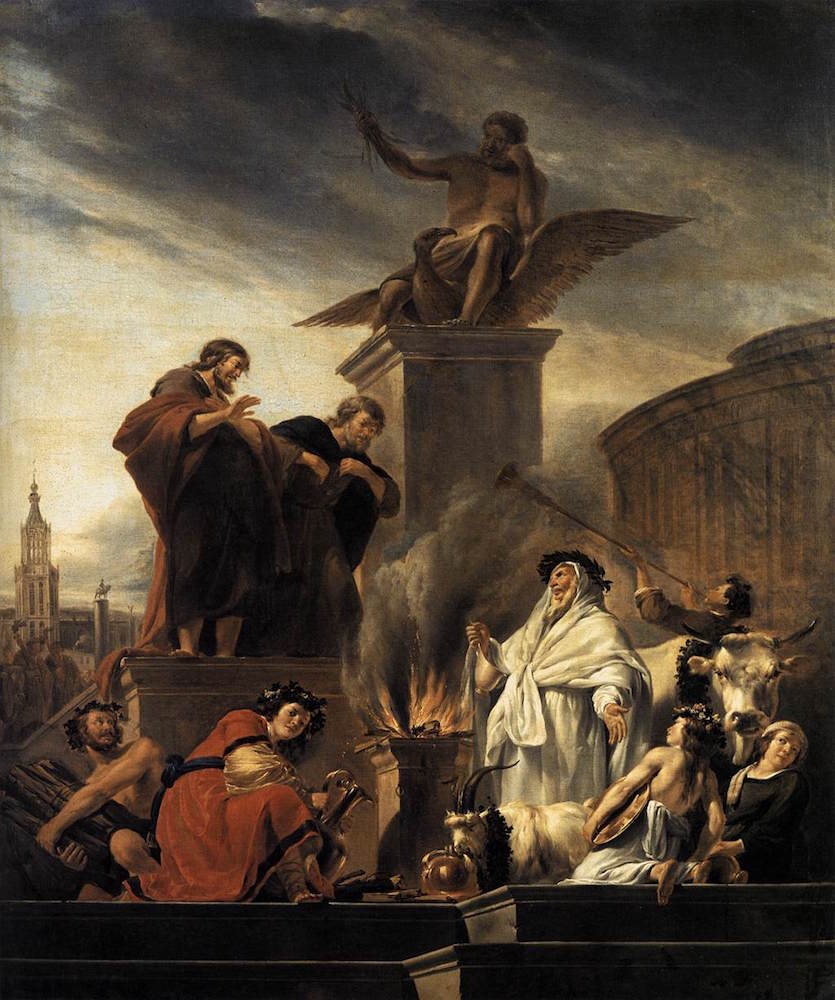
* There’s a comic touch to their preaching travails, too: in one exciting episode (Acts 14), Paul (of course) heals a cripple while the dynamic duo preaches in Lystra, leading excited witnesses to take them for Hermes and Zeus and start sacrificing to them.


No tips, please: Paul and Barnabas refusing the sacrifices of Lystrans in this detail (click for the full image) of a 1650 painting by Nicolaes Berchem.

** Beyond the Epistle and the Acts, there is also a very much later Gospel of Barnabas.

On this day..

1859: Oscar Jackson lynched, precipitating the Wright County War

(Thanks to Meaghan Good of the Charley Project for the guest post. -ed.)

The story of what would become known as the Wright County War began on September 21, 1858, when Henry A. Wallace was found lying dead in a clump of willows on his own farm, his head bashed in. He had last been seen alive on August 27, twenty-five days earlier.

Wallace’s employee, Oscar F. Jackson, was the prime suspect in his murder. Jackson had agreed to help Wallace reap his hay crop in exchange for a portion of the harvest, and on August 27 the two men had been seen working together in the fields near where Wallace’s body was later found.

Jackson showed a curious lack of concern about his boss’s disappearance. He never even bothered to tell the authorities he was missing, and when neighbors noted that Wallace hadn’t been seen in weeks and decided to launch a search, Jackson declined to join in. An impoverished sharecropper, Jackson also seemed to have become suddenly flush with cash — an oddity because like most of the residents of Wright County, Jackson was poor, still struggling to recover from the Panic of 1857. Wallace was comparatively well-off.

A grand jury indicted Jackson for his employer’s murder, but the case against him was incredibly feeble. At the trial, Jackson’s attorneys pointed out that no one had seen the murder or could even determine the day it took place, and suggested any number of people could have visited Wallace and killed him at any time during that three-and-a-half-week period that he was missing.

The jury quite rightly gave Jackson the benefit of doubt and acquitted him on April 3, 1859, after eighteen hours of deliberation.

That night, a lynch party of fifteen men chased him into the woods. Fearing for his life, Jackson fled to St. Paul.

The local citizenry — among them Henry Wallace’s brother, Hiram — were not prepared to let the matter rest. And, horrifyingly, neither was the Wright County Sheriff, George M. Bertram,* or the justice of the peace, Cyrus Chase Jenks.

Five days after Jackson’s acquittal, the three men went to find the presumed murderer in Hennepin County. There, Hiram Wallace swore out a complaint against Jackson accusing him of theft, and Jenks issued a warrant for his arrest. Never mind that Jenks did not have jurisdiction outside of Wright County: Sheriff Bertram delivered the warrant to Alfred Brackett, the deputy sheriff of Hennepin County, and asked him to serve it.

Walter N. Trenery wrote in his 1962 book, Murder in Minnesota,

Brackett found Jackson in St. Paul’s Apollo Saloon the next day. Handcuffing his prisoner, the deputy set out with him for St. Anthony by buggy. Jackson pleaded for time to call his attorney, but at first Brackett would not allow it. On the ride Jackson insisted that his arrest was based on a false charge, the purpose of which was to get him back to Rockford [in Wright County] where he would be murdered… Brackett reconsidered. When the two men reached St. Anthony, he sent word to Jackson’s counsel and persuaded the Wright County sheriff to spend the night in town before starting back to Rockford.

The implacable Sheriff Bertram

Jackson’s lawyer hastily drew up a writ of habeas corpus and before the day was out he’d served it to Sheriff Bertram. The Hon. Isaac Atwater, a Minnesota Supreme Court justice, ordered Jackson’s release on April 11. He was immediately re-arrested, however, as by then Jenks and Bertram had realized their error, gone back to Wright County and drawn up a second warrant. Jackson’s attorney responded with a second writ of habeas corpus, and on April 13, the man was ordered released again.

His friends had pooled their money and come up with enough for him to leave Minnesota forever, but for some reason Jackson returned to Rockford instead of skipping town. The residents of Wright County still wanted to lynch him, and to that end a neighbor swore out yet another phony complaint against him and yet another justice of the peace issued yet another warrant for his arrest.

A mob virtually tore Jackson’s cabin and its contents to pieces and set several fires. They surrounded the home of Jackson’s father-in-law, George Holdship, where the fugitive was reported to be hiding, and set more fires.

On April 24, Sheriff Bertram arrived at Holdship’s residence, and after he swore Jackson would not be harmed, arrested Jackson and took him away.

According to John D. Bessler’s book Legacy Of Violence: Lynch Mobs And Executions In Minnesota,

Less than half a mile from the house an armed mob overtook Sheriff Bertram’s procession. The sheriff relinquished power without resistance and rode off with the deputies, failing to even report the incident. After taunting Jackson throughout the night, the mob strung him up, even as his wife arrived to plead for mercy. Her pleas ignored, she was sent away distraught and empty-handed. The bloodthirsty mob hauled Jackson up and down times, failing to get Jackson to confess but successfully mangling his neck. Only when Jackson was hoisted up for a third time, at 2:00 P.M. on April 25, did his neck break. Jackson’s body was left dangling from a beam that protruded from Wallace’s cabin.

A coroner’s jury was called on the same day Jackson died and decided he had met with his death at the hands of some person or persons unknown. “The jury was not likely,” Trenery noted dryly, “to accuse its own members.”

But the story didn’t end there.

At the time of Oscar Jackson’s lynching, Minnesota had been a state for less than a year; it was admitted to the Union on May 11, 1858. Their first state governor, Henry Hastings Sibley, was anxious to maintain the rule of law, which had been besmirched by the Jackson outrage. One newspaper said, a tad melodramatically, “Wright County will be painted black upon the map of Minnesota — a patch of loathsome leprosy upon the fair surface of the land.”

Sibley offered a $500 reward for the arrest and conviction of anyone concerned with the lynching. It went unclaimed and the lynching started to slip away into obscurity, until July, when Oscar Jackson’s wife spotted Emery W. Moore (called “Emory” or “Aymer” in some accounts) at a gathering in Minnehaha Falls. Moore had been a member of the lynch mob, and it was his warrant that lead to Jackson’s arrest at his father-in-law’s house.

Mrs. Jackson alerted St. Paul’s chief of police, who arrested Moore for murder, and he was sent to Rockford to stand trial.

What followed, as Trenery describes it, was something of a solemn farce:

To prevent further collusion among local officials, the governor directed Charles H. Berry, the state’s attorney general, to conduct the prosecution in person. Berry opened the preliminary examination in Monticello on July 31, 1859, with an angry mob swarming about the building, shouting and threatening the agents of law enforcement. Mrs. Jackson, testifying for the prosecution, clearly and unequivocally named the leaders of the lynch mob and described the circumstances under which her husband had died. When the Wright County sheriff took the stand to explain how the mob had overwhelmed him and took Jackson from his custody, the attorney general found the sheriff’s explanation so unsatisfactory that he ordered Bertram arrested and held as an accomplice in the lynching. Berry then discovered that certain prosecution witnesses had mysteriously disappeared before they could testify, and he was forced to adjourn the hearing before it had been in session a full day.

To add insult to injury, that evening the vigilantes descended on the place where Emery Moore was confined, set him free, and melted into the darkness.

Berry returned to St. Paul and reported all this to the governor.

Fed up, Sibley declared Wright County to be “in a state of insurrection” and sent in the state militia to put a stop to mob justice and force the county officials to do their damn jobs. Three units — the Pioneer Guards, the St. Paul City Guards and the Stillwater Guards — marched in, aided by 35 special policemen.

The results were mixed. At first the militia was unable to find any members of the lynch mob, the locals just shrugged their shoulders when asked where they had gone, and the sheriff and other officials refused outright to cooperate. Only when they found out Governor Sibley was on his way over to personally take charge did the county officials “find” and arrest three suspected lynchers: Emery Moore, Hiram S. Angell, and J.E. Jenks.**

Satisfied, the governor sent the state militia home. The three-day occupation was later facetiously dubbed the Wright County War. It was a bloodless war.

The arrested men were almost immediately set free on a $500 bail, and in October, a grand jury refused to indict them. In the end, no one at all was punished for Oscar Jackson’s death, and Henry Wallace’s murder was never officially solved.

Charles Bryant groused in his History of the Upper Mississippi Valley,

And so the drama ended; the curtain fell; and the so-called “Wright county war” was a thing of the past. Its effects, however, long remained in the enormous expense incurred, which, with other criminal cases of less magnitude, created an indebtedness almost resulting in bankruptcy, and depreciating county orders to less than thirty-five cents on the dollar.

Of the principals involved in this story:

  • Sheriff Bertram left office in 1860 and was succeeded by W. Smith Brookins.
  • Cyrus Jenks died in Meeker City, Minnesota in 1897. He was almost 90 years old.
  • Governor Sibley stayed in office until 1860, and did not seek reelection. In 1862, he was appointed colonel of the Minnesota Militia and led them against the Native Americans in the Dakota War.
  • Charles Berry was later appointed as a judge in the Idaho Territory. He died in 1900.
  • Alfred Brackett fought in the Civil War, leading what would become Brackett’s Battallion, which served longer than any other Minnesota unit. The unit fought against the Confederates between 1861 and 1864, then became part of the Northwestern Indian Expedition in the Dakota Territory.
  • Hiram Angell also fought in the Civil War, with the Third Minnesota Volunteer Infantry Regiment. He died in St. Louis, Kentucky on April 5, 1862.
  • J.E. Jenks got elected to Minnesota’s House of Representatives in the 1870s and served for a year.

Nearly twenty years after Henry Wallace’s death, first his gold watch and then his rifle were found near the former site of Oscar Jackson’s cabin.

* Wright County boasts a Bertram Chain of Lakes, named for Sheriff Bertram.

** J.E. Jenks was probably Cyrus Jenks’s son; records note that Cyrus had a son named John Edwin Jenks who would have been about 22 years old in 1859, which matches J.E.’s first name and age.

On this day..

1915: Cordella Stevenson lynched

(Thanks to Meaghan Good of the Charley Project for the guest post. -ed.)

On this date in 1915, a mob visited Cordella Stevenson’s cabin, dragged her out, and lynched her.

The good citizens of Columbus, Mississippi, found her body the next day, hanging from a tree limb. The site of her lynching was only 50 yards north of the Mobile and Ohio Railroad, and rail passengers who came in and out of the city that day saw her corpse thus displayed. She had been “maltreated” (that is, raped) and stripped naked before being strung up.

Several months before, Gabe Frank, a local white man, lost his barn to fire. Although there was no direct evidence to implicate him and he had not been seen in the area for months prior to the fire, Cordella and Arch Stevenson’s son came under suspicion of arson.

The parents were respectable people who had worked for the same white employer for over a decade, but the son had a “worthless” reputation. Frank tried tracking the young man with bloodhounds, but was unsuccessful. The local police arrested Cordella and kept her locked up for several days, hoping she might know something of her son’s whereabouts, but they eventually released her without charge.

The Stevensons thought or hoped that would be the end of the matter.

Arch and Cordella had already gone to bed that Wednesday night in December when, at about 10:00 p.m., they heard someone pounding on their door. Before they could get to the door to answer it, the vigilantes had broken it down. They seized Cordella, pointed their rifles at Arch, and threatened to shoot him if he moved. At some point he managed to flee, bullets whizzing miraculously past him in the dark, and he ran to town for help. Arch knew what was good for him; after reporting what happened to the authorities, he fled the area for parts unknown. Meanwhile, somewhere out there in the night, the mob fell on his wife.

Kerry Segrave recorded in his book Lynching of Women in the United States: Recorded Cases, 1851-1946:

Sheriff Bell telephoned to Justice of the Peace McKellar to hold an inquest. He was out of town and did not return until Thursday night. As a result, the naked body was left hanging in view of the “morbid” crowd that came to see it until Friday morning when it was cut down and the inquest was held. That inquest jury returned a verdict that Cordella Stevenson came to her death at the hands of persons unknown.

The Chicago Defender, a (still-extant) black newspaper noted for its accurate reporting of Jim Crow era violence, bitterly editorialized, “This these southern culprits did. No law below the Mason and Dixon line that would cause them to fear. No officer in the police department that would dare to do his duty. No man in the government circles in Washington that has enough backbone to enforce the Constitution of the United States. This mob knew and they went on with their ghastly work.”

A century later, Cordella Stevenson’s ghastly death has still not been forgotten. In 2013, a poem for her, titled “What the Dark Said”, was published in the collection Ain’t No Grave, by Tennessee poet TJ Jarrett.

On this day..

1922: Ali Kemal

On this date in 1922, Anglophile Turkish politician Ali Kemal (English Wikipedia entry | Turkish) was lynched by a nationalist mob at Izmit during the Turkish War of Independence.

Though he is even to present-day Turkey the iconic traitor, it would be more generous to take him as the prophet of a future stillborn in the whirlwind of war.

Although he was of their generation, just a few years older than the “Three Pashas”, Kemal was not at all of their ethno-nationalist outlok. A cosmopolitan with a Circassian mother and a British wife — Kemal happens to be the great-grandfather of British pol Boris Johnson* — Kemal clashed with the Young Turks’ political organ and consequentially found European exile more congenial for much of the run-up to World War I. His book Fetret anticipates an inclusive, liberal, and westernized Ottoman Empire. It was a dream that shellfire pounded into mud, and not only for the Ottomans: these were years for national chauvanism run amok.

Politically sidelined within Turkey as the Young Turks steered the empire into war and genocide, Kemal re-emerged post-1918 — when the former empire lay supine before its conquerors — as a minister of state not merely acceptable to the Allied occupation but actively collaborating in its objectives. (Quite impolitic was his co-founding The Association of the Friends of England in Turkey even as England was occupying Istanbul and carving up the defeated empire.)

It is from this that his reputation as a Quisling figure derives, though there is little cause to believe that Kemal undertook these actions in anything other than a spirit of sincere public-service. The fact that he did so under the aegis of foreign domination, however, underscores the futility of his position: that Anglo-friendly, polyglot Turkey of his imaginings was not in the cards.

He and the nationalists were anathema to one another now, and though he resigned from the government in 1919 his university position gave him a platform to continue writing and lecturing against the Ataturk’s growing Turkish National Movement. Curiously, he did not join the sultan in flight from Turkey when the nationalists took the capital in hand and abolished the sultanate. Instead he was arrested having a placid shave at a barber shop by minions of Gen. Nureddin Pasha. The Nov. 13, 1922 New York Times described the horrific aftermath:

Ali Kemal Bey, editor of the anti-Nationalist newspaper Sabah, who was arrested at Ismid on the charge of subversive actions, was killed by a mob after having been officially condemned to death.

He was taken before General Nureddin Pasha who pronounced the death sentence dramatically: “In the name of Islam, in the name of the Turkish nation, I condemn you to death as a traitor.”

Ali Kemal remained passive, uttering no word of protest. His hands tied, he was led to a scaffold.

Before he reached the gibbet, however, an angry mob of women pounced on him, attacking him with knives, stones, clubs, tearing at his clothing and slashing at his body and head with cutlasses.

After a few minutes of excruciating torture, the victim expired. His body was dragged through the streets by the mob and exposed to public gaze on the scaffold for several hours.

The editor’s death has caused profound resentment and emotion in Constantinople, where he was known as one of Turkey’s most enlightened and most impartial citizens.

* Johnson, the former Mayor of London and (as of this writing) Britain’s Secretary of State, embraces this part of his ancestry but things were a little touchier when the Ottoman Empire and British Empire took opposite sides in World War I: at this awkward juncture, Ali Kemal’s English in-laws Anglicized his children’s names, using the surname of his late wife’s mother — Johnson.

Kemal also had a Turkish son by a subsequent marriage; his grandsons via that line, Boris Johnson’s cousins, are a major Istanbul publisher and a Turkish diplomat.

On this day..

1926: The Lowman lynchings

Aiken, South Carolina disgraced October 8, 1926 with the lynching of three members of the Lowman family.

American lynch law come 1926 was into its decline phase; the 30 lynchings in that year across the country have never been equalled in the nine decades since, but were also 50% below the rates at the beginning of the 1920s, and very far from the peak 1890s where triple-digit counts of mob murder were the perennial norm.

One might say that both the phenomenon and its pracitioners had matured. If exhortations to better refer justice to the law were the authorities’ running strategy for quelling lynch mobs, then the mobs themselves became complicit with the barristers — and could reserve recourse to extrajudicial means for occasions when the courts failed to work Judge Lynch’s will. Leo Frank’s case a decade prior to this is an excellent example: though there was a virtual lynch atmosphere at his trial, it was only after the man’s death sentence had been commuted by the governor that a lynch gang systematically extracted the man from prison to slay him.

Something like this pattern appears to distinguish the Lowman lynchings.

This dreadful case began with an exercise in that other grand tradition of racialized justice, the drug war — Prohibition-style. On April 25, 1925, the Lowmans’ tenant farm near Monetta was raided by police on a bootlegging tip.* The Lowmans resisted and a firefight broke out, leaving two dead: Annie Lowman, and Sheriff Henry Hampton “Bud” Howard.

Annie’s killing would of course never be punished. But inside of three weeks, fourteen-year-old Clarence Lowman was death-sentenced as Sheriff Howard’s killer, along with his cousin and “conspirator” 21-year-old Demmon Lowman. Bertha Lowman, Demmon’s older sister, received a life sentence.

And so Judge Lynch might rest easy.

Except that one year later, the South Carolina Supreme Court surprisingly threw out the Lowmans’ sentences as prejudicially obtained. The second trial began in October and right away the state suffered a setback when Judge Samuel Lanham threw out the murder case against Demmon Lowman.

Judge Lynch was wide awake now.

That very night — October 7 — white vigilantes organized a new verdict. According to the NAACP’s investigation, “within one hour of [Lanham’s] decision, news had been sent to as distant a point as Columbia that the three Lowmans were to be lynched that night.”

At 3 o’clock in the morning of October 8, and aided by the local constabulary, the mob stormed the jail and dragged Clarence, Demmon and Bertha Lowman away to a pine thicket outside of town where they were gunned down.

“On the way Clarence Lowman jumped from the car in which he was held,” the NAACP investigator would later report in the summation of his interviews.

He was shot down and recaptured, in order to prevent telltale blood marks, a rope was tied to the back of the car and the other end of it around Clarence’s body. In this manner he was dragged about a mile to the place of execution. The members of the mob sated that Bertha was the hardest one to kill. She was shot but not killed instantly. She dragged herself over the ground and as one member of the mob put it, ‘bleated like a goat.’ Another member of the mob, slightly more decent, said that she begged so piteously for her life and squirmed about so that a number of shots had to be fired before one found a vital spot and ended her agony.

Although the NAACP supplied South Carolina’s governor with the identities of 22 alleged members of the lynch mobs (including the sheriff himself) and 11 other witnesses to its actions, no man was ever sanctioned for this event, and an all-white grand jury declined to forward any indictments.

A distant Lowman relative was quoted in the Augusta Chronicle recollecting the stories his grandmother told about that horrible night, and the impression those stories had in his own life.

“She [grandma] talked about it all the time,” William Cue said. “Took them out of jail — drug them out like dead mules. When I drive past, I think about it — it happened in that house. … I learned something from that. … There was a lot of times where a man mistreated me and it kept me from doing anything.”

* It’s been argued by latter-day researchers that the tip itself was bogus, and supplied to police further to a personal vendetta — which, if true, would make the Lowmans victims of the 1920s version of SWATting.

On this day..