1951: King Abdullah’s assassins

AMMAN, Jordan, Sept. 4 — Four men sentenced to death here last week for complicity in the assassination of King Abdullah in July were hanged today in Amman prison. Regent Emire Naif had confirmed the sentences of the special tribunal.

Those put to death were Musa Abdulla el-Husseini, Abed Okkeh, Abdulkadir Farhat and Zakariya Okkeh.

Col. Abdulla el-Tell, former governor of Jerusalem, and Musa Ayyubi who were sentenced to death in absentia are reported to be living in Egypt.

New York Times, September 5, 1951*

The men hanged this day were among the authors of “the most dastardly crime Jordan ever witnessed”: the July 20, 1951 assassination of independent Jordan’s first king.

The cagey Hashemite monarch Abdullah I had been emir of Transjordan, an artificial British mandate jigsaw-piece that Abdullah got by virtue of cutting a deal with Winston Churchill.

This sinecure came with the significant drawback of dependency on London’s reach and interests, and Abdullah’s great achievement was to set Transjordan-cum-Jordan** on firm enough footing to survive the postwar sunset of the British Empire.

Abdullah faced an early test of Jordan’s chops shortly after his country’s 1946 independence when the Arab-Israeli War erupted. For Abdullah, this was a state-building opportunity; indeed, his government had for years backed Palestinian-partition plans that other Arab states had opposed — with the expectation that Jordan could help itself to the eastern part of that partition.

Abdullah did just that in 1948, invading and annexing the Jordan River’s West Bank all the way to East Jerusalem … while willingly acceding to (some have said actively colluding in) the creation of a partitioned Jewish state that was theoretically anathema to Jordan’s allies.

Jordanian territorial aggrandizement, however, brought with it the West Bank’s Palestinian population, severely aggrieved at having seen their aspirations to statehood cynically sacrificed by Abdullah. They got, into the bargain, Jordanian citizenship and a severe suppression of independence agitation.

So when Abdullah came to visit Jerusalem’s Al-Aqsa Mosque, a Palestinian gunman murdered him.

While the assassin himself was immediately shot dead by the king’s bodyguards, ten allegedly in on the plot were very hastily tried in mid-August … eight in the Amman courtroom, and two overseas in Egypt tried in absentia. Dr. Musa Abdullah el Husseini, Abdel Kadir Farahat, and the brothers Abed and Zakariya Okka were condemned to die, along with the absconded Abdulla el Tel and Musa Ahmed el Ayoubi. (The latter two would never be executed.)

According to the London Times‘ Aug. 29, 1951 wrap of the legal proceedings,

The events leading up to the murder, as they were described during the hearing, began with two meetings in Egypt, in September and October [1950], between el Tel and el Ayoubi, who decided then that the king should die. El Tel then met el Husseini i Cairo, and henceforth directed and financed the plot with el Ayoubi as his chief lieutenant. Abed Okka acted as an intermediary, and Zachariya Okka and Farahat were later drawn into the plot, the latter ultimately providing the murderer with a revolver.

The remaining four men who faced trial — Dr. Daud el Husseini, Franciscan Father Ibrahim Ayyad, Tawfik el Husseini, and Kamil Kaluti — were acquitted.

This event, which might have been feared to prefigure a more terrible disruption within Jordan, within Palestine, even in the entire Middle East, did nothing of the sort. Power transitioned to the long reign of Abdullah’s grandson King Hussein, who was actually present at his grandfather’s assassination. (And might have shared his fate, save for a medal the teenaged Hussein had pinned to his breast that deflected a bullet.)

As Mary Cristina Wilson writes,

There was an element of cover-up in the conduct of the trial. The grievances and frustrations of the accused were not broached … The idea of an independent Palestine was, for the moment, dead. Abdullah’s assassination was a terrible revenge wreaked for the death of that idea, but it signified retribution for events that were already history, not the beginning of the new order … Though not without parallels in the future, it was without echoes.

Jordan would govern the West Bank, albeit absent virtually any internationally-recognized legitimacy there, until Israel attacked and occupied the territory in the Six-Day War in 1967. The legacy of this event will be familiar to the reader.

In 1988, Jordan officially resigned its own claims on the West Bank to the Palestine Liberation Organization, “the sole legitimate representative of the Palestinian people.”

* Any number of online sites say this hanging occurred on September 6. Given the existence of September 5 papers reporting the execution, I think it’s safe to rule those erroneous. Wikipedia sources this version to James Lunt’s Hussein of Jordan.

** “Transjordan” officially became simply “Jordan” in 1949. Events in this post span either side of that re-branding, so for the sake of clarity, we’re just going to use “Jordan” throughout.

On this day..

1771: Henry Stroud and Robert Campbell, for revenge

On this date in 1771, Henry Stroud and Robert Campbell were hanged at Bethnal Green Road — a pointed message to the Spitalfield working class.

Their hanging was tit for tat in an exchange of deadly violence between the state and laboring Londoners.

Two years before, an anti-union law making it a capital crime to cut silk out of looms had actually been put to use with the hanging of two as part of the suppression of a Spitalfields weavers riot.

This execution provoked in the following months a horrifying mob vengeance against the independent weaver who had testified — falsely, it was suspected — against those hanged men. When said informer, name of Daniel Clark, was recognized walking in the area one day, an angry crowd formed and “stript him, tied his hands behind him, took him to a pond, threw him in, and then threw stones and brickbats at him for some time; then took him out, tied a cord round his neck, and threw him in the pond again, and then threw stones and brickbats at him till they beat out his brains.”*

Snitches get … brickbats.

Justice David Wilmot** determined to hunt out some of this lynch mob he could make an example of, not disdaining to resort to arm-twisting and witness-buying.† Wilmot’s advertisement for leads drew anonymous threats, which the justice scornfully published in newspapers to up the ante.

The writers of these letters … [are] pursuing with insatiable & heart felt revenge, their designs against you should any one person suffer from your busy concern. & know farther that having such connections at all your haunts, and free access at most time to your person, ’til not the whole third regiment of guards that can protect you from the well concerted plan for your destruction.

The result was a chaotic five-day trial, at which witnesses openly flinched at the prospect of popular vengeance waiting outside the Old Bailey doors.

Henry Stroud, nevertheless, was identified by several witnesses as having taken a prominent part in visiting popular justice upon Clark, in the form of two or three hurled bricks that knocked the victim down — while Robert Campbell was reputed to have thrust the bloodied Clark’s head into the pool.

They were pointedly put to death behind a heavily armed cordon near the very spot of the homicide. Stroud, at least, went to his death still vigorously protesting his innocence.‡

“Thus did the alternating pageants of ritual murder come to an end,” writes Peter Linebaugh of this exclamatory execution in The London Hanged. “A hundred bayonets from the War Office protecting the hangman and the magistrates. The scapegoating of the class antagonism concluded with this powerful, official display of power in the streets, where usually the trill of [weaving] shuttles would fill the air.”

* Quoted in Norma Landau’s “Gauging crime in late Eighteenth Century London,” Social History, 35:4.

** Not to be confused with Justice Wilmot, then the sitting Chief Justice of the Common Pleas. Justice David Wilmot’s credentials from this affair and otherwise established him as a hated enemy of the London working class, and consequently his home was torched during the proletarian Gordon Riots.

† viz., testimony of one witness among the several in the Old Bailey transcript who openly discuss payola: “another gentleman offered me fourscore pounds; a gentleman that brought me the summons; he said, you know one Bob Campbell; I said, I did not by name; he said, he would give me fourscore pounds; I was frightened, he said, I see you are a stranger; if you will but swear to the man I will give you fourscore pounds.”

‡ After the days-long prosecution, Stroud’s entire defense case ran two sentences: “I am as innocent of the affair as ever was a child in the world. I neither handled brick, stone, tile, nor anything, so help me God.”

On this day..

1705: The Camisards Catinat and Ravanel

On this date in 1705, two men were burned at the stake and two others broken on the wheel — Camisards all, put to death in Nimes, France.

The Camisards* were French Protestants of the mountainous southern Cevennes region who make their entry into these pages because the crown in 1685 revoked the Edict of Nantes, France’s guarantee of multiconfessional toleration.

Protestants were going to be bullied into conversion — or, in many cases, flight. (London’s Spitalfields textile industry, for instance, got a welcome shot in the arm from refugee Huguenot weavers.)

In 1702, the Cevennes Protestants pushed back.

“A persecution unsurpassed in violence had lasted near a score of years,” Robert Louis Stevenson wrote in his 19th century travelogue of the region. “This was the result upon the persecuted; hanging, burning, breaking on the wheel, had been in vain; the dragoons had left their hoof-marks over all the countryside; there were men rowing in the galleys, and women pining in the prisons of the Church; and not a thought was changed in the heart of any upright Protestant.”

On July 24, 1702, the Catholic torturer-priest running this show was assassinated, and the Camisard revolt was on.

Two years of dirty neighbor-on-neighbor violence mostly petered out in 1704 with the loss of the Camisards’ two main leaders — Jean Cavalier, the brilliant peasant-turned-commander who was bought off by an army commission and a royal pension, and Roland Laporte, who was betrayed as by Judas for 200 pieces of gold.

Catinat and Ravanel were Cavalier’s lieutenants; according to Alexandre Dumas, Catinat was a peasant named Abdias Maurel who picked up his nickname after serving under Marshal Catinat in the War of Spanish Succession.

The prospect of a renewed rising drew them back — a bold and terrible stroke to mount a surprise massacre and kidnap the exiled English Duke of Berwick. Catinat returned from his hidey-hole in Geneva; Ravanel came the bush where he was the last notable Camisard commander in the field.

An informer spilled the secret and the conspirators were busted in Nimes before they could spring their trap.

They faced immediate trial and condemnation — Catinat and Ravanel, along with two younger fighters named Jonquet and Villas.

After a long bout of pre-execution torture on April 21 to reveal their conspirators,**

The next day, the 22nd April, 1705, they were taken from the prison and drawn to the place of execution in two carts, being unable to walk, on account of the severe torture to which they had been subjected, and which had crushed the bones of their legs. A single pile of wood had been prepared for Catinat and Ravanel, who were to be burnt together; they were in one cart, and Villas and Jonquet, for whom two wheels had been prepared, were in the other.

The first operation was to bind Catinat and Ravanel back to back to the same stake, care being taken to place Catinat with his face to windward, so that his agony might last longer, and then the pile was lit under Ravanel.

As had been foreseen, this precaution gave great pleasure to those people who took delight in witnessing executions. The wind being rather high, blew the flames away from Catinat, so that at first the fire burnt his legs only — a circumstance which, the author of the History of the Camisards tells us, aroused Catinat’s impatience. Ravanel, however, bore everything to the end with the greatest heroism, only pausing in his singing to address words of encouragement to his companion in suffering, whom he could not see, but whose groans and curses he could hear; he would then return to his psalms, which he continued to sing until his voice was stifled in the flames. Just as he expired, Jonquet was removed from the wheel, and carried, his broken limbs dangling, to the burning pile, on which he was thrown. From the midst of the flames his voice was heard saying, “Courage, Catinat; we shall soon meet in heaven.” A few moments later, the stake, being burnt through at the base, broke, and Catinat falling into the flames, was quickly suffocated. That this accident had not been forseen and prevented by proper precautions caused great displeasure to spectators who found that the three-quarter of an hour which the spectacle had lasted was much too brief a time.

Villas lived three hours longer on his wheel, and expired without having uttered a single complaint.

A hecatomb of Camisard executions followed, fed by the denunciations of frightened or avaricious people; still others were “merely” condemned to the galleys … bringing at last a sullen peace of arms to the turbulent province.

* Here’s a 19th century public domain novel about the whole Camisard business.

** While three bore the torture quietly, Villas coughed up the name Boeton de Saint-Laurent-d’Aigozre. This man, too, was arrested and executed.

On this day..

1942: Vasily Klubkov, Zoya Kosmodemyanskaya’s betrayer

We’ve touched in these pages — one of our earliest posts, in fact — on Soviet war heroine Zoya Kosmodemyanskaya, a teenager executed by the advancing German army in November 1941 for conducting partisan attacks behind enemy lines.

Zoya’s story became known after the Red Army recaptured village of Petrishchevo, where she was hanged. A January 27, 1942 Pravda article recounted the gallows defiance of the young guerrilla, whom villagers knew only by her nom de guerre, “Tanya”. She had withstood German torture, refused to give them any information, and at her hanging incited her countrymen and -women to resist the invaders. She’s still to this day a beloved national martyr in Russia, which is why she’s also an Ace in our execution playing cards.

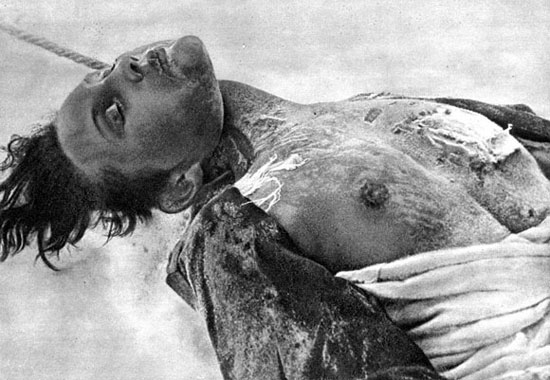
The young woman on the gallows, and in the ghastly post-mortem pictures with her left breast mutilated swiftly became propaganda grist for Moscow.

Zoya’s instant Joan of Arc-like legend invited investigation of the precise circumstances of her capture and death … and this in turn meant extremely dangerous scrutiny for any Soviet citizen in her environs whose behavior in those last days could be held to be in any way sub-heroic.

This brings us to today’s unfortunate entry, Vasily Klubkov, a humble mail-sorter before the war whose picture belongs in the dictionary next to “poor luckless sod.” Just him, Zoya, and everyone else on the terrible Eastern Front.

It was on this date* in 1942 that Klubkov paid the penalty for Zoya’s sacrifice.

Vasily Klubkov and Boris Krainov were other partisans who had been detailed along with Zoya Kosmodemyanskaya to torch some enemy assets on the same mission around Petrishchevo. Practically children all, they each acted independently from the others; long story short, Zoya and Vasily Klubkov were both captured.

Zoya fiercely endured every torture the Germans could throw at her, but Klubkov was made of softer stuff. When an officer pointed a gun at his head and demanded some answers, Klubkov started talking.

“I was a coward,” he later admitted. “I was scared I would be shot.”

Now, this admission very much against his own safety was made to the NKVD in March 1942, and since we already know that Vasily Klubkov was the sort to fold under torture, we can well imagine that the NKVD also got whatever it wanted out of the misfortunate young man. Considering the politicized quality of the trial and the circumstances of the “confession,” it has to be treated with caveats.

Under NKVD pressure, Klubkov signed off on a version of events that just so happened to mesh beautifully with the iconography already forming around the hanged “Tanya”: namely, that he was brought face-to-face with his fellow-prisoner and confirmed her identity, whereas she refused to breathe a word to her captors; that he saw her stripped naked and bashed with truncheons for hours and still summon the fortitude to refuse her interrogators the least satisfaction. Pavel Klubkov gave posterity firsthand evidence of Zoya Kosmodemyanskaya’s heroism in captivity.

“Klubkov may have been telling the truth, since it’s easy to imagine a terrified teenager on his first mission agreeing to his German captors’ demands,” notes Andrew Nagorski in The Greatest Battle: Stalin, Hitler, and the Desperate Struggle for Moscow That Changed the Course of World War II. “But there’s no way of knowing for sure how he really behaved, since he surely was just as terrified when he was interrogated by the NKVD. Or how much of what he said about Zoya was accurate, since the NKVD may already have been preparing the transcript with the idea of her elevation to mythic status.”

Heck, the reason the NKVD even had Klubkov to interrogate was that he escaped German custody, another big character red flag as far as the Soviets were concerned. That he escaped from the same custody that martyred Zoya Kosmodemyanskaya probably sealed his fate before he received his first pistol-whipping. NKVD records paint a kid who has already given up.

Well he might have. The verdict of the court was surely ordained from the start, but it was formally delivered on April 3: “Execution by shooting, without confiscation of property due to its absence.”

* Though there are some cites for April 3 out there, it appears that April 3 was the date of his conviction by a military tribunal and April 16 his execution date. This is a bit of a protracted delay by wartime Soviet tribunal standards, but then, Klubkov would have been a person of relevance to the state itself. The highest-ranking official who thought he could approve Klubkov’s execution without asking anyone else might have been a little further up the food chain than for your run-of-the-mill deserter.

On this day..

1430: Seven Parisian conspirators, during the Hundred Years War

In the early 15th century, France had stacked upon the woes of the Hundred Years War those of a civil war — between Armagnacs and Burgundians.

Burgundy, doughty duchy of Nibelungenlied renown, stretched to the Low Countries and was a gestating wealthy merchant state that perhaps had more in common with the English than with feudal, agrarian France. What Burgundy and England demonstrably had in common from 1419 was an alliance. Together, they bossed the northern half of what is now France during the endless Hundred Years War.

Thanks to this timely arrangement, the English came to occupy Paris — in Burgundian possession since 1418, when said party had bloodily ejected the French royalist Armagnacs.

Into this very low ebb of Valois fortunes entered Joan of Arc.

It is true that the king has made a truce with the duke of Burgundy for fifteen days and that the duke is to turn over the city of Paris at the end of fifteen days. Yet you should not marvel if I do not enter that city so quickly. I am not content with these truces and do not know if I will keep them.

-Joan of Arc, in a letter to Reims

Late in the 1420s, the illiterate farm girl somehow reversed the failing fortunes of the southerly French court. Joan, of course, will die at an English stake … but it is the Burgundians who will capture her.

At any rate, in 1429, Joan showed up and the French suddenly began going from victory to victory, knocking English and Burgundian heads in north-central France and culminating with having Charles VII crowned at Reims … which is actually north (well, northeast) of Paris.

Although Joan’s attack on Paris failed, advancing French arms put the fear of Holy Maid in the city and also cut off quite a lot of its rural food supply. “The capital itself was in a frightful state. As a result of interrupted communication and exposed supply routes, together with harassment by brigands and peasants, many Parisians were starving.”

Good times.

This naturally led some of the Armagnac-inclined citizens of Paris to think about ways to give the city back up to the French. We take up the narration of Anatole France, on a plot revolving around the “Seigneur de l’Ours,” or Jaquet Guillaume. (From here (HTML), or here (PDF).)

He was not of gentle birth and his arms were the sign of his hostelry. It was the custom in those days to give the title of Seigneur to the masters of the great Paris inns. Thus Colin, who kept the inn at the Temple Gate, was known as Seigneur du Boisseau. The hôtel de l’Ours stood in the Rue Saint-Antoine, near the Gate properly called La Porte Baudoyer, but commonly known as Porte Baudet, Baudet possessing the double advantage over Baudoyer of being shorter and more comprehensible. It was an ancient and famous inn, equal in renown to the most famous, to the inn of L’Arbre Sec, in the street of that name, to the Fleur de Lis near the Pont Neuf, to the Epée in the Rue Saint-Denis, and to the Chapeau Fétu of the Rue Croix-du-Tirouer. As early as King Charles V’s reign the inn was much frequented. Before huge fires the spits were turning all day long, and there were hot bread, fresh herrings, and wine of Auxerre in plenty. But since then the plunderings of men-at-arms had laid waste the countryside, and travellers no longer ventured forth for fear of being robbed and slain. Knights and pilgrims had ceased coming into the town. Only wolves came by night and devoured little children in the streets. There were no fagots in the grate, no dough in the kneading-trough. Armagnacs and Burgundians had drunk all the wine, laid waste all the vineyards, and nought was left in the cellar save a poor piquette of apples and of plums.

The Seigneur de l’Ours … was the proprietor of the house with the sign of the Bear (l’Ours). He held it by right of his wife Jeannette, and had come into possession of it in the following manner.

Fourteen years before, when King Henry with his knighthood had not yet landed in France, the host of the Bear Inn had been the King’s sergeant-at-arms, one Jean Roche, a man of wealth and fair fame. He was a devoted follower of the Duke of Burgundy, and that was what ruined him. Paris was then occupied by the Armagnacs. In the year 1416, in order to turn them out of the city, Jean Roche concerted with divers burgesses. The plot was to be carried out on Easter Day, which that year fell on the 29th of April. But the Armagnacs discovered it. They threw the conspirators into prison and brought them to trial. On the first Saturday in May the Seigneur de l’Ours was carried to the market place in a tumbrel with Durand de Brie, a dyer, master of the sixty cross-bowmen of Paris, and Jean Perquin, pin-maker and brasier. All three were beheaded, and the body of the Seigneur de l’Ours was hanged at Montfaucon where it remained until the entrance of the Burgundians. Six weeks after their coming, in July, 1418, his body was taken down from gibbet and buried in consecrated ground.

Now the widow of Jean Roche had a daughter by a first marriage. Her name was Jeannette; she took for her first husband a certain Bernard le Breton; for her second, Jaquet Guillaume, who was not rich. He owed money to Maître Jean Fleury, a clerk at law and the King’s secretary. His wife’s affairs were not more prosperous; her father’s goods had been confiscated and she had been obliged to redeem a part of her maternal inheritance. In 1424, the couple were short of money, and they sold a house, concealing the fact that it was mortgaged. Being charged by the purchaser, they were thrown into prison, where they aggravated their offence by suborning two witnesses, one a priest, the other a chambermaid. Fortunately for them, they procured a pardon.

The Jaquet Guillaume couple, therefore, were in a sorry plight. There remained to them, however, the inheritance of Jean Roche, the inn near the Place Baudet, at the sign of the Bear, the title of which Jaquet Guillaume bore. This second Seigneur de l’Ours was to be as strongly Armagnac as the other had been Burgundian, and was to pay the same price for his opinions.

Six years had passed since his release from prison, when, in the March of 1430, there was plotted by the Carmelites of Melun and certain burgesses of Paris that conspiracy which we mentioned on the occasion of Jeanne’s departure for l’ÃŽle de France. It was not the first plot into which the Carmelites had entered; they had plotted that rising which had been on the point of breaking out on the Day of the Nativity, when the Maid was leading the attack near La Porte Saint-Honoré; but never before had so many burgesses and so many notables entered into a conspiracy. A clerk of the Treasury, Maître Jean de la Chapelle, two magistrates of the Châtelet, Maître Renaud Savin and Maître Pierre Morant, a very wealthy man, named Jean de Calais, burgesses, merchants, artisans, more than one hundred and fifty persons, held the threads of this vast web, and among them, Jaquet Guillaume, Seigneur de l’Ours.

The Carmelites of Melun directed the whole. Clad as artisans, they went from King to burgesses, from burgesses to King; they kept up the communications between those within and those without, and regulated all the details of the enterprise. One of them asked the conspirators for a written undertaking to bring the King’s men into the city. Such a demand looks as if the majority of the conspirators were in the pay of the Royal Council.

In exchange for this undertaking these monks brought acts of oblivion signed by the King. For the people of Paris to be induced to receive the Prince, whom they still called Dauphin, they must needs be assured of a full and complete amnesty. For more than ten years, while the English and Burgundians had been holding the town, no one had felt altogether free from the reproach of their lawful sovereign and the men of his party. And all the more desirous were they for Charles of Valois to forget the past when they recalled the cruel vengeance taken by the Armagnacs after the suppression of the Butchers.

One of the conspirators, Jaquet Perdriel, advocated the sounding of a trumpet and the reading of the acts of oblivion on Sunday at the Porte Baudet.

“I have no doubt,” he said, “but that we shall be joined by the craftsmen, who, in great numbers will flock to hear the reading.”

He intended leading them to the Saint Antoine Gate and opening it to the King’s men who were lying in ambush close by.

Some eighty or a hundred Scotchmen, dressed as Englishmen, wearing the Saint Andrew’s cross, were then to enter the town, bringing in fish and cattle.

“They will enter boldly by the Saint-Denys Gate,” said Perdriel, “and take possession of it. Whereupon the King’s men will enter in force by the Porte Saint Antoine.”

The plan was deemed good, except that it was considered better for the King’s men to come in by the Saint-Denys Gate.

On Sunday, the 12th of March, the second Sunday in Lent, Maître Jean de la Chapelle invited the magistrate Renaud Savin to come to the tavern of La Pomme de Pin and meet divers other conspirators in order to arrive at an understanding touching what was best to be done. They decided that on a certain day, under pretext of going to see his vines at Chapelle-Saint-Denys, Jean de Calais should join the King’s men outside the walls, make himself known to them by unfurling a white standard and bring them into the town. It was further determined that Maître Morant and a goodly company of citizens with him, should hold themselves in readiness in the taverns of the Rue Saint-Denys to support the French when they came in. In one of the taverns of this street must have been the Seigneur de l’Ours, who, dwelling near by, had undertaken to bring together divers folk of the neighbourhood.

The conspirators were acting in perfect agreement. All they now awaited was to be informed of the day chosen by the Royal Council; and they believed the attempt was to be made on the following Sunday. But on the 21st of March Brother Pierre d’Allée, Prior of the Carmelites of Melun, was taken by the English. Put to the torture, he confessed the plot and named his accomplices. On the information he gave, more than one hundred and fifty persons were arrested and tried. On the 8th of April, the Eve of Palm Sunday, seven of the most important were taken to the market-place on a tumbrel. They were: Jean de la Chapelle, clerk of the Treasury; Renaud Savin and Pierre Morant, magistrates at the Châtelet; Guillaume Perdriau; Jean le François, called Baudrin; Jean le Rigueur, baker, and Jaquet Guillaume, Seigneur de l’Ours. All seven were beheaded by the executioner, who afterwards quartered the bodies of Jean de la Chapelle and of Baudrin.

Jaquet Perdriel was merely deprived of his possessions. Jean de Calais soon procured a pardon. Jeannette, the wife of Jaquet Guillaume, was banished from the kingdom and her goods confiscated.

Joan, for her part, had taken a noble prisoner named Franquet d’Arras. Anatole France says that after the plot was discovered, she attempted to exchange that hostage for Jaquet Guillaume. Having no affirmative reply, Joan proceeded to execute Arras shortly before her capture in May 1430 — a fact that was used against her at her trial.

Burgundy lost her political independence a few decades later.

On this day..

Purim

February 24, 2013 is the Jewish festival of Purim. (Actually, it began at sundown last night.)

This holiday, corresponding to 14 Adar of the Hebrew calendar, falls on different dates of the Gregorian calendar (most often in March). It commemorates a bloody story from the Book of Esther. (The quotes in this post are from this translation of Esther.)

The factual historicity of Esther is pretty questionable, but that debate is a bit beside the point for purposes of the present post. As folklore or fact, the story of Esther and Mordecai, of their near-destruction and the consequent execution of their persecutor, is a staple of tradition and literature.


The thumbnail version of the Purim story has Esther (Hadassah), a Jew living in the Persian capital of Susa, plucked out of obscurity to become the (or a) queen of a “King Ahasverus”.

If Esther has a historical basis, this would be about the fourth or fifth century B.C.E., and “Ahasverus” could be Xerxes (the guy who invaded Greece and made Herodotus famous), or the much later Artaxerxes II.

Esther is an orphan being raised by her cousin Mordecai, and when Esther wins “Who Wants To Live In The Persian Harem?” Mordecai advises her to keep judiciously silent about her Hebrew lineage.

Mordecai doesn’t manage the same trick, however, and offends the king’s powerful minister Haman by refusing to bow to him. This gets the overweening Haman upset at not only Mordecai but at all Jews who share his anti-idolatry scruples, and Haman persuades King Ahasverus to authorize their indiscriminate slaughter:

“There is a certain people scattered abroad and dispersed among the peoples in all the provinces of your kingdom; their laws are different from those of every other people, and they do not keep the king’s laws, so that it is not for the king’s profit to tolerate them. If it please the king, let it be decreed that they be destroyed.”

13 Adar is the date fixed for the Jews’ destruction, by pur, a casting of lots — hence the festival’s eventual date and name. Haman, of course, does not realize that this policy makes Esther his enemy.

In order to save her cousin and her people, Esther must risk a death sentence of her own by approaching the king unbidden in his inner chambers. Mordecai charges her to her duty with a timeless moral force:

“Think not that in the king’s palace you will escape any more than all the other Jews. For if you keep silence at such a time as this, relief and deliverance will rise for the Jews from another quarter, but you and your father’s house will perish. And who knows whether you have not come to the kingdom for such a time as this?”

Esther pulls this dangerous maneuver off, and gains thereby a private audience with just the king and Haman. There, she springs her trap — revealing her Jewish identity.

The king again said to Esther, “What is your petition, Queen Esther? It shall be granted you. And what is your request? Even to the half of my kingdom, it shall be fulfilled.”

Then Queen Esther answered, “If I have found favor in your sight, O king, and if it please the king, let my life be given me at my petition, and my people at my request. For we are sold, I and my people, to be destroyed, to be slain, and to be annihilated. If we had been sold merely as slaves, men and women, I would have held my peace; for our affliction is not to be compared with the loss to the king.”

Then King Ahasverus said to Queen Esther, “Who is he, and where is he, that would presume to do this?”

And Esther said, “A foe and enemy! This wicked Haman!” Then Haman was in terror before the king and the queen.

Word arrives at this inopportune juncture that Haman, who has been gleefully preparing his vengeance, has just had completed a 50-cubit (~20-meter) gallows to execute Mordecai upon. The enraged king instead orders Haman hung on it.

“Hanging” Haman on the “gallows” was traditionally interpreted in the ancient and medieval world as crucifixion,* or some analogously excrutiating way to die.

By any method of execution, though, the dramatic power of the scene — sudden reversal of fortune, virtue elevated over wickedness, the oppressed turning the tables on their oppressors, divine deliverance — is obvious.

Haman and his gallows have consequently stood as a potent literary device ever since: for perfidious council; for violent anti-Semitism; for unusually spectacular punishment (to be hung “as high as Haman”); for the concept of getting one’s comeuppance or being hoisted by one’s own petard.

At least the guy was remembered. Hands up if you can name any other ancient Persian courtier.


“The Punishment of Haman” is a corner of Michelangelo’s Sistine Chapel.

However, this satisfying palace politics turnabout is not the end of the story, and punishment is not reserved only for the wicked minister.

Esther persuades the king not only to revoke Haman’s order, but to issue a new one — one that Esther and Mordecai will write tabula rasa over the king’s seal.

The writing was in the name of King Ahasverus and sealed with the king’s ring, and letters were sent by mounted couriers riding on swift horses that were used in the king’s service, bred from the royal stud. By these the king allowed the Jews who were in every city to gather and defend their lives, to destroy, to slay, and to annihilate any armed force of any people or province that might attack them, with their children and women, and to plunder their goods, upon one day throughout all the provinces of King Ahasverus, on the thirteenth day of the twelfth month, which is the month of Adar

So the Jews smote all their enemies with the sword, slaughtering, and destroying them, and did as they pleased to those who hated them. In Susa the capital itself the Jews slew and destroyed five hundred men, and also slew Parshandatha and Dalphon and Aspatha and Poratha and Adalia and Aridatha and Parmashta and Arisai and Aridai and Vaizatha, the ten sons of Haman the son of Hammedatha, the enemy of the Jews; but they laid no hand on the plunder. That very day the number of those slain in Susa the capital was reported to the king.

And the king said to Queen Esther, “In Susa the capital the Jews have slain five hundred men and also the ten sons of Haman. What then have they done in the rest of the king’s provinces! Now what is your petition? It shall be granted you. And what further is your request? It shall be fulfilled.”

And Esther said, “If it please the king, let the Jews who are in Susa be allowed tomorrow also to do according to this day’s edict. And let the ten sons of Haman be hanged on the gallows.”

So the king commanded this to be done; a decree was issued in Susa, and the ten sons of Haman were hanged. The Jews who were in Susa gathered also on the fourteenth day of the month of Adar and they slew three hundred men in Susa; but they laid no hands on the plunder.

Now the other Jews who were in the king’s provinces also gathered to defend their lives, and got relief from their enemies, and slew seventy-five thousand of those who hated them; but they laid no hands on the plunder.


This bloodbath is obviously a bit more ethically problematic than Haman’s individual fate.

Now, sure, this is an event of questionable authenticity situated in Iron Age tribal mores and exaggerated by the ubiquitous ancient inflation of head counts. The subtext (“defend their lives” … “relief from their enemies”) also implies something like civil strife, blows exchanged rather than merely blows delivered. The overt text says that the victims were people who intended to do exactly the same thing to the Jews.

Still, the plain words on the page says 75,000 humans were slaughtered by a mobilized ethno-nationalist group, “children and women” among them. Just imagine the same parable about a Serb in a Bosnian king’s court, and say a little thanksgiving that the Book of Esther doesn’t identify these 75,000 as constituents of any specific demographic group that remains a going concern today.

Purim is a beloved holiday among its celebrants, but most any explication of it on the Internet comes with a comment thread agonizing over (or rationalizing) the body count. (For example.)

That part of the narrative has unsurprisingly invited highly prejudicial interpretations, especially among hostile Christian interlocutors (pdf).

American pastor Washington Gladden called the first Purim “a fiendish outbreak of fanatical cruelty.”

The fact that the story was told, and that it gained great popularity among the Jews, and by some of those in later ages came to be regarded as one of the most sacred books of their canon is, however, a revelation to us of the extent to which the most baleful and horrible passions may be cherished in the name of religion … it is not merely true that these atrocities are here recited; they are clearly indorsed.

The Nazis promoted the Jews-as-mass-murderers version, too; there’s even an instance where the Zdunska Wola ghetto was required to provide ten Jews to hang for the ten hanged sons of Haman. The frothing anti-Semitic propagandist Julius Streicher, being positioned on the trap for execution after the Nuremberg trials, reportedly bellowed “Purim Fest 1946!” to the witnesses.

Blessedly Purim Fest is not ultimately defined by the likes of Streicher, nor by the bloodthirstiness that is this site’s regrettable stock in trade. For most observants it’s simply one of the most joyous holidays of the year, a time for gifts and feasting and dress-up and carnivals and celebration sometimes thought of as the “Jewish Mardi Gras” or “Jewish Halloween”. Adherents have even been encouraged in all religious solemnity to drink in celebration until they can no longer tell “blessed be Mordecai” from “cursed be Haman.”

Deliverance indeed. L’chaim.

* The concept of Haman crucified in turn encouraged Jews under Christendom to use the figure of Haman (who once upon a time, could be subject to Guy Fawkes-like effigy-burning on Purim) as a veiled stand-in for the current oppressor Christ, and/or encouraged Judeophobic Christians to impute this intention to Purim observances.

On this day..

1136: Gwenllian, the Welsh warrior woman

On an uncertain date perhaps around February 1136, the Welsh princess Gwenllian (or Gwenlhian, or Gwenliana) lost a battle to a Norman lord, who had her summarily beheaded.

This execution occurred in the aftermath of the Norman conquest. Having taken England, those invaders had made inroads into its western neighbor, even temporarily occupying much of the country.

But Welsh lords pushed the Normans back, and we find those Normans at this moment in disarray over an internal succession crisis — a period known as “The Anarchy”.

Map of medieval Wales.

Seeing the opportunity, Wales’s constituent principalities rose in a “Great Revolt”.

Gwenllian, that hottie from history, was daughter of the ruler of Gwynedd, married in a political match to the ruler of Deheubarth.

While these two men in Gwenllian’s life met up with one another to plot their next moves, Norman raids on Deheubarth forced Gwenllian to lead a force into the field to fight them.

It was a sight “like the queen of the Amazons, and a second Penthesilea,” writes the chronicler. “Morgan, one of her sons, whom she had arrogantly brought with her in that expedition, was slain, and the other, Malgo, taken prisoner; and she, with many of her followers, was put to death.”

That was a bummer for Gwenllian — doomed to haunt the castle under whose walls she fought her fatal battle — but not only her, as her bereaved proceeded to mount a furious counterattackwith a vast destruction of churches, towns, growing crops, and cattle, the burning of castles and other fortified places, and the slaughter, dispersion, and sale into foreign parts, of innumerable men, both rich and poor.”

For centuries afterwards, Welsh armies took the field crying “Revenge for Gwenllian!” The field where the battle was fought is named in her honor, as is a spring there that’s reputed to have welled up at the spot where her head fell. She’s even been speculatively — maybe a bit hopefully — identified as a possible author of the Mabinogion, a Welsh literary classic, but she’s definitely the subject of a bardic lullaby

Sleep, Gwenllian, my heart’s delight
Sleep on through shivering spear and brand,
An apple rosy red within thy baby hand;
Thy pillowed cheeks a pair of roses bright,
Thy heart as happy day and night!
Mid all our woe, O vision rare!
Sweet little princess cradled there,
Thy apple in thy hand thy all of earthly care.
Thy brethren battle with the foe,
Thy sire’s red strokes around him sweep,
Whilst thou, his bonny babe, art smiling through thy sleep
All Gwalia shudders at the Norman blow!
What are the angels whispering low
Of thy father now
Bright babe, asleep upon my knee,
How many a Queen of high degree
Would cast away her crown to slumber thus like thee!

There’s obvious, as-yet-unrealized commercial potential here in this sacrificial princess (though she’s not to be confused with Gwenllian of Wales). Word is that a silver screen treatment of the Gwenllian legend is circulating in Hollywood studios looking to duplicate the success of Braveheart.

On this day..

1645: Conor Macguire, Lord Baron of Enniskillen

On this date in 1645, Conor Ma(c)guire, Lord Baron of Enniskillen, was drawn, hanged, and quartered at Tyburn.

Lord Macguire’s offense had occurred three-plus years earlier during the Irish Rebellion of 1641 — a bloody Catholic-Protestant civil war that would start the ball rolling towards Cromwell‘s depredations.

If the grievances of the latter are still well-remembered, English and Scottish Protestants had their own bill of particulars from the Irish Rebellion over Catholic-perpetrated slaughters like the Portadown Massacre. (Irish Catholics had their grievances from spending the preceding decade suffering land grabs for English settlers under the authoritarian rule of Thomas Wentworth. And on it goes.)

Actually, in the wake of the Irish Rebellion, there was a systematic project to collect witness testimony (not all of it reliable) about Catholic-on-Protestant violence. This codex would come in handy for Cromwell’s subsequent statecraft; it’s freely available online in an enormous searchable database.

Such beyond-the-pale doings took place literally beyond “the Pale” around Dublin, and outside similar fortified spots where the English holed themselves up.

These outposts gave the foreign heretics quite a bit of leverage, which Macguire and some other lords contrived to reverse via a plot to seize Dublin castle, kill its English lords, “and to put all the Protestants there likewise to the sword.” It was the lynchpin of an audacious coup that involved similar actions at English strongholds all around the island.

While some other fortresses did succumb, the plot against Dublin failed when Macguire’s co-conspirator Hugh “the Stereotype” MacMahon got drunk the night before and blabbed about it to his Presbyterian brother-in-law. Thus narrowly preserved, Dublin authorities arrested MacMahon and Macguire. (MacMahon was drawn and quartered in November 1644.)

The personal was very much political here, with the loss of lands and revenues under Wentworth stoking national and religious resentments against the English lords and settlers. Macguire described the recruiting pitch made by one of the rebellion’s leading spirits, Rory O’Mo(o)re: “[O’More] began to lay down to me the case that I was in then, overwhelmed in debt, the smallness of my estate, and the greatness of the estate my ancestors had, and how I should be sure to get it again, or at least a good part thereof.” (Source)

Whatever rank greed held in Conor Macguire’s motivations, however, he was constant to his horrific end. This interesting account of the scene on the scaffold will hardly fail to move the most ardent Orangeman to a bit of pity for the poor bastard enduring in his last moments on earth an endless badgering by the London sheriff to endorse a policy statement on intersectional strife.

On Thursday, February 20th, he was drawn on a sledge from the Tower, through London, and so to Tyburn; when being removed into a cart, he kneeled and prayed awhile; after which Sheriff Gibbs spake to him, representing the heinousness of his crime, and the vast numbers who had been murdered by that conspiracy, for which he was to suffer, and, therefore, exhorted him to express his sorrow for it: to which he answered, ‘I desire Almighty God to forgive me my sins.’

Sheriff Gibbs.—Do you believe you did well in those wicked actions?

Macg.—I have but a short time, do not trouble me.

Sher.—Sir, it is but just I should trouble you, that you may not be troubled for ever.

Macg.—I beseech you, Sir, trouble me not; I have but a little time to spend.

Sher.—I shall give you as much time after as you shall spend to give satisfaction to the people; I do require you, as an instrument set in God’s hands here, to make an acknowledgment to the people, whether you are sorry for what you have done or no; whether it be good or no.

Macg.—I beseech you do not trouble me; I am not disposed to give you an account. Pray give .me leave to pray.

Dr. Sibbald.—Give glory to God, that your soul may not be presented to God with the blood of so many thousand people.

Sher.—You are either to go to heaven or hell. If you make not an ingenuous confession your case is desperate. Had you any commission or not?

Macg.—I tell you there was no commission that ever I saw.

Sher.—Who were actors or plotters with you? or, who gave you any commission?

Macg.—For God’s sake give mo leave to depart in peace. They then asked him if he had not some pardon or bull from the Pope for what he did? to which he only answered, ‘I am not of the same religion with you.’ And being further urged about a bull, or pardon, said, ‘I saw none of it; all that I knew I delivered on my examinations; all that I said on my examinations are true; all that I said is right. I beseech you let me depart in peace.’ And so not returning them any answer to their question, he continued mumbling over a paper, which he had in his hand, as he had done from his first coming. The sheriffs commanded his pockets to be searched, whether ho had no bull or pardon about him, but they found in his pocket only some beads and a crucifix, which were taken from him. And then Dr. Sibbald said to him, ‘Come, my Lord, leave these, and acknowledge your fault to God and the world: one drop of the blood of Jesus Christ is able to purge you of all the heavy load that is upon you; it is not your Ave Marias nor these things will do you any good, but it is Agnus Dei qui tollit peccata Mundi.’ The Lord Macguire seemed not to regard his discourse, but read out of his paper to the people as followeth:

Since I am here to die, I desire to depart with a quiet mind, and with the marks of a good Christian; that is, asking forgiveness first of God, and next of the world. And I do forgive, from the bottom of my heart, all my enemies and offenders, even those that have a hand in my death. I die a Roman Catholick, and although I have been a great sinner, yet I am now, by God’s grace, heartily sorry for all my sins; and I do most confidently trust to be saved, not by my own works, but only by the passion, merits, and mercy of my dear Saviour Jesus Christ, into whose hand I commend my soul.

And then added, ‘I beseech you, gentlemen, let me have a little time to say my prayers.’

Sher.—Sir, if you answer ingenuously to those questions we shall ask you, you shall have time afterwards; whether do you account the shedding of Protestant blood to be a sin or not, and whether do you desire pardon of God for that sin?

Macg.—I do desire pardon of God for all my sins: I cannot resolve you in anything for my part.

Sher.—You can tell what your conscience dictates to you. Do you think it was a sin or not?

Macg.—For my part I cannot determine it.

Sher.—Then now it seems nothing to you to kill so many.

Macg.—How do you mean killing of them? to tell you my mind directly, for the killing, I do not know that, but I think, the Irish had a great cause for their wars.

Sher.—Was there any assault made upon you? Had you not entered into a covenant? Had you not engaged yourselves by oath to the king?

Macg.—For Jesus Christ’s sake, I beseech you, give me a little time to prepare myself.

Sher.—Have pity on your own soul.

Macg.—For God’s sake have pity on me, and let me say my prayers.

Sher.—I say the like to you, in relation to your own soul, whether do you think the massacre of so many thousand Protestants was a good act? For Jesus Christ’s sake have pity on your soul.

Macg.—Pray let me have a little time to say my prayers.

All this time his eye was mostly on his papers, mumbling something out of them to himself. Whereupon one of the sheriffs demanded these papers from him; he flung them down; they were taken up and given to the sheriff. They asked him further, whether they were not some agreement with the recusants in England? Whereunto he answered, ‘I take it upon my death, I do not know that any man knew of it;’ and after some other such like talk, the sheriff bidding him prepare for death, he said: ‘I beseech all the Catholics here to pray for me. I beseech God to have mercy on my soul:’ and so was executed.

On this day..

1892: Four anarchists in Jerez

On this date in 1892, four anarchists named Burique, Lamela, Lebrijano and Zarzuela were publicly garroted on a large stage in front of the prison at the Andalusian city of Jerez (or Xeres).

Spain, like many other European states, grappled with anarchists in the late years of the 19th century.

Revolutionary peasants made the rich agricultural lands of Andalusia among the anarchist strongholds: the shadowy La Mano Negra, the “Black Hand”, had been smashed up with a number of executions in the early 1880s. This was not the end of agitation, however: its successor movement, Los Desheredades, “the Disinherited,” continued to grow.

On the night of January 9, 1892, a band of several hundred agricultural workers boldly raided Jerez in an attempt to free some anarchist prisoners. They were driven off after a night’s fearful fighting — a prototype “anarchist outrage” for headlines the world over. It was, for Federico Urales, “an act of dreams. Sticks and sickles to beat the well-fed lords of Jerez, from the men who starved to keep to keep their lands.” (Source, in Spanish)


From the Melbourne, Australia Argus, Jan. 11, 1892

“We know what the workers are: wicked people! With them, one has the bread in one hand, and the garrote in the other.” -from Vicente Blasco Ibanez’s La Bodega, in which the Jerez mutiny is a central theme. It’s available in the public domain in the original Spanish

Dozens of “outragers” were captured in hot pursuit that next morning. The investigation quickly honed in on the four ringleaders, who were put to death this date. One allegedly left a written statement conveniently renouncing anarchy. Another spoke from the platform, and “declared that he died in the cause of the working classes, and he appealed to the crowd not to respond by expressing sympathy.”*

But many others would suffer lengthy, non-capital sentences on evidence perhaps more expedient than rigorous. The poet Fermin Salvochea spent most of his fifties in prison on a spurious accusation of having conspired in the Jerez attack.

And these executions scarcely quelled Spain’s unrest. Angry cadres demonstrated (or rioted) against the executions throughout Iberia, provoking the familiar cycle of more police raids, more outrages, more martyrs … for years to come, and culminating in the indiscriminate arrests and mass torture of Barcelona anarchists in that city’s Montjuic Castle in in 1896-97

* From the Feb. 11, 1892 New York Times, which proceeds to describe the distinctive execution method thus:

[The garrote] is a brass collar, which is contracted by means of a screw in the back. As the screw is turned the collar shuts upon the neck of the condemned, and at the same time the sharpened steel point of the screw enters the spinal marrow where it joins with the brain, causing instantaneous death.

On this day..

1708: Indian Sam and his female accomplice

On this date in 1708, the slave “Indian Sam” and an unnamed black woman were put to death for the murder of a prominent Queens landowner named William Hallet. The woman was burned; the apparent principal of the plot was hung in gibbets with a blade or spike positioned to torment him as he twisted … a terrible landmark for what Graham Russell Hodges calls the “closing vise of slavery.”

(Two additional accomplices were also hanged later, and several other slaves questioned whose ultimate fate was unknown.)

New York had greatly curtailed Africans’ liberties with its 1706 “Code Noir”, and the growing conflict would soon give birth to a bloody slave revolt.

But grievances were settled, too, at the rough and ready level of private violence. One witness recounted (pdf) the scene.

William Hallet junior who labored at a place called Hellgate his wife and five children in a quarter of an hour were all murdered by one Indian slave whom he had up for 4 years. There was a negro woman Slave in the house who was to him in counseling him in this bloody matter. Both he and his wife have gone at Justice Hattely house with some others … about seven at night [Hallet and his wife] returned home and went to bed … The slaves were watching their opportunity for they had to do it that night, and the house being something dark, [Indian Sam] came into the house and had a[n] axe laid behind the door and seeing his Master asleep took the axe and struck him first with the edge and then with the back of it. The first shook awakened his wife who was abed in the same room and she called murder, thereupon he struck her with the back of an axe on the head. There was one child lying in a box about 7 or 8 years of age. Those he murdered with the back of an axe and then drags the Young Child out from its murdered mother and Struck it on the head. The mother of the murdered child was also big with child.

From Lord Cornbury,* Governor of New York, later recounted what followed to the Board of Trade (Feb. 10, 1708):

My Lords.

… I have nothing new to acquaint you with, only that a most barbarous murder has been committed upon the Family of one Hallet by an Indian Man Slave, and a Negro Woman, who have murder’d their Master, Mistress and five Children; The Slaves were taken, and I immediately issued a special commission for the Tryal of them, which was done, and the man sentenced to be hanged, and the Woman burnt, and they have been executed; They Discovered two other Negros their accomplices who have been tryed, condemned & Executed.

Later that year, New York passed another law imposing potentially torturous executions (“pains of Death in such manner and with such Circumstances as the aggravation and Enormity of their Crime in the Judgement of the Justices … shall merit and require”) for slave conspiracies.

Hallet was the descendant of one of New York’s prominent early grandees whose name long remained prominent, which would lead us to suppose that the restaurant called William Hallet in nearby present-day Astoria is not altogether coincidental.

* A character with a rather scandalous reputation.

On this day..